Insomnia among vocational college students in China: Status and influencing factors
Abstract
BACKGROUND: Sleep-related problems, particularly insomnia and sleep disturbances, have become increasingly prevalent. However, few studies have specifically explored these issues among vocational college students AIM: To investigate the prevalence and influencing factors of insomnia and its relationship with sleep disturbances in Chinese vocational college students SETTING: Two vocational colleges in Ganzhou, Jiangxi Province, China METHODS: A cross-sectional survey was conducted in April 2025 using cluster sampling. A total of 1,993 students completed the Athens Insomnia Scale (AIS), the Espie Sleep Disturbance Questionnaire (SDQ) and a self-designed questionnaire RESULTS: In all, 48.02% of students reported insomnia symptoms in the past month. Higher insomnia severity was significantly associated with three SDQ dimensions: sleep restlessness/agitation (t = 7.466, p < 0.001), mental overactivity (t = 9.670, p < 0.001) and preoccupation with insomnia consequences (t = 9.509, p < 0.001). Other significant factors included being female (t = −3.582, p < 0.001), being a freshman (t = −5.782, p < 0.001), dissatisfaction with their academic major (t = −4.731, p < 0.001), alcohol use (t = 2.654, p = 0.007) and engaging in fewer than 7 h per week of extracurricular study or reading (t = −2.328, p = 0.020 CONCLUSION: Insomnia in vocational college students is influenced by multiple factors and is strongly linked to sleep disturbances CONTRIBUTION: This study provides empirical evidence on insomnia in this population and offers insights to guide targeted interventions in higher education settings
vocational college students; insomnia; sleep disturbance; influencing factors; status
Introduction
Sleep is a vital physiological activity for humans, and good sleep quality is directly linked to both physical and mental health.1,23,4567,89,10,1112
In China, studies on sleep problems have predominantly used the Pittsburgh Sleep Quality Index (PSQI),13,14151617,18
To better understand the relationship between insomnia and sleep disturbance among vocational college students and to evaluate the applicability of relevant sleep questionnaires in this specific population in China, our research team conducted a survey in April 2025. Using cluster sampling, our study recruited 1993 vocational college students from two institutions - Jiangxi College of Applied Technology and Jiangxi Environmental Engineering Vocational College. The findings are reported as follows.
Research methods and design
Subjects
In April 2025, a cluster sampling method was used to select 2086 vocational college students from 85 administrative classes across two grades (freshman and sophomore) at Jiangxi College of Applied Technology and Jiangxi Environmental Engineering Vocational College, covering major academic disciplines at both institutions. To ensure data quality and maximise the response rate, members of the research team - who had previously taught the selected student cohorts and were familiar with their class routines - coordinated the distribution and onsite collection of questionnaires during class breaks. A total of 2086 questionnaires were distributed, 2063 were returned (response rate: 98.90%), and 1993 were valid (validity rate: 95.54%). Inclusion criteria: informed consent. Exclusion criteria: individuals with psychiatric disorders (e.g. depression, anxiety, schizophrenia) or neurological diseases; those currently taking psychotropic medications or other drugs that may affect sleep (e.g. hypnotics, antidepressants, stimulants); individuals with diagnosed chronic conditions that could impact sleep (e.g. asthma, diabetes, chronic pain); and those unable to complete the questionnaire fully or with clearly abnormal responses were excluded.
Instruments
Athens Insomnia Scale
The Athens Insomnia Scale (AIS), developed by Soldatos et al., was used to assess insomnia among vocational college students. This scale is based on the diagnostic criteria for insomnia in the International Classification of Diseases (ICD-10) and evaluates the severity of insomnia symptoms over the past month. The scale contains 8 items assessing sleep onset delay, night awakenings, early morning awakenings, total sleep duration, sleep quality, negative emotional impact, daytime dysfunction and daytime sleepiness. Each item is scored on a 4-point scale (0 = no problem to 3 = severe problem), and the total score is the sum of all items, with higher scores indicating more severe insomnia. A total score ≥ 6 suggests the presence of insomnia and the need for medical or psychological intervention.16 In this study, the Cronbach's α of the scale was 0.87.
Espie Sleep Disturbance Questionnaire
The Espie Sleep Disturbance Questionnaire, developed by Espie et al. and localised by Lu Lin et al., was used to assess sleep disturbance among vocational college students. Compared with commonly used sleep quality scales such as the Pittsburgh Sleep Quality Index (PSQI), the SDQ focuses more on participants' experiences with sleep problems and their perceptions and attitudes toward the causes of insomnia.19
Higher scores indicate greater severity of subjective sleep disturbance in the corresponding dimension or overall.20
Self-designed demographic and behavioural questionnaire
Based on relevant studies on factors affecting sleep quality among Chinese college students,4,9,21,22,232425262728
Statistical analysis
Statistical analyses were performed using SPSS 17.0. Group differences in insomnia were assessed using independent samples t-tests. Pearson correlation and multiple linear regression analyses were conducted to examine the associations between insomnia, dimensions of sleep disturbances and other influencing factors. A p-value < 0.05 was considered statistically significant.
Ethical considerations
Ethical clearance to conduct this study was obtained from the Biomedical Research Ethics Committee of Gannan Medical University (No. 2025438). The study was conducted according to the guidelines of the Declaration of Helsinki. Written informed consent was obtained from the participants.
Results
General status of insomnia among vocational college students
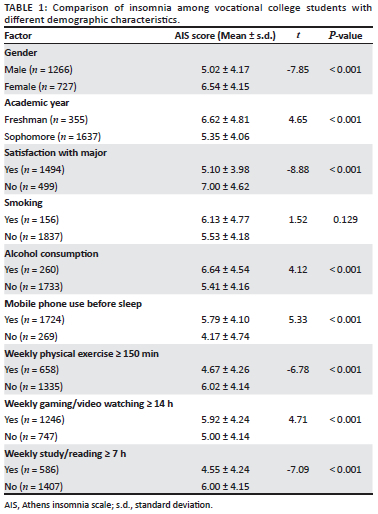
Participants were aged 17-26 years, with a mean age of 19.26 ± 0.88 years. Among 1993 vocational college students, the AIS total score was 5.57 ± 4.23, with 957 students (48.02%) scoring ≥ 6. Higher levels of insomnia were observed in students who were female, freshmen, dissatisfied with their major, consumed alcohol, used mobile phones before sleep, exercised less than 150 min per week, spent more than 14 h per week on gaming or watching videos, or spent less than 7 h per week studying or reading. Detailed results are shown in Table 1.
General status of sleep disturbance among vocational college students
Among the 1993 vocational college students, the SDQ total score was 25.50 ± 9.46. The subscale scores were as follows: sleep restlessness or agitation (12.18 ± 5.03), mental overactivity (6.20 ± 2.57), preoccupation with the consequences of insomnia (5.11 ± 2.11) and insufficient sleep preparation (2.00 ± 1.05).
Correlation between insomnia and dimensions of sleep disturbance
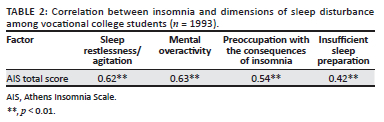
The total AIS score was significantly and positively correlated with all SDQ subscale scores among the 1993 students. Detailed results are presented in Table 2.
Regression analysis of insomnia, sleep disturbances and related factors
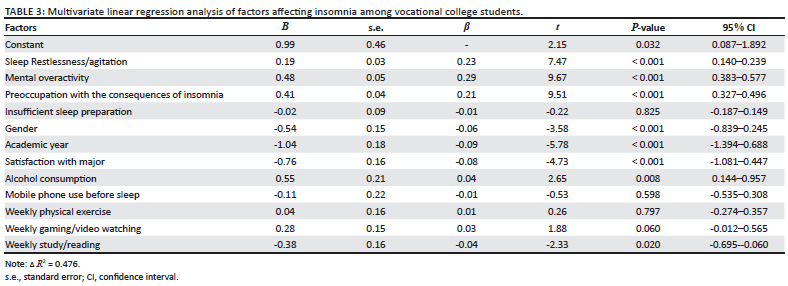
To further explore the relationship between insomnia and sleep disturbances, as well as related factors among vocational college students, the total AIS score was used as the dependent variable, with SDQ subscale scores and statistically significant demographic variables as independent variables. The independent variables were coded as follows: gender (male = 1, female = 0); academic year (sophomore = 1, freshman = 0); satisfaction with major (yes = 1, no = 0); alcohol consumption (yes = 1, no = 0); mobile phone use before sleep (yes = 1, no = 0); weekly physical exercise (≥ 150 min = 1, < 150 min = 0); weekly use of mobile phone or computer for gaming or video watching (≥ 14 h = 1, < 14 h = 0); and weekly study/reading time (≥ 7 h = 1, < 7 h = 0). Multivariate linear regression analysis was performed using a forward selection approach, with variables entered stepwise based on a significance level of P < 0.05 to identify significant predictors. Results showed that the SDQ subscales of sleep restlessness/agitation, mental overactivity and preoccupation with insomnia consequences positively predicted insomnia severity. Additionally, female gender, freshman, dissatisfaction with one's major, alcohol consumption and less than 7 h of weekly study/reading were associated with more severe insomnia (F = 160.086, p < 0.001). Detailed results are presented in Table 3.
Discussion
In this study, nearly 50% of participants reported experiencing insomnia in the past month. Although AIS is less commonly used in China, the detection rate of sleep problems in this study was notably higher than those reported in previous studies using the PSQI - such as Zang et al.'s finding that 17.47% of university students had poor sleep quality,72930313233
This study found a significant correlation between insomnia and sleep disturbances. Specifically, sleep restlessness or agitation, mental overactivity and preoccupation with the consequences of insomnia were all significant predictors of insomnia severity. Vocational college students who have difficulty relaxing their bodies, experience high tension before sleep, and worry about being unable to fall asleep often find it hard to relax before sleep, which leads to difficulty falling asleep and an increased likelihood of feeling sleep-deprived the next day.34
Our results also indicate that female students report more severe insomnia, consistent with previous studies using the PSQI.353637,383940
In contrast, by the second year, students might have gradually adjusted to college life: academic and daily schedules become more stable, stress related to transition may decrease and sleep routines become more regular - which could explain the lower insomnia prevalence in sophomores. Moreover, students dissatisfied with their academic major were also more prone to pre-sleep anxiety, resulting in heightened arousal and impaired sleep quality. Alcohol consumption, known to negatively affect sleep,41
Moreover, we found no significant association between physical activity and insomnia. This result contrasts with the findings of Mahfouz et al.,424344
Strengths and limitations
This study has several novel contributions. Firstly, most previous research on insomnia has focused on university students, with limited attention to vocational college students. By targeting this specific population, the present study found a more severe insomnia issue compared to previous studies on university students, suggesting that sleep health among vocational college students warrants greater attention. Secondly, existing sleep quality studies in China predominantly utilise PSQI, which may not adequately capture insomnia and sleep disturbance issues. This study explored both insomnia and sleep disturbances and found a significant link between them, which may offer direction for more precise intervention planning. Thirdly, the study found that female students, those dissatisfied with their major, those with a habit of drinking alcohol and students with less than 7 h of extracurricular learning and reading time per week were more likely to experience severe insomnia. Although this study used a self-designed questionnaire with single-item measures, which imposes certain limitations, the findings still provide a valuable reference for future in-depth research on factors influencing insomnia among vocational college students. For example, the association between extracurricular learning time and insomnia warrants further investigation into specific aspects such as the timing of study sessions (e.g. studying within 1 h before bedtime) and the difficulty of study content and their effects on insomnia. Fourthly, this study enriches the empirical data on sleep health among vocational college students and provides evidence to support targeted interventions in higher education institutions.
Nevertheless, this study has several limitations. Firstly, as a cross-sectional study, it cannot establish causal relationships. Future research should consider longitudinal or interventional designs to explore causal pathways. Secondly, the data were collected through self-report questionnaires, which may be subject to response bias because of over-reporting or under-reporting, thereby affecting objectivity. Future studies should incorporate more objective measurement tools. Thirdly, as mentioned above, some variables (such as physical activity and mobile phone use) were measured using single-item questions. However, factors such as exercise intensity, timing of exercise (e.g. exercising within 20 min before bedtime),2845
Recommendations
The findings of this study suggest that mental health education and sleep hygiene promotion in vocational colleges should be strengthened in response to the high prevalence of insomnia. Educational institutions should enhance the promotion of knowledge on sleep and insomnia, helping students develop self-management strategies.3346474849
Conclusion
This study investigated the current status of insomnia, its associated factors and its relationship with sleep disturbances among students from two vocational colleges in Jiangxi Province, China. The results revealed that nearly 50% of the participants experienced insomnia in the past month. Factors associated with more severe insomnia included three dimensions from SDQ (sleep restlessness or agitation, mental overactivity and preoccupation with the consequences of insomnia). Additionally, female gender, being a freshman, dissatisfaction with one's major, alcohol consumption and spending less than 7 h per week on extracurricular study and reading were also identified as significant risk factors. Targeted interventions addressing these factors are necessary to improve sleep quality in this population.
Competing interests
The authors reported that they received funding from the 2024 Jiangxi Province University Humanities and Social Sciences Project and the 2022 Jiangxi Provincial Key Research Base Project of Philosophy and Social Sciences, which may be affected by the research reported in the enclosed publication. The authors have disclosed those interests fully and have implemented an approved plan for managing any potential conflicts arising from their involvement. The terms of these funding arrangements have been reviewed and approved by the affiliated university in accordance with its policy on objectivity in research.
CRediT authorship contribution
Chunying Chang: Writing - original draft. Jiabao Zhai: Writing - original draft. Die Hu: Investigation, Project administration, Resources, Writing - review & editing, Supervision. Yanan Zheng: Investigation, Project administration, Resources, Writing - review & editing, Supervision. All authors reviewed the article, contributed to the discussion of results, approved the final version for submission and publication and take responsibility for the integrity of its findings.
Funding information
This work was supported by the 2024 Jiangxi Province University Humanities and Social Sciences Project (grant number: SZZX24188). This work was supported by the 2022 Jiangxi Provincial Key Research Base Project of Philosophy and Social Sciences (grant number: 22SKJD41).
Data availability
The data that support the findings of this study are available from the corresponding author, Yanan Zheng, upon reasonable request.
Disclaimer
The views and opinions expressed in this article are those of the authors and are the product of professional research. They do not necessarily reflect the official policy or position of any affiliated institution, funder, agency or that of the publisher. The authors are responsible for this article's results, findings and content.
Acknowledgements
The authors would like to thank the participants in the present study.
References
- 1. Yanan Z, Die H, Mei Y. Construction of dimensions on psychosomatic health elements in college students. Med Philos. 2023;44(4):30-33.
- 2. Lu W, Hai Z, Bingjie S, Zhiwei X, Xin G. Correlation of short sleep duration and screening myopia among primary and middle school students in Beijing. Chin J Sch Health. 2025;46(1):14-17.
-
3. Fulin C, Kunxia C, Qian W, Junling L, Yingying Z. The relationship between sleep hygiene practice and insomnia in college students: A moderate mediation model. Adv Psychol. 2024;14(8):292-303. https://doi.org/10.12677/ap.2024.148547
» https://doi.org/10.12677/ap.2024.148547 - 4. Yang Z, Lan W, Xiaofeng F, Guiyu Q. Prevalence of sleep disorders in the Chinese college students: A meta-analysis. Occup Health. 2023;39(19):2705-2709.
-
5. Izquierdo-Condoy JS, Paz C, Nati-Castillo HA, et al. Impact of mobile phone usage on sleep quality among medical students across Latin America: Multicenter cross-sectional study. J Med Internet Res. 2025;27:e60630. https://doi.org/10.2196/60630
» https://doi.org/10.2196/60630 - 6. Yang C, Haiyan L. Effect of short video addiction on sleep quality in college students moderated mediating effect. China J Health Psychol. 2024;32(2):251-257.
-
7. Yan Z, Shuang R, Tingting L, Xiaoge W, Li Z. A study on the relationship between dietary factors, eating window and sleep quality among college students. Chin J Health Educ. 2024;40(5):472-478. https://doi.org/10.16168/j.cnki.issn.1002-9982.2024.05.017
» https://doi.org/10.16168/j.cnki.issn.1002-9982.2024.05.017 -
8. Yanan Z, Wen H, Yiyuan W, Chunying C, Hong T. Quality of sleep and influencing factors among freshmen in Ganzhou. Chin J Sch Health. 2017;38(1):57-64. https://doi.org/10.16835/j.cnki.1000-9817.2017.01.018
» https://doi.org/10.16835/j.cnki.1000-9817.2017.01.018 - 9. Qiuliang Z. The relationship between mobile phone dependence and cognitive failure in higher vocational students: Mediating effect of loneliness. Psychol Tech Appl. 2021;9(3):164-169.
- 10. Junjie Z, Enna W. Combined effect of family care and class belonging on internet addiction in vocational college students with left-behind experience in Henan province. Med Soc. 2022;35(7):124-129.
- 11. Yue Z, Jingyu L, Yaye J, Lange Z, Yan P. Relationship between interpersonal problems and depression in higher vocational students: A chain mediating effect of general self-efficacy and perceived social support. China J Health Psychol. 2023;31(6):942-948.
-
12. Benjafield AV, Sert Kuniyoshi FH, Malhotra A, et al. Estimation of the global prevalence and burden of insomnia: A systematic literature review-based analysis. Sleep Med Rev. 2025;82:102121. https://doi.org/10.1016/j.smrv.2025.102121
» https://doi.org/10.1016/j.smrv.2025.102121 - 13. Qiong L, Meng L, Xingyu C, Jianing Y. Negative rumination and sleep quality of college students: The role of negative emotion and bedtime procrastination. Chin J Clin Psychol. 2024;32(1):203-206.
- 14. Ying W, Ronghua H. The relationship between stress perception and sleep quality among college students: Chain mediating effect of expression inhibition and anxiety emotions. Chin J Behav Med Brain Sci. 2024;33(1):51-56.
- 15. Xinmin L. Abnormal psychology. 3rd ed. Beijing: People's Medical Publishing House; 2018, p. 221.
-
16. Soldatos CR, Dikeos DG, Paparrigopoulos TJ. Athens insomnia scale: Validation of an instrument based on ICD-10 criteria. J Psychosom Res. 2000;48(6):555-560. https://doi.org/10.1016/S0022-3999(00)00095-7
» https://doi.org/10.1016/S0022-3999(00)00095-7 -
17. Gardani M, Bradford DRR, Russell K, et al. A systematic review and meta-analysis of poor sleep, insomnia symptoms and stress in undergraduate students. Sleep Med Rev. 2022;61:101565. https://doi.org/10.1016/j.smrv.2021.101565
» https://doi.org/10.1016/j.smrv.2021.101565 -
18. Jniene A, Errguig L, El Hangouche AJ, et al. Perception of sleep disturbances due to bedtime use of blue light-emitting devices and its impact on habits and sleep quality among young medical students. Biomed Res Int. 2019;2019:7012350. https://doi.org/10.1155/2019/7012350
» https://doi.org/10.1155/2019/7012350 -
19. Violani C, Devoto A, Lucidi F, Lombardo C, Russo PM. Validity of a short insomnia questionnaire: The SDQ. Brain Res Bull. 2004;63(5):415-421. https://doi.org/10.1016/j.brainresbull.2003.06.002
» https://doi.org/10.1016/j.brainresbull.2003.06.002 -
20. Espie CA, Inglis SJ, Harvey L, Tessier S. Insomniacs' attributions. Psychometric properties of the dysfunctional beliefs and attitudes about sleep scale and the sleep disturbance questionnaire. J Psychosom Res. 2000;48(2):141-148. https://doi.org/10.1016/S0022-3999(99)00090-2
» https://doi.org/10.1016/S0022-3999(99)00090-2 - 21. Jiayuan L, Jing L, Wenyan Z, Hongjie L. Exploration of current situation and influencing factors of sleep procrastination behavior of 839 college students in a city. Chin J Sch Doct. 2023;37(4):241-254.
- 22. Huiping L, Hongli S, Hanqing W. Impact of college students' social media dependence on sleep disorders: The mediating role of missing anxiety. China J Health Psychol. 2023;31(4):567-571.
- 23. Yong W, Jingtao W, Xiaolin Z, Jun H. Leisure Physical exercise and the developmental trajectory of sleep quality in college students: Based on parallel latent growth modeling. J Guangzh Sport Univ. 2023;43(6):82-94.
-
24. World Health Organization. Guidelines for controlling and monitoring the tobacco epidemic [homepage on the Internet]. Geneva: World Health Organization; c1998 [cited 2025 Dec 09]. Available from: https://extranet.who.int/fctcapps/fctcapps/fctc/kh/surveillance/who-guidelines-controlling-and-monitoring-tobacco-epidemic
» https://extranet.who.int/fctcapps/fctcapps/fctc/kh/surveillance/who-guidelines-controlling-and-monitoring-tobacco-epidemic -
25. Yaru L, Jing W, Liyun Z, et al. The drinking status and associated factors in adults in China. Chin J Epidemiol. 2018;39(7):4. https://doi.org/10.4172/2167-0269.1000370
» https://doi.org/10.4172/2167-0269.1000370 -
26. Pieh C, Humer E, Hoenigl A, et al. Smartphone screen time reduction improves mental health: A randomized controlled trial. BMC Med. 2025;23(1):107. https://doi.org/10.1186/s12916-025-03944-z
» https://doi.org/10.1186/s12916-025-03944-z -
27. Bull FC, Al-Ansari SS, Biddle S, et al. World Health Organization 2020 guidelines on physical activity and sedentary behaviour. Br J Sports Med. 2020;54(24):1451-1462. https://doi.org/10.1136/bjsports-2020-102955
» https://doi.org/10.1136/bjsports-2020-102955 -
28. Alnawwar MA, Alraddadi MI, Algethmi RA, et al. The effect of physical activity on sleep quality and sleep disorder: A systematic review. Cureus. 2023;15(8):e43595. https://doi.org/10.7759/cureus.43595
» https://doi.org/10.7759/cureus.43595 - 29. Weiwei H, Xing P, Xiaohua L, et al. Effect of posttraumatic stress disorder symptoms on sleep quality of college students from single-parent families: Mediating effect of psychotic-like experiences. China J Health Psychol. 2024;32(7):961-966.
-
30. Lin X, Lei P, Tan Q, Xiong B. Culture, goal orientation and achievement of vocational college students. Front Psychol. 2025;16:1639938. https://doi.org/10.3389/fpsyg.2025.1639938
» https://doi.org/10.3389/fpsyg.2025.1639938 -
31. Li W, Xu T, Diao L, Wu Q. The impact of perceived discrimination on mobile phone addiction among Chinese higher vocational college students: A chain mediating role of negative emotions and learning burnout. Psychol Res Behav Manag. 2024;17:401-411. https://doi.org/10.2147/PRBM.S440958
» https://doi.org/10.2147/PRBM.S440958 -
32. Nwanaji-Enwerem U, Condon EM, Conley S, et al. Adapting the health stigma and discrimination framework to understand the association between stigma and sleep deficiency: A systematic review. Sleep Health. 2022;8(3):334-345. https://doi.org/10.1016/j.sleh.2022.03.004
» https://doi.org/10.1016/j.sleh.2022.03.004 -
33. Huang Y, Yang L, Liu Y, Zhang S. Effects of perceived stress on college students' sleep quality: A moderated chain mediation model. BMC Psychol. 2024;12(1):476. https://doi.org/10.1186/s40359-024-01976-3
» https://doi.org/10.1186/s40359-024-01976-3 -
34. Narisawa H. Anxiety and its related factors at bedtime are associated with difficulty in falling asleep. Tohoku J Exp Med. 2013;231(1):37-43. https://doi.org/10.1620/tjem.231.37
» https://doi.org/10.1620/tjem.231.37 - 35. Xinyue L, Shan W, Fei W, et al. Association between mobile phone dependence and sleep quality among 1934 students in two ordinary universities in Guangzhou City. Occup Health. 2022;38(6):823-830.
- 36. Chunyang L, Meihua L, Wei L, Ameng Z. Current status of sleep disturbance and influencing factors among college students in clinical medicine. Chin Prev Med. 2020;21(11):1178-1182.
-
37. Hantsoo L, Khou CS, White CN, Ong JC. Gender and cognitive-emotional factors as predictors of pre-sleep arousal and trait hyperarousal in insomnia. J Psychosom Res. 2013;74(4):283-289. https://doi.org/10.1016/j.jpsychores.2013.01.014
» https://doi.org/10.1016/j.jpsychores.2013.01.014 - 38. Hagen E, Friedman E, Hale L, Salzieder N, Peppard P. Severity of stressfulness of major life events and insomnia symptoms in women and men. J Sleep Sleep Dis Res. 2012;35:A238.
-
39. Li Y, Bai W, Zhu B, et al. Prevalence and correlates of poor sleep quality among college students: A cross-sectional survey. Health Qual Life Outcomes. 2020;18(1):210. https://doi.org/10.1186/s12955-020-01465-2
» https://doi.org/10.1186/s12955-020-01465-2 -
40. Doane LD, Gress-Smith JL, Breitenstein RS. Multi-method assessments of sleep over the transition to college and the associations with depression and anxiety symptoms. J Youth Adolesc. 2015;44(2):389-404. https://doi.org/10.1007/s10964-014-0150-7
» https://doi.org/10.1007/s10964-014-0150-7 - 41. Xiaojiao W, Bianhong S. Effect of cognitive behavioral therapy for insomnia on sleep quality and mood in patients with alcohol dependence. Chin J Gen Pract. 2020;18(02):318-321.
-
42. Mahfouz MS, Ali SA, Bahari AY, et al. Association between sleep quality and physical activity in Saudi Arabian university students. Nat Sci Sleep. 2020;12:775-782. https://doi.org/10.2147/NSS.S267996
» https://doi.org/10.2147/NSS.S267996 -
43. Zhao H, Lu C, Yi C. Physical activity and sleep quality association in different populations: A meta-analysis. Int J Environ Res Public Health. 2023;20(3): 1864. https://doi.org/10.3390/ijerph20031864
» https://doi.org/10.3390/ijerph20031864 -
44. Zhong C, Masters M, Donzella SM, Diver WR, Patel AV. Electronic screen use and sleep duration and timing in adults. JAMA Netw Open. 2025;8(3):e252493. https://doi.org/10.1001/jamanetworkopen.2025.2493
» https://doi.org/10.1001/jamanetworkopen.2025.2493 -
45. Kheirinejad S, Visuri A, Ferreira D, Hosio S. 'Leave your smartphone out of bed': Quantitative analysis of smartphone use effect on sleep quality. Pers Ubiquitous Comput. 2023;27(2):447-466. https://doi.org/10.1007/s00779-022-01694-w
» https://doi.org/10.1007/s00779-022-01694-w -
46. Kalkanis A, Lenkens D, Steiropoulos P, Testelmans D. Sleep regularity as an important component of sleep hygiene: A systematic review. Sleep Med Rev. 2025;84:102203. https://doi.org/10.1016/j.smrv.2025.102203
» https://doi.org/10.1016/j.smrv.2025.102203 -
47. Magalhães P, Pereira B, Oliveira A, et al. The mediator role of routines on the relationship between general procrastination, academic procrastination and perceived importance of sleep and bedtime procrastination. Int J Environ Res Public Health. 2021;18(15): 7796. https://doi.org/10.3390/ijerph18157796
» https://doi.org/10.3390/ijerph18157796 -
48. Miller MB, Curtis AF, Hall NA, et al. Daily associations between modifiable sleep behaviors and nighttime sleep among young adult drinkers with insomnia. J Clin Sleep Med. 2022;18(3):703-712. https://doi.org/10.5664/jcsm.9706
» https://doi.org/10.5664/jcsm.9706 -
49. Demichelis OP, Grainger SA, Burr L, Henry JD. Emotion regulation mediates the effects of sleep on stress and aggression. J Sleep Res. 2023;32(3):e13787. https://doi.org/10.1111/jsr.13787
» https://doi.org/10.1111/jsr.13787

Accepted: 11 Dec. 2025
Published: 03 Feb. 2026