Spirituality, depression and quality of life in medical students in KwaZulu-Natal
Abstract
BACKGROUND: The majority of studies on spirituality demonstrate its positive association with mental health. Despite the increasing number of studies, there remains a dearth of studies emanating from African countries looking at the relationship between mental illness, quality of life and measures of spirituality. The present study evaluates the role of spirituality in relation to current depression and quality of life in medical students, who are known to be at high risk for depression. OBJECTIVES: The aim of this study was to determine the prevalence of moderate and severe depressive symptoms in this population and explore potential correlations between spirituality, depression and quality of life. METHODS: 230 medical students were surveyed at the University of KwaZulu-Natal Medical School, using the Zung Self-Rating Depression Scale (Zung SDS), Spiritual Involvement and Beliefs Scale (SIBS), WHO Quality of Life Scale (WHOQOL) and a demographic data sheet. RESULTS: There was a high prevalence of depressive symptoms in the medical students, with a significant proportion (15.6%) showing evidence of severe depressive symptoms (indicating likely depressive illness). Those with a history of mental illness or of having attended traditional, complementary or alternate medical practitioners showed higher levels of depression. Lower spirituality was associated with non-adherence to a major religion and a history of mental illness. Quality of life was better in second and fifth year students and poorer in those with a history of mental illness. CONCLUSION: Medical students' experiences of depression (most probably due to stress) and its relationship with spirituality and quality of life merit further investigation with a view to establishing policy guidelines for dealing with this issue.
Introduction and background
Over the last 25 years, spirituality has become a topic of increasing interest to medical professionals in the field of mental health.1,2 While much research initially focused on general medical disorders, the role of spirituality in mental and substance-related disorders has been the focus of a growing literature base.1,2 Key to any research in the field of spirituality is the definition used. From the Vedic definition of spirituality as a personal connection with God or a supreme being to the more clinical definition of spirituality as a journey towards transcendental consciousness and connectedness with one's own inner life force, spirituality is not uncommonly used interchangeably with religion.32,3 The difficulty in isolating spirituality as a valid construct has given rise to concerns about how it is measured.4
Spirituality has been shown to influence quality of life.5556
A strong scientific connection has been made between spirituality and general medicine in the literature, and this has influenced practice, for example in integrating pastoral care in hospitals as part of patient management.787,8 However, in contrast, it has also been argued that an awareness of religious and spiritual activities of patients can show both their value as a resource for healthy mental and social functioning, as well as an indication of when such beliefs are distorted and limiting, and contribute to pathology rather than alleviate it.9
Depression, a widely prevalent mental health problem, is the fourth principal cause of disease affliction and the leading cause of non-fatal burden, affecting 12% of the population.10 1110
There are many theories regarding the causes of depression, which have been well-documented.121314,15 and the latter for being problematic in isolating predisposition within the context of environmental susceptibility,16,17 both of these models identify stress as being a contributing factor to depression. Further, depression is negatively associated with quality of life, while spirituality is positively associated with quality of life.5
Medical school is well established as being a high-stress environment, and depression is prevalent in medical students.181818 18
The majority of available literature on spirituality focuses on studies carried out in the US and UK, with a significant lack of research focusing on the assessment of spirituality and quality of life in African or Eastern countries.1,2 Furthermore, research populations have been predominantly of Judeo-Christian religions.1,2 In South Africa, there is a small but growing literature on spirituality, all concurring that spirituality must be integrated into the local practice of psychiatry; however, there have not been studies measuring these constructs within the South African context.7,8 Given the burden of depression and stress associated with medical students, this study was therefore embarked upon to explore potential associations between spirituality, depression and quality of life in medical students attending the University of KwaZulu-Natal.
Method
Participants
A cross-sectional convenience sample of medical students attending the Nelson R Mandela School of Medicine at the University of KwaZulu-Natal were surveyed using four self-administered questionnaires. All 950 students from first to final year were eligible to participate in the study. There were no exclusion criteria. Participation was voluntary and written informed consent was required. Confidentiality was maintained and questionnaires were submitted anonymously.
Instruments
The following tools were employed: a demographic data sheet, the Zung self-rating depression scale (Zung SDS), the Spiritual Involvement and Beliefs Scale (SIBS) and the WHO Quality of Life Scale (WHOQOL).
The demographic data sheet
This included year of study, age, race, gender, current medical and psychiatric history, socio-economic status (income), religious affiliation, traditional beliefs and consultation with traditional, complementary and alternate health practitioners.
The Zung self-rating depression scale (Zung SDS)
This is a reliable and valid tool to screen for and rate depression.19,20 Strong significant correlations have been found between the Zung SDS and the Hamilton Rating Scale for Depression, as well as with the Minnesota Multiphasic Personality Inventory Depression Scale.2019 1919
The Spiritual Involvement and Beliefs Scale (SIBS)
This is a multi-dimensional scale that was devised to be broadly appropriate and valid across religious conventions in assessing values, attitudes and behaviours.21212221 21212121
The World Health Organization Quality of Life (WHOQOL) questionnaire
This tool is a measure of quality of life and has proved valuable in quality of life studies.232323234
Ethical considerations
Ethical approval for this study to proceed was obtained from the University of KwaZulu-Natal's Biomedical Research Ethics Committee (Ref BE178/13).
Data analysis
Of the 950 medical students, from first to fifth year, 646 (68.0%) declined. 304 (32.0%) agreed to participate and 74 (24.3%) sets of questionnaires were incomplete and excluded from the final analysis. The final sample comprised 230 (24.2%) medical students. All information was captured in Microsoft Excel and subsequently analysed descriptively on the spreadsheet while further statistical computations used the Statistical Package for Social Sciences (SPSS version 19).
All demographic data were analysed descriptively and presented as frequency counts. As all the instruments yielded ordinal data, the median was used to summarise these measures. Further statistical computations used non-parametric techniques. The Mann-Whitney U-test was used for all two-group comparisons, and the Kruskal-Wallis test was used for comparisons involving three or more groups. The Spearman Rank Order Correlation was used for analysing the relationships between the Zung SDS, SIBS and WHOQOL, and the Zung SDS and WHOQOL domains.
The alpha level was set at 0.05, so any p-value less than 0.05 would be considered to be statistically significant.
Results
A total of 230 medical students participated in this research. The average age was 21 years and there were more women (71.3%) than men (28.7%). The proportion of participants
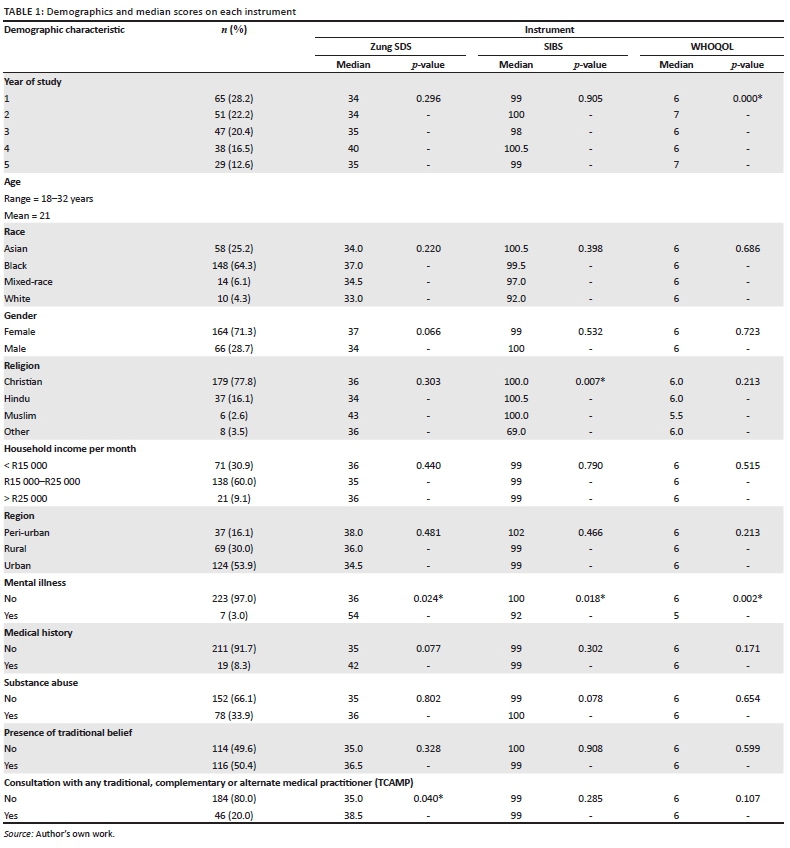
from each year of study was highest at first year level (28.2%) and decreased in a linear fashion through second year (22.2%), third year (20.4%), fourth year (16.5%) and fifth year (12.0%). Ethnic (racial) representation was predominantly black (64.3%), followed by Asian (25.2%), with relatively few mixed-race (6.1%) and white (4.3%) participants. The main religion was Christian (77.8%), followed by Hindu (16.1%), with very few Muslim (2.6%) and Other (3.5%). Most participants were in the middle R15 000-R25 000 per month income bracket (60.0%), followed by the less than R15 000 per month bracket (30.9%) and the higher over R25 000 per month bracket (9.1%). Just over half (53.9%) lived in urban areas, just under a third in rural areas (30.0%) and the remainder in peri-urban areas (16.1%). Other background information indicated current mental illness (3.0%), other current medical conditions (8.3%), substance abuse (33.9%), presence of traditional beliefs (50.4%) and consultation with any traditional, complementary or alternate medical practitioner (TCAMP) (20.0%). Demographic traits are compiled in Table 1 together with the median scores on each instrument.
Comparisons within the various demographic characteristics (also summarised in Table 1) indicated a few significant differences between groups on some of the instrument scores. Spirituality scores (SIBS) were significantly higher in those indicating consultation with any TCAMP and significantly lower in those whose religion was specified as 'Other', although this latter result needs to be regarded with caution as this only involved eight participants. There was no difference in either depression scores or spirituality scores between different years of study; however, quality of life was perceived to be better in the second and fifth year students compared to the other years (p < 0.000). Finally, the seven students (3.0%) who indicated a current mental illness all had significantly higher depression levels, lower levels of spirituality and perceived a poorer quality of life. Again, this result needs to be regarded with caution because of the small sample size.
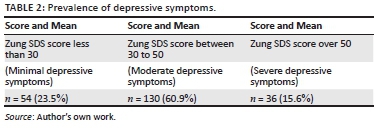
The prevalence of moderate and severe depressive symptoms among the medical students may be seen in Table 2. These results show that almost three-quarters of the medical students (76.5%) who participated in this research were experiencing problems with depressive symptoms, with one-fifth of these (15.6% of total sample) having severe depressive symptoms. Notably this means only a quarter of students were experiencing minimal or no symptoms of depression.
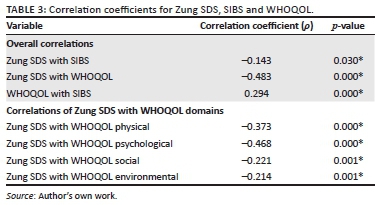
Table 3 reports the results of the correlational analysis performed between the ZUNG SDS, SIBS and WHOQOL scores.
The analysis yielded a significant negative correlation (ρ = -0.143) between depressive and spirituality scores (t(228) = 2.188; p = 0.030), a significant negative correlation (ρ = -0.483) for depressive symptoms and quality of life (t(228) = 8.331; p = 0.000), and a significant positive correlation (ρ = 0.294) between spirituality and quality of life (t(228) = 4.642; p = 0.000). Thus, higher levels of depression were associated with lower levels of spirituality and poorer quality of life. Higher levels of spirituality were associated with perceived better quality of life. When looking at the association between depression and individual domains of quality of life, the Zung SDS had a significant inverse association with all of the WHOQOL domains.
Taken together, these results have shown some associations between certain demographic variables and the scores on one or more of the instruments used. In particular, those with a history of mental illness or of having consulted TCAMPs showed higher levels of depression. Lower spirituality was associated with non-adherence to a major religion and a history of mental illness. Quality of life was better in second and fifth year students and poorer in those with a history of mental illness. Depressive symptoms were present in almost three-quarters of the medical students, with a significant proportion showing evidence of a severe depressive symptoms (indicating likely depressive illness).
Discussion
To the best of our knowledge, this is the first study examining the rates of depressive symptoms in medical students in KwaZulu-Natal, investigating relationships between depression, spirituality and quality of life. While this was a small-scale study, it has shed light on these aspects as they affect medical students.
The finding of elevated rates of depressive symptoms among the current sample of medical students confirms trends evidenced in previous studies.1824
Of particular interest with respect to depression was consultation with any TCAMP: students showed higher depressive symptoms. It is hypothesised that this could possibly be due to help-seeking behaviour to deal with depressive symptoms. It is interesting to note the inclusive role of holistic healing where it can be seen that help-seeking has not been limited only to general practitioners or specialist psychiatrists.
The negative relationship between spirituality and depressive symptoms supports the findings of previous studies.255
The role of spirituality is also particularly important in the training of psychiatrists. While this domain was ignored for many years, more recent research has suggested that spirituality should be integrated into the practical training of psychiatrists, especially in a diverse setting like South Africa which is multi-cultural, with many religions being practised.2627
Finally, conceptually, this study chose to use religion and spirituality interchangeably. Future research should consider separating these concepts and tightening their definitions as it has been argued recently that spirituality is a much broader concept which should not be quantified only through the lens of religion.26
Limitations foreseen were incomplete filling in of information leading to inadequate data. This was overcome by obtaining a proper sample size. The voluntary participation may have introduced bias as depressed individuals might not want to participate, being influenced by depressive symptoms, for example lack of energy and decreased concentration. There is the possibility that some of the results were falsified, leading to under-reporting, as medical students have some knowledge of depression and want to avoid the stigma of mental illness. This was overcome by allowing anonymity. Another limitation that may be noted is the inherent limitations of any self-reported measures. Finally, the cross-sectional nature of this study does not allow us to determine causal relationships between depression, spirituality and quality of life.
Conclusion
This study has clearly shown that depression among medical students is a matter for concern which needs to be addressed. In developing a healthcare system in South Africa designed to serve everyone, medical students are an important population. Given the negative association of depression with spirituality, it is recommended that facilities for counselling and the provision of spiritual outlets for support should be included in government policies to work towards decreasing depressive symptoms in medical students. It is necessary to address the unhappiness related to the poorer perceived quality of life so as to facilitate the retention of professional services in South Africa.
Competing interests
The authors declare that they have no financial or personal relationships that may have inappropriately influenced them in writing this article.
Authors' contributions
N.P. (University of KwaZulu-Natal) was primarily responsible for the research idea, literature review, research design, data collection, data analysis and synthesis of the research article. S.R. (University of KwaZulu-Natal) was the co-supervisor and responsible for modifying the research question adjusting the research design, making conceptual contributions and assisting in editing the research article. J.K.B (University of KwaZulu-Natal) was the research supervisor and contributed by improving the research question and design, making conceptual contributions and assisting in data analysis and final adjustments to the research article.
Acknowledgements
References
- 1. Bonelli RM, Koenig HG. Mental disorders, religion and spirituality 1990 to 2010: A systematic evidence-based review. J Relig Health. 2013;52(2):657-73.
- 2. Blazer D. Religion/spirituality and depression: What can we learn from empirical studies? Am J Psychiat. 2012;169(1):10-2.
-
3. Swami R. Is religion different from spirituality? [homepage on the Internet]. c2012 [updated 2012 Sep 19; cited 2012 May]. Available from: http://radhanathswamionline.com/insights/religion-spirituality/
» http://radhanathswamionline.com/insights/religion-spirituality/ - 4. Koenig HG. Research on religion, spirituality, and mental health: A review. Can J Psychiat. 2009;54:283-291.
- 5. Baker DC. Studies of the inner life: The impact of spirituality on quality of life. Qual Life Res. 2003;12(0):51-7.
- 6. Saxena S, Orley J. Quality of life assessment: The world health organization perspective. Eur Psychiat. 1997;12, suppl 3(0):263s-6s.
-
7. Janse van Rensburg ABR. The role of spirituality in South African Specialist Psychiatrist Practice and Training [homepage on the Internet]. c2012 [updated 2012 Jan; cited 2012 Dec]. Available from: http://hdl.handle.net/10539/11211
» http://hdl.handle.net/10539/11211 - 8. Van Rensburg AJ, Myburgh C, Szabo CP, Poggenpoel M. The role of spirituality in specialist psychiatry: A review of the medical literature. Afr J Psychiat. 2013;16(4):247-55.
- 9. Koenig HG. Concerns about measuring "spirituality" in research. J Nerv Ment Dis. 2008;196:349-355.
- 10. Üstün TB, Ayuso-Mateos JL, Chatterji S, Mathers C, Murray CJL. Global burden of depressive disorders in the year 2000. Brit J Psychiat. 2004;184(5):386-92.
- 11. Tomlinson M, Grimsrud AT, Stein DJ, Williams DR, Myer L. The epidemiology of major depression in South Africa: Results from the South African Stress and Health Study. S Afr Med J. 2009;99:368-73.
- 12. Beck AT. Depression. 2nd ed. Philadelphia: University of Pennsylvania Press; 2009.
- 13. Sadock BJ, Sadock VA, Ruiz P. Comprehensive Textbook of Psychiatry. 9th ed. New York: Lippincott Williams and Wilkins; 2009.
- 14. Belsky J, Pluess M. Beyond diathesis stress: Differential susceptibility to environmental influences. Psychol Bull. 2009;135(6), Nov:885-908.
- 15. McClaren N. The myth of the biopsychosocial model. Aust NZ J Psychiat. 2002;36, Oct:701-703.
- 16. Ghaemi SN. The rise and fall of the biopsychosocial model. BJ Psych. 2009;195(1), June:3-4.
- 17. Tavakoli HR. A closer evaluation of current methods in psychiatric assessments. A challenge for the biopsychosocial model. Psychiatry (Edgmont). 2009;6(2), Feb:25-30.
- 18. Zoccolillo M, Murphy GE, Wetzel RD. Depression among medical students. J Affect Disorders. 1986;11(1):91-6.
- 19. Zung WWK. A self-rating scale for depression. Arch Gen Psychiatry. 1965;12:63-70.
- 20. Biggs JT, Wylie LT, Ziegler VE. Validity of the Zung Self-rating Depression Scale. Brit J Psychiat. 1978;132:381-5.
- 21. Hatch RL, Burg MA, Naberhaus DS, Hellmich LK. The Spiritual Involvement and Beliefs Scale. Development and testing of a new instrument. J Fam Practice. 1998;46(6):476-86.
- 22. De Jager Meezenbroek E, Garssen B, Van den Berg M, Van Dierendonck D, Visser A, Schaufeli WB. Measuring spirituality as a universal human experience: A review of spirituality questionnaires. J Relig Health. 2012;51:336-354.
- 23. Kràgeloh C, Henning M, Hawken S, Zhao Y, Shepherd D, Billington R. Validation of the WHOQOL-BREF Quality of Life Questionnaire for Use with Medical Students. Educ Health. 2011;24(2):1-5.
-
24. Council on Higher Education (CHE). Access and throughput in South African higher education - Three case studies [homepage on the Internet]. c2010 [updated 2010 Mar; cited 2012 Dec]. Available from: http://www.che.ac.za/media_and_publications/higher-education-monitor/higher-education-monitor-9-access-and-throughput
» http://www.che.ac.za/media_and_publications/higher-education-monitor/higher-education-monitor-9-access-and-throughput - 25. Doolittle BR, Farrell M. The association between depression and spirituality in an urban clinic. Primary Care Companion J Clin Psychiatr. 2006;6:114-118.
- 26. Janse van Rensburg ABR. South African Society of Psychiatrists guidelines for the integration of spirituality in the approach to psychiatric practice. S Afr J Psychiat. 2014;20(4):133-139.
- 27. Welgemoed MA, Van Staden CW. Does religious identification of South African psychiatrists matter in their approach to religious matters in clinical practice? S Afr J Psychiat. 2014;(20)4:141-145.

Accepted: 06 July 2015
Published: 22 Mar. 2016