Clozapine monitoring at a specialised psychiatric hospital: A retrospective chart review
Abstract
BACKGROUND: Clozapine is the only Food and Drug Administration (FDA) and National Institute for Care and Excellence (NICE) approved drug for treatment-resistant schizophrenia (TRS). Its potentially life-threatening haematological side effects of neutropaenia and agranulocytosis mandate rigorous monitoring of neutrophil counts, presenting unique, Third-World population challenges. AIM: To describe the Clozapine white blood cell monitoring practice and outcomes in a local psychiatric hospital. SETTING: At a specialist Psychiatry unit in Durban, KwaZulu-Natal, which follows a modified algorithm of the South African Standard Treatment Guidelines for Clozapine monitoring. METHODS: A retrospective chart review composed of 120 patients on Clozapine treatment from 01 July 2018-31 December 2020. Demographic and clinical information was captured in a Redcap database. Descriptive statistics using categorical variables were used RESULTS: The study population was from a low socioeconomic background, with low levels of education and employment. A baseline neutrophil count was recorded in 58 files (48.3%). Clozapine was stopped in 6 out of the 120 patients due to 'neutropaenia' (absolute neutrophil counts ranging from 1.18 to 1.6); none developed agranulocytosis. Their duration of Clozapine treatment ranged from 2 weeks-15 years. CONCLUSION: Haematological monitoring frequency and documentation of patients receiving Clozapine were not in compliance with the hospital's adapted guidelines and may have resulted in the termination of treatment before true neutropaenia developed. Patients developed neutropaenia at low doses of Clozapine and after many years of treatment. CONTRIBUTION: These results suggest local Clozapine monitoring guidelines should be more strictly adhered to.
clozapine monitoring guidelines; clozapine monitoring guidelines in South Africa; treatment-resistant schizophrenia; benign ethnic neutropaenia; benign familial neutropaenia; clozapine-induced neutropaenia; clozapine-induced agranulocytosis
Introduction
Clozapine is the only Food and Drug Administration (FDA)- and National Institute for Care and Excellence (NICE)-approved drug for treatment-resistant schizophrenia (TRS).121
Schizophrenia is prevalent in approximately 0.3% - 0.7% of the population3456,7
Treatment-resistant schizophrenia is defined as 'schizophrenia that has not responded adequately to treatment despite the sequential use of at least two antipsychotic drugs' (at least one of which should be a secondgeneration antipsychotic that is not Clozapine).1897,101
Neutropaenia is defined as an absolute neutrophil count (ANC) of < 1.5 × 1091112121212,1312,13
Agranulocytosis is defined as an absence of circulating white cells or leukocytes or an ANC of < 0.5 × 109121412
Clozapine-induced neutropaenia or CIAG can be prevented by identifying at-risk patients, especially those who are immunocompromised and monitoring them closely. The risk of agranulocytosis rises with age, but the risk of neutropaenia decreases with age.1212151515
Benign familial neutropaenia (BFN), also controversially known as benign ethnic neutropaenia (BEN),16
[T]he occurrence of a neutropaenia, defined by normative data in white populations, in individuals of other ethnic groups who are otherwise healthy and who do not have repeated or severe infections.12
Benign familial neutropaenia's pathogenesis may be explained by a genetic polymorphism that affects the expression of the Duffy antigen on erythrocytes.171717
These findings support the need for Clozapine monitoring criteria that are sensitive to ethnic differences.1717
According to the NICE and South African Standard Treatment Guidelines (SASTG) and Essential Medicines List for South Africa, after Clozapine initiation, differential WCCs need to be done weekly for 18 weeks to monitor for the development of CIN.1,2,181,2,181113991399131792
The authors have anecdotally observed that weekly blood tests have significant cost and compliance implications for both hospitals and patients. The drawing of blood is painful and unpleasant for patients. Travel costs to the hospital are prohibitive for outpatients, especially for mental healthcare users who are often social grant recipients. For hospitals, each patient visit has cost implications for human resources, time and consumables. These factors are likely to negatively impact adherence to rigorous monitoring protocols.
The cost-effectiveness of various methods of monitoring white blood cells was assessed in the United Kingdom, the United States and two European countries, and these methods were compared to no-monitoring.181818
Treatment-resistant schizophrenia occurs in about one-third of patients5
Research methods and study design
Study design and setting
This study was a descriptive, retrospective chart review and was conducted at a specialised psychiatry unit in Durban, KZN.
Study population and sampling strategy
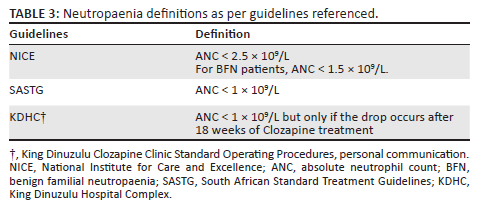
The files of adult patients, over 18 years old, who were receiving Clozapine during the study period were included in the analysis. Inclusion criteria were files of all patients who were on Clozapine regardless of the indication. All files were included until the required sample size was reached. The study site has its own Clozapine monitoring guidelines (King Dinuzulu Clozapine Clinic Standard Operating Procedures, personal communication) which is a modified algorithm of the SASTG: Clozapine would be stopped if a patient's ANC is < 1 × 10⁹
Data analysis
Descriptive statistics were used to summarise the data. Frequencies and percentages were used for categorical data. Frequency distributions of numeric data were examined for normality, and mean standard deviation (s.d.) or medians of the interquartile range (IQR) were used as appropriate.
Compliance with guidelines was determined by meeting a set of criteria as predetermined by the aforementioned NICE and SASTG Clozapine monitoring guidelines.1,2,18t-test. A sample size of 114 patients was necessary to estimate the proportion of patient monitoring which is compliant with treatment guidelines to within 13% with a probability of 95% and assuming baseline compliance of 50%. The p-value was set to 0.05. The sample size was calculated, and the data were analysed using Stata V13.1 statistical software.
Ethical considerations
Ethical approval was obtained from the Biomedical Research Ethics Committee of the the University of KwaZulu-Natal (BREC/00002262/2020) and the KwaZulu-Natal Department of Health. Permission was granted by the Ethics Committee of the study site to conduct the research.
Results
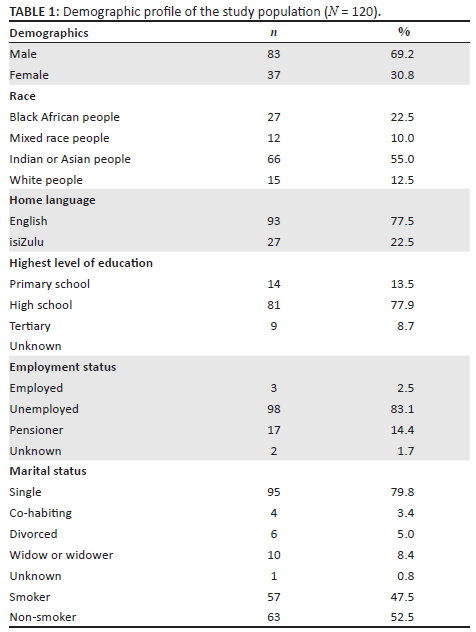
A total of 120 clinical records were reviewed. The majority of the patient samples were black African people, mixed race people and Indian or Asian people (87.5%), predominantly male (N = 83; 69.2%), with the mean age of the total sample being 43.97 years (s.d. ± 14.22) and a median of 43.0 years. The demographic profile of subjects is summarised in Table 1. The highest level of education (HLOE) was high school (N = 81; 77.9%), with the majority (N = 72; 88.9%) having not completed matric (Grade 12) and nine (7.5%) having completed tertiary education; there was also a high unemployment rate of 98%; and 95% of the sample were single.
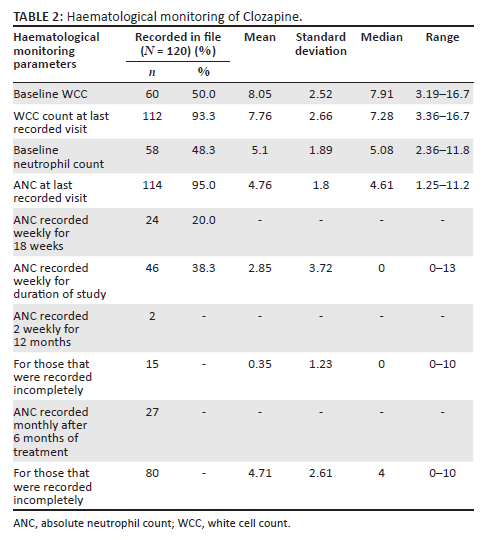
Table 2 summarises the recorded haematological monitoring data. Complete monitoring data were not available for all 120 participants. Of the 120 files reviewed, half (N = 60) recorded a baseline total WCC, and 48.3% of the files recorded a baseline neutrophil count. Haematological data at the last recorded visit during the study period were available in 93.3% (WCC) and 95% (neutrophil count) of clinical records. Twenty-four files (20%) had recorded the initial neutrophil count; 2 files (1.7%) had the biweekly neutrophil counts monitored for 12 months; and 27 files (22.5%) had monthly neutrophil counts documented 12 months after Clozapine was initiated. None of the 120 patients in the sample had evidence of BFN, i.e. no patients had a low baseline neutrophil count.
Table 3 provides definitions of neutropaenia as per the different guidelines referenced in this article.
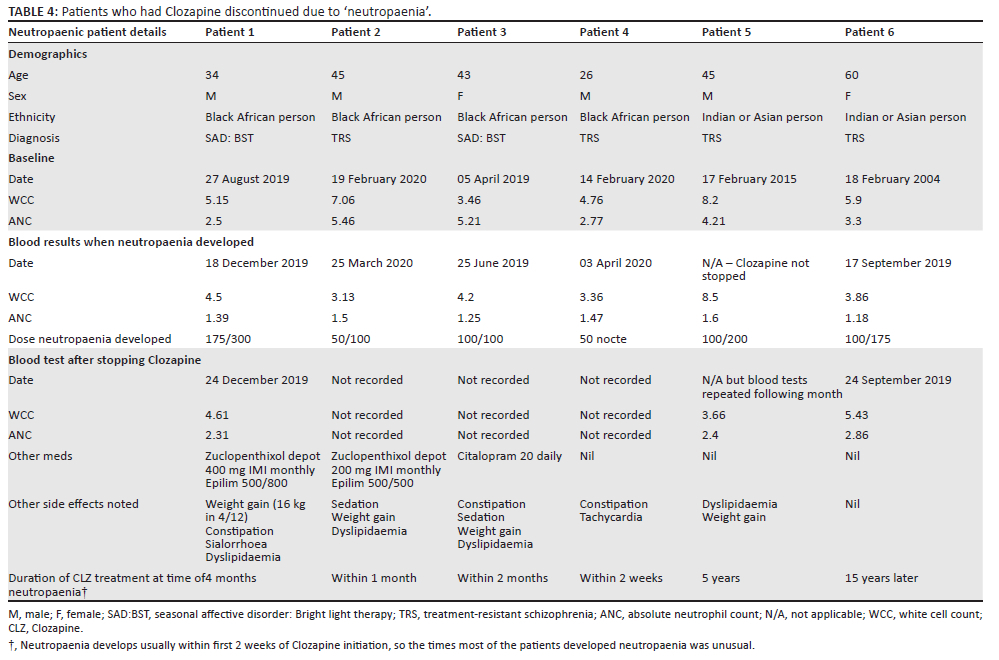
Table 4 provides details of the six (0.05%) patients who developed 'neutropaenia' (i.e. whose Clozapine was stopped due to concerns about decreasing neutrophil counts or whose reason for stopping Clozapine was recorded as neutropaenia by the treating clinician). All six participants were black African people (N = 4) and Indian people or Asian people (N = 2). All baseline blood results were within normal ranges. Clozapine doses ranged from 50 mg to 475 mg total daily doses. Patients 1-3 were based on the NICE guidelines (ANC < 1.5); patients 4, 5 and 6 had Clozapine discontinued at ANCs of 1.5, 1.6 and 1.18, respectively. With patient 5, Clozapine was not discontinued; rather the differential count was repeated, and when the neutrophil count was > 3.0 in the following month, the result was deemed a laboratory error. Clinical records indicated 'neutropaenia' as a reason for discontinuing Clozapine in patient 6. Patients 1-4 developed neutropaenia between 5 and 15 weeks of initiation of Clozapine. If the hospital's guidelines were used, none of these patients would have had their Clozapine stopped as none of their ANCs dropped below 1 × 10⁹p = 0.03, using a binomial probability test).
The black African, mixed race and Indian and/or Asian patients had a lower mean baseline WCC than the white participants. The black African patients were noted to have had a statistically significant lower mean ANC of 3.59, s.d. ± 1.73 (P < 0.05).
Repeat differential counts were not recorded for three of the six patients to determine if their neutrophil counts had changed after Clozapine had been stopped. For the other three patients, two had their blood tests repeated within 1 week, and one had their blood tests repeated within 1 month, at which time all three of their ANCs had normalised.
Discussion
Clozapine is the only evidence-based and approved drug for the treatment of TRS. However, it has a rigorous haematological monitoring protocol due to its risk of neutropaenia and agranulocytosis. The Clozapine monitoring practice in a public specialist psychiatric hospital was therefore explored to determine the adherence to recommended guidelines and the frequency of haematological effects.
The study consisted of participants, mainly of Indian people or Asian people (55%) and black African people (22.5%). Most international studies were conducted in predominantly white populations.1,4,5,13192020
The study site utilised an adapted version of the SASTG for Clozapine monitoring; however, less than a quarter of our sample was being haematologically monitored according to these or the NICE guidelines. Comparative figures for other local or international clinical sites were not available. While the reasons for the low monitoring rate could not be ascertained from a retrospective file review, possible reasons could be missing or unrecorded information, clinicians not having enough time to do blood tests on these patients, and even patients defaulting on their clinic follow-up appointments. Another contributory factor was the Severe acute respiratory syndrome coronavirus 2 (SARS-CoV-2) or the COVID-19 pandemic, which decreased patients' clinic visits in general.
Rigorous monitoring has been reported to not be cost-effective and public health authorities in the United Kingdom, the United States and several European countries were recommended to revise their Clozapine monitoring protocols.181818
In the sample, 2.5% of the participants developed CIN. While this falls within the normal range defined for South Africa, the small sample size and the shortcomings identified in the monitoring practices at the hospital must be considered.19119197,13
In this study, BFN was not a factor as baseline white cell and neutrophil counts in the entire sample were within normal ranges. Local guidelines stipulate a lower threshold of discontinuing Clozapine than international standards: an ANC of < 1 × 109291391320
Six participants (0.05%) in this study developed neutropaenia as defined by the Maudsley Handbook and NICE guidelines, which state that Clozapine should be discontinued if the ANC drops below 2.5 × 10913
As recorded in Table 4, patients 1-4 developed 'neutropaenia' between 5 and 15 weeks of Clozapine initiation, and patients 5 and 6 developed 'neutropaenia' after several years. Clozapine-induced neutropaenia usually manifests 1-2 weeks post-initiation of Clozapine11713
At a specialised hospital, where this study was conducted, patients often have severe forms of mental illness, with medical and substance disorders as co-morbidities; polypharmacy is therefore not uncommon. The possible role of other psychotropic agents impacting the haematological profile of patients must also be considered in patients receiving Clozapine. Our Findings indicated that two of the six patients were also administered sodium valproate; this confounds the attribution of the haematological abnormalities to Clozapine as this anticonvulsant and/or mood stabiliser is known to have adverse haematological effects as well.10
Limitations and recommendations
The study is limited by the small sample size and the quality of the available records. The findings may not be generalisable to other hospitals in the country or to samples with different demographic profiles.
Consensus needs to be reached on which monitoring guidelines are appropriate for the local context and what normative values are appropriate and sensitive to different race groups. The evidence suggests that haematological monitoring is not cost-effective, but in the best interest of patient care, a revised monitoring protocol should be considered to prevent any fatal occurrences of BFN. Local guidelines regarding haematological monitoring of patients on Clozapine should also be reviewed to include recognition of the phenomenon of BFN. This is evidence-based practice in the United Kingdom for patients at risk of developing BEN, who have a lower white cell and the absolute neutrophil cutoff for withdrawing Clozapine. The South African guidelines should also be revised to guide decision-making in the context of co-prescribed drugs that also have haematological side effects. Haematological monitoring guidelines should also be standardised, and one guideline should be adopted by the National Department of Health, so all patients receive the same standard of care throughout the country.
Conclusion
The haematological monitoring frequency and documentation of patients receiving Clozapine were not in compliance with the hospital's adapted guidelines and may have resulted in premature termination of treatment. Contrary to the literature, patients developed neutropaenia at low doses of Clozapine and after many years of treatment. The choice of treatment guidelines influences the decision to stop Clozapine treatment.
Competing interests
The authors declare that they have no financial or personal relationship(s) that may have inappropriately influenced them in writing this article.
Authors' contributions
The authors confirm sole responsibility for the following: study conception and design, data collection, analysis and interpretation of results and manuscript preparation. This study was also presented as a poster at the 2022 SASOP biological congress and the abstract appeared in the South African Journal of Psychiatry.
Funding information
The authors received no financial support for the research, authorship, and/or publication of this article.
Data availability
Data sets generated during and/or analysed during the current study are available from the corresponding author, M.V.D., on reasonable request.
Disclaimer
The views expressed in the submitted article are the author's own and not an official position of the institution.
Acknowledgements
The authors would like to thank Dr Vuyokazi Ntlantsana for her assistance and advice.
References
- 1.NICE. Psychosis and schizophrenia in adults: Treatment and management (Clinical Guideline 178). London: Royal College of Psychiatrists; 2014.
-
2.Standard treatment guidelines and essential medicines list for South Africa. Hospital-level adults [homepage on the Internet]. 2019 [cited 2018 Oct 26] Edition. Available from: http://www.health.gov.za/edp.php
» http://www.health.gov.za/edp.php - 3.American Psychiatric Association. Diagnostic and Statistical Manual of Mental Disorders 5. Arlington, VA: American Psychiatric Association; 2013.
- 4.Saayman N. Combined minimal medication and psychosocial interventions in acute-phase schizophrenic psychosis: Knowledge, attitudes, and practices of psychiatrists in South Africa. Johannesburg: University of the Witwatersrand; 2010.
-
5.Lally J, Gaughran F, Philip T, Sarah Curran SR. Treatment-resistant schizophrenia: Current insights on the pharmacogenomics of antipsychotics. Pharmacogenomics Pers Med. 2016;9:117-129. https://doi.org/10.2147/PGPM.S115741
» https://doi.org/10.2147/PGPM.S115741 -
6.Kennedy J, Altar C, Taylor D. The social and economic burden of treatment-resistant schizophrenia: A systematic literature review. International Clin Psychopharmacol. 2014;29(2):63-76. https://doi.org/10.1097/YIC.0b013e32836508e6
» https://doi.org/10.1097/YIC.0b013e32836508e6 -
7.Curry B, Palmer E, Mounce C, Smith G, Shah V. Assessing prescribing practices of Clozapine before and after the implementation of an updated risk evaluation and mitigation strategy. Ment Health Clin. 2018;8(2):63-67. https://doi.org/10.9740/mhc.2018.03.063
» https://doi.org/10.9740/mhc.2018.03.063 -
8.Meltzer HY. Clozapine: Balancing safety with superior antipsychotic efficacy. Clin Schizophr Relat Psychoses. 2012;6(3):134-144. https://doi.org/10.3371/CSRP.6.3.5
» https://doi.org/10.3371/CSRP.6.3.5 -
9.Werneck de Castro A, Elkis H. Rehospitalization rates of patients with schizophrenia discharged on haloperidol, risperidone or clozapine. Rev Bras Psiquiatr. 2007;29(3):207-212. https://doi.org/10.1590/S1516-44462007000300004
» https://doi.org/10.1590/S1516-44462007000300004 -
10.Warnez S, Alessi-Severini S. Clozapine: A review of clinical practice guidelines and prescribing trends. BMC Psychiatry. 2014;14:102. https://doi.org/10.1186/1471-244X-14-102
» https://doi.org/10.1186/1471-244X-14-102 -
11.Flanagan R, Dunk L. Haematological toxicity of drugs used in psychiatry. Hum Psychopharmacol Clin Expo. 2008:23:27-41. https://doi.org/10.1002/hup.917
» https://doi.org/10.1002/hup.917 -
12.Rajagopal S. Clozapine, agranulocytosis, and benign ethnic neutropenia. Postgrad Med J. 2005;81(959):545-546. https://doi.org/10.1136/pgmj.2004.031161
» https://doi.org/10.1136/pgmj.2004.031161 - 13.Taylor D, Barnes T, Young A. The Maudsley: Prescribing guidelines. 13th edn. London: Wiley-Blackwell; 2018.
-
14.Richardson C, Davis E, Vyas G, DiPaula B, MCMahon R, Kelly D. Evaluation of the safety of Clozapine use in patients with benign neutropaenia. J Clin Psychiatry. 2016;77(11):e1454-e1459. https://doi.org/10.4088/JCP.15m10315
» https://doi.org/10.4088/JCP.15m10315 -
15.Reid E, Orrell C, Stoloff K, Joska J. Psychotropic prescribing in HIV. S Afr J HIV Med. 2012;13(4):194-188. https://doi.org/10.7196/SAJHIVMED.863
» https://doi.org/10.7196/SAJHIVMED.863 -
16.Ortiz MV, Meier ER, Hsieh MM. Identification and clinical characterization of children with Benign ethnic neutropenia. J Pediatr Hematol Oncol. 2016;38(3):e140-e143. https://doi.org/10.1097/MPH.0000000000000528
» https://doi.org/10.1097/MPH.0000000000000528 - 17.McKEan A, Vella-Brincat J, Begg E. Prescribing and monitoring Clozapine in Christchurch. Christchurch: The Royal Australian and New Zealand College of Psychiatrists; 2008.
-
18.Girardin FR, Poncet A, Blondon M, et al. Monitoring white blood cell count in adult patients with schizophrenia who are taking Clozapine: A cost-effectiveness analysis. Lancet Psychiatry. 2014;1(1):55-62. https://doi.org/10.1016/S2215-0366(14)70245-7
» https://doi.org/10.1016/S2215-0366(14)70245-7 -
19.Geldenhuys C, Zunza M, Tiffin N, Koen L, Decloedt EH. Clozapine-associated leukopenia and agranulocytosis in Western Cape, South Africa: A 3-year retrospective cohort study. J Clin Psychopharmacol. 2021;41(3):250-254. https://doi.org/10.1097/JCP.0000000000001394
» https://doi.org/10.1097/JCP.0000000000001394 -
20.American Psychiatric Association, Clozapine REMS Program Updates [homepage on the Internet]. 2021 [cited n.d.]. Available from: https://www.nami.org/NAMI/media/NAMI-Media/PDFs/FINAL11-30_Clozapine-REMS-Program-Updates_Indiv-Families.pdf
» https://www.nami.org/NAMI/media/NAMI-Media/PDFs/FINAL11-30_Clozapine-REMS-Program-Updates_Indiv-Families.pdf

Accepted: 01 Sept. 2023
Published: 20 Oct. 2023