Influence of first- and second-generation antipsychotics on anthropometric parameters of male psychiatric patients
Abstract
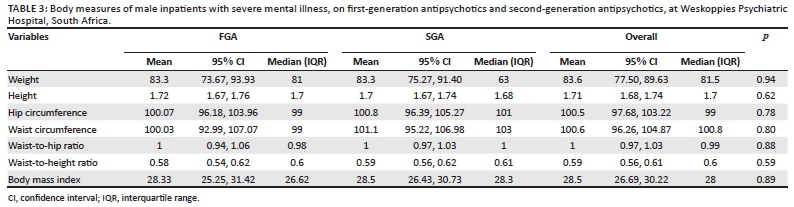
BACKGROUND: The use of antipsychotic medication, particularly second generation antipsychotics (SGAs) is a major risk factor for cardiovascular disease in people with severe mental illness (SMI). Few studies have compared body measures of people with SMI taking first generation antipsychotics (FGAs) to those taking SGAsAIM: We compare body measures between long-term male inpatients using either FGAs or SGAsSETTING: The study was conducted at Weskoppies Psychiatric Hospital, in Pretoria, GautengMETHODS: A total of 30 patients were selected from a list of male inpatients and were included in our study. Each participant had the following anthropometric measures done and these were compared between the two groups: Waist circumference (WC), body mass index (BMI), waist to hip ratio (WHR), waist to height ratio (WHtR) and hip circumference (HC). Hospital records were used to record demographic variables, diagnosis, comorbid disease and psychotropic medication for each participantRESULTS: Participants in the FGA and SGA groups had similar body measures, resulting in similar BMI, WHR and WHtR. Participants had a mean HC of 100.5 cm, 95% confidence interval (CI) (97.68, 103.22). BMI ranged from 21.87 kg/m2 to 37.65 kg/m2, with an overall mean of 28.5 kg/m2, 95% CI (26.69, 30.22). Participants had a mean WHtR of 0.59, 95% CI (0.56, 0.61). Participants had a mean WC of 100.6 cm and 95% CI (96.26, 104.87), and the mean WHR of both groups was 1.0CONCLUSION: Participants using FGAs and SGAs had similar body measures, and these indicated that this sample of male inpatients with SMI is at high risk for CVD
psychiatric patients; antipsychotics; BMI; waist circumference; waist-to-hip ratio; waist-to-height ratio; body measures
Introduction
People with severe mental illness (SMI), especially those with psychotic disorders such as schizophrenia, reportedly have a shorter life expectancy compared to the general population. This shorter life expectancy is associated with increased rates of risk factors like hypertension, diabetes, obesity, strokes, myocardial infarction, coronary heart disease, peripheral vascular disease, congestive heart failure, as well as other cardiovascular diseases (CVDs).1,2,3 Evidence suggests that the incidence of CVD increases with antipsychotic use, higher body mass index (BMI) and higher baseline CVD prevalence.14,5
The first antipsychotic, chlorpromazine, was introduced in 1952.6789
Second-generation or 'atypical' antipsychotic drugs (SGAs) are compounds that are efficacious against the symptoms of schizophrenia, but with nil or minimal extra-pyramidal side effects.10101112
Different antipsychotics seem to affect weight gain differently. The SGAs clozapine and olanzapine are associated with the greatest weight gain.3,13 Chlorpromazine, an FGA, is also associated with weight gain, while quetiapine and risperidone, both SGAs, have an intermediate risk. Asenapine, amisulpride, fluphenazine, haloperidol and ziprasidone have little effect on weight, while aripiprazole promotes weight loss.214
In psychiatric settings, a simple measure for screening for CVD risk may be useful, because people with SMI are twice as likely to have metabolic syndrome compared to the general population.4,5 Currently, the recommended body measures for the assessment of cardiovascular risk in patients with SMI on antipsychotics are BMI and waist circumference (WC), which are measures of overall adiposity and central adiposity, respectively.1415,16,17,18
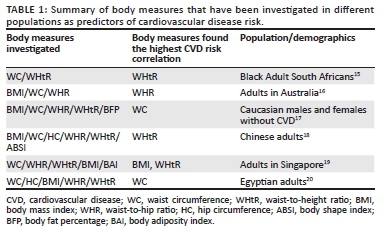
Other body measures include anthropometric indices such as waist-to-hip ratio (WHR) and WC, which are measures of central obesity. These measures are both convenient and cost-effective ways of assessing CVD risk and are suitable for use in busy, poorly resourced settings.15Table 1. Increased BMI, WC and WHR were all significantly correlated to 5- or 10-year CVD risk in the Australian Diabetes, Obesity and Lifestyle (AusDiab) Study.16161718151920
Most of the studies that have investigated the metabolic effects of FGAs and SGAs measured biological markers of metabolic risk, but very few studies have investigated the influence of antipsychotic medication on body measures associated with CVD risk.13,21,22,23 Even fewer studies have investigated CVD risk based on body measures in people with SMI, who are on FGAs or SGAs. In our study, we compared body measures of long-term male inpatients on FGAs and those on SGAs to obtain an impression of their risk for CVD and to record possible differences between the two groups. Firstly, we gathered the body measures including WHR, WHtR, BMI, WC and HR of long-term inpatients at Weskoppies Psychiatric hospital, who were on either SGAs or FGAs. Secondly, we assessed if body measures of patients on FGAs and SGAs differed significantly.
Methods
Study design
Our study was a cross-sectional quantitative study.
Setting and sampling
Our study was conducted at a specialised psychiatric hospital in Pretoria. The study population included inpatients with SMI in the chronic care unit (CCU), who had been prescribed either FGAs or SGAs. The authors obtained informed consent from potential study participants.
Participants were selected from a group of male inpatients identified by the treating team of the CCU. Male inpatients in the CCU who were older than 18 years, had been admitted for at least two years and had been prescribed either SGAs or FGAs were included in the study. Potential participants were excluded if they were on a combination of FGAs and SGAs or on other medications associated with weight gain. such as sodium valproate and tricyclic antidepressants. The patterns of body fat depositions in men and women differ24
Patients who lacked capacity to consent to take part in our study as well as those who declined participation were also excluded.
Measurements
Participants were measured in a standing position, without shoes and wearing light clothing. All participants were weighed on the same digital scale. The height was measured using a stadiometer with participants standing against the wall with their feet together. The BMI of each participant was calculated using the formula: BMI = weight in kilograms (kg) divided by height in meters squared (m224
We conducted our study during the COVID-19 pandemic and followed all standard COVID-19 protocols:
Sanitised all equipment between each participant.
All participants and the researcher wore masks at all times.
Both authors and participants sanitised their hands before and after measuring.
Contact with participants was kept brief enough to conduct all necessary measurements.
The authors and participants kept a distance of at least 1.5 m while explaining the research and obtaining informed consent.
Participant demographics, diagnosis, comorbid disease and their psychotropic medication were recorded from hospital records.
Data analysis
We described continuous variables using the descriptive mean, median, standard deviation and inter-quartile range. Categorical variables were described using frequencies and proportions, and differences in categorical variables were assessed using chi-square tests. The t-test was used to compare mean body measures between the FGA and SGA groups. Tests were evaluated at 5% level of significance. All analysis was done using STATA 15.
Ethical considerations
Our study was approved by the Faculty of Health Sciences Research Ethics Committee at the University of Pretoria (262/2020).
Results
The age of the participants ranged from 24 to 74 years, with a mean age of 48.4 years. Participants on FGAs were slightly older (mean = 50.7 years) than those on SGAs (mean = 46.2 years). Age was not correlated to any of the continuous variables. Thus, there was no need to control for age.
All participants in the FGA group (n = 15) had been diagnosed with a psychotic disorder, including schizophrenia (n = 13), a psychotic disorder as a result of another medical condition (n = 1) and a cannabis induced psychotic disorder (n = 1). In the SGA group (n = 15), participants were diagnosed with schizophrenia (n = 13), mild intellectual disability (n = 1) and major neurocognitive disorder (n = 1).
Participants had the following comorbid conditions, hypertension (FGA [n = 3]; SGA [n = 3]), diabetes (FGA [n = 2]; SGA [n = 3]), hypercholesterolemia (FGA [n = 3]; SGA [n = 3]), HIV (FGA [n = 1); SGA (n = 1]), benign prostate hyperplasia (FGA [n = 1]; SGA [n = 0]), cannabis use disorder (FGA [n = 2]; SGA [n = 1]), chronic obstructive pulmonary disease (FGA [n = 1]; SGA [n = 0]) and somatisation disorder (FGA [n = 0]; SGA [n = 1]). In the FGA group, five patients had no comorbidities and in the SGA group six patients had no comorbidities.
Antipsychotics
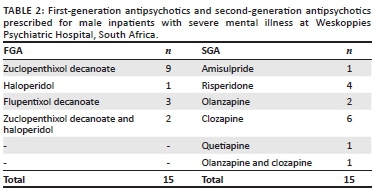
All the participants were on antipsychotic drugs. The types and distribution of antipsychotics are shown in Table 2.
Body measures
Participants in the FGA and SGA groups had similar body measures for HC, WC, WHR, WHtR and BMI's between the two groups (Table 3).
Discussion
Body measures associated with CVD risk in a population of long-term male inpatients who had been admitted for several years and were relatively stable on treatment, on either FGAs or SGAs were done. Participants in our study had similar body measures and similar high risk for CVD. These long-term patients had relatively similar lifestyles, including a similar level of activity, diet and smoking habits. We would thus expect that these patients would have similar body measures, and that any differences could be attributed to factors other than lifestyle, such as prescription medication.
In our study, participants had very similar body measures, irrespective of taking FGAs or SGAs. The two groups were also similar in terms of the presence of comorbidities such as hypertension, diabetes, and hypercholesterolaemia. In the literature, SGAs are generally expected to have more metabolic side effects that increase the risk of CVDs than FGAs.25,26,27 In our study, the lack of difference in body measures and CVD risk may be explained by the variety of SGAs prescribed to participants. Second-generation antipsychotics are a heterogenous group of drugs with different metabolic effects. That being so, some SGAs may not be worse culprits than FGAs regarding cardiovascular risk. This has been suggested in a systemic review and meta-analysis done in 2019.22289242930313131
Other body measure values in our study also suggested higher CVD risk. The participants in our study had a mean BMI of > 25 kg/m223215
Strengths and limitations
Strengths: We assessed two groups of patients with SMI, either on FGAs or on SGAs, who had similar living circumstances and life styles. We were thus able to account for some confounding variables when comparing potential changes in body measures because of side effects of drugs. We only included men, thus avoided having to control for female metabolic differences. This is also a limitation as it reduces the generilisability of our study to male mental healthcare users on antipsychotic medication and excludes females.
Limitations: Our study was a cross-sectional study, which means that both the exposure and the outcome were assessed simultaneously. We did not account for the length of time patients had been admitted and could not assess the temporal relationship between exposure and outcome. The sample size was small, and there were no adjustments made for the presence of comorbidities. The presence of comorbidities such as hypertesion, diabetes and hypercholesterolaemia was, however, similar in both groups, and it does not seem like their presence made a significant impact on the results of the body measures taken. Finally, we only investigated chronic inpatients with SMI. Outpatients were not included. Because of budget constraints, we did not compare all the metabolic parameters of patients on either FGAs or SGAs.
Implications and recommendations
Because of the small sample size, generalisation of the results is inappropriate. Nonetheless, it contributes to research drawing on body measures to gauge cardiovascular risk in patients with SMI, who are on antipsychotic drug treatment. Further studies are needed to assess the usefulness of body measures associated with cardiovascular risk in chronic patients with SMI who are treated with FGAs or SGAs.
Conclusion
In our study, all the participants had similar body measures irrespective of using FGAs or SGAs. Overall the body measures reflected that this sample of chronic, male inpatients with SMI is at high risk for CVD.
Competing interests
The authors declare that they have no financial or personal relationships that may have inappropriately influenced them in writing this article.
Authors' contributions
M.P.N.-N. conceived of the presented idea and developed the theory with the encouragement and supervision of T.B. and P.M.J. M.P.N.-N. collected all the data. C.J.v.R. performed the computations and verified the analytical methods. M.P.N.-N. wrote the manuscript with support from P.M.J.
Funding information
This research received no specific grant from any funding agency in the public, commercial or not-for-profit sectors.
Data availability
The principal investigator will be storing all the data and documents related to the study at the following non-residential address: Weskoppies Hospital, Ketjen street, Pretoria West, 0001.
Disclaimer
The views and opinions expressed in this article are those of the authors and do not necessarily reflect the official policy or position of any affiliated agency of the authors.
Acknowledgements
The authors would like to acknowledge and thank Cheryl Tosh for copyediting the manuscript.
References
-
1. Correll CU, Solmi M, Veronese N, et al. Prevalence, incidence and mortality from cardiovascular disease in patients with pooled and specific severe mental illness: A large-scale meta-analysis of 3,211,768 patients and 113,383,368 controls. World J Psychiatry. 2017;16(2):163-180. https://doi.org/10.1002/wps.20420
» https://doi.org/10.1002/wps.20420 -
2. De Hert M, Correll CU, Bobes J, et al. Physical illness in patients with severe mental disorders. I: Prevalence, impact of medications and disparities in health care. World J Psychiatry. 2011;10(1):52-77. https://doi.org/10.1002/j.2051-5545.2011.tb00014.x
» https://doi.org/10.1002/j.2051-5545.2011.tb00014.x - 3. Newcomer JW, Leucht S. Metabolic adverse effects associated with antipsychotic medications. In: Weinberger DR, Harriso PJ, editors. Schizophrenia. Oxford: Wiley-Blackwell, 2011; p. 577-597.
-
4. McEvoy JP, Meyer JM, Goff DC, et al. Prevalence of the metabolic syndrome in patients with schizophrenia: Baseline results from the clinical antipsychotic trials of intervention effectiveness (catie) schizophrenia trial and comparison with national estimates from NHANES III. Schizophr Res. 2005;80(1):19-32. https://doi.org/10.1016/j.schres.2005.07.014
» https://doi.org/10.1016/j.schres.2005.07.014 -
5. De Hert M, Van Winkel R, Van Eyck D, et al. Prevalence of the metabolic syndrome in patients with schizophrenia treated with antipsychotic medication. Drug Saf. 2006;29(10):911-1010. https://doi.org/10.2165/00002018-200629100-00140
» https://doi.org/10.2165/00002018-200629100-00140 - 6. Delay J, Deniker P, Ropert R. Quatre années d'expérience de la chlorpromazine dans le traitement des psychoses. La Presse Medicale. 1956;64(22):493-496.
-
7. Leucht S, Cipriani A, Spineli L, et al. Comparative efficacy and tolerability of 15 antipsychotic drugs in schizophrenia: A multiple-treatments meta-analysis. Lancet. 2013;382(9896):951-962. https://doi.org/10.1016/S0140-6736(13)60733-3
» https://doi.org/10.1016/S0140-6736(13)60733-3 - 8. Rossiter D, Blockman M, Barnes KI, et al. South African medicines formulary. 12th ed. Pretoria: Health and Medical Publishing Group; 2016.
- 9. Taylor D, Barnes TRE, Young AH. The maudsley prescribing guidelines in psychiatry. 13th ed. Hoboken, NJ: Wiley; 2019.
-
10. Macdonald GJ, Bartolomé JM. A decade of progress in the discovery and development of 'atypical' antipsychotics. Prog Med Chem. 2010;49:37-80. https://doi.org/10.1016/S0079-6468(10)49002-5
» https://doi.org/10.1016/S0079-6468(10)49002-5 -
11. Breden E, Liu M, Dean S. Metabolic and cardiac side effects of second-generation antipsychotics: What every clinician should know. J Pharm Pract. 2009;22(5):478-488. https://doi.org/10.1177/0897190008330200
» https://doi.org/10.1177/0897190008330200 -
12. Holt RIG, Peveler RC. Obesity, serious mental illness and antipsychotic drugs. Diabetes Obes Metab. 2009;11(7):665-679. https://doi.org/10.1111/j.1463-1326.2009.01038.x
» https://doi.org/10.1111/j.1463-1326.2009.01038.x -
13. Melkersson K, Dahl M-L. Adverse metabolic effects associated with atypical antipsychotics: Literature review and clinical implications. Drugs. 2004;64(7):701-723. https://doi.org/10.2165/00003495-200464070-00003
» https://doi.org/10.2165/00003495-200464070-00003 -
14. American Diabetes Assosciation, American Psychiatric Association, American Association of Clinical Endocrinologists, North American Association for the Study of Obesity. Consensus development conference on antipsychotic drugs and obesity and diabetes. Obes Res. 2004;12(2):362-368. https://doi.org/10.1038/oby.2004.46
» https://doi.org/10.1038/oby.2004.46 -
15. Ware LJ, Rennie KL, Kruger HS, et al. Evaluation of waist-to-height ratio to predict 5 year cardiometabolic risk in sub-saharan african adults. Nutr Metab Cardiovasc Dis. 2014;24(8):900-907. https://doi.org/10.1016/j.numecd.2014.02.005
» https://doi.org/10.1016/j.numecd.2014.02.005 -
16. Chen L, Peeters A, Magliano DJ, et al. Anthropometric measures and absolute cardiovascular risk estimates in the australian diabetes, obesity and lifestyle (ausdiab) study. Eur J Cardiovasc Prev Rehabil. 2007;14(6):740-745. https://doi.org/10.1097/HJR.0b013e32816f7739
» https://doi.org/10.1097/HJR.0b013e32816f7739 -
17. Van Dijk SB, Takken T, Prinsen EC, Wittink H. Different anthropometric adiposity measures and their association with cardiovascular disease risk factors: A meta-analysis. Neth Heart J. 2012;20(5):208-218. https://doi.org/10.1007/s12471-011-0237-7
» https://doi.org/10.1007/s12471-011-0237-7 -
18. Liu J, Tse LA, Liu Z, et al. Predictive values of anthropometric measurements for cardiometabolic risk factors and cardiovascular diseases among 44 048 chinese. J Am Heart Assoc. 2019;8(16):e010870. https://doi.org/10.1161/JAHA.118.010870
» https://doi.org/10.1161/JAHA.118.010870 -
19. Lam BCC, Koh GCH, Chen C, Wong MTK, Fallows SJ. Comparison of body mass index (bmi), body adiposity index (bai), waist circumference (wc), waist-to-hip ratio (whr) and waist-to-height ratio (whtr) as predictors of cardiovascular disease risk factors in an adult population in singapore. PLoS One. 2015;10(4):e0122985. https://doi.org/10.1371/journal.pone.0122985
» https://doi.org/10.1371/journal.pone.0122985 -
20. Assaad-Khalil SH, Mikhail MM, Aati TA, et al. Optimal waist circumference cutoff points for the determination of abdominal obesity and detection of cardiovascular risk factors among adult Egyptian population. Indian J Endocrinol Metab. 2015;19(6):804-810. https://doi.org/10.4103/2230-8210.167556
» https://doi.org/10.4103/2230-8210.167556 -
21. Rumala B, Fan X, Sharma B, et al. Waist circumference does not predict insulin resistance in African American schizophrenia patients. Int J Cult Ment Health. 2008;1(2):93-104. https://doi.org/10.1080/17542860802201117
» https://doi.org/10.1080/17542860802201117 -
22. Buhagiar K, Jabbar F. Association of first- vs. second-generation antipsychotics with lipid abnormalities in individuals with severe mental illness: A systematic review and meta-analysis. Clin Drug Investig. 2019;39(3):253-273. https://doi.org/10.1007/s40261-019-00751-2
» https://doi.org/10.1007/s40261-019-00751-2 -
23. Burns JK, Motala AA, Saloojee S. High risk of metabolic syndrome among black south african women with severe mental illness. S Afr J Psychiatr. 2017;23(1):1-6. https://doi.org/10.4102/sajpsychiatry.v23i0.1089
» https://doi.org/10.4102/sajpsychiatry.v23i0.1089 - 24. World Health Organization. Waist circumference and waist-hip ratio: Report of a who expert consultation, Geneva, 8-11 December 2008. Geneva: World Health Organization; 2011.
-
25. Karen LT, Michael RR, Joanna G, Carissa F, Huong-Lan N, Karl R. Antipsychotic-induced insulin resistance and postprandial hormonal dysregulation independent of weight gain or psychiatric disease. Diabetes. 2013;62(9):3232-3240. https://doi.org/10.2337/db13-0430
» https://doi.org/10.2337/db13-0430 -
26. Dubisar BM, Stoner SC, Reynolds J, Khan R, Ramlatchman L. Adverse effects of atypical antipsychotic agents and their effects on quality of life. Pharmacotherapy. 2004;24(7):843-847. https://doi.org/10.1592/phco.24.9.843.36098
» https://doi.org/10.1592/phco.24.9.843.36098 -
27. Hirsch L, Yang J, Bresee L, Jette N, Patten S, Pringsheim T. Second-generation antipsychotics and metabolic side effects: A systematic review of population-based studies. Drug Saf. 2017;40(9):771-781. https://doi.org/10.1007/s40264-017-0543-0
» https://doi.org/10.1007/s40264-017-0543-0 -
28. Spelman LM, Walsh PI, Sharifi N, Collins P, Thakore JH. Impaired glucose tolerance in first-episode drug-naïve patients with schizophrenia. Diabet Med. 2007;24(5):481-485. https://doi.org/10.1111/j.1464-5491.2007.02092.x
» https://doi.org/10.1111/j.1464-5491.2007.02092.x -
29. Motala AA, Esterhuizen T, Pirie FJ, Omar MA. The prevalence of metabolic syndrome and determination of the optimal waist circumference cutoff points in a rural south african community. Diabetes Care. 2011;34(4):1032-1037. https://doi.org/10.2337/dc10-1921
» https://doi.org/10.2337/dc10-1921 -
30. Heitmann BL, Frederiksen P, Lissner L. Hip circumference and cardiovascular morbidity and mortality in men and women. Obes Res. 2004;12(3):482-487. https://doi.org/10.1038/oby.2004.54
» https://doi.org/10.1038/oby.2004.54 -
31. Cameron AJ, Magliano DJ, Söderberg S. A systematic review of the impact of including both waist and hip circumference in risk models for cardiovascular diseases, diabetes and mortality. Obes Rev. 2013;14(1):86-94. https://doi.org/10.1111/j.1467-789X.2012.01051.x
» https://doi.org/10.1111/j.1467-789X.2012.01051.x -
32. Dudina A, Cooney MT, Bacquer DD, et al. Relationships between body mass index, cardiovascular mortality, and risk factors: A report from the score investigators. Eur J Prev Cardiol. 2011;18(5):731-742. https://doi.org/10.1177/1741826711412039
» https://doi.org/10.1177/1741826711412039

Accepted: 14 Dec. 2021
Published: 17 Feb. 2022