Intimate partner violence, adverse childhood experiences and prenatal substance use in South Africa
Abstract
BACKGROUND: Intimate partner violence (IPV) is one of the most pressing public health conditions among women worldwide, particularly in sub-Saharan Africa. Intimate partner violence in South Africa, along with human immunodeficiency virus (HIV), is an epidemic that is closely linked to trauma and substance use in women. AIM: This study aimed to identify factors associated with IPV among pregnant women, with a specific focus on adverse childhood experiences (ACE), prenatal substance use, and HIV status. SETTING: A large public general hospital in the KwaZulu-Natal province. METHODS: The sampled study participants included 223 adult postpartum women (18 - 45 years) based on convenience sampling who recently gave birth. Four separate logistic regression models were fitted to examine the role of ACE, perinatal substance abuse and HIV against threat (model 1), physical violence (model 2), sexual violence (model 3) and any IPV (model 4) outcomes (threat and/or physical and/or sexual violence. RESULTS: The prevalence of threat, physical violence, sexual violence and any IPV were 19.7%, 16.6%, 1.8% and 20.2%, respectively. The total ACE scores ranged from 0 to 11 (of 13 possible events) with a mean of 3.28 (standard deviation [s.d.] = 2.76), where 14.4% reported using substances during pregnancy (n = 32) as well as 47.1% (n = 105) of participants living with HIV. The authors found that the presence of family support was protective against IPV physical. CONCLUSION: It is essential that obstetric services screen and address potential risk factors along the life course pathways from early adversity to adult maternal health that drive IPV, particularly in young women who may lack family support during pregnancy CONTRIBUTION: This research gives insight into the dynamics between IPV, HV, ACE and perinatal substance use facing young women in South Africa.
adverse childhood experiences; HIV; substance abuse; pregnancy; IPV
Introduction
Despite the considerable advances in human rights legislation in many countries,11,21345617
It is well-established that issues of HIV and IPV in SA are gendered and closely linked to young women. According to an HIV incidence study,33643,8884,9
Many of the challenges experienced by pregnant women and risky behaviours are deeply rooted in early childhood beginnings. Adverse childhood experiences (ACEs) are linked to a myriad of health problems later in life and that include health risk behaviours, that women engage in from a young age.10,11121310,14
Aims and objectives
The study aimed to identify factors associated with IPV among pregnant women, with a specific focus on ACE, substance use, and HIV status. The study had the following objectives:
• To establish the association between IPV and ACEs.
• To calculate the association between IPV and prenatal substance use.
• To establish the association between IPV and HIV status.
Methodology
Study design and setting
The investigation involved a secondary data analysis of a cross-sectional study involving adult postpartum women who recently gave birth while attending one of the large public general hospitals in KwaZulu-Natal (KZN) province, South Africa.
Study population and sampling strategy
The sampled study participants included 223 adult postpartum women (18 years - 45 years) based on convenience sampling.
Data collection
The data collection took place between January and December 2018. The eligibility criteria were female participants who: (1) could read and/or write English or IsiZulu, (2) had given birth in the past week receiving in- or out-patient services at the hospital and (3) were aged between 18 and 45 years. All consenting study participants were interviewed by a senior psychiatry registrar fluent in English and IsiZulu. They were interviewed within one week of delivery using structured questionnaires.
Measurement
The main outcome of the study was IPV experienced during a lifetime. There are four types of IPV outcomes1,15,16,17
The main explanatory variable was ACEs, which were measured with the WHO's Adverse Childhood Experiences International Questionnaire (ACE-IQ). It was previously used in other South African studies also.3,15,16
A clinical research form designed for this research was used to obtain self-reported status on any perinatal substance use. The HIV status was based on antibody testing, with two consecutive parallel tests using Architect® (Abbott Diagnostics, Wiesbaden, Germany) and Cobas E601® (Roche, Basel, Switzerland). Lastly, a sociodemographic questionnaire collected information on the participant's age, occupation, education, social support, and income. Family support was measured by the presence of relationship with family members.
Data analysis
Two analyses were undertaken for this investigation, the first summarising the participants' sociodemographic and clinical profiles using descriptive statistics. The second examined the role of ACE, perinatal substance abuse and HIV against threat (model 1), physical violence (model 2), sexual violence (model 3) and any IPV (model 4) outcomes by fitting four separate logistic regression models. The data were analysed using Stata 17, and a p-value < 0.05 was considered statistically significant.
Ethical considerations
Written consent was obtained from all participants, and the study was approved by the Biomedical Research Ethics Committee (Dual Approval #: BE479/17 and BREC/00003292/2021) at the University of KwaZulu-Natal.
Results
Sociodemographic profile
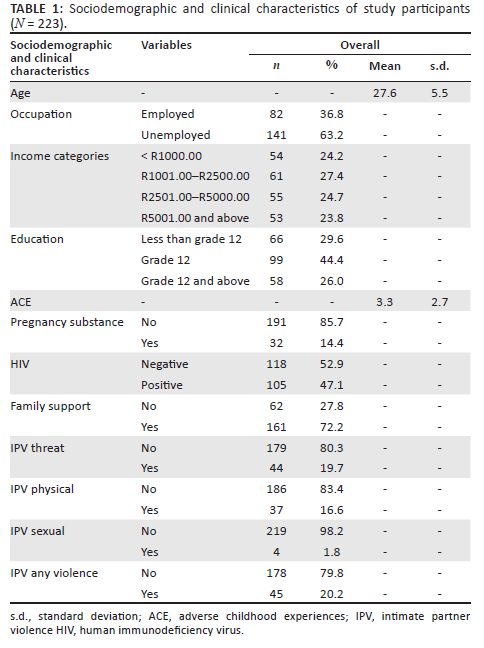
A total of 223 female study participants were involved in this investigation. Their mean age was 27.7 years (standard deviation [s.d.] = 5.52), most (n = 206; 92.4%) were black women, and 54 of the participants (24.2%) lived on an income of R1000.00 ($70.00) per month (Table 1).
Clinical profile
The observed number of adverse events experienced in childhood ranged from 1-11 (of a possible 13 events), with a mean of 3.28 (s.d. = 2.76). Out of the 223 participants, 32 (14.4%) reported substance use during pregnancy, and 105 (47.1%) living with HIV. The prevalence of threat, physical violence, sexual violence, and any IPV, were 19.7% (n = 44), 16.6% (n = 37), 1.8% (n = 4) and 20.2% (n = 45), respectively (Table 1).
Regression results
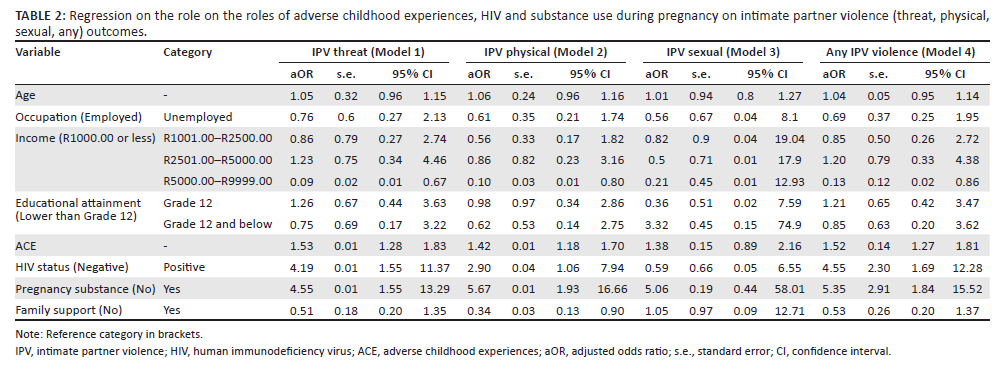
Table 2 summarises the logistic regression results against the IPV outcomes in: (1) threat, (2) physical violence, (3) sexual violence and (4) any IPV based on four separate fitted models. Except for sexual violence outcomes (model 3), ACE, perinatal substance abuse and HIV were all significant risk factors against threat (model 1), physical violence (model 2) and any IPV outcomes (model 4). The authors found that the presence of family support was protective against IPV physical. In model 1, ACE (adjusted odds ratio [aOR] = 1.53, 95% confidence interval [CI]: 1.28-1.83), perinatal substance (aOR = 4.55, 95% CI: 1.55-13.29) and HIV status (aOR = 4.19, 95% CI: 1.55-11.37) were significant risk factors for IPV threat. In model 2, ACE (aOR = 1.42, 95% CI: 1.18-1.70), perinatal substance (aOR = 5.67, 95% CI: 1.93-17.70) and HIV status (aOR = 2.90, 95% CI: 1.067.94) were significant risk factors for IPV threat. The authors found that the presence of family support was protective against IPV physical (aOR = 0.34, 95% CI: 0.13-0.90) in model 2. In model 4, ACE (aOR = 1.52, 95% CI 1.27-1.81), perinatal substance (aOR = 5.35, 95% CI: 1.84-15.50) and HIV status (aOR = 4.55, 95% CI: 1.69-12.30) were significant risk factors for IPV threat.
Discussion
The authors investigated the role of adverse childhood experiences (ACEs), perinatal substance abuse, and HIV against IPV in one of the largest HIV hyperendemic settings globally. With the exception of sexual violence outcomes, the authors found, on the one hand that ACEs, perinatal substance abuse and HIV were identified to be consistent risk factors of IPV threat, physical and any IPV. On the other hand, the authors found that the presence of family support was protective against IPV physical.172,18,19
The lack of significant findings against sexual violence warrants further discussion. A previous study by Kidman and Violari20
Despite important study findings, there are two limitations worth noting. Firstly, this study is based on cross-sectional design, which limits causal inference and warrants further studies based on longitudinal methods that participants can be assessed early for any ACEs and tracked throughout their lifetime for any development of risky behaviours that could perpetuate HIV and IPV prevalence. Secondly, there could have been under-reporting of substance use during pregnancy. Unlike HIV status based on biomarkers, the study relied on self-report of substance use during pregnancy that is vulnerable to social desirability bias.
Notwithstanding these limitations, the strength of the study is the uniqueness of the sample. A group of women were approached within one week postpartum to have their voices heard. It is believed that ACEs are the root cause of risky behaviour that sustain the HIV epidemic,21
Conclusion
The study found that ACEs, perinatal substance use and HIV were associated with IPV. Considering that HIV is an endemic in KZN, this poses a threat to individuals' health as well as the broader public health. The authors also found that the younger women are more prone to drug abuse and IPV. Findings show that family support was a protective strategy against physical IPV. Because of neglect and less utilisation of psychological services, family support was not found to be protective for other forms of IPV as it was with physical IPV.22
Although there was no significant association between sexual IPV and ACEs, substance abuse and HIV, the authors conclude that it was because of the low prevalence of sexual IPV in the study, as this finding varied with other studies of a similar nature. The dynamics between IPV, HIV, ACEs and perinatal substance are of a complex nature. This requires more research into this field and increased awareness among the healthcare professionals and the public at large. The results of this research can be used to improve women's quality of life by enhancing parenting strategies to avert ACEs. This will in turn, lessen the risk of being victims to IPV as girl children grow into womanhood.
Competing interests
The authors declare that they have no financial or personal relationships that may have inappropriately influenced them in writing this article.
Authors' contributions
M.L.N. and A.T. developed the concept for the current study and analysed the data. B.S.B. was the principal investigator of the main study who collected the data. S.M. and S.P. were supervisors for the original study. All authors contributed to drafting the work or revising it critically for important intellectual content and approved the version to be published.
Funding information
This research received no specific grant from any funding agency in the public, commercial, or not-for-profit sectors.
Data availability
The data are not publicly available because of the sensitivity of the information and the need to protect the confidentiality of our study participants. The datasets are available from B.S.B. upon reasonable request.
Disclaimer
The views and opinions expressed in this article are those of the authors and do not necessarily reflect the official policy or position of any affiliated agency of the authors, and the publisher.
Acknowledgements
The authors would like to acknowledge the participants for making this study possible.
References
-
1.World Health Organization. Understanding and addressing violence against women [cited 2021 Oct 19]. Available from: https://apps.who.int/iris/bitstream/handle/10665/77432/WHO_RHR_12.36_eng.pdf
» https://apps.who.int/iris/bitstream/handle/10665/77432/WHO_RHR_12.36_eng.pdf -
2.Abramsky T, Watts CH, Garcia-Moreno C, et al. What factors are associated with recent intimate partner violence? findings from the WHO multi-country study on women's health and domestic violence. BMC Public Health. 2011;11(1):1-17. https://doi.org/10.1186/1471-2458-11-109
» https://doi.org/10.1186/1471-2458-11-109 -
3.Karim SSA, Baxter C. HIV incidence rates in adolescent girls and young women in sub-Saharan Africa. Lancet Glob Health. 2019;7(11):e1470-e1471. https://doi.org/10.1016/S2214-109X(19)30404-8
» https://doi.org/10.1016/S2214-109X(19)30404-8 -
4.Lekalakala-Mokgele E. Exploring gender perceptions of risk of HIV infection and related behaviour among elderly men and women of Ga-Rankuwa, Gauteng Province, South Africa. SAHARA J. 2016;13(1):88-95. https://doi.org/10.1080/17290376.2016.1218790
» https://doi.org/10.1080/17290376.2016.1218790 -
5.Tomita A, Vandormael AM, Cuadros D, et al. Green environment and incident depression in South Africa: A geospatial analysis and mental health implications in a resource-limited setting. Lancet Planet Health. 2017;1(4):e152-e162. https://doi.org/10.1016/S2542-5196(17)30063-3
» https://doi.org/10.1016/S2542-5196(17)30063-3 -
6.Allinder SM, Fleischman J. The world's largest HIV epidemic in crisis: HIV in South Africa [homepage on the Internet]. [cited 2021 Oct 19]. Available from: https://www.csis.org/analysis/worlds-largest-hiv-epidemic-crisis-hiv-south-africa
» https://www.csis.org/analysis/worlds-largest-hiv-epidemic-crisis-hiv-south-africa -
7.Pingley T. The Impact of Witnessing Domestic Violence on Children: A Systematic Review. 2017. Retrieved from Sophia, the St. Catherine University repository website: https://sophia.stkate.edu/msw_papers/776
» https://sophia.stkate.edu/msw_papers/776 -
8.Karim QA, Baxter C. The dual burden of gender-based violence and HIV in adolescent girls and young women in South Africa. S Afr Med J. 2016;106(12):1151-1153. https://doi.org/10.7196/SAMJ.2017.v106i12.12126
» https://doi.org/10.7196/SAMJ.2017.v106i12.12126 -
9.Bernstein M, Phillips T, Zerbe A, et al. Intimate partner violence experienced by HIV-infected pregnant women in South Africa: A cross-sectional study. BMJ Open. 2016;6(8):e011999. https://doi.org/10.1136/bmjopen-2016-011999
» https://doi.org/10.1136/bmjopen-2016-011999 -
10.Mersky JP, Lee CP. Adverse childhood experiences and poor birth outcomes in a diverse, low-income sample. BMC Pregnancy Childbirth. 2019;19(1):387. https://doi.org/10.1186/s12884-019-2560-8
» https://doi.org/10.1186/s12884-019-2560-8 -
11.Wiehn J, Hornberg C, Fischer F. How adverse childhood experiences relate to single and multiple health risk behaviours in German public university students: A cross-sectional analysis. BMC Public Health. 2018;18(1):1005. https://doi.org/10.1186/s12889-018-5926-3
» https://doi.org/10.1186/s12889-018-5926-3 -
12.Gibbs A, Dunkle K, Washington L, Willan S, Shai N, Jewkes R. Childhood traumas as a risk factor for HIV-risk behaviours amongst young women and men living in urban informal settlements in South Africa: A cross-sectional study. PLoS One. 2018;13(4):e0195369. https://doi.org/10.1371/journal.pone.0195369
» https://doi.org/10.1371/journal.pone.0195369 -
13.Novais M, Henriques T, Vidal-Alves MJ, Magalhães T. When problems only get bigger: The impact of adverse childhood experience on adult health. Front Psychol. 2021;12:2797. https://doi.org/10.3389/fpsyg.2021.693420
» https://doi.org/10.3389/fpsyg.2021.693420 -
14.Nikulina V, Gelin M, Zwilling A. Is there a cumulative association between adverse childhood experiences and intimate partner violence in emerging adulthood? J Interpers Violence. 2021;36(3-4):NP1205-1232NP. https://doi.org/10.1177/0886260517741626
» https://doi.org/10.1177/0886260517741626 -
15.Bhengu BS, Tomita A, Mashaphu S, Paruk S. The role of adverse childhood experiences on perinatal substance use behaviour in KwaZulu-Natal Province, South Africa. AIDS Behav. 2020 Jun;24(6):1643-1652. https://doi.org/10.1007/s10461-019-02661-y
» https://doi.org/10.1007/s10461-019-02661-y -
16.Munezero T, Tomita A. Hypertension and its associated mental health challenges among female african refugees in Durban, South Africa. J Nerv Ment Dis. 2021;209(11):802-808. https://doi.org/10.1097/NMD.0000000000001387
» https://doi.org/10.1097/NMD.0000000000001387 -
17.Do HP, Baker PRA, Van Vo T, et al. Intergenerational effects of violence on women's perinatal wellbeing and infant health outcomes: Evidence from a birth cohort study in Central Vietnam. BMC Pregnancy Childbirth. 2021;21(1):648. https://doi.org/10.1186/s12884-021-04097-6
» https://doi.org/10.1186/s12884-021-04097-6 -
18.Capaldi DM, Knoble NB, Shortt JW, Kim HK. A systematic review of risk factors for intimate partner violence. Partner Abuse. 2012;3(2):231. https://doi.org/10.1891/1946-6560.3.2.231
» https://doi.org/10.1891/1946-6560.3.2.231 -
19.Shri N, Muhammad T. Association of intimate partner violence and other risk factors with HIV infection among married women in India: Evidence from National Family Health Survey 2015-16. BMC Public Health. 2021;21(1):2105. https://doi.org/10.1186/s12889-021-12100-0
» https://doi.org/10.1186/s12889-021-12100-0 -
20.Kidman R, Violari A. Dating violence against HIV-infected youth in South Africa: Associations with sexual risk behavior, medication adherence, and mental health. J Acquir Immune Defic Syndr. 2018;77(1):64-71. https://doi.org/10.1097/QAI.0000000000001569
» https://doi.org/10.1097/QAI.0000000000001569 -
21.Brown DW, Anda RF. Adverse childhood experiences: Origins of behaviors that sustain the HIV epidemic. AIDS Lond Engl. 2009;23(16):2231-2233. https://doi.org/10.1097/QAD.0b013e3283314769
» https://doi.org/10.1097/QAD.0b013e3283314769 -
22.Mengo C, Small E, Black B. Intimate partner violence and women's mental health: The mediating role of coping strategies among women seeking help from the police. J Interpers Violence. 2021;36(1-2):527-551. https://doi.org/10.1177/0886260517729402
» https://doi.org/10.1177/0886260517729402

Accepted: 07 Aug. 2022
Published: 09 Dec. 2022