Electroconvulsive therapy (ECT) with ketamine induction for catatonia in an HIV positive patient
Abstract
INTRODUCTION: The successful use of ECT as treatment for catatonia, in the context of HIV (human immunodeficiency virus) infection, has been described previously. Ketamine has been used as an anaesthetic induction agent for ECT, although not considered the induction agent of choice. There are also case reports suggesting that ketamine may be an alternative treatment specifically for catatonia. PATIENT PRESENTATION: This case report describes the management of a female patient who presented with catatonia, evidenced by stupor, waxy flexibility, mutism, negativism, and stereotypy, as well as stage four HIV infection, with poor response to previous psychotherapeutic interventions. MANAGEMENT AND OUTCOME: We describe the course of management of this patient with ECT, following poor initial clinical response to ECT with propofol induction, the subsequent use of ketamine as an anaesthetic induction agent for ECT, with associated improvement in seizure quality, and good overall clinical response to ECT demonstrated thereafter. CONCLUSION AND CONTRIBUTIONS: This case report suggests that ketamine may be a viable induction agent for ECT in this clinical setting.
ECT; case report; Ketamine; HIV; catatonia
Introduction
Catatonia is a longstanding recognised indication for electroconvulsive therapy (ECT).1112,3,4,56,7
The overall efficacy of ECT has been linked to several factors, including seizure quality as indicated by, firstly, seizure duration over 25 s; secondly, heart rate response indicating a seizure-related sympathetic response; and thirdly, overall seizure quality as observed from the electroencephalogram (EEG) pattern of progression from low amplitude polyspike to higher amplitude spike and wave before postictal suppression.891011,1213,14
This case report describes the successful use of ketamine as an induction agent in ECT for prolonged catatonia in a patient with HIV.
Ethical considerations
Permission for publication was obtained from the specialised psychiatric hospital and the University of the Witwatersrand Human Research Ethics Committee (reference number M200384). Informed consent for publication of the case report was also obtained from the patient and next of kin.
Patient presentation
Ms X, a 36-year-old woman, presented to a specialised psychiatric hospital as a referral from a peripheral district psychiatric unit. She was known to the district hospital following an index presentation six years before this current admission, with behavioural disturbance, aggression and mutism. She had been diagnosed with HIV and had been on combined antiretroviral therapy (ART) (fixed oral dose combination of efavirenz, emtricitabine, and tenofovir) for approximately five years. She had also been treated with clozapine 350 mg by mouth at night and citalopram 30 mg by mouth in the morning at the district hospital, although record-keeping was poor, and it was not possible to determine how this combination of psychotropic medication had been reached. The mutism had remained prominent since the first presentation. She was admitted to the district hospital three weeks prior to transfer with deteriorating agitated behaviour, aggression, refusal to eat and ongoing mutism. She had been given a trial of oral lorazepam with no improvement in symptoms. She was known from the referral hospital with a chronic, five year history of nonprogressive raised alkaline phosphatase (ALP) and gamma-glutamyl transferase (GGT), for which preliminary workup had been completed prior to transfer, including a normal ultrasound scan of the abdomen.
On arrival at the hospital, she was noted to be mute, uncooperative and combatively refusing to be examined by avoiding gaze and interaction and resisting movement. Physically, she had a body mass index (BMI) of 30 kg/m2
Blood workup demonstrated advanced HIV infection (Stage 3 HIV infection, HIV viral load 106 copies/ml, CD4 count was 193 cells/mm3
Management and outcome
There was no clinical or laboratory cause found for the EEG and CTB scan findings, and the magnetic resonance imaging (MRI) booking date was several months away. Work-up for possible ECT, including repeat urea and electrolytes and ECG, as well as repeat liver function tests with no worsening of the ALP and GGT, showed no contraindications to performing ECT, and therefore it was decided to commence with a trial of ECT.
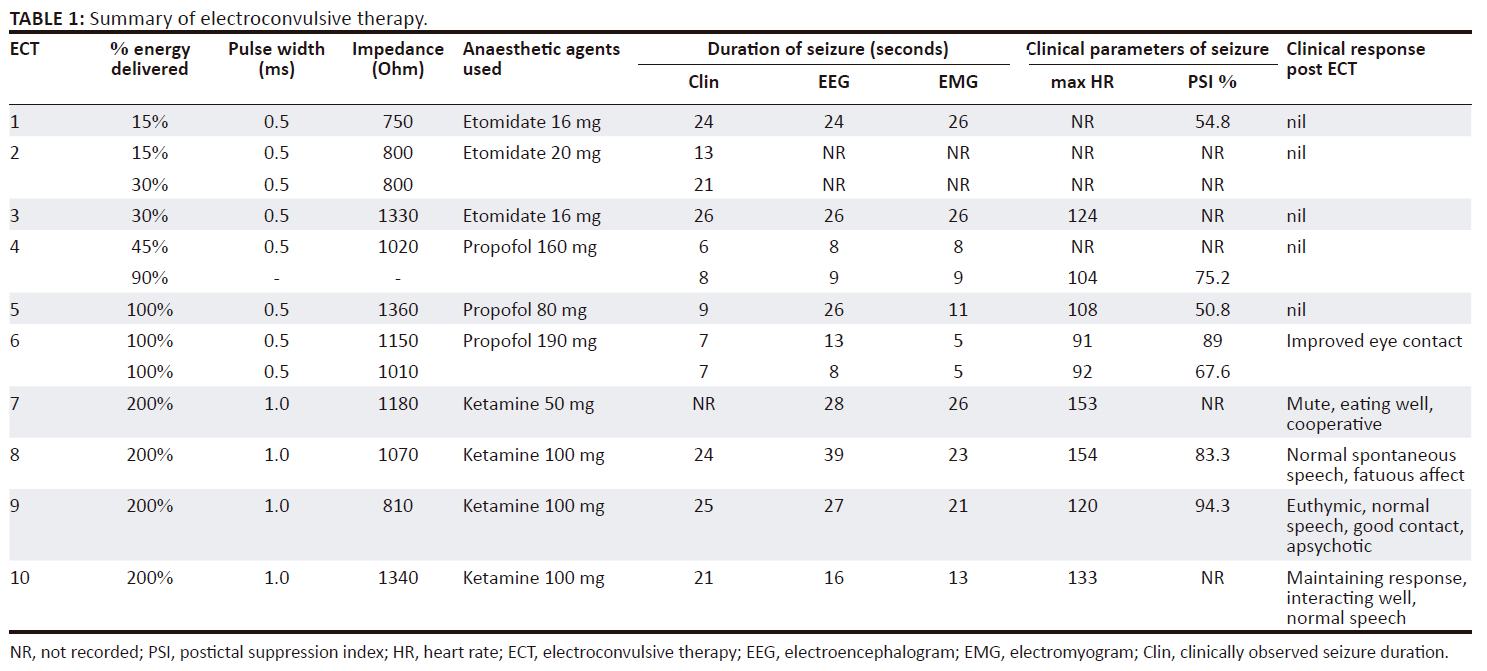
Details of 10 ECT treatments are provided in Table 1. Bitemporal ECT was administered twice a week. The decision to use ketamine as an induction agent from session seven was based on a lack of availability of etomidate, which was the preferred agent, and the documented poor seizure quality with propofol induction. Following the decision to use ketamine as the induction agent, combined with a decision to double the dosage of ECT at session seven, the improvement in seizure quality on several parameters (duration of seizure on clinical, EEG and EMG recordings as well as heart rate response) was noted. There was no record of the emergence of delirium or perceptual disturbances. There was a significant improvement noted immediately post session eight, with the resumption of spontaneous speech on interview 2 h post ECT, a reactive affect and improved interaction. The improvement continued and was sustained for two further sessions of ECT, with subsequent termination of ECT. There was a sustained improvement for 6 weeks post ECT. The patient was discharged to follow-up at the district hospital on quetiapine 300 mg at night, citalopram 40 mg daily and a fixed dose combination of antiretrovirals (tenofovir, emtricitabine and efavirenz). Neurocognitive testing post ECT was limited due to language and educational constraints. However, functional improvement in several symptom domains was noted by the clinical team, as well as positive feedback regarding a significant recovery from the patient's relatives.
Discussion
Ketamine is an N-methyl-D-aspartate (NMDA) receptor antagonist, and theories regarding its efficacy in depression relate to its role in glutamate signalling and synaptic plasticity.151617
There are case reports of successful treatment of catatonia in HIV-positive individuals using ECT.6,718
There are three possible explanations for the response after session eight. Firstly, it is possible that the use of ketamine lowered the seizure threshold and, in addition to the increased treatment dose to deliver the ECT, resulted in adequate seizure quality which led to a subsequent clinical response; this hypothesis is supported by the resolution of catatonia after two sessions where adequate seizure (duration and heart rate response) was observed (session seven and eight). Secondly, it is possible that the use of ketamine, regardless of the adequate seizure, at a dose of > 0.5 mg/kg had a direct causal effect on the improvement of catatonia, although the improvement was only noted immediately after the second dose of ketamine was given. Thirdly, it is possible that both the improvement in seizure quality (seizure duration and heart rate response) and direct effect of ketamine synergistically resulted in an improvement in catatonia.
Evidence supporting the use of ketamine in psychiatry is inconsistent. While there is evidence to suggest rapid improvement in depressive symptoms following ketamine infusions, the risk of dependence and abuse, as well as the initial euphoria associated with ketamine, remain concerns, as does the inability to fully 'mask' the immediate effects of ketamine in controlled studies.1913,1410
There are a few case reports of liver dysfunction associated with regular recreational ketamine use in HIV-positive men on ART, specifically ritonavir-containing regimes.2021
Limitations of this case report
The pathogenesis of catatonia related to advanced HIV, ART treatment or the underlying pathological EEG and CT brain changes in this patient are beyond the scope of this case presentation and has not been further explored. Magnetic resonance imaging was not available. Poor district-level record-keeping regarding the duration of catatonia, symptom progression and associated medical conditions makes a retrospective diagnosis of 'prolonged catatonia' uncertain. Raised ALP and GGT were not further investigated. Longer-term follow-up has not been possible to assess for any re-emergence of catatonia and long-term benefit or adverse effects following ECT. Limitations of case reports have previously been described which apply in this case, including that a single case report is not significant evidence for a cause-effect relationship; the case report is retrospective and naturalistic; and the risk of overinterpretation bias exists.22
Conclusion
This case report illustrates the safe and effective use of ketamine as an induction agent for anaesthesia for ECT in an HIV-positive patient presenting with catatonia. Improved seizure quality resulting from the use of ketamine as an induction agent is a possible factor in the positive response to ECT.
Competing interests
The authors declare that they have no financial or personal relationship(s) that may have inappropriately influenced them in writing this article.
Authors' contributions
Y.N. was the treating clinician and wrote the text and contributed to the literature search. C.A.B. advised on the use of ketamine and assisted with the literature search, editing and text revision.
Funding information
The authors received no financial support for the research, authorship, and/or publication of this article.
Data availability
Data sharing is not applicable to this article, as no new data were created or analysed in this study.
Disclaimer
The views expressed in the submitted article are our own and not an official position of the institution.
Acknowledgements
References
-
1.Wilcox J, Duffy P. The syndrome of catatonia. Behav Sci. 2015;5(4):576-588. https://doi.org/10.3390/bs5040576
» https://doi.org/10.3390/bs5040576 -
2.Prakash O, Bagepally B. Catatonia and mania in patient with AIDS: Treatment with lorazepam and risperidone. Gen Hosp Psychiatry. 2012;34(3):321.e5-321.e6. https://doi.org/10.1016/j.genhosppsych.2012.01.010
» https://doi.org/10.1016/j.genhosppsych.2012.01.010 -
3.Huffman JC, Fricchione GL. Catatonia and psychosis in a patient with AIDS treatment with lorazepam and aripiprazole. J Clin Psychopharmacol. 2005;25(5):508-510. https://doi.org/10.1097/01.jcp.0000177848.85415.e9
» https://doi.org/10.1097/01.jcp.0000177848.85415.e9 -
4.Kumar P, Jain Mk. Progressive multifocal leukoencephalopathy in AIDS camouflaged with catatonia: A wolf in sheep's clothing. Indian J Psychiatry. 2006;48(1):69-71. https://doi.org/10.4103/0019-5545.31625
» https://doi.org/10.4103/0019-5545.31625 -
5.Foster R, Olajide D, Everall IP. Antiretroviral therapy-induced psychosis: A case report and brief review of the literature. HIV Med. 2003;4(2):139-144. https://doi.org/10.1046/j.1468-1293.2003.00142.x
» https://doi.org/10.1046/j.1468-1293.2003.00142.x - 6.Cappai A, Smith S. ECT dilemma: Should we start this treatment earlier? Sch J Appl Sci Res. 2018;1(8):43-45.
-
7.Schaerf FW, Miller RR, Lipsey JR, McPherson RW. ECT for major depression in four patients infected with human immunodeficiency virus. Am J Psychiatry. 1989;146(6):782-784. https://doi.org/10.1176/ajp.146.6.782
» https://doi.org/10.1176/ajp.146.6.782 - 8.Shah AJ, Wadoo O, Latoo J. Electroconvulsive Therapy (ECT): Important parameters which influence its effectiveness. BJMP. 2013;6(4):a634.
-
9.Segal J, Davidow RJ. Sevoflurane induction for electroconvulsive therapy (ECT) - A clinical review and cost analysis. S Afr Psychiatry Rev. 2006;9(4):223-228. https://doi.org/10.4314/ajpsy.v9i4.30221
» https://doi.org/10.4314/ajpsy.v9i4.30221 -
10.Cobb K, Nanda M. Ketamine and electroconvulsive therapy: So happy together? Curr Opin Anesthesiol. 2018;31(4):459-462. https://doi.org/10.1097/ACO.0000000000000607
» https://doi.org/10.1097/ACO.0000000000000607 -
11.Krystal AD, Weiner RD, Dean MD, et al. Comparison of seizure duration, ictal EEG, and cognitive effects of ketamine and methohexital anesthesia with ECT. J Neuropsychiatry Clin Neurosci. 2003;15(1):27-34. https://doi.org/10.1176/jnp.15.1.27
» https://doi.org/10.1176/jnp.15.1.27 -
12.Kranaster L, Kammerer-Ciernioch J, Hoyer C, Sartorius A. Clinically favourable effects of ketamine as an anaesthetic for electroconvulsive therapy: A retrospective study. Eur Arch Psychiatry Clin Neurosci. 2011;261(8):575-582. https://doi.org/10.1007/s00406-011-0205-7
» https://doi.org/10.1007/s00406-011-0205-7 -
13.Kobayashi B, Wright C, Burns M, Bera R. Ketamine for acute catatonia: A case report. Curr Psychiatry. 2021;20(6):24-28. https://doi.org/10.12788/cp.0132
» https://doi.org/10.12788/cp.0132 -
14.Jalan D, Martin R, Mehra A, et al. Poster number: NR 36 from 2018 AAGP annual meeting. Utility of intravenous ketamine as an alternative, effective depression treatment for hospitalized patients unable to receive electroconvulsive therapy due to medical risks. Am J Geriatr Psychiatry. 2018;26(3) Supplement 1:S162-S163. https://doi.org/10.1016/j.jagp.2018.01.198
» https://doi.org/10.1016/j.jagp.2018.01.198 -
15.Murrough JW, Abdallah CG, Mathew SJ. Targeting glutamate signalling in depression: Progress and prospects. Nat Rev Drug Discov. 2017;6(7):472-486. https://doi.org/10.1038/nrd.2017.16
» https://doi.org/10.1038/nrd.2017.16 -
16.Lloyd JR, Silverman ER, Kugler JL, Cooper JJ. Electroconvulsive therapy for patients with catatonia: Current perspectives. Neuropsychiatr Dis Treat. 2020;25(16):2191-2208. https://doi.org/10.2147/NDT.S231573
» https://doi.org/10.2147/NDT.S231573 -
17.Rasmussen SA, Mazurek MF, Rosebush PI. Catatonia: Our current understanding of its diagnosis, treatment and pathophysiology. World J Psychiatry. 2016;6(4):391-398. https://doi.org/10.5498/wjp.v6.i4.391
» https://doi.org/10.5498/wjp.v6.i4.391 -
18.Nielsen RM, Olsen KS, Lauritsen AOE, Boesen HC. Electroconvulsive therapy as a treatment for protracted refractory delirium in the intensive care unit - Five cases and a review. J Crit Care. 2014;29(5):881.e1-881.e6. https://doi.org/10.1016/j.jcrc.2014.05.012
» https://doi.org/10.1016/j.jcrc.2014.05.012 -
19.Nemeroff CB. Ketamine: Quo vadis? Am J Psychiatry. 2018;175(4):297-299. https://doi.org/10.1176/appi.ajp.2018.18010014
» https://doi.org/10.1176/appi.ajp.2018.18010014 -
20.Zhou J, Shaw SG, Gilleece Y. Dilated common bile duct and deranged liver function tests associated with ketamine use in two HIV-positive MSM. Int J STD AIDS. 2013;24(8):667-669. https://doi.org/10.1177/0956462413479894
» https://doi.org/10.1177/0956462413479894 -
21.Antoniou T, Lin-in Tseng A. Interactions between recreational drugs and antiretroviral agents. Ann Pharmacother. 2002;36(10):1598-1613. https://doi.org/10.1345/aph.1A447
» https://doi.org/10.1345/aph.1A447 -
22.Nissen T, Wynn R. The clinical case report: A review of its merits and limitations. BMC Res Notes. 2014;7(264):1-7. https://doi.org/10.1186/1756-0500-7-264
» https://doi.org/10.1186/1756-0500-7-264

Accepted: 06 Sept. 2022
Published: 30 Jan. 2023