Premorbid adjustment amongst outpatients with schizophrenia in a Nigerian psychiatric facility
Abstract
BACKGROUND: Studies from developed countries have shown that poor premorbid adjustment in patients with schizophrenia is associated with poor outcome. However, similar studies in developing countries like Nigeria are few despite the stability of schizophrenia prevalence across cultures. AIM: The aim of this study was to assess the prevalence and correlates of poor premorbid adjustment amongst outpatients with schizophrenia. SETTING: The Neuropsychiatric Hospital, Abeokuta in Ogun State, Nigeria. METHODS: The premorbid adjustment of 300 outpatients with schizophrenia was assessed using the premorbid adjustment scale. Pattern and severity of psychosis, overall illness severity, global assessment of functioning and socio-demographic factors were investigated as correlates of premorbid functioning. RESULTS: About half (53.3%) of the respondents had poor premorbid adjustment and most of them were males (56.9%). Poor premorbid adjustment was associated with male gender (χ2 = 7.81, p = 0.005) whilst good premorbid adjustment was associated with no or borderline illness severity (χ2 = 8.26, p = 0.016) as well as no or mild impairment in functioning (χ2 = 7.01, p = 0.029) amongst the respondents. Positive, negative and general symptomatology were predicted by premorbid adjustment at different developmental stages CONCLUSION: Consistent with existing literature, poor premorbid adjustment was prevalent amongst patients with schizophrenia in this study and was associated with male gender, poorer clinical outcomes and greater illness severity. Mental health promotion and other preventative approaches are recommended as possible early intervention strategies in dealing with schizophrenia.
premorbid adjustment; premorbid functioning; schizophrenia; psychosis; functioning; out-patients; Nigeria
Introduction
Premorbid adjustment in relation to mental disorder has been defined by various authors. Philips122,3
Generally, it has been shown that most patients with schizophrenia had poor premorbid adjustment,4,567891011121314
Some of the limitations of this work are the rather small sample size and narrow investigation for possible correlates of poor premorbid adjustment. Whilst the study above did not assess scholastic and occupational premorbid functioning for some developmental stages, utilised a small sample size of 58 in all and compared the findings amongst two clinical groups - schizophrenia and mania - there is a need to carry out a study that only focuses on schizophrenia, is comprehensive (assesses beyond the social functioning of the patients) and explores the relationship between the variable of interest and significant clinical parameters (psychosis pattern illness severity and current functioning). These correlates may aid the retrospective diagnosis of poor premorbid adjustment as well as prognosticate illness outcome in patients with schizophrenia. Findings on pre-psychotic and early psychotic illness constitute significant prognostic parameters in the management of psychotic disorders. However, such studies amongst Nigerian patients with schizophrenia are few. Therefore, studies on schizophrenia and related concepts from Nigeria becomes imperative for scientific knowledge and comparative purpose. Our study therefore aimed to study 'premorbid adjustment' and its correlates amongst a sample of Nigerian patients with schizophrenia, as well as investigate the contribution of the clinical variables at different socio-sexual stages of premorbid functioning.
Methods
This cross-sectional research was part of a larger study conducted amongst outpatients with schizophrenia, at the Neuropsychiatric Hospital, Abeokuta in Ogun State, Nigeria. Individuals who fulfilled the inclusion criteria were recruited (through consecutive sampling method) for the study over a 3-month period (January-March 2014). The inclusion criteria were being within the age bracket of 18-64 years, having a clinical diagnosis of schizophrenia and having been an outpatient of the hospital for at least 1 year.
An estimated sample size of 256 was derived based on the prevalence of 78% of social disability amongst outpatients with schizophrenia in the same study setting 21 years ago.1516

where:
n = the desired sample size when the population is > 10 000 Z = the standard normal deviate, 1.96 at 95% confidence level p = the proportion of social disability amongst outpatients with schizophrenia, 78%15
q = 1.0 - p = 0.22
d = degree of accuracy desired usually set at 0.05.
Therefore:

n = 263.68
However, because the study population is below 10 000, the true sample size (nf) was estimated as:

where:
nf = the desired sample size when the study population is less than 10 000
n = the desired sample size when the study population is more than 10 000, that is, 264
N = the estimated study population which is 9417, the population of outpatients within the age of 18-64 years and with the diagnosis of schizophrenia in the year 2010.17
Therefore:

nf = 256
This was then oversampled by 15% to account for refusal and non-response, which gave a total of 294.4-300.
During the data collection, a total number of 316 patients who met the inclusion criteria were approached. Using the World Health Organization International Classification of Diseases as a diagnostic instrument to confirm the diagnosis of schizophrenia amongst the respondents, 11 did not meet the diagnostic criteria whilst 5 did not give consent to participate. The remaining 300 patients who were positive for schizophrenia and gave their consent were recruited for the study.
The study was approved by the Neuropsychiatric Hospital Aro Health Research Ethics Committee, and all respondents consented to participate in the study. Patients who met the inclusion criteria were assessed for their socio-demographic factors, level of premorbid adjustment, severity and pattern of psychosis, overall severity of psychosis and their current level of functioning in that order.
Participant's socio-demographic and clinical characteristics were assessed using the socio-demographic questionnaire which contained close-ended questions.
The premorbid adjustment scale (PAS)181912142014
The positive and negative syndrome scale (PANSS)212223a coefficients for the positive and negative scales were found to be 0.73 and 0.83, respectively.24p < 0.001), 0.68 (p < 0.01), 0.66 (p < 0.01) and 0.60 (p < 0.02), respectively.25r = 0.88.2627n = 0.985, 0.980 and 0.797, p < 0.001, respectively).
The severity subscale of the clinical global impression (CGI)2829293028303132p < 0.001.
The global assessment of functioning (GAF)3334353336r = 0.86) whilst its relationship to the global assessment of relational functioning was significant (r = 0.60, P < 0.0001) as was its relationship to the social and occupational functioning assessment scale (r = 0.60, P < 0.0001). This instrument has been used in various studies in this environment.37,38p < 0.001.
Statistical analysis
The Statistical Package for Social Sciences (version 16.0) was used to analyse the data obtained in this work.
Categorical data from qualitative variables were expressed as percentages of the total whilst continuous data of numerical variables were expressed in means (and standard deviations). However, data of 'premorbid adjustment' which are continuous were further dichotomised into 'good' and 'bad' adjustment using the median score.39
Chi-square analysis was done to determine the association between premorbid adjustment and the other variables (both socio-demographic and clinical).
The variables that demonstrated significance in the tests of association (gender, illness severity and global assessment of functioning) were entered as predictor variables in a multivariate logistic regression, whilst the outcome variable remained the premorbid adjustment. The derived logistic regression odds ratio was presented with 95% confidence intervals.
The contribution of premorbid adjustment at different socio-sexual stages to the clinical variables was investigated using multiple linear regression.
The level of significance for all statistical tests was p < 0.05.
Results
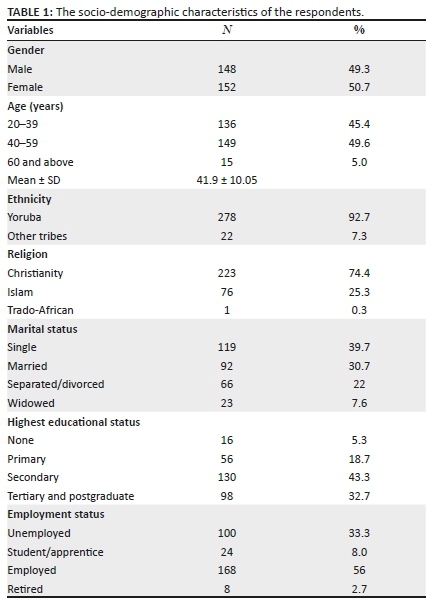
The study respondents were 300 in total: 148 males and 152 females. The mean age of the respondents was 41.9 (standard deviation [SD] = 10.1) years, with a range of 20-64 years and most were of the Yoruba tribe (92.7%), Christians (74.4%), unmarried (69.3%) with secondary level of education (43.3%) and employed (Table 1).
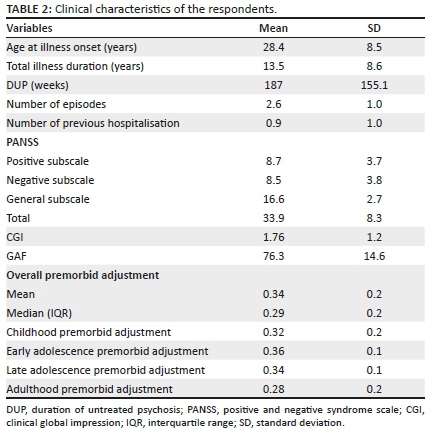
The mean age (SD) of the onset of illness, duration of illness, duration of untreated psychosis, number of episodes, number of previous hospitalisation, total PANSS score and GAF score were 28.4 ± 8.5 (14-60) years, 13.5 ± 8.6 (2-40) years, 187.03 ± 155.05 (6-1300) weeks, 2.6 ± 1.0 (0-5), 0.9 ± 1.0, 33.85 ± 8.27 (30-106) and 76.25 ± 14.57 (21-85), respectively (Table 2).
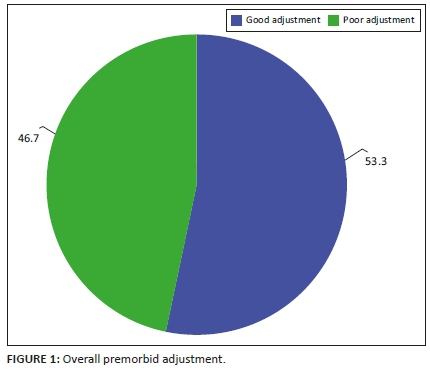
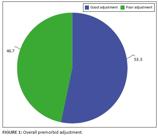
The mean overall premorbid adjustment score was 0.34, whilst the median was 0.29. Using the median to split into 'good' and 'poor premorbid' adjustment, 53.3% of the respondents had poor premorbid adjustment (Figure 1).
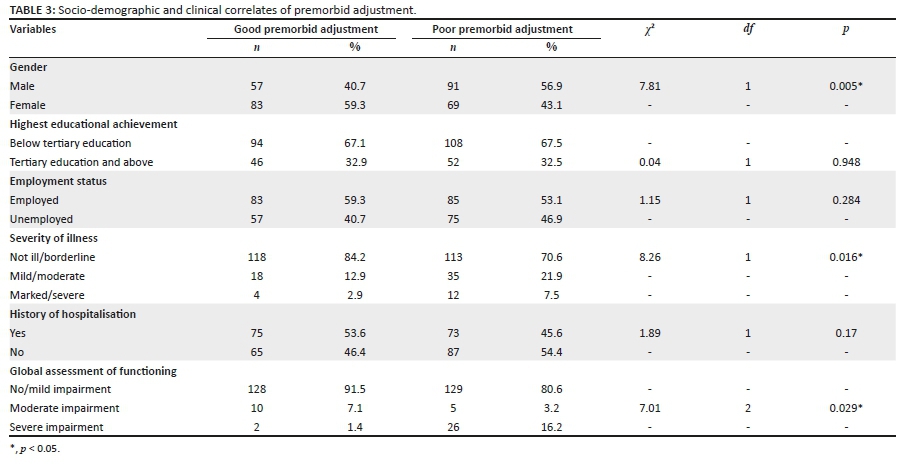
Poor premorbid adjustment was significantly associated with the male gender, whilst good premorbid adjustment was associated with no to borderline illness as well as no to mild impairment (Table 3).
Of the three variables investigated, only the gender added significantly to the prediction (Table 4). The odds of having a poor premorbid adjustment was twofold greater for males as opposed to females (Table 4).
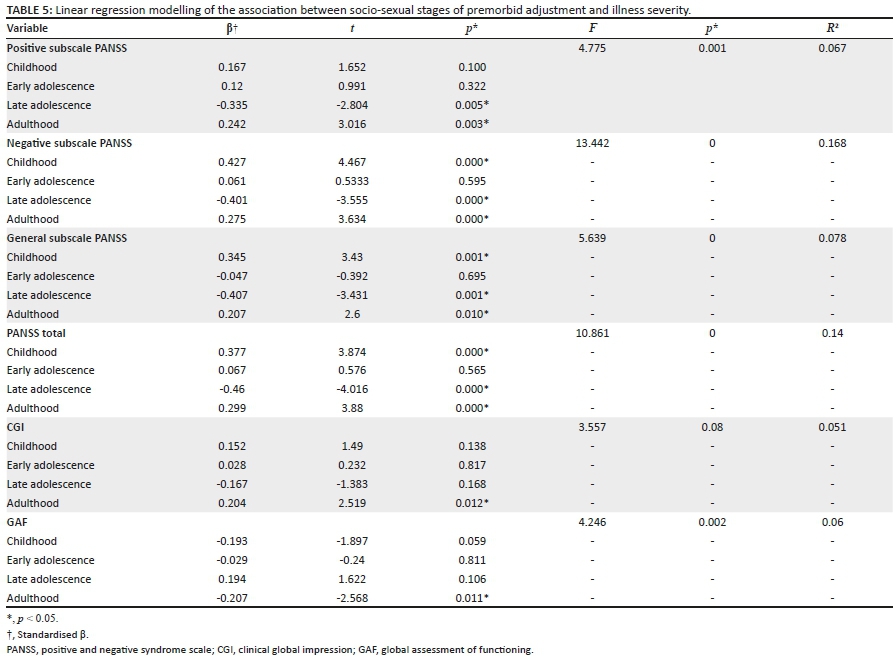
As shown in Table 5, multiple linear regression models were estimated to predict the severity of psychosis (based on PANSS scores), overall illness severity and current level of functioning from four premorbid developmental stages amongst the participants. With regard to the positive subscale of the PANSS, the developmental stages accounted for only 6.7% of the variability of the positive symptomatology. However, only the adulthood stage demonstrated a significant prediction to the model (p = 0.003). Negative PANSS score was independently predicted by childhood, late adolescence and adulthood premorbid functioning (p = 0.000), explaining 16.8% of the variability in the negative symptomatology. In terms of general PANSS, the developmental stages only accounted for 6.4% of the variability in the non-specific symptomatology.
Childhood and late adolescence were statistically significant in terms of their predictive power (p = 0.001). Total PANSS scores were predicted by childhood, late adolescence and adulthood premorbid functioning (p = 0.001). The premorbid adjustment explained 14% of the variability in the global psychotic phenomena.
The prediction model for the relationship between premorbid functioning and global illness severity was not significant (F = 3.56, p = 0.08) although adulthood premorbid functioning significantly explained 5.1% of the variance in illness severity (p = 0.012). Similarly, global functioning was predicted by adulthood premorbid functioning scores (p = 0.011) and the overall model was significant (F = 4.25, p = 0.002). Premorbid functioning accounted for 6% of the variance in global functioning.
Discussion
This study aimed to determine the prevalence of poor premorbid adjustment as well as its correlates amongst Nigerian patients with schizophrenia. It represents one of the few studies that have focused on the subject amongst patients in the developing countries.
The prevalence of poor premorbid adjustment in this sample is slightly more than 50% and is consistent with earlier studies conducted amongst Nigerians144,5,1840,41,4243,44
Of all the variables investigated, poor premorbid adjustment was significantly associated with male gender. Studies14,45,46,4719191913484948,49
Findings from the multiple linear regression analysis in this study demonstrated that the later epoch ages (late adolescence and adulthood) consistently demonstrated a significant relationship with the positive, negative and generalised subscales. Consistent with this picture, Larsen et al.50
Studies have shown that poor premorbid adjustment is associated with severity of symptoms51,525153
Overall, this work has highlighted the premorbid adjustment of a group of outpatients with schizophrenia. However, given the modest amounts of explanatory power attributable to premorbid functioning at different epoch ages in this study, it may be reasonable to suggest that other unmeasured factors play active roles in the evolution of schizophrenia. Thus, premorbid functioning need not be seen as the singular predictor of illness or illness outcome in schizophrenia. Despite the strengths of this work, other potential variables related to premorbid functioning such as investigation for biomarkers or neurological abnormalities were not conducted. Also, the possible history of febrile convulsions, seizure disorder, head trauma or psychoactive substance use prior to the onset of the illness was not obtained. These may also have been important contributors to the poor premorbid functioning amongst the sample.53,54,55,56
As noted earlier, a large proportion of this study population appeared to be stable both clinically and functionally. Beyond premorbid functioning, additional current factors such as adequate compliance with treatment and good family support may have contributed to this. It may, therefore, be important to investigate the role of some of these factors in illness severity in the future studies.
Cross-sectional studies do not provide a firm basis for determining the direction of causality of events. However, our focus on an earlier period helped to create a temporal ordering of premorbid adjustment and illness-related variables. Notwithstanding this, the possibility of recall bias cannot be ruled out in relation to premorbid functioning.
Furthermore, the results of the linear regression modelling of the relationship between illness severity and premorbid functioning must be interpreted with caution because of non-normality and non-linearity observed in both the illness severity measures and the PAS scores. Attempts at log transformation did not yield any normalisation of the data. Thus, whilst our analysis maintained fidelity to other assumptions of linear regression, the aforementioned assumptions were not followed.
It is also important to note that this work was conducted in a southwest Nigerian hospital with members of one ethnic group being over-represented. Thus, its generalisation to other parts of the country must be made with caution.
Conclusion
Poor premorbid adjustment was considerably present in this sample of patients with schizophrenia, and it was associated with male gender. In other words, clinicians should bear in mind that male patients with the illness may have likely had poorer premorbid functioning than females, especially in terms of marital and occupational achievement. These factors should also be considered when formulating rehabilitation goals as males may have lower room for improvement (and hence remission). Antenatal care providers should also be interested in exploring the other factors that may be responsible for insults to developing brains as well as their pathogenesis in the development of schizophrenia. Therefore, antenatal studies that encompass follow-up into adulthood period should be one of the focus of future researchers.
Competing interests
The authors declare that they have no financial or personal relationships that may have inappropriately influenced them in writing this article.
Authors' contributions
O.O.F. was responsible for the conceptualisation of the research, writing of the research proposal, data collection, data analysis, and writing and editing the manuscript. A.O. guided O.O.F. through all the stages of the work. In addition, he painstakingly handled the multivariate analysis and read through the proposal as well as the manuscript to ensure its worth to be published. A.O.A. made significant corrections to the proposal as well as the manuscript. He supervised the research from conceptualisation to publishing stage.
Ethical considerations
Ethical approval for this study was granted by the Neuropsychiatric Hospital Aro Research Ethics Committee (No. PR00/13).
Funding information
This research received no specific grant from any funding agency in the public, commercial or not-for-profit sectors.
Data availability
Data sharing is not applicable to this article.
Disclaimer
The views and opinions expressed in this article are those of the authors and do not necessarily reflect the official policy or position of any affiliated agency of the authors.
Acknowledgements
This manuscript was part of a larger study titled 'A Study On Disability Among Out-Patients With Schizophrenia Attending The Neuropsychiatric Hospital, Aro, Abeokuta, Ogun State'. The authors thank the patients who served as the respondents in this study as well as the management of the Neuropsychiatric Hospital, Aro who provided an enabling environment for the conduct of this research.
References
-
1.Phillips L. Case history data and prognosis in schizophrenia. J Nerv Ment Dis. 1953 Jun;117(6):515-525. https://doi.org/10.1097/00005053-195306000-00004
» https://doi.org/10.1097/00005053-195306000-00004 -
2.Corripio I, Pérez V, Catafau A, Mena E, Carrió I, Alvarez E. Striatal D2 receptor binding as a marker of prognosis and outcome in untreated first-episode psychosis. Neuroimage. 2006;29(2):662-666. https://doi.org/10.1016/j.neuroimage.2005.07.038
» https://doi.org/10.1016/j.neuroimage.2005.07.038 -
3.Schmael C, Georgi A, Krumm B, et al. Premorbid adjustment in schizophrenia - An important aspect of phenotype definition. Schizophr Res. 2007 May 1;92(1):50-62. https://doi.org/10.1016/j.schres.2007.01.016
» https://doi.org/10.1016/j.schres.2007.01.016 -
4.Horton LE, Tarbox SI, Olino TM, Haas GL. Trajectories of premorbid childhood and adolescent functioning in schizophrenia-spectrum psychoses: A first-episode study. Psychiatry Res. 2015 Jun 30;227(2-3):339-346. https://doi.org/10.1016/j.psychres.2015.02.013
» https://doi.org/10.1016/j.psychres.2015.02.013 -
5.Tarbox SI, Brown LH, Haas GL. Diagnostic specificity of poor premorbid adjustment: Comparison of schizophrenia, schizoaffective disorder, and mood disorder with psychotic features. Schizophr Res. 2012;141(1):91-97. https://doi.org/10.1016/j.schres.2012.07.008
» https://doi.org/10.1016/j.schres.2012.07.008 -
6.Weinberger DR, Canon-Spoor E, Potkin SG, Wyatt RJ. Poor premorbid adjustment and CT scan abnormalities in chronic schizophrenia. Am J Psychiatry. 1980;137:1410-1413. https://doi.org/10.1176/ajp.137.11.1410
» https://doi.org/10.1176/ajp.137.11.1410 -
7.Weinberger DR, DeLisi LE, Perman GP, Targum S, Wyatt RJ. Computed tomography in schizophreniform disorder and other acute psychiatric disorders. Arch Gen Psychiatry. 1982 Jul 1;39(7):778-783. https://doi.org/10.1001/archpsyc.1982.04290070014004
» https://doi.org/10.1001/archpsyc.1982.04290070014004 -
8.Silverstein M, Mavrolefteros G, Close D. Premorbid adjustment and neuropsychological performance in schizophrenia. Schizophr Bull. 2002;28(1):157-165. https://doi.org/10.1093/oxfordjournals.schbul.a006918
» https://doi.org/10.1093/oxfordjournals.schbul.a006918 - 9.Addington J, Addington D. Premorbid functioning, cognitive functioning, symptoms and outcome in schizophrenia. J Psychiatry Neurosci. 1993;18(1):18.
-
10.Haim R, Rabinowitz J, Bromet E. The relationship of premorbid functioning to illness course in schizophrenia and psychotic mood disorders during two years following first hospitalization. J Nerv Ment Dis. 2006;194(10):791-795. https://doi.org/10.1097/01.nmd.0000240158.39929.e3
» https://doi.org/10.1097/01.nmd.0000240158.39929.e3 -
11.Rabinowitz J, Napryeyenko O, Burba B, et al. Premorbid functioning and treatment response in recent-onset schizophrenia: Prospective study with risperidone long-acting injectable. J Clin Psychopharmacol. 2011;31(1):75-81. https://doi.org/10.1097/JCP.0b013e31820568c6
» https://doi.org/10.1097/JCP.0b013e31820568c6 -
12.Brill N, Reichenberg A, Weiser M, Rabinowitz J. Validity of the premorbid adjustment scale. Schizophr Bull. 2008 Sep;34(5):981-983. https://doi.org/10.1093/schbul/sbm128
» https://doi.org/10.1093/schbul/sbm128 -
13.McGlashan TH. Premorbid adjustment, onset types, and prognostic scaling: Still informative? Schizophr Bull. 2008 Sep;34(5):801-805. https://doi.org/10.1093/schbul/sbn073
» https://doi.org/10.1093/schbul/sbn073 -
14.Gureje O, Aderibigbe Y, Olley O, Bamidele R. Premorbid functioning in schizophrenia: A controlled study of Nigerian patients. Compr Psychiatry. 1994;35(6):437-440. https://doi.org/10.1016/0010-440X(94)90226-7
» https://doi.org/10.1016/0010-440X(94)90226-7 -
15.Gureje O, Bamidele R. Thirteen-year social outcome among Nigerian outpatients with schizophrenia. Soc Psychiatr Psychiatr Epidemiol. 1999;34(3):147-151. https://doi.org/10.1007/s001270050126
» https://doi.org/10.1007/s001270050126 -
16.Sample size in statistics (how to find it): Excel, Cochran's formula, general tips [homepage on the Internet]. Statistics How To. [cited 2019 Nov 24]. Available from: https://www.statisticshowto.datasciencecentral.com/probability-and-statistics/find-sample-size/
» https://www.statisticshowto.datasciencecentral.com/probability-and-statistics/find-sample-size/ -
17.Home [homepage on the Internet]. [cited 2020 May 24]. Available from: https://www.neuroaro.gov.ng/main/index.php/home
» https://www.neuroaro.gov.ng/main/index.php/home -
18.Cannon-Spoor E, Potkin SG, Wyatt RJ. Measurement of premorbid adjustment in chronic schizophrenia. Schizophr Bull. 1982 Jan 1;8(3):470-484. https://doi.org/10.1093/schbul/8.3.470
» https://doi.org/10.1093/schbul/8.3.470 - 19.Van Mastrigt S, Addington J. Assessment of premorbid function in first-episode schizophrenia: Modifications to the premorbid adjustment scale. J Psychiatry Neurosci. 2002;27(2):92.
-
20.Hien D, Haas G, Cook H. Gender differences in premorbid social adjustment and intimacy motivation in schizophrenia. J Clin Psychol. 1998;54(1):35-48. https://doi.org/10.1002/(SICI)1097-4679(199801)54:1%3C35::AID-JCLP4%3E3.0.CO;2-T
» https://doi.org/10.1002/(SICI)1097-4679(199801)54:1%3C35::AID-JCLP4%3E3.0.CO;2-T -
21.Kay SR, Opler LA, Lindenmayer JP. The positive and negative syndrome scale (PANSS): Rationale and standardisation. Br J Psychiatry Suppl. 1989;(7):59-67. https://doi.org/10.1192/S0007125000291514
» https://doi.org/10.1192/S0007125000291514 -
22.Overall JE, Gorham DR. The brief psychiatric rating scale. 1962 [homepage on the Internet]. [cited 2020 May 24]. Available from: https://journals.sagepub.com/doi/10.2466/pr0.1962.10.3.799
» https://journals.sagepub.com/doi/10.2466/pr0.1962.10.3.799 -
23.Kay SR, Singh MM. A temporal measure of attention in schizophrenia and its clinical significance. Br J Psychiatry. 1974;125(0):146-151. https://doi.org/10.1192/bjp.125.2.146
» https://doi.org/10.1192/bjp.125.2.146 -
24.Kay SR, Fiszbein A, Opler LA. The positive and negative syndrome scale (PANSS) for schizophrenia. Schizophr Bull. 1987;13(2):261-276. https://doi.org/10.1093/schbul/13.2.261
» https://doi.org/10.1093/schbul/13.2.261 -
25.Garrett HE. Statistics in psychology & education [homepage on the Internet]. 6th ed. R.S. Woodworth: Amazon.com: Books. [cited 2020 May 24]. Available from: https://www.amazon.com/Statistics-Psychology-Education-Garrett-Woodworth/dp/B001PBLSOA
» https://www.amazon.com/Statistics-Psychology-Education-Garrett-Woodworth/dp/B001PBLSOA -
26.Burns JK, Jhazbhay K, Emsley R. Cannabis use predicts shorter duration of untreated psychosis and lower levels of negative symptoms in first-episode psychosis: A South African study. Afr J Psychiatry. 2010;13(5):395-399. https://doi.org/10.4314/ajpsy.v13i5.63106
» https://doi.org/10.4314/ajpsy.v13i5.63106 -
27.Lawal R, Suleiman G, Onyeze B. Risperdone in the treatment of chronic schizophrenia. Niger Med Practit. 2004 Apr 29;44(1):11-18. https://doi.org/10.4314/nmp.v44i1.28675
» https://doi.org/10.4314/nmp.v44i1.28675 - 28.Guy W. ECDEU assessment manual for psychopharmacology. Rockville, MD: US Department of Health, and Welfare; 1976. p. 534-537.
-
29.Forkmann T, Scherer A, Boecker M, Pawelzik M, Jostes R, Gauggel S. The clinical global impression scale and the influence of patient or staff perspective on outcome. BMC Psychiatry. 2011;11(1):83. https://doi.org/10.1186/1471-244X-11-83
» https://doi.org/10.1186/1471-244X-11-83 -
30.Leucht S, Engel RR. The relative sensitivity of the clinical global impressions scale and the brief psychiatric rating scale in antipsychotic drug trials. Neuropsychopharmacology. 2006;31(2):406-412. https://doi.org/10.1038/sj.npp.1300873
» https://doi.org/10.1038/sj.npp.1300873 - 31.Ak M, Yavuz KF, Lapsekili N, Türkçapar MH. Evaluation of burden in a group of patients with chronic psychiatric disorders and their caregivers. Düşünen Adam J Psychiatry Neurol Sci. 2012;25:330-337.
-
32.Adeyemi JD, Ohaeri JU, Obembe A, Odusanya OO, Dutheil Y. The efficacy and tolerability of paroxetine in the treatment of depression in Nigeria. Niger Q J Hosp Med. 1999;9(3):218-222. https://doi.org/10.4314/nqjhm.v9i3.12383
» https://doi.org/10.4314/nqjhm.v9i3.12383 - 33.American Psychiatric Association. Diagnostic and statistical manual of mental disorders. Washington, DC: American Psychiatric Association; 1994. p. 143-146.
-
34.Luborsky L. Clinicians' judgments of mental health: A proposed scale. Arch Gen Psychiatry. 1962;7(6):407-417. https://doi.org/10.1001/archpsyc.1962.01720060019002
» https://doi.org/10.1001/archpsyc.1962.01720060019002 -
35.Endicott J, Spitzer RL, Fleiss JL, Cohen J. The global assessment scale: A procedure for measuring overall severity of psychiatric disturbance. Arch Gen Psychiatry. 1976;33(6):766-71. https://doi.org/10.1001/archpsyc.1976.01770060086012
» https://doi.org/10.1001/archpsyc.1976.01770060086012 -
36.Hilsenroth MJ, Ackerman SJ, Blagys MD, et al. Reliability and validity of DSM-IV axis V. Am J Psychiatry. 2000;157(11):1858-1863. https://doi.org/10.1176/appi.ajp.157.11.1858
» https://doi.org/10.1176/appi.ajp.157.11.1858 -
37.Adewuya AO, Makanjuola RO. Subjective life satisfaction and objective living conditions of patients with schizophrenia in Nigeria. Psychiatr Serv. 2010;61(3):314-336. https://doi.org/10.1176/ps.2010.61.3.314
» https://doi.org/10.1176/ps.2010.61.3.314 -
38.Lasebikan VO. Validation of yoruba version of family burden interview schedule (Y-FBIS) on caregivers of schizophrenia patients. ISRN Psychiatr. 2012;2012:165179. https://doi.org/10.5402/2012/165179
» https://doi.org/10.5402/2012/165179 -
39.Dama M, Shah J, Norman R, et al. Short duration of untreated psychosis enhances negative symptom remission in extended early intervention service for psychosis. Acta Psychiatr Scand. 2019;140(1):65-76. https://doi.org/10.1111/acps.13033
» https://doi.org/10.1111/acps.13033 -
40.Gourion D, Gourevitch R, Leprovost JB, lôo Olié JH, Krebs MO. Neurodevelopmental hypothesis in schizophrenia. L'Encephale. 2004;30(2):109-118. https://doi.org/10.1016/S0013-7006(04)95421-8
» https://doi.org/10.1016/S0013-7006(04)95421-8 -
41.Owen MJ, O'Donovan MC, Thapar A, Craddock N. Neurodevelopmental hypothesis of schizophrenia. Br J Psychiatry. 2011;198(3):173-175. https://doi.org/10.1192/bjp.bp.110.084384
» https://doi.org/10.1192/bjp.bp.110.084384 -
42.Rund BR. The research evidence for schizophrenia as a neurodevelopmental disorder. Scand J Psychol. 2018;59(1):49-58. https://doi.org/10.1111/sjop.12414
» https://doi.org/10.1111/sjop.12414 -
43.Onaolapo AY, Onaolapo OJ. Schizophrenia aetiology and drug therapy: A tale of progressive demystification and strides in management. Adv Pharmacol Pharm. 2018;6(2):19-42. https://doi.org/10.13189/app.2018.060201
» https://doi.org/10.13189/app.2018.060201 - 44.Saladino RE, Romeo G, Francone M, et al. Schizophrenia and HLA: Work in progress about typing usefulness and diagnostic therapeutic outlooks. 32nd European Immunogenetics and Histocompatibility Conference; 2018 May 9-12; Lido, Venice.
-
45.Childers SE, Harding CM. Gender, premorbid social functioning, and long-term outcome in DSM-III schizophrenia. Schizophr Bull. 1990;16(2):309-318. https://doi.org/10.1093/schbul/16.2.309
» https://doi.org/10.1093/schbul/16.2.309 -
46.Haahr UH, Larsen TK, Simonsen E, et al. Relation between premorbid adjustment, duration of untreated psychosis and close interpersonal trauma in first-episode psychosis. Early Interv Psychiatry. 2018;12(3):316-323. https://doi.org/10.1111/eip.12315
» https://doi.org/10.1111/eip.12315 -
47.Preston NJ, Orr KG, Date R, Nolan L, Castle DJ. Gender differences in premorbid adjustment of patients with first episode psychosis. Schizophr Res. 2002;55(3):285-290. https://doi.org/10.1016/S0920-9964(01)00215-8
» https://doi.org/10.1016/S0920-9964(01)00215-8 -
48.Lenroot RK, Giedd JN. Sex differences in the adolescent brain. Brain Cogn. 2010;72(1):46-55. https://doi.org/10.1016/j.bandc.2009.10.008
» https://doi.org/10.1016/j.bandc.2009.10.008 - 49.Tuszynski J, Rietman E, Taylor S, Siegelmann H, Cavaglia M. Thermodynamic measures of human brain development from fetal stage to adulthood. BioRxiv. 2019;549360.
-
50.Larsen TK, McGlashan TH, Johannessen JO, Vibe-Hansen L. First-episode schizophrenia: II. Premorbid patterns by gender. Schizophr Bull. 1996;22(2):257-269. https://doi.org/10.1093/schbul/22.2.257
» https://doi.org/10.1093/schbul/22.2.257 - 51.Dewangan RL, Singh P. Premorbid adjustment in predicting symptom severity and social cognitive deficits in schizophrenia. East Asian Arch Psychiatry. 2018;28(3):75.
- 52.Mahmoodi-Gharaei J, Basirnia A, Abedi N, et al. Association of premorbid adjustment with symptom profile and quality of life in first episode psychosis in a tertiary hospital in Tehran, Iran. Iran J Psychiatry. 2010;5(1):23.
-
53.Üçok A, Polat A, Çakır S, Genç A. One year outcome in first episode schizophrenia. Eur Arch Psychiatry Clin Neurosci. 2006;256(1):37-43. https://doi.org/10.1007/s00406-005-0598-2
» https://doi.org/10.1007/s00406-005-0598-2
Accepted: 07 Mar. 2021
Published: 28 May 2021