Food insecurity in women with mental illnesses attending a psychiatric hospital in KwaZulu-Natal
Abstract
BACKGROUND: Food insecurity is a problem for many people globally. Women and people living with mental illnesses are at a particular risk. There is limited information regarding food insecurity in women living with mental illnesses from South Africa AIM: To describe the prevalence of food insecurity, its association with socio-demographic and clinical factors, as well as quality of life (QoL) in women with mental illnesses attending a psychiatric hospital SETTING: King Dinuzulu Hospital Complex in eThekwini KwaZulu-Natal over a 6-month period METHODS: A researcher-designed questionnaire was used to collect socio-demographic and clinical data, while the Household Food Insecurity Access Scale (HFIAS) and the World Health Organization QoL questionnaire (WHO QOL-BREF) were used to collect data on food insecurity and QoL, respectively RESULTS: The 123 participants had a mean age of 50 years (standard deviation [s.d.] ± 13.89), and an overall prevalence of food insecurity of 47.1%. In a bivariate analysis, food insecurity was significantly associated with younger age (p = 0.02), having no monthly household income (p = 0.01), a comorbid psychiatric diagnosis (p = 0.02) and a poorer overall QoL (p < 0.001 CONCLUSION: Women with mental illnesses had a higher prevalence of food insecurity, with an associated poorer QoL. Additional measures are required to improve food security in this vulnerable group CONTRIBUTION: This study found that women with mental illness had more than twice the prevalence of food insecurity than the general population in KwaZulu-Natal
food insecurity; quality of life; women with mental illness; psychiatric hospital; KwaZulu-Natal
Introduction
Food insecurity is a global problem, but remains a particular challenge for many developing countries, which are faced with widespread inequality and poverty.1,2,342567
Food security is defined as a situation where people have access to enough food for an active, healthy lifestyle.8910,1112
Limited access to food is hypothesised to be the result of household poverty, rather than an absolute shortage of food.1314,157,1617,1819,202113,22,2318,24,2526,27,28
In SA, women are at particular risk of food insecurity because of their higher levels of unemployment, lower levels of tertiary education293031,32,33
Persons living with mental illnesses are particularly vulnerable to food insecurity,26,34,3526,3511,36343411
Possible explanations for the higher prevalence of food insecurity in individuals with mental illnesses include the high rampancy of unemployment,35,37183538,39
Research from high income countries confirmed the high prevalence of food insecurity in women with mental illnesses. A scoping review of 39 studies reported an association between food insecurity and poorer mental health,244041
Limited literature was found in low- and middle-income (LMIC) countries, with only two studies investigating food insecurity and mental illness in women. In SA, a study from Cape Town found that there was a statistically significant association between food insecurity, depression and suicidality in the postpartum period.42432440
Quality of life is regarded as the richness of the individual's personal experience, including their social, occupational and interpersonal functioning,444411,4524,46
There is limited information regarding food insecurity in women living with mental illnesses generally,47,48,49
Research methods and design
Study design and setting
This quantitative, cross-sectional survey was conducted at King Dinuzulu Hospital Complex (KDHC), a public hospital, previously known as King George V Hospital, situated in Springfield, a low- to middle-income area of the eThekwini Municipality. In addition to general health services, the hospital offers specialised services in psychiatry, orthopaedic spinal surgery and multi-drug resistant tuberculosis. This study was conducted at the psychiatry unit, which provides both in-and out-patient psychiatric services.
Study population
The study population consisted of women with mental illnesses who were attending KDHC from within the eThekwini Municipality and further afield. Patients are usually referred from primary healthcare facilities and the adjacent district hospital for assessment and treatment, and are provided with care through the out-patient clinic by appointment, or by being admitted to the psychiatric ward, where their treatment commences. Once stable, they are discharged, with out-patient appointments needing to be kept monthly to collect their medication or to see a psychiatrist. The services are free, with most patients being poor and unable to afford private healthcare. This is also reflected in their living circumstances, as many are unemployed, which can affect their ability to have adequate food for themselves and their families. The study population is likely to be mainly Indian because of the area of the hospital, which serves mainly the Indian and coloured community.
Data collection instruments
Three data collection tools were used in this study, these being a researcher designed socio-demographic and clinical data questionnaire, the Household Food Insecurity Access Scale (HFIAS) and the World Health Organization QoL questionnaire (WHO QOL-BREF). Demographic and clinical data were collected by the principal investigator (PI) using a structured questionnaire designed for the study. The socio-demographic questionnaire collected data on age, level of education, employment, marital status, number of dependents, residential area, and grant recipient status. The clinical data collected related to clinical diagnosis, duration of illness, comorbid medical or psychiatric conditions.
The main outcome variable was food insecurity, which was measured using the HFIAS, which was developed by the USAID Food and Nutrition Technical Assistance (FANTA) project.505151
The WHOQOL-BREF is a 26-item questionnaire that explores four domains related to QoL, that is physical health, psychological, social relationships and environment, and is a valid and reliable cross culturally sound tool.5252
Data collection process
Data were collected over a period of 6 months, from June 2023 to December 2023, by which time the pandemic was over and things had returned to normal. Doctors working at the KDHC psychiatric unit were briefed regarding the study protocol to identify women for possible inclusion. Women with mental illnesses who met the inclusion criteria were referred by these doctors to the PI, who was responsible for informing them about the study and obtaining their consent to participate. Participants were interviewed by the PI who asked them to read the questions on the three data collection tools that had been uploaded onto an electronic device, their answers being recorded onto the device with a data collection tool called REDCap. The PI is bilingual in English and IsiZulu, and was at hand to help those participants who required such assistance with the use of the device and clarity with the questions, which was provided in English.
Sampling
Convenience sampling was used to identify women for inclusion, with an estimated proportion of 0.3% of the women who attended the clinic during the year being required, a desired precision of 8% and a 95% confidence interval (CI), which resulted in a sample size of 123 participants being regarded as adequate.53
Participants needed to be 18 years and older, able to read and write in English or IsiZulu, stable outpatients or inpatients, who were already stable and discharged in accordance with the Mental Health Care Act of 200254
Data analysis
Statistical analyses were conducted using Stata 18, with descriptive analyses, frequencies, means and medians being used to describe categorical and continuous data for all data sets. Bivariate analysis was conducted to test for association between the food secure and insecure groups, while the two-sample t-test was used for association with continuous variables and the Wilcoxon rank-sum test was applied for non-parametric or non-normally distributed variables. The Pearson's Chi-squared test was used for categorical variables with the Fisher's exact test being used when the numbers were less than five.
Ethical considerations
Ethical clearance to conduct this study was obtained from the University of KwaZulu-Natal Biomedical Research Ethics Committee (No. BREC/00005109/2022). Permission to conduct the study at KDHC, which is a government facility, was obtained from the KZN Provincial Department of Health, with approval also obtained from the hospital manager. This study was conducted in accordance with the South African Good Clinical Practice Guidelines, namely the ethical principles, risk, burdens and benefit, right and safety of participants, informed consent, ethics review, appropriate management of study data, and exclusion of minors. Written informed consent was obtained from all participants in English or IsiZulu.
Results
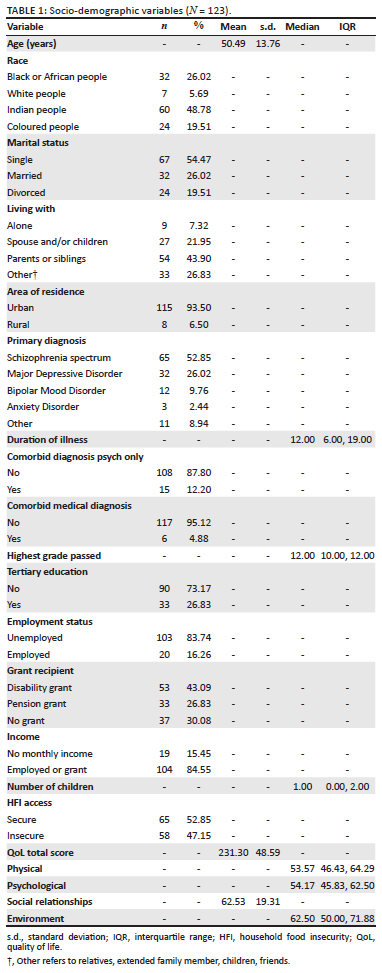
A total of 124 women were approached to participate in the study, only one participant having declined, with 123 female participants being included in the study. The mean age of participants was 50.49 years with standard deviation (s.d.) ±13.76 (Table 1), with most being of Indian ethnicity (48.78%), single (54.47%) and living with their parents or siblings (43.9%). The majority were unemployed (83.74%), and while most relied on social (26.83%) or disability grants (43.09%) for their monthly household income, 15.45% had no source of monthly income.
A schizophrenia spectrum disorder was the most common diagnosis (52.85%), the median duration of illness being 12 years, with an interquartile range (IQR) of 6.00 to 19.00. Of the 16 (13.01%) participants who had a comorbid illness, 14 (87.50%) had a psychiatric illness, while two (12.50%) had a medical illness only.
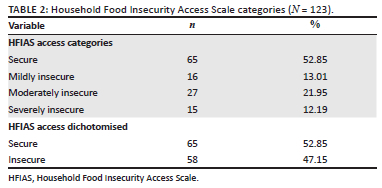
Table 2 shows the HFIAS categories, with 47.15% of participants having reported food insecurity of different levels, with most being moderately food insecure (21.95%). The results showed that the overall prevalence of food insecurity in this study was 47.15%, with 13.01%, 21.95% and 12.19% being mildly, moderately and severely food insecure, respectively.
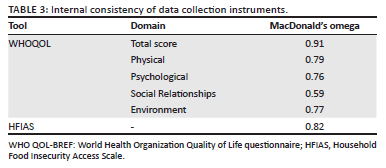
Data for internal consistency regarding the WHOQOL-BREF and HFIAS are presented in Table 3. Internal consistency, at greater than 0.70, was within acceptable limits, except for the social relationships domain of the WHOQOL-BREF.
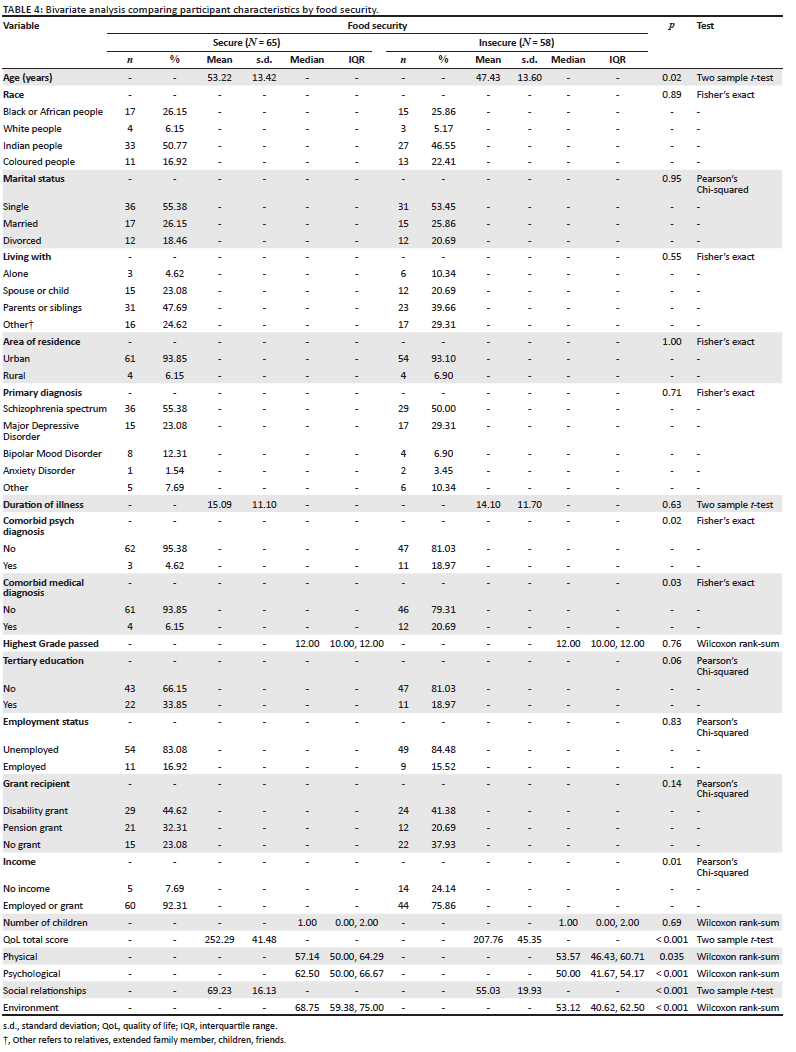
Table 4 shows the bivariate analysis, where food insecurity was significantly associated with younger age (p = 0.02), having no monthly income (p = 0.01), a comorbid psychiatric diagnosis (p = 0.02) and a poorer overall QoL (p < 0.001). Participants who were food insecure scored lower in total score of QoL (p < 0.001), as well as in all the domains of QoL: physical (p < 0.035), psychological (p < 0.001), social relationships (p < 0.001) and environment (p < 0.001).
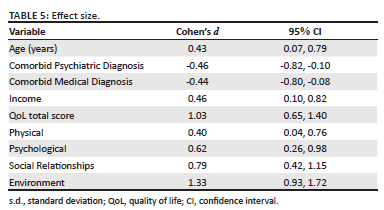
The effect size for significantly associated variables is presented in Table 5.
Discussion
The rationale for conducting this study in women with mental illness was because of the global evidence that shows that women and people with mental illnesses are more vulnerable to food insecurity.24,28
There is a wide variation in the published prevalence of food insecurity in people with mental illnesses, ranging from 9.9% to 85.7%.5555345534
The findings of this study confirm the global reports of an increased prevalence of food insecurity in mentally ill people compared to those without from the corresponding population. The prevalence of food insecurity in this study is almost double that reported among the general population of SA, which ranges between 26% and 29%.10,1110,1131,3233
No association was found between household size and food insecurity, with some studies indicating that households with a higher number of family members were found to have higher odds of food insecurity than those with fewer members.56,57
In this study, almost 70% of the participants were recipients of social or disability grants; SA having one of the most extensive systems of publicly funded social assistance programmes in the world in the form of cash transfers for those with chronic illness and advanced age.58,59606123
We did not find an association between race, ethnicity and food insecurity, this aspect having been indicated in previous studies.22,62,63
Our finding of a significant association between comorbid psychiatric disorders and food insecurity is in keeping with previous studies, which found that severe mental disorders are generally chronic in nature, chronic conditions often being associated with higher odds of food insecurity.6465
The association between severe mental illnesses and QoL is well established in the literature, with findings suggesting that affected individuals have a poorer QoL than those who are not.4621,6621
While this study makes an important contribution to the literature on food security on women with mental illnesses in SA, several limitations are acknowledged. The study only being conducted in one hospital and the small sample size may have limited the statistical power and contributed to some of the negative findings. It would have been helpful to collect data on total household income to investigate the association between total monthly household income and food insecurity. Use of a male comparative group would have assisted in making conclusive gender comparisons. The internal consistency of the social relationships domain was low; therefore, the associations found should be interpreted with caution. Another study conducted on an all-female population also reported low internal consistency in this domain.67
Conclusion
Our study sought to describe the prevalence of food insecurity and its association with socio-demographic factors, clinical factors and QoL in women with mental illnesses attending a psychiatric hospital in KZN. We found a high prevalence of food insecurity among our participants which highlights the need to screen women with mental illnesses for food insecurity, as it may have a significant impact on health (including mental health), nutrition, behaviour and QoL. Longitudinal studies are needed to determine food insecurity in women with mental illnesses on a broader scale to establish the extent of the problem and therefore inform interventions that can be directed at this vulnerable population group. Qualitative research looking into the lived experiences of women experiencing food insecurity is also needed.
Competing interests
The authors declare that they have no financial or personal relationship(s) that may have inappropriately influenced them in writing this article.
Authors' contributions
P.S.D. developed the protocol, sort ethical approval, collected study data and contributed towards the preparation of the article. S.S. assisted with the data analysis, as well as editing of the first and final drafts of the main article. V.N. assisted with the data analysis and methods section in the main article. S.M. supervised the protocol development, data collection, analysis and preparation of the article.
Funding information
This research received no specific grant from any funding agency in the public, commercial or not-for-profit sectors.
Data availability
The data to support the findings of this study are available from the corresponding author, P.S.D., upon reasonable request.
Disclaimer
The views and opinions expressed in this article are those of the authors and are the product of professional research. The article does not necessarily reflect the official policy or position of any affiliated institution, funder, agency or that of the publisher. The authors are responsible for this article's results, findings and content.
Acknowledgements
The authors would like to thank Miss Nombulelo Ndlovu for her assistance with REDCap and data collection, as well as the staff and patients at King Dinuzulu Hospital for participating in the study.
References
-
1. Beacom E, Furey S, Hollywood L, Humphreys P. Investigating food insecurity measurement globally to inform practice locally: A rapid evidence review. Crit Rev Food Sci Nutr. 2021;61(20):3319-3339. https://doi.org/10.1080/10408398.2020.1798347
» https://doi.org/10.1080/10408398.2020.1798347 -
2. Cafiero C, Viviani S, Nord M. Food security measurement in a global context: The food insecurity experience scale. Measurement. 2018;116:146-152. https://doi.org/10.1016/j.measurement.2017.10.065
» https://doi.org/10.1016/j.measurement.2017.10.065 -
3. Iannotti L, Kleban E, Fracassi P, Oenema S, Lutter C. Evidence for policies and practices to address global food insecurity. Annu Rev Public Health. 2024;45(1):375-400. https://doi.org/10.1146/annurev-publhealth-060922-041451
» https://doi.org/10.1146/annurev-publhealth-060922-041451 - 4. Baquedano FG, Zereyesus YA, Valdes C, Ajewole K. International Food Security Assessment 2021-31. Washington: U.S. Department of Agriculture, Economic Research Service; 2021.
- 5. Dabone C, Mbagwu I, Muray M, et al. Global food insecurity and African, Caribbean, and Black (ACB) populations during the COVID-19 pandemic: A rapid review. J Racial Ethn Health Disparities. 2021;5(9):1-16.
-
6. Bjornlund V, Bjornlund H, Van Rooyen A. Why food insecurity persists in sub-Saharan Africa: A review of existing evidence. Food Secur. 2022;14(4):845-864. https://doi.org/10.1007/s12571-022-01256-1
» https://doi.org/10.1007/s12571-022-01256-1 -
7. De Wet-Billings N. Perpetuation of household food insecurity during COVID-19 in South Africa. J Health Popul Nutr. 2023;42(1):96. https://doi.org/10.1186/s41043-023-00441-y
» https://doi.org/10.1186/s41043-023-00441-y -
8. Grisaru N, Kaufman R, Mirsky J, Witztum E. Food insecurity and mental health: A pilot study of patients in a psychiatric emergency unit in Israel. Community Mental Health J. 2011;47(5):513-519. https://doi.org/10.1007/s10597-010-9339-8
» https://doi.org/10.1007/s10597-010-9339-8 -
9. Carter KN, Kruse K, Blakely T, Collings S. The association of food security with psychological distress in New Zealand and any gender differences. Soc Sci Med. 2011;72(9):1463-1471. https://doi.org/10.1016/j.socscimed.2011.03.009
» https://doi.org/10.1016/j.socscimed.2011.03.009 -
10. Misselhorn A, Hendriks SL. A systematic review of sub-national food insecurity research in South Africa: Missed opportunities for policy insights. PLoS One. 2017;12(8):e0182399. https://doi.org/10.1371/journal.pone.0182399
» https://doi.org/10.1371/journal.pone.0182399 -
11. Sorsdahl K, Slopen N, Siefert K, Seedat S, Stein DJ, Williams DR. Household food insufficiency and mental health in South Africa. J Epidemiol Community Health. 2010;65(5):426-431. https://doi.org/10.1136/jech.2009.091462
» https://doi.org/10.1136/jech.2009.091462 - 12. Argent J, Finn A, Leibbrandt M, Woolard I. Poverty: Analysis of the NIDS Wave 1 dataset. National Income Dynamics Study, NiDS Discussion Paper. 2009;12, South African Labour and Development Research Unit, Cape Town.
-
13. Crush J, Frayne B, Pendleton W. The crisis of food insecurity in African cities. J Hunger Environ Nutr. 2012;7(2-3):271-292. https://doi.org/10.1080/19320248.2012.702448
» https://doi.org/10.1080/19320248.2012.702448 -
14. Chang Y, Chatterjee S, Kim J. Household finance and food insecurity. J Fam Econ Issues. 2014;35:499-515. https://doi.org/10.1007/s10834-013-9382-z
» https://doi.org/10.1007/s10834-013-9382-z -
15. Magaña-Lemus D, Ishdorj A, Rosson CP, Lara-Álvarez J. Determinants of household food insecurity in Mexico. Agric Food Econ. 2016;4:1-20. https://doi.org/10.1186/s40100-016-0054-9
» https://doi.org/10.1186/s40100-016-0054-9 -
16. Loopstra R, Tarasuk V. Severity of household food insecurity is sensitive to change in household income and employment status among low-income families1-3. J Nutr. 2013;143(8):1316-1323. https://doi.org/10.3945/jn.113.175414
» https://doi.org/10.3945/jn.113.175414 -
17. Broussard NH. What explains gender differences in food insecurity? Food Policy. 2019;83:180-194. https://doi.org/10.1016/j.foodpol.2019.01.003
» https://doi.org/10.1016/j.foodpol.2019.01.003 -
18. Grimaccia E, Naccarato A. Food insecurity in Europe: A gender perspective. Soc Indic Res. 2022;161(2):649-667. https://doi.org/10.1007/s11205-020-02387-8
» https://doi.org/10.1007/s11205-020-02387-8 -
19. Strickland JR. The relationship of food insecurity and mental health in single-parent households: A literature review. Undergraduate Res Nat Clin Sci Technol J. 2024;8:1-13. https://doi.org/10.26685/urncst.554
» https://doi.org/10.26685/urncst.554 -
20. Balistreri KS. Family structure and child food insecurity: Evidence from the current population survey. Soc Indic Res. 2018;138(3):1171-1185. https://doi.org/10.1007/s11205-017-1700-7
» https://doi.org/10.1007/s11205-017-1700-7 -
21. Hanmer J, DeWalt DA, Berkowitz SA. Association between food insecurity and health-related quality of life: A nationally representative survey. J Gen Intern Med. 2021;36:1638-1647. https://doi.org/10.1007/s11606-020-06492-9
» https://doi.org/10.1007/s11606-020-06492-9 -
22. Masa R, Khan Z, Chowa G. Youth food insecurity in Ghana and South Africa: Prevalence, socioeconomic correlates, and moderation effect of gender. Chil Youth Serv Rev. 2020;116:105180. https://doi.org/10.1016/j.childyouth.2020.105180
» https://doi.org/10.1016/j.childyouth.2020.105180 -
23. Chakona G, Shackleton CM. Food insecurity in South Africa: To what extent can social grants and consumption of wild foods eradicate hunger? World Dev Perspect. 2019;13:87-94. https://doi.org/10.1016/j.wdp.2019.02.001
» https://doi.org/10.1016/j.wdp.2019.02.001 -
24. Maynard M, Andrade L, Packull-McCormick S, Perlman CM, Leos-Toro C, Kirkpatrick SI. Food insecurity and mental health among females in high-income countries. Int J Environ Res Public Health. 2018;15(7):1424. https://doi.org/10.3390/ijerph15071424
» https://doi.org/10.3390/ijerph15071424 -
25. Botreau H, Cohen MJ. Gender inequality and food insecurity: A dozen years after the food price crisis, rural women still bear the brunt of poverty and hunger. In: Marc J. Cohen, editor. Advances in food security and sustainability. Vol. 5. Elsevier, Amsterdam, 2020; p. 53-117. https://doi.org/10.1016/bs.af2s.2020.09.001
» https://doi.org/10.1016/bs.af2s.2020.09.001 -
26. Hadfield-Spoor M. Disability, health and hunger [homepage on the Internet]. Trussell Trust; 2018 [cited n.d.]. Available from: https://s3-eu-west-1amazonawscom/trusselltrust-documents/Disability-Health-and-Hunger-Report-Jan2018pdf
» https://s3-eu-west-1amazonawscom/trusselltrust-documents/Disability-Health-and-Hunger-Report-Jan2018pdf -
27. Lachaud J, Mejia-Lancheros C, Wang R, et al. Mental and substance use disorders and food insecurity among homeless adults participating in the At Home/Chez Soi study. PLoS One. 2020;15(4):e0232001. https://doi.org/10.1371/journal.pone.0232001
» https://doi.org/10.1371/journal.pone.0232001 -
28. Teasdale SB, Morell R, Lappin JM, Curtis J, Watkins A, Ward PB. Prevalence and correlates of food insecurity in community-based individuals with severe mental illness receiving long-acting injectable antipsychotic treatment. Br J Nutr. 2020;124(4):470-477. https://doi.org/10.1371/journal.pone.0232001
» https://doi.org/10.1371/journal.pone.0232001 - 29. Africa SS. Quarterly labour force survey, 4th Quarter 2022. Pretoria: Statistics South Africa; 2022.
-
30. Barlow V, Kushitor SB, Harper J, Sigge GO. Changing childcare demands because of COVID-19 lockdown regulations and household food security in South Africa. Soc Sci Human Open. 2023;8(1):100738. https://doi.org/10.1016/j.ssaho.2023.100738
» https://doi.org/10.1016/j.ssaho.2023.100738 - 31. Mncayi N, Dunga S. Determinants of housing insecurity in a low income South African township. Int J Econ Finance Stud. 2017;9(2):117-133.
-
32. Ngema PZ, Sibanda M, Musemwa L. Household food security status and its determinants in Maphumulo local municipality, South Africa. Sustainability. 2018;10(9):3307. https://doi.org/10.3390/su10093307
» https://doi.org/10.3390/su10093307 - 33. Dunga HM. An empirical analysis on determinants of food security among female-headed households in South Africa. Int J Soc Sci Human Stud. 2020;12(1):66-81.
-
34. Smith J, Stevens H, Lake AA, Teasdale S, Giles EL. Food insecurity in adults with severe mental illness: A systematic review with meta-analysis. J Psychiatr Mental Health Nurs. 2023;31(2):133-151. https://doi.org/10.1111/jpm.12969
» https://doi.org/10.1111/jpm.12969 -
35. Smith J, Ker S, Archer D, Gilbody S, Peckham E, Hardman CA. Food insecurity and severe mental illness: Understanding the hidden problem and how to ask about food access during routine healthcare. BJPsych Adv. 2023;29(3):204-212. https://doi.org/10.1192/bja.2022.33
» https://doi.org/10.1192/bja.2022.33 - 36. Whitaker RC, Phillips SM, Orzol SM. Food insecurity and the risks of depression and anxiety in mothers and behavior problems in their preschool-aged children. Pediatrics. 2006;118(3):e859-e868.
- 37. Bond N, D'Arcy C. Mind the income gap. Money and mental health policy institute. 2020;13.
-
38. Chandra PS, Satyanarayana VA. Gender disadvantage and common mental disorders in women. Int Rev Psychiatry. 2010;22(5):513-524. https://doi.org/10.3109/09540261.2010.516427
» https://doi.org/10.3109/09540261.2010.516427 -
39. Klose M, Jacobi F. Can gender differences in the prevalence of mental disorders be explained by sociodemographic factors? Archiv Womens Mental Health. 2004;7:133-148. https://doi.org/10.1007/s00737-004-0047-7
» https://doi.org/10.1007/s00737-004-0047-7 -
40. Corman H, Curtis MA, Noonan K, Reichman NE. Maternal depression as a risk factor for children's inadequate housing conditions. Social Science & Medicine. 2016;149:76-83. https://doi.org/10.1016/j.socscimed.2015.11.054
» https://doi.org/10.1016/j.socscimed.2015.11.054 -
41. Garg A, Toy S, Tripodis Y, Cook J, Cordella N. Influence of maternal depression on household food insecurity for low-income families. Acad Pediatr. 2015;15(3):305-310. https://doi.org/10.1016/j.acap.2014.10.002
» https://doi.org/10.1016/j.acap.2014.10.002 -
42. Dewing S, Tomlinson M, Le Roux IM, Chopra M, Tsai AC. Food insecurity and its association with co-occurring postnatal depression, hazardous drinking, and suicidality among women in peri-urban South Africa. J Affect Disord. 2013;150(2):460-465. https://doi.org/10.1016/j.jad.2013.04.040
» https://doi.org/10.1016/j.jad.2013.04.040 -
43. Zahidi F, Khalid M, Surkan PJ, Azadbakht L. Associations between food insecurity and common mental health problems among reproductive-aged women in Kabul-Afghanistan. Front Nutr. 2022;8:794607. https://doi.org/10.3389/fnut.2021.794607
» https://doi.org/10.3389/fnut.2021.794607 -
44. Fujii DE, Wylie AM, Nathan JH. Neurocognition and long-term prediction of quality of life in outpatients with severe and persistent mental illness. Schizophr Res. 2004;69(1):67-73. https://doi.org/10.1016/S0920-9964(03)00122-1
» https://doi.org/10.1016/S0920-9964(03)00122-1 - 45. Myers CA. Food insecurity and psychological distress: A review of the recent literature. Curr Nutr Rep. 2020;9(2):107-118.
-
46. Berghöfer A, Martin L, Hense S, Weinmann S, Roll S. Quality of life in patients with severe mental illness: A cross-sectional survey in an integrated outpatient health care model. Qual Life Res. 2020;29:2073-2087. https://doi.org/10.1007/s11136-020-02470-0
» https://doi.org/10.1007/s11136-020-02470-0 -
47. Martin MS, Maddocks E, Chen Y, Gilman SE, Colman I. Food insecurity and mental illness: Disproportionate impacts in the context of perceived stress and social isolation. Public Health. 2016;132:86-91. https://doi.org/10.1016/j.puhe.2015.11.014
» https://doi.org/10.1016/j.puhe.2015.11.014 - 48. Casey P, Goolsby S, Berkowitz C, et al. Maternal depression, changing public assistance, food security, and child health status. Pediatrics. 2004;113(2):298-304.
-
49. Zahid H, Noreen S, Rizwan B, et al. Food insecurity and its effect on mental health: A systematic review. Proceedings S.Z.M.C [Internet]. 2021 [cited 2025 Apr 05]; Nov. 8;35(4):18-24. Available from: https://proceedings-szmc.org.pk/index.php/szmc/article/view/180.
» https://proceedings-szmc.org.pk/index.php/szmc/article/view/180 -
50. Coates J, Swindale A, Bilinsky P. Household food insecurity access scale (HFIAS) for measurement of household food access: Indicator Guide (v. 3). Food and Nutrition Technical Assistance Project, Academy for Educational Development. Washington, DC; 2007. https://doi.org/10.1037/e576842013-001
» https://doi.org/10.1037/e576842013-001 -
51. Mabusela M, Tomita A, Paruk S, Paruk F. Prevalence of depressive symptoms in patients with rheumatoid arthritis at a regional hospital in KwaZulu-Natal, South Africa. S Afr J Psychiatry. 2022;28:1702. https://doi.org/10.4102/sajpsychiatry.v28i0.1702
» https://doi.org/10.4102/sajpsychiatry.v28i0.1702 - 52. Skevington SM, Lotfy M, O'Connell KA. The World Health Organization's WHOQOL-BREF quality of life assessment: Psychometric properties and results of the international field trial. A report from the WHOQOL group. Qual Life Res. 2004;13:299-310.
-
53. Ausvet. Epitools in sample size calculations [homepage on the Internet]. 2021 [n.d.]. Available from: https://epitools.ausvet.com.au/samplesize
» https://epitools.ausvet.com.au/samplesize -
54. South African Government. Mental Health Care Act 17 of 2002 [homepage on the Internet]. 2002 [cited No date]. Available from: https://www.gov.za/documents/mental-health-care-act
» https://www.gov.za/documents/mental-health-care-act -
55. Teasdale SB, Mueller-Stierlin AS, Ruusunen A, Eaton M, Marx W, Firth J. Prevalence of food insecurity in people with major depression, bipolar disorder, and schizophrenia and related psychoses: A systematic review and meta-analysis. Crit Rev Food Sci Nutr. 2023;63(20):4485-4502. https://doi.org/10.1080/10408398.2021.2002806
» https://doi.org/10.1080/10408398.2021.2002806 -
56. Drammeh W, Hamid NA, Rohana A. Determinants of household food insecurity and its association with child malnutrition in Sub-Saharan Africa: A review of the literature. Curr Res Nutr Food Sci J. 2019;7(3):610-623. https://doi.org/10.12944/CRNFSJ.7.3.02
» https://doi.org/10.12944/CRNFSJ.7.3.02 - 57. Mortazavi Z, Dorosty AR, Eshraghian MR, Ghaffari M, Ansari-Moghaddam A, Mohammadi M. Household food insecurity in Southeastern Iran: Severity and related factors. Int J Food Sci. 2017;2017:7536024.
- 58. Woolard I, Leibbrandt M. The evolution and impact of unconditional cash transfers in South Africa. In: Sepúlveda C, Yifu Lin J, Paz Sepulveda C, editors. Development challenges in a postcrisis world. Washington: World Bank Publications, 2013; p. 363.
-
59. Zembe-Mkabile W, Surender R, Sanders D, Jackson D, Doherty T. The experience of cash transfers in alleviating childhood poverty in South Africa: Mothers' experiences of the Child Support Grant. Global Public Health. 2015;10(7):834-851. https://doi.org/10.1080/17441692.2015.1007471
» https://doi.org/10.1080/17441692.2015.1007471 -
60. Nnaeme CC, Patel L, Plagerson S. How cash transfers enable agency through livelihoods in South Africa. World Dev. 2020;131:104956. https://doi.org/10.1016/j.worlddev.2020.104956
» https://doi.org/10.1016/j.worlddev.2020.104956 -
61. Satumba T, Bayat A, Mohamed S. The impact of social grants on poverty reduction in South Africa. J Econ. 2017;8(1):33-49. https://doi.org/10.1080/09765239.2017.1336304
» https://doi.org/10.1080/09765239.2017.1336304 -
62. Mazenda A, Molepo N, Mushayanyama T, Ngarava S. The invisible crisis: The determinants of local food insecurity in Gauteng municipalities, South Africa. Br Food J. 2022;124(13):274-289. https://doi.org/10.1108/BFJ-11-2021-1234
» https://doi.org/10.1108/BFJ-11-2021-1234 -
63. Ngumbela XG, Khalema EN, Nzimakwe TI. Local worlds: Vulnerability and food insecurity in the Eastern Cape province of South Africa. JÀMBÁ. 2020;12(1):1-10. https://doi.org/10.4102/jamba.v12i1.830
» https://doi.org/10.4102/jamba.v12i1.830 -
64. Jih J, Stijacic-Cenzer I, Seligman HK, Boscardin WJ, Nguyen TT, Ritchie CS. Chronic disease burden predicts food insecurity among older adults. Public Health Nutr. 2018;21(9):1737-1742. https://doi.org/10.1017/S1368980017004062
» https://doi.org/10.1017/S1368980017004062 -
65. Tarasuk V, Mitchell A, McLaren L, McIntyre L. Chronic physical and mental health conditions among adults may increase vulnerability to household food insecurity. J Nutr. 2013;143(11):1785-1793. https://doi.org/10.3945/jn.113.178483
» https://doi.org/10.3945/jn.113.178483 -
66. Russell JC, Flood VM, Yeatman H, Wang JJ, Mitchell P. Food insecurity and poor diet quality are associated with reduced quality of life in older adults. Nutr Diet. 2016;73(1):50-58. https://doi.org/10.1111/1747-0080.12263
» https://doi.org/10.1111/1747-0080.12263 -
67. Rondung E, Oliveira S, Esteves F. Validity and reliability of the WHOQOL-BREF in a pregnant population. Health Qual Life Outcomes. 2023;21(1):96. https://doi.org/10.1186/s12955-023-02166-2
» https://doi.org/10.1186/s12955-023-02166-2

Accepted: 24 Oct. 2024
Published: 16 May 2025