Validation and improvement of the mental health literacy scale to assess undergraduate nursing students in South Africa
Abstract
BACKGROUND: Mental Health Literacy (MHL) refers to knowledge, skills and attitudes related to mental health and is often measured by the revised Mental Health Literacy Scale (MHLS). This scale has been validated on a group of primary healthcare (PHC) workers in Zambia and South Africa, but its usefulness for a group of nursing students has not been investigated until now AIM: To investigate the psychometric properties of the revised scale for a group of undergraduate nursing students at a South African university, while also assessing the level of MHL in the group under investigation SETTING: Nursing students (N = 121) studying for their Bachelor of Nursing degree at a South African public university METHODS: A quantitative, cross-sectional survey was conducted between July 2023 and August 2023, using a purposive sampling technique. A socio-demographic data form and a revised version of the MHLS were used to collect data online. Descriptive statistics, Cronbach's alpha, exploratory factor analysis (EFA) and confirmatory factor analysis (CFA) were used to analyse the data RESULTS: The EFA and CFA seemed to confirm a new 5-factor structure, including only 17 items. This structure holds similar factors to the MHL subscales. The reliability of most of the new factors was good, with two factors that need further intervention. This version of the MHLS proposed satisfactory levels of MHL for this group CONCLUSION: This study proposes a shortened, 5-factor structure version of the MHLS to be used to assess nursing students CONTRIBUTION: The revised 5-factor structure measure can potentially identify gaps in the MHL of students, and this can inform appropriate interventions to address the MHL needs in South Africa generally
mental health literacy scale; nursing students; primary healthcare; South Africa; Psychometric properties
Introduction
The term mental health literacy (MHL) was coined in the late 1990s by Anthony Jorm, and since then, it has been extensively researched in Australia and other developed countries.12
Most MHL measurements fail to simultaneously account for all the features of MHL and describe adequate psychometric properties.3,45
As the PHC nurse is often the first contact with a patient, it is imperative that these healthcare workers have sufficient command of MHL. Unfortunately, Lahti and colleagues78
To date, there has been no investigation of the level of MHL among South African nursing students. Indeed, there have been only two studies that have validated the MHLS in a South African context,6,9
Research methods and design
Study design
A quantitative, cross-sectional design was used to investigate the psychometric properties of the MHLS in the context of nursing students and determine their levels of MHL.9
Setting, study population and sampling strategy
The study was conducted at the North-West University, South Africa, on a population of 121 nursing students in their first to fourth years towards completing the Bachelor of Nursing degree. We employed a purposive sampling technique to include students from all 4 years as the study was concluded in the first semester, before the fourth-year students completed the module on mental health. Students who completed their fourth year already, were excluded, as they had completed the module on mental health.
Data collection
The data collection tool used was the revised version of the MHLS,910r[69] = 0.797, p < 0.0014), Korhonen and colleagues found Chronbach's alpha values for three of the subscales to be below the acceptable level, but the reliability for the combined scale was acceptable (0.804). Korhonen and colleagues6,9
Procedure
Students were invited to participate in the study by means of a link to a learning management system. Those interested had to click on the link for more information on the project as well as the consenting process. After completing the latter, participants were allowed to complete the questionnaire online. As reimbursement for the time they spent completing the form, they could provide their email address to receive a R30 coffee voucher. Data were collected between July and August 2023.
Data analysis
The quantitative data analysis was conducted using IBM® Statistical Package for the Social Sciences (SPSS) Version 28 software,1110
Ethical considerations
Ethical clearance to conduct this study was obtained from the North-West University Health Research Ethics Committee (No. NWU-00188-22-A1). Online, formal, written informed consent was obtained from all participants, who were provided with numbers to ensure confidentiality; no identifying details were shared.
Results
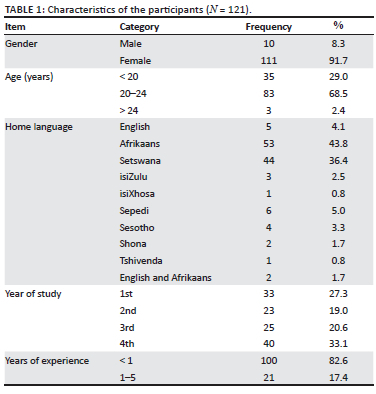
A total of 121 student nurses, whose characteristics are reported in Table 1, completed the online questionnaire, with no questionnaires excluded. The gender distribution of the participants was as follows: 92% (n = 111) were female, and 8% (n = 10) were male. Most of the participants (69%) were between the ages of 20 and 24. In terms of home language, 44% (n = 53) listed Afrikaans and 36% (n = 44) gave their home language as Setswana. Most of the participants (33%) were in their fourth year, followed by those in their first year (27%), their third year (21%) or their second year (19%). Over 82% (n = 100) of the students reported having less than 1 year of professional nursing experience; the remaining 17% (n = 21) reported a corresponding 1-5 years.
Psychometric properties of the revised mental health literacy scale
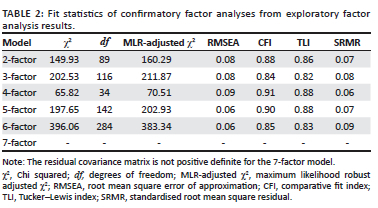
The data were found to be non-normally distributed, showing characteristics of skewness and kurtosis. When dividing the skewness and kurtosis statistics by their relevant standard error, values between −1.96 and +1.96 are considered normal. In this sample (including demographic information and all 35 items), 77.5% indicated skewness and 50.0% kurtosis. Therefore, the robust maximum likelihood (MLR) estimator for the analyses in Mplus 8.10 was used.1010Table 2), an EFA (with PCA and PAF) was performed, also in Mplus, 8.10,10
Each of the possible factor structures, specified according to significant loadings identified in the respective PAFs, was tested in Mplus - the fit statistics from the first run of each factor structure are reported in Table 2. Owing to the small sample size, the data could not be split into two different sets, as per good practice guidelines, in order to perform any CFA in a separate data set. However, to be able to propose a factor structure for future study, every possible factor structure from the EFA was inspected and/or developed to determine the best fit through CFA for further analysis. The 2-factor structure decreased in fit, while the 3-factor structure improved (although not to acceptable levels), and the 4-factor structure could not be developed any further. The 1-factor and 6-factor structures were abandoned as too many items with low factor loadings would have had to be removed, but the 5-factor structure achieved acceptable fit after the removal of two items with factor loadings below 0.35 (χ2 [df] = 142.30 [109]; MLR-adjusted χ2 = 148.33; RMSEA = 0.05; Comparative Fit Index [CFI]/Tucker-Lewis Index [TLI] = 0.94/0.92; standardised root mean square residual [SRMR] = 0.06).
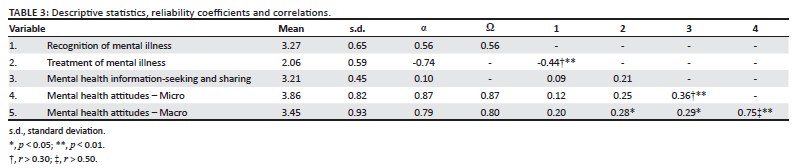
The descriptive statistics of the proposed factor structures, Cronbach's alpha and Omega reliability coefficients, and evaluated relationships are presented in Table 3. The first factor in the revised structure represented items from the first subscale: Recognition of mental illness (items 4, 5 and 7; measured on a scale of 1-4), whereas the second factor consisted of only two items (12 and 28; measured on a scale of 1-4 and 1-5, respectively), both relating to the treatment of mental illness. The third factor in the revised structure combined items from two subscales: Knowledge of how to seek information (items 16, 17 and 19; measured on a scale of 1-5) and two items from attitudes (25 and 26; measured on a scale of 1-5), hence this factor was named mental health information-seeking and sharing, as some items also relate to sharing diagnosis. The fourth factor identified in the new factor structure consists of items 29, 30, 31 and 32 (measured on a scale of 1-5). All of these items belong to the original subscale attitudes. In the revised structure, this subscale is also represented in factor 5 by items 33, 34 and 35 (measured on a scale of 1-5). On closer investigation, the difference between these factors was that the first is concerned with mental health attitudes regarding significant others on a micro level (named mental health attitude-micro level), whereas the fifth factor was concerned with mental health attitudes of others in the larger community a person lives in, or macro level (named mental health attitude-macro level).
The internal consistencies (Cronbach's alpha and Omega) of mental health information-seeking and sharing, mental health attitude-micro level and mental health attitude-macro level were all acceptable at α = 0.75 and ω = 0.75, α = 0.87 and ω = 0.87, and α = 0.79 and ω = 0.80, respectively. The internal consistency of recognition of mental illness was very low (α = 0.56 and ω = 0.56), and this needs to be further investigated. The treatment of mental illnesses' alpha value was above the cut-off point, but remained negative, regardless of the reversal of negative items. It might be an issue that there are only two items for the factor; it could be because of the small sample size, or a negative inter-item correlation, but in this case, it is probably because the two items were measured on different Likert scales (item 12 on 1-4 and item 28 on 1-5). The internal consistency for the complete measure, consisting of 17 items, was α = 0.77 and ω = 0.83; its mean overall was 3.70 with a standard deviation (s.d.) of 0.45.
Discussion
This study set out to investigate the usefulness of the MHLS in a group of nursing students in South Africa.
While Korhonen and colleagues9
The internal consistencies for mental health attitudes on a micro level, mental health information-seeking and sharing, and mental health attitudes on a macro level were all high; however, the internal consistencies for recognition of mental illness and treatment of mental illness were found to be very low and negative, respectively. It should be noted that Korhonen and colleagues9912,13
Preliminary findings using the revised 5-factor model, as presented in this study, indicate that the sample of undergraduate nursing students had a satisfactory level of MHL. Crisp and colleagues121314,15,1617
Although this was a small cross-sectional study, with a low response rate, which limited the generalisability of the results, its contribution in terms of the development of the MHLS to be useful in the education sector is clear. For future use, adjusting the Likert scales to use the same range throughout the questionnaire (e.g. by removing the neutral option from items 16-35) could strengthen the reliability of all the factors, especially the mental health treatment factor. Future research on the scale should focus on adapting or removing or adding applicable items through consultation with experts to improve content validity, and further clarifying the factor structure by conducting a larger-scale study, using EFA and CFA to investigate the validity of the structure.
Conclusion
Increasing the MHL of healthcare students could assist in integrating mental health treatment into PHC services, particularly in low- and middle-income countries.18
Competing interests
The authors reported that they received funding from the National Research Foundation, which may be affected by the research reported in the enclosed publication. The authors have disclosed those interests fully and have implemented an approved plan for managing any potential conflicts arising from their involvement. The terms of these funding arrangements have been reviewed and approved by the affiliated University in accordance with its policy on objectivity in research.
CRediT authorship contribution
Lauren Blommetjies: Conceptualisation, Investigation, Methodology, Writing - original draft, Writing - review & editing. Elmari Deacon: Conceptualisation, Methodology, Supervision, Validation, Writing - original draft, Writing - review & editing. All authors reviewed the article, contributed to the discussion of results, approved the final version for submission and publication, and take responsibility for the integrity of its findings.
Funding information
This work was supported by the National Research Foundation (grant number: 148785).
Data availability
The data that support the findings of this study are available from the corresponding author, Elmari Deacon, upon reasonable request.
Disclaimer
The views and opinions expressed in this article are those of the authors and are the product of professional research. They do not necessarily reflect the official policy or position of any affiliated institution, funder, agency or that of the publisher. The authors are responsible for this article's results, findings and content.
Acknowledgements
We gratefully acknowledge the participants.
References
-
1. Tay JL, Tay YF, Klainin-Yobas P. Mental health literacy levels. Arch Psychiatr Nurs. 2018;32(5):757-763. https://doi.org/10.1016/j.apnu.2018.04.007
» https://doi.org/10.1016/j.apnu.2018.04.007 -
2. Jorm AF, Korten AE, Jacomb PA, Christensen H, Rodgers B, Pollitt P. 'Mental health literacy': A survey of the public's ability to recognise mental disorders and their beliefs about the effectiveness of treatment. Med J Aust. 1997;166(4):182-186. https://doi.org/10.5694/j.1326-5377.1997.tb140071.x
» https://doi.org/10.5694/j.1326-5377.1997.tb140071.x -
3. Kutcher S, Bagnell A, Wei Y. Mental health literacy in Secondary Schools. Child Adolesc Psychiatr Clin North Am. 2015;24(2):233-244. https://doi.org/10.1016/j.chc.2014.11.007
» https://doi.org/10.1016/j.chc.2014.11.007 -
4. O'Connor M, Casey L. The Mental Health Literacy Scale (MHLS): A new scale-based measure of mental health literacy. Psychiatr Res. 2015;229(1-2):511-516. https://doi.org/10.1016/j.psychres.2015.05.064
» https://doi.org/10.1016/j.psychres.2015.05.064 -
5. Wei Y, McGrath PJ, Hayden J, Kutcher S. Mental health literacy measures evaluating knowledge, attitudes and help-seeking: A scoping review. BMC Psychiatry. 2015;15(1):1-20. https://doi.org/10.1186/s12888-015-0681-9
» https://doi.org/10.1186/s12888-015-0681-9 -
6. Korhonen J, Axelin A, Grobler G, Lahti M. Content validation of Mental Health Literacy Scale (MHLS) for primary health care workers in South Africa and Zambia - A heterogeneous expert panel method. Glob Health Action. 2019;12(1):1668215. https://doi.org/10.1080/16549716.2019.1668215
» https://doi.org/10.1080/16549716.2019.1668215 -
7. Lahti M, Groen G, Mwape L, et al. Design and development process of a youth depression screening m-Health application for primary health care workers in South Africa and Zambia: An overview of the MEGA project. Issues Ment Health Nurs. 2019;41(1):24-30. https://doi.org/10.1080/01612840.2019.1604919
» https://doi.org/10.1080/01612840.2019.1604919 -
8. Dirwayi NP. Mental illness in primary health care: a study to investigate nurse's knowledge of mental illness and attitudes of nurses toward the mentally ill. (Thesis). University of Cape Town, Faculty of Humanities, Department of Psychology. 2002. Available from: http://hdl.handle.net/11427/7930
» http://hdl.handle.net/11427/7930 -
9. Korhonen J, Axelin A, Katajisto J, Lahti M. Construct validity and internal consistency of the revised mental health literacy scale in South African and Zambian contexts. Nurs Open. 2021;9(2):966-977. https://doi.org/10.1002/nop2.1132
» https://doi.org/10.1002/nop2.1132 - 10. Stockemer D. Quantitative methods for the social sciences: A practical introduction with examples in SPSS and Stata. Cham: Springer International Publishing; 2019.
- 11. IBM Corp. IBM SPSS statistics for Windows, Version 28.0. IBM Corp; 2023, Armonk, NY, US.
- 12. Crisp A, Gelder M, Goddard E, Meltzer H. Stigmatization of people with mental illnesses: A follow-up study within the changing minds campaign of the Royal College of Psychiatrists. World Psychiatry. 2005;4(2):106-113.
-
13. Furnham A, Hamid A. Mental health literacy in non-western countries: A review of the recent literature. Ment Health Rev J. 2014;19(2):84-98. https://doi.org/10.1108/MHRJ-01-2013-0004
» https://doi.org/10.1108/MHRJ-01-2013-0004 -
14. Saito AS, Creedy DK. Determining mental health literacy of undergraduate nursing students to inform learning and teaching strategies. Int J Ment Health Nurs. 2021;30(5):1117-1126. https://doi.org/10.1111/inm.12862
» https://doi.org/10.1111/inm.12862 -
15. Weare R, Green C, Olasoji M, Plummer V. ICU nurses feel unprepared to care for patients with mental illness: A survey of nurses' attitudes, knowledge, and skills. Intensive Crit Care Nurs. 2019;53:37-42. https://doi.org/10.1016/j.iccn.2019.03.001
» https://doi.org/10.1016/j.iccn.2019.03.001 -
16. Kemp CG, Mntambo N, Weiner BJ, et al. Pushing the bench: A mixed methods study of barriers to and facilitators of identification and referral into depression care by professional nurses in KwaZulu-Natal, South Africa. SSM Ment Health. 2021;1:100009. https://doi.org/10.1016/j.ssmmh.2021.100009
» https://doi.org/10.1016/j.ssmmh.2021.100009 -
17. Sand-Jecklin K, Murray B, Summers B, Watson J. Educating nursing students about health literacy: From the classroom to the patient bedside. Online J Issues Nurs. 2010;15(3). https://doi.org/10.3912/OJIN.Vol15No03PPT02
» https://doi.org/10.3912/OJIN.Vol15No03PPT02 -
18. Marangu E, et al. Assessing Mental Health Literacy of Care Workers in Kenya: A Cross Sectional Survey. International Journal of Mental Health Systems. 2021;15(55). https://doi.org/10.1186/s13033-021-00481-z
» https://doi.org/10.1186/s13033-021-00481-z

Accepted: 21 Nov. 2025
Published: 28 Jan. 2026