Extrapyramidal side effects in first-episode schizophrenia treated with flupenthixol decanoate
Abstract
BACKGROUND: Concern for the development of extrapyramidal side effects (EPSEs) represents a barrier to the routine use of long-acting injectable (LAI) antipsychotic medication in patients with first-episode schizophrenia (FES). Flupenthixol decanoate is a first-generation antipsychotic, which is readily available in the public healthcare system in South Africa. AIM: The aim of this study was to describe the nature, occurrence and severity of EPSEs and their impact on patients with FES over 12 months of treatment with flupenthixol decanoate (fluanxol depot). SETTING: The study was based in Cape Town, South Africa, and patients with FES were recruited from inpatient services at Stikland and Tygerberg Hospitals and surrounding psychiatric clinics. This was a sub-study of a larger study, which examined several outcomes in patients with FES treated with the lowest effective dose of flupenthixol decanoate. METHODS: The Extrapyramidal Symptom Rating Scale (ESRS) was used to assess both subjective experience and objective measures of EPSEs in a cohort of patients with FES (N = 130). The relationship between demographic and clinical risk factors for individual subsets of EPSEs was also determined. RESULTS: In the context of an overall good 12-month tolerability, EPSEs peaked at month 3. Patients with akathisia were more likely to have greater symptoms of depression, and Parkinsonism was predicted by higher Positive and Negative Syndrome Scale scores (independent of medication dosage). Black and white patients showed higher total ESRS and higher subjective ESRS scores, compared with patients of mixed ancestry, and white patients scored higher on Parkinsonism ratings. CONCLUSION: Flupenthixol decanoate is well tolerated in patients with FES. Certain clinical features of schizophrenia may be related to EPSEs. Ethnicity is a socio-cultural construct, and hence the differential risk of EPSEs should be interpreted according to ethnicity. Variations in the environment, diet, substance use and genetics may all affect the pharmacokinetics and pharmacodynamics of psychotropic drugs and warrant further investigation.
flupenthixol; Parkinsonism; dystonia; akathisia; tardive dyskinesia
Introduction
There is a growing interest in the use of long-acting injectable (LAI) antipsychotics in patients with first-episode schizophrenia (FES).1,21,23456
EPSEs contribute significantly to disability and cause social embarrassment. Akathisia, the subjective feeling of inner restlessness,789,1010
Overall, there are few studies that examined EPSEs related to LAI antipsychotics in patients with FES.211
Method
Setting
This was a sub-study of a larger study, which aimed to examine the clinical, functional and biological outcomes in patients with FES treated with the lowest effective dose of flupenthixol decanoate medication over 12 months. The study was based in Cape Town, South Africa, and patients with FES were recruited from inpatient services at Stikland and Tygerberg Hospitals and surrounding psychiatric clinics between 2007 and 2011.
Participants
Participants were both males and females aged between 16 and 45 years meeting the Diagnostic and Statistical Manual of Mental Diseases, Fourth Edition, Text Revisions (DSM-IV TR)12
Intervention
Patients received oral flupenthixol (1-3 mg/day for 7 days), followed by flupenthixol decanoate injections every 2 weeks throughout the study period. The initial dose was 10 mg every 2 weeks, and increases of 10 mg every 6 weeks were permitted, if clinically indicated, to a maximum of 30 mg every 2 weeks IMI. Additional oral flupenthixol was permitted at the discretion of the investigator, as was lorazepam, anticholinergics, propranolol, antidepressants and medication for general medical conditions. No benzodiazepines, propranolol or anticholinergics were permitted in the 12 hours prior to assessments. Patients were followed up for a 12-month period, and there were nine scheduled visits: at baseline, 1, 2, 4 and 6 weeks and at 3, 6, 9 and 12 months.
Data collection
Socio-demographic, anthropometric and clinical data were collected at baseline including age, gender, ethnicity, diagnoses, duration of untreated psychosis and history of illicit substance use. Patients were assessed on intake by using the Structured Clinical Interview for DSM-IV,131415161718
Statistical analysis
Baseline measures for categorical variables were summarised as counts and percentages. Changes in ESRS scores (total and individual items, including subjective scores) over the various time points were summarised as least square means assessed by using variance estimation, precision and comparison (VEPAC) and normalised by using CoxBox transformation. Time points were normalised by using type III decomposition. We performed linear mixed-effect regression models for the following ESRS subscales: subjective ESRS, Parkinsonism, akathisia, tardive dyskinesia and acute dystonia, examining clinical (total PANSS, total depression, insight subscales) and demographic (age, gender and ethnicity) variables as potential predictors. We employed a mixed-effect linear regression model for repeated measures to evaluate a number of variables (age, ethnicity, gender, total PANSS score, total CDSS score, BIS subscale scores and flupenthixol dose) as predictors for EPSEs as measured by ESRS scores (total, subjective and subsections). Statistica (version 13.3) was used for all analyses and the level of statistical significance was set at p < 0.05.
Ethical consideration
We obtained ethics approval from the Human Health Research Ethics Committee (HREC) of Stellenbosch University (Ref. N06/08/148). All participants provided written informed consent or assented, and if they were under age 18 years a parent or legal guardian provided consent.
Results
Demographic and baseline clinical details
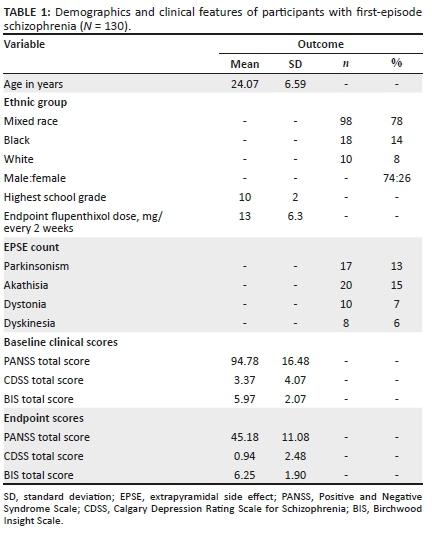
Patients with FES (n = 130) were young (mean age 24.07 years), predominantly mixed-race ancestry (78%) and male (74%). Absolute numbers of EPSE AEs over 12 months were: akathisia (n = 20, 15%), Parkinsonism (n = 17, 13%), dystonia (n = 10, 7%) and dyskinesia (n = 8, 6%) (Table 1).
Total extrapyramidal symptoms scores over 12 months
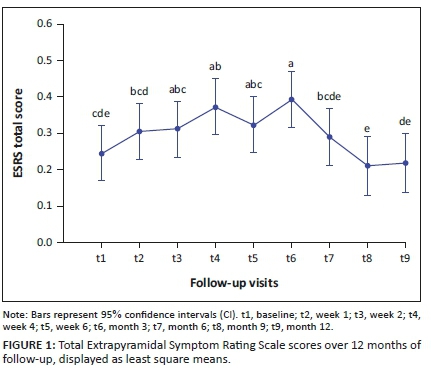
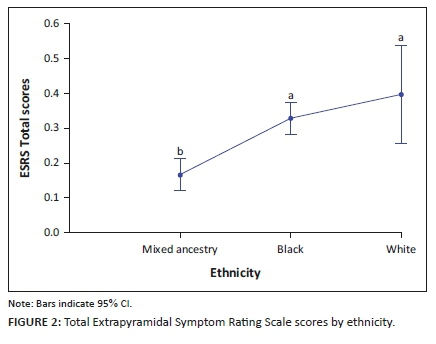
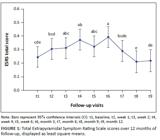
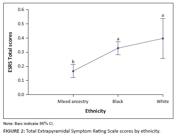
Total ESRS scores were relatively low over 12 months (Figure 1). Total ESRS scores peaked in the third month of treatment (Figure 1), which was associated with a significant number of dropouts (p = 0.03) (Supplementary Table 2). Total ESRS scores then declined approximately to baseline levels by 12 months. Specifically, ESRS scores were significantly lower at baseline compared with week 4 (p < 0.01) and month 3 (p < 0.01). Total ESRS scores were also lower at month 9 compared with week 2 (p = 0.04), week 4 (p = 0.03), week 6 (p = 0.01) and month 3 (p < 0.001). At 12 months, total ESRS scores were lower than at week 4 (p = 0.04), week 6 (p = 0.02) and month 3 (p ≤ 0.0001). Further, ESRS total score was significantly higher across the 12-month period overall for black (p ≤ 0.001) and white (p = 0.02) patients compared with patients of mixed ancestry. This was not significant for any specific time points (Figure 2).
Subjective Extrapyramidal Symptom Rating Scale scores over 12 months
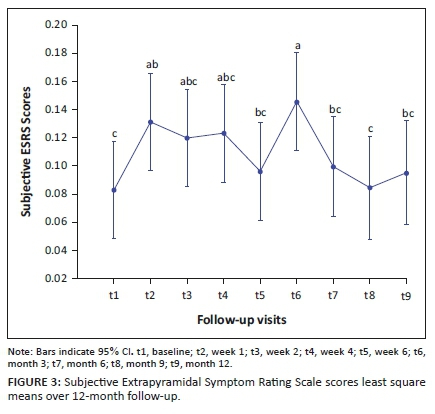
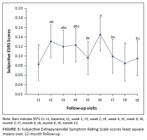
Subjective ESRS scores were relatively low over the 12-month study duration (Figure 3). The scores of the ESRS subjective component were significantly higher at week 1 compared with baseline (p = 0.02), that is, in the lead up to receiving the first depot antipsychotic, whilst receiving oral flupenthixol. Subjective ESRS symptoms were also significantly greater at month 3 compared with baseline (p < 0.001), and at month 9 compared with week 1 (p = 0.04). Thereafter, the subjective experience of ESRS symptoms was significantly lower when compared with month 3 at the subsequent three follow-up visits: at month 6 (p = 0.03), month 9 (p = 0.01) and month 12 (p = 0.02). White and black patients also reported experiencing significantly more EPSEs (p < 0.001) than patients of mixed ancestry.
Relationship between extrapyramidal side effects and clinical and demographic factors
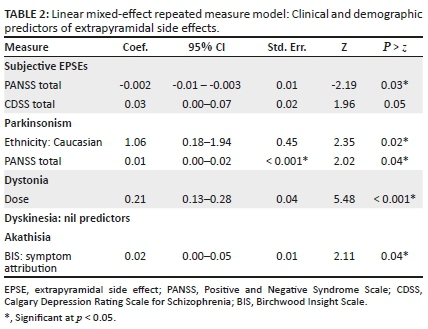
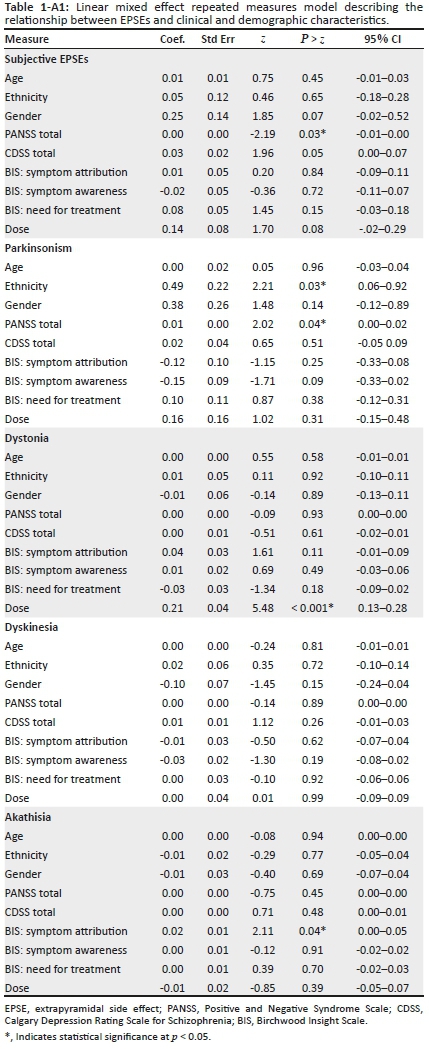
Table 2 summarises the statistically significant findings of the linear mixed-effect repeated measures model describing the relationship between EPSEs and clinical and demographic characteristics (refer to Appendix 1, Table 1-A1 for the full results of the model). Higher subjective ESRS scores were predicted by higher depression scores (p = 0.05) and lower total PANSS scores (p = 0.03). For the ESRS subscales, a higher Parkinsonism score was predicted by a higher total PANSS score (p = 0.043) and ethnicity, with white patients scoring significantly higher (p = 0.027). Acute dystonia was predicted by dose (p < 0.0001). Akathisia was predicted by a lower total PANSS score (p = 0.04) and higher scores for the symptom attribution subscale of the BIS (p = 0.028). No clinical or demographic variables emerged as predictors of tardive dyskinesia.
Discussion and conclusion
In this study, we examined the subjective and objective nature of EPSEs in a cohort of patients with FES treated with flupenthixol decanoate, an LAI antipsychotic, over 12 months. Our study has two main findings. Firstly, we found that in the context of overall good 12-month tolerability, EPSEs peaked at month 3 and this peak was associated with a significant increase in dropouts. Secondly, we found evidence of an association between clinical symptomatology and subjective and total EPSEs.
Both subjective and total ESRS scores showed a similar trend, a statistically significant initial rise in scores followed by a decline to approximately baseline by the endpoint. This finding is in keeping with the onset of acute extrapyramidal symptoms in other studies. Dystonia is a particularly acute EPSE, and in 95% of cases the onset is within 5 days of antipsychotic initiation or within the few days after LAI antipsychotics are administered.192020
Schizophrenia itself may be associated with abnormal movements,212223242526
Although ESRS totals and subjective ESRS scores followed a similar longitudinal course in our study, the onset of side effects differed. The subjective experience scores rose sharply, showing a statistically significant increase in the first week of the study, whilst on low-dose oral flupenthixol (1 mg daily) but prior to the initiation of depot antipsychotics. One possibility for this finding is that patients were aware of extrapyramidal symptoms before the signs were clinically apparent. This might be explained by the cognitive effects of neuroleptics (Awad, 1993; Lindstrom, 1994) in that dysphoria caused by neuroleptics may predict the onset of EPSEs.2930
Our second key finding was the relationship between clinical and demographic factors and individual extrapyramidal symptom subtypes, namely Parkinsonism, dystonia and akathisia. Patients with akathisia were more likely to be have greater symptoms of depression (as measured by the CDSS). In the International Suicide Prevention Trial (InterSePT), greater rates of akathisia were associated with higher PANSS anxiety or depression factor scores,3122
Parkinsonism was predicted by higher PANSS scores and ethnicity with white patients having higher rates. Parkinsonism has been associated with higher PANSS scores in previous studies.3119193233
We found that ethnicity was a significant predictor for a number of outcomes. Black and white patients showed higher total ESRS and higher subjective ESRS scores, compared with patients of mixed ancestry. White patients also scored higher on Parkinsonism ratings. It has been hypothesised that ethnic differences in response to medications in general are largely mediated by pharmacokinetics, specifically gut absorption and first-pass metabolism, high levels of protein binding and hepatic elimination.344353637,3836
The key strengths of this study were that it investigated a cohort of patients with FES who were well characterised with regular standardised assessments over a 12-month period. Patients had minimal exposure to antipsychotics at the start of the study, and approximately half were neuroleptic naïve following which all patients were treated with the same medication type where antipsychotic administration was assured. Limitations include the relatively small sample size for examining individual EPSE components. Further, we did not have a comparison group (such as oral antipsychotics) to compare emergent EPSEs in our population too. Finally, because of data limitations, we are unable to report on reasons for dropouts at each time point.
In conclusion, we found a favourable 12-month tolerability of flupenthixol decanoate, a first-generation LAI antipsychotics, in patients with FES. The medication warrants further investigation into its suitability as a first-line agent for patients with FES. Subjective EPSEs increased prior to objective findings, which may provide an opportunity for earlier intervention. Clinical and demographic variables were identified as risk factors for Parkinsonism, dystonia and akathisia. This requires further investigation, and in the case of ethnicity genetic vulnerability and environmental factors in individual populations should be prioritised.
Competing interests
F.P.J. has received honoraria for speaking from Aspen. B.C. received honoraria for speaking from Janssen and Sandoz. R.E. has participated in speakers or advisory boards and received honoraria from Janssen, Lundbeck, Servier and Otsuka and has received research funding from Janssen and Lundbeck. L.A. has no competing interests to declare.
Authors' contributions
F.P.J. was involved in conceptualisation, data curation, writing original draft and then in writing, reviewing and editing it. B.C. was involved in conceptualisation, supervision, investigation, methodology, project administration and also in writing, reviewing and editing. R.E. was involved in conceptualisation, funding acquisition, methodology, project administration, resources, supervision and also in writing, reviewing and editing. L.A. performed methodology, investigation, supervision and also in writing, reviewing and editing.
Funding information
The study was funded by a grant from New Partnership for Africa's Development (NEPAD), through the Department of Science and Technology of South Africa, and an unrestricted grant from Lundbeck International. Funders have played no role in the study design, data collection, analysis and interpretation and in writing the manuscript.
Data availability statement
This study involves secondary data analysis. Data sharing is not applicable to this article as no new data were created or analysed in this study.
Disclaimer
The views and opinions expressed in this article are those of the authors and do not necessarily reflect the official policy or position of any affiliated agency of the authors.
Acknowledgements
The authors acknowledge Prof. Martin Kidd for assistance with data analysis and Dr Karis Moxley (Department of Psychiatry, Stellenbosch University) for technical editing.
References
-
1.Kim B, Lee S-H, Yang YK, Park J-I, Chung Y-C. Long-acting injectable antipsychotics for first-episode schizophrenia: The pros and cons. Schizophr Res Treat. 2012;2012:1-8. https://doi.org/10.1155/2012/560836
» https://doi.org/10.1155/2012/560836 -
2.Chiliza B, Ojagbemi A, Esan O, et al. Combining depot antipsychotic with an assertive monitoring programme for treating first-episode schizophrenia in a resource-constrained setting. Early Interv Psychiatry. 2016;10(1):54-62. https://doi.org/10.1111/eip.12141
» https://doi.org/10.1111/eip.12141 -
3.Mahapatra J, Quraishi SN, David A, Sampson S, Adams CE. Flupenthixol decanoate (depot) for schizophrenia or other similar psychotic disorders. Cochrane Database Syst Rev. 2014;6:CD001470. https://doi.org/10.1002/14651858.CD001470.pub2
» https://doi.org/10.1002/14651858.CD001470.pub2 - 4.Standard P, Inhibitor IR, Limited HR. Product monograph. Boston, MA: Packag, 2010; p. 1-23.
-
5.Weiden PJ, Buckley PF, Grody M. Understanding and treating "first-episode" schizophrenia. Psychiatr Clin North Am. 2007;30(3):481-510. https://doi.org/10.1016/j.psc.2007.04.010
» https://doi.org/10.1016/j.psc.2007.04.010 -
6.Salimi K, Jarskog LF, Lieberman JA. Antipsychotic drugs for first-episode schizophrenia: A comparative review. CNS Drugs. 2009;23(10):837-855. https://doi.org/10.2165/11314280-000000000-00000
» https://doi.org/10.2165/11314280-000000000-00000 - 7.Arana GW. An overview of side effects caused by typical antipsychotics. Journal of Clinical Psychiatry. 2000;61(Suppl 8):5-11.
-
8.Poyurovsky M. Acute antipsychotic-induced akathisia revisited. Br J Psychiatr. 2010;196(2):89-91. https://doi.org/10.1192/bjp.bp.109.070540
» https://doi.org/10.1192/bjp.bp.109.070540 -
9.Sachdev PS. Neuroleptic-induced movement disorders: An overview. Psychiatr Clin North Am. 2005;28(1):255-274. https://doi.org/10.1016/j.psc.2004.10.004
» https://doi.org/10.1016/j.psc.2004.10.004 - 10.Wirshing WC. Movement disorders associated with neuroleptic treatment. J Clin Psychiatr. 2001;62(Suppl 2):15-18.
-
11.Haddad PM, Das A, Keyhani S, Chaudhry IB. Antipsychotic drugs and extrapyramidal side effects in first episode psychosis: A systematic review of head-head comparisons. J Psychopharmacol. 2012;26(5 Suppl):15-26. https://doi.org/10.1177/0269881111424929
» https://doi.org/10.1177/0269881111424929 - 12.American Psychiatric Association. Diagnostic and Statistical Manual of Mental Disorders, (DSM IV). 4th Ed.(Mdd). Washington, DC: APA, 1994; p. 915.
- 13.First MB, Spitzer RL, Gibbon M, Williams JBW. Structured clinical interview for DSM-IV-TR axis I disorders, research version, patient edition. New York: Biometrics Research New York State Psychiatric Institute; 2002
-
14.Kay SR, Fiszbein A, Opler LA. The positive and negative syndrome scale (PANSS) for schizophrenia. Schizophr Bull. 1987;13(2):261-276. https://doi.org/10.1093/schbul/13.2.261
» https://doi.org/10.1093/schbul/13.2.261 -
15.Emsley R, Rabinowitz J, Torreman M, et al. The factor structure for the Positive and Negative Syndrome Scale (PANSS) in recent-onset psychosis. Schizophr Res. 2003;61(1):47-57. https://doi.org/10.1016/S0920-9964(02)00302-X
» https://doi.org/10.1016/S0920-9964(02)00302-X -
16.Addington D, Addington J, Maticka-Tyndale E. Assessing depression in schizophrenia: The Calgary depression scale. Br J Psychiatr. 1993;163(S22):39-44. https://doi.org/10.1192/S0007125000292581
» https://doi.org/10.1192/S0007125000292581 -
17.Birchwood M, Smith J, Drury V, Healy J, Macmillan F, Slade M. A self-report insight scale for psychosis: Reliability, validity and sensitivity to change. Acta Psychiatr Scand. 1994;89(1):62-67. https://doi.org/10.1111/j.1600-0447.1994.tb01487.x
» https://doi.org/10.1111/j.1600-0447.1994.tb01487.x - 18.Guy W. National Institute of Mental Health (U.S.). Psychopharmacology Research Branch. Division of Extramural Research Programs. ECDEU assessment manual for psychopharmacology. Rev. 1976. Rockville, MD: U.S. Dept. of Health, Education, and Welfare, Public Health Service, Alcohol, Drug Abuse, and Mental Health Administration, National Institute of Mental Health, Psychopharmacology Research Branch, Division of Extramural Research Programs; 1976.
-
19.Caroff SN, Campbell EC. Drug-induced extrapyramidal syndromes: Implications for contemporary practice. Psychiatr Clin North Am. 2016;39(3):391-411. https://doi.org/10.1016/j.psc.2016.04.003
» https://doi.org/10.1016/j.psc.2016.04.003 -
20.Tarsy D. Neuroleptic-induced extrapyramidal reactions: Classification, description, and diagnosis. Clin Neuropharmacol. 1983;6(Suppl 1):S9-S26. https://doi.org/10.1097/00002826-198300061-00004
» https://doi.org/10.1097/00002826-198300061-00004 -
21.Walther S, Strik W. Motor symptoms and schizophrenia. Neuropsychobiology. 2012;66(2):77-92. https://doi.org/10.1159/000339456
» https://doi.org/10.1159/000339456 -
22.Bratti IM, Kane JM, Marder SR. Chronic restlessness with antipsychotics. Am J Psychiatry. 2007;164(11):1648-1654. https://doi.org/10.1176/appi.ajp.2007.07071150
» https://doi.org/10.1176/appi.ajp.2007.07071150 -
23.Peralta V, Campos MS, De Jalón EG, Cuesta MJ. Motor behavior abnormalities in drug-naïve patients with schizophrenia spectrum disorders. Mov Disord. 2010;25(8):1068-1076. https://doi.org/10.1002/mds.23050
» https://doi.org/10.1002/mds.23050 -
24.Koning JPF, Tenback DE, Van Os J, Aleman A, Kahn RS, Van Harten PN. Dyskinesia and parkinsonism in antipsychotic-naive patients with schizophrenia, first-degree relatives and healthy controls: A meta-analysis. Schizophr Bull. 2010;36(4):723-731. https://doi.org/10.1093/schbul/sbn146
» https://doi.org/10.1093/schbul/sbn146 -
25.Caligiuri M, Lohr J. Instrumental motor predictors of neuroleptic-induced parkinsonism in newly medicated schizophrenia patients. J Neuropsychiatry Clin Neurosci. 1997;9(4):562-567. https://doi.org/10.1176/jnp.9.4.562
» https://doi.org/10.1176/jnp.9.4.562 -
26.Peralta V, Cuesta MJ. The effect of antipsychotic medication on neuromotor abnormalities in neuroleptic-naive nonaffective psychotic patients. Prim Care Companion J Clin Psychiatry. 2010;12(2):e1-e11. https://doi.org/10.4088/PCC.09m00799gry
» https://doi.org/10.4088/PCC.09m00799gry -
27.Lindstrom LH. Long-term clinical and social outcome studies in schizophrenia in relation to the cognitive and emotional side-effects of antipsychotic-drugs. ACTA Psychiatr Scand. 1994;89(380):74-76. https://doi.org/10.1111/j.1600-0447.1994.tb05837.x
» https://doi.org/10.1111/j.1600-0447.1994.tb05837.x -
28.Awad AG. Subjective response to neuroleptics in schizophrenia. Schizophr Bull. 1993;19(3):609-618. https://doi.org/10.1093/schbul/19.3.609
» https://doi.org/10.1093/schbul/19.3.609 -
29.Gervin M, Browne S, Garavan J, Roe M, Larkin C, O'Callaghan E. Dysphoric subjective response to neuroleptics in schizophrenia: Relationship to extrapyramidal side effects and symptomatology. Eur Psychiatry. 1999;14(7):405-409. https://doi.org/10.1016/S0924-9338(99)00228-X
» https://doi.org/10.1016/S0924-9338(99)00228-X -
30.Carpenter WT, Heinrichs DW, Wagman AMI. Deficit and nondeficit forms of schizophrenia: The concept. Am J Psychiatry. 1988;145(5):578-583. https://doi.org/10.1176/ajp.145.5.578
» https://doi.org/10.1176/ajp.145.5.578 - 31.Chouinard G. Interrelations between psychiatric symptoms and drug-induced movement disorder. J Psychiatry Neurosci. 2006;31(3):177-180.
-
32.Khanna R, Das A, Damodaran SS. Prospective study of neuroleptic-induced dystonia in mania and schizophrenia. Am J Psychiatry. 1992;149(4):511-513. https://doi.org/10.1176/ajp.149.4.511
» https://doi.org/10.1176/ajp.149.4.511 -
33.Miller DD, McEvoy JP, Davis SM, et al. Clinical correlates of tardive dyskinesia in schizophrenia: Baseline data from the CATIE schizophrenia trial. Schizophr Res. 2005;80(1):33-43. https://doi.org/10.1016/j.schres.2005.07.034
» https://doi.org/10.1016/j.schres.2005.07.034 -
34.Johnson JA. Influence of race or ethnicity on pharmacokinetics of drugs. J Pharmaceutical Sci. 1997;86:1328-1333. https://doi.org/10.1021/js9702168
» https://doi.org/10.1021/js9702168 -
35.Jorde LB, Wooding SP. Genetic variation, classification and "race". Nat Genet. 2004;36(11 Suppl):S28-S33. https://doi.org/10.1038/ng1435
» https://doi.org/10.1038/ng1435 -
36.Chaudhry I, Neelam K, Duddu V, Husain N. Ethnicity and psychopharmacology. J Psychopharmacol. 2008;22(6):673-680. https://doi.org/10.1177/0269881107082105
» https://doi.org/10.1177/0269881107082105 -
37.Emsley RA, Roberts MC, Rataemane S, et al. Ethnicity and treatment response in schizophrenia: A comparison of 3 ethnic groups. J Clin Psychiatr. 2002;63(1):9-14. https://doi.org/10.4088/JCP.v63n0103
» https://doi.org/10.4088/JCP.v63n0103 -
38.Lin KM, Anderson D, Poland RE. Ethnicity and psychopharmacology. Bridging the gap. Psychiatr Clin North Am. 1995;18(3):635-647. https://doi.org/10.1016/S0193-953X(18)30045-5
» https://doi.org/10.1016/S0193-953X(18)30045-5

Accepted: 02 Oct. 2021
Published: 11 Jan. 2021