Prevalence of depressive symptoms in adolescents living with HIV in Johannesburg, South Africa
Abstract
BACKGROUND: Adolescents living with HIV (ALWHIV) are more vulnerable to developing depressive symptoms. Despite this knowledge, the screening for depression is not routinely integrated into HIV treatment programmes AIM: The study aimed to determine the prevalence of depressive symptoms among ALWHIV SETTING: The study was carried out in the primary healthcare clinics and an antiretroviral clinic situated in a district hospital, West Rand District, Johannesburg METHODS: This was a cross-sectional study of 125 ALWHIV. The modified Patient Health Questionnaire for Adolescents (PHQ-A) was used to screen for depressive symptoms with a score of ≥ 5 deemed significant. A distress protocol was used for immediate psychological intervention RESULTS: The prevalence of depressive symptoms was 44.8% and the majority of ALWHIV reported mild-moderate symptoms (36.8%). Overall, 25.6% of adolescents had suicidal behaviours. Those with psychosocial difficulties and those who reported a previous suicide attempt were 3.6 (adjusted odds ratio [aOR] 3.59, 95% confidence interval [CI]:1.17-11.03) and 6.9 (aOR 6.93, 95% CI:1.39-34.55) times likely to develop depressive symptoms, respectively CONCLUSION: A high prevalence of depressive symptoms was found in ALWHIV. Psychosocial difficulties and previous suicide attempts were predictive factors for depressive symptoms. This highlights the unmet need for the integration of mental health screening and overall mental health services into adolescent HIV programmes CONTRIBUTION: This study emphasises an urgent need for routine mental health screening and prompt psychosocial support in ALWHIV
depressive symptoms; adolescents; HIV; PHQ-A; South Africa
Introduction
It is estimated that over 2 million adolescents between the ages of 10 and 19 years are living with either perinatally or horizontally acquired human immunodeficiency virus (HIV) globally, and 90% of these adolescents live in sub-Saharan Africa.1,2,32,444,5,65
There is evidence supporting that adolescents with HIV are particularly more vulnerable to developing depressive symptoms compared to the general population.7,87,87,87,8
The prevalence of depressive symptoms among ALWHIV ranges from 4.4% to 59% across studies.7,8,9,10,11,12,13,14,15871016
Several factors associated with higher prevalence rates of depressive symptoms in ALWHIV have been described in the literature. These factors can be categorized into sociodemographic factors, psychological factors and clinical HIV-related factors. The sociodemographic factors described include being female, having a poor socioeconomic status, AIDS-related orphanhood and having an unemployed caregiver.7,17,1819,20181817131313811,2122
Despite these findings and the recommendations by the WHO, UNAIDS and the South African National ART Guidelines, the screening for mental health problems among ALWHIV is not routinely integrated as part of HIV treatment programmes in the West Rand Health District in Johannesburg. In addition, research on mental health issues of children and adolescents lags considerably behind that of adults.235
This study aimed to establish the occurrence of depressive symptoms among ALWHIV attending general primary health clinics and one antiretroviral (ARV) clinic in the West Rand Health District in Johannesburg. The researchers hypothesised that HIV-positive adolescents attending general primary health clinics are at high risk of developing depressive symptoms. The objectives of the study were to determine the prevalence of depressive symptoms in ALWHIV attending the general primary health clinics in the West Rand using the Patient Health Questionnaire for Adolescents (PHQ-A). Furthermore, the sociodemographic profile and HIV-related data were described.
Research methods and design
Study design, setting and sampling techniques
A cross-sectional study of ALWHIV attending the Phedisong HIV clinic at Dr Yusuf Dadoo Hospital, a 245-bed facility, and five PHC clinic facilities in the West Rand Health District, Johannesburg, was conducted from January to November 2022. The district has 51 PHC facilities and two district hospitals, which serve the urban and peri-urban areas of the district. There are clinics that were excluded from the study as they did not have any ALWHIV. Patients from the Phedisong clinic are transferred to PHC facilities once they are stable. These PHC clinics provide HIV/AIDS and tuberculosis (TB) related treatment using the integrated care model for these illnesses. Currently, ALWHIV is only referred to the PHC medical officer in that particular clinic or to the specialized community psychiatry clinics if they present with psychiatric symptoms during their routine HIV management appointment.
A convenience sampling method was employed to recruit the participants. Participants included HIV-positive male and female adolescents from the age of 10 to 19 years who were on ARVs. The participants could read and write English and knew their HIV status prior to recruitment and enrolment. Adolescents who were unable to consent or who did not have a guardian to give consent were excluded.
The potential participants and their parents or caregivers were contacted by the clinic staff to obtain permission for the researcher to access the personal information contained in their files. The investigator then obtained the list of ALWHIV who gave permission from each facility. The adolescents together with their parents or caregivers were recruited telephonically to participate in the study and a research enrolment day was scheduled by the researcher. The enrolment day was scheduled to coincide with the participants' scheduled HIV clinic appointment date where possible. The investigator confirmed the disclosure of HIV status using the clinic file and also from the parent or caregiver before recruitment. On the scheduled enrolment and participation day, information about the study was shared again and informed written consent and assent were obtained from the participant's parent or caregiver.
Sample size
Sample size estimation was conducted using the Stata 18 Statistical program.2418
Data collection and measurement
Data were obtained using a structured socio-demographic questionnaire, which was completed by the participants. The HIV-related clinical data were obtained from the participants' files. Screening for depressive symptoms was carried out using the PHQ-A, which is a modified version of the PHQ-9. The PHQ-A is a validated instrument for screening, diagnosing, monitoring and measuring the severity of depressive symptoms in adolescents.252525
Data analysis
The data for this study were collated on Microsoft Excel™ and statistically analysed using the Stata 18 statistical program.2426,27
Variables associated with depressive symptoms were determined based on a significance level of p ≤ 0.05, with p > 0.05 indicating a non-significant association. With regard to bivariate analysis, odds ratios (OR), 95% CI, and p-values were calculated to assess the risk factors for depressive symptoms. Variables with significance levels of 20% or below in the bivariate analysis were included in the multivariate analysis. Overfitting was estimated using the 'least likely' command to check for extreme outliers. Interactions between variables were estimated and model selection was based on Akaike's and Schwarz's Bayesian information criteria to identify the best-fitting model.28
-
Definitions in the study
In the absence of definitive clinic notes ascribing mode of infection (MOI), the MOI was measured using a cut-off age of 10 years based on existing sub-Saharan African paediatric HIV cohorts.2629
Ethical considerations
Ethical clearance to conduct this study was obtained from the University of the Witwatersrand, Faculty of Health Sciences Human Research Ethics Committee (Medical), (No. M210659). Research site approval was obtained from the West Rand District Council's Research Committee. Permission to share the patient's personal details with the research investigator for recruitment purposes was telephonically obtained from caregivers or directly from the adolescents 18 years and older by the allocated clinic nurse. Written informed assents and consents were obtained prior to data collection from the participants and caregivers for participants younger than 18 years by the investigator. To protect the participant's identity, a unique number was then assigned to the participant's file. Hard copies of the data were stored in a lockable cabinet in the principal investigator's office and the electronic spreadsheet was password-protected. Only the principal investigator, supervisors and statistician had access to the data.
The investigator reviewed the PHQ-A immediately after completion and participants reporting psychological distress and in need of immediate mental health care were referred urgently for risk assessment and containment on the same day. Those with moderate to severe depressive symptoms or severe depressive symptoms were referred to the nearest specialised community psychiatric services.
Results
Sociodemographic characteristics
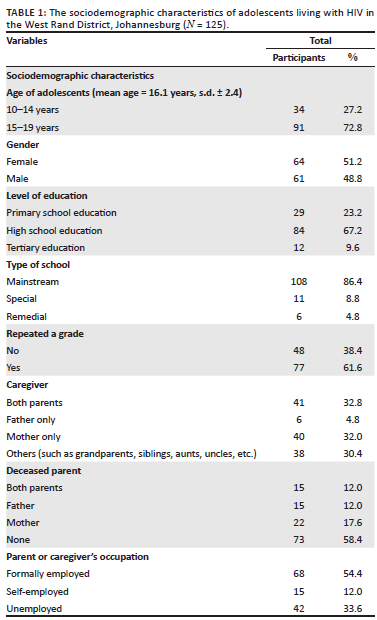
Overall, 158 adolescents were recruited to participate in the study and 125 were enrolled and screened. Thirty-three adolescents were excluded from the study for several reasons including being unaware of their HIV status (n = 24), school commitments (n = 8) and no reasons given (n = 1). There were almost equal female (n = 64, 51.2%) and male (n = 61, 48.8%) participants. The mean age of participants was 16.1 years, standard deviation (s.d.) ± 2.4 (Table 1). Eighty-four (67.2%) participants were in high school and the majority attended mainstream schooling (n = 108, 86.4%) (Table 1). Significantly more adolescents repeated grades at school (n = 77, 61.6%). In terms of caregiver support, the majority of participants (87, 69.6%) had either one (n = 46, 36.8%) or both parents (n = 41, 32.8%) as caregivers. The majority of the caregivers were employed (n = 68, 54.4%) (Table 1).
Psychiatric and HIV-related characteristics
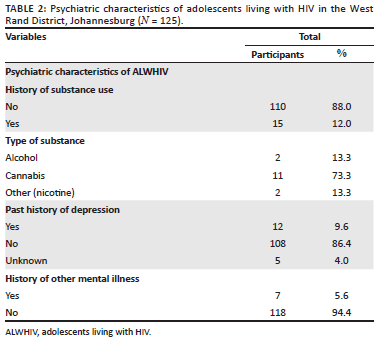
A notable 9.6% of ALWHIV reported a previous diagnosis of major depressive disorder (Table 2). However, the majority of the participants did not report a previous history of other psychiatric diagnosis (n = 118, 94.4%) or substance use history (n = 110, 88%) (Table 2). Only 12% of participants reported substance use, with cannabis, alcohol and nicotine being the only substances that were reported by the participants (Table 2). The study did not further test the validity of the participants' subjective responses regarding substance use. The majority of the participants demonstrated vertical transmission (n = 106, 84.8%) and early ART initiation at ≤ 10 years of age (n = 86, 68.8%). Eighty-one per cent of participants (n = 101) were adherent to ART. Most of the participants did not have other chronic medical illnesses (n = 120, 96.8%) and HIV-related opportunistic infections (n = 85, 68.5%). A high number of participants had a CD4 count of less than 500 cells/mm3n = 64, 55.2%) at initiation. Many of the participants (n = 88, 72.7%) had full viral suppression (VL < 50 copies/ML).22
Prevalence of depressive symptoms
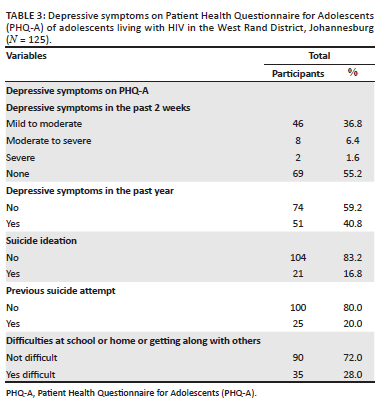
The overall prevalence of depressive symptoms was 44.8% (n = 56) on PHQ-A (Table 3). These participants had experienced depressive symptoms in the past 2 weeks prior to the PHQ-A being administered. In this study sample, 40.8% (n = 51) of participants reported depressive symptoms in the past year (Table 3). In terms of the severity of the depressive symptoms, 36.8% (n = 46) reported mild to moderate depressive symptoms, 6.4% (n = 8) moderate to severe symptoms and 1.6% (n = 2) severe depressive symptoms (Table 3).
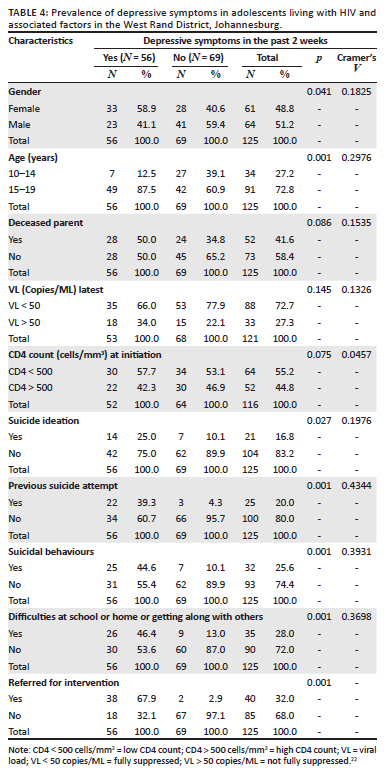
The prevalence of depressive symptoms was higher among the female participants (58.9%, n = 33) (Table 4). Concerning the participant's age, the prevalence was higher for older adolescents (15-19 years) (87.5%, n = 49) than younger adolescents (10-14 years) (12.5%, n = 7) (Table 4). The majority of the participants with depressive symptoms had suppressed VL (n = 35, 66%) and low CD4 counts at initiation (n = 30, 57.7%) (Table 4). This prevalence of depressive symptoms was the same in participants with deceased parent or parents and in those with both parents alive (Table 4). The prevalence of depressive symptoms was strongly associated with older adolescents, previous suicidal attempts and difficulties at school or home or getting along with others (Table 4).
Overall, 25.6% (n = 46) of participants reported suicidal behaviours on the PHQ-A with 16.8% (n = 21) suicidal ideation and 20% (n = 25) reporting a previous suicide attempt (Table 4). Twenty-eight per cent (n = 35) of adolescents reported difficulties at school or home or getting along with others (Table 4), and only two of these participants were already attending psychotherapy. After the completion and assessment of the PHQ-A, 32% (n = 40) of participants were referred for further assessment and management (Table 4) and three participants were referred for urgent intervention.
Factors associated with the prevalence of depressive symptoms
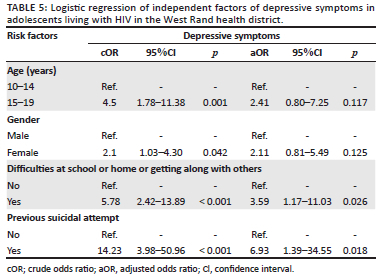
Multivariate analysis showed that ALWHIV with difficulties at school or home environment or getting along with others and those who reported a previous suicide attempt were 3.6 (aOR 3.59, 95% CI:1.17-11.03) and 6.9 (aOR 6.93, 95% CI:1.39-34.55) times likely to develop depressive symptoms, respectively, compared to those who did not have any difficulties and those who never attempted suicide before (Table 5).
Discussion
Similar to other studies, the prevalence of depressive symptoms among the ALWHIV in this study was high (44.8%). This prevalence was higher among female adolescents (58.9%) and in the older age group of 15-19 years (87.5%). Evidence shows that the prevalence of depressive symptoms is higher among adolescents with HIV/AIDS when compared to adolescents without HIV/AIDS in the general population.303112123233
While our study found a high prevalence of depressive symptoms in ALWHIV, there are, however, studies that have reported lower prevalence rates.1,7,9,10,13,17,18,32,34,35,36361,7,9,10,13,17,18,32,34,3518,343712,3812
In this study, the reported suicidal behaviour by the adolescents on the PHQ-A was 25.6% of which 16.8% reported suicidal ideation in the past month and 20% reported previous suicide attempts. This finding was similar to the general population but lower than that reported among ALWHIV in other studies.30,36,3936
In previous studies, a high prevalence of depressive symptoms was reported to be linked to non-adherence, low CD4 count at initiation, high viral load and presence of opportunistic infections.8,12,13,31,34,35,403422,418,12,13,31,34,35,40
A notable finding in this study is that only 12% of the participants reported using substances, which is much lower than the prevalence of 41.6% that was found in a previous review and meta-analysis in sub-Saharan Africa.4218
Concerning academic performance and psychosocial difficulties, 61.6% and 28% of the participants experienced difficulties, respectively, which is consistent with available literature.434344447,12,32,44,45
This study further contributes to knowledge about mental health screening in ALWHIV. There were however several limitations to this study. The study's outcomes, while informative, should be interpreted with a degree of caution because of the small sample size. Because this study was a cross-sectional study, we could not infer causal relationships. Certain file-based data were missing from the retrospective analysis. Because the participants were accompanied by their caregivers, social-desirability bias may have influenced how they responded to some questions. There were also challenges with data collection as adolescents were booked on any day for their clinic visits with no structured adolescent clinic for this high-risk group. Only one clinic in the district had a dedicated structured adolescent clinic with support groups. There was no control group, therefore, we could not determine if the depressive symptoms are specific to HIV-infected adolescents or a characteristic of adolescents dealing with any chronic illness. The findings of this study could not be generalised as the study was conducted in one district in Johannesburg.
Conclusion
Our study shows a high prevalence of depressive symptoms in ALWHIV. Our findings showed that psychosocial difficulties and previous suicide attempts were predictive factors of depressive symptoms. These findings emphasise the need for integrating mental healthcare into routine HIV/AIDS, TB and non-communicable disease (NCD) programmes as recommended by WHO and the South Africa national ART guidelines.21,22
Competing interests
The authors declare that they have no financial or personal relationships that may have inappropriately influenced them in writing this article.
Authors' contributions
V.G. was the principal investigator who developed the research question, created the protocol, designed the methodology, interpreted the findings and authored the final article as part of her requirements for a Master of Medicine in Psychiatry. M.T. and N.M. supervised the study, assisted with the formulation of the research question, the analysis and interpretation of the data and contributed substantially to the critical revision and approval of the final version of the manuscript.
Funding information
This research received no specific grant from any funding agency in the public, commercial or not-for-profit sectors.
Data availability
Data are available from the corresponding author upon special request.
Disclaimer
The views and opinions expressed in this article are those of the authors and are the product of professional research. It does not necessarily reflect the official policy or position of any affiliated institution, funder, agency or that of the publisher. The authors are responsible for this article's results, findings and content.
Acknowledgements
The authors would like to acknowledged with gratitude assistance from West Rand District Health staff members for acquiring permission to access patient's personal information and the patients who participated in the study. The assistance of Dr. Clarence Yah with the statistical analysis of this study is also acknowledged.
References
-
1. Woollett N, Cluver L, Bandeira M, Brahmbhatt H. Identifying risks for mental health problems in HIV positive adolescents accessing HIV treatment in Johannesburg. J Child Adolesc Ment Health. 2017;29(1):11-26. https://doi.org/10.2989/17280583.2017.1283320
» https://doi.org/10.2989/17280583.2017.1283320 -
2. Mabaso M, Maseko G, Sewpaul R, et al. Trends and correlates of HIV prevalence among adolescents in South Africa: Evidence from the 2008, 2012 and 2017 South African National HIV Prevalence, Incidence and Behaviour surveys. AIDS Res Ther. 2021;18(1):97. https://doi.org/10.1186/s12981-021-00422-3
» https://doi.org/10.1186/s12981-021-00422-3 -
3. Naidoo I, Takatshane S, Sewpaul R, et al. Past and current status of adolescents living with HIV in South Africa, 2005-2017. BMC Res Notes. 2022;15(1):132. https://doi.org/10.1186/s13104-022-06006-2
» https://doi.org/10.1186/s13104-022-06006-2 - 4. Simbayi LC, Zuma K, Zungu N, et al. South African national HIV prevalence, incidence, behaviour and communication survey, 2017: Towards achieving the UNAIDS 90-90-90 targets. Cape Town: HSRC Press; 2019.
-
5. Vreeman RC, McCoy BM, Lee S. Mental health challenges among adolescents living with HIV. J Int AIDS Soc. 2017;20(3):21497. https://doi.org/10.7448/IAS.20.4.21497
» https://doi.org/10.7448/IAS.20.4.21497 -
6. Olashore AA, Paruk S, Akanni OO, Tomita A, Chiliza B. Psychiatric disorders in adolescents living with HIV and association with antiretroviral therapy adherence in sub-Saharan Africa: A systematic review and meta-analysis. AIDS Behav. 2021;25(6):1711-1728. https://doi.org/10.1007/s10461-020-03100-z
» https://doi.org/10.1007/s10461-020-03100-z -
7. Kim MH, Mazenga AC, Yu X, et al. Factors associated with depression among adolescents living with HIV in Malawi. BMC Psychiatry. 2015;15:264. https://doi.org/10.1186/s12888-015-0649-9
» https://doi.org/10.1186/s12888-015-0649-9 -
8. Kemigisha E, Zanoni B, Bruce K, et al. Prevalence of depressive symptoms and associated factors among adolescents living with HIV/AIDS in South Western Uganda. AIDS Care. 2019;31(10):1297-1303. https://doi.org/10.1080/09540121.2019.156651
» https://doi.org/10.1080/09540121.2019.156651 -
9. Ayano G, Demelash S, Abraha M, Tsegay L. The prevalence of depression among adolescent with HIV/AIDS: A systematic review and meta-analysis. AIDS Res Ther. 2021;18(1):23. https://doi.org/10.1186/s12981-021-00351-1
» https://doi.org/10.1186/s12981-021-00351-1 -
10. West N, Schwartz S, Mudavanhu M, et al. Mental health in South African adolescents living with HIV. AIDS Care. 2019;31(1):117-124. https://doi.org/10.1080/09540121.2018.1533222
» https://doi.org/10.1080/09540121.2018.1533222 -
11. Haas AD, Technau K, Pahad S, et al. Mental health, substance use and viral suppression in adolescents receiving ART at a paediatric HIV clinic in South Africa. J Int AIDS Soc. 2020;23(12):e25644. https://doi.org/10.1002/jia2.25644
» https://doi.org/10.1002/jia2.25644 -
12. Gaitho D, Kumar M, Wamalwa D, Wambua GN, Nduati R. Understanding mental health difficulties and associated psychosocial outcomes in adolescents in the HIV clinic at Kenyatta National Hospital, Kenya. Ann Gen Psychiatry. 2018;17:29. https://doi.org/10.1186/s12991-018-0200-8
» https://doi.org/10.1186/s12991-018-0200-8 -
13. Abebe H, Shumet S, Nassir Z, Agidew M, Abebaw D. Prevalence of depressive symptoms and associated factors among HIV-positive youth attending ART follow-up in Addis Ababa, Ethiopia. AIDS Res Treat. 2019;2019:4610458. https://doi.org/10.1155/2019/4610458
» https://doi.org/10.1155/2019/4610458 -
14. Too EK, Abubakar A, Nasambu C, et al. Prevalence and factors associated with common mental disorders in young people living with HIV in sub-Saharan Africa: A systematic review. J Int AIDS Soc. 2021;24(Suppl 2):e25705. https://doi.org/10.1002/jia2.25705
» https://doi.org/10.1002/jia2.25705 -
15. Yonaba Okengo C, Kazyomo L, Bague A, Ouedraogo P. Depression and psychological experience of adolescents living with HIV in Ouagadougou, Burkina Faso. Clin Mother Child Health. 2022;19:436. https://doi.org/10.35248/2090-7214.22.19.436
» https://doi.org/10.35248/2090-7214.22.19.436 -
16. Casale M, Boyes M, Pantelic M, Toska E, Cluver L. Suicidal thoughts and behaviour among South African adolescents living with HIV: Can social support buffer the impact of stigma? J Affect Disord. 2019;245:82-90. https://doi.org/10.1016/j.jad.2018.10.102
» https://doi.org/10.1016/j.jad.2018.10.102 -
17. Lwidiko A, Kibusi SM, Nyundo A, Mpondo BCT. Association between HIV status and depressive symptoms among children and adolescents in the Southern Highlands Zone, Tanzania: A case-control study. PLoS One. 2018;13(2):e0193145. https://doi.org/10.1371/journal.pone.0193145
» https://doi.org/10.1371/journal.pone.0193145 -
18. Mukangabire P, Moreland P, Kanazayire C, et al. Prevalence and factors related to depression among adolescents living with HIV/AIDS, in Gasabo District, Rwanda. Rwanda J Med Health Sci. 2021;4(1):37-52. https://doi.org/10.4314/rjmhs.v4i1.4
» https://doi.org/10.4314/rjmhs.v4i1.4 -
19. Chi P, Li X. Impact of parental HIV/AIDS on children's psychological well-being: A systematic review of global literature. AIDS Behav. 2013;17(7):2554-2574. https://doi.org/10.1007/s10461-012-0290-2
» https://doi.org/10.1007/s10461-012-0290-2 -
20. Cluver L, Gardner F, Operario D. Psychological distress amongst AIDS-orphaned children in urban South Africa. J Child Psychol Psychiatry. 2007;48(8):755-763. https://doi.org/10.1111/j.1469-7610.2007.01757.x
» https://doi.org/10.1111/j.1469-7610.2007.01757.x -
21. Joint United Nations Programme on HIV/AIDS and World Health Organization. Integration of mental health and HIV interventions. Key considerations [homepage on the Internet]. Geneva; 2022 [cited 2023 Jun 15]. Available from: https://www.unaids.org/sites/default/files/media_asset/integration-mental-health-hiv-interventions_en.pdf
» https://www.unaids.org/sites/default/files/media_asset/integration-mental-health-hiv-interventions_en.pdf -
22. Republic of South Africa National Department of Health. 2023 ART clinical guidelines for the management of HIV in adults, pregnancy and breastfeeding, adolescents, children, infants and neonates [homepage on the Internet]. 2023. Available from: National ART Clinical Guideline AR 4.5 20230713 Version 4 WEB.pdf (health.gov.za)
» health.gov.za -
23. James SL, Abate D, Abate KH, et al. Global, regional, and national incidence, prevalence, and years lived with disability for 354 diseases and injuries for 195 countries and territories, 1990-2017: A systematic analysis for the Global Burden of Disease Study 2017. Lancet. 2018;392(10159):1789-1858. https://doi.org/10.1016/S0140-6736(18)32279-7
» https://doi.org/10.1016/S0140-6736(18)32279-7 - 24. StataCorp. Stata Statistical Software: Release 18. College Station, TX: StataCorp LLC; 2023.
-
25. Johnson JG, Harris ES, Spitzer RL, Williams JBW. The patient health questionnaire for adolescents: Validation of an instrument for the assessment of mental disorders among adolescent primary care patients. J Adolesc Health. 2002;30(3):196-204. https://doi.org/10.1016/s1054-139x(01)00333-0
» https://doi.org/10.1016/s1054-139x(01)00333-0 - 26. Allen M, editor. Cramér's V. In book: The SAGE encyclopedia of communication research methods. Thousand Oaks, CA: SAGE; 2017.
-
27. Akoglu H. User's guide to correlation coefficients. Turk J Emerg Med. 2018;18(3):91-93. https://doi.org/10.1016/j.tjem.2018.08.001
» https://doi.org/10.1016/j.tjem.2018.08.001 - 28. Akaike H. Information theory and an extension of the maximum likelihood principle. In: Parzen E, Tanabe K, Kitagawa G, editors. Selected Papers of Hirotugu Akaike. Springer Series in Statistics. New York, NY: Springer; 1998, p. 199-213.
-
29. The Collaborative Initiative for Paediatric HIV Education and Research (CIPHER) Global Cohort Collaboration, Slogrove AL, Schomaker M, et al. The epidemiology of adolescents living with perinatally acquired HIV: A cross-region global cohort analysis. PLoS Med. 2018;15(3):e1002514. https://doi.org/10.1371/journal.pmed.1002514
» https://doi.org/10.1371/journal.pmed.1002514 -
30. Jörns-Presentati A, Napp AK, Dessauvagie AS, et al. The prevalence of mental health problems in sub-Saharan adolescents: A systematic review. PLoS One. 2021;16(5):e0251689. https://doi.org/10.1371/journal.pone.0251689
» https://doi.org/10.1371/journal.pone.0251689 -
31. Ekat MH, Yotebieng M, Leroy V, et al. Association between depressive symptoms and adherence among adolescents living with HIV in the Republic of Congo: A cross sectional study. Medicine (Baltimore). 2020;99(35):e21606. https://doi.org/10.1097/MD.0000000000021606
» https://doi.org/10.1097/MD.0000000000021606 -
32. Bankole KO, Bakare MO, Edet BE, et al. Psychological complications associated with HIV/AIDS infection among children in South-South Nigeria, sub-Saharan Africa. Cogent Med. 2017;4:1372869. https://doi.org/10.1080/2331205X.2017.1372869
» https://doi.org/10.1080/2331205X.2017.1372869 -
33. Madigan S, Racine N, Vaillancourt T, et al. Changes in depression and anxiety among children and adolescents from before to during the COVID-19 pandemic: A systematic review and meta-analysis. JAMA Pediatr. 2023;177(6):567-581. https://doi.org/10.1001/jamapediatrics.2023.0846
» https://doi.org/10.1001/jamapediatrics.2023.0846 -
34. Girma D, Assegid S, Gezahegn Y. Depression and associated factors among HIV-positive youths attending antiretroviral therapy clinics in Jimma town, southwest Ethiopia. PLoS One. 2021;16(1):e0244879. https://doi.org/10.1371/journal.pone.0244879
» https://doi.org/10.1371/journal.pone.0244879 -
35. Smith Fawzi MC, Ng L, Kanyanganzi F, et al. Mental health and antiretroviral adherence among youth living with HIV in Rwanda. Pediatrics. 2016;138(4):e20153235. https://doi.org/10.1542/peds.2015-3235
» https://doi.org/10.1542/peds.2015-3235 -
36. Buckley J, Otwombe K, Joyce C, et al. Mental health of adolescents in the era of antiretroviral therapy: Is there a difference between HIV-infected and uninfected youth in South Africa? J Adolesc Health. 2020;67(1):76-83. https://doi.org/10.1016/j.jadohealth.2020.01.010
» https://doi.org/10.1016/j.jadohealth.2020.01.010 -
37. Laurenzi CA, Skeen S, Gordon S, et al. Preventing mental health conditions in adolescents living with HIV: An urgent need for evidence. J Int AIDS Soc. 2020;23(5):e25556. https://doi.org/10.1002/jia2.25556
» https://doi.org/10.1002/jia2.25556 -
38. Dow DE, Turner EL, Shayo AM, Mmbaga B, Cunningham CK, O'Donnell K. Evaluating mental health difficulties and associated outcomes among HIV-positive adolescents in Tanzania. AIDS Care. 2016;28(7):825-833. https://doi.org/10.1080/09540121.2016.1139043
» https://doi.org/10.1080/09540121.2016.1139043 -
39. Wonde M, Mulat H, Birhanu A, Biru A, Kassew T, Shumet S. The magnitude of suicidal ideation, attempts and associated factors of HIV positive youth attending ART follow ups at St. Paul's hospital Millennium Medical College and St. Peter's specialized hospital, Addis Ababa, Ethiopia, 2018. PLoS One. 2019;14(11):e0224371. https://doi.org/10.1371/journal.pone.0224371
» https://doi.org/10.1371/journal.pone.0224371 -
40. Dessauvagie AS, Jörns-Presentati A, Napp AK, et al. The prevalence of mental health problems in sub-Saharan adolescents living with HIV: A systematic review. Glob Ment Health (Camb). 2020;7:e29. https://doi.org/10.1017/gmh.2020.18
» https://doi.org/10.1017/gmh.2020.18 -
41. Sherr L, Cluver LD, Toska E, He E. Differing psychological vulnerabilities among behaviourally and perinatally HIV infected adolescents in South Africa - Implications for targeted health service provision. AIDS Care. 2018;30(Suppl 2):92-101. https://doi.org/10.1080/09540121.2018.1476664
» https://doi.org/10.1080/09540121.2018.1476664 -
42. Olawole-Isaac A, Ogundipe O, Amoo EO, Adeloye DO. Substance use among adolescents in sub-Saharan Africa: A systematic review and meta-analysis. S Afr J Child Health. 2018;12(2b):79-83. https://doi.org/10.7196/SAJCH.2018.v12i2b.1524
» https://doi.org/10.7196/SAJCH.2018.v12i2b.1524 -
43. Van Opstal SEM, Wagener MN, Miedema HS, et al. School functioning of children with perinatal HIV-infection in high-income countries: A systematic review. PLoS One. 2021;16(6):e0252746. https://doi.org/10.1371/journal.pone.0252746
» https://doi.org/10.1371/journal.pone.0252746 -
44. Rukuni R, McHugh G, Majonga E, et al. Disability, social functioning and school inclusion among older children and adolescents living with HIV in Zimbabwe. Trop Med Int Health. 2018;23(2):149-155. https://doi.org/10.1111/tmi.13012
» https://doi.org/10.1111/tmi.13012 -
45. McCarthy AE, Young JF, Benas JS, Gallop RJ. School-related outcomes from a randomized controlled trial of adolescent depression prevention programs. J Emot Behav Disord. 2018;26(3):170-181. https://doi.org/10.1177/1063426617717739
» https://doi.org/10.1177/1063426617717739

Accepted: 10 Sept. 2024
Published: 12 Nov. 2024