High risk of metabolic syndrome among black South African women with severe mental illness
Abstract
BACKGROUND: There is an increased prevalence of metabolic syndrome (MetS) in individuals with severe mental illness (SMI) globally. The prevalence of MetS is higher in black women compared to black men from South Africa AIM: To compare the prevalence of MetS between black South African men and women with SMI taking antipsychotic medication. Further, this prevalence was compared to the prevalence in a matched control group of black South African men and women without SMI SETTING: A general hospital psychiatric unit METHODS: A cross-sectional study was undertaken to compare the prevalence of MetS in a group of multi-ethnic participants with SMI treated with antipsychotic medication and a matched control group without SMI, applying the 2009 Joint Interim Statement (JIS) criteria. Here, we included only the black African participants to compare MetS prevalence between men and women RESULTS: There were 232 participants in the group with SMI (male 155 and female 77) and without SMI (male 156 and female 76). The prevalence of MetS was more than three times higher in women with SMI compared to men with SMI (37.7% vs. 10.3%, p < 0.001). There was no significant difference in the prevalence of MetS in men or women between the groups with and without SMI. In multivariate logistic regression analysis, female gender (odds ratio [OR] 7.66), advancing age (OR 1.08) and longer duration of illness (OR = 1.15) were significant risk factors for MetS in SMI CONCLUSION: In black South Africans with SMI on antipsychotic medication, there is a higher prevalence and risk for MetS in women compared to men
Introduction
From 1990 to 2013, there was an 81% increase in deaths from cardiovascular disease (CVD) in sub-Saharan Africa (SSA), with more women dying from CVD than men.12213
The study of MetS in severe mental illness (SMI) is relevant because there is an increased prevalence of MetS in SMI.4546,7,89
An inconsistent association between race and ethnicity and the metabolic side effects of antipsychotics has been reported previously. For example, black patients taking olanzapine experienced more weight gain than white patients,106
However, very little is known about gender differences in the prevalence of MetS among black patients with SMI taking antipsychotic medication from Africa.
We hypothesised that the prevalence of MetS will be higher in black women compared to black men with SMI taking antipsychotic medication from South Africa, because the prevalence of MetS is higher in black women compared to black men in the general population of South Africa39,10
The aim of this study, therefore, was to compare the prevalence of MetS between black South African men and women with SMI taking antipsychotic medication. Further, the prevalence of MetS among black South African men and women with SMI taking antipsychotic medication was compared to the prevalence of MetS in a matched control group of black South African men and women without SMI. Identifying subgroups of patients with SMI who are at higher risk for MetS than others is important because the results can be used to guide focused screening and monitoring.
Research methods and design
Study design and setting
A group of black African, Indian, coloured (mixed ancestry) and white study participants with SMI taking antipsychotic medication were recruited from the psychiatric unit of a general hospital in Durban, South Africa, from February 2012 to December 2014 for a previously described cross-sectional study to investigate the prevalence of MetS in patients with SMI.11
Study population
Male and female patients who were aged 18-65 years, taking a first-generation antipsychotic (FGA) or second-generation antipsychotic (SGA) as monotherapy or polytherapy (combined with other psychotropic medication) for at least 3 months and who met Diagnostic and Statistical Manual of Mental Disorders (4th ed., text rev.; DSM-IV-TR; American Psychiatric Association, 2000) criteria for schizophrenia, bipolar 1 mood disorder or schizoaffective disorder were included in the study.12
Control participants were recruited by placing posters explaining the purpose and procedures for the study at the entrance, exit and other high-traffic areas in the hospital. Hospital staff, health science students and members of the public who were physically healthy and who had no lifetime diagnosis or treatment for a mental illness were invited to participate in the study. Control participants who were HIV positive or pregnant were excluded. Control participants were matched for age, gender and ethnicity with study participants.
Data collection
Demographic and clinical data were obtained by the administration of a specially designed questionnaire and examination of clinical records. Age, gender, diagnosis of mental illness, duration of illness, antipsychotic prescriptions, a family and personal history of diabetes, hypertension or the use of lipid-lowering therapy were recorded on anonymised data sheets.
Weight in kilograms (kg) and height in centimetres (cm) were measured for calculation of the body mass index (BMI). BMI (kg/m2
The primary outcome measure was the prevalence of MetS, which was defined using the 2009 Joint Interim Statement (JIS) definition,2
Data analysis
Statistical analyses were performed using SAS, version 9.4 (SAS Institute, Cary, North Carolina). Descriptive statistics for demographic, behavioural, clinical and laboratory characteristics were expressed as means (± SD) for continuous variables and as percentages for categorical variables. The unpaired t-test was used to compare means of continuous variables, and Fisher's exact test was used for the analysis of categorical data; unpaired t-tests or the Wilcoxon two-sample test was used for the analysis of continuous data. Stratified analyses were performed in order to determine whether age, duration of illness, diagnosis, cigarette smoking or antipsychotic medication were confounding the relationship between MetS and gender in patients with SMI. A logistic regression model, adjusting for age, diagnosis of mental illness, antipsychotic medication, duration of illness and cigarette smoking was fitted to the data to further examine the association between MetS and gender. All statistical tests were 2-sided and p-values < 0.05 were regarded as significant.
Ethical considerations
This study was approved by the Biomedical Research Ethics Committee of the University of KwaZulu-Natal (BE 088/11). Written informed consent was obtained from all study and control participants in English or Isizulu.
Results
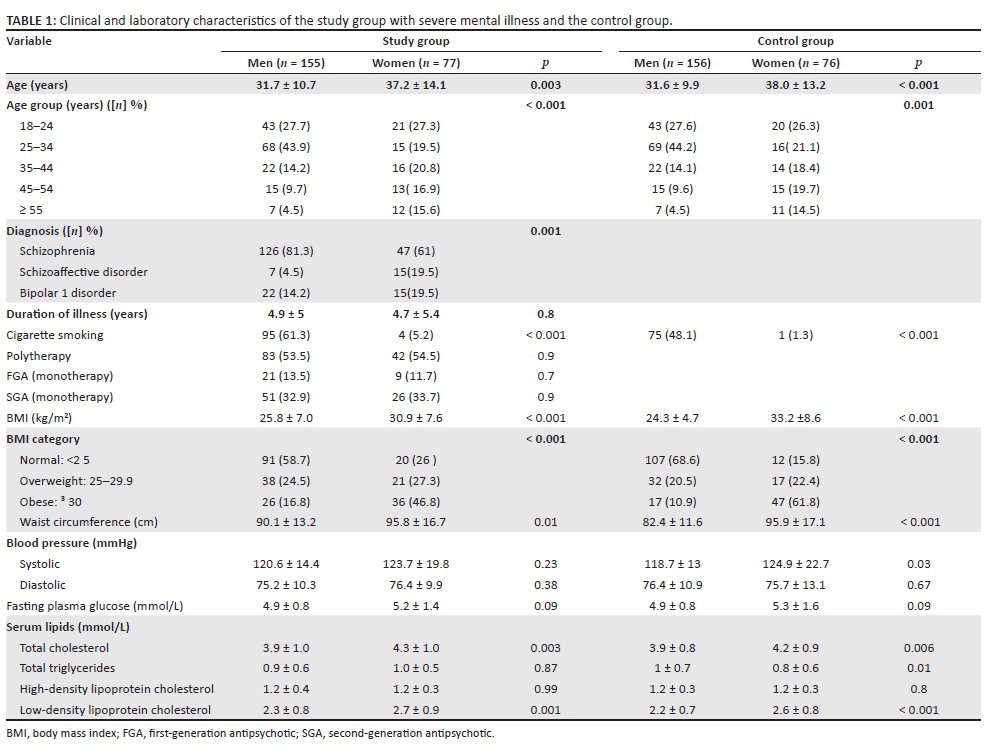
Table 1 shows the characteristics of the study and control groups. The study and control group included 232 participants each. There was a greater proportion of men in both groups, 66.8% (n = 155) in the study group and 67.2% (n = 156) in the control group. Women were significantly older than men in the study (p = 0.003) and control group (p < 0.001). When compared to men with SMI, women were more likely to be diagnosed with schizoaffective disorder and bipolar disorder (p = 0.001), had a lower prevalence of cigarette smoking (5.2% vs. 61.3%) and a higher prevalence of total body obesity (BMI) (46.8% vs. 16.8%). Women with SMI had a higher mean waist circumference (p = 0.01), total serum cholesterol (p = 0.003) and LDL cholesterol level (p = 0.001) compared to men with SMI.
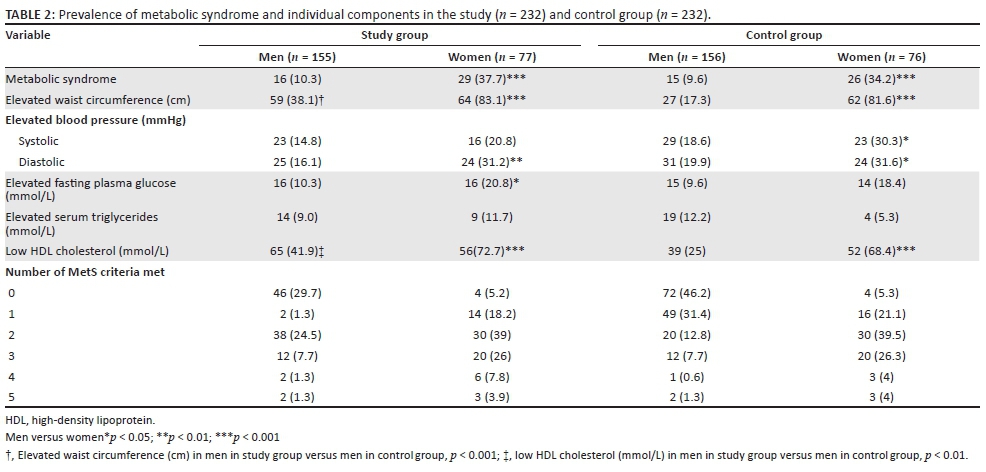
The overall prevalence of MetS was more than three times higher in women with SMI compared to men with SMI (37.7% vs. 10.3%; p < 0.001). Regarding the individual MetS components, except for the systolic blood pressure and serum triglycerides, all the other components were significantly more prevalent in women with SMI compared to men with SMI (p < 0.05).
There was no significant difference in the overall prevalence and prevalence of the individual components of MetS between women with and without SMI. Similarly, there was no significant difference in the overall prevalence of MetS between men with and without SMI, but men with SMI had a higher prevalence of the elevated waist circumference and low HDL criterion than men without SMI (Table 2).
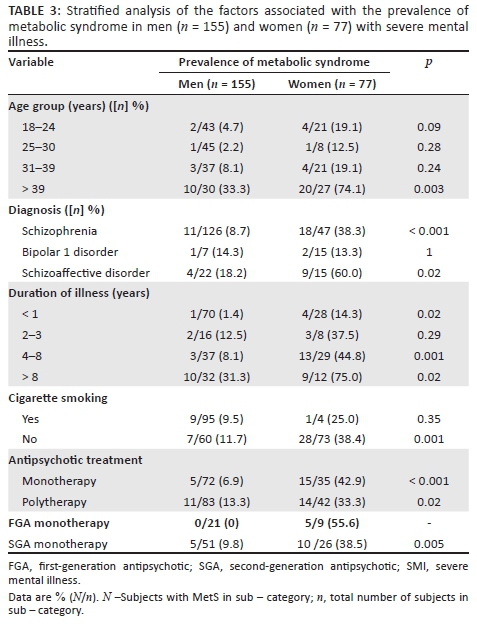
In stratified analysis, variables that were significant confounders of the relationship between MetS and gender in individuals with SMI were age (p = 0.003), duration of illness (p = 0.02), cigarette smoking (p < 0.001), schizophrenia (p < 0.001), schizoaffective disorder (p < 0.02), antipsychotic monotherapy (p < 0.001), antipsychotic polytherapy (p = 0.02) and SGA monotherapy (p = 0.005). Compared to men, the prevalence of MetS was higher in women taking both FGAs (monotherapy; 55.6% vs. 0%) and SGAs (monotherapy; 38.5% vs. 9.8%; p < 0.005) (Table 3).
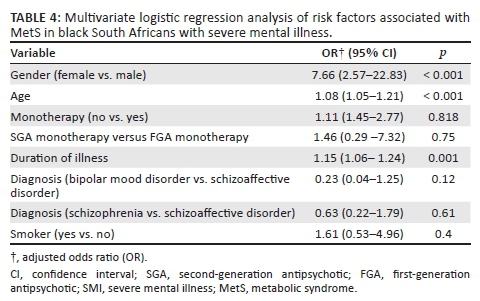
In multivariate logistic regression analysis, after adjusting for the significant confounding variables, female gender (odds ratio (OR) 7.66, confidence interval (CI) 2.57-22.83, p < 0.001), advancing age (OR 1.08, CI 1.05-1.21, p < 0.001) and longer duration of illness (OR 1.15, CI 1.06-1.24, p = 0.001) remained significantly associated with MetS in SMI (Table 4).
Discussion
The main finding of this study in black South Africans with SMI taking antipsychotic medication is a threefold higher overall prevalence of MetS, and an almost eightfold higher risk for MetS in black women with SMI compared to black men with SMI using JIS criteria. There was no difference in the overall prevalence of MetS between women with SMI and women without SMI, or men with SMI and men without SMI from a matched control group.
A higher prevalence of MetS in women with SMI has been reported in individual studies,6413
Regarding the individual criteria, a higher prevalence of the elevated waist circumference criterion of MetS among women with SMI is a consistent finding globally,4p < 0.001) is a concern. However, the appropriateness of the waist circumference criteria currently used to diagnose MetS in black Africans has been called into question. There is a suggestion that gender differences in the prevalence of central obesity and MetS in black South African women may have been overestimated because of the use of inappropriate waist circumference cut offs for individuals of African descent.336
In this study, women with SMI had an almost eightfold higher risk for MetS than men with SMI. A higher risk for MetS in women with SMI is in keeping with the findings of other reports from Turkey78144,6,7
There was a significantly higher prevalence of MetS in women compared to men taking SGAs in the stratified analysis (p = 0.005), but this association did not remain significant in multivariate analysis. The prevalence of MetS was higher in women taking both FGAs and SGAs confirming the lack of a class effect for antipsychotic medication.15
Age is a known risk factor for MetS, and the cumulative exposure to antipsychotic medication and the effects of poor lifestyle choices over time is a key predictor of MetS in SMI.46
In this study, there was no significant difference in the prevalence and gender distribution of MetS between the study and control groups. Two studies, one from Venezuela167
The aetiology of CVD in SMI is known to be multi-factorial and the lack of a difference in the prevalence of MetS between the study and the control group in this study may be explained by common determinants of MetS in the two groups. It is possible that the role of antipsychotic medication in the aetiology of MetS in SMI may be exaggerated in the psychiatric literature5,1731819
Limitations of this study include the cross-sectional design which precluded causal associations and the lack of information regarding other recognised risk factors for MetS such as diet and physical activity. Furthermore, our results may not be generalisable and may be biased by the recruitment of participants and controls from a hospital setting only. Strengths include a within-study control group matched for age, gender as well as ethnicity and the inclusion of participants taking both FGAs and SGAs.
There is little doubt that CVD awareness, education and preventative interventions for women from high-income developed countries has resulted in substantially decreased mortality from CVD.1
Conclusion
This is the first study to draw attention to the higher prevalence and risk for MetS in black South African women with SMI on antipsychotic medication compared to men with SMI on antipsychotic medication. MetS is a risk factor for CVD, and unless corrective action is taken, many black women with SMI in South Africa could lose their lives each year, to what are essentially preventable conditions.
Competing interests
The authors declare that they have no financial or personal relationships which may have inappropriately influenced them in writing this article.
Authors' contributions
S.S. was responsible for the study concept and design. She was involved in the acquisition of the data, the drafting and the preparation of the manuscript, including the final version. A.A.M. contributed substantially to the study proposal, the drafting and preparation of the manuscript as well as the critical revision and approval of the final version of the manuscript. J.K.B. contributed to the study proposal, revision and approval of the final version of the manuscript.
Acknowledgements
This research was made possible by grant number R24TW008863 from the Office of the US Global AIDS Coordinator and the US Department of Health and Human Services, National Institutes of Health (NIH OAR and NIH ORWH). Its contents are solely the responsibility of the authors and do not necessarily represent the official views of the government.
References
-
1. Mensah G, Roth G, Sampson U, et al. Mortality from cardiovascular diseases in sub-Saharan Africa, 1990-2013: A systematic analysis of data from the Global Burden of Disease Study 2013: Cardiovascular topic. Cardiovasc J Afr. 2015;26(2):S6-10. https://doi.org/10.5830/CVJA-2015-036
» https://doi.org/10.5830/CVJA-2015-036 -
2. Alberti KGMM, Eckel RH, Grundy SM, et al. Harmonizing the metabolic syndrome: A Joint Interim Statement of the International Diabetes Federation task force on epidemiology and prevention; National Heart, Lung, and Blood Institute; American Heart Association; World Heart Federation; International. Circulation. 2009;120(16):1640-1645. https://doi.org/10.1161/CIRCULATIONAHA.109.192644
» https://doi.org/10.1161/CIRCULATIONAHA.109.192644 -
3. Motala AA, Esterhuizen T, Pirie FJ, Omar MAK. The prevalence of metabolic syndrome and determination of the optimal waist circumference cutoff points in a rural South African community. Diabetes Care. 2011;34(4):1032-1037. https://doi.org/10.2337/dc10-1921
» https://doi.org/10.2337/dc10-1921 -
4. Vancampfort D, Stubbs B, Mitchell AJ, et al. Risk of metabolic syndrome and its components in people with schizophrenia and related psychotic disorders, bipolar disorder and major depressive disorder: A systematic review and meta-analysis. World Psychiatry. 2015;14:339-347. https://doi.org/10.1002/wps.20252
» https://doi.org/10.1002/wps.20252 -
5. de Leon J. Beyond the "hype" on the association between metabolic syndrome and atypical antipsychotics: The confounding effects of cohort, typical antipsychotics, severe mental illness, comedications, and comorbid substance use. J Clin Psychopharmacol. 2008;28(2):125-131. https://doi.org/10.1097/JCP.0b013e318166f533
» https://doi.org/10.1097/JCP.0b013e318166f533 -
6. McEvoy JP, Meyer JM, Goff DC, et al. Prevalence of the metabolic syndrome in patients with schizophrenia: Baseline results from the Clinical Antipsychotic Trials of Intervention Effectiveness (CATIE) schizophrenia trial and comparison with national estimates from NHANES III. Schizophr Res. 2005;80(1):19-32. https://doi.org/10.1016/j.schres.2005.07.014
» https://doi.org/10.1016/j.schres.2005.07.014 -
7. Boke O, Servet A, Gokhan S, Esin Boke S, Ahmet Rifat S. Prevalence of metabolic syndrome among inpatients with schizophrenia. Int J Psychiatry Med. 2008;38:103-112. https://doi.org/10.2190/PM.38.1.j
» https://doi.org/10.2190/PM.38.1.j -
8. Díaz-Domínguez DA, de la Rosa-Donlucas F, Romans-Demaria L, Grajales-Almeida JR, Sauer-Vera T, Sotelo-Monroy GE. Prevalence of metabolic syndrome and associated risk factors in hospitalized patients with schizophrenia in Mexico. Int J Ment Health. 2013;42(4):95-104. https://doi.org/10.2753/IMH0020-7411420405
» https://doi.org/10.2753/IMH0020-7411420405 -
9. Seeman MV. Schizophrenia: Women bear a disproportionate toll of antipsychotic side effects. J Am Psychiatr Nurses Assoc. 2010;16(1):21-29. https://doi.org/10.1177/1078390309350918
» https://doi.org/10.1177/1078390309350918 -
10. Stauffer VL, Sniadecki JL, Piezer KW, et al. Impact of race on efficacy and safety during treatment with olanzapine in schizophrenia, schizophreniform or schizoaffective disorder. BMC Psychiatry. 2010;10(1):89. https://doi.org/10.1186/1471-244X-10-89
» https://doi.org/10.1186/1471-244X-10-89 -
11. Saloojee S, Burns JK, Motala AA. Metabolic syndrome in South African patients with severe mental illness: Prevalence and associated risk factors. PLoS One. 2016;11(2):e0149209. https://doi.org/10.1371/journal.pone.0149209
» https://doi.org/10.1371/journal.pone.0149209 - 12. American Psychiatric Association. Diagnostic and statistical manual of mental disorders: DSM-IV-TR. 4th ed., text rev. Washington, DC: American Psychiatric Association; 2000.
-
13. Maaroganye K, Mohapi M, Rheeder P. The prevalence of metabolic syndrome and its associated factors in long-term patients in a specialist psychiatric hospital in South Africa. Afr J Psychiatry. 2013;16:414-423. https://doi.org/10.4314/ajpsy.v16i6.53
» https://doi.org/10.4314/ajpsy.v16i6.53 -
14. Lee NY, Kim SH, Jung DC, et al. The prevalence of metabolic syndrome in Korean patients with schizophrenia receiving a monotherapy with aripiprazole, olanzapine or risperidone. Prog Neuro-Psychopharmacol Biol Psychiatry. 2011;35:1273-1278. https://doi.org/10.1016/j.pnpbp.2011.03.022
» https://doi.org/10.1016/j.pnpbp.2011.03.022 -
15. Leucht S, Cipriani A, Spineli L, et al. Comparative efficacy and tolerability of 15 antipsychotic drugs in schizophrenia: A multiple-treatments meta-analysis. Lancet. 2013;382:951-962. https://doi.org/10.1016/S0140-6736(13)60733-3
» https://doi.org/10.1016/S0140-6736(13)60733-3 -
16. Baptista T, Serrano A, Uzcátegui E, et al. The metabolic syndrome and its constituting variables in atypical antipsychotic-treated subjects: Comparison with other drug treatments, drug-free psychiatric patients, first-degree relatives and the general population in Venezuela. Schizophr Res. 2011;126:93-102. https://doi.org/10.1016/j.schres.2010.10.014
» https://doi.org/10.1016/j.schres.2010.10.014 -
17. Clerici M, Bartoli F, Carretta D, Crocamo C, Bebbington P, Carrà G. Cardiovascular risk factors among people with severe mental illness in Italy: A cross-sectional comparative study. Gen Hosp Psychiatry. 2014;36(6):698-702. https://doi.org/10.1016/j.genhosppsych.2014.08.005
» https://doi.org/10.1016/j.genhosppsych.2014.08.005 -
18. Sliwa K, Acquah L, Gersh BJ, Mocumbi AO. Impact of socioeconomic status, ethnicity, and urbanization on risk factor profiles of cardiovascular disease in Africa. Circulation. 2016;133(12):1199-1208. https://doi.org/10.1161/CIRCULATIONAHA.114.008730
» https://doi.org/10.1161/CIRCULATIONAHA.114.008730 -
19. Okop KJ, Mukumbang FC, Mathole T, Levitt N, Puoane T. Perceptions of body size, obesity threat and the willingness to lose weight among black South African adults: A qualitative study. BMC Public Health. 2016;16:365. https://doi.org/10.1186/s12889-016-3028-7
» https://doi.org/10.1186/s12889-016-3028-7

Accepted: 03 Mar. 2017
Published: 10 Apr. 2017