The relationship between locus of control and depression: A cross-sectional survey with university students in Botswana
Abstract
BACKGROUND: Research has consistently revealed a positive association between external locus of control and depression. Little, if any, research has investigated locus of control and depression in the sociocultural context of Botswana. AIM: To explore the relationship between locus of control and depression among undergraduate students in Botswana and to determine the impact of age and gender on this relationship. SETTING: University of Botswana. METHODS: A sample of 272 students was surveyed through a self-administered questionnaire, which included the Levenson's multidimensional locus of control scale, the Beck Depression Inventory-II and demographic questions. Data analysis utilised descriptive statistics, correlation analysis, independent samples t-tests and standard multiple regression analysis. RESULTS: Of the 272 participants, 47.3% scored low (minimal) levels of depression, 23.4% scored mild levels, 18.0% scored moderate levels and 11.3% scored severe levels of depression. Students who believed that they were in control of events in their lives were less likely to present with depressive symptoms (r = -0.29, p = 0.000), while students who believed that chance (r = 0.45, p = 0.000) or powerful others (r = 0.40, p = 0.000) controlled their lives were more likely to have high depression scores. Both internal and external locus of control, together with age, explained 31% of the variance in depression scores; gender made no significant contribution to levels of depression. CONCLUSION: The study results draw attention to locus of control as one of the cognitive variables associated with depression. Further research is needed to determine how locus of control can be addressed in the treatment and prevention of depression in university contexts.
Introduction
Mental health problems among university students have been widely studied.123,4 Whether or not university life contributes to students developing depression will depend on various genetic, neurobiological and psycho-social factors,5,6 but may also be influenced by students' beliefs that they have little or no control over events occurring in their lives. Such beliefs are referred to as 'locus of control'.
The construct of locus of control was introduced by Julian Rotter as part of his social learning theory.77
Some studies have established a relationship between locus of control and depression.8,9 Peterson101112,13,14 Associations between locus of control and depression were also established in student samples from various parts of the world. For example, an American study found that college students who displayed internal locus of control had lower depression scores than students with external locus of control.15161741814
The theory of locus of control helps to explain, at least to some extent, why some students are able to successfully adapt to the demands of university life while others become vulnerable to depression. When faced with challenges, students who believe to a large extent that they are in control of events in their lives will feel encouraged to become proactive. Students who believe that they have little control and that the control lies with powerful others or chance are likely to experience emotional distress and become passive in their behaviour. It appears that the belief that one has little or no control over events that happen in one's life affects a person in a similar way as actual lack of control does, that is, it causes feelings of helplessness, passivity, loss of interest and feelings of hopelessness,19
The literature search did not reveal any research that had investigated the relationship between locus of control and depression in the sociocultural context of Botswana. While no official statistics about the prevalence and distribution of depression are available for Botswana, previous studies identified relatively high prevalence of depression among university students.3,20 The study aimed to explore the association between locus of control and depression in a sample of undergraduate students in Botswana. The study followed Levenson's21212222
Method
Study design
A cross-sectional survey was conducted within the quantitative research paradigm.
Participants and procedure
Applying convenience sampling method, the researchers distributed a self-administered questionnaire in classes attended by undergraduate students from various disciplines within the University of Botswana. The participants completed the questionnaires individually in the lecture venues and returned them to the researchers in the class. In total, 335 questionnaires were distributed, of which 303 questionnaires were returned. Twenty-four questionnaires were excluded from data analysis because they were incomplete over large parts; seven questionnaires were not considered because the respondents were below the age of 18 years and no informed consent was obtained from their parents. Thus, the final sample comprised 272 participants.
Instruments
The self-administered questionnaire contained two scales assessing locus of control and depression, respectively, and questions to determine participants' gender and age. In order to describe characteristics of the sample, additional questions were asked about participants' year of study, faculty enrolement and parents' level of education as an indicator of participants' socio-economic background.
Locus of control was assessed using Levenson's multidimensional locus of control scale.2323
Depression was measured with the Beck Depression Inventory-II (BDI-II).24252424263,20 and was, therefore, regarded as appropriate for the present study.
Data analysis
Data were analysed utilising descriptive statistics, independent samples t-tests (to determine gender differences), Pearson's product-moment correlation coefficient (to determine associations between locus of control, age and depression) and standard multiple regression analysis (to determine whether internal and external locus of control [powerful others, chance], gender and age predicted depression).
Ethical consideration
Participation in the study was anonymous and voluntary and participants were assured that they could withdraw from filling out the questionnaire at any time. Ethical clearance was obtained from the Department of Psychology Ethics Board for Student Research at the University of Botswana. Considering possible distressing effects of filling out the BDI on the students, the researchers debriefed all participants and offered them information about where they could seek psychological help if they felt that the questionnaire had evoked some emotional distress. Although the researchers had announced in classes that students under the age of 18 years should not participate in the study, seven under-aged students filled out the questionnaire. Owing to the anonymity of the participants, the researchers were not able to identify these seven students in order to provide them with additional assistance. However, the seven participants were part of the debriefing about where to obtain psychological help.
Results
The study included a total of 272 participants. Their average age was 20.10 years (mean; standard deviation [s.d.] = 2.84) and most of them were female students (80.2%). Participants were first-year (42.5%), second-year (30.8%), third-year (12.8%) and fourth-year (13.9%) undergraduate students enrolled in the Faculties of Social Sciences (69.9%), Business (23.8%), Humanities (2.2%), Education (2.2%), Health Sciences (1.5%) and Science (0.4%). Almost half of the participants' mothers or female guardians (45.7%) had completed tertiary level education; 44.9% reported the same for their fathers or male guardians.
In the study, internal consistency reliability was low for the internal locus of control subscale (α = 0.44) but acceptable for the subscales measuring the 'chance' dimension (α = 0.69) and the 'powerful others' dimension of external locus of control (α = 0.70). A Cronbach's alpha of 0.90 was obtained for the BDI-II, suggesting a strong internal consistency reliability.
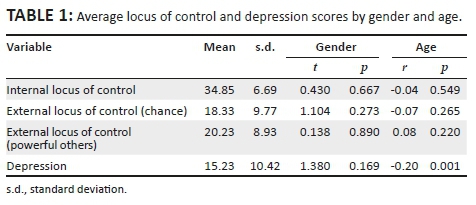
Table 1 presents average locus of control and depression scores by gender and age. A mean score of 34.85 (s.d. = 6.69) was obtained for internal locus of control. For external locus of control, the mean scores were 18.33 (s.d. = 9.77) for locus of control (chance) and 20.23 (s.d. = 8.93) for locus of control (powerful others).
The mean score for depression was 15.23 (s.d. = 10.42); the percentage of participants who scored at minimal level of depression was 47.3% and 23.4% at mild depression, 18.0% at moderate depression and 11.3% at severe level of depression.
Gender and age made no difference in participants' locus of control scores. Gender also made no difference in participant's depression scores. However, age had a weak but statistically significant negative association with depression. Younger participants were more likely to have higher depression scores (r = −0.20, p = 0.001; Table 1).
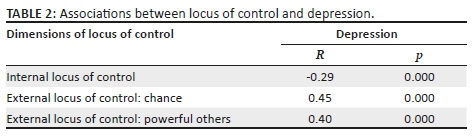
Table 2 presents associations between locus of control and depression. The results show that the correlation between internal locus of control and depression was negative though weak (r = -0.29, p = 0.000), while both external locus of control (chance) and external locus of control (powerful others) were positively associated with depression; the correlations were moderate (r = 0.45, p = 0.000; r = 0.40, p = 0.000).
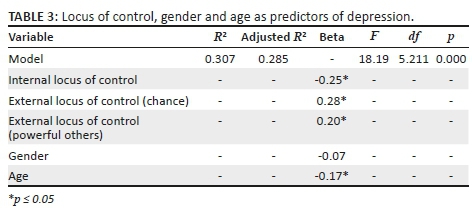
To determine whether or not locus of control predicted depression, standard multiple regression analysis was performed. A model was tested that included (1) internal locus of control, (2) external locus of control (chance), (3) external locus of control (powerful others), (4) gender and (5) age as predictor variables (Table 3). This model explained 30.7% of the variances in depression scores (R2R2F[5, 211] = 18.19, p = 0.000). External locus of control (chance) made the largest unique contribution (beta = 0.28). External locus of control (powerful others) (beta = 0.20), internal locus of control (beta = -0.25) and age (beta = -0.17) also made significant contributions, while gender did not significantly contribute to depression.
Discussion
This study aimed to explore the relationship between locus of control and depression in a sample of university students in Botswana. The results revealed that internal locus of control was negatively associated with depression. The two dimensions of external locus of control (chance and powerful others) were positively associated with depression. The associations between locus of control and depression were moderate and lower for internal locus of control than for the two dimensions of external locus of control.
Both low internal and high external locus of control predicted depression; together with age they explained about 31.0% of the variances in the participants' depression scores. These results are consistent with findings from various other studies.12,13,14
While there are various genetic, neurobiological and psycho-social factors contributing to depression, the results draw attention to locus of control as one of the cognitive variables playing a significant role in depression. The results suggest that when students believe that they are in control over events in their lives they are less likely to present with depressive symptoms. One can assume that such belief encourages students to address stressful events proactively, which prevents them from engaging in negative thoughts about themselves, the world and the future112
In this study, the belief that 'chance' would control events in one's life was slightly more strongly associated with depression than the belief that 'powerful others' would control events in one's life. This result differs from findings in other studies where the belief in 'powerful others' produced slightly stronger associations with depression than the belief in 'chance'.12421
[P]eople who believe that the world is unordered (chance) would behave and think differently than people who believe that the world is ordered but that powerful others are in control. (p. 398)
Beliefs in chance could potentially result in more feelings of helplessness and produce more depressive symptoms as chance is basically not controllable, whereas powerful others, depending on who they are, could, in principle, be influenced. According to Levenson,2127
In this study, 18.0% of the participants scored a moderate level of depression and 11.3% scored a severe level of depression. These percentages are within the range of depression prevalence found in other studies with university students in the region,3,28,29 although the results vary widely. Younger students had higher depression scores than older students, which suggests that for some students the beginning of their student life was already overshadowed by depressive symptoms, which were likely to affect their academic performance30
While the prevalence of depression in this sample does not permit us to draw conclusions about its representativeness in the larger student community, it nevertheless calls for psychological and psychiatric interventions. The results also indicate a need for preventative strategies that attend to students with external locus of control before they present with depressive symptoms. Rotter7
Limitations
The study had a few limitations. Firstly, the sampling method does not allow for the generalisation of the results to other populations or other university students. Secondly, the reliability of the study could have been impacted negatively by the use of self-report measures. Thirdly, the study did not consider mediating and moderating variables that could have influenced the association between locus of control and depression. More research is necessary to address these limitations.
Conclusion
This study aimed at exploring the relationship between locus of control and depression among undergraduate students in Botswana. The results draw attention to locus of control as one of the cognitive variables that play a significant role in depression. The results suggest that students who display internal locus of control are less likely to be depressed, whereas students who display external locus of control are more likely to present with depressive symptoms. Depression has negative implications for students' academic success, future employment, future relationships and their happiness in life. It is worthwhile to consider locus of control as one of the significant variables when addressing depression as a mental health problem among university students. Further research is needed to determine how locus of control can be addressed successfully in the treatment and prevention of depression within university contexts.
Competing interests
The authors declare that they have no financial or personal relationships that may have inappropriately influenced them in writing this article.
Disclaimer
The views expressed in this article are the authors' own and not an official position of the institution.
Authors' contributions
T.K. was responsible for the research idea, literature review, data collection, data analysis and writing of the article. I.E.P. supervised the study and contributed to project design, literature review, data analysis and writing of the article.
Acknowledgements
References
-
1. Eisenberg D, Gollust SE, Golberstein E, Hefner JL. Prevalence and correlates of depression, anxiety, and suicidality among university students. Am J Orthopsychiatry. 2007;77(4):534-542. https://doi.org/10.1037/0002-9432.77.4.534
» https://doi.org/10.1037/0002-9432.77.4.534 -
2. Bitsika V, Sharpley CF, Rubenstein V. What stresses university students: An interview investigation of the demands of tertiary studies. J Psychol Counc Sch. 2010;20(1):41-54. https://doi.org/10.1375/ajgc.20.1.41
» https://doi.org/10.1375/ajgc.20.1.41 -
3. Hetolang LT, Amone-P'Olak K. The association between stressful life events and depression among students in a university in Botswana. S Afr J Psychol [serial online]. 2017 [cited 2018 Jan 12]. Available from: http://journals.sagepub.com/home/sap
» http://journals.sagepub.com/home/sap -
4. Zawawi JA, Hamaideh SH. Depressive symptoms and their correlates with locus of control and satisfaction with life among Jordanian college students. Eur J Psychol. 2009;5(4):71-103. https://doi.org/10.5964/ejop.v5i4.241
» https://doi.org/10.5964/ejop.v5i4.241 -
5. Beck AT. The evolution of the cognitive model of depression and its neurobiological correlates. Am J Psychiatry. 2008;165(8):969-977. https://doi.org/10.1176/appi.ajp.2008.08050721
» https://doi.org/10.1176/appi.ajp.2008.08050721 -
6. Lorant V, Croux C, Weich S, Deliège D, Mackenbach J, Ansseau M. Depression and socioeconomic risk factors: 7-year longitudinal population study. Br J Psychiatry. 2007;190(4):293-298. https://doi.org/10.1192/bjp.bp.105.020040
» https://doi.org/10.1192/bjp.bp.105.020040 -
7. Rotter JB. Generalized expectancies for internal versus external control of reinforcement. Psychol Monogr. 1966;80(1):1-28. https://doi.org/10.1037/h0092976
» https://doi.org/10.1037/h0092976 -
8. Lefcourt HM. Locus of control. Current trends in theory and research. New York: Psychology Press; 2014. https://doi.org/10.4324/9781315798813
» https://doi.org/10.4324/9781315798813 -
9. Wiersma JE, van Oppen P, van Schaik DJF, van der Does AJW, Beekman ATF, Penninx BWJH. Psychological characteristics of chronic depression: A longitudinal cohort study. J Clin Psychiatry. 2011;72(3):288-294. https://doi.org/10.4088/JCP.09m05735blu
» https://doi.org/10.4088/JCP.09m05735blu -
10. Peterson C. Uncontrollability and self-blame in depression: Investigation of the paradox in a college population. J Abnorm Psychol. 1979;88(6):620-624. https://doi.org/10.1037/0021-843X.88.6.620
» https://doi.org/10.1037/0021-843X.88.6.620 -
11. Clark DA, Steer RA, Beck AT. Common and specific dimensions of self-reported anxiety and depression: Implications for the cognitive and tripartite models. J Abnorm Behav. 1994;103(4):645-654. https://doi.org/10.1037/0021-843X.103.4.645
» https://doi.org/10.1037/0021-843X.103.4.645 -
12. Benassi VA, Sweeney PD, Dufour CL. Is there a relationship between locus of control and depression. J Abnorm Psychol. 1988;97(3):357-367. https://doi.org/10.1037/0021-843X.97.3.357
» https://doi.org/10.1037/0021-843X.97.3.357 - 13. Presson PK, Benassi VA. Locus of control orientation and depressive symptomatology: A meta-analysis. J Soc Behav Pers. 1996;11(1):201-212.
-
14. Cheng C, Cheung S, Chio JH, Chan MS. Cultural meaning of perceived control: A meta-analysis of locus of control and psychological symptoms across 18 cultural regions. Psychol Bull. 2013;139(1):152-188. https://doi.org/10.1037/a0028596
» https://doi.org/10.1037/a0028596 -
15. Evans RG. The relationship of two measures of perceived control to depression. J Pers Assess. 1981;45(1):66-70. https://doi.org/10.1207/s15327752jpa4501_13
» https://doi.org/10.1207/s15327752jpa4501_13 -
16. Griffin DP. Locus of control and psychological well-being: Separating the measurement of internal and external constructs - A pilot study [homepage on the Internet]. EKU Libraries Research Award for Undergraduates. 2014 [cited 2017 Mar 15];2. Available from: http://encompass.eku.edu/ugra/2014/2014/2
» http://encompass.eku.edu/ugra/2014/2014/2 - 17. Jaswal S, Dewan A. The relationship between locus of control and depression. J Pers Clin Stud. 1997;13(1-2):25-27.
-
18. April KA, Dharani B, Peters K. Impact of locus of control expectancy on level of well-being. Rev Eur Stud. 2012;4(2):124-137. https://doi.org/10.5539/res.v4n2p124
» https://doi.org/10.5539/res.v4n2p124 - 19. Seligman MEP. Helplessness: On depression, development, and death. San Francisco, CA: Freeman; 1975.
-
20. Korb I, Plattner IE. Suicide ideation and depression in university students in Botswana. J Psychol Afr. 2014;24(5):420-426. https://doi.org/10.1080/14330237.2014.997010
» https://doi.org/10.1080/14330237.2014.997010 -
21. Levenson H. Multidimensional locus of control in psychiatric patients. J Consult Clin Psychol. 1973;41(3):397-404. https://doi.org/10.1037/h0035357
» https://doi.org/10.1037/h0035357 -
22. Kessler RC, Bromet EJ. The epidemiology of depression across cultures. Annu Rev Publ Health. 2013;34:119-138. https://doi.org/10.1146/annurev-publhealth-031912-114409
» https://doi.org/10.1146/annurev-publhealth-031912-114409 - 23. Levenson H. Reliability and validity of the I, P, and C scales. A multidimensional view of locus of control. Paper presented at: 81st Annual Convention of the American Psychological Association, 1973 Aug 27-31; Montreal, Canada: American Psychological Association.
- 24. Beck AT, Steer RA, Brown GK. Beck depression inventory manual. 2nd ed. San Antonio, TX: The Psychological Corporation; 1996.
-
25. Dyrbye LN, Thomas MR, Shanafelt TD. Systematic review of depression, anxiety, and other indicators of psychological distress among U.S. and Canadian medical students. Acad Med. 2006;81(4):354-373. https://doi.org/10.1097/00001888-200604000-00009
» https://doi.org/10.1097/00001888-200604000-00009 -
26. Govender RD, Schlebusch L. Suicidal ideation in seropositive patients seen at a South African HIV voluntary counselling and testing clinic. Afr J Psychiatry. 2012;15:94-98. https://doi.org/10.4314/ajpsy.v15i2.12
» https://doi.org/10.4314/ajpsy.v15i2.12 - 27. Makgala CJ, Monkge DC. Witchcraft renaissance: The paradox of sorcery and christianity among the Batswana, 1849-2008. Botsw Notes Rec. 2011;43:140-150.
-
28. Adewuya AO, Ola BA, Aloba OO, Mapayi BM, Oginni OO. Depression amongst Nigerian university students: Prevalence and sociodemographic correlates. Soc Psychiatry Psychiatr Epidemiol. 2006;41(8):674-678. https://doi.org/10.1007/s00127-006-0068-9
» https://doi.org/10.1007/s00127-006-0068-9 -
29. Othieno CJ, Okoth RO, Peltzer K, Pengpid S, Malla LO. Depression among university students in Kenya: Prevalence and socio-demographic correlates. J Affect Disord. 2014;165:120-125. https://doi.org/10.1016/j.jad.2014.04.070
» https://doi.org/10.1016/j.jad.2014.04.070 - 30. Turner DP, Thompson ME, Brunner LB, Arif AA. Depressive symptoms and academic performance of North Carolina college students. N C Med J. 2012;73(3):169-175.

Accepted: 22 Jan. 2019
Published: 19 Feb. 2019