Youth exposure to violence and victimization in a South African community sample
Abstract
BACKGROUND: Studies show that youth in low socioeconomic communities suffer significant disturbances in mental and emotional health because of exposure to violence and peer victimisation, manifesting in internalising disorders such as depression, anxiety and traumatic stress. AIM: To examine the relation between risks and exposure to community violence and peer victimisation. SETTING: Low socioeconomic communities in Durban, KwaZulu-Natal. METHODS: Data were collected via school and home interviews with youth and maternal caregivers using standardised schedules and instruments. These included the Demographics and Questions about Child's Health schedule, the Family History of Risk Questionnaire, the Child Behaviour Checklist, the Social Experiences Questionnaire and the Survey of Children's Exposure to Violence. Youth sample comprised 256 participants, with age range from 9 to 18 years, and 65% being female. RESULTS: Sociodemographic risks were significantly associated with lifetime witnessing violence, victimisation and hearing about violence. Low maternal education was associated with overt peer victimisation and cyber-victimisation. Internalising conditions such as worry and oversensitivity, fear and concentration, youth anxiety and maternal anxiety were also significantly associated with violence exposure and peer victimisation. CONCLUSION: Predisposing risks for exposure to violence and victimisation occur in all domains, suggesting that interventions should target these domains to minimise their impact. Co-occurring experience of violence at the personal, proximal and distal levels perpetuate a cyclical loop of violence, intersecting and influencing each other. CONTRIBUTION: Risk factors such as anxious attachment, avoidant attachment and anxiety, conceptually often seen as maladaptive outcomes, also serve as predisposing risks for violence exposure.
youth; risk factors; sociodemographic risk; psychosocial risk; maternal education; violence exposure; peer victimisation; cyber victimisation; internalizing disorders
Introduction
International studies consistently demonstrate that youth in low socioeconomic status (SES) communities are not only exposed to high rates and distinct types of violence but also show substantive evidence of the adverse effects of violence exposure. Long-term effects of trauma, for example, often persist into adulthood, manifesting as chronic mental health conditions, difficulties in forming healthy relationships and impaired cognitive and emotional development. The prevalence and extent of violence exposure were clearly illustrated in a landmark survey by Verner and Alda,123
The linkages between risk and violence exposure, victimisation and other forms of violence feature consistently in the literature as shown in a meta- analysis of longitudinal studies on violence exposure by Castellvi et al.45
In South Africa, indications are that the youth are increasingly signalling their experiences of stress, trauma and violence as seen in a resurgence of violence in schools and universities, including bullying and victimisation and reported higher levels of suicide and school dropouts.678,9 Often, however, research findings on the extent, scope and the nature of youths' experience of violence raise questions because of the inconsistencies and disparities in the reporting of such experiences. Makol et al.10
In South Africa, past socioeconomic and structural inequalities, many a legacy of apartheid policies, have created a climate of violence, which continues to perpetuate a cycle of endemic exposure to violence,11 121314
Peer victimisation forms part of a complex interrelated system of direct and indirect violence and typically involves the intentional use or threat of physical or psychological violence, which may result in physical injury or psychological harm.15 1617181920
One of the damaging effects of apartheid is that the majority, who are black African, have grown up in a society that was marked by political and social violence, further segregated along racial and economic lines. Research on these components has identified several key risk factors including gender, ethnicity, poverty, unemployment, the mental health of a parent, parental educational status, single-parent family, exposure to violence and peer victimisation.21 22
Research methods and design
This study is part of a larger collaborative research project on risk and resilience among youth in low socioeconomic communities in Durban, South Africa, titled Project CARE.
It builds on the previous work by Pillay et al.18
Setting
This study was conducted in low socioeconomic communities in Durban, KwaZulu-Natal. They were identified using Evan's22
Study participants
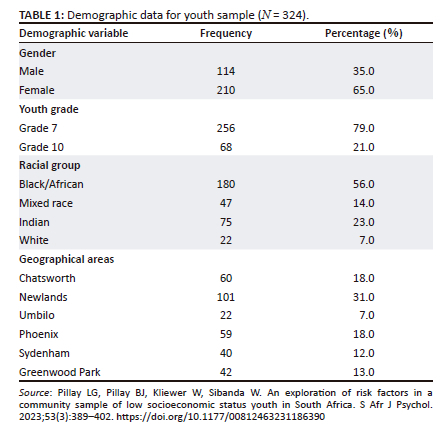
The participants (N = 324), were youth and their maternal caregivers. Table 1 presents youth demographic information. Youth participants in grade 7 (n = 256) and grade 10 (n = 68) were recruited from schools within the eThekwini Municipality (Durban) area. Approximately 73.1% (n = 237) of the youth live with their biological mothers as the primary maternal caregivers, while 26.9% (n = 87) lived with extended maternal caregivers, including stepmothers, grandmothers and elder sisters. Households with more than eight members compromised 19.8% (n = 64) of the sample.
Maternal caregivers' ages ranged from 21 to 75 years (M = 41.57, s.d. = 9.86). The maternal caregivers comprised 54.6% (n = 177) who were married or co-habiting, while 43.5% (n = 141) reported as never married or co-habiting. Most caregivers reported having a grade 9 to grade 12 high school education (70%, n = 228) and most reported being either unemployed or unable to work or being full-time housewives or retired (52.8%, n = 171). More than a third of the caregivers reported being unemployed or were unable to work. Household income was diverse across the sample, with 142 (43.8%) reporting that their income was unstable and varied from month to month.
Data collection
Project CARE, from which this study is derived, sampled community schools with grade 7 and grade 10 scholars. This was based on prior studies on risk22
The youth and caregivers who submitted their informed consent were contacted, and arrangements were made for interviews by trained research assistants at their homes using structured caregiver and youth interview questionnaires. The youth and caregivers were interviewed separately. All measures and data collected were checked and reviewed by the team of clinical psychologists involved in the research project. This was to ensure validity and reliability of data collected via instruments and to ensure proper data capturing and management.
Instruments
Various questionnaires were included in the caregiver and child interviews to collect a wide range of data with respect to socioeconomic, psychosocial, psycho-emotional and biomedical factors.
The following questionnaires were part of the Maternal Caregiver Interview:
The Demographics and Questions about Child's Health schedule was developed by the Project CARE research team and was used to collect data on demographic measures, family and parental information and parental assessment of a child's health.
The Family History of Risk, a 22-item questionnaire used to assess the presence or absence of events that could be considered as elevating the risk for maladjustment, was developed by the Programme for Prevention Research in 1999.2424
The maternal caregivers completed the Child Behaviour Checklist (CBCL), which contains a series of 113 items that help assess a child's behavioural and emotional problems over the 3 months preceding the administration of the questionnaire.25
The Youth Interview included the following questionnaires:
The Social Experiences Questionnaire (SEQ-S) is a self-report measure of children's experience of relational victimisation, overt victimisation and cyber-victimisation and is derived from the Problem Behaviour Frequency Scales. Internal consistency ranges from 0.77 to 0.80. Crick et al.2627
The Survey of Children's Exposure to Violence, a 40-item survey, was used to measure youth's exposure to community violence. The survey assesses the frequency that a child has been victimised by, has witnessed or heard about, 20 different forms of violence and violence-related activities in the community. Satisfactory reliability (test-retest, r = 0.90; internal consistency, α = 0.85) has been reported.2829
Data analysis
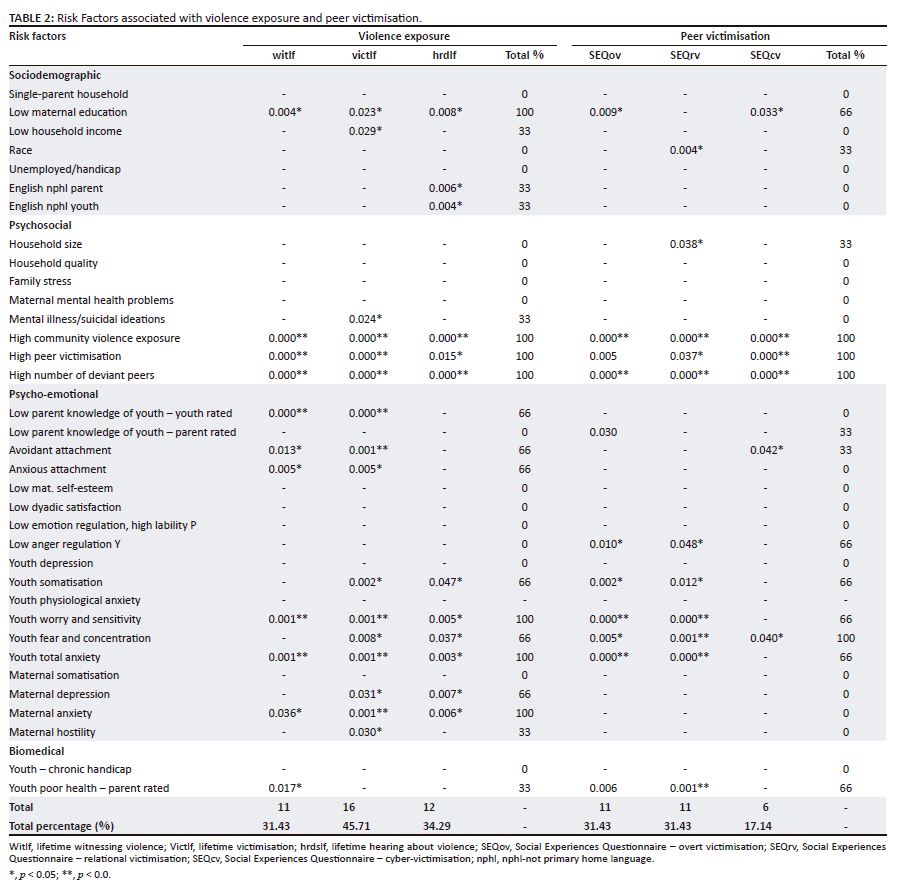
Data analysis was performed using SPSS version 25.30p < 0.001. A chi-square test was used to determine the associations between the 35 risk factors and exposure to violence and peer victimisation. Violence exposure comprised three sub-measures, namely lifetime exposure to victimisation of violence, lifetime witnessing violence and lifetime hearing about violence. Peer victimisation also included three sub-measures, namely overt victimisation, relational victimisation and cyber-victimisation. Based on the total of three sub-measures, a risk factor that featured ≥ 2 was considered significant. In statistical data analysis, the occurrence of more than two significant subtests in a test of association is significant because it increases the likelihood that the observed associations are not because of chance, thereby enhancing the overall statistical power of the test, making the results more reliable and robust and leading to more confident and reliable conclusions.
Ethical considerations
Ethical clearance to conduct this study was obtained from the University of KwaZulu-Natal, Biomedical Research Ethics Committee (No. BE052/11). Youth and caregiver participation was voluntary with the choice of withdrawing from the study at any time. All youth and caregiver participants were awarded a shopping voucher as a gesture of appreciation for the time and effort invested in the project.
Results
Table 1 presents the demographic data for youths participating in the study.
Table 2 presents the 35 risk factors and their associations with community violence exposure and peer victimisation. The results show that among the sociodemographic risk factors, low maternal education was significantly associated with lifetime witnessing violence, X2n = 317) = 8.410, p < 0.004; lifetime victimisation, X2n = 323) = 5.134, p < 0.023 and lifetime hearing about violence, X2n = 240) = 6.990, p < 0.008. Low maternal education was also significantly associated with overt peer victimisation (X2n = 312] = 6.904, p < 0.009) and cyber peer victimisation (X2n = 322] = 4.565, p < 0.033). On the psychosocial risk domain, community violence exposure, victimisation and having a high number of deviant peer relationships were significantly associated with direct and indirect violence exposure and peer victimisation. Similarly, youth worry and oversensitivity, youth fear and concentration, youth and total anxiety and maternal anxiety were significantly associated with measures of violence exposure and measures of peer victimisation. Sixteen (45.71%) of the 35 risk factors were significantly associated with lifetime victimisation, 11 (31.43%) with lifetime witnessing community violence and 12 (34.29%) with lifetime hearing about community violence.
Discussion
This study investigated the relationship between 35 risk factors and direct and indirect violence exposure and peer victimisation in a diverse low socioeconomic community sample. The negative impact of exposure to violence on youth development, mental health and academic achievements has been well documented.5,31,32,33 In the literature on violence exposure and victimisation, much of the focus is on the maladaptive psychological outcomes, especially in terms of internalising and externalising disorders and interventions.1318
Low maternal education emerged as a high sociodemographic risk for youth, associated with lifetime witnessing violence, hearing about violence and both overt and cyber peer victimisation. Mothers with low education may not view indirect exposure to violence and victimisation as being critical to a child's development as direct experience of violence and may therefore be less disposed to attending to the potential negative impact. Additionally, mothers with lower education may suffer greater helplessness in dealing with violence and may further engage a 'normalisation' defence strategy. Mothers with low education may also lack the self-confidence and may experience more challenges in accessing resources and institutional assistance. While low household income (alluding to poverty) only features as a significant risk for lifetime victimisation, the combination with poor maternal education and environmental deprivation creates a cumulative disadvantage, where each risk reinforces the negative impact of the other. For instance, a mother with limited education may have fewer job opportunities, leading to poverty, which in turn exacerbates the challenges posed by an impoverished environment. A US-based study, for example, found high rates of past-year exposure to violence for youth residing in high-disadvantage neighbourhoods.34
While maternal emotional dysregulation did not emerge as significant, it is nonetheless a critical covariate of low maternal education, which places children at risk for psychological and behavioural problems353637
As expected, exposure to community violence is a significant risk factor for victimisation, and conversely, victimisation increases the likelihood of exposure to violence. The experience of violence is rarely isolated, often perpetuating a cyclical loop of violence, exposure and victimisation. Leoschut et al.38
Our study also shows that factors traditionally seen as maladaptive outcomes additionally serve as predisposing risk factors for violence exposure. For instance, while youth with numerous deviant peers may exhibit outcomes such as anxious attachment, avoidant attachment, anxiety, fear and low concentration,4,39 these traits, in turn, predispose them to increased exposure to violence and victimisation. This may occur through various mechanisms. For example: (1) youth with high levels of anxiety or fear may have impaired judgment and decision-making abilities, making them more likely to engage in risky behaviours or associate with deviant peers; (2) anxiety and fear can heighten stress responses, making youth more reactive to threats, leading to behaviours that provoke or attract violence; (3) avoidant attachment can result in reluctance to seek help from supportive adults or peers, leaving youth more isolated and vulnerable to victimisation; (4) peers and perpetrators of violence may perceive anxious or fearful youth as easy targets, increasing the likelihood of victimisation; and (5) youth with these traits may use maladaptive coping strategies such as substance abuse or aggression, which can further expose them to violent environments. Together these factors create a cycle where maladaptive traits increase the likelihood of encountering violence, which in turn can reinforce and exacerbate these traits.
Conclusion
Our study clearly shows that the risk factors associated with exposure to violence and peer victimisation occur on all levels, including the sociodemographic, psychosocial, psycho-emotional and biomedical clusters. While studies often recommend macrolevel interventions such as community empowerment, legislation and policy development,404142
Although this study presented an inclusive taxonomy of risk factors and its associations with violence exposure and victimisation, in a representative sample of youth in KwaZulu-Natal, certain limitations are noted. Initially, the use of a cross-sectional design did not yield longitudinal data, especially to track changes in patterns of occurring risks and associations over time. This study also utilised self-report inventories, which could be subject to inaccurate understanding of constructs, poor recall and misrepresentation. Despite the potential impact of low maternal education, trained research assistants mitigated these issues, enhancing the reliability and validity of written responses. The addition of qualitative clinical interviews may be useful in increasing the veracity of the data. Qualitative interviews allow nuanced information about thoughts, feelings and behaviours; provide a deeper understanding of context; can reveal underlying motivations and allow for clarification of ambiguous or incomplete responses.
While the study reflects the overall demographics of the race groups in South Africa, it would be useful if more equitable numbers of participants from the different race groups were included in the sample. In addition, this study did not include gender-specific factors and associations. Given the growing incidences of reported gender-based violence, it is imperative that future research must necessarily explore gender as a risk and its association with violence exposure. This would endear such studies with critical community and societal relevance and would also consider a fuller spectrum of the experience of violence in our communities. Nonetheless, this study contributes uniquely to the literature on risk factors and to the understanding of the associations between risk factors and violence exposure and peer victimisation among youth in low socioeconomic communities in South Africa.
Competing interests
The authors declare that they have no financial or personal relationship(s) that may have inappropriately influenced them in writing this article.
Authors' contributions
L.G.P. contributed towards the concept and design of the research article, the design of interviews and training of research assistants, data collection, analysis and drafting the final article for submission and publication. B.J.P. made substantive contributions to the conceptualisation and design of the article, assisted with revisions and approved the final version of the article for submission and publication. W.S. contributed towards the concept and design of the article, data and statistical analysis, revised relevant contributions and approved the version for submission and publication.
Funding information
This research article and the authors received no specific grant from any funding agency in the public, commercial or not-for-profit sectors.
Data availability
The demographic information and data collected are held jointly by the Department of Behavioural Medicine, College of Health Sciences, UKZN, and Department of Psychology, Virginia Commonwealth University, Washington, USA. The data are managed with numbered identifiers on SPSS version 25 and may be requested from the authors L.G.P., B.J.P., W.S. and principal researchers (Basil J. Pillay, Wendy Kliewer, Nishola Rawatlal, Karl Swain, Lingum Pillay).
Disclaimer
The views and opinions expressed in this article are those of the authors and are the product of professional research. It does not necessarily reflect the official policy or position of any affiliated institution, funder, agency or that of the publisher. The authors are responsible for this article's results, findings and content.
Acknowledgements
The authors would like to acknowledge Dr. W. Kliewer for her critical and co-principal role in conceptualising, designing and facilitating the main project on which this research article is based. The work was supported by the Project CARE research team at the Department of Behavioural Medicine, Nelson Mandela College of Medicine, UKZN, and the Department of Psychology, Virginia Commonwealth University, USA.
References
- 1. Verner D, Alda E. Youth at risk, social exclusion, and intergenerational poverty dynamics: A new survey instrument with application to Brazil. Washington, DC: World Bank, 2004; p. 1-46
- 2. Finkelhor D, Turner H. National Survey of Children's Exposure to Violence III, 1997-2014 [United States]. Inter-university Consortium for Political and Social Research [distributor]. Michigan: ICPSR University of Michigan; 2016.
- 3. Cuevas CA, Finkelhor D, Shattuck A, TurnerHeather, Hamby S. Children's exposure to violence and the intersection between delinquency and victimization. In: Justice UDo, editor. October ed. Washington, DC: Office of Juvenile Justice and Delinquency Prevention; 2013.
-
4. Castellvi P, Miranda-Mendizabal A, Pares-Badell O, et al. Exposure to violence, a risk for suicide in youths and young adults. A meta-analysis of longitudinal studies. Acta Psychiatr Scand. 2017;135(3):195-211. https://doi.org/10.1111/acps.12679
» https://doi.org/10.1111/acps.12679 -
5. Kliewer W, Lepore SJ. Exposure to violence, social cognitive processing, and sleep problems in urban adolescents. J Youth Adolesc. 2015;44(2):507-517. https://doi.org/10.1007/s10964-014-0184-x
» https://doi.org/10.1007/s10964-014-0184-x - 6. Weybright EH, Caldwell LL, Xie HJ, Wegner L, Smith EA. Predicting secondary school dropout among South African adolescents: A survival analysis approach. S Afr J Educ. 2017;37(2):1353.
- 7. Curtin SC, Garnett MF. Suicide and homicide death rates among youth and young adults aged 10-24: United States, 2001-2021. In: Prevention. USDoHaHSCfDCa, editor. Atlanta: National Center for Health Statistics; 2023.
-
8. Matzopoulos R, Cois A, Probst C, Parry C, Vellios N, Sorsdahl K. Estimating the changing burden of disease attributable to alcohol use in South Africa for 2000, 2006 and 2012. S Afr Med J. 2022;112(8b):662-675. https://doi.org/10.7196/SAMJ.2022.v112i8b.16487
» https://doi.org/10.7196/SAMJ.2022.v112i8b.16487 -
9. Owolabi EO, Nyamathe S, Joseph C, et al. Mapping access to care and identification of barriers for traumatic brain injury in a South African township. J Eval Clin Pract. 2023;29(2):380-391. https://doi.org/10.1111/jep.13793
» https://doi.org/10.1111/jep.13793 -
10. Makol BA, De Los Reyes A, Garrido E, Harlaar N, Taussig H. Assessing the mental health of maltreated youth with child welfare involvement using multiiInformant reports. Child Psychiatry Hum Dev. 2021;52(1):49-62. https://doi.org/10.1007/s10578-020-00985-8
» https://doi.org/10.1007/s10578-020-00985-8 - 11. Dalvit L. A decolonial perspective on online media discourses in the context of violence against people with disabilities in South Africa. Comunicação e Sociedade. 2022;41:169-187.
-
12. Das-Munshi J, Lund C, Mathews C, Clark C, Rothon C, Stansfeld S. Mental health inequalities in adolescents growing up in post-apartheid South Africa: Cross-sectional survey, SHaW Study. PLoS One. 2016;11(5):e0154478. https://doi.org/10.1371/journal.pone.0154478
» https://doi.org/10.1371/journal.pone.0154478 -
13. Sui X, Massar K, Kessels LTE, Reddy PS, Ruiter RAC, Sanders-Phillips K. Violence exposure in South African adolescents: Differential and cumulative effects on psychological functioning. J Interpers Violence. 2021;36(9-10):4084-4110. https://doi.org/10.1177/0886260518788363
» https://doi.org/10.1177/0886260518788363 -
14. Hong JS, Espelage DL, Rose CA. Bullying, peer victimization, and child and adolescent health: An introduction to the special issue. J Child Fam Stud. 2019;28(9):2329-2334. https://doi.org/10.1007/s10826-019-01502-9
» https://doi.org/10.1007/s10826-019-01502-9 -
15. Zhu J, Yu C, Zhang W, et al. Peer victimization, deviant peer affiliation and impulsivity: Predicting adolescent problem behaviors. Child Abuse Negl. 2016;58:39-50. https://doi.org/10.1016/j.chiabu.2016.06.008
» https://doi.org/10.1016/j.chiabu.2016.06.008 -
16. Cole DA, Maxwell MA, Dukewich TL, Yosick R. Targeted peer victimization and the construction of positive and negative self-cognitions: Connections to depressive symptoms in children. J Clin Child Adolesc Psychol. 2010;39(3):421-435. https://doi.org/10.1080/15374411003691776
» https://doi.org/10.1080/15374411003691776 -
17. Fincham DS, Altes LK, Stein DJ, Seedat S. Posttraumatic stress disorder symptoms in adolescents: Risk factors versus resilience moderation. Compr Psychiatry. 2009;50(3):193-199. https://doi.org/10.1016/j.comppsych.2008.09.001
» https://doi.org/10.1016/j.comppsych.2008.09.001 -
18. Pillay LG, Pillay BJ, Kliewer W, Sibanda W. An exploration of risk factors in a community sample of low socioeconomic status youth in South Africa. S Afr J Psychol. 2023;53(3):389-402. https://doi.org/10.1177/00812463231186390
» https://doi.org/10.1177/00812463231186390 -
19. Gutman LM, Peck SC, Malanchuk O, Sameroff AJ, Eccles JS. X: Integrative summary. Monogr Soc Res Child Dev. 2017;82(4):133-142. https://doi.org/10.1111/mono.12336
» https://doi.org/10.1111/mono.12336 -
20. Buchmann M, Grutter J, Zuffiano A. Parental educational aspirations and children's academic self-concept: Disentangling state and trait components on their dynamic interplay. Child Dev. 2022;93(1):7-24. https://doi.org/10.1111/cdev.13645
» https://doi.org/10.1111/cdev.13645 -
21. Kliewer W, Pillay BJ, Borre A, Zaharakis N, Drazdowski T, Jaggi L. Community violence exposure, family management practices, and substance use in youth: A cross-cultural study. S Afr J Psychol. 2017;47(2):246-259. https://doi.org/10.1177/0081246316667918
» https://doi.org/10.1177/0081246316667918 -
22. Evans GW, Li D, Whipple SS. Supplemental material for cumulative risk and child development. Psychol Bull. 2013;139(6):1342-1396. https://doi.org/10.1037/a0031808
» https://doi.org/10.1037/a0031808 -
23. Evans GW, Li D, Whipple SS. Cumulative risk and child development. Am Psychol Assoc. 2013;139(6):1342-1396. https://doi.org/10.1037/a0031808
» https://doi.org/10.1037/a0031808 -
24. Johnson PD, Kliewer W. Family and contextual predictors of depressive symptoms in inner-city African American youth. J Child Fam Stud. 1999; 8(2):181-192. https://doi.org/10.1023/A:1022087801526
» https://doi.org/10.1023/A:1022087801526 - 25. Achenbach T. Integrative guide for the 1991 CBCL/4±18, YSR and TRF profiles. Burlington, VT: Universty of Vermont; 1991.
-
26. Crick NR, Grotpeter JK. Children's treatment by peers: Victims of relational and overt aggression. Dev Psychopathol. 1996;8:367-380. https://doi.org/10.1017/S0954579400007148
» https://doi.org/10.1017/S0954579400007148 -
27. Storch EA, Crisp H, Roberti JW, Bagner DM, Masia-Warner C. Psychometric evaluation of the social experience questionnaire in adolescents: Descriptive data, reliability, and factorial validity. Child Psychiatry Hum Dev. 2005;36(2):167-176. https://doi.org/10.1007/s10578-005-3495-z
» https://doi.org/10.1007/s10578-005-3495-z -
28. DuRant R, Cadenhead C, Pendergrast R, Slavens G, Linder C. Factors associated with the use of violence among urban black adolescents. Am J Public Health. 1994;84(4):612-617. https://doi.org/10.2105/AJPH.84.4.612
» https://doi.org/10.2105/AJPH.84.4.612 - 29. Richters JE, Saltzman W. Survey of exposure to community violence: Self-report version. Ann Arbor, MD: National Institute of Mental Health; 1990.
- 30. IBM Corp. Released 2017. IBM SPSS Statistics for Windows VA, NY: IBM Corp. IBM SPSS version 25. New York, NY: IBM Corp; 2017.
-
31. De Wet N, Somefun O, Rambau N. Perceptions of community safety and social activity participation among youth in South Africa. PLoS One. 2018;13(5):e0197549. https://doi.org/10.1371/journal.pone.0197549
» https://doi.org/10.1371/journal.pone.0197549 -
32. Turner HA, Shattuck A, Finkelhor D, Hamby S. Polyvictimization and youth violence exposure across contexts. J Adolesc Health. 2016;58(2):208-214. https://doi.org/10.1016/j.jadohealth.2015.09.021
» https://doi.org/10.1016/j.jadohealth.2015.09.021 -
33. Maholmes V, Prinz RJ. Children's exposure to violence. Clin Child Fam Psychol Rev. 2009;12(1):1-2. https://doi.org/10.1007/s10567-009-0045-4
» https://doi.org/10.1007/s10567-009-0045-4 -
34. Kravitz-Wirtz N, Bruns A, Aubel AJ, Zhang X, Buggs SA. Inequities in community exposure to deadly gun violence by race/ethnicity, poverty, and neighborhood disadvantage among youth in large US cities. J Urban Health. 2022;99(4):610-625. https://doi.org/10.1007/s11524-022-00656-0
» https://doi.org/10.1007/s11524-022-00656-0 -
35. Leerkes EM, Su J, Calkins SD, O'Brien M, Supple AJ. Maternal physiological dysregulation while parenting poses risk for infant attachment disorganization and behavior problems. Dev Psychopathol. 2017;29(1):245-257. https://doi.org/10.1017/S0954579416000122
» https://doi.org/10.1017/S0954579416000122 -
36. Kaminer D, Du Plessis B, Hardy A, Benjamin A. Exposure to violence across multiple sites among young South African adolescents. Peace Conflict: J Peace Psychol. 2013;19(2):112-124. https://doi.org/10.1037/a0032487
» https://doi.org/10.1037/a0032487 -
37. Arroyo-Borrell E, Renart G, Saurina C, Saez M. Influence maternal background has on children's mental health. Int J Equity Health. 2017;16(1):63. https://doi.org/10.1186/s12939-017-0559-1
» https://doi.org/10.1186/s12939-017-0559-1 -
38. Leoschut L, Kafaar Z. The frequency and predictors of poly-victimisation of South African children and the role of schools in its prevention. Psychol Health Med. 2017;22(suppl. 1):81-93. https://doi.org/10.1080/13548506.2016.1273533
» https://doi.org/10.1080/13548506.2016.1273533 -
39. Turanovic JJ. Exposure to violence and victimization: Reflections on 25 years of research from the national longitudinal study of adolescent to adult health. J Adolesc Health. 2022;71(6S):S14-S23. https://doi.org/10.1016/j.jadohealth.2022.08.015
» https://doi.org/10.1016/j.jadohealth.2022.08.015 -
40. Hornor G. Resilience. J Pediatr Health Care. 2017;31(3):384-390. https://doi.org/10.1016/j.pedhc.2016.09.005
» https://doi.org/10.1016/j.pedhc.2016.09.005 -
41. Dray J, Bowman J, Campbell E, et al. Effectiveness of a pragmatic school-based universal intervention targeting student resilience protective factors in reducing mental health problems in adolescents. J Adolesc. 2017;57(1):74-89. https://doi.org/10.1016/j.adolescence.2017.03.009
» https://doi.org/10.1016/j.adolescence.2017.03.009 -
42. Pretorius TB, Padmanabhanunni A, Campbell JT. The role of fortitude in relation to exposure to violence among adolescents living in lower socio-economic areas in South Africa. J Child Adolesc Ment Health. 2016;28(2):153-162. https://doi.org/10.2989/17280583.2016.1200587
» https://doi.org/10.2989/17280583.2016.1200587

Accepted: 20 Aug. 2024
Published: 30 Sept. 2024