Teaching transference focused psychotherapy to South African mental health practitioners
Abstract
BACKGROUND: Personality disorders (PDs) are estimated to occur in 6.8% of South Africans and in 45% to 80% of clinical populations. Mental health practitioners often harbour negative attitudes and lack confidence in working with such patients. Brief training in transference focused psychotherapy (TFP) has been shown to improve attitudes and confidence in the management of clinical encounters with PD AIM: This study aimed to describe the characteristics of attendees at a brief TFP training workshop and determine the impact of training on attitudes and clinical confidence towards patients with PD SETTING: We conducted two 3 h online workshops, spaced 1 week apart to staff at South African University training hospitals METHODS: At baseline, participants (N = 41) completed questionnaires on demographics, perceived need for training, supervision adequacy and perceived confidence. At baseline and after the second session, the Attitude to Personality Disorder Questionnaire (APDQ) and the Clinical Confidence in Personality Disorder Questionnaire (CCPDQ) were completed. Longitudinal data were analysed using linear mixed-effects regression RESULTS: In the completer sample (N = 13), there were significant improvements in the APDQ enthusiasm subscale (p = 0.029) and in clinical confidence (CCPDQ) (p = 0.032). The APDQ total and other subscales also showed improvements. Participants with higher baseline confidence were more likely to drop out CONCLUSION: Brief training in TFP can lead to significant improvements in attitude and confidence in managing patients with PD CONTRIBUTION: This is the first study in the South African context demonstrating the potential value of brief teaching in TFP
personality disorders; training; transference focused psychotherapy; attitudes; confidence
Introduction
Personality disorders (PDs) occur frequently in the general population with prevalence estimates ranging from 9% to 12%.1,23,456786,9,1011612,13,14
Transference focused psychotherapy (TFP) is an evidence-based treatment with demonstrated efficacy in patients with PDs.15,16,17181920,212223
We set out to provide a brief training workshop in basic TFP principles in managing difficult clinical encounters in routine clinical settings to mental health practitioners (students and supervisors) at training hospitals and clinics attached to university training centres across South Africa. Firstly, we aimed to describe the characteristics, attitudes and confidence in the management of PDs of psychiatry registrars and supervisors attending transference focused psychotherapy training, as well as the factors associated with attrition from training. Secondly, we aimed to determine if there is an improvement in attitudes and clinical confidence in the management of PDs from before to after receiving training in TFP. We expected to find an increase in attitudes and clinical confidence from before and after receiving training.
Research methods and design
Population and sample
We conducted a training evaluation in a group of mental health practitioners attending a brief training workshop in TFP. In May 2023, a series of two 3-h online training sessions, spaced 1 week apart, were held in the theory and clinical application of TFP in the management of BPD. The training was held as part of the South African College of Psychiatrists (Colleges of Medicine of South Africa) online training initiative. Attendees at the training were mental health practitioners working at training sites and were eligible to participate in the study if they were affiliated with a university as a trainee or supervisor. University affiliated trainees and staff typically include registrars in psychiatry, consultant psychiatrists, clinical psychologists and intern clinical psychologists. In South Africa, specialisation in psychiatry is minimum 4-year qualification (post medical internship) that includes 1 year of theoretical teaching in psychology and psychotherapy (forming one paper out of three as the Part-I, FCPsych exam), followed by training on PD as part of the Part-II FCPsych course. Mandatory clinical training in psychotherapy includes two 'short cases' (6-8 session cases in Cognitive Behavioural Therapy (CBT) or Dialectical Behaviour Therapy [DBT] group-skills training), and one 'long case' (minimum 20 sessions in psychodynamic or supportive psychotherapy), with regular (minimum of 30 h) supervision from a psychologist or psychiatrist. In turn, clinical psychology is a 6-year masters training, that includes a final year clinical internship.
Procedures and measures
Each workshop was started by an introduction to the basic theory of TFP, including object-relations theory, working in the transference and countertransference, concepts of technical neutrality and techniques of clarification, confrontation and interpretation. Each theory session was followed by a live role-play of a fictional patient with borderline personality presenting with suicidality in the context of an emergency room and then at a community clinic. The workshop was structured around a freely accessible educational paper. (Lee, T. and Hersh, R.G. 2019).24
Eligible participants who gave informed consent completed a baseline questionnaire prior to the start of the first training session. Demographic and background characteristics (clinical training background, university affiliation, level of experience, past training) were collected. At baseline we also collected data using a 6-point Likert scale on three measures, namely the belief in need for specific training in management of BPD (BNST), experiences of the perceived adequacy of supervision and support in working with BPD (EPASS), as well as perceived confidence in the diagnosis and management of BPD (PCDM). At baseline prior to the first training session and again 1 week later after the second training session, participants completed the Attitude to Personality Disorder Questionnaire (APDQ), a validated 35-item scale that measures positive and negative attitudes towards PD.252623
Statistical analysis
We inspected data for normality using frequency histograms and the Shapiro-Wilk's test for normality. For determining internal consistency and reliability, we used the Cronbach's alpha-coefficient. For correlations between continuous variable, we used the Pearson's correlation coefficient for normal data and the Spearman's rank correlation coefficient for non-normal data. We explored if there were any predictors of attrition from the study using univariate and multivariate logistic regression analysis (variables reaching significance at p < 0.05 in univariate models were entered into a multivariable model). For longitudinal, panel data (pre-training session to post-training session APDQ and CCPDQ scales), we used random effects linear regression with adjustment for baseline scores and maximum likelihood estimation. The final models were visually inspected for normality of residuals and outliers. We used Stata version 16 and reported results as statistically significant with a p-value of p < 0.05.27
Ethical considerations
All participants provided written informed consent. Ethical clearance to conduct this study was obtained from the University of Cape Town Human Research Ethics Committee (No. HREC REF: 787/2022). Data were anonymised upon collection.
Results
Sample characteristics
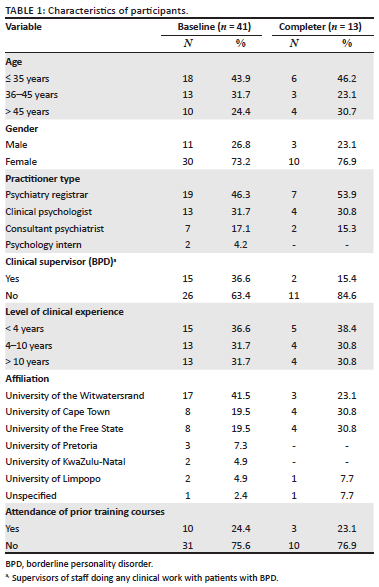
The first training session (baseline) was attended by n = 110 participants and the second session, 1 week later by n = 64 participants. The baseline questionaries were completed by n = 41 participants and the follow-up session by n = 22 participants. Data were matched for n = 13 pairs who completed both baseline and follow-up questionnaires. Table 1 contains the demographic and background characteristic of the participants. Just under half of the participants were psychiatric registrars, followed by consultant psychiatrists and clinical psychologists. Just over a third of participants supervised other clinicians in the management of BPD. A quarter of participants (24.3%, n = 10) had attended other courses on the management of PDs. Among the 10 participants who had attended prior courses, 40% (n = 4) attended DBT training, 20% (n = 2) Schema Therapy training, 20% (n = 2) Other Psychodynamic (Masterson Disorders of the Self Course), 10% (n = 1) TFP, 10% (n = 1) General Psychiatric Management (GPM) and 10% (n = 1) 'Other' PD courses.
Internal consistency and scale reliability
The APDQ had a high degree of internal consistency (Cronbach's alpha = 0.96) and the CCPDQ also reached a high level of reliability (Cronbach's alpha = 0.92).
Factors associated with attrition between baseline and second training sessions
Attrition for study participation was high between the first (n = 41) and second training session (n = 22) and only n = 13 baseline questionnaires were matched after the second training session (68.3% attrition). Participants who had higher scores on their perceived adequacy of supervision and support in working with BPD, had a significantly higher odds of not completing the second training session questionnaire (unadjusted odds ratio [OR] = 2.01, p = 0.030, 95% confidence interval [CI] = 1.07-3.80), similarly participants who scored higher on their baseline clinical confidence in the management of BPD (CCPDQ) had a significantly higher odds of not completing the post-training assessment (unadjusted OR = 1.08, p = 0.047, 95% CI = 1.00-1.16). There was a trend towards significance for higher odds of drop-out for participants who were actively involved in supervising clinicians in the management of BPD (unadjusted OR = 4.77, p = 0.068, 95% CI = 0.88-25.56). No other variables were associated with drop-out. When the two-variables reaching significance at p < 0.05 were entered into a multivariable logistic model, only perceived adequacy of supervision reached a trend towards significance (adjusted OR = 1.90, p = 0.057, 95% CI = 0.97-3.68).
Changes in attitudes and confidence in management of borderline personality disorder
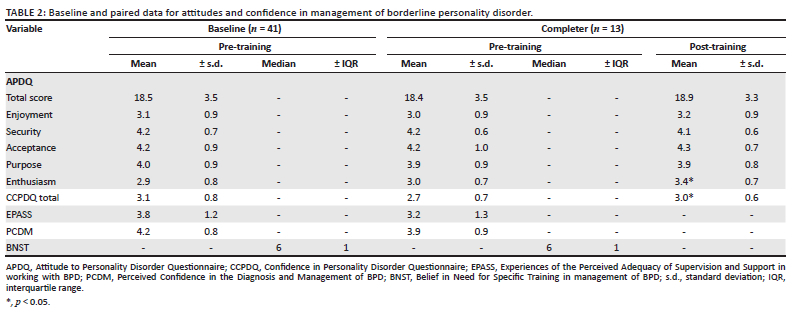
Table 2 contains the full baseline (n = 41) and paired data (n = 13) for participants completing pre- and post-study assessments. At baseline, there was a moderately strong positive and statistically significant correlation between the APDQ total score and the CCPDQ score (r = 0.47, p = 0.002). For matched participants (n = 13), the mean baseline total score on the APDQ was 18.38 (95% CI = 16.22-20.52), which increased to 18.97 (95% CI = 16.97-20.98), a non-significant increase baseline adjusted analysis (β = 0.59, p = 0.173, 95% CI = -0.26-1.45). Similarly, there were no significant improvements in the APDQ subscales measuring Enjoyment, Security, Acceptance or Purpose. There was a statistically significant improvement on the APDQ Enthusiasm subscale, with a mean increase from 3.07 to 3.42 (β = 0.35, p = 0.029, 95% CI = 0.03-0.65). For confidence in management of PDs using a psychodynamic approach as measured by the CCPDQ, there was a statistically significant improvement in the baseline adjusted analysis, with an increase in mean scores from 2.7 pre-training to 3.0 post-training (β = 0.31, p = 0.032, 95% CI = 0.03-0.59).
Discussion
In this study, we have shown that relatively brief training in TFP is associated with a small but significant improvement in attitudes and confidence in the management of PDs. In the completer analysis, both scales measuring attitude and confidence tended to be unchanged or had small, improved scores. We did not find any significant improvement in the total score for attitude as measured by the APDQ total score, or the enjoyment, security, acceptance, purpose subscales. However, we found a small but significant increase in the enthusiasm subscale of the APDQ. Improvement in enthusiasm is important as this sub-score measures levels of frustration and feelings of being drained (i.e., exhaustion) and brief training was able to reduce such negative emotions around potential encounters with personality disordered patients. Also, we found a small significant improvement in the clinical confidence in managing PD using TFP principles.
Our findings are in line with those found in the TFP training workshop study conducted with UK trainee psychiatrists, where an improvement in the clinical confidence using TFP principles as measured by the CCPDQ improved significantly.232328
Conclusion
This study has important limitations. Study dropout was high and the small sample size in the completer analysis may have impacted the results, making it potentially difficult to detect smaller effects. Our drop-out rate is consistent with similar training workshop studies in GPM for PD, using multiple time-points, where attrition has been as high as 73%.13
Our findings are encouraging and suggest that future training of clinicians in TFP principles may be useful in developing a better understanding of PDs, equipping practitioners with more skills and confidence to manage difficult clinical encounters. However, to evaluate this, future training may need to be delivered in person, targeted at more homogenous populations, and be administered over a single extended length session across multiple settings, or ensure conditions conducive to higher attendance if delivered over multiple sessions.
Competing interests
The authors declare that they have no financial or personal relationships that may have inappropriately influenced them in writing this article.
Authors' contributions
H.S.T., T.L., I.F., C.B. contributed to the design and conceptualisation of the study, and edited subsequent versions of the article. H.S.T. and C.B. managed the data acquisition, I.F. and T.L. were involved in the study procedures of teaching the clinical model and conducting the role play. H.S.T. curated and analysed the data and wrote the first draft.
Funding information
This research received no specific funding from any funding agency in the public, commercial or non-profit sectors.
Data availability
Data are available on request from the corresponding author H.S.T.
Disclaimer
The views and opinions expressed in this article are those of the authors and are the product of professional research. The article does not necessarily reflect the official policy or position of any affiliated institution, funder, agency or that of the publisher. The authors are responsible for this article's results, findings and content.
Acknowledgements
The authors would like to acknowledge the support from the South African College of Psychiatrists in providing online administrative support for the study.
References
-
1. Volkert J, Gablonski TC, Rabung S. Prevalence of personality disorders in the general adult population in Western countries: Systematic review and meta-analysis. Br J Psychiatry. 2018;213(6):709-715. https://doi.org/10.1192/bjp.2018.202
» https://doi.org/10.1192/bjp.2018.202 -
2. Winsper C, Bilgin A, Thompson A, et al. The prevalence of personality disorders in the community: A global systematic review and meta-analysis. Br J Psychiatry. 2020;216(2):69-78. https://doi.org/10.1192/bjp.2019.166
» https://doi.org/10.1192/bjp.2019.166 -
3. Beckwith H, Moran PF, Reilly J. Personality disorder prevalence in psychiatric outpatients: A systematic literature review. Personal Ment Health. 2014;8(2):91-101. https://doi.org/10.1002/pmh.1252
» https://doi.org/10.1002/pmh.1252 -
4. Zimmerman M, Chelminski I, Young D. The frequency of personality disorders in psychiatric patients. Psychiatr Clin North Am. 2008;31(3):405-420, vi. https://doi.org/10.1016/j.psc.2008.03.015
» https://doi.org/10.1016/j.psc.2008.03.015 -
5. Suliman S, Stein DJ, Williams DR, Seedat S. DSM-IV personality disorders and their axis I correlates in the South African population. Psychopathology. 2008;41(6):356-364. https://doi.org/10.1159/000152377
» https://doi.org/10.1159/000152377 -
6. Baker J, Beazley PI. Judging personality disorder: A systematic review of clinician attitudes and responses to borderline personality disorder. J Psychiatr Pract. 2022;28(4):275-293. https://doi.org/10.1097/PRA.0000000000000642
» https://doi.org/10.1097/PRA.0000000000000642 -
7. Commons Treloar AJ, Lewis AJ. Professional attitudes towards deliberate self-harm in patients with borderline personality disorder. Aust N Z J Psychiatry. 2008;42(7):578-584. https://doi.org/10.1080/00048670802119796
» https://doi.org/10.1080/00048670802119796 -
8. Lindell-Innes R, Phillips-Hughes AL, Bartsch D, Galletly C, Ludbrook C. Attitudes of psychiatry trainees towards patients with borderline personality disorder: Does the stigma begin during training? Personal Ment Health. 2023;17(4):387-395. https://doi.org/10.1002/pmh.1587
» https://doi.org/10.1002/pmh.1587 -
9. Lanfredi M, Elena Ridolfi M, Occhialini G, et al. Attitudes of mental health staff toward patients with borderline personality disorder: An Italian cross-sectional multisite study. J Pers Disord. 2021;35(1):41-56. https://doi.org/10.1521/pedi_2019_33_421
» https://doi.org/10.1521/pedi_2019_33_421 -
10. Black DW, Pfohl B, Blum N, et al. Attitudes toward borderline personality disorder: A survey of 706 mental health clinicians. CNS Spectr. 2011;16(3):67-74. https://doi.org/10.1017/S109285291200020X
» https://doi.org/10.1017/S109285291200020X -
11. Aviram RB, Brodsky BS, Stanley B. Borderline personality disorder, stigma, and treatment implications. Harv Rev Psychiatry. 2006;14(5):249-256. https://doi.org/10.1080/10673220600975121
» https://doi.org/10.1080/10673220600975121 -
12. Krawitz R. Borderline personality disorder: Attitudinal change following training. Aust N Z J Psychiatry. 2004;38(7):554-559. https://doi.org/10.1080/j.1440-1614.2004.01409.x
» https://doi.org/10.1080/j.1440-1614.2004.01409.x -
13. Masland SR, Price D, MacDonald J, Finch E, Gunderson J, Choi-Kain L. Enduring effects of one-day training in good psychiatric management on clinician attitudes about borderline personality disorder. J Nerv Ment Dis. 2018;206(11):865-869. https://doi.org/10.1097/NMD.0000000000000893
» https://doi.org/10.1097/NMD.0000000000000893 -
14. Shanks C, Pfohl B, Blum N, Black DW. Can negative attitudes toward patients with borderline personality disorder be changed? The effect of attending a STEPPS workshop. J Pers Disord. 2011;25(6):806-812. https://doi.org/10.1521/pedi.2011.25.6.806
» https://doi.org/10.1521/pedi.2011.25.6.806 -
15. Cristea IA, Gentili C, Cotet CD, Palomba D, Barbui C, Cuijpers P. Efficacy of psychotherapies for borderline personality disorder: A systematic review and meta-analysis. JAMA Psychiatry. 2017;74(4):319-328. https://doi.org/10.1001/jamapsychiatry.2016.4287
» https://doi.org/10.1001/jamapsychiatry.2016.4287 -
16. Oud M, Arntz A, Hermens ML, Verhoef R, Kendall T. Specialized psychotherapies for adults with borderline personality disorder: A systematic review and meta-analysis. Aust N Z J Psychiatry. 2018;52(10):949-961. https://doi.org/10.1177/0004867418791257
» https://doi.org/10.1177/0004867418791257 -
17. Crotty K, Viswanathan M, Kennedy S, et al. Psychotherapies for the treatment of borderline personality disorder: A systematic review. J Consult Clin Psychol. 2024;92(5):275-295. https://doi.org/10.1037/ccp0000833
» https://doi.org/10.1037/ccp0000833 - 18. Caligor E, Kernberg O, Clarkin J, Yeomans F. Psychodynamic therapy for personality pathology: Treating self and interpersonal functioning. Washington DC: American Psychiatric Association Publishing; 2018.
- 19. Steiner J. Problems of psychoanalytic technique: Patient-centered and analyst- centered interpretations. Routledge: Psychic Retreats; 1993; p. 131-48.
- 20. Yeomans FE, Clarkin JF, Kernberg OF. Transference-focussed psychotherapy for borderline personality disorder: A clinical guide. Arlington, VA: American Psychiatric Publishing, Inc., 2015; p. xv, 411-415.
- 21. Kernberg OF. The inseparable nature of love and aggression: Clinical and theoretical perspectives. Arlington, VA: American Psychiatric Publishing, Inc., 2012; p. xx, 400-420.
- 22. Hersh RG, Caligor E, Yeomans FE. Fundamentals of transference-focussed psychotherapy: Applications in psychiatric and medical settings. Cham: Springer International Publishing, 2016; p. 59-85.
-
23. Sinisi A, Marchi M, Prior D, Lee T. The Contribution of transference focussed psychotherapy in improving psychiatry trainees' attitude and technical confidence towards patients with personality disorders. BJPsych Open. 2022;8(S1):S10-S11. https://doi.org/10.1192/bjo.2022.97
» https://doi.org/10.1192/bjo.2022.97 - 24. Lee T, Hersh RG. Managing the clinical encounter with patients with borderline personality disorder in a general psychiatry setting: Key contributions from transference-focused psychotherapy. BJPsych Advances. 2019;25(4):229-36.
-
25. Bowers L, Allan T. The attitude to personality disorder questionnaire: Psychometric properties and results. J Pers Disord. 2006;20(3):281-293. https://doi.org/10.1521/pedi.2006.20.3.281
» https://doi.org/10.1521/pedi.2006.20.3.281 - 26. Reid H, Lee T. Clinical confidence with personality disorder questionnaire (CCPDQ). London: DeanCross Personality Disorder Service, ELFT National Health Service Trust; 2019.
- 27. StataCorp. Stata statistical software: Release 16. College Station, TX: StataCorp LP; 2019.
-
28. Lee T, Grove P, Garrett C, Whitehurst T, Kanter-Bax O, Bhui K. Teaching trainee psychiatrists a mentalization-based treatment approach to personality disorder: Effect on attitudes. BJPsych Bull. 2022;46(5):298-302. https://doi.org/10.1192/bjb.2021.50
» https://doi.org/10.1192/bjb.2021.50

Accepted: 02 Sept. 2024
Published: 15 Nov. 2024