Psychiatric morbidity in children involved in bullying treated at the Free State Psychiatric Complex
Abstract
BACKGROUND: Bullying is a multifaceted problem with many consequences. AIM: This study aimed to determine the psychiatric morbidity of children involved in bullying, either as bullies or victims, treated at the Child and Adolescent Mental Health Care Centre of the Free State Psychiatric Complex (FSPC). SETTING: Free State Psychiatric Complex, Bloemfontein, South Africa. METHODS: This retrospective cross-sectional study included children under 18 years treated at the FSPC Care Centre between January and September 2017. Information was extracted from patient files. RESULTS: Of 288 patients, 98 (34.0%) were involved in bullying: 66 were bullies, 28 victims, 3 bully-victims, and 1 unspecified. For gender and family structure, there were no statistically significant differences between children involved and those not involved in bullying and between bullies and victims. Almost all bullies (95.4%) had aggression as presenting complaint compared with 39.3% of the victims (p < 0.01). Statistically significantly more victims, than bullies, reported sadness (21.4%, 4.6%, p = 0.02). Attention deficit/hyperactivity disorder (ADHD) was diagnosed in most children, both involved (73.5%) and not involved (63.2%). Statistically significant differences for the presence of conduct disorder were found between children involved and those not involved in bullying (31.6%, 10.0%, p < 0.01) and between bullies and victims (39.4%, 14.3%, p = 0.02. CONCLUSION: The prevalence of conduct disorder diagnosis was more common in bullies than in victims and those involved in bullying as opposed to those not involved. CONTRIBUTION: Psychiatric information of bullying victims and perpetrators in the Free State, which had a high prevalence of bullying in a national survey.
bullying; victims and bullies; psychiatric conditions; health profile; involved versus not involved
Introduction
Bullying is a multifaceted and dynamic form of interpersonal aggression influenced by multiple factors.121
A United Nations Educational, Scientific and Cultural Organization (UNESCO) publication334556
Numerous studies have investigated individual and social contributing factors to bullying behaviour. Individual characteristics associated with bullying behaviour include, for example, age, gender, socio-economic status, ethnicity and special education needs.787
Children can be involved in bullying as either bullies (doing the bullying), victims (being abused or intimidated by a bully) or bully-victims (being both bully and victim). Males show a preponderance of being the bully and victim.9,10101154,10
Bullying is a traumatic experience that can result in serious consequences for the mental and physical health of those affected. Various bullying exposures have been associated with poor academic outcomes12,134,14,15161748,181920
It has been reported that mental health predisposed to being the victim of bullying, illustrating 'bi-directionality of relationships between bullying victimisation and mental health outcomes' (p. 1313).42122
Studies tend to focus on the victims of bullying. For example, the systematic review of Serafini et al.19
Aim
This study aimed to determine the psychiatric morbidity of children involved in bullying, either as bullies or victims, being treated at the Child and Adolescent Mental Health Care Centre of the Free State Psychiatric Complex (FSPC).
Specific objectives were to:
•determine the health profile (presenting physical and emotional complaints and clinical diagnoses), family structure and academic performance of children being treated at the FSPC who are involved in bullying
•compare these factors with those of children who are not involved in bullying
•compare these factors between bullies and victims.
Research methods and design
A cross-sectional study was conducted in 2017 at the Child and Adolescent Mental Health Care Centre. This care centre is part of the FSPC and provides tertiary outpatient services to children and adolescents residing within the Free State province. The study population included all children under the age of 18 years who were treated at the care centre between January and September 2017. Interviews were conducted by different members of the multi-professional team and psychiatric diagnoses were confirmed during ward rounds. Academic performance was rated as good, average or poor by the professionals conducting the assessment interview based on information provided by the parent or guardian or child.
Data collection
Data were collected from the patient files by means of a structured data form designed by the researchers. Information included demographic characteristics, involvement in bullying, family structure, academic performance and psychiatric morbidity (physical and referral complaints, clinical diagnosis).
Pilot study
A pilot study was conducted on the first five files of children from the study population. The structured data form was confirmed to be adequate for the purpose of this study. No changes were made to the data form and the collection steps were not amended. Data from these files were included in the main study.
Data analysis
The data were entered into an Excel spreadsheet. The analysis was carried out by the Department of Biostatistics, Faculty of Health Sciences, University of the Free State (UFS). Results are summarised by frequencies and percentages (categorical variables) and medians and interquartile ranges (numeric variables because of skew distributions). Subgroups were compared using Mann-Whitney tests (numerical variables) and chi-squared or Fisher's exact tests (categorical variables, depending on cell sizes).
Ethical considerations
The study was approved by the UFS Health Sciences Research Ethics Committee [UFS-HSD2017/0620], the Free State Department of Health, and the Ethics Committee of the FSPC. Ministerial consent for non-therapeutic research on minors was obtained. Each file was given a unique study number to ensure confidentiality.
Results
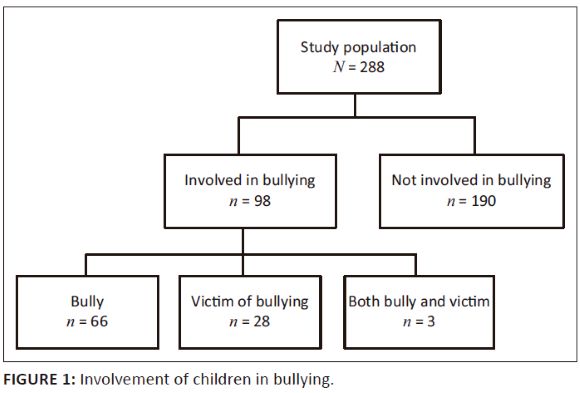
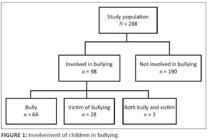
As shown in Figure 1, 288 patient files were reviewed, and 98 (34.0%) children were identified as being involved in bullying, either as bully (n = 66; 22.9%), victim (n = 28; 9.7%), or bully-victim (n = 3; 1.3%). One file indicated that the child was involved in bullying but did not specify the type of involvement.
The median age of children involved in bullying was 9 years (range 4-17 years), while children not involved in bullying had a median age of 11 years (range 2-17 years). The median ages of bullies and victims were 9 years.
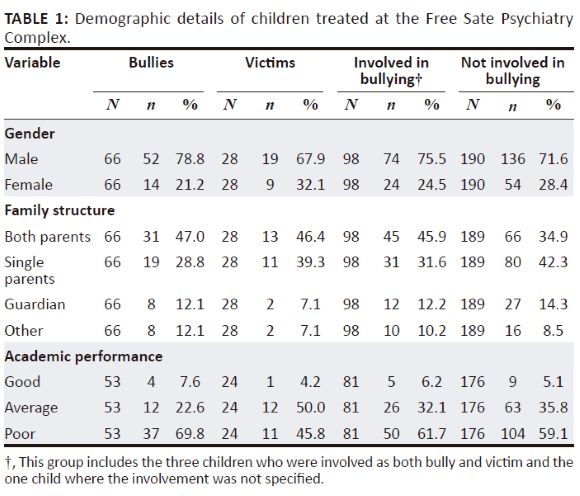
More than 70% of children involved and those not involved in bullying were male (Table 1). A larger percentage of the bullies (78.8%) compared with the victims (67.9%) were male. The highest percentage of children involved in bullying (45.9%) lived with both parents, while 42.3% of the children not involved lived with a single parent. For gender and family structure, there were no statistically significant differences between the children involved and those not involved in bullying and between the bullies and the victims.
Children involved (61.7%) and those not involved (59.1%) in bullying mostly showed poor academic performance. Half (50.0%) of the victims had average academic performance compared with 22.6% of the bullies (p = 0.06).
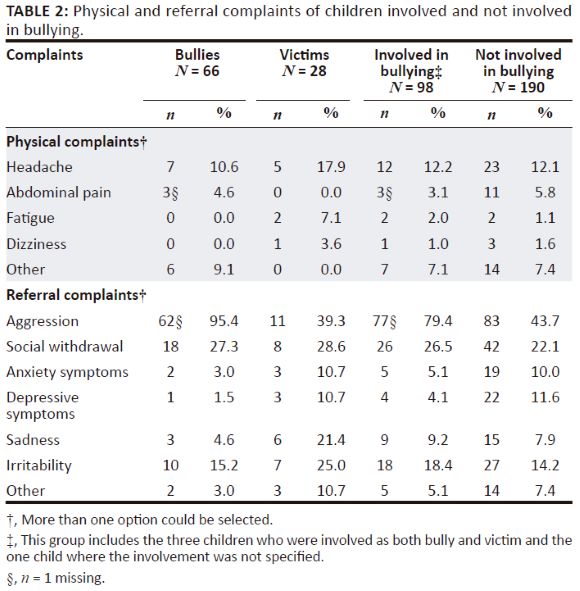
Headache was the most frequently reported physical complaint among those involved in bullying (12.2%) as well as those who were not (12.1%) (Table 2). Victims (17.9%) reported a higher percentage of headaches than bullies (10.6%). There were, however, no statistically significant differences between any of the groups concerning physical complaints.
Children involved in bullying were statistically significantly more likely to present with aggression than children not involved (p < 0.01). Almost all bullies (95.4%) presented with aggression compared with 39.3% of the victims (p < 0.01). Social withdrawal was the second most common referral complaint for bullies (27.3%) and victims (28.6%). There was a statistically significant difference between children involved in bullying (4.1%) versus those not involved (11.6%) about depressive symptoms (p = 0.04). Statistically significantly more victims than bullies reported sadness (p = 0.02).
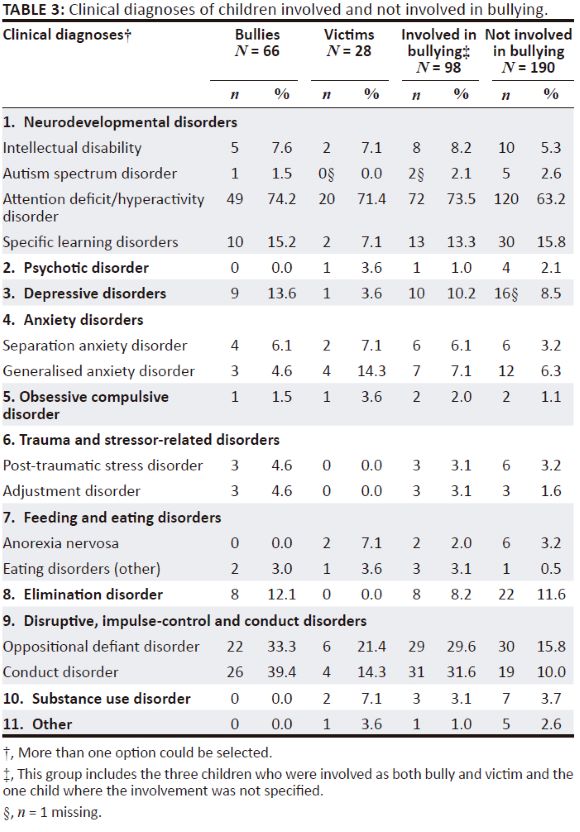
The clinical diagnoses of the children are summarised in Table 3. A child could be diagnosed with more than one clinical disorder. Attention deficit/hyperactivity disorder was diagnosed in most children, both involved (73.5%) and not involved (63.2%) in bullying. Statistically significant differences for the presence of conduct disorder were found between children involved and those not involved in bullying (p < 0.01) and between bullies and victims (p = 0.02). Statistically significantly more children involved in bullying than those not involved were diagnosed with optional defiant disorder (p = 0.01). A higher percentage of bullies (33.3%) were diagnosed with oppositional defiant disorder than victims (21.4%); however, the difference was not statistically significant.
Discussion
This study explored the psychiatric morbidity in children involved in bullying treated at a child and adolescent psychiatric outpatient centre. Approximately a third of the children treated at the centre during the study period were involved in bullying, mainly as bullies. Paruk and Nassen6
Children in the study were predominantly male. Males are more prone to be bullies and victims.9,10105,117
An association between family structure and involvement in bullying was not apparent in this study, with a greater percentage of children involved in bullying living with both parents, and most children not involved in bullying living with a single parent. Other factors that were not observed, such as family dysfunction and instability, might have provided different results, as was found in the study of Ganesan et al.8
Only a few physical complaints were reported by bullies and victims, such as fatigue, headaches, dizziness and abdominal pain. This finding was not expected as the literature indicated that a large number of physical complaints occur in these groups.14,16,174,1025
In both bullies and victims, ADHD was a common diagnosis, with a higher percentage in both groups than in children not involved in bullying. Previous research shows a positive association between ADHD and bullying involvement. Cuba Bustinza et al.218,18265
An unexpected finding was the low prevalence of depressive disorders in the victim group, as research highlights the association between victimisation and mental health problems, such as depression and anxiety.4,156
Study limitations
This study focused only on children seen at a psychiatric treatment facility and relied on information in patient files. If patients did not volunteer information or were not directly questioned on bullying involvement, the information would not have been observed. Details on the types of bullying, such as verbal, physical, relational and cyberbullying, were limited. The research on bullying involvement might be strengthened by focusing on a narrower age group and using tailored questionnaires with patients and families to provide more detailed results.
Conclusion and recommendations
More than a third of children referred to a psychiatric outpatient centre were involved in bullying. This indicates a high prevalence of bullying involvement among these children. Most children of the study population were male and almost all the bullies presented with aggression. Aggressive behaviour is a referral reason that usually demands urgent attention, which might explain the high prevalence at the centre. Gender and age are also associated with aggression during childhood, which might explain this constellation of factors. The prevalence of poor academic achievement was high in all groups, showing the possibility of susceptibility to bullying involvement and psychiatric illness. An additional comorbid condition, namely ADHD with a high prevalence in the bully and victim group, indicates the necessity of a multifaceted and multidisciplinary approach. For socio-demographic characteristics, there were no statistically significant differences between the children involved and those not involved in bullying and between the bullies and the victims.
The most prominent psychiatric morbidity in this study population was conduct disorder. Although bullying and conduct disorder have distinct qualities, the study's results motivate the inclusion of different intervention strategies in bullying prevention programmes. Bullying prevention programmes might be strengthened by incorporating the family through direct parent management training, an essential component in treating conduct disorder, and not only focusing on the child involved in bullying. The importance of screening for both victims and perpetrators of bullying involvement is also highlighted. Psychiatric intervention should also focus on the psychiatric morbidity of children involved in bullying. Early identification and intervention at primary care level might preclude the development of a psychiatric disorder, such as conduct disorder.
Community-based investigations should be conducted where bullying is most prevalent, such as in schools and neighbourhoods, to attain information on the morbidity among bullying participants. In addition to the need for prevention and early identification of bullying involvement, it is recommended that teachers, parents and other family members should be made more aware of the behavioural changes and morbidity of children involved in bullying so that they can act rapidly and effectively.
Competing interests
The authors declare that they have no financial or personal relationships that may have inappropriately influenced them in writing this article.
Authors' contributions
M.Ma., M.Mo., A.M. and S.S. (undergraduate medical students, University of the Free State) developed the protocol, performed the data collection and did the initial write-up of this study. J.l.R. (Department of Psychiatry, University of the Free State) was the supervisor of this study, suggested the concept, assisted with the protocol development, data collection and interpretation of data, and write-up of this study. H.l.R. (Department of Psychiatry, University of the Free State) updated the literature and assisted with the write-up of this study. G.J. (Department of Biostatistics, University of the Free State) assisted with the planning, performed data analysis, assisted with the interpretation and wrote the article.
Funding information
This research received no specific grant from any funding agency in the public, commercial or not-for-profit sectors.
Data availability
The data that support the findings of this study are available from the corresponding author, G.J., upon reasonable request.
Disclaimer
The views and opinions expressed in this article are those of the authors and do not necessarily reflect the official policy or position of any affiliated agency of the authors.
Acknowledgements
The authors would like to acknowledge Nkosikhona Mkhize (Faculty of Health Sciences, University of the Free State) for participation as a research group member in the planning phase of the project. Ms T. Mulder, medical editor/writer, Faculty of Heath Sciences, University of the Free State, for technical and editorial preparation of the manuscript.
References
-
1.Swearer SM, Hymel S. Understanding the psychology of bullying: Moving toward a social-ecological diathesis-stress model. Am Psychol. 2015;70(4):344-353. https://doi.org/10.1037/a0038929
» https://doi.org/10.1037/a0038929 - 2.Olweus D. Bullying at school: What we know and what we can do. Oxford: Blackwell Publishing; 1993.
-
3.UNESCO. Behind the numbers: Ending school violence and bullying [homepage on the Internet]. 2019 [cited 2022 Sept 27]. Available from: https://unesdoc.unesco.org/ark:/48223/pf0000366483
» https://unesdoc.unesco.org/ark:/48223/pf0000366483 -
4.Boyes ME, Bowes L, Cluver LD, Ward CL, Badcock NA. Bullying victimisation, internalising symptoms, and conduct problems in South African children and adolescents: A longitudinal investigation. J Abnorm Child Psychol. 2014;42(8):1313-1324. https://doi.org/10.1007/s10802-014-9888-3
» https://doi.org/10.1007/s10802-014-9888-3 -
5.Manuel D, Adams S, Mpilo M, Savahl S. Prevalence of bullying victimisation among primary school children in South Africa: A population-based study. BMC Res Notes. 2021;14(1):342. https://doi.org/10.1186/s13104-021-05747-w
» https://doi.org/10.1186/s13104-021-05747-w -
6.Paruk ME, Nassen R. Cyberbullying perpetration and victimisation amongst adolescent psychiatric patients at Lentegeur Hospital, South Africa. S Afr J Psychiatr. 2022;28:1755. https://doi.org/10.4102/sajpsychiatry.v28i0.1755
» https://doi.org/10.4102/sajpsychiatry.v28i0.1755 -
7.Fink E, Patalay P, Sharpe H, Wolpert M. Child- and school-level predictors of children's bullying behaviour: A multilevel analysis in 648 primary schools. J Educ Psychol. 2018;110(1):17-26. https://doi.org/10.1037/edu0000204
» https://doi.org/10.1037/edu0000204 -
8.Ganesan K, Shakoor S, Wertz J, et al. Bullying behaviours and other conduct problems: Longitudinal investigation of their independent associations with risk factors and later outcomes. Soc Psychiatry Psychiatr Epidemiol. 2021;56(11):2041-2052. https://doi.org/10.1007/s00127-021-02062-4
» https://doi.org/10.1007/s00127-021-02062-4 -
9.Hamel N, Schwab S, Wahl S. Bullying: Group differences of being victim and being bully and the influence of social relations. Stud Educ Eval. 2021;68:100964. https://doi.org/10.1016/j.stueduc.2020.100964
» https://doi.org/10.1016/j.stueduc.2020.100964 -
10.Smith PK, López-Castro L, Robinson S, Görzig A. Consistency of gender differences in bullying in cross-cultural surveys. Aggress Violent Behav. 2019;45:33-40. https://doi.org/10.1016/j.avb.2018.04.006
» https://doi.org/10.1016/j.avb.2018.04.006 -
11.Juan A, Zuze L, Hannan S, Govender A, Reddy V. Bullies, victims and bully-victims in South African schools: Examining the risk factors. S Afr J Educ. 2018;38(1):S1-S10. https://doi.org/10.15700/saje.v38ns1a1585
» https://doi.org/10.15700/saje.v38ns1a1585 -
12.Halliday S, Gregory T, Taylor A, Digenis C, Turnbull D. The impact of bullying victimization in early adolescence on subsequent psychosocial and academic outcomes across the adolescent period: A systematic review. J Sch Violence. 2021;20(3):351-373. https://doi.org/10.1080/15388220.2021.1913598
» https://doi.org/10.1080/15388220.2021.1913598 -
13.Ladd GW, Ettekal I, Kochenderfer-Ladd B. Peer victimization trajectories from kindergarten through high school: Differential pathways for children's school engagement and achievement? J Educ Psychol. 2017;109(6):826-841. https://doi.org/10.1037/edu0000177
» https://doi.org/10.1037/edu0000177 -
14.Herge WM, La Greca AM, Chan SF. Adolescent peer victimization and physical health problems. J Pediatr Psychol. 2016;41(1):15-27. https://doi.org/10.1093/jpepsy/jsv050
» https://doi.org/10.1093/jpepsy/jsv050 -
15.Moore SE, Norman RE, Suetani S, Thomas HJ, Sly PD, Scott JG. Consequences of bullying victimization in childhood and adolescence: A systematic review and meta-analysis. World J Psychiatry. 2017;7(1):60-76. https://doi.org/10.5498/wjp.v7.i1.60
» https://doi.org/10.5498/wjp.v7.i1.60 -
16.Gini G, Pozzoli T. Bullied children and psychosomatic problems: A meta-analysis. Pediatrics. 2013;132(4):720-729. https://doi.org/10.1542/peds.2013-0614
» https://doi.org/10.1542/peds.2013-0614 -
17.Malhi P, Bharti B. School bullying and association with somatic complaints in victimized children. Indian J Pediatr. 2021;88(10):962-967. https://doi.org/10.1007/s12098-020-03620-5
» https://doi.org/10.1007/s12098-020-03620-5 -
18.Husky MM, Delbasty E, Bitfoi A, et al. Bullying involvement and self-reported mental health in elementary school children across Europe. Child Abuse Negl. 2020;107:104601. https://doi.org/10.1016/j.chiabu.2020.104601
» https://doi.org/10.1016/j.chiabu.2020.104601 -
19.Serafini G, Aguglia A, Amerio A, et al. The relationship between bullying victimization and perpetration and non-suicidal self-injury: A systematic review. Child Psychiatry Hum Dev. 2023;54(1):154-157. https://doi.org/10.1007/s10578-021-01231-5
» https://doi.org/10.1007/s10578-021-01231-5 -
20.Armitage R. Bullying in children: Impact on child health. BMJ Paediatr Open. 2021;5(1):e000939. https://doi.org/10.1136/bmjpo-2020-000939
» https://doi.org/10.1136/bmjpo-2020-000939 -
21.Cuba Bustinza C, Adams RE, Claussen AH, et al. Factors associated with bullying victimization and bullying perpetration in children and adolescents with ADHD: 2016 to 2017 National Survey of Children's Health. J Atten Disord. 2022;26(12):1535-1548. https://doi.org/10.1177/10870547221085502
» https://doi.org/10.1177/10870547221085502 -
22.Simmons JA, Antshel KM. Bullying and depression in youth with ADHD: A systematic review. 2021;50:379-414. https://doi.org/10.1007/s10566-020-09586-x
» https://doi.org/10.1007/s10566-020-09586-x -
23.Arseneault L. Annual research review: The persistent and pervasive impact of being bullied in childhood and adolescence: Implications for policy and practice. J Child Psychol Psychiatry. 2018;59(4):405-421. https://doi.org/10.1111/jcpp.12841
» https://doi.org/10.1111/jcpp.12841 -
24.Copeland WE, Wolke D, Angold A, Costello EJ. Adult psychiatric outcomes of bullying and being bullied by peers in childhood and adolescence. JAMA Psychiatry. 2013;70(4):419-426. https://doi.org/10.1001/jamapsychiatry.2013.-504
» https://doi.org/10.1001/jamapsychiatry.2013.-504 - 25.National Academies of Sciences, Engineering, and Medicine. Preventing bullying through science, policy, and practice. Washington, DC: The National Academies Press; 2016.
- 26.American Psychiatric Association. Diagnostic and statistical manual of mental disorders. 5th ed. Arlington, VA: American Psychiatric Association; 2013.

Accepted: 09 Jan. 2023
Published: 30 Mar. 2023