Predictors of bullying reported by perpetrators in a sample of senior school students in Benin City, Nigeria
Abstract
BACKGROUND: Bullying behaviour amongst adolescents is becoming a significant public health challenge. Whilst the traditional and electronic bullying as reported by victims has been widely reported, surveys amongst perpetrators, particularly in Africa, are still lacking. AIM: This study is aimed at determining the prevalence of bullying by perpetrators and analysing the relationship between bullying perpetration and psycho-socio-demographic characteristics amongst senior school students in Benin City, Nigeria. SETTING: Senior secondary school in Benin City, Nigeria. METHODS: A cross-sectional survey of 465 final-year secondary school students aged 16-19 years, who were selected by multistage random sampling, was conducted. The students were made to fill a self-designed questionnaire, in addition to an adapted version of the Wagnild and Young's resilience scale. RESULTS: The lifetime prevalence of bullying was 16.3%. Binary logistic regression revealed bullying to be significantly associated with students who are male (adjusted odds ratio [AOD] = 2.13, confidence interval [CI] = 1.16-3.93), have poor relations with their teachers (AOR = 2.98, CI = 1.68-5.29), have used alcohol (AOR = 3.51, CI = 1.74-7.09) and are involved in cult and gangsterism (AOR = 9.14, CI = 2.55-32.75). CONCLUSION: The rate of bullying perpetration by youth in Benin City, Nigeria, is significant and is comparable to global occurrence. The predictors of bullying in this study suggest that perpetrators are individuals who may benefit from rehabilitative measures.
bullying; cultism; predictor; prevalence; perpetrators; senior students; south-south; Nigeria
Introduction
Bullying behaviour amongst adolescents and students represents a significant public health challenge.123
Bullying is intended to harm or disturb a victim despite the victim's apparent distress.4356
Bullying has a popular image as a school-based behaviour; however, it can occur in other settings like lunchrooms, hallways, on the bus,378
Reported prevalence rates of bullying across many studies and countries suggest that bullying is a distressingly common phenomenon amongst adolescent and student samples.99
Amongst a large sample of 202 056 school-aged children and adolescents in 40 countries worldwide, Craig et al. reported that the prevalence of being involved in bullying (as a bully, victim, or bully and victim) varied considerably between countries, with estimates ranging from 8.6% to 45.2% in boys and 4.8% - 35.8% in girls.1011812
In Nigeria, a high prevalence of bullying has been similarly reported. It was found from a randomly selected sample of 300 junior secondary school students in Benin City, South-South Nigeria, that almost four in five participants (78%) reported being bullied, whilst 71% admitted that they had bullied someone at least once.713
The international literature reveals that bullying behaviours are universal and complex, and many personal and situational factors are associated with it.97,10,13,145,6,1516
Bullying is most common in late childhood, peaking at about 12 years of age with a transition to high school and then declining after that.9171111
Previous studies have also reported that there is a difference between the rates of bullying and victimisation by different ethnic groups within the same country.11918,19
Involvement in bullying, either as a perpetrator or as a victim, is associated with numerous physical, mental and social consequences.202122,2320
Despite the relatively high prevalence of bullying across studies and countries and the enormous consequences that are associated with it, it is under-researched in Nigeria. Most studies on bullying have been conducted in the developed countries; the few available studies in Nigeria have focussed on the victims of bullying, and little profiling has been carried out on perpetrators. Thus, it is crucial to investigate bullying from the end of the culprit in the Nigerian setting. This finding will add to the body of literature by filling in gaps in the understanding of the risk factors of bullying within the Nigerian context. Moreover, the finding will contribute to preventive measures of bullying because identification and handling of bullies will lead to a safe environment for the vulnerable ones. Therefore, this study aimed to determine the prevalence of bullying as reported by perpetrators and examine the association of bullying amongst senior school students with demographics, family, school-related, risky behaviours and psychological characteristics.
Methods
Study location
The study was a cross-sectional study carried out in Benin City, South-South Nigeria. The city is situated within three local government areas (LGAs): Egor, Ikpoba-Okha and Oredo. The selected LGA (Oredo) has 138 secondary schools comprising 13 government-owned (public) and 125 government-approved private schools with student populations of 23 672 and 38 688, respectively. Thus, the public-to-private school students ratio is 1:1.6.
Study population
The study sample consisted of final-year adolescent students, aged 16-19 years, in the senior secondary schools (SSS). The choice of students was informed based on various considerations that include the ability to comprehend contents of the test materials, the cut-off age for the chosen instrument and to make for easy comparison of findings with existing studies in the literature.
Sampling technique
A multistage random sampling technique was adopted in selecting the final-year students of the SSS. The first stage involved a random selection of Oredo LGA. In the second stage, 18 gender-mixed schools from the same LGA were selected by stratifying the schools into public and private schools to ensure appropriate school representation. The selection was restricted to only mixed-gender schools because all the private schools in Oredo LGA are mixed-gender schools, and unregistered schools were excluded from the process. At this stage, four public and 14 private schools were chosen. In the last stage (third), students were selected from each of the participating schools using the proportional representation method. A simple random sampling technique was applied using the class register to select the students from each arm of the final-year classes. A total of 187 students from the public and 305 from the private schools were recruited to maintain the ratio of 1:1.6, thus making a total sample size of 492 students. This figure exceeded the minimum estimated sample size of 317 students calculated when the Fisher's formula was applied247
Selection criteria
Students in the SSS three classes outside the age range of 16-19 years and those who or whose parents or guardians refused to give consent were excluded from the study.
Questionnaire administration
The questionnaires were administered to students in their classrooms during break time in batches of 15-30 students with the help of two trained research assistants. The students required minimal assistance, which was provided, for filling in the self-report questionnaire. During the process, confidentiality in handling information was strictly observed. The duration of the study lasted for six and a half weeks.
Measures
Demographics
These included gender, age and religion. Age was categorised into 16-17 and 18-19 years groups, whilst religion was dichotomised into Christianity and other religion because Christianity was the dominant religion in the area.
Family-related factors
These factors covered family structure, parental religiosity and perceived relationship with parents. Parental religiosity as perceived by the respondents was rated as either high if parents or guardians pray regularly or low if they occasionally or hardly pray.
School and academic-related factors
Enquiries were made regarding the school type, perceived relationship of participants with teachers and academic performance. Academic performance was investigated as a 'yes or no' question by asking whether respondents had repeated a class in the past.
Psychological factors
Feeling of stress and psychological resilience were examined. The resilience scale developed by Wagnild and Young was used to measure the degree of each participant's resilience;2526r = 0.74, p = 0.00), was used in this study. Responses were made on a seven-point scale, with higher scores indicating greater resilience; however, the participants were classified into either low or high resilience based on the mean score of 34.9.
Inquiries about risky behaviours such as involvement in cult and gangsterism, alcohol, tobacco and cannabis use were made on whether the behaviour had ever been carried out in the past.
Bullying was enquired through a 'yes or no' question. The operational definition of bullying covers any form of bullying ever inflicted on someone in school, such as kicking, punching, slapping, gossiping, name-calling, threatening, intimidating and teasing.
Statistical analyses
Data were analysed using the Statistical Package for Social Sciences (SPSS) 22. A frequency distribution was performed to determine the prevalence of bullying. Continuous variable such as age was categorised into two groups: 16-17 and 18-19 years. Chi-squared test was used to determine the variables associated with bullying. Furthermore, variables significantly associated with bullying on bivariate analysis were subjected to binary logistic regression to determine the predictors of the same. A p-value of less than 0.05 was set as statistical significance.
Ethical considerations
Ethical approval was obtained from the Ethics Committee of the University of Benin Teaching Hospital. Permission was also obtained from the Ministry of Education and the authorities of the schools involved. The students who were recruited to fill the questionnaires for the study either obtained written consent from their parents or guardians if they were less than 18 years or gave their consent if they were 18 years and above. The consent form was given to those less than 18 years to take home to their parents or guardians and to return the following day.
Results
A total of 492 questionnaires were returned following administration; 27 questionnaires were discarded because they were either incompletely filled or contained inconsistent responses, or both. The proper response rate of 94.5% and 465 questionnaires were analysed. The mean age of the respondents was 16.9 years (standard deviation [SD] = 0.9 year).
There were 210 (45.2%) female and 255 (54.8%) male students; of the students, 183 (39.4%) were in public schools and 282 (60.6%) were in private schools.
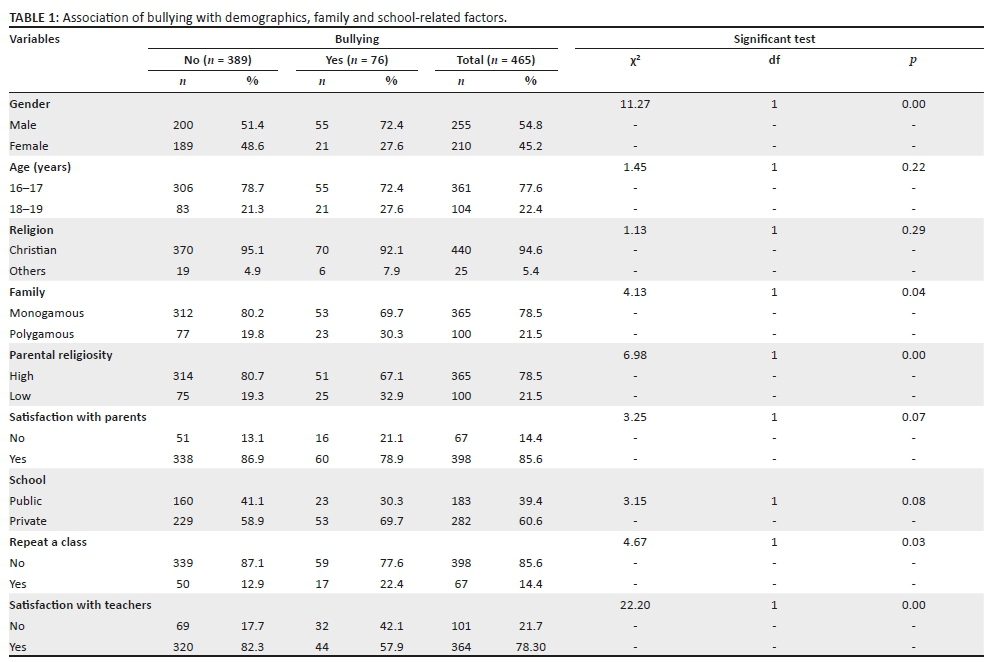
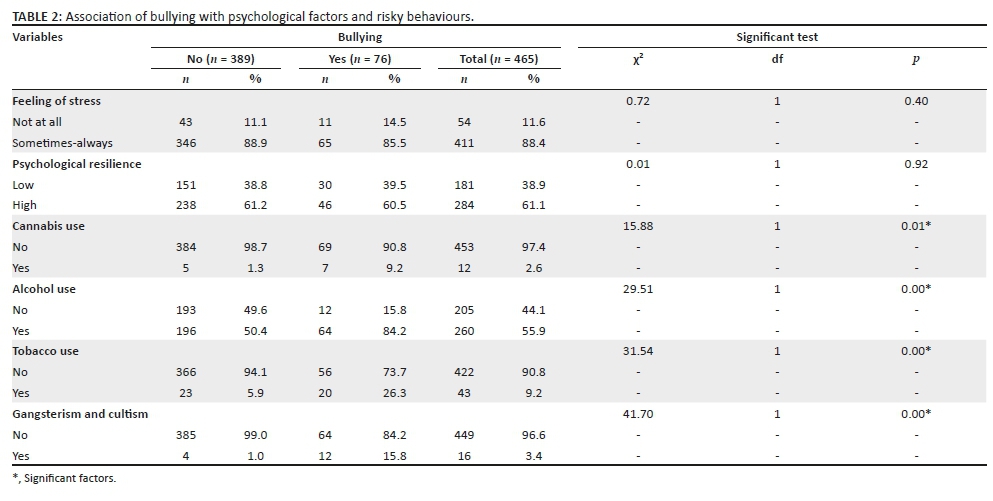
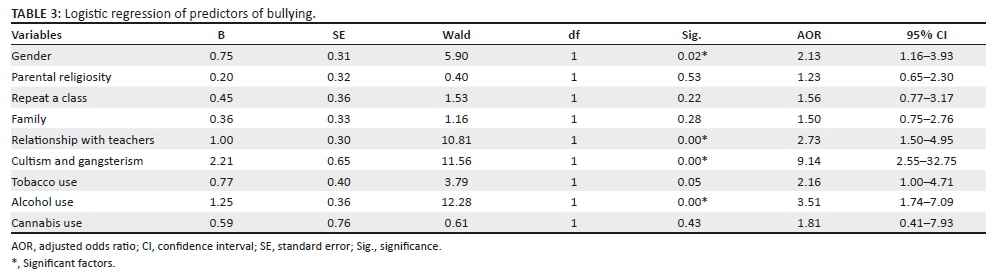
About 16.3% of students reported bullying someone in school in their lifetime. Being a male, a product of a polygamous family, low parental religiosity, history of having ever used alcohol, tobacco and cannabis, having repeated a class, lifetime history of involvement in cultism and gangsterism and not having a satisfying relationship with teachers were all significantly associated with bullying someone (see Tables 1 and 2). Following a binary logistic regression, the independent predictors of bullying perpetration were being a male, having ever used alcohol, involvement in cult and gangsterism, and a lack of satisfactory relationship with teachers. Male students were two times more likely (adjusted odds ratio [AOD] = 2.13, confidence interval [CI] = 1.16-3.93) to bully compared to their female counterparts. Students who had used alcohol reported three times more likelihood of bullying than those who had never used, whilst those who were involved in cult and gangsterism had about nine times increased rate of bullying than their counterparts who had not done so. Adolescents who reported 'no' satisfaction about the relationship with their teachers also predicted bullying (AOR = 2.73, CI = 1.50-4.95). Students who reported past use of tobacco and cannabis fell short of statistically significant relationship with bullying (p = 0.05 and 0.07, respectively) (see Table 3).
Discussion
Traditional and electronic bullying, as reported by victims, has been widely reported,27,28,29
This rate is comparable with 13% reported amongst school children in South Africa,28303129,31,32114,33,34
Women are likely to be at the receiving end of violence or bullying, whereas men are more likely to be the perpetrators.4,34
Studies have substantiated the age-long lay assumptions that violence and aggressive behaviour are associated with being male.353637,38
In addition to the biological factors, the effects of life experiences and environmental influences on the mind have been used to explain the gender difference in bullying and negative attitudes towards peers.3935353535
In this study, adolescents who are bullies were found to have increased risk of alcohol use compared with those with no bullying experience. It has also been reported that adolescents who have experienced bullying, whether as victims or as perpetrators, have an increased risk of drinking compared with those with no bullying experience.404142
Lifetime use of cannabis was not found to predict bullying in this study independently, but it has a significant association with it, as shown in previous reports.29,3143,44
However, when other variables such as age, gender and polygamous family that are known to be associated with cannabis use in this environment45,46
The present study highlights the role of gangsterism in bullying perpetration. Being a member of a gang increased the rate of bullying by nine times when compared to students who were not members of such a group.
Gangsterism has been previously related to bullying, perpetration and victimisation.32,474848,4948,495048,4949
Adolescent bullies are likely to perceive the relationship with their teachers negatively, as suggested by the present study. This negative perception may be related to being in the 'bad book' of their instructors. Lyznicki et al. have suggested that bullies have trouble following rules, and do not often have a good relationship with their teachers and parents.434
Limitations and strengths
This study has some limitations that must be discussed. Firstly, the sample size was small and the study was conducted in only one major city in Nigeria. This limits the generalisability of the findings to other parts of the country and obliterates the possibility of identifying cultural influences on bullying. Secondly, the study did not include electronic bullying and therefore should be interpreted with caution. The study was focussed on bullying carried out in the school premises; hence, it did not cover cyberbullying. Further study should investigate this because it is an essential form of bullying. Also, there is a section of private secondary schools in Benin City that is blind to the authorities. These schools are cheap and unregistered. They thrive because of the poor financial fortunes of the average Nigerian that serve as an attraction to patronise substandard schools. These illegal schools were not captured in this work. A definite statement on the state of bullying amongst Nigerian students may need to take this into account in the future. Lastly, predictability is difficult with a cross-sectional study because cause and effect cannot be precisely ascertained. However, the study possesses some strengths worth mentioning. It looked at bullying from the angle of the perpetrators, especially in this part of the world where less attention is still being paid to children in need of care, who are often labelled 'beyond parental control'.51
Conclusion
The rate of bullying perpetration by youths in Benin City, Nigeria, is significant and the pattern follows the prevalence that has been reported elsewhere, with men dominating the world of bullying perpetration. The association between bullying and identified variables, such as cultism which may indicate an antisocial problem and poor relationship with teacher, suggests the need to provide care and protection rather than punishment and expulsion to perpetrators of bullying. The burden it poses on individual health of both the victim and the perpetrator may just yet not have been transmitted to a healthcare burden because of lack of awareness and under-reportage.
Competing interests
The authors have declared that no competing interests exist.
Authors' contributions
O.O.A. was responsible for data collection and analysis. O.O.A., A.A.O. and S.O.O. wrote the initial draft and critically reviewed the final version of the manuscript. E.U. made significant intellectual contributions to the final manuscript. All the authors have read and approved the final version of the manuscript.
Funding information
This research received no specific grant from any funding agency in the public, commercial, or not-for-profit sectors.
Data availability statement
The datasets used and analyzed during the current study are available from the corresponding author on reasonable request.
Disclaimer
The views and opinions expressed in this article are those of the authors and do not necessarily reflect the official policy or position of any affiliated agency of the authors.
Acknowledgements
The authors thank the respondents for their participation in this research.
References
-
1.Lien L, Welander-Vatn A. Factors associated with the persistence of bullying victimization from 10th grade to 13th grade: A longitudinal study. Clin Pract Epidemiol Ment Health. 2013;9:243. https://doi.org/10.2174/1745017901309010243
» https://doi.org/10.2174/1745017901309010243 -
2.Smith PK, Cowie H, Olafsson RF, Liefooghe AP. Definitions of bullying: A comparison of terms used, and age and gender differences, in a fourteen-country international comparison. Child Dev. 2002;73(4):1119-1133. https://doi.org/10.1111/1467-8624.00461
» https://doi.org/10.1111/1467-8624.00461 - 3.Olweus D. Bullying at school: What we know and what we can do. 1st ed. Oxford: Wiley-Blackwell; 1993.
- 4.Lyznicki JM, McCaffree MA, Robinowitz CB. Childhood bullying: Implications for physicians. Am Fam Physician. 2004;70(9):1723-1728.
-
5.Björkqvist K. Sex differences in physical, verbal, and indirect aggression: A review of recent research. Sex Roles. 1994;30(3-4):177-188. https://doi.org/10.1007/BF01420988
» https://doi.org/10.1007/BF01420988 -
6.Wang J, Iannotti RJ, Nansel TR. School bullying among adolescents in the United States: Physical, verbal, relational, and cyber. J Adolesc Health. 2009;45(4):368-375. https://doi.org/10.1016/j.jadohealth.2009.03.021
» https://doi.org/10.1016/j.jadohealth.2009.03.021 -
7.Egbochuku EO. Bullying in Nigerian schools: Prevalence study and implications for counseling. J Soc Sci. 2007;14(1):65-71. https://doi.org/10.1080/09718923.2007.11978400
» https://doi.org/10.1080/09718923.2007.11978400 -
8.Costa MR, Xavier CC, Andrade AC, Proietti FA, Caiaffa WT. Bullying among adolescents in a Brazilian urban center-'Health in Beagá' Study. Revista de saude publica. 2015;49:56. https://doi.org/10.1590/S0034-8910.2015049005188
» https://doi.org/10.1590/S0034-8910.2015049005188 - 9.Kljakovic M, Hunt C, Jose P. Incidence of bullying and victimisation among adolescents in New Zealand. N Z J Psychol. 2015;44(2):57-67.
-
10.Craig W, Harel-Fisch Y, Fogel-Grinvald H, et al. A cross-national profile of bullying and victimization among adolescents in 40 countries. Int. J Public Health. 2009;54(2):216-224. https://doi.org/10.1007/s00038-009-5413-9
» https://doi.org/10.1007/s00038-009-5413-9 -
11.Nansel TR, Overpeck M, Pilla RS, Ruan WJ, Simons-Morton B, Scheidt P. Bullying behaviors among US youth: Prevalence and association with psychosocial adjustment. JAMA. 2001;285(16):2094-2100. https://doi.org/10.1001/jama.285.16.2094
» https://doi.org/10.1001/jama.285.16.2094 -
12.Muula AS, Herring P, Siziya S, Rudatsikira E. Bullying victimization and physical fighting among Venezuelan adolescents in Barinas: Results from the Global School-Based Health Survey 2003. Ital J Pediatr. 2009;35(1):38. https://doi.org/10.1186/1824-7288-35-38
» https://doi.org/10.1186/1824-7288-35-38 - 13.Owuamanam DO, Makinwa VI. Prevalence of bullying among secondary school students in Ondo state, Nigeria. ESJ. 2015;11(20):326-333.
-
14.Goldbaum S, Craig WM, Pepler D, Connolly J. Developmental trajectories of victimization: Identifying risk and protective factors. J App Sch Psychol. 2003;19(2):139-156. https://doi.org/10.1300/J008v19n02_09
» https://doi.org/10.1300/J008v19n02_09 -
15.Owens L, Shute R, Slee P. 'Guess what I just heard!': Indirect aggression among teenage girls in Australia. ISRA. 2000;26(1):67-83. https://doi.org/10.1002/(SICI)1098-2337(2000)26:1<67::AID-AB6>3.0.CO;2-C
» https://doi.org/10.1002/(SICI)1098-2337(2000)26:1<67::AID-AB6>3.0.CO;2-C -
16.Rodkin PC, Berger C. Who bullies whom? Social status asymmetries by victim gender. Int J Behav Dev. 2008;32(6):473-485. https://doi.org/10.1177/0165025408093667
» https://doi.org/10.1177/0165025408093667 -
17.Pellegrini AD, Long JD. A longitudinal study of bullying, dominance, and victimization during the transition from primary school through secondary school. Br J Dev Psychol. 2002;20(2):259-280. https://doi.org/10.1348/026151002166442
» https://doi.org/10.1348/026151002166442 -
18.Duffy AL, Nesdale D. Peer groups, social identity, and children's bullying behavior. Soc Dev. 2009 Feb;18(1):121-139. https://doi.org/10.1111/j.1467-9507.2008.00484.x
» https://doi.org/10.1111/j.1467-9507.2008.00484.x -
19.Pepler D, Jiang D, Craig W, Connolly J. Developmental trajectories of bullying and associated factors. Child Dev. 2008;79(2):325-338. https://doi.org/10.1111/j.1467-8624.2007.01128.x
» https://doi.org/10.1111/j.1467-8624.2007.01128.x -
20.Dake JA, Price JH, Telljohann SK. The nature and extent of bullying at school. J Sch Health. 2003;73(5):173-180. https://doi.org/10.1111/j.1746-1561.2003.tb03599.x
» https://doi.org/10.1111/j.1746-1561.2003.tb03599.x -
21.Kumpulainen K. Psychiatric conditions associated with bullying. Int J Adolesc Med Health. 2008;20(2):121-132. https://doi.org/10.1515/IJAMH.2008.20.2.121
» https://doi.org/10.1515/IJAMH.2008.20.2.121 -
22.Coggan C, Bennett S, Hooper R, Dickinson P. Association between bullying and mental health status in New Zealand adolescents. Int J Ment Health Promot. 2003;5(1):16-22. https://doi.org/10.1080/14623730.2003.9721892
» https://doi.org/10.1080/14623730.2003.9721892 -
23.Kim YS, Leventhal B. Bullying, and suicide. A review. Int J Adolesc Med Health. 2008;20(2):133-154. https://doi.org/10.1515/IJAMH.2008.20.2.133
» https://doi.org/10.1515/IJAMH.2008.20.2.133 - 24.Vaughan JP, Morrow RH. Manual of epidemiology for district health management. Geneva: World Health Organization, 1989; p. 175-179.
- 25.Wagnild GM, Young HM. Development and psychometric evaluation of the resilience scale. J Nurs Meas. 1993;1(2):165-178.
-
26.Akanni OO, Otakpor AN. Psychological distress and resilience: A study of prevalence and association among school-attending adolescents in Benin-City. Sri Lanka J Psychiatry. 2016;7(1):18-22. https://doi.org/10.4038/sljpsyc.v7i1.8099
» https://doi.org/10.4038/sljpsyc.v7i1.8099 -
27.Fareo DO. Bullying in Nigerian secondary schools: Strategies for counseling intervention. Edu Res Rev. 2015;10(4):435-443. https://doi.org/10.5897/ERR2012.239
» https://doi.org/10.5897/ERR2012.239 -
28.Khuzwayo N, Taylor M, Connolly C. Prevalence and correlates of violence among South African high school learners in uMgungundlovu District Municipality, KwaZulu-Natal, South Africa. S Afr Med J. 2016;106(12):1216-1221. https://doi.org/10.7196/SAMJ.2017.v106i12.10969
» https://doi.org/10.7196/SAMJ.2017.v106i12.10969 -
29.Thomas HJ, Connor JP, Lawrence DM, Hafekost JM, Zubrick SR, Scott JG. Prevalence and correlates of bullying victimisation and perpetration in a nationally representative sample of Australian youth. Aust N Z J Psychiatry. 2017;51(9):909-920. https://doi.org/10.1177/0004867417707819
» https://doi.org/10.1177/0004867417707819 -
30.Sterzing PR, Shattuck PT, Narendorf SC, Wagner M, Cooper BP. Bullying involvement and autism spectrum disorders: Prevalence and correlates of bullying involvement among adolescents with an autism spectrum disorder. Arch Pediatr Adolesc Med. 2012;166(11):1058-1064. https://doi.org/10.1001/archpediatrics.2012.790
» https://doi.org/10.1001/archpediatrics.2012.790 -
31.Maïano C, Aimé A, Salvas MC, Morin AJ, Normand CL. Prevalence and correlates of bullying perpetration and victimization among school-aged youth with intellectual disabilities: A systematic review. Res Dev Disabil. 2016;49:181-195. https://doi.org/10.1016/j.ridd.2015.11.015
» https://doi.org/10.1016/j.ridd.2015.11.015 -
32.Bergmann MC, Baier D. Prevalence and correlates of cyberbullying perpetration. Findings from a German representative student survey. Int J Environ Res Public Health. 2018;15(2):274. https://doi.org/10.3390/ijerph15020274
» https://doi.org/10.3390/ijerph15020274 - 33.Stephens MM, Cook-Fasano HT, Sibbaluca K. Childhood bullying: Implications for physicians. Am Fam Physician. 2018;97(3):187-192.
-
34.Vanderbilt D, Augustyn M. The effects of bullying. Pediatr Child Health. 2010;20(7):315-320. https://doi.org/10.1016/j.paed.2010.03.008
» https://doi.org/10.1016/j.paed.2010.03.008 -
35.Staniloiu A, Markowitsch H. Gender differences in violence and aggression - A neurobiological perspective. Procedia Soc Behav Sci. 2012;33:1032-1036. https://doi.org/10.1016/j.sbspro.2012.01.279
» https://doi.org/10.1016/j.sbspro.2012.01.279 -
36.Briken P, Habermann N, Berner W, Hill A. XYY chromosome abnormality in sexual homicide perpetrators. Am J Med Genet B. Neuropsychiatric Genet. 2006;141(2):198-200. https://doi.org/10.1002/ajmg.b.30279
» https://doi.org/10.1002/ajmg.b.30279 -
37.Schulte-Rüther M, Markowitsch HJ, Shah NJ, Fink GR, Piefke M. Gender differences in brain networks supporting empathy. Neuroimage. 2008;42(1):393-403. https://doi.org/10.1016/j.neuroimage.2008.04.180
» https://doi.org/10.1016/j.neuroimage.2008.04.180 -
38.Yamasue H, Kuwabara H, Kawakubo Y, Kasai K. Oxytocin, sexually dimorphic features of the social brain, and autism. Psychiatry Clin Neurosci. 2009;63(2):129-140. https://doi.org/10.1111/j.1440-1819.2009.01944.x
» https://doi.org/10.1111/j.1440-1819.2009.01944.x - 39.Berkowitz L. Aggression: Its causes, consequences, and control. McGraw-Hill; 1993.
-
40.Gaete J, Tornero B, Valenzuela D, et al. Substance use among adolescents involved in bullying: A cross-sectional multilevel study. Front Psychol. 2017;8:1056. https://doi.org/10.1111/j.1440-1819.2009.01944.x
» https://doi.org/10.1111/j.1440-1819.2009.01944.x -
41.Ito TA, Miller N, Pollock VE. Alcohol and aggression: A meta-analysis on the moderating effects of inhibitory cues, triggering events, and self-focused attention. Psychol Bull. 1996;120(1):60. https://doi.org/10.1037/0033-2909.120.1.60
» https://doi.org/10.1037/0033-2909.120.1.60 - 42.Kelly EV, Newton NC, Stapinski LA, Teesson M. Prospective associations between personality and bullying among Australian adolescents. Aust N Z J Psychiatry. 2018;52(2):173-180.
-
43.Andréasson S, Engström A, Allebeck P, Rydberg U. Cannabis and schizophrenia. A longitudinal study of Swedish conscripts. Lancet. 1987;330(8574):1483-1486. https://doi.org/10.1016/S0140-6736(87)92620-1
» https://doi.org/10.1016/S0140-6736(87)92620-1 -
44.Moore TH, Zammit S, Lingford-Hughes A, et al. Cannabis use and risk of psychotic or affective mental health outcomes: A systematic review. Lancet. 2007;370(9584):319-328. https://doi.org/10.1016/S0140-6736(07)61162-3
» https://doi.org/10.1016/S0140-6736(07)61162-3 -
45.Adelekan ML, Abiodun OA, Imouokhome-Obayan AO, Oni GA, Ogunremi OO. Psychosocial correlates of alcohol, tobacco and cannabis use: Findings from a Nigerian university. Drug Alcohol Depend. 1993;33(3):247-256. https://doi.org/10.1016/0376-8716(93)90111-3
» https://doi.org/10.1016/0376-8716(93)90111-3 -
46.Manyike PC, Chinawa JM, Chinawa AT, Obu HA, Nwokocha AR, Odetunde OI. Correlates for psycho-active substance use among boarding secondary school adolescents in Enugu, South East, Nigeria. BMC Pediatr. 2016;16(1):78. https://doi.org/10.1186/s12887-016-0615-9
» https://doi.org/10.1186/s12887-016-0615-9 -
47.White R, Mason R. Bullying and gangs. Int J Adolesc Med Health. 2012;24(1):57-62. https://doi.org/10.1515/ijamh.2012.008
» https://doi.org/10.1515/ijamh.2012.008 - 48.Oluwatobi P, Babatunde V. Cultism or gangsterism and its effect on moral development of learners in Nigerian tertiary Institutions. JETERAPS. 2010;1(2):61-64.
- 49.Ezema VS, Otu MS, Ohubuenyi AG. Activities of cultist and measures for eradicating cultism among sec school students in Nigeria: Implication for child development and counselling. Eur J Soc Sci. 2017;55(3):254-261.
- 50.World Health Organization (WHO). The ICD-10 classification of mental and behavioural disorders: Clinical descriptions and diagnostic guidelines. Geneva: World Health Organization; 1992.
-
51.Olashore AA, Akanni OO, Olashore OO. Associate factors of delinquency among incarcerated male juveniles in a Borstal Institution in Nigeria. Int J Forensic Ment Health. 2017;16(3):207-214. https://doi.org/10.1080/14999013.2017.1288668
» https://doi.org/10.1080/14999013.2017.1288668

Accepted: 17 Oct. 2019
Published: 30 Jan. 2020