Length of hospital admission, cannabis use and associated factors in patients with bipolar disorder
Abstract
BACKGROUND: Psychiatric care is increasingly shifting towards de-institutionalisation and outpatient treatment, resulting in a reduction in the length of hospital admission (LOA) for patients with serious mental illness (SMI). Understanding the factors influencing LOA in patients with bipolar disorder (BD) is important for managing associated healthcare costs. AIM: The study aims to determine socio-demographic and clinical characteristics of patients with BD and to determine whether cannabis use affected LOA. SETTING: Chris Hani Baragwanath Academic Hospital, South Africa. METHODS: A retrospective record review of the patients admitted with BD between 01 July 2022 and 30 June 2023 was conducted. RESULTS: The median LOA was 23 days. No significant associations were found between clinical characteristics, socio-demographic factors and LOA. Over one-third of the patients used cannabis. However, there was no association between cannabis use and LOA CONCLUSION: The LOA in patients with BD was similar to that of patients with SMI in general, as reported within sub-Saharan African literature. The lack of an association between socio-demographic or clinical characteristics and LOA in the patients with BD supports existing South African literature findings. Cannabis use among patients with BD was lower than that reported in patients with SMI in South Africa. No clear association was found between cannabis use and LOA. CONTRIBUTION: Preliminary data suggested an increase in cannabis use post-decriminalisation in South Africa. While there are concerns about the impact of cannabis use on the healthcare system should cannabis use increase, this study found no evidence that cannabis use increases LOA in patients with BD.
bipolar disorder; cannabis use; length of hospital admission; South Africa; serious mental Illness
Introduction
Psychiatric care is shifting from institutionalisation to outpatient care and day treatment services.11,2
In this context, understanding the factors that influence the length of hospital admission (LOA) for psychiatric inpatients is important. Long LOA is associated with substantial clinical, psychosocial and economic burdens, especially in resource-limited settings, such as South Africa.1,3
Research findings on the ideal LOA for patients with SMI are inconsistent. Some studies have found that shorter admissions have similar relapse and readmission rates to longer admissions, while others have suggested that shorter admissions have a negative impact on these outcomes.4,56,789,10,11
While existing data have focused on the LOA in patients with SMI, with particular emphasis on schizophrenia,1112,131314,15
According to the World Health Organization (WHO), South Africa has a high prevalence of HIV, with an estimated 3.9 million people living with HIV in 2023.161718,1919
In September 2018, the South African Constitutional Court decriminalised the private use and cultivation of cannabis by adults, which may have led to an increase in cannabis use.20,21,22,2324
Given the limited data on LOA among South African patients with BD, this study aimed to determine the factors associated with hospital stay duration, focusing on those who use cannabis. Understanding these relationships could inform resource allocation, intervention strategies and policies in mental health services.
Aims and objectives
The study aims to investigate the socio-demographic and clinical characteristics of patients diagnosed with BD and to examine the relationship between cannabis use and LOA.
The study objectives were to: (1) describe the socio-demographic and clinical profile of patients admitted with BD, (2) determine the number of patients with BD using cannabis, and (3) determine if an association between LOA and cannabis use or other socio-demographic and clinical characteristics exists.
Research methods and design
Study design
This was a retrospective record review of all adult patients diagnosed with BD who were admitted to Chris Hani Baragwanath Academic Hospital (CHBAH), South Africa, between 01 July 2022 and 30 June 2023.
Study setting
The study was conducted at CHBAH psychiatry department in Soweto, South Africa. The department operates with two female patients' wards and three male patients' wards and receives an average of 155 admissions per month.
Study population
All adult male and female patients who were admitted to CHBAH during the study period and who had a diagnosis of BD were included. Diagnosis was obtained from patient records, and BD was diagnosed and recorded by the treating doctor according to the Diagnostic and Statistical Manual of Mental Disorders, Fifth Edition (DSM-5). Only BD was included. Substance-induced bipolar and related disorders and BDs because of another medical condition were not included.
Data collection
Data were collected by reviewing the clinical records of all patients 18 years and older admitted to CHBAH with a diagnosis of BD during the study period. Demographic information included: age, gender, relationship status and employment status. Clinical information included: psychiatric comorbidities, medical comorbidities and a history of substance use (cannabis, crystal methamphetamine, alcohol, heroin and nicotine). Psychiatric comorbidities excluded substance use disorders. Alcohol was included in the substance category, not as a separate variable.
Six patients were admitted but were later transferred to a long-term psychiatric facility. They were excluded from the study because tracking LOA at these facilities was not feasible, as ethics clearance was only obtained for data collection related to CHBAH records. All participants were diagnosed with bipolar I disorder: male patients were four in number and female patients were two. They were transferred to long-stay facilities. Substance use was defined as the ingestion, inhalation or injection of any substance (legal or illicit) within 30 days before the admission. Substance use could be based on history from the patient or family, or as defined by a positive multi-drug urine test (MDUT) result. The MDUT was a bedside-administered qualitative lateral flow immunochromatographic urinary assay multi-drug five-panel test for cocaine, methamphetamine, amphetamine, cannabis and opioid detection. Length of hospital admission was defined as the number of days between admission and discharge.
Data analysis
The data were analysed using STATA, version 18. For socio-demographic and clinical characteristics, categorical data were summarised using frequencies and percentages. For continuous variables, such as age, that were not normally distributed, the median and interquartile ranges (IQR) were used to describe the data. All repeat admissions were recorded under a specific patient identification number, but analysed as separate admissions to avoid skewing results. The LOA for BD at CHBAH during the study period was summarised using the median (IQR).
The proportion of BD admissions with cannabis use before admission versus those who had no cannabis use before the current admission was described using frequencies and percentages. Linear regression determined the associations between LOA, cannabis use and other socio-demographic factors. The regression coefficient, 95% confidence interval (CI) and p-values were reported. Significance was set at 5%.
Ethical considerations
Permission to conduct research was obtained from CHBAH, and ethical clearance was obtained from the University of Witwatersrand, Human Research Ethics Committee (Certificate No. M240736). The study was also registered with the National Health Research Database (GP_202402_061). There was no risk to patients or confidentiality concerns as this was a retrospective record review, and no patient identifiers were collected. Informed consent from individual patients was therefore not required.
Results
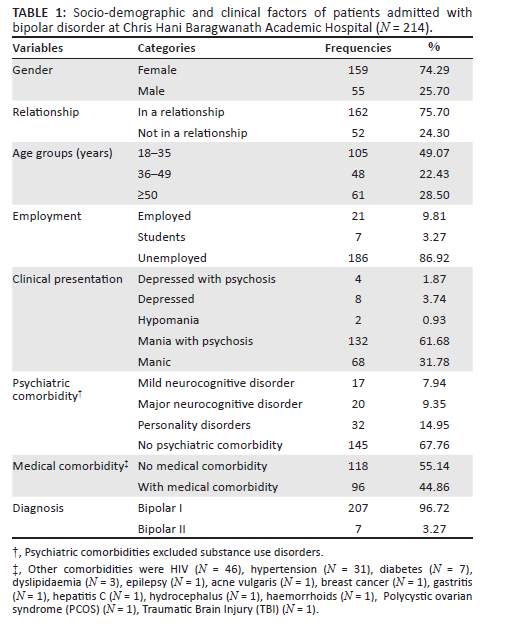
Altogether 192 patients were admitted, and 214 admissions were recorded (as some patients were admitted multiple times). Of the 192 patients, 90.62% were admitted once, 7.29% were admitted twice and 2.08% were admitted three times. More female patients were admitted (N = 159, 74.29%) than male patients (N = 55, 25.70%). Of the total admissions, the median (IQR) age was 36 (from 29 to 51) years. Most of the admissions were between 18 years and 35 years of age (N = 105, 49.07%). Most patients were not in a relationship (N = 162, 75.70%), most were unemployed (N = 186, 86.92%) and almost two-thirds (N = 132, 61.68%) had mania with psychotic features. Personality disorders were the most common psychiatric comorbidity (N = 32, 14.95%). The majority had comorbid borderline personality disorder (N = 17, 7.94%) and antisocial personality disorder (N = 8, 3.74%). Of the admitted patients with BD, almost half (N = 97, 45.32%) had a medical comorbidity, with a fifth (N = 46, 21.49%) being infected with HIV. Most patients had a diagnosis of bipolar I disorder (N = 207, 96.72%), with the minority (N = 7, 3.27%) being diagnosed with bipolar II disorder (Table 1).
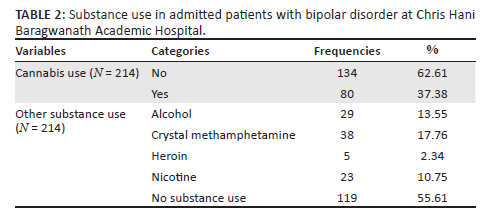
The median (IQR) LOA of the 214 admissions was 23 (range: 13-38) days. Eighteen patients with multiple admissions stayed in the hospital for a median (IQR) of 45 (range: 32-80) days over the duration of data collection. All patients with multiple admissions had a history of substance use and reported ongoing cannabis use. Of the patients admitted, 80 (37.38%) used cannabis, 38 (17.76%) used crystal methamphetamine, 29 (13.55%) used alcohol, 23 (10.75%) used nicotine and 5 (2.34%) used heroin. Over a quarter of the patients (N = 58, 27.10%) used two or more substances. Of those who used cannabis, 28 (35.00%) were identified by the MDUT, while 52 (65.00%) were self-reported. No MDUT was performed in 46 (57.50%) patients who reported cannabis use. Of those who used other substances, 21 (22.11%) were confirmed to use other substances via the MDUT, while 74 (77.89%) were self- or family-reported. As a result of a lack of resources, some patients did not get an MDUT (Table 2).
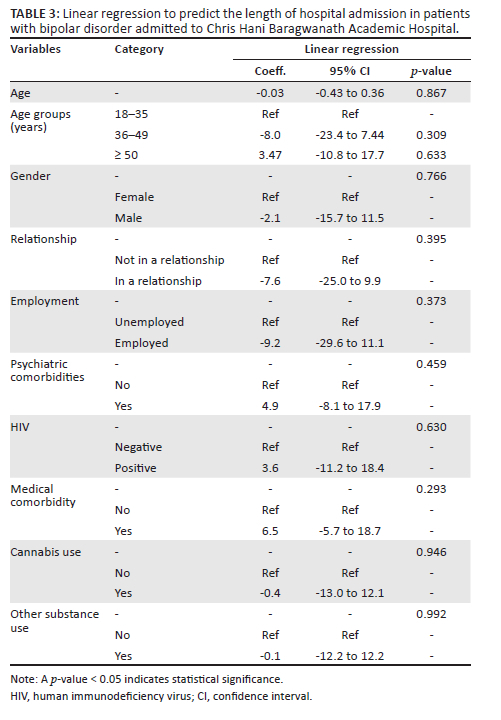
No significant association was found between LOA, age, relationship status and employment. Psychiatric, medical comorbidities, cannabis and other substance use were not associated with LOA.
Discussion
This study examined the factors associated with LOA in patients with BD, as well as the relationship between LOA and cannabis use in patients with BD. The decriminalisation of cannabis use in South Africa could increase its use, which may have important clinical implications. The median LOA was 23 days, which aligns with the duration of admission for patients with SMI from other local studies and healthcare facilities in sub-Saharan Africa.15,19,2526,2728,29,30
Approximately 8.41% (N = 18) of the cohort had multiple admissions and stayed longer in the hospital when the duration of all admissions during the study period was considered. They had a median hospital stay of 45 days (IQR: 32-80). In South Africa, the ongoing bed shortage in many facilities may necessitate a higher discharge rate. While this likely contributes to lower LOA, it may potentially contribute to an increase in readmission rates. According to Glick et al., the deinstitutionalisation and shift to community-based care led to lower LOA, thereby, minimising healthcare costs.31
The socio-demographic profiles of the patients were similar to those reported in other studies.19,32,33N = 105) (Table 1) of admissions occurring in patients aged 18-35. The high proportion of young people in this cohort is consistent with the typical age of onset of BD, which usually manifests in late adolescence and early adulthood.3434,35
Most patients were not in a relationship (N = 162, 75.70%) and were unemployed (N = 186, 86.92%) (Table 1). This may reflect the negative impact of BD on patients' lives, affecting their ability to maintain stable employment because of mood instability, cognitive impairments and the stigma they experience.36373737
More female patients (N = 159, 73.44%) were admitted than male patients (N = 55, 26.56%) (Table 1). This was consistent with the literature, which reported that more female patients with BD are admitted, despite a similar prevalence of BD in male and female patients.38,39Table 3), which aligns with the findings of similar studies.14,17404141,42,43,4441,45
Chris Hani Baragwanath Academic Hospital has a maternal mental health clinic that screens and treats women with mental illnesses. This clinic serves patients with BD who are pregnant and post-partum from CHBAH and other surrounding community clinics. Consequently, there may be improved screening and identification of women who require admission. The post-partum status of some women may be a factor necessitating a lower threshold for admission, given the urgency to stabilise their condition and minimise risk to their infants. However, the reasons for admission and the pregnancy status of the women admitted were not captured in this study, and so the above interpretation remains speculative.
Over 95% of the admissions were diagnosed with bipolar I disorder. Almost two-thirds of the patients presented with mania along with psychotic symptoms, followed by over 30% of the patients who presented with manic episodes without psychotic symptoms. In contrast, patients admitted with depressive episodes and hypomania are rare. This is expected because admission of patients with BD is mostly indicated in the manic phase, which is difficult to treat on an outpatient basis because of poor treatment adherence or during severe depressive episodes with increased suicide risk.464732
Both medical and psychiatric comorbidities are common in patients with BD.4848,4950,51525353,5415,16,17,4955
Personality disorders were the most common psychiatric comorbidity found in this study; the findings are in consistent with previous literature reporting a higher incidence of borderline and narcissistic personality disorders.5657
Cannabis was the most used substance, reported by one-third of patients, followed by crystal methamphetamine and alcohol. Although cannabis was the most frequently used substance, it was not a significant predictor of LOA (Table 3). This finding is relevant because recent South African literature reports that cannabis use may be increasing among patients admitted with SMI following the decriminalisation of home cannabis use in 2018.23,245859
Strengths and limitations
As this study was conducted in one facility and was retrospective, the results may not be generalisable to other populations. The sample size may have limited our ability to detect significant associations, particularly with cannabis use. Although women patients in this study had the most admissions, the LOA was similar between the genders. The reason for this remains unclear and requires further exploration of gender-specific factors that influence LOA. The study assessed LOA; however, there is no specific protocol for when patients are discharged. While the patients would not be discharged unless their treating team deemed it appropriate based on the treating team's risk assessment to discharge them, it was beyond the scope of this study to assess factors such as insufficient bed capacity, presence of residual symptoms, levels of support in the home environment and level of patient insight into their illness.
This study relied on BD diagnoses obtained from hospital records. Some patients may have been excluded because they were erroneously diagnosed with substance-induced bipolar and related disorders, as their symptoms occurred in the context of substance use. These patients would only be diagnosed with BD retrospectively if their symptoms occurred independently of substance use. Similarly, the diagnoses were determined by the treating physician and were not independently confirmed in this study. However, as the discharge summary is performed by a psychiatry registrar and reviewed by a consultant, the likelihood of the chances of minimising an erroneous diagnosis is increased.
No association was found between cannabis and LOA, which could be because of other unmeasured factors such as variability in cannabis potency, different usage methods, frequency and patterns of cannabis use. Cannabis use may be under-reported because of limited administration of the MDUT and reliance on self and family reports. While some studies have found some concordance between self-reporting and MDUT, self-reports often lack accuracy and reliability.60,61 Owing to limited resources at CHBAH, there are times when not all patients receive an MDUT upon admission.
Conclusion
Although the literature examines LOA in patients with SMI in South Africa, there is a paucity of literature specifically examining patients with BD. The findings of this study are similar to those of South African and other low- to middle-income countries and add to the body of knowledge on this topic.19
Although limited evidence exists regarding LOA in the South African patients with BD, to the best of our knowledge, this study is the first to examine cannabis use and its impact on LOA in this population. Cannabis was the most commonly used substance in this study; however, its use did not affect the LOA. South Africa is a resource-constrained country that requires targeted interventions to reduce LOA. These results do not suggest that reducing cannabis use decreases the LOA in patients with BD. However, this does not mean that decreasing cannabis use would not benefit patients and the healthcare system. Standardised treatment protocols, unmeasured socio-economic factors, medication adherence and comorbid substance use may have confounded the results. Additionally, episode severity and hospital resource constraints could also have influenced the LOA independent of cannabis use. Although these variables may have been confounding factors in this study, the research remains valuable in that it guides future research by identifying patients, diagnostic and treatment facility factors that warrant further exploration as potential factors influencing LOA in patients admitted with BD.
A higher proportion of women with BD were admitted compared to other studies.19,39,40
Also, it is noteworthy that all patients with multiple admissions during the study period had a history of substance use. This suggests a need for further research to evaluate the impact of cannabis use on readmission rates and the cumulative duration of hospitalisation throughout the lifespan among patients with BD.
This article is based on research originally conducted as part of Sewela R. Mamadi-Moshidi's master's thesis titled, 'Length of hospital admission, cannabis use, and associated factors in patients with bipolar disorder', submitted to the Department of Psychiatry, Faculty of Health Sciences, University of Witwatersrand in 2025. The thesis is currently unpublished and not publicly available. The thesis was supervised by Sibulele Zuma and Lisa Galvin. The manuscript has been revised and adapted for journal publication. The author confirms that the content has not been previously published or disseminated and complies with ethical standards for original publication.
Competing interests
The authors declare that they have no financial or personal relationships that may have inappropriately influenced them in writing this article.
CRediT authorship contribution
Sewela R. Mamadi-Moshidi: Conceptualisation; Methodology; Investigation; Data curation; Formal analysis; Writing-original draft; Writing-review & editing; Visualisation; Project administration. Sibulele Zuma: Supervision; Validation; Writing-review & editing. Lisa Galvin: Supervision; Validation; Writing-review & editing. All authors reviewed the article,contributed to the discussion of the results, approved the final version for submission and publication.
Funding information
This research received no specific grant from any funding agency in the public, commercial or not-for-profit sectors.
Data availability
The data that support the findings of this study are available from the corresponding author, S.R.M.-M., upon reasonable request.
Disclaimer
The views and opinions expressed in this article are those of the authors and are the product of professional research. They do not necessarily reflect the official policy or position of any affiliated institution, funder, agency or that of the publisher. The authors are responsible for this article's results, findings and content.
Acknowledgements
The authors would like to acknowledge Dr. Zwifadzo Matsena Zingoni for assisting with the statistical data analysis.
References
-
1.World Health Organization. Comprehensive mental health action plan 2013-2030 [homepage on the Internet]. Geneva: World Health Organization; 2021 [cited 2025 Jun 12]. Available from: https://www.who.int/publications/i/item/9789240031029
» https://www.who.int/publications/i/item/9789240031029 -
2.Novella EJ. Theoretical accounts on deinstitutionalisation and the reform of mental health services: A critical review. Med Health Care Philos. 2008;11(3):303-314. https://doi.org/10.1007/s11019-008-9123-5
» https://doi.org/10.1007/s11019-008-9123-5 -
3.Myeni SY, Ntlantsana V, Tomita A, Aguwa US, Bridgmohun R, Shabalala S. The profile of long-stay patients in a psychiatric hospital in KwaZulu-Natal, South Africa. S Afr J Psychiat. 2025;31:2358. https://doi.org/10.4102/sajpsychiatry.v31i0.2358
» https://doi.org/10.4102/sajpsychiatry.v31i0.2358 -
4.Miettunen J, Lauronen E, Veijola J, Koponen H, Saarento O, Isohanni M. Patterns of psychiatric hospitalizations in schizophrenic psychoses within the Northern Finland 1966 birth cohort. Nord J Psychiatry. 2006;60(4):286-293. https://doi.org/10.1080/08039480600790168
» https://doi.org/10.1080/08039480600790168 -
5.Mattes JA. The optimal length of hospitalization for psychiatric patients: A review of the literature. Hosp Community Psychiatr. 1982;33(4):284-288. https://doi.org/10.1176/ps.33.10.824
» https://doi.org/10.1176/ps.33.10.824 -
6.Frieri T, Montemagni C, Rocca G, Rocca P, Villari V. Clinical outcomes and length of stay in an Italian psychiatric emergency service. Soc Psychiatry Psychiatr Epidemiol. 2013;48(6):1013-1020. https://doi.org/10.1007/s00127-012-0607-5
» https://doi.org/10.1007/s00127-012-0607-5 - 7.AbuMadini MS, Rahim SI. Psychiatric admission in a general hospital. Patient profiles and patterns of service utilization over a decade. Saudi Med J. 2002;23(1):44-50.
- 8.Lund C, Fisher AL. South African mental health process indicators. J Ment Health Policy Econ. 2001;4(1):9-16.
-
9.Tulloch AD, Fearon P, David AS. Length of stay of general psychiatric inpatients in the United States: Systematic review. Adm Policy Ment Health. 2011;38(3):155-168. https://doi.org/10.1007/s10488-010-0310-3
» https://doi.org/10.1007/s10488-010-0310-3 -
10.Munley PH. Demographic and clinical characteristics as predictors of length of hospitalization and readmission. J Clin Psychol. 1977;33(4):1093-1100. https://doi.org/10.1002/1097-4679(197710)33:4<1093::AID-JCLP2270330438>3.0.CO;2-9
» https://doi.org/10.1002/1097-4679(197710)33:4<1093::AID-JCLP2270330438>3.0.CO;2-9 -
11.Addisu F, Chemali Z, Tesfaye M, Dejene T, Wondafrash M. Length of stay of psychiatric admissions in a general hospital in Ethiopia: A retrospective study. Int J Ment Health Syst. 2015;9(1):13. https://doi.org/10.1186/s13033-015-0006-x
» https://doi.org/10.1186/s13033-015-0006-x -
12.Kessing LV, Hansen MG, Andersen PK. Course of illness in depressive and bipolar disorders: Naturalistic study 1994-1999. Br J Psychiatry. 2004;185(5):372-377. https://doi.org/10.1192/bjp.185.5.372
» https://doi.org/10.1192/bjp.185.5.372 -
13.Esan O, Esan A. Epidemiology and burden of bipolar disorder in Africa: A systematic review of data from Africa. Soc Psychiatry Psychiatr Epidemiol. 2016;51(1):93-100. https://doi.org/10.1007/s00127-015-1091-5
» https://doi.org/10.1007/s00127-015-1091-5 -
14.Abaatyo J, Kaggwa MM, Favina A, Olagunju AT. Readmission and associated clinical factors among individuals admitted with bipolar affective disorder at a psychiatric facility in Uganda. BMC Psychiatry. 2023;23(1):474. https://doi.org/10.1186/s12888-023-04960-0
» https://doi.org/10.1186/s12888-023-04960-0 -
15.Barnett BS, Kusunzi V, Magola L, et al. Factors associated with long length of stay in an inpatient psychiatric unit in Lilongwe, Malawi. Soc Psychiatry Psychiatr Epidemiol. 2019;54(2):235-242. https://doi.org/10.1007/s00127-018-1611-1
» https://doi.org/10.1007/s00127-018-1611-1 -
16.World Health Organization. Global health observatory [homepage on the Internet]. Geneva: World Health Organization; 2023 [cited 2025 Jun 12]. Available from: https://www.who.int/data/gho/data/themes/hiv-aids
» https://www.who.int/data/gho/data/themes/hiv-aids -
17.Antinori A, Arendt G, Becker JT, et al. Updated research nosology for HIV-associated neurocognitive disorders. Neurology. 2007;69(18):1789-1799. https://doi.org/10.1212/01.WNL.0000287431.88658.8b
» https://doi.org/10.1212/01.WNL.0000287431.88658.8b -
18.Johnson JM, Wu CY, Winder GS, Casher MI, Marshall VD, Bostwick JR. The effects of cannabis on inpatient agitation, aggression, and length of stay. J Dual Diagn. 2016;12(3-4):244-251. https://doi.org/10.1080/15504263.2016.1245457
» https://doi.org/10.1080/15504263.2016.1245457 -
19.Mkhwebane NC, Friedlander W. Retrospective review: Factors impacting length of stay in bipolar disorder at a tertiary hospital. S Afr J Psychiatr. 2024;30:2310. https://doi.org/10.4102/sajpsychiatry.v30i0.2310
» https://doi.org/10.4102/sajpsychiatry.v30i0.2310 -
20.Hunt GE, Malhi GS, Cleary M, Lai HMX, Sitharthan T. Prevalence of comorbid bipolar and substance use disorders in clinical settings, 1990-2015: Systematic review and meta-analysis. J Affect Disord. 2016;206:331-349. https://doi.org/10.1016/j.jad.2016.07.011
» https://doi.org/10.1016/j.jad.2016.07.011 -
21.Lubaale EC, Mavundla SD. Decriminalisation of cannabis for personal use in South Africa. Afr Hum Rights Law J. 2019;19(2):819-842. https://doi.org/10.17159/1996-2096/2019/v19n2a13
» https://doi.org/10.17159/1996-2096/2019/v19n2a13 -
22.Moshori R, Galvin L, Paruk L. Changes in cannabis use post decriminalisation in mental health care users in South Africa. S Afr J Psychiat. 2025;31:a2305. https://doi.org/10.4102/sajpsychiatry.v31i0.2305
» https://doi.org/10.4102/sajpsychiatry.v31i0.2305 -
23.Swartz MC, Dannatt L, Lachman A. Cannabis use among hospitalised adolescents before and after decriminalisation in South Africa. S Afr J Psychiatr. 2024;30:2244. https://doi.org/10.4102/sajpsychiatry.v30i0.2244
» https://doi.org/10.4102/sajpsychiatry.v30i0.2244 -
24.Mona K, Ntlantsana V, Tomita AM, Paruk S. Prevalence of cannabis use in people with psychosis in KwaZulu-Natal, South Africa. S Afr J Psychiatr. 2022;28:1927. https://doi.org/10.4102/sajpsychiatry.v28i0.1927
» https://doi.org/10.4102/sajpsychiatry.v28i0.1927 - 25.Oladeji B, Ogundele A, Dairo M. Determinants of length of stay in the psychiatric wards of the University College Hospital, Ibadan, Nigeria. Afr J med Sci. 2012;41(2):147-152.
-
26.Sheidow AJ, McCart M, Zajac K, Davis M. Prevalence and impact of substance use among emerging adults with serious mental health conditions. Psychiatr Rehabil J. 2012;35(3):235-243. https://doi.org/10.2975/35.3.2012.235.243
» https://doi.org/10.2975/35.3.2012.235.243 -
27.Anic A, Robertson LJ. Prevalence and clinical correlates of substance use amongst acute psychiatric inpatients in Gauteng, South Africa. S Afr J Psychiatr. 2020;26:a1526. https://doi.org/10.4102/sajpsychiatry.v26i0.152
» https://doi.org/10.4102/sajpsychiatry.v26i0.152 - 28.Otieno FA. Length of stay and the influence of specific factors at Tara-the H Moross centre [Master's dissertation]. Johannesburg: University of the Witwatersrand; 2010.
-
29.Niehaus DJH, Koen L, Galal U, et al. Crisis discharges and readmission risk in acute psychiatric male inpatients. BMC Psychiatry. 2008;8:44. https://doi.org/10.1186/1471-244X-8-44
» https://doi.org/10.1186/1471-244X-8-44 -
30.De Menil VP, Knapp M, McDaid D, Njenga FG. Service use, charge, and access to mental healthcare in a private Kenyan inpatient setting: The effects of insurance. PLoS One. 2014;9(3):e90297. https://doi.org/10.1371/journal.pone.0090297
» https://doi.org/10.1371/journal.pone.0090297 -
31.Glick ID, Sharfstein SS, Schwartz HI. Inpatient psychiatric care in the 21st century: The need for reform. Psychiatr Serv. 2011;62(2):206-209. https://doi.org/10.1176/ps.62.2.pss6202_0206
» https://doi.org/10.1176/ps.62.2.pss6202_0206 -
32.Shi X, Zhao Y, Yang H, et al. Factors associated with hospitalization times and length of stay in patients with bipolar disorder. Front Psychiatry. 2023;14:1140908. https://doi.org/10.3389/fpsyt.2023.1140908
» https://doi.org/10.3389/fpsyt.2023.1140908 -
33.Franken H, Parker J, Allen R, Wicomb RA. A profile of adult acute admissions to Lentegeur psychiatric hospital, South Africa. S Afr J Psychiatr. 2019;25:1244. https://doi.org/10.4102/sajpsychiatry.v25i0.1244
» https://doi.org/10.4102/sajpsychiatry.v25i0.1244 -
34.Kawa I, Carter JD, Joyce PR, et al. Gender differences in bipolar disorder: Age of onset, course, comorbidity, and symptom presentation. Bipolar Disord. 2005;7(2):119-125. https://doi.org/10.1111/j.1399-5618.2004.00180.x
» https://doi.org/10.1111/j.1399-5618.2004.00180.x -
35.Xu F, Cheng P, Xu J, et al. Influencing factors of length of stay among repeatedly hospitalized patients with mood disorders: A longitudinal study in China. Ann Gen Psychiatry. 2024;23(1):15. https://doi.org/10.1186/s12991-024-00497-y
» https://doi.org/10.1186/s12991-024-00497-y -
36.Shippee ND, Frye MA, Williams MD, Shah ND, Moriarty JP, Ziegenfuss JY. Differences in demographic composition and in work, social, and functional limitations among the populations with unipolar depression and bipolar disorder: Results from a nationally representative sample. Health Qual Life Outcomes. 2011;9(1):90. https://doi.org/10.1186/1477-7525-9-90
» https://doi.org/10.1186/1477-7525-9-90 -
37.Newman L, Harris V, Evans LJ, Beck A. Factors associated with length of stay in psychiatric inpatient services in London, UK. Psychiatric Q. 2018;89(1):33-43. https://doi.org/10.1007/s11126-017-9498-7
» https://doi.org/10.1007/s11126-017-9498-7 -
38.Fellinger M, Waldhör T, Blüml V, Williams N, Vyssoki B. Influence of gender on inpatient treatment for bipolar disorder: An analysis of 60,607 hospitalisations. J Affect Disord. 2018;225:104-107. https://doi.org/10.1016/j.jad.2017.08.007
» https://doi.org/10.1016/j.jad.2017.08.007 -
39.Hendrick V, Altshuler LL, Gitlin MJ, Delrahim S, Hammen C. Gender and bipolar illness. J Clin Psychiatry. 2000;61(5):393-396. https://doi.org/10.1192/bjp.186.4.297
» https://doi.org/10.1192/bjp.186.4.297 -
40.Oliver MI, Pearson N, Coe N, Gunnell D. Help-seeking behaviour in men and women with common mental health problems: Cross-sectional study. Br J Psychiatry. 2005;186(4):297-301. https://doi.org/10.1192/bjp.186.4.297
» https://doi.org/10.1192/bjp.186.4.297 -
41.El-Mallakh RS, Vöhringer PA, Ostacher MM, et al. Antidepressants worsen rapid-cycling course in bipolar depression: A STEP-BD randomized clinical trial. J Affect Disord. 2015;184:318-321. https://doi.org/10.1016/j.jad.2015.04.054
» https://doi.org/10.1016/j.jad.2015.04.054 -
42.Karanti A, Bobeck C, Osterman M, et al. Gender differences in the treatment of patients with bipolar disorder: A study of 7354 patients. J Affect Disord. 2015;174:303-309. https://doi.org/10.1016/j.jad.2014.11.058
» https://doi.org/10.1016/j.jad.2014.11.058 -
43.Carney SM, Goodwin GM. Lithium - A continuing story in the treatment of bipolar disorder. Acta Psychiatr Scand Suppl. 2005;111(426):7-12. https://doi.org/10.1111/j.1600-0447.2005.00521.x
» https://doi.org/10.1111/j.1600-0447.2005.00521.x -
44.Yonkers KA, Wisner KL, Stowe Z, et al. Management of bipolar disorder during pregnancy and the postpartum period. Am J Psychiatr. 2004;161(4):608-620. https://doi.org/10.1176/appi.ajp.161.4.608
» https://doi.org/10.1176/appi.ajp.161.4.608 -
45.Viktorin A, Lichtenstein P, Thase ME, et al. The risk of switching to mania in patients with bipolar disorder during treatment with an antidepressant alone and in combination with a mood stabiliser. Am J Psychiatry. 2014;171(10):1067-1073. https://doi.org/10.1176/appi.ajp.2014.13111501
» https://doi.org/10.1176/appi.ajp.2014.13111501 -
46.Ösby U, Tiainen A, Backlund L, et al. Psychiatric admissions and hospitalization costs in bipolar disorder in Sweden. J Affect Disord. 2009;115(3):315-322. https://doi.org/10.1016/j.jad.2008.09.011
» https://doi.org/10.1016/j.jad.2008.09.011 -
47.Tohen M, Hennen J, Zarate CM, et al. Two-year syndromal and functional recovery in 219 cases of first-episode major affective disorder with psychotic features. Am J Psychiatry. 2000;157(2):220-228. https://doi.org/10.1176/appi.ajp.157.2.220
» https://doi.org/10.1176/appi.ajp.157.2.220 -
48.Amann BL, Radua J, Wunsch C, König B, Simhandl C. Psychiatric and physical comorbidities and their impact on the course of bipolar disorder: A prospective, naturalistic 4-year follow-up study. Bipolar Disord. 2017;19(3):225-234. https://doi.org/10.1111/bdi.12495
» https://doi.org/10.1111/bdi.12495 -
49.Douzenis A, Seretis D, Nika S, et al. Factors affecting hospital stay in psychiatric patients: The role of active comorbidity. BMC Health Serv Res. 2012;12:166. https://doi.org/10.1186/1472-6963-12-166
» https://doi.org/10.1186/1472-6963-12-166 -
50.Kilbourne AM, Han X, Conigliaro J, et al. Burden of general medical conditions among individuals with bipolar disorder. Bipolar Disord. 2004;6(5):368-373. https://doi.org/10.1111/j.1399-5618.2004.00138.x
» https://doi.org/10.1111/j.1399-5618.2004.00138.x - 51.O'Briene S. The impact of the HIV epidemic on length of stay in an acute psychiatric ward at a general hospital in Gauteng, South Africa [Master's dissertation]. Johannesburg: University of Witwatersrand; 2021.
-
52.Collins PY, Berkman A, Mestry K, Pillai A. HIV prevalence among men and women admitted to a South African public psychiatric hospital. AIDS Care. 2009;21(7):863-867. https://doi.org/10.1080/09540120802626188
» https://doi.org/10.1080/09540120802626188 -
53.Henning MP, Krüger C, Fletcher L. HIV seropositivity in recently admitted and long-term psychiatric in-patients: Prevalence and diagnostic profile. Afr J Psychiatry. 2012;15(1):47-53. https://doi.org/10.4314/ajpsy.v15i1.7
» https://doi.org/10.4314/ajpsy.v15i1.7 -
54.Uys H. Prevalence and clinical presentation of HIV-positive female psychiatric inpatients. Afr J Psychiatry. 2013;16(1):23-28. https://doi.org/10.4314/ajpsy.v16i1.4
» https://doi.org/10.4314/ajpsy.v16i1.4 -
55.Ford N, Shubber Z, Meintjes G, et al. Causes of hospital admission among people living with HIV worldwide: A systematic review and meta-analysis. Lancet HIV. 2015;2(10):e438-e444. https://doi.org/10.1016/S2352-3018(15)00137-X
» https://doi.org/10.1016/S2352-3018(15)00137-X -
56.George EL, Taylor DO, Richards JA, Miklowitz DJ, Simoneau TL. The comorbidity of bipolar disorder and Axis II personality disorders: Prevalence and clinical correlates. Bipolar Disord. 2003;5(2):115-122. https://doi.org/10.1034/j.1399-5618.2003.00028.x
» https://doi.org/10.1034/j.1399-5618.2003.00028.x -
57.Fan AH, Hassell J. Bipolar disorder and comorbid personality psychopathology. J Clin Psychiatry. 2008;69(11):1794-1803. https://doi.org/10.4088/JCP.v69n1115
» https://doi.org/10.4088/JCP.v69n1115 -
58.Chander G, Himelhock S, Moore RD. Substance abuse and psychiatric disorders in HIV-positive patients: Epidemiology and impact on antiretroviral therapy. Drugs. 2006;66(6):769-789. https://doi.org/10.2165/00003495-200666060-00004
» https://doi.org/10.2165/00003495-200666060-00004 -
59.Oliva-Moreno J, López-Bastida J, Osuna-Guerrero R, Montejo-González AL, Duque-González B. The socioeconomic costs of mental illness in Spain. Eur J Health Econ. 2009;10(4):361-369. https://doi.org/10.1007/s10198-008-0135-0
» https://doi.org/10.1007/s10198-008-0135-0 -
60.Large MM, Smith G, Sara G, Paton MB, Kedzior KK, Nielssen OB. Meta-analysis of self-reported substance use compared with laboratory substance assay in general adult mental health settings. Int J Methods Psychiatr Res. 2012;21(2):134-148. https://doi.org/10.1002/mpr.1350
» https://doi.org/10.1002/mpr.1350 -
61.Khalili P, Janani L, Nadimi AE, et al. Validity of self-reported substance use: Research setting versus primary health care setting. Subst Abuse Treat Prev Policy. 2021;16(1):1-9. https://doi.org/10.1186/s13011-021-00398-3
» https://doi.org/10.1186/s13011-021-00398-3

Accepted: 06 Sept. 2025
Published: 05 Dec. 2025