The burden of insomnia among public health sector nurses in KwaZulu-Natal, South Africa
Abstract
BACKGROUND: Insomnia is defined as poor quantity or quality of sleep resulting in impaired daytime functioning and distress. Insomnia has been found to occur at higher rates in health care workers and has been associated with physiological dysfunction, illness and distress as well as many socio-demographic and lifestyle-related factors AIM: This study aims to establish the burden of insomnia and its associated socio-demographic, lifestyle and occupation-related factors among nurses SETTING: Nurses employed in the public sector in Kwazulu-Natal Province South Africa comprised the study group. A cross-sectional descriptive online survey was conducted METHODS: Nurses were invited to participate in an online survey from September to December 2023. The survey comprised a socio-demographic questionnaire and three instruments: the Sleep Condition Indicator, the Single Item Measure of Burnout and the Sleep-Hygiene Index (SHI RESULTS: Of the 235 participants surveyed, 41.7% screened positive for insomnia and had significantly lower frequencies of good sleep-hygiene practices on the SHI. After controlling for socio-demographic, clinical and work-related covariates, a psychiatric history adjusted odds ratio [aOR]: 5.52; CI:1.06-28.66) and poor sleep hygiene (aOR: 1.07; CI: 1.02-1.13) displayed significant association with insomnia. All levels of work-related stress were significantly associated with insomnia (p < 0.01), with total burnout having a 10.3-fold increased association CONCLUSION: The study highlights the concerning burden of insomnia and its association with burnout, poor sleep hygiene and a psychiatric comorbidity, among nurses CONTRIBUTION: Given that the risk factors associated with insomnia identified in our study (i.e. poor sleep hygiene, burnout and psychiatric illness) are all potentially modifiable, our findings may serve as a reference for future health-promotion initiatives, aimed at health care professionals, such as health education, screening and mindfulness and wellness programmes
insomnia; nurses; health care workers; sleep hygiene; burnout
Introduction
Sleep plays a crucial role in both physical and mental homeostasis,123
Insomnia may be defined as a collection of symptoms where individuals experience challenges in initiating, maintaining and/or returning to sleep, causing significant day-time dysfunction.4567
Health care workers appear to be at particular risk of insomnia, having a much higher rate of 30% - 90% of this condition globally.389
Serving a population approaching 70 million,10111213
A variety of socio-demographic and lifestyle-related factors may influence sleep patterns, with age and gender being the most common risk factors, and females and the elderly displaying a higher prevalence.1412,15,1617
Poor sleep hygiene practices are also significantly associated with poor sleep quality and may harm mental and physical health and lower QoL in health care shift workers.1819
Given the general finding that nurses appear to be at particular risk of insomnia, and the extent to which the South African public health system depends on nursing staff in particular, this study aims to determine the burden of insomnia and its association with socio-demographic profile, occupational and lifestyle-related factors among nurses in KwaZulu-Natal (KZN) Province, South Africa. At the time of writing, there is a paucity of studies on insomnia in this population in South Africa.
Research methods and design
This is a cross-sectional, descriptive quantitative study comprising nurses currently working in public health facilities (clinics and hospitals) in KZN, South Africa. Nurses who are registered with the South African Nursing Council (SANC), between the ages of 18 and 60 years and employed in the public sector were invited to participate in the study. Non-public sector nurses, non-nursing medical professionals and those with sensory-motor deficits or acute medical illnesses were excluded. A minimum sample size of 215 was required, calculated using an online sample size calculator (www.calculator.net/sample-size-calculator.html) with a 95% confidence level, a 41% estimated population proportion based on a previous study920
Measures
Participants were administered four instruments: a researcher-designed socio-demographic questionnaire, the Sleep Condition Indicator (SCI), Single Item Measure of Burnout (SIMB) and Sleep Hygiene Index (SHI). The socio-demographic questionnaire included demographic, biographical, clinical and lifestyle-related questions, developed by the researchers and piloted on a sample of 10 nurses to assess its feasibility prior to implementation. Factors examined were age, race, gender, nursing category, workplace, years of experience, workplace support, absence because of insomnia, substance use, family history and medical history. The SCI is based on DSM-5 criteria for primary insomnia2121
The SIMB, developed by Schmoldt et al., is a single-item rating of subjective burnout, with responses range from 1 (I feel extremely exhausted and question my ability to continue. I may need to make changes or seek help) to 5 (I enjoy my work. I have no burnout symptoms).222324
The SHI is a 13-item self-reported measure developed from the International Classification of Sleep Disorders (ICSD) to evaluate sleep hygiene behaviours.252525r (139) = 0.71, p < 0.01),26
Data analysis
IBM SPSS Statistics version 28 for Windows was utilised for statistical analysis. Continuous variables were found to be normally distributed using the Shapiro-Wilk test and visual inspection of histogram plots and were summarised using means and standard deviations (s.d.). Categorical variables were described using proportions (%), and Pearson's chi-square test was performed to measure the association between categorical variables. Assumptions for the chi-square test were checked using Fisher's exact test, and with p-values, odds ratios and 95% confidence intervals were reported. To account for potential confounders, variables with a p < 0.3 in the univariate analysis were included in the multivariate logistic regression model. This threshold was chosen to ensure that variables with possible confounding effects were not prematurely excluded.27p-value of less than 0.05 was considered statistically significant.
Ethical considerations
Ethical clearance to conduct this study was obtained from the University of Kwazulu-Natal Biomedical Research Ethics Committee (No. BREC/00005346/2023) and the KwaZulu-Natal Department of Health. All participants were provided with study information on an online platform before providing informed consent. Confidentiality was maintained through the authors having exclusive access to the data and no identifying data being used.
Results
Four sets of results are presented: those relating to the socio-demographic questionnaire and SIMB, the SCI and clinical factors, the SHI, and a multi-variate regression to establish association.
Participants' characteristics
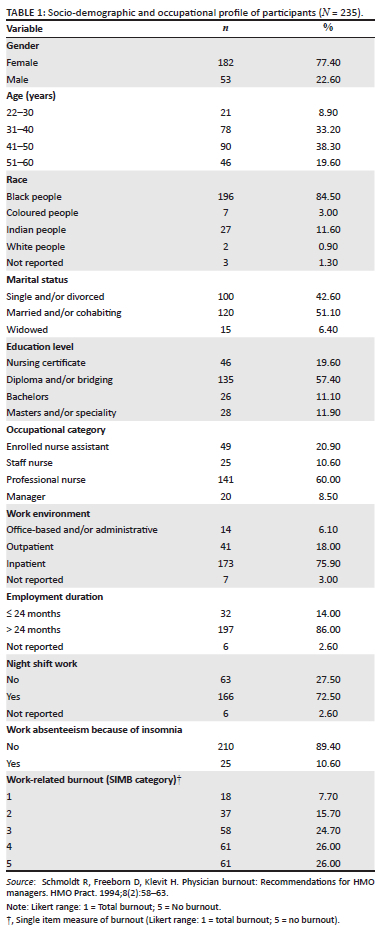
A total of 235 completed surveys were received. The participants' socio-demographic and occupational characteristics are displayed in Table 1.
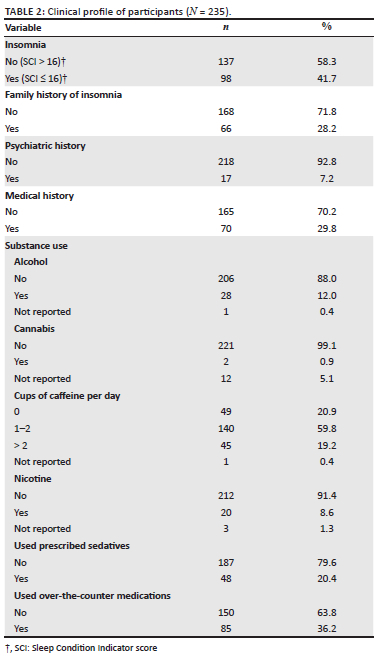
Participants' clinical profiles, including substance and medication use, are presented in Table 2, with 41.7% screening positive for insomnia using an SCI cut-off score of 16. A positive family history of insomnia was reported by 66 individuals (28.2%), while co-morbidities were reported by 17 (7.2%) having been diagnosed with a psychiatric disorder and 70 (29.8%) having a general medical condition (e.g. hypertension, diabetes, epilepsy and allergies). In addition, 28 (12%) participants reported using alcohol, two (0.9%) used cannabis to assist with sleep and 20 (8.6%) used nicotine in the form of cigarettes; 49 (20.9%) did not consume caffeine-containing beverages such as coffee or energy drinks; 140 (59.8%) consumed 1-2 cups of caffeinated-drinks daily and 45 (19.2%) consumed more than two cups daily. Regarding medication used for insomnia, 48 (20.4%) utilised prescription sedatives (the commonest being amitriptyline, followed by alprazolam and zolpidem), and an additional 85 (36.2%) used over-the-counter drugs (including non-prescription items, such as antihistamines, for example chlorpheniramine, supplements, nootropics and herbal products) to help them sleep.
Sleep hygiene
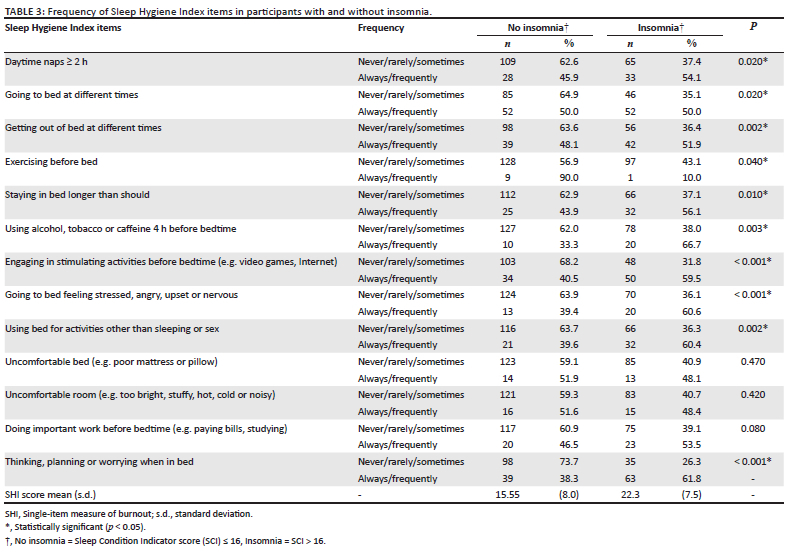
The results of the SHI showed that participants scored between 0 and 48 (µ = 18.37; s.d.: 8.46). Individuals suffering from insomnia had sub-optimal sleep hygiene (µ = 22.3; s.d.: 7.5) in comparison to those without insomnia (SHI µ = 15.55; s.d.: 8.0) (Table 3). Sleep Hygiene Index items that were significantly associated with insomnia were irregular sleeping and waking times; using alcohol or caffeine 4 h before bed; engaging in stimulating activities before bed; going to bed feeling stressed, angry, upset or nervous; using bed for activities other than sleep and/or sex and thinking, planning or worrying while in bed (Table 3). Environmental factors such as room and bed comfort were not associated with insomnia.
Association between insomnia, sleep hygiene and socio-demographic, clinical and occupational factors
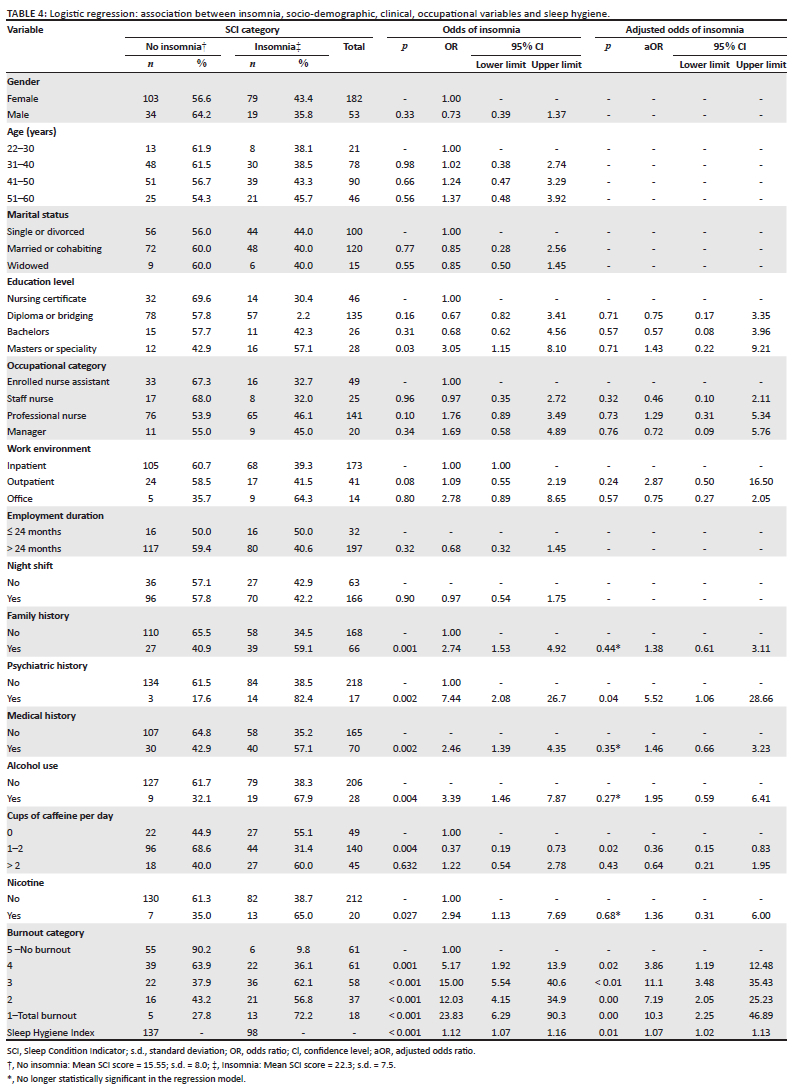
Univariate logistic regression demonstrated that the presence of insomnia was significantly associated with a positive family history of the condition (p = 0.001), a higher educational level (Masters/Speciality) (p = 0.03), the presence of medical and psychiatric disorders (p = 0.002), the regular use of alcohol and nicotine (p = 0.004 and 0.027, respectively), poor sleep hygiene (p < 0.001) and all categories of work-related burnout (p < 0.01) (Table 4). After controlling for covariates, only psychiatric history (aOR: 5.52; CI:1.06-28.66), all SIMB categories, inclusive of stress and burnout and sleep hygiene (aOR: 1.07; CI: 1.02-1.13) were significantly associated with insomnia, while 1-2 cups of coffee appeared to be protective (p = 0.02, aOR:0.36; CI: 0.15-0.38).
Discussion
The study aimed to determine the burden and factors associated with insomnia amongst nursing staff in public health facilities in KZN. The findings that 41.7% of nurses met the criteria for a DSM-5 diagnosis of insomnia disorder are concerning but in keeping with a recent systematic review that showed insomnia rates between 12.8% and 76.4% in health care workers.28929
Our findings may be attributed to the predominance of females in our sample, as only 22.6% of our sample were male, matching the gender profile of the nurses employed by the South African Department of Health3031313
Insomnia in our study was associated with a family history, which is in keeping with other studies that show it to have a genetic basis.3233
Insomnia was correlated with a higher degree of education, which contradicted the findings of an earlier study where insomnia was reported to be lower in people with a higher level of education.3435
Our study also revealed an association between nicotine use and the occurrence of insomnia, and while consuming more than two cups of caffeinated drinks was not associated with poorer sleep patterns in our sample, 1-2 cups were protective. Research has indicated that nicotine has the potential to induce insomnia, and in turn, insomnia can lead to the use of nicotine and other substances as a technique for self-medication.3637,3837
An unexpected finding in our sample was that shift work was not associated with insomnia, which could be because of the nurses in the public sector working shifts for many months, thus acclimatising to a new circadian rhythm. Systemic reviews have shown that changing shifts disrupts the circadian rhythm and results in insomnia.2839,40
Our findings that nurses suffering from insomnia had inadequate sleep hygiene practices is consistent with recent research findings,4142,43
A few limitations may have affected our findings, the cross-sectional design being unable to establish causality, the questionnaires being self-rated and depended on the participants' recall and the findings therefore possibly being over- or under-reported. Furthermore, alcohol, cannabis and nicotine use were also self-reported as binary responses and not quantified. The questionnaires used were not validated in South Africa, according to the author's knowledge, although they have been used internationally. The study's strength lies in its modest sample size and its focus on insomnia disorder as defined in the DSM-5, which necessitates functional impairment, while simultaneously emphasising the impact of burnout on sleep. While similar data may exist for other countries, replicating this study in South Africa is important for addressing a notable gap in local data, given the region's unique socio-economic and cultural dynamics that may influence the interplay between burnout and insomnia. As the study was only conducted in KZN, the findings may not reflect the broader community of nurses in other provinces. Future studies would be benefit with using non-self-report measures of insomnia, such as smart watches for more objective data on sleep patterns and to focus on interventions.
Conclusion
The study expands on the emerging literature on health care worker wellness in SA by focusing on insomnia and possible associations, because of it being an important component of physical and mental wellness. The high rate of insomnia raises awareness about its effects on the quality of nursing and the personal burden related to a lack of sleep among public sector nurses who often work in under-staffed and under-resourced circumstances. Such studies can serve as a reference for future health and wellness promotion aimed at health care professionals. Assisting nurses to have good quality sleep is likely to result in their having more job satisfaction and being able to provide optimal patient care.
Competing interests
The authors declare that they have no financial or personal relationships that may have inappropriately influenced them in writing this article.
Authors' contributions
P.P.N. was the principal investigator of the study in the context of her Master's degree in Psychiatry. She conceptualised the study, wrote the research protocol, gathered and analysed the data, interpreted the findings and wrote the final article. K.N., as the supervisor and S.M., as the co-supervisor, assisted with the formulation of the research question, and contributed to the writing of the article.
Funding information
This research received no specific grant from any funding agency in the public, commercial or not-for-profit sectors.
Data availability
Deidentified data that support the findings of this study are available from the corresponding author, P.P.N. upon reasonable request.
Disclaimer
The views and opinions expressed in this article are those of the authors and do not necessarily reflect the official policy or position of any affiliated agency of the authors.
Acknowledgements
The authors are deeply grateful to Catherine Connolly and Vuyokazi Ntlantsana for their invaluable assistance with data analysis; and to Ermien Van Pletzen for editing the article.
References
-
1. Miletínová E, Bušková J. Functions of sleep. Physiol Res. 2021;70(2):177. https://doi.org/10.33549/physiolres.934470
» https://doi.org/10.33549/physiolres.934470 -
2. Kapsi S, Katsantoni S, Drigas A. The role of sleep and impact on brain and; earning. Int J Recent Contribut Eng Sci IT. 2020;8(3):59-68. https://doi.org/10.3991/ijes.v8i3.17099
» https://doi.org/10.3991/ijes.v8i3.17099 -
3. Lee S, Gonzalez BD, Small BJ. My job impacts my sleep: Signs and symptoms of insomnia among healthcare workers. Industr Health. 2021;59(2):86-98. https://doi.org/10.2486/indhealth.2020-0191
» https://doi.org/10.2486/indhealth.2020-0191 -
4. Riemann D, Benz F, Dressle RJ, et al. Insomnia disorder: State of the science and challenges for the future. J Sleep Res. 2022;31(4):e13604. https://doi.org/10.1111/jsr.13604
» https://doi.org/10.1111/jsr.13604 - 5. American Psychiatric Association. Diagnostic and statistical manual of mental disorders. 5th ed. Washington, DC: American Psychiatric Association; 2013.
-
6. Morin CM, Jarrin DC. Epidemiology of insomnia: Prevalence, course, risk factors, and public health burden. Sleep Med Clin. 2022;17(2):173-191. https://doi.org/10.1016/j.jsmc.2022.03.003
» https://doi.org/10.1016/j.jsmc.2022.03.003 -
7. Peltzer K, Pengpid S. Prevalence, and social and health correlates of insomnia among persons 15 years and older in South Africa. S Afr J Psychol. 2019;49(4):467-478. https://doi.org/10.1177/0081246318818623
» https://doi.org/10.1177/0081246318818623 -
8. Lee BEC, Ling M, Boyd L, Olsson C, Sheen J. The prevalence of probable mental health disorders among hospital healthcare workers during COVID-19: A systematic review and meta-analysis. J Affect Disord. 2023;330:329-345. https://doi.org/10.1016/j.jad.2023.03.012
» https://doi.org/10.1016/j.jad.2023.03.012 -
9. Shah J, Monroe-Wise A, Talib Z, et al. Mental health disorders among healthcare workers during the COVID-19 pandemic: A cross-sectional survey from three major hospitals in Kenya. BMJ Open. 2021;11(6):e050316. https://doi.org/10.1136/bmjopen-2021-050316
» https://doi.org/10.1136/bmjopen-2021-050316 -
10. Statistics South Africa. Census 2022: Statistical release (P0301.4) [homepage on the Internet]. Pretoria: Statistics South Africa; 2022 [cited 2024 May 20]. Available from: https://census.statssa.gov.za/assets/documents/2022/P03014_Census_2022_Statistical_Release.pdf
» https://census.statssa.gov.za/assets/documents/2022/P03014_Census_2022_Statistical_Release.pdf - 11. Abrahams GL, Thani XC, Kahn SB. South African public primary healthcare services and challenges. Administratio Publica. 2022;30(2):63-85.
-
12. Wang M-F, Shao P, Wu C, et al. The relationship between occupational stressors and insomnia in hospital nurses: The mediating role of psychological capital. Front Psychol. 2023;13:1070809. https://doi.org/10.3389/fpsyg.2022.1070809
» https://doi.org/10.3389/fpsyg.2022.1070809 -
13. Dong H, Zhang Q, Sun Z, Sang F, Xu Y. Sleep disturbances among Chinese clinical nurses in general hospitals and its influencing factors. BMC Psychiatry. 2017;17:1-9. https://doi.org/10.1186/s12888-017-1402-3
» https://doi.org/10.1186/s12888-017-1402-3 -
14. Sivertsen B, Pallesen S, Friborg O, et al. Sleep patterns and insomnia in a large population-based study of middle-aged and older adults: The Tromsø study 2015-2016. J Sleep Res. 2021;30(1):e13095. https://doi.org/10.1111/jsr.13095
» https://doi.org/10.1111/jsr.13095 -
15. Yang B, Wang Y, Cui F, et al. Association between insomnia and job stress: A meta-analysis. Sleep Breathing. 2018;22:1221-1231. https://doi.org/10.1007/s11325-018-1682-y
» https://doi.org/10.1007/s11325-018-1682-y -
16. Guandalini LS, Da Silva EF, De Lima Lopes J, Santos VB, Lopes CT, De Barros ALBL. Analysis of the evidence of related factors, associated conditions and at-risk populations of the NANDA-I nursing diagnosis insomnia. Int J Nurs Sci. 2020;7(4):466-476. https://doi.org/10.1016/j.ijnss.2020.09.003
» https://doi.org/10.1016/j.ijnss.2020.09.003 -
17. Bennaroch K, Shochat T. Psychobiological risk factors for insomnia and depressed mood among hospital female nurses working shifts. Front Sleep. 2023;2:1206101. https://doi.org/10.3389/frsle.2023.1206101
» https://doi.org/10.3389/frsle.2023.1206101 - 18. Hattatoğlu DG, Aydin Ş, Aydin C, Yildiz BP. The effect of sleep hygiene and sleep deterioration on quality of life in shiftworking healthcare professionals. Arch Neuropsychiatry. 2021;58(1):11.
-
19. Shriane AE, Ferguson SA, Jay SM, Vincent GE. Sleep hygiene in shift workers: A systematic literature review. Sleep Med Rev. 2020;53:101336. https://doi.org/10.1016/j.smrv.2020.101336
» https://doi.org/10.1016/j.smrv.2020.101336 -
20. Calculator.net. Sample Size Calculator [homepage on the Internet]. [cited 2023 Jan 31]. Available from: https://www.calculator.net/sample-size-calculator.html
» https://www.calculator.net/sample-size-calculator.html -
21. Espie CA, Kyle SD, Hames P, Gardani M, Fleming L, Cape J. The Sleep Condition Indicator: A clinical screening tool to evaluate insomnia disorder. BMJ Open. 2014;4(3):e004183. https://doi.org/10.1136/bmjopen-2013-004183
» https://doi.org/10.1136/bmjopen-2013-004183 - 22. Schmoldt R, Freeborn D, Klevit H. Physician burnout: Recommendations for HMO managers. HMO Pract. 1994;8(2):58-63.
-
23. Rohland BM, Kruse GR, Rohrer JE. Validation of a single-item measure of burnout against the Maslach Burnout Inventory among physicians. Stress Health J Int Soc Investig Stress. 2004;20(2):75-79. https://doi.org/10.1002/smi.1002
» https://doi.org/10.1002/smi.1002 -
24. Dolan ED, Mohr D, Lempa M, et al. Using a single item to measure burnout in primary care staff: A psychometric evaluation. J Gen Intern Med. 2015;30:582-587. https://doi.org/10.1007/s11606-014-3112-6
» https://doi.org/10.1007/s11606-014-3112-6 -
25. Seun-Fadipe CT, Aloba OO, Oginni OA, Mosaku KS. Sleep hygiene index: Psychometric characteristics and usefulness as a screening tool in a sample of Nigerian undergraduate students. J Clin Sleep Med. 2018;14(8):1285-1292. https://doi.org/10.5664/jcsm.7256
» https://doi.org/10.5664/jcsm.7256 -
26. Mastin DF, Bryson J, Corwyn R. Assessment of sleep hygiene using the Sleep Hygiene Index. J Behav Med. 2006;29:223-227. https://doi.org/10.1007/s10865-006-9047-6
» https://doi.org/10.1007/s10865-006-9047-6 -
27. Mickey RM, Greenland S. The impact of confounder selection criteria on effect estimation. Am J Epidemiol. 1989;129(1):125-137. https://doi.org/10.1093/oxfordjournals.aje.a115101
» https://doi.org/10.1093/oxfordjournals.aje.a115101 - 28. Brito RS, Dias C, Afonso Filho A, Salles C. Prevalence of insomnia in shift workers: A systematic review. Sleep Sci. 2021;14(1):47.
-
29. Al Maqbali M, Al Sinani M, Al-Lenjawi B. Prevalence of stress, depression, anxiety and sleep disturbance among nurses during the COVID-19 pandemic: A systematic review and meta-analysis. J Psychosom Res. 2021;141:110343. https://doi.org/10.1016/j.jpsychores.2020.110343
» https://doi.org/10.1016/j.jpsychores.2020.110343 -
30. Rabie T, Rossouw L, Machobane BF. Exploring occupational gender-role stereotypes of male nurses: A South African study. Int J Nurs Pract. 2021;27(3):e12890. https://doi.org/10.1111/ijn.12890
» https://doi.org/10.1111/ijn.12890 -
31. Boer J, Höhle N, Rosenblum L, Fietze I. Impact of gender on insomnia. Brain Sci. 2023;13(3):480. https://doi.org/10.3390/brainsci13030480
» https://doi.org/10.3390/brainsci13030480 -
32. Barclay NL, Kocevska D, Bramer WM, Van Someren EJ, Gehrman P. The heritability of insomnia: A meta-analysis of twin studies. Genes Brain Behav. 2021;20(4):e12717. https://doi.org/10.1111/gbb.12717
» https://doi.org/10.1111/gbb.12717 -
33. Lee PH, Feng Y-CA, Smoller JW. Pleiotropy and cross-disorder genetics among psychiatric disorders. Biol Psychiatry. 2021;89(1):20-31. https://doi.org/10.1016/j.biopsych.2020.09.026
» https://doi.org/10.1016/j.biopsych.2020.09.026 -
34. Aernout E, Benradia I, Hazo J-B, et al. International study of the prevalence and factors associated with insomnia in the general population. Sleep Med. 2021;82:186-192. https://doi.org/10.1016/j.sleep.2021.03.028
» https://doi.org/10.1016/j.sleep.2021.03.028 -
35. Perlis ML, Pigeon WR, Grandner MA, et al. Why treat insomnia? J Prim Care Community Health. 2021;12:21501327211014084. https://doi.org/10.1177/21501327211014084
» https://doi.org/10.1177/21501327211014084 -
36. Pasman JA, Smit DJ, Kingma L, Vink JM, Treur JL, Verweij KJ. Causal relationships between substance use and insomnia. Drug Alcohol Depend. 2020;214:108151. https://doi.org/10.1016/j.drugalcdep.2020.108151
» https://doi.org/10.1016/j.drugalcdep.2020.108151 -
37. Gardiner C, Weakley J, Burke LM, et al. The effect of caffeine on subsequent sleep: A systematic review and meta-analysis. Sleep Med Rev. 2023;69:101764. https://doi.org/10.1016/j.smrv.2023.101764
» https://doi.org/10.1016/j.smrv.2023.101764 -
38. Drapeau C, Hamel-Hébert I, Robillard R, Selmaoui B, Filipini D, Carrier J. Challenging sleep in aging: the effects of 200 mg of caffeine during the evening in young and middle-aged moderate caffeine consumers. J Sleep Res. 2006;15(2):133-141. https://doi.org/10.1111/j.1365-2869.2006.00518.x
» https://doi.org/10.1111/j.1365-2869.2006.00518.x -
39. Aydin Guclu O, Karadag M, Akkoyunlu ME, et al. Association between burnout, anxiety and insomnia in healthcare workers: A cross-sectional study: Burnout, anxiety and insomnia in healthcare workers. Psychol Health Med. 2022;27(5):1117-1130. https://doi.org/10.1080/13548506.2021.1874434
» https://doi.org/10.1080/13548506.2021.1874434 -
40. Membrive-Jimenez MJ, Gomez-Urquiza JL, Suleiman-Martos N, et al., editors. Relation between burnout and sleep problems in nurses: A systematic review with meta-analysis. Healthcare. 2022;10(5):954. https://doi.org/10.3390/healthcare10050954
» https://doi.org/10.3390/healthcare10050954 -
41. Baranwal N, Phoebe KY, Siegel NS. Sleep physiology, pathophysiology, and sleep hygiene. Progr Cardiovasc Dis. 2023;77:59-69. https://doi.org/10.1016/j.pcad.2023.02.005
» https://doi.org/10.1016/j.pcad.2023.02.005 -
42. Booker LA, Barnes M, Alvaro P, et al. The role of sleep hygiene in the risk of Shift Work Disorder in nurses. Sleep. 2019;43(2):zsz228. https://doi.org/10.1093/sleep/zsz228
» https://doi.org/10.1093/sleep/zsz228 - 43. Yazdi Z, Jalilolghadr S, Tootoonchian F. Effect of a sleep hygiene education program on sleep problems in female nurses on shift work. J Sleep Sci. 2017;2(1-2):28-33.

Accepted: 18 Mar. 2025
Published: 22 May 2025