The valproate prescription pattern for female mental healthcare users of reproductive age
Abstract
BACKGROUND: Sodium valproate (valproate) that is used both as an anti-epileptic and a mood stabiliser is teratogenic in pregnancy. A Dear Health Care Professional Letter (DHCPL) issued in December 2015 recommended the avoidance of sodium valproate prescription in women of childbearing age (WOCBA) and pregnant women. AIM: This study aimed to describe the prescription pattern of valproate in female mental healthcare users (MHCUs. SETTING: Regional hospital psychiatry department in King Dinizulu Hospital Complex, Durban, KwaZulu-Natal. METHODS: This was a descriptive, retrospective chart review of female in- and out-patient aged 12-55 years who were receiving a valproate prescription for mental illness between 01 January 2018 and 31 December 2020. RESULTS: Of the 158 females who received valproate during the study period, 15 (9.5%) had it tapered off while 143 (90.5%) were continued. Only 19% of all the patients had documented counselling regarding valproate, 19 (12%) had documented contraceptive use, and six (3.8%) continued its use at any point during pregnancy. The most frequently prescribed dose range was 800 mg - 1499 mg/day (n = 111, 70.7%) and the most common psychiatric indication was a psychotic disorder. CONCLUSION: This study showed that prescription of valproate in female MHCUs still occurs in practice in a referral centre in South Africa despite the guidelines outlining management of those of reproductive age on valproate. The prescription pattern and monitoring of valproate were poorly documented in relation to the guideline. CONTRIBUTION: This study highlights the lack of adherence to recommendations regarding the prescription of valproate in WOCBA and the need for improved documentation of the indications, consent and counselling.
valproate; prescription; women of reproductive age; South Africa; mental health care user
Introduction
The drug valproate is used both as an antiepileptic and a mood stabiliser, with increasing use for conditions other than epilepsy,12,345
In utero exposure to valproate, particularly in the first trimester, can result in foetal valproate syndrome (FVS), which includes dysmorphic features and congenital malformations (10% probability), namely neural tube defects, for example, spina bifida, cardiovascular abnormalities and developmental delays.3,6,78,98,10
Besides the risk to the foetus or unborn child, valproate has adverse health risks in general, with side effects affecting fertility, specific to females. Polycystic ovarian syndrome (PCOS) is likely the most common endocrine disorder affecting female fertility in those of reproductive age. Polycystic ovarian syndrome and its features (polycystic ovaries, hyperandrogenism and menstrual abnormalities) were more prevalent in females taking valproate compared to those treated with other antiepileptic drugs for epilepsy.11,1213
In December 2015, a Dear Health Care Professional Letter (DHCPL) was issued and included recommendations for the avoidance of sodium valproate prescription in women of childbearing age (WOCBA) and pregnant women.14,15103,6,1016,17
Other safe prescribing bodies also concurred with these guidelines and the potential teratogenic effects of valproate such as the British National Formulary, European Pharmacovigilance Risk Assessment Committee (PRAC), Coordination Group for Mutual Recognition and Decentralised Procedures-Human (CMDh), and the International College of Neuro-Psychopharmacology treatment guidelines for Bipolar Disorder in adults (CINP-BD-2017)).18,19,20217,16
Despite these guidelines, the use of valproate in females of childbearing age, particularly in the treatment of bipolar disorder, has continued to increase in some studies and remains unchanged in others.2,7,10,22
A recent South African study showed increasing awareness but a lack of proper understanding of valproate risks among patients, probably because of healthcare professionals providing inadequate information during counselling.10
In the international context, a study in the United Kingdom (UK) showed a decline in awareness of risks associated with valproate by the users despite the new guidelines, and similar to the South African context, users received inadequate counselling by the health care professionals and showed sub-optimal understanding of risks.232,3,6
Research methods and design
Study design, setting, participants and procedure
This quantitative descriptive, retrospective chart review of in- and out-patient females was conducted at a psychiatric service in KZN province, South Africa. The study was carried out at a public sector tertiary hospital psychiatric department that provides specialised psychiatry services to the eThekwini Municipality. Access to specialised care (tertiary) starts with a referral from primary healthcare facilities, to district, regional, then tertiary psychiatry units.
The study population consisted of female patients aged 12-55 years with a valproate prescription who attended the psychiatric department from 01 January 2018 to 31 December 2020 and for whom any Diagnostic and Statistical Manual of Mental Disorders, Fifth Edition (DSM 5) psychiatric diagnosis was available. All data were anonymised.
Measures
The structured data sheet consisted of socio-demographic and clinical questions based on the literature. Data collected included age, level of education, marital and employment status, primary DSM-5 diagnosis, comorbid medical and psychiatric diagnoses, metabolic risk (glucose level, presence of hypertension or diabetes), pre-existing or new sodium valproate prescription, as well as monitoring sodium valproate levels, full blood count (FBC), liver function test (LFT), urea and electrolytes, valproate dose, documentation of signed informed consent for valproate use and documented contraceptive use (included all oral, surgical or barrier methods) in clinical notes.24,25
Statistical methods
The data were extracted from the patient files by a medical doctor with clinical psychiatry experience, manually recorded on the data forms and captured electronically onto the academic software tool, Redcap. Descriptive statistics, such as frequencies, percentages, mean and standard deviation, were used to summarise the data. The data collected were analysed with SPSS version 28.0 (IBM Corp, Armonk, NY, USA) and Stata version 16.0 (StataCorp, College Station, TX, USA). Categorical data were presented as frequencies and percentages. Descriptive statistics (mean and standard deviation) were used to describe the continuous data that were collected.
Ethical considerations
The study was approved by the Biomedical Research Ethics Committee (BREC) (reference number is BREC/00002649/202) of the University of KZM, the KZN Department of Health and the hospital. Data were obtained from clinical records available at the hospital. Permission to conduct this study was sought from the hospital and Department of Health (DOH). All data with potential identifiers were removed and replaced with codes to ensure anonymity of participants.
Results
Socio-demographic profile
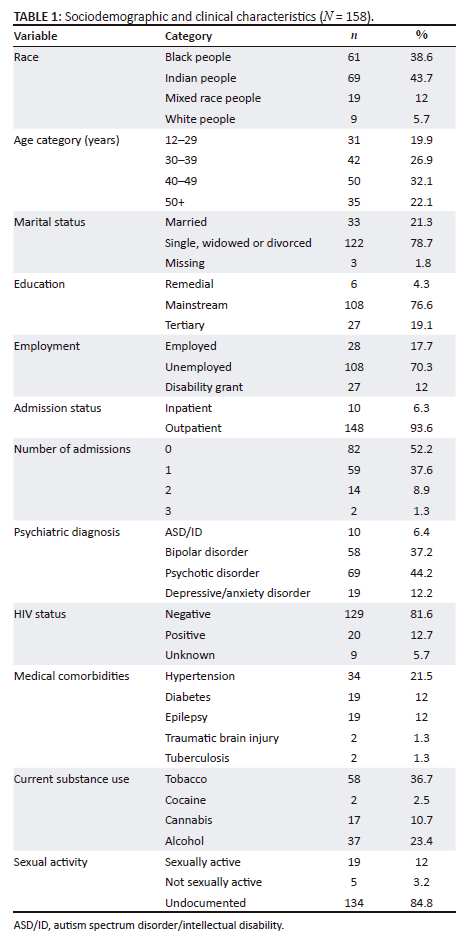
A total of 158 files of females who met the inclusion criteria were included. Some of the findings regarding the socio-demographic profile included the following: 69 patients receiving valproate were of Indian race (n = 69, 43%), with the highest age group for valproate prescription being between 40 and 49 years (n = 50, 31.6%), single or divorced or widowed (n = 122, 78.7%), unemployed (n = 111, 70.3%) and had tertiary education (n = 27, 19.1%) (Table 1).
In terms of their clinical profiles, the majority were outpatients during the study period (n = 148, 93.6%), with 52.53% (n = 83) having never been admitted, 37.34% (n = 59) having had one admission, 8.86% (n = 14) with two admissions and 1.27% (n = 2) with three admissions. The most common indication for valproate prescription was a primary psychotic disorder (n = 69, 44.2%), then bipolar disorders (n = 58, 37.2%) and depressive/anxiety disorders (n = 19, 12.2%). The documented human immunodeficiency virus (HIV) status was positive in 20 (12.7%) and negative in 129 (81.6%) participants. Their medical comorbidities included hypertension (n = 34, 21.5%), diabetes, epilepsy, head injury and tuberculosis, which accounted for (n = 19, 12%), 19 (12.5%), 2 (1.3%) and 2 (1.3%), respectively (Table 1).
Valproate prescribing patterns
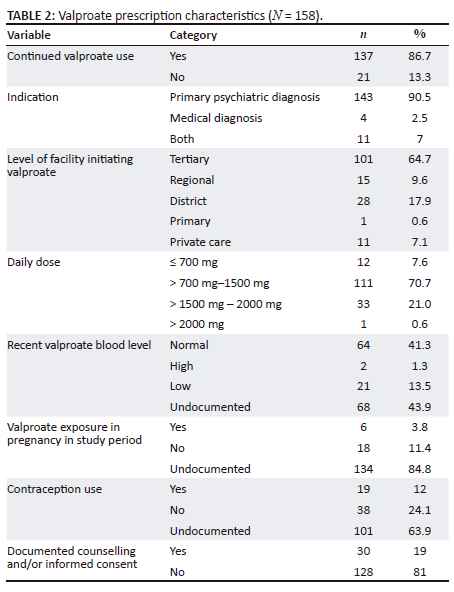
The majority of valproate prescriptions were initiated at tertiary level health facilities (n = 101, 64.74%), followed by the district (n = 28, 17.75%) and regional levels (n = 15, 9.62%), with few being prescribed by the private sector (n = 11, 7.05%) and primary healthcare facilities (n = 1, 0.64%). The valproate daily dose ranged above 700 mg - 1500 mg (n = 111, 70.3%), to 1500 mg - 2000 mg (n = 33, 20.9%) and ≤700 mg (n = 12, 7.6%), with only one person (0.6%) being on a daily dose of above 2000 mg (Table 2).
Documented informed consent and contraceptive prescription
Valproate prescription was stopped during the study period in 21 (13.3%) females, while 137 (86.7%) had continued valproate prescriptions. Valproate use during any point in pregnancy was recorded for (n = 6, 3.8%). A total of 134 (84.8%) files had not recorded the pregnancy status prior to valproate administration or during the course of valproate treatment and 18 (11.4%) files had a negative pregnancy test documented prior to administration. Six patients were subsequently recorded as becoming pregnant while on valproate. Contraceptive use was documented for 24.1% (n = 38, 24.1%) of the females, while counselling on and consent for valproate use was documented for 30 (19.9%) females (Table 2).
Clinical monitoring
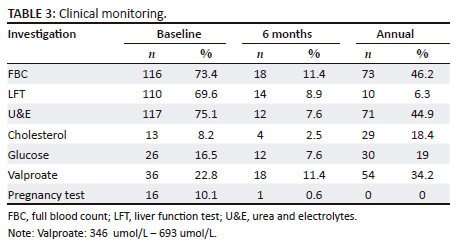
Blood test monitoring of valproate levels was documented in 36 (22.8%) females, with the required 6 months and annual monitoring being poorly documented (Table 3).
Co-prescriptions
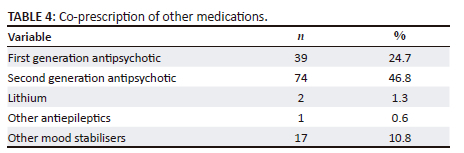
Of the 158 files, 157 (84.2%) had co-prescription of valproate with other medications (Table 4), of whom two (1.3%) were prescribed lithium, while 17 (10.8%) had other mood stabilisers. First generation antipsychotics accounted for 39 co-prescriptions (24.7%) and co-prescription of second-generation antipsychotics was noticed in 74 females (46.8%).
Discussion
The study aimed to determine the prescription pattern and adherence to the prescriber guidelines for the use of sodium valproate among females of childbearing age with mental illness at a psychiatric hospital in KZN province, South Africa.
Socio-demographic profile
A total of 158 females were prescribed valproate, the key findings being that valproate still remains prescribed in WOCBA, with most receiving more than 800 mg/day for psychiatric disorders, the files indicating poor documentation of informed consent, contraception use and monitoring for side effects.
As a cross-sectional study, the authors could not assess if valproate prescriptions had decreased in number over time, but its continued use in 158 women (in an outpatient clinic seeing 350-375 female mental healthcare users [MHCUs] per month) 5 years after the DHCPL memorandum remains concerning. This may be because of patients being initiated prior to the current guideline. Of note, valproate use was discontinued in 21 females during the study period. The majority of women continued on valproate were outpatients and had no admissions during the study period (Table 1), which might suggest a fairly clinically stable population on valproate who may have not been planning to have children, but this was not well documented. This finding could also highlight that more complex cases being reviewed in a tertiary level setting providing appropriate specialised management required more than one mood stabiliser. However, the possible adverse effects that could result from valproate prescription and precautionary measures should have been discussed with the patient and documented on the outpatient review, as per the MHRA guidelines, which state that valproate should not be used in females of childbearing potential unless there is no other suitable alternative.1026
Valproate prescription pattern
The main indication for valproate use in the study population was for psychiatric disorders, with psychotic disorders (n = 69, 44.2%) being the main indication, which differs from the literature, where the main psychiatric indication was bipolar disorders.2,327
The majority of females had valproate prescriptions that were greater than 800 mg/day; this is concerning as the development of FVS could be dose dependent. Teratogenic risk with valproate is seen to be greatest with daily doses above 1000 mg (other studies state daily doses above 1500 mg).8,10,2626
Documented informed consent and contraceptive prescription
The recommendations and guidelines regarding valproate use state that adequate information needs to be given regarding the use of valproate and the implications.1010,18,19n = 101, 63.9%) had no documentation of contraception use status. Of those with documented contraceptive status, 66.6% were not on contraception despite valproate use and guideline recommendations. Possible explanations for this major deficit in clinical care documentation could be inadequate healthcare worker knowledge on valproate prescription, the complexity of patient profiles (the majority were on more than one drug)2829,30,31
Valproate exposure during pregnancy has been shown to have teratogenic effects and should be discontinued. The PPP indicates that females of childbearing potential should have a baseline pregnancy test before treatment initiation, and repeated during the course of treatment with valproate.192,629
Clinical monitoring
Besides teratogenic and neuro-developmental risks associated with valproate,10,23,26,282332,33,3417,24
Co-prescriptions
Finally, in this study, 84.2% (n = 133) of the 158 females were receiving a combination prescription, and included co-prescription with other mood stabilisers and antipsychotic medications (mainly second generation antipsychotics), suggesting that valproate was used for augmentation of antipsychotics for psychotic illnesses284
Recommendations
The findings in this study showed that the SAHPRA guidelines set out in 2018 for the use of sodium valproate were not fully adhered to in this study population. There was very poor documentation of information and counselling on its use and effects on pregnancies, placing females on a PPP and finding safer alternative medications in its place. This risk should be reason enough to make it mandatory for healthcare professionals to adhere to the correct prescription of valproate in the female population, specifically in mental health patients, where valproate is commonly prescribed to a very vulnerable group. A checklist with mandatory questions and investigations, as well as signed acknowledgement of information and counselling about valproate, should be completed at baseline and the biannual or annual reviews of patients to ensure that the guidelines are adhered to. Relevant information about valproate needs to be provided to prescribers on a regular basis so that they are familiar with the serious effects of valproate in an effort to create better awareness and therefore enable them to impart this to their patients.
Limitations
A number of limitations may have affected the findings. The first being that a hospital-based study may introduce sample bias and limit generalisability to community samples. With the study being a retrospective review and its cross-sectional nature, could lead to changes being missed over time, and issues related to the quality of record keeping not being addressed. Foetal valproate syndrome might be dependent on valproate dose; the mean dose that was prescribed in this population was not studied as reference was only made to dose ranges. The authors also did note if valproate dose was in the process of being weaned or cross titrated during its use in the study period. Socio-demographic data were collected from the start of the study period and did not account for changes in some of the variables during the study period. The World Health Organization (WHO) found that women of reproductive age is up to 49 years, while the Centers for Disease Control and Prevention contraceptive guidance for healthcare providers observe that the age of definitive loss of natural fertility is 41 years but can range up to age 51 years.35,36
Conclusion
This study showed that prescription of valproate in female MHCUs still occurs in practice in South Africa despite the guidelines outlining management of those of reproductive age on valproate. Other aspects of the guidelines regarding counselling on valproate use and contraception use, were poorly documented, as was overall monitoring. There needs to be ongoing efforts to remind clinicians about the conditions under which valproate can be prescribed and for improved documentation of the clinical factors that are important to ensure optimal clinical care.
Competing interests
The authors declare that they have no financial or personal relationships that may have inappropriately influenced them in writing this article.
Authors' contributions
P.S.G. was the primary investigator; A.T. contributed to statistical analysis; V.J. was the co-supervisor, and S.P. was the supervisor.
Funding information
This research received no specific grant from any funding agency in the public, commercial, or not-for-profit sectors.
Data availability
The data that support the findings of this study are available on request from the corresponding author, P.S.G.
Disclaimer
The views and opinions expressed in this article are those of the authors and are the product of professional research. It does not necessarily reflect the official policy or position of any affiliated institution, funder, agency, or that of the publisher. The authors are responsible for this article's results, findings, and content.
Acknowledgements
References
-
1.Murphy S, Bennett K, Doherty CP. Prescribing trends for sodium valproate in Ireland. Seizure. 2016;36:44-48. https://doi.org/10.1016/j.seizure.2016.01.019
» https://doi.org/10.1016/j.seizure.2016.01.019 -
2.Beardsley SJ, Dostal I, Cole J, Gutierrez A, Robson J. Valproate use in women aged 15-44 years: An observational study in general practice. BJGP Open. 2021;5(2):BJGPO.2020.0104. https://doi.org/10.3399/BJGPO.2020.0104
» https://doi.org/10.3399/BJGPO.2020.0104 -
3.Gaudio M, Konstantara E, Joy M, Van Vlymen J, De Lusignan S. Valproate prescription to women of childbearing age in English primary care: Repeated cross-sectional analyses and retrospective cohort study. BMC Pregnancy Childbirth. 2022;22(1):1-8. https://doi.org/10.1186/s12884-021-04351-x
» https://doi.org/10.1186/s12884-021-04351-x -
4.Haddad PM, Das A, Ashfaq M, Wieck A. A review of valproate in psychiatric practice. Expert Opin Drug Metab Toxicol. 2009;5(5):539-551. https://doi.org/10.1517/17425250902911455
» https://doi.org/10.1517/17425250902911455 -
5.Bowden C, Singh V. Valproate in bipolar disorder: 2000 onwards. Acta Psychiatr Scand. 2005;111(s426):13-20. https://doi.org/10.1111/j.1600-0447.2005.00522.x
» https://doi.org/10.1111/j.1600-0447.2005.00522.x -
6.McTaggart S, MacColl G, Gronkowski K, Wood R, Leach JP, Bennie M. Impact of regulatory safety notices on valproate prescribing and pregnancy outcome among women of child-bearing potential in Scotland: A population-based cohort study. BMJ Open. 2022;12(4):e058312. https://doi.org/10.1136/bmjopen-2021-058312
» https://doi.org/10.1136/bmjopen-2021-058312 -
7.Sibanyoni AU, Joubert M, Naidu K. Are female bipolar patients of reproductive age aware of the teratogenic risk of sodium valproate? A qualitative study. S Afr J Psychiatr. 2022;28:1719. https://doi.org/10.4102/sajpsychiatry.v28i0.1719
» https://doi.org/10.4102/sajpsychiatry.v28i0.1719 - 8.Gruppuso PA, Ahmed R, Adashi EY. Valproate teratogenicity: A moving target. Obstetr Gynecol. 2022;140(3):408-411.
-
9.Toledo M, Mostacci B, Bosak M, et al. Expert opinion: Use of valproate in girls and women of childbearing potential with epilepsy: Recommendations and alternatives based on a review of the literature and clinical experience - A European perspective. J Neurol. 2021;268(8):2735-2748. https://doi.org/10.1007/s00415-020-09809-0
» https://doi.org/10.1007/s00415-020-09809-0 - 10.Medicines and Healthcare products Regulatory Agency. Valproate medicines (Epilim, Depakote): Contraindicated in women and girls of childbearing potential unless conditions of Pregnancy Prevention Programme are met. Volume 11, Issue 9. © Crown Copyright 2018. London: South Colonnade, 2018; p. 2-5.
- 11.Hu X, Wang J, Dong W, Fang Q, Hu L, Liu C. A meta-analysis of polycystic ovary syndrome in women taking valproate for epilepsy. Epilepsy Res. 2011; 97(1-2):73-82.
-
12.Douglas KM, Fenton AJ, Eggleston K, Porter RJ. Rate of polycystic ovary syndrome in mental health disorders: A systematic review. Archiv Womens Mental Health. 2021;25:1-11. https://doi.org/10.1007/s00737-021-01179-4
» https://doi.org/10.1007/s00737-021-01179-4 - 13.Marangell LB. Current issues: Women and bipolar disorder. Dialogues Clin Neurosci. 2022;10(2):229-238.
-
14.Mehta U, Smith M, Kalk E, et al. Understanding and responding to prescribing patterns of sodium valproate-containing medicines in pregnant women and women of childbearing age in Western Cape, South Africa. Drug Saf. 2021;44(1):41-51. https://doi.org/10.1007/s40264-020-00987-4
» https://doi.org/10.1007/s40264-020-00987-4 - 15.Letter DHP. Valproate (Epilim, Depakote): NEW restrictions on use. United Kingdom: Sanofi, 2018.
-
16.SAHPRA. Valproate-containing medicines: High risk of congenital abnormalities and developmental disorders [homepage on the Internet]. SAHPRA; 2018 [cited 2023 Oct 16]. Available from: https://www.sahpra.org.za/wp-content/uploads/2019/10/1eb80484IMPORTANTMEDICINESAFETYINFORMATION-MedicinescontainingValproate.pdf
» https://www.sahpra.org.za/wp-content/uploads/2019/10/1eb80484IMPORTANTMEDICINESAFETYINFORMATION-MedicinescontainingValproate.pdf -
17.Africa SS. Professional information for epilim [homepage on the Internet]. SANOFI South Africa; 2021 [cited 2023 Oct 16]. Available from: https://www.sanofi.co.za/dam/jcr%3Ab352c078-9463-4613-99b9-268c9b78486e/Epilim%2520Range_Professional%2520Information_2021.02.23%2520%281%29.pdf
» https://www.sanofi.co.za/dam/jcr%3Ab352c078-9463-4613-99b9-268c9b78486e/Epilim%2520Range_Professional%2520Information_2021.02.23%2520%281%29.pdf -
18.Craig JJ. Women and valproate: What should neurologists do? Pract Neurol. 2018;18(3):219-221. https://doi.org/10.1136/practneurol-2018-001932
» https://doi.org/10.1136/practneurol-2018-001932 - 19.Sisodiya SM. Valproate and childbearing potential: New regulations. London: BMJ Publishing Group Ltd; 2018.
-
20.Tachibana M, Hashimoto T, Tanaka M, et al. Patterns in psychiatrists' prescription of valproate for female patients of childbearing age with bipolar disorder in Japan: A questionnaire survey. Front Psychiatry. 2020;11:250. https://doi.org/10.3389/fpsyt.2020.00250
» https://doi.org/10.3389/fpsyt.2020.00250 - 21.South African Department of Health. Sodium valproate unsafe in pregnancy. Pretoria: South African Department of Health; 2018.
-
22.Macfarlane A, Greenhalgh T. Sodium valproate in pregnancy: What are the risks and should we use a shared decision-making approach? BMC Pregnancy Childbirth. 2018;18(1):200. https://doi.org/10.1186/s12884-018-1842-x
» https://doi.org/10.1186/s12884-018-1842-x -
23.Atturu H, Odelola A. Valproate prescribing in women of childbearing age: An audit of clinical practice. Adv Psychiatry. 2015;2015. https://doi.org/10.1155/2015/520784
» https://doi.org/10.1155/2015/520784 -
24.GROUP DMA. Shared care guidelines for prescribing valproate in the treatment of bipolar disorder [homepage on the Internet]. 2017 [cited 2023 Nov 29]. Available from: https://nhsdorset.nhs.uk/Downloads/aboutus/medicines-management/Shared%20Care%20Guidelines/MH%20Shared%20care%20Guidelines%20for%20prescribing%20valproate%20.pdf
» https://nhsdorset.nhs.uk/Downloads/aboutus/medicines-management/Shared%20Care%20Guidelines/MH%20Shared%20care%20Guidelines%20for%20prescribing%20valproate%20.pdf - 25.Taylor DM, Barnes TRE, Young AH. The Maudsley® Prescribing Guidelines in Psychiatry. 14th ed. London: Wiley Blackwell, 2021; p. 259-261.
-
26.Paton C, Cookson J, Ferrier IN, Bhatti S, Fagan E, Barnes TR. A UK clinical audit addressing the quality of prescribing of sodium valproate for bipolar disorder in women of childbearing age. BMJ Open. 2018;8(4):e020450. https://doi.org/10.1136/bmjopen-2017-020450
» https://doi.org/10.1136/bmjopen-2017-020450 - 27.Taylor DM, Barnes TRE, Young AH. The Maudsley Prescribng Guidelines in Psychiatry. 14th ed. London: Wiley Blackwell, 2021; p. 202, 285, 297.
-
28.Baldwin DS, Amaro HJ. Prescription of valproate-containing medicines in women of childbearing potential who have psychiatric disorders: Is it worth the risk? CNS Drugs. 2020;34(2):163-169. https://doi.org/10.1007/s40263-019-00694-4
» https://doi.org/10.1007/s40263-019-00694-4 -
29.James L, Barnes TR, Lelliott P, Taylor D, Paton C. Informing patients of the teratogenic potential of mood stabilizing drugs: A case note review of the practice of psychiatrists. J Psychopharmacol. 2007;21(8):815-819. https://doi.org/10.1177/0269881107077222
» https://doi.org/10.1177/0269881107077222 -
30.Wieck A, Rao S, Sein K, Haddad PM. A survey of antiepileptic prescribing to women of childbearing potential in psychiatry. Archiv Womens Mental Health. 2007;10(2):83-85. https://doi.org/10.1007/s00737-007-0175-y
» https://doi.org/10.1007/s00737-007-0175-y -
31.Mace S, Taylor D. Improving adherence to NICE guidance for bipolar illness: Valproate use in women of childbearing potential. Psychiatrist. 2011;35(2):63-67. https://doi.org/10.1192/pb.bp.110.030106
» https://doi.org/10.1192/pb.bp.110.030106 -
32.Wartman C, VandenBerg A. Valproate: Not all boxed warnings are created equal. Ann Pharmacother. 2022;56(12):1349-1355. https://doi.org/10.1177/10600280221085991
» https://doi.org/10.1177/10600280221085991 -
33.Rasgon NL, Altshuler LL, Fairbanks L, et al. Reproductive function and risk for PCOS in women treated for bipolar disorder. Bipolar Disord. 2005;7(3):246-259. https://doi.org/10.1111/j.1399-5618.2005.00201.x
» https://doi.org/10.1111/j.1399-5618.2005.00201.x -
34.McIntyre RS, Mancini DA, McCann S, Srinivasan J, Kennedy SH. Valproate, bipolar disorder and polycystic ovarian syndrome. Bipolar Disord. 2003;5(1):28-35. https://doi.org/10.1034/j.1399-5618.2003.00009.x
» https://doi.org/10.1034/j.1399-5618.2003.00009.x -
35.World Health Organization. Maternal, newborn, child and adolescent health and ageing [homepage on the Internet]. World Health Organization. [cited 2023 Oct 18]. Available from: https://www.who.int/data/maternal-newborn-child-adolescent-ageing/indicator-explorer-new/mca/women-of-reproductive-age-(15-49-years)-population-(thousands)
» https://www.who.int/data/maternal-newborn-child-adolescent-ageing/indicator-explorer-new/mca/women-of-reproductive-age-(15-49-years)-population-(thousands) -
36.Centres for Disease Control and Prevention. CDC contraceptive guidance for health care providers [homepage on the Internet]. Centres for Disease Control and Prevention; 2016 [cited 2023 Oct 18]. Available from: https://www.cdc.gov/reproductivehealth/contraception/mmwr/spr/stop_using_contraceptives.html
» https://www.cdc.gov/reproductivehealth/contraception/mmwr/spr/stop_using_contraceptives.html

Accepted: 11 Jan. 2024
Published: 26 Mar. 2024