Prevalence and predictors of high-dose antipsychotic therapy among adult psychiatric inpatients in Baghdad, Iraq
Abstract
BACKGROUND: Current evidence-based guidelines recommend the use of antipsychotic monotherapy at the lowest effective dose. Nonetheless, high-dose antipsychotics and antipsychotic polypharmacy appear to be common in clinical practice, often deviating from established recommendations AIM: This study aimed to estimate the prevalence and factors associated with high-dose antipsychotic prescribing among adult psychiatric inpatients SETTING: The study was conducted at Ibn Rushd Psychiatric Teaching Hospital in Baghdad, Iraq METHODS: The medical records of inpatients admitted from 24 April 2023 to 12 September 2023, were retrospectively analysed to extract routinely collected patient-level data and medication details; dosing appropriateness was based on that stated in the British National Formulary RESULTS: Of the 225 eligible patients, 51.1% were male, aged 18-82 years (mean = 33.9). Altogether, 48.6% of patients received antipsychotic polypharmacy, and 35.6% were prescribed high-dose antipsychotics. No significant associations were found between high-dose antipsychotic prescribing and patients' characteristics, including age, sex, length of hospital stay, and number of admissions. Predictors of high-dose antipsychotics were polypharmacy (adjusted odd ratio [AOR]:12.61; 95% confidence interval [CI]: 1.78, 89.50), first-generation antipsychotics (AOR: 7.049; 95% CI 1.33, 37.44), quetiapine (AOR: 5.66; 95% CI 1.16, 27.53), procyclidine (AOR: 0.17; 95% CI 0.05, 0.55), and antidepressants (AOR: 0.19; 95% CI 0.05, 0.76 CONCLUSION: Approximately one in three patients received regular high-dose antipsychotic therapy, which contradicts optimal clinical practice and risks patient safety. Targeted educational interventions are warranted to enhance guideline adherence and promote safe and appropriate use of antipsychotics CONTRIBUTION: This is the first study to assess the magnitude and factors associated with high-dose antipsychotic prescription in Iraq
high-dose antipsychotics; antipsychotic polypharmacy; psychosis; audit; antipsychotics; mental health
Introduction
Antipsychotic medications constitute a critical intervention for acute and long-term management of severe mental illness such as psychosis, bipolar disorder and treatment-resistant cases of major depressive disorder.12,311
Evidence-based guidelines recommend antipsychotic monotherapy prescribed at the lowest effective dose.2,32,32,3
Despite guidelines recommendations, observational studies show that prescription of antipsychotic polypharmacy and high-dose antipsychotics appear to be common in clinical practice.445678,9
In acute adult psychiatric settings, antipsychotic polypharmacy, a key contributor to high-dose prescribing, is often used to stabilise patients with behavioural disturbances, promote rapid control of symptoms, and return the patient to baseline level of functioning.1011121213
Patients with severe mental illness exhibit a reduced life expectancy compared to the general population, which is attributed, in part, to the prescription of combined and high-dose antipsychotics.98,1415
Research methods and design
Study design and setting
This study was an observational cross-sectional analysis of adult patients who received inpatient psychiatric care at the Ibn Rushd Psychiatric Teaching Hospital in Baghdad. This psychiatric hospital has delivered outpatient and inpatient mental health services since 1968 and is one of the two mental health hospitals in Iraq. The outpatient department is divided into four specialised units catering to distinct patient populations: children, adults, the elderly, and those with substance abuse issues, with an average of 150 patient consultations per working day. The inpatient department comprises six psychiatric wards with 48 beds and two substance abuse wards with 16 beds. The hospital employs an electronic database system, where each patient is assigned a unique healthcare number, enabling researchers to access information on inpatient admissions and outpatient visits using this identifier. Reporting of the study findings was guided by adhering to the Strengthening the Reporting of Observational Studies in Epidemiology (STROBE) guidelines.16
Study population and data collection
Convenience sampling was employed to extract the information of patients receiving antipsychotic therapy during admission from 24 April 2023 to 12 September 2023. No sample size calculation was necessary because we included all patients admitted during the study period.
All adult patients with a diagnosis of schizophrenia and related psychotic disorders, mood disorders, or substance abuse receiving antipsychotic medication(s) were included. Patients under 18 years old, those with neurocognitive disorders such as Alzheimer's disease, or personality disorders were excluded. The researcher reviewed 245 patient records; 20 were excluded because of age (n = 11), no antipsychotic medication prescribed (n = 4), neurological diseases (n = 4), and personality disorder (n = 1), leaving 225 patients eligible for inclusion. If there were multiple admissions during the study period, the first admission was considered. Given the exploratory nature of the study, teaching commitment of the first author, and resource implications, a sample size of 225 patients was deemed appropriate to represent the prescription pattern at the site.
The data collected included sociodemographic information such as age and sex, clinical information including psychiatric diagnosis and readmissions during the study period, and medication information such as medication name, total daily dose, and route of administration. This information was extracted from the electronic medical records by one experienced clinical pharmacist. The data were then entered into Excel, cleaned, and transferred to Statistical Package for the Social Sciences (SPSS) for analysis.
Measurement of outcomes
The primary endpoint of the study was the rate of high-dose antipsychotic therapy. The British National Formulary (BNF) was consulted to determine the maximum doses for antipsychotics. The maximum doses of FGAs such as intramuscular (IM) chlorpromazine and IM haloperidol, and IM fluphenazine deconate depot were 200 mg/day, 20 mg/day, and 50 mg/week, respectively. The maximum daily doses for SGAs such as olanzapine, quetiapine, and risperidone were 20 mg, 800 mg, and 16 mg, respectively. For the purpose of the study, high-dose antipsychotic therapy was defined as the total daily dose of single agent being more than the maximum recommended dose, or the dosage where the sum of the percentages of the maximum doses of two or more antipsychotics received by the patient was more than 100%.7,11
Statistical analysis
Descriptive statistics were used to indicate patients' characteristics and medication details. Data were represented as n (%) for categorical variables, and mean (standard deviation [s.d.]) or median (interquartile range [IQR]) for continuous variables. To test the association between categorical variables, the Pearson chi-squared test was used; for the continuous variables, the Mann-Whitney U test was used. Binary logistic regression using the enter method was used to identify the predictors of high-dose antipsychotic therapy. Data were analysed using SPSS version 22.0 (IBM Corp., Chicago, IL, US) and a p-value < 0.05 was used to indicate statistical significance.
Ethical considerations
Ethical clearance to conduct this study was received from the institutional review boards of both the College of Pharmacy, Mustansiriyah University, and the Iraqi Ministry of Health (reference no: 130133). Data were deidentified to protect patient confidentiality.
Results
Socio-demographic and clinical characteristics of the study population
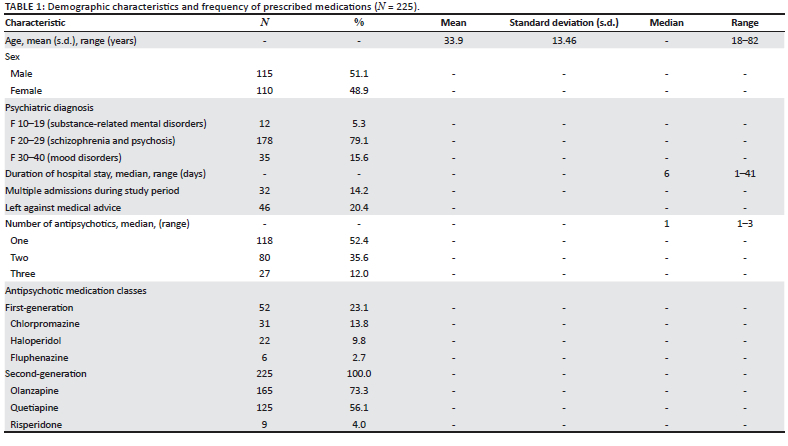
Of the 225 patients admitted during the study period, 115 (51.1%) were male and 110 (48.9%) were female. The median age was 30.0 years (range: 18-82), with a mean age of 33.9 (s.d. = 13.46). Most patients (79.1%) had a diagnosis of schizophrenia or psychosis, 15.6% had a diagnosis of mood disorders, and 5.3% had substance-related mental disorders. The median duration of hospital stay was 6 days, with a range of 1-41 days. Nearly 14% were readmitted during the study period, and 20.4% left against medical advice (Table 1).
Prescription pattern of antipsychotics
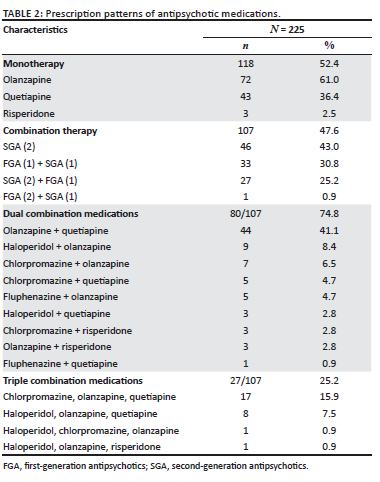
Just over one half (52.4%, n = 118) of patients received antipsychotic monotherapy, while 47.6% (n = 107) were prescribed polypharmacy: 35.6% received two antipsychotics and 12.0% received three antipsychotics. All patients received SGAs, while only 23.1% of them also received FGAs. The most commonly prescribed medication was olanzapine (73.3%) followed by quetiapine (56.1%) and chlorpromazine (3.8%), while the least prescribed was fluphenazine depot injection (2.7%). Procyclidine, an anticholinergic medication, was given to 37.9%. Other psychotropic medications prescribed concomitantly included benzodiazepines (80.4%), mood stabilisers (75.1%), and antidepressants (23.6%).
All patient recipients of antipsychotic monotherapy were prescribed SGAs. For those receiving antipsychotic polypharmacy, the most commonly used combination was two agents from the SGAs, accounting for 43.0%, followed by one agent from FGAs and another agent from SGAs (30.8%). Nearly a quarter of patients (25.2%) received two agents from SGAs and one from the FGAs, and only one patient (0.9%) received two agents from FGAs and one from the SGAs. The most commonly used combination was olanzapine and quetiapine (41.1%), followed by olanzapine, quetiapine, and chlorpromazine (15.9%), and olanzapine and haloperidol (8.4%) (see Table 2).
Prevalence and predictors of high-dose antipsychotics
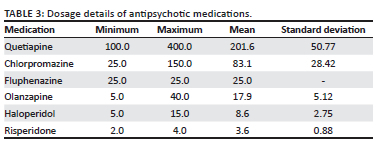
In this study, 35.6% (n = 80) received high-dose antipsychotic therapy, which was through antipsychotic polypharmacy in 93.8% (n = 75) of cases, and only 6.2% (n = 5) had high-dose as a result of using one medication exclusively, namely, olanzapine at a dose exceeding the maximum recommended dose. Nearly half of high-dose recipients, that is, 53.8% (n = 43), were prescribed doses between 100% and 150% of the high-dose limit, 45.0% (n = 36) were between 150% - 200% and 1.3% (n = 1) received more than 200%. Dosage details of prescribed antipsychotic medications are displayed in Table 3.
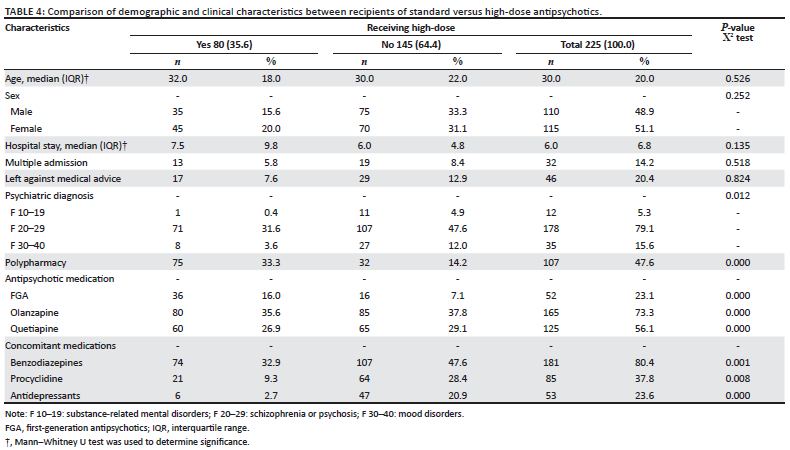
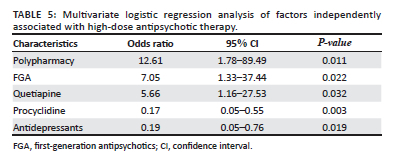
In the bivariate analysis, prescription of high-dose was not associated with age, sex, hospital stay, or the admission and discharge status. On the other hand, high-dose was associated with psychiatric diagnosis, polypharmacy, FGAs, olanzapine and quetiapine, benzodiazepines, antidepressants, and procyclidine (see Table 4). According to the multivariate binary logistic regression, the predictors of high-dose in the descending order were polypharmacy (adjusted odd ratio [AOR]: 12.61; 95% confidence interval [CI] 1.78, 89.50), FGAs (AOR: 7.05; 95% CI 1.33, 37.44), quetiapine (AOR: 5.66; 95% CI 1.16, 27.53), procyclidine (AOR: 0.17; 95% CI 0.05, 0.55), and antidepressants (AOR: 0.19; 95% CI 0.05, 0.76) (see Table 5).
Discussion
In this study, all patients received SGAs, while 23.1% also received FGAs. Olanzapine was the most commonly prescribed antipsychotic medication at a rate of 73.3% followed by quetiapine at 56.1%. Polypharmacy was common, with 47.6% of patients receiving more than one antipsychotic medication: 35.6% received two antipsychotics and 12.0% received three. High-dose antipsychotics, which were prescribed to 35.6% of patients, result primarily from polypharmacy. Notably, 45.0% of high-dose prescriptions exceeded 150% of the recommended dose limit. Multivariate regression analysis indicated no association between high-dose antipsychotic prescription and demographic or clinical factors such as age, sex, psychiatric diagnosis, length of hospital stay, number of admissions, and discharge status. Predictors of receiving high-dose include antipsychotic polypharmacy, FGAs, quetiapine, antidepressants, and anticholinergic prescribing. Our findings are in line with an Australian study, which found that treatment-related factors were the primary predictors of high-dose antipsychotic prescribing.5
In this study, 35.6% received high-dose antipsychotic therapy. This rate is comparable to the 27.0% rate reported in Australia and Cyprus, but is lower than the 50.8% rate reported in Italy.5,6,71711111118
Polypharmacy was a predictor of receiving high-dose, which is in line with other studies.861920
In this study, 47.6% of patients received polypharmacy which is similar to a study in Qatar that included inpatients and outpatients where 55.9% of patients were on monotherapy, 29.6% on dual and 14.5% on more than two agents.214,6,10,22,23,2492,32525
Receiving FGAs was a predictor of receiving high-dose antipsychotics, which is in line with other studies.2612102627
Patients receiving high doses are less likely to receive procyclidine. Other studies reported the opposite, with high-dose antipsychotics increasing the likelihood of receiving anticholinergics.8,2823282
Less antidepressant use was a predictor of high-dose, which is in line with other studies.2911
In this study, no patients received clozapine, which aligns with the findings from a study in Qatar, where only 2.4% received clozapine.3010313299
This is the first national study to describe the magnitude and factors associated with high-dose antipsychotic therapy, providing a baseline for future monitoring of prescribing trends. The study is considered representative because the study site is one of two hospitals in Iraq that provide inpatient psychiatric care. Although the study design is retrospective, the data were collected by one experienced clinical pharmacist researcher, thus minimising variation and enhancing the data quality. However, because of the cross-sectional nature, causality cannot be established. In addition, we excluded as-required antipsychotic medications; thus, the rate of antipsychotic polypharmacy and high-dose antipsychotics may be underestimated.
We observed a high rate of antipsychotic polypharmacy and high-dose antipsychotics, which are unaligned with standard practice guidelines, increase side effects and drug interactions, and thus risk patient safety.2,31233
It is possible that clinicians were unaware that they were pursuing high-dose therapy because, in most cases, high-dose antipsychotics result from polypharmacy. Education programmes for clinicians are vital to enhance adherence to guidelines and ensure optimal delivery of psychopharmacological therapy. Clozapine and long-acting injectable antipsychotics are effective in reducing the risk of relapse, and thus, improving the utilisation of these agents as maintenance therapy, when appropriate, especially in those with multiple admissions, should be considered.2,11
Conclusion
The study's findings indicate that one in three patients received high-dose antipsychotics. Patients receiving combined antipsychotics or FGAs are particularly at risk. This practice, which is not endorsed by guidelines, should be reviewed to ensure patient safety. Targeted educational interventions are recommended to enhance adherence to prescription guidelines and optimise treatment outcomes.
Competing interests
The authors declare that they have no financial or personal relationships that may have inappropriately influenced them in writing this article.
CRediT authorship contribution
Ola A. Nassr: Conceptualisation, Data curation, Formal analysis, Funding acquisition, Investigation, Methodology, Project administration, Resources, Software, Supervision, Visualisation, Writing - original draft, Writing - review & editing. Raghad F. Wadeea: Data curation, Methodology, Project administration, Visualisation, Writing - review & editing.
Funding information
This research received no specific grant from any funding agency in the public, commercial, or not-for-profit sectors.
Data availability
The data that support the findings of this study are available from the corresponding author, Ola A. Nassr, upon reasonable request.
Disclaimer
The views and opinions expressed in this article are those of the authors and are the product of professional research. They do not necessarily reflect the official policy or position of any affiliated institution, funder, agency, or that of the publisher. The authors are responsible for this article's results, findings, and content.
Acknowledgements
The authors would like to thank Mustansiriyah University (www.uomustansiriyah.edu.iq) Baghdad, Iraq for its support in the present work.
References
-
1. Leucht S, Priller J, Davis JM. Antipsychotic drugs: A concise review of history, classification, indications, mechanism, efficacy, side effects, dosing, and clinical application. Am J Psychiatry. 2024;181(10):865-878. https://doi.org/10.1176/appi.ajp.20240738
» https://doi.org/10.1176/appi.ajp.20240738 -
2. Keepers GA, Fochtmann LJ, Anzia JM, et al. The American Psychiatric Association practice guideline for the treatment of patients with schizophrenia. Am J Psychiatry. 2020;177(9):868-872. https://doi.org/10.1176/appi.ajp.2020.177901
» https://doi.org/10.1176/appi.ajp.2020.177901 -
3. Barnes TR, Drake R, Paton C, et al. Evidence-based guidelines for the pharmacological treatment of schizophrenia: Updated recommendations from the British Association for Psychopharmacology. J Psychopharmacol. 2020;34(1):3-78. https://doi.org/10.1177/0269881119889296
» https://doi.org/10.1177/0269881119889296 -
4. Ayani N, Morimoto T, Sakuma M, Kikuchi T, Watanabe K, Narumoto J. Antipsychotic polypharmacy is associated with adverse drug events in psychiatric inpatients. J Clin Psychopharmacol. 2021;41(4):397-402. https://doi.org/10.1097/JCP.0000000000001416
» https://doi.org/10.1097/JCP.0000000000001416 -
5. Gisev N, Bell JS, Chen TF. Factors associated with antipsychotic polypharmacy and high-dose antipsychotics among individuals receiving compulsory treatment in the community. J Clin Psychopharmacol. 2014;34(3):307-312. https://doi.org/10.1097/JCP.0000000000000098
» https://doi.org/10.1097/JCP.0000000000000098 -
6. Mandarelli G, Carabellese F, Di Sciascio G, Catanesi R. Antipsychotic polypharmacy and high-dose antipsychotic regimens in the Residential Italian Forensic Psychiatric Population (REMS). Front Psychol. 2022;13:. https://doi.org/10.3389/fpsyg.2022.722985
» https://doi.org/10.3389/fpsyg.2022.722985 -
7. Kaikoushi K, Karanikola M, Middleton N, Bella E, Chatzittofis A. Prescription patterns in psychiatric compulsory care: Polypharmacy and high-dose antipsychotics. BJPsych Open. 2021;7(5):e149. https://doi.org/10.1192/bjo.2021.982
» https://doi.org/10.1192/bjo.2021.982 -
8. Anozie IG, James BO, Omoaregba JO, Oriji SO, Erohubie PO, Enebe AC. Correlates of high-dose antipsychotic prescription amongst outpatients with Schizophrenia in a Nigerian Hospital. S Afr J Psychiatr. 2022;28:1791. https://doi.org/10.4102/sajpsychiatry.v28i0.1791
» https://doi.org/10.4102/sajpsychiatry.v28i0.1791 -
9. Langan J, Shajahan P. Antipsychotic polypharmacy: Review of mechanisms, mortality and management. Psychiatrist. 2010;34(2):58-62. https://doi.org/10.1192/pb.bp.108.024257
» https://doi.org/10.1192/pb.bp.108.024257 -
10. Lassen S, Heintz T, Pedersen T, et al. Nationwide study on antipsychotic polypharmacy among forensic psychiatric patients. Int J Circumpolar Health. 2023;82(1):. https://doi.org/10.1080/22423982.2023.2218654
» https://doi.org/10.1080/22423982.2023.2218654 -
11. Royal College of Psychiatrists. The risks and benefits of high-dose antipsychotic medication [homepage on the Internet]. College Report 190. 2024 [cited Apr 2025]. Available from: https://www.rcpsych.ac.uk/docs/default-source/improving-care/better-mh-policy/college-reports/college-report-cr190.pdf?sfvrsn=54f5d9a2_2
» https://www.rcpsych.ac.uk/docs/default-source/improving-care/better-mh-policy/college-reports/college-report-cr190.pdf?sfvrsn=54f5d9a2_2 -
12. Ying J, Chew QH, Wang Y, Sim K. Global neuropsychopharmacological prescription trends in adults with schizophrenia, clinical correlates and implications for practice: A scoping review. Brain Sci. 2023;14(1):6. https://doi.org/10.3390/brainsci14010006
» https://doi.org/10.3390/brainsci14010006 -
13. Johnson CF, Ingram F, Thomson F, Srireddy P, Jani BD, Greenlaw N. General practice pharmacist-led antipsychotic physical health monitoring: A prospective intervention scoping study. Fam Pract. 2024;41(1):41-49. https://doi.org/10.1093/fampra/cmad120
» https://doi.org/10.1093/fampra/cmad120 -
14. Ray WA, Chung CP, Murray KT, Hall K, Stein CM. Atypical antipsychotic drugs and the risk of sudden cardiac death. N Engl J Med. 2009;360(3):225-235. https://doi.org/10.1056/NEJMoa0806994
» https://doi.org/10.1056/NEJMoa0806994 -
15. Singh A, Kumar V, Pathak H, et al. Effect of antipsychotic dose reduction on cognitive function in schizophrenia. Psychiatry Res. 2022;308:. https://doi.org/10.1016/j.psychres.2021.114383
» https://doi.org/10.1016/j.psychres.2021.114383 -
16. Cuschieri S. The STROBE guidelines. Saudi J Anaesth. 2019;13(Suppl. 1):S31-S34. https://doi.org/10.4103/sja.SJA_543_18
» https://doi.org/10.4103/sja.SJA_543_18 -
17. Samara MT, Klupp E, Helfer B, Rothe PH, Schneider-Thoma J, Leucht S. Increasing antipsychotic dose for non response in schizophrenia. Cochrane Database Syst Rev. 2018;5(5):. https://doi.org/10.1002/14651858.CD011883.pub2
» https://doi.org/10.1002/14651858.CD011883.pub2 -
18. Ataniya R, Koike T, Inamoto A. Halved dose of antipsychotics versus high-dose antipsychotic therapy for relapse in patients with schizophrenia receiving high-dose antipsychotic therapy: A randomized single-blind trial. Int J Mol Sci. 2025;26(9):4003. https://doi.org/10.3390/ijms26094003
» https://doi.org/10.3390/ijms26094003 -
19. Paton C, Barnes TRE, Cavanagh M-R, Taylor D, Lelliott P, POMH-UK Project Team. High-dose and combination antipsychotic prescribing in acute adult wards in the UK: The challenges posed by p.r.n. prescribing. Br J Psychiatry. 2008;192(6):435-439. https://doi.org/10.1192/bjp.bp.107.042895
» https://doi.org/10.1192/bjp.bp.107.042895 -
20. Alsabhan JF, Almalag HM, Aljafali L, Alnughamish H, Almutlaq G. Prescribing pattern of antipsychotics for patients with schizophrenia using the total daily dose online tool. Saudi Pharm J. 2023;31(12):. https://doi.org/10.1016/j.jsps.2023.101837
» https://doi.org/10.1016/j.jsps.2023.101837 -
21. Aburamadan HAR, Sridhar SB, Tadross TM, Shariff A. Assessment of prescription pattern of antipsychotic medications in a psychiatry inpatient setting of a secondary care hospital of United Arab Emirates. Clin Schizophr Relat Psychoses. 2021;15(5):S8. https://doi.org/10.3371/CSRP.AHSS.073021
» https://doi.org/10.3371/CSRP.AHSS.073021 -
22. Lelliott P, Paton C, Harrington M, Konsolaki M, Sensky T, Okocha C. The influence of patient variables on polypharmacy and combined high dose of antipsychotic drugs prescribed for in-patients. Psychiatric Bull. 2002;26(11):411-414. https://doi.org/10.1192/pb.26.11.411
» https://doi.org/10.1192/pb.26.11.411 -
23. John AP, Gee T, Alexander S, Ramankutty P, Dragovic M. Prevalence and nature of antipsychotic polypharmacy among inpatients with schizophrenia spectrum disorders at an Australian mental health service. Aust Psychiatry. 2014;22(6):546-550. https://doi.org/10.1177/1039856214546672
» https://doi.org/10.1177/1039856214546672 -
24. Farrell C, Brink J. The prevalence and factors associated with antipsychotic polypharmacy in a forensic psychiatric sample. Front Psychiatry. 2020;11:263. https://doi.org/10.3389/fpsyt.2020.00263
» https://doi.org/10.3389/fpsyt.2020.00263 -
25. Lerner V, Libov I, Kotler M, Strous RD. Combination of 'atypical' antipsychotic medication in the management of treatment-resistant schizophrenia and schizoaffective disorder. Prog Neuropsychopharmacol Biol Psychiatry. 2004;28(1):89-98. https://doi.org/10.1016/j.pnpbp.2003.09.024
» https://doi.org/10.1016/j.pnpbp.2003.09.024 -
26. Dong M, Zeng L-N, Zhang Q, et al. Prescription of antipsychotic and concomitant medications for adult Asian schizophrenia patients: Findings of the 2016 Research on Asian Psychotropic Prescription Patterns (REAP) survey. Asian J Psychiatr. 2019;45:74-80. https://doi.org/10.1016/j.ajp.2019.08.010
» https://doi.org/10.1016/j.ajp.2019.08.010 -
27. Gaviria AM, Franco JG, Aguado V, et al. A non-interventional naturalistic study of the prescription patterns of antipsychotics in patients with schizophrenia from the Spanish Province of Tarragona. PLoS One. 2015;10(10):. https://doi.org/10.1371/journal.pone.0139403
» https://doi.org/10.1371/journal.pone.0139403 -
28. Hori H, Yasui-Furukori N, Hasegawa N, et al. Prescription of anticholinergic drugs in patients with schizophrenia: Analysis of antipsychotic prescription patterns and hospital characteristics. Front Psychiatry. 2022;13:. https://doi.org/10.3389/fpsyt.2022.823826
» https://doi.org/10.3389/fpsyt.2022.823826 -
29. Takahashi T, Otsubo T, Kunisawa S, Sasaki N, Imanaka Y. Factors associated with high-dose antipsychotic prescriptions in outpatients with schizophrenia: An analysis of claims data from a Japanese prefecture. Neuropsychopharmacol Rep. 2020;40(3):224-231. https://doi.org/10.1002/npr2.12109
» https://doi.org/10.1002/npr2.12109 -
30. Ouanes S, Becetti I, Ghuloum S, et al. Patterns of prescription of antipsychotics in Qatar. PLoS One 2020;15(11):. https://doi.org/10.1371/journal.pone.0241986
» https://doi.org/10.1371/journal.pone.0241986 -
31. Bitter I, Dossenbach MRK, Brook S, et al. Olanzapine versus clozapine in treatment-resistant or treatment-intolerant schizophrenia. Prog Neuropsychopharmacol Biol Psychiatry. 2004;28(1):173-180. https://doi.org/10.1016/j.pnpbp.2003.09.033
» https://doi.org/10.1016/j.pnpbp.2003.09.033 -
32. Gobbi G, Comai S, Debonnel G. Effects of quetiapine and olanzapine in patients with psychosis and violent behavior: A pilot randomized, open-label, comparative study. Neuropsychiatr Dis Treat. 2014;10:757-765. https://doi.org/10.2147/NDT.S59968
» https://doi.org/10.2147/NDT.S59968 -
33. Kadra G, Stewart R, Shetty H, et al. Antipsychotic polypharmacy prescribing and risk of hospital readmission. Psychopharmacology. 2018;235(1):281-289. https://doi.org/10.1007/s00213-017-4767-6
» https://doi.org/10.1007/s00213-017-4767-6

Accepted: 03 Nov. 2025
Published: 14 Jan. 2026