Attention-deficit/hyperactivity disorder and behavioural planning deficiencies in South African primary school children
Abstract
BACKGROUND: Attention-deficit/hyperactivity disorder (ADHD) is defined as a cognitive or behavioural developmental disorder. Inattentiveness, overactivity and impulsivity are regarded as the main clinical symptoms of ADHD. These symptoms may occur together or separately resulting in three recognised presentations: predominantly inattentive, predominantly hyperactive-impulsive and combined presentations. AIM: This study investigated deficiencies in behavioural planning in South African primary school children with and without ADHD. SETTING: Tzaneen area in Limpopo province, South Africa. METHODS: A total of 156 children (78 with ADHD and 78 matched controls without ADHD) of both genders, who were medication naïve and aged 6-15 years, participated in the study. The performance of the two groups was compared on a test of planning and problem-solving, the Tower of London (ToL) task. The results were analysed as a function of gender, age and ADHD presentation. RESULTS: Children with ADHD especially ADHD-PI and ADHD-C used significantly more moves and took a longer time to complete the task than the controls (p < 0.001). There were no significant differences in the number of moves and time taken by the predominantly hyperactive-impulsive presentations of ADHD when compared to the controls. Gender and age did not influence the performance. CONCLUSION: The results showed that children with ADHD showed significantly more deficits mainly the ADHD-PI and ADHD-C presentations, which indicates that inattention is mainly responsible for deficiencies in behaviour planning. The ADHD-HI presentations and the control group were not affected.
attention-deficit, hyperactivity; disorder; behavioural planning; developmental disorder; primary school children; hyperactive
Introduction
Attention-deficit/hyperactivity disorder (ADHD) is a common heterogeneous neurodevelopmental disorder of genetic origin, with a childhood onset and which often persists into adulthood.1,23
Globally, the prevalence of ADHD does not significantly differ between America, Australia and Africa.2,425
In children and adolescents, ADHD predominantly affects males with a male-female sex ratio of 4:1 in clinical samples and 2.4:1 in population studies.22,5
It is widely recognised that ADHD is not only a behaviour disorder characterised by hyperactivity, impulsivity and inattention, but it is fundamentally a cognitive disorder, involving a developmental impairment of executive functions (EFs), which are the controlling system of the brain.67
Symptoms of ADHD arise from a primary deficit in specific EF domains, such as response inhibition, working memory, set-shifting and planning.1,2,689
Executive dysfunction is generally attributed to structural and functional frontal pathology.1,101,11,127,13,1414
Planning can be described as the execution of goal-directed behaviour to predict and evaluate outcomes. Also identifying, organising steps and elements needed to carry out an intention.15,16171819
A study by Kofman et al.1920212223
The purpose of the study was to investigate whether children with ADHD have deficits in behaviour planning as measured by the Tower of London (TOL)
Research methods and design
Study design
The study was conducted in primary schools in the Tzaneen area, Limpopo, during 2017. A quantitative, cross-sectional case-control study, experimental design was used. To establish whether children with ADHD are deficient in behaviour planning, the sample was divided into participants with ADHD and matched controls without symptoms of ADHD.
Setting
The selected regions were in a rural area in which assessment of this nature is very rare. The areas were selected based on the remoteness of the regions so that the community could benefit from such research.
Study population and sampling strategy
The sample (n = 156) was divided equally in terms of gender (76 boys and 80 girls), aged 6-15 years of age, were recruited from a school-based population in the Tzaneen area in the Limpopo province, South Africa. They were Sepedi and Xitsonga speaking, grade 1-grade 7 learners. The participants were divided into two age groups: 6-10 and 11-15 years. The sample was chosen because of its accessibility. To detect symptoms of ADHD, the learners were screened using the disruptive behavioural disorder (DBD) rating scale, based on ratings from parents and teachers.24,2555n = 78). Children with an intelligence quotient (IQ) lower than 80 and/or who are suffering from any head injury, epilepsy, cerebral palsy, cerebral malaria, autism spectrum disorder or severe psychiatric disorders, as reported on the demographic questionnaire by parents and confirmed by the teachers, were excluded from this study. At the time of testing, the researcher ensured that none of the children were taking psychostimulant medication.
Data collection
Data were collected from primary school children within the Tzaneen area in Limpopo province during 2017. School principals gave their permission to conduct the study at their schools. Informed, written consent was obtained from the parents. The return rate of the questionnaires was 98%. The study was explained to all children selected for testing, and their assent was obtained. The assessments were conducted in the mornings. The children were assessed individually in a quiet room during school hours. The total number of correct responses for the TOL (total score) and the time taken to complete the specific response were recorded. The testing procedure for each child lasted 30 min and was conducted by a clinical psychologist and four research assistants (who held bachelor's degrees in psychology) and were fluent in the child's home language.
Instruments
Screening instruments: Disruptive behaviour disorder rating scale. The disruptive behaviour disorder rating scale (DBD), by Pelham et al.24,2555
Cronbach's α for the primary school population in the Limpopo province was calculated at 0.90 for the HI scale and 0.92 for the inattention scale.5α for the HI scale was calculated at 0.74, and at 0.79 for the inattention scale.
Assessment of behaviour planning
The Tower of London: The TOL is a widely used instrument for assessing planning ability. Shallice262728,29,3031,3220,33
The apparatus consisting of three wooden beads (red, yellow and blue) had been placed. The researcher presented an example of the problems, on cards, which were to be solved in two to five steps. In a practice problem, the same initial position was used, where two steps were needed to reach a solution. The task consisted of 12 problems, which had been graded in terms of their difficulty. From the start position, the participants were expected to move the beads to the finish position shown on the cards, making use of the least number of steps. The reliability coefficients were split-half reliability, r = 0.72, and internal consistency, Cronbach's α = 0.69.17,34
Data analysis
Analysis of variance (ANOVA) was used to investigate possible between-group differences using the ToL raw scores. Analysis was done using Statistica 10 StatSoft.35Post hoc tests consisted of multiple comparisons using the Bonferroni method.36
Ethical consideration
We confirm that this manuscript is the original and has not been submitted to any other journal for publication. University of KwaZulu-Natal, is fully aware of this submission. Ethical approval to conduct the study was obtained (from the Biomedical Research Ethics Committee of the University of KwaZulu-Natal (Ethical Clearance Number HSS/1452/015D). In addition, permission was obtained from the Department of Education, Limpopo province, and school principals of the selected schools. Informed consent was obtained from the parents or legal guardians of the learners to participate in the study. The children also assented to their participation in the study. Participation in the study was voluntary, and participants were informed that they could withdraw at any stage.
Results
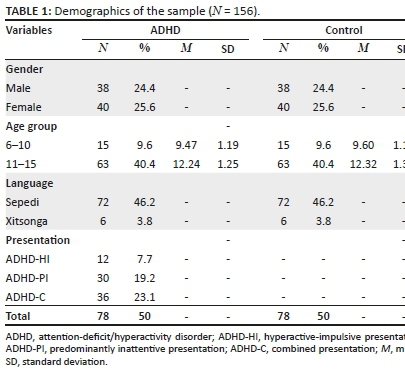
The study hypothesised that children with ADHD will have impairments in behaviour planning when compared with neurotypically children. Age did not affect the results; therefore, it was not taken into account for further analysis. Statistically significant differences were found for the inattention scores (p < 0.001) and the HI scores (p < 0.001) of the DBD rating when the ADHD and control group were compared. The demographics and DBD scores for the sample are presented in Table 1.
The descriptive statistics, the results of the ANOVA and the post hoc analysis for the number of moves and the time taken in seconds on the TOL are shown in Table 2.
Number of moves
There was neither main nor interacting effect for gender and age; therefore, the gender and age groups were analysed together. There was, however, a statistically significant difference in performance between the ADHD and control groups: F(3, 149) = 10.54, p < 0.001,  = 0.18. Post hoc analysis (Bonferroni) revealed that there was a statistically significant difference in performance between both the ADHD-PI and ADHD-C presentations and the control group (p < 0.001). The ADHD-PI and ADHD-C subtypes used significantly more moves than the controls. There was no significant difference in the number of moves used by the ADHD-HI subtype when compared to the controls.
Time taken to complete the task
There was neither main nor interacting effect for gender and age. Therefore, the gender groups were not analysed separately. There was, however, a statistically significant difference in performance between the ADHD and control groups: F(3, 149) = 11.52, p < 0.001,  = 0.19. Post hoc analysis (Bonferroni) revealed that the differences between the ADHD-PI and ADHD-C and the control group were statistically significant, both at the p < 0.001 level. The children with ADHD-PI and ADHD-C took significantly more time than the controls to move the beads. There was no significant difference in the time taken by the ADHD-HI presentation when compared to the controls. Effect sizes
 of 0.18 (number of moves) and of 0.19 (time taken) are considered to be large.37
Discussion
The study compared the performance of children with ADHD and a non-ADHD control group on measures of behaviour planning and problem-solving. No gender and age differences on task performance were found in this study. This was consistent with the study done by Biederman et al.38398,40,41,42,434445
Chhabildas et al.4647,48,4950,515253
The results show that children with ADHD are significantly more impaired on measures of planning behaviour and problem-solving, especially the ADHD-PI and ADHD-C presentations when compared to ADHD-HI and the control group of non-ADHD children. The ADHD-C presentation's poor performance indicated that children with symptoms of both inattention and hyperactivity-impulsivity are struggling to perform tasks by not being able to select strategies that entail reasoning. The findings were consistent with the study conducted by Sarkis et al.542021225556
Generally, children diagnosed with ADHD-C struggle to remember instructions and to plan new strategies in a different situation.56
However, the current study differs from the study by Houghton et al.4423235758
The posterior parietal cortex is connected with the PFC and has been shown to represent neural correlates of decision-making and planning.5914
Implication
Children with ADHD usually are hasty and disorderly when they plan behaviour.58
Limitations
The sample size was small, especially when the ADHD group was subdivided into three presentations. This may have influenced on the statistical outcome. Caution should be exercised when generalising these results to all South African children as the sample was homogeneous, consisting of rural Sepedi and Xitsonga speaking children only from the same geographical area. It is recommended for future studies to include more language groups. The TOL instructions should be standardised in different languages.
Conclusion
The goal of the study was to assess the behaviour planning deficits in children with ADHD. The study showed that especially the inattentive and combined ADHD presentations have problems with planning, and problem-solving using the TOL.
Competing interests
The authors declare that they have no financial or personal relationships that may have inappropriately influenced them in writing this article.
Authors' contributions
T.T.B. made an extensive contribution to the concept and design of the article, collected data and drafted the article, and finalised the version to be published. B.J.P. assisted with overseeing, made substantial remarks on the prepared article and approved the final version to be published. A.M. provided the data analysis and tables, revised the article and approved the version to be published.
Funding information
This project was partially funded by the University of KwaZulu-Natal.
Data availability statement
Data will be available in the University of KwaZulu-Natal library, no data sharing.
Disclaimer
The views expressed in this article are those of the authors and not an official position of the institution or funder.
Acknowledgements
The authors acknowledge the following field workers: Xichavo Lobyana, Khuliso Matidza, Penny Mafela and Rotakala Sadiki.
References
-
1.Faraone SV. Attention deficit hyperactivity disorder and premature death. Nat Rev Dis Primers. 2015;385(9983):2132-2133. https://doi.org/10.1016/S0140-6736(14)61822-5
» https://doi.org/10.1016/S0140-6736(14)61822-5 -
2.Polanczyk G, De Lima MS, Horta BL, Biederman J, Rohde LA. The worldwide prevalence of ADHD: A systematic review and metaregression analysis. Am J Psychiatry. 2007;164(6):942-948. https://doi.org/10.1176/ajp.2007.164.6.942
» https://doi.org/10.1176/ajp.2007.164.6.942 - 3.American Psychiatric Association. Diagnostic and statistical manual of mental disorders: DSM-5. Washington, DC: American Psychiatric Association.
-
4.Bakare M. Attention deficit hyperactivity symptoms and disorder (ADHD) among African children: A review of epidemiology and co-morbidities. Afr J Psychiatry. 2012;15(5):358-361. https://doi.org/10.4314/ajpsy.v15i5.45
» https://doi.org/10.4314/ajpsy.v15i5.45 -
5.Meyer A, Eilertsen D-E, Sundet JM, Tshifularo J, Sagvolden T. Cross-cultural similarities in ADHD-like behaviour amongst South African primary school children. S Afr J Psychol. 2004;34(1):122-138. https://doi.org/10.1177/008124630403400108
» https://doi.org/10.1177/008124630403400108 -
6.Ciuluvica C, Mitrofan N, Grilli A. Aspects of emotion regulation difficulties and cognitive deficit in executive functions related of ADHD symptomatology in children. Procedia Soc Behav Sci. 2013;78:390-394. https://doi.org/10.1016/j.sbspro.2013.04.317
» https://doi.org/10.1016/j.sbspro.2013.04.317 -
7.Miyake A, Friedman NP. The nature and organization of individual differences in executive functions: Four general conclusions. Curr Direct Psychol Sci. 2012;21(1):8-14. https://doi.org/10.1177/0963721411429458
» https://doi.org/10.1177/0963721411429458 -
8.Nigg JT, Blaskey LG, Huang-Pollock CL, Rappley MD. Neuropsychological executive functions and DSM-IV ADHD subtypes. J Am Acad Child Adolesc Psychiatry. 2002;41(1):59-66. https://doi.org/10.1097/00004583-200201000-00012
» https://doi.org/10.1097/00004583-200201000-00012 -
9.Rhodes MG, Kelley CM. Executive processes, memory accuracy, and memory monitoring: An aging and individual difference analysis. J Mem Lang. 2005;52(4):578-594. https://doi.org/10.1016/j.jml.2005.01.014
» https://doi.org/10.1016/j.jml.2005.01.014 -
10.Willcutt EG, Doyle AE, Nigg JT, Faraone SV, Pennington BF. Validity of the executive function theory of attention-deficit/hyperactivity disorder: A meta-analytic review. Biol Psychiatry. 2005;57(11):1336-1346. https://doi.org/10.1016/j.biopsych.2005.02.006
» https://doi.org/10.1016/j.biopsych.2005.02.006 -
11.Cortese S, Kelly C, Chabernaud C, Proal E, Di Martino A, Milham MP. Toward systems neuroscience of ADHD: A meta-analysis of 55 fMRI studies. Am J Psychiatry. 2012;169(10):1038-1055. https://doi.org/10.1176/appi.ajp.2012.11101521
» https://doi.org/10.1176/appi.ajp.2012.11101521 - 12.Gendle MH, Young EL, Romano AC. Experimental. Effects of oral 5-hydroxytryptophan on a standardized planning task: Insight into possible dopamine/serotonin interactions in the forebrain. Clin Exp Hum. 2013;28(3):270-273.
-
13.Arnsten AF, Li B-M. Neurobiology of executive functions: Catecholamine influences on prefrontal cortical functions. Biol Psychiatry. 2005;57(11):1377-1384. https://doi.org/10.1016/j.biopsych.2004.08.019
» https://doi.org/10.1016/j.biopsych.2004.08.019 -
14.Sagvolden T, Johansen EB, Aase H, Russell VA. A dynamic developmental theory of attention-deficit/hyperactivity disorder (ADHD) predominantly hyperactive/impulsive and combined subtypes. Behav Brain Sci. 2005;28(3):397-418. https://doi.org/10.1017/S0140525X05000075
» https://doi.org/10.1017/S0140525X05000075 - 15.Kaller CP, Unterrainer JM, Rahm B, Halsband U. The impact of problem structure on planning: Insights from the Tower of London task. Cogn Brain Res. 2004;20(3):462-472.
- 16.Chiang H-L, Gau SS-F. Impact of executive functions on school and peer functions in youths with ADHD. Res Dev Disabil. 2014;35(5):963-972.
-
17.Kaller CP, Unterrainer JM, Stahl C. Assessing planning ability with the Tower of London task: Psychometric properties of a structurally balanced problem set. Psychol Assess. 2012;24(1):46. https://doi.org/10.1037/a0025174
» https://doi.org/10.1037/a0025174 - 18.Lezak MD, Howieson DB, Loring DW, Fischer JS. Neuropsychological assessment. 5th ed. New York, Oxford University Press; 2004.
-
19.Kofman O, Gidley Larson J, Mostofsky SH. A novel task for examining strategic planning: Evidence for impairment in children with ADHD. J Clin Exp Neuropsychol. 2008;30(3):261-271. https://doi.org/10.1080/13803390701380583
» https://doi.org/10.1080/13803390701380583 - 20.Pila-Nemutandani RG, Meyer A. Behaviour planning and problem solving deficiencies in children with symptoms of attention deficit hyperactivity disorder from the Balobedu culture, Limpopo province, South Africa. J Child Adolesc Mental Health. 2016;28(2):109-121.
- 21.Schmitz M, Cadore L, Paczko M, Kipper L, Chaves M, Rohde LA. Neuropsychological performance in DSM-IV ADHD subtypes: An exploratory study with untreated adolescents. Can J Psychiatry. 2002;47(9):863-869.
-
22.Mokobane M, Pillay BJ, Meyer A. Behaviour planning and inhibitory control in Sepedi-speaking primary school children with attention-deficit/hyperactivity disorder. S Afr J Psychol. 2020;50(1):11-23. https://doi.org/10.1177/0081246319838104
» https://doi.org/10.1177/0081246319838104 -
23.Geurts HM, Verté S, Oosterlaan J, Roeyers H, Sergeant JA. ADHD subtypes: Do they differ in their executive functioning profile? Archiv Clin Neuropsychol. 2005;20(4):457-477. https://doi.org/10.1016/j.acn.2004.11.001
» https://doi.org/10.1016/j.acn.2004.11.001 - 24.Pelham Jr WE, Gnagy EM, Greenslade KE, Milich RJ. Teacher ratings of DSM-III-R symptoms for the disruptive behavior disorders. J Am Child Adolesc Psychiatry. 1992;31(2):210-218.
-
25.Pillow DR, Pelham WE, Hoza B, Molina BS, Stultz CH. Confirmatory factor analyses examining attention deficit hyperactivity disorder symptoms and other childhood disruptive behaviors. J Abnorm Child Psychol. 1998;26(4):293-309. https://doi.org/10.1023/A:1022658618368
» https://doi.org/10.1023/A:1022658618368 -
26.Shallice T, Biological Sciences. Specific impairments of planning. Child Neuropsychol. 982;298(1089):199-209. https://doi.org/10.1098/rstb.1982.0082
» https://doi.org/10.1098/rstb.1982.0082 - 27.Foxcroft C, Roodt GJ. An overview of assessment: Definition and scope. Oxford University Press, 2005; p. 3-7.
-
28.Albert D, Steinberg LJ. Age differences in strategic planning as indexed by the Tower of London. 2011;82(5):1501-1517. https://doi.org/10.1111/j.1467-8624.2011.01613
» https://doi.org/10.1111/j.1467-8624.2011.01613 -
29.Gau SSF, Shang CY. Executive functions as endophenotypes in ADHD: Evidence from the Cambridge Neuropsychological Test Battery (CANTAB). J Am Acad Child Adolesc Psychiatry. 2010;51(7):838-849. https://doi.org/10.1111/j.1469-7610.2010.02215.x
» https://doi.org/10.1111/j.1469-7610.2010.02215.x - 30.Unterrainer JM, Owen AM. Planning and problem solving: From neuropsychology to functional neuroimaging. J Physiol Paris. 2006;99(4-6):308-317.
-
31.Alvarez JA, Emory E. Executive function and the frontal lobes: A meta-analytic review. Neuropsychol Rev. 2006;16(1):17-42. https://doi.org/10.1007/s11065-006-9002-x
» https://doi.org/10.1007/s11065-006-9002-x -
32.Beauchamp M, Dagher A, Aston J, Doyon J. Dynamic functional changes associated with cognitive skill learning of an adapted version of the Tower of London task. Neuroimage. 2003;20(3):1649-1660. https://doi.org/10.1016/j.neuroimage.2003.07.003
» https://doi.org/10.1016/j.neuroimage.2003.07.003 - 33.Scheres A, Oosterlaan J, Geurts H, Morein-Zamir S, Meiran N, Schut H. Executive functioning in boys with ADHD: Primarily an inhibition deficit? Archiv Clin Neuropsychol. 2004;19(4):569-594.
-
34.Kaller CP, Debelak R, Köstering L, et al. Assessing planning ability across the adult life span: Population-representative and age-adjusted reliability estimates for the Tower of London (TOL-F). Archiv Clin Neuropsychol. 2016;31(2):148-164. https://doi.org/10.1093/arclin/acv088
» https://doi.org/10.1093/arclin/acv088 - 35.StatSoft I. STATISTICA (data analysis software system), version 10. 2011. Google Scholar; 2011.
- 36.Weinfurt KP, Multivariate analysis of variance. In LG. Grimm & PR. Yarnold editors, Reading and understanding multivariate statistics. Washington DC: American Psychological Association, 1995; p. 245-276.
- 37.Cohen J. Statistical power analysis for the behavioral sciences. 2nd ed. Hillsdale, NJ: Erlbaum; 1988.
-
38.Biederman J. Attention-deficit/hyperactivity disorder: A selective overview. Biol Psychiatry. 2005;57(11):1215-1220. https://doi.org/10.1016/j.biopsych.2004.10.020
» https://doi.org/10.1016/j.biopsych.2004.10.020 - 39.Seidman LJ, Valera EM, Makris NJ. Structural brain imaging of attention-deficit/hyperactivity disorder. Biol Psychiatry. 2005;57(11):1263-1272.
-
40.Chiang H-L, Huang L-W, Gau SS-F, Shang C-Y. Associations of symptoms and subtypes of attention-deficit hyperactivity disorder with visuospatial planning ability in youth. Res Dev Disabil. 2013;34(9):2986-2995. https://doi.org/10.1016/j.ridd.2013.06.020
» https://doi.org/10.1016/j.ridd.2013.06.020 - 41.Culbertson WC, Zillmer EA. The Tower of LondonDX: A standardized approach to assessing executive functioning in children. Archiv Clin Neuropsychol. 1998;13(3):285-301.
- 42.Hughes C. Finding your marbles: Does preschoolers' strategic behavior predict later understanding of mind? Dev Psychol. 1998;34(6):1326.
-
43.Tripp G, Ryan J, Peace K. Neuropsychological functioning in children with DSM-IV combined type attention deficit hyperactivity disorder. Aust N Z J Psychiatry. 2002;36(6):771-779. https://doi.org/10.1046/j.1440-1614.2002.01093.x
» https://doi.org/10.1046/j.1440-1614.2002.01093.x - 44.Houghton S, Douglas G, West J, Whiting K, Wall M, Langsford S. Differential patterns of executive function in children with attention-deficit hyperactivity disorder according to gender and subtype. J Child Neurol. 1999;14(12):801-805.
- 45.Yáñez-Téllez G, Romero-Romero H, Rivera-García L, Prieto-Corona B, Bernal-Hernández J, Marosi-Holczberger E. Cognitive and executive functions in ADHD. Actas Esp Psiquiatr. 2012;40(6):293-298.
-
46.Chhabildas N, Pennington BF, Willcutt EG. A comparison of the neuropsychological profiles of the DSM-IV subtypes of ADHD. J Abnorm Child Psychol. 2001;29(6):529-540. https://doi.org/10.1023/A:1012281226028
» https://doi.org/10.1023/A:1012281226028 - 47.Sheppard D, Bradshaw JL, Georgiou N, Bradshaw JA, Lee PJ. Movement sequencing in children with Tourette's syndrome and attention deficit hyperactivity disorder. Mov Disord. 2000;15(6):1184-1193.
-
48.Kalff AC, De Sonneville LM, Hurks PP, et al. Low and high-level controlled processing in executive motor control tasks in 5-6 year old children at risk of ADHD. J Child Psychol Psychiatry. 2003 Oct;44(7):1049-1057. https://doi.org/10.1111/1469-7610.00189
» https://doi.org/10.1111/1469-7610.00189 -
49.Siklos S, Kerns KA. Assessing multitasking in children with ADHD using a modified Six Elements Test. Archiv Clin Neuropsychol. 2004;19(3):347-361. https://doi.org/10.1016/S0887-6177(03)00071-4
» https://doi.org/10.1016/S0887-6177(03)00071-4 - 50.Pasolunghi MC, Cornoldi C, De Liberto SJ. Working memory and intrusions of irrelevant information in a group of specific poor problem solvers. Mem Cognit. 1999;27(5):779-790.
-
51.Cornoldi C, Marzocchi GM, Belotti M, Caroli MG, Meo T, Braga CJ. Working memory interference control deficit in children referred by teachers for ADHD symptoms. Clin Neuropsychol. 2001;7(4):230-240. https://doi.org/10.1076/chin.7.4.230.8735
» https://doi.org/10.1076/chin.7.4.230.8735 -
52.Taylor HE, Larson SJ. Teaching children with ADHD-: What do elementary and middle school social studies teachers need to know? Soc Stud. 1998;89(4):161-164. https://doi.org/10.1080/00377999809599845
» https://doi.org/10.1080/00377999809599845 - 53.Oosterlaan J, Scheres A, Sergeant JA. Which executive functioning deficits are associated with AD/HD, ODD/CD and comorbid AD/HD+ ODD/CD? J Abnorm Child Psychol. 2005;33(1):69-85.
-
54.Sarkis SM, Sarkis EH, Marshall D, Archer JJ. Self-regulation and inhibition in comorbid ADHD children: An evaluation of executive functions. J Atten Disord. 2005;8(3):96-108. https://doi.org/10.1177/1087054705277265
» https://doi.org/10.1177/1087054705277265 - 55.Solanto MV, Gilbert SN, Raj A, Zhu J, Pope-Boyd S, Stepak B. Neurocognitive functioning in AD/HD, predominantly inattentive and combined subtypes. J Abnorm Child Psychol. 2007;35(5):729-744.
-
56.Saydam RB, Ayvaşik HB, Alyanak BJ. Executive functioning in subtypes of attention deficit hyperactivity disorder. Archiv Neuropsychiatry. 2015;52(4):386. https://doi.org/10.5152/npa.2015.8712
» https://doi.org/10.5152/npa.2015.8712 -
57.Barkley RA. Behavioural inhibition, sustained attention, and executive functions: Constructing a unifying theory of ADHD. Psychol Bull. 1997;121(1):65. https://doi.org/10.1037/0033-2909.121.1.65
» https://doi.org/10.1037/0033-2909.121.1.65 -
58.Schwenck C, Schmiedeler S, Zenglein Y, Renner T, Romanos M, Jans T. Reflective and impulsive reactions in ADHD subtypes. Atten Defic Hyperact Disord. 2009;1(1):3-10. https://doi.org/10.1007/s12402-009-0002-6
» https://doi.org/10.1007/s12402-009-0002-6 - 59.Faraone S, Asherson P, Banaschewski T, Biederman J, Buitelaar J, Ramos-Quiroga J. Attention-deficit/hyperactivity disorder. Nat Rev Dis Primers. 2015;15020.

Accepted: 04 Aug. 2020
Published: 22 Oct. 2020