State patients who committed violent crimes and were admitted to Weskoppies Hospital from 2005 to 2014: Profiles and trends
Abstract
BACKGROUND: Most of the available literature focus on characteristics of violent offenders and trends of crime patterns in the general population. The crime trends in the population of those who may be mentally ill have not been well described AIM: To describe the profiles and trends of mentally ill persons who committed violent crimes prior to admission as state patients SETTING: The study was conducted at Weskoppies Psychiatric Hospital METHOD: A retrospective record review of state patients admitted between 2005 and 2014 was conducted to describe demographic, clinical, forensic and victim profiles of state patients admitted from 2005 to 2014. Trends over time were also assessed RESULTS: Hundred and seventy state patient files were reviewed. The majority were males (91.43%), with a history of substance use (55.0%) %), previous psychiatric treatment (46.4%), and diagnosed with a psychotic disorder (82.1%). The 10 year trend showed that murder was the leading charge during 2006 and 2007. It was surpassed by sexual assault crimes as the most common charge after 2007, except for 2009 when murder was again the most common. From 2010 onward, sexual assault remained the most common offence leading to admission as a state patient CONCLUSION: This study found changes over time in crime patterns of state patients who committed murder and sexual assault. State patients may have different criminal patterns than the general public. This together with the high rates of substance use and previous psychiatric treatment can be important focus areas for future research
state patients; violent crimes; trends; Weskoppies Psychiatric Hospital; psychiatry treatment
Introduction
South Africa is currently viewed as one of the most violent countries in the world.123,4
Moreover, there is a perception that those who are mentally ill are more likely to commit violent acts than those in the general population.5674,7,8
Literature has mapped out some of the factors that are of importance in understanding the relationship between mental illness and violent or criminal behaviour.4444,7,84,999,10
Characteristics of mentally ill offenders are well documented in the literature. A study conducted by Munetz et al. showed that psychiatric patients were generally at a greater risk of being arrested than the rest of the population. The study further showed that common diagnostic categories of those arrested were schizophrenia with co-morbid substance use.111213
These available South African studies only described profiles of offenders; however, data illustrating changes in trends of the demographic and forensic characteristics in those who are mentally ill are lacking. This study was considered to be an important first step to address this gap in the data about changes in trends in mentally ill offenders, especially in a developing country context. A motivation for this study was the reported increase in violent crimes in the general population. However, the mentally ill are such a select population that correlations between this study population and the general population were not a focus of this study. The aim of the study was to describe trends of violent crimes committed by mentally ill people prior and leading to referral to a tertiary psychiatric hospital as state patients. Individuals charged with violent offences who have been found unfit to stand trial and/or who are found not to be criminally responsible because of mental illness or intellectual disability can be referred for care, treatment and rehabilitation as a state patient. They are referred by the court in terms of section 77(6)(a) or 78(6) of the Criminal Procedure Act 4 of 2017.14
Methods
The study was conducted at Weskoppies Psychiatric Hospital in Gauteng province, South Africa. It was a retrospective, record-based survey of state patients admitted to the Weskoppies Forensic Unit between 01 January 2005 and 31 December 2014.
A descriptive analysis was done looking at violent crimes committed by state patients and set out to assess trends over time. A total of 140 records of the total 170 state patients admitted over the study period were sampled. The rest of the files were missing. Included in the study were male and female state patients, older than 18 years of age who had committed a violent crime. A violent crime was described as one when the accused was charged with murder or culpable homicide or rape or compelled rape as provided for in sections 3 or 4 of the Criminal Law (Sexual Offences and Related Matters) Amendment Act, 2007, or another charge involving serious violence.
A data capturing sheet was used by the primary researcher to collect relevant data from all the selected files.
The three categories of variables included in this study were socio-demographics profiles, clinical profiles and variables related to the offence and victim profiles. Statistical analysis involved descriptive analysis by year or time categories, using frequencies and percentages. Comparisons were performed according to the year of admission in terms of demographics, patterns in crimes, state patient and victim profiles.
Ethical consideration
Permission to conduct the study and review the relevant patient files was obtained from the chief executive officer of Weskoppies Psychiatric Hospital on behalf of Gauteng Department of Health as per regulations at that stage. Ethical approval was granted by the Faculty of Health Sciences' Research Ethics Committee at the University of Pretoria (Ethical clearance number: 160/2017). All data were anonymised.
Results
The clinical files of 140 patients, who were referred according to the Criminal Procedure Act to be admitted as state patients, were included in the study.
Demographic characteristics
The age of individuals at admission ranged from 18 to 70 years, with a mean age of 33.4 (median of 31) years and standard deviation (s.d.) of 9.4 years. The demographic characteristics are summarised in Table 1.
Clinical characteristics
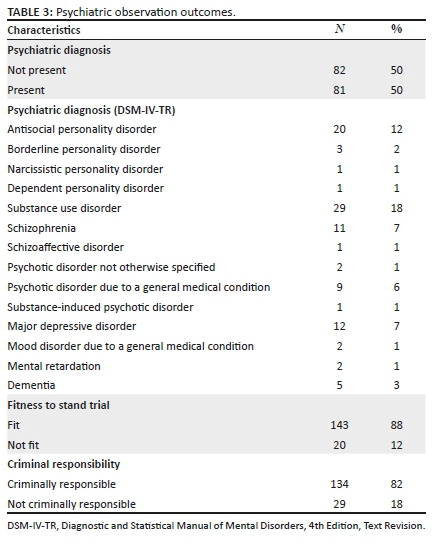
In the non-psychiatric diagnostic category, 47.9% of the study had no medical co-morbidities and 6.4% were unknown as they were not recorded in the patient files. In terms of psychiatric diagnoses, psychotic disorders (82.1%) were the leading diagnostic category for admission and prior to admission substances were used by 55.0% of those in our study population. The remaining 34.3% (N = 46) denied using substances prior to admission and 12.1% (N = 17) were not known as they were not recorded in the patient files. Almost half (46.4%) of the study population received psychiatric treatment prior to admission. Table 2 presents a summary of the clinical data.
Yearly trends
Throughout the 10-year period, those diagnosed with psychotic disorders showed the largest proportion of those admitted (see Figure 1). The trend in the admission patterns amongst those diagnosed with psychotic disorders oscillated throughout the 10-year period. In 2010 there were highest number of people admitted with psychotic disorders. This was followed by a slight downward trend in the psychotic disorder admission numbers, whilst there were slightly more admissions of individuals with intellectual disability and neurocognitive disorders after 2010.
Those who previously received psychiatric treatment prior to admission as state patients were in the majority throughout the 10-year period except in 2008 and after 2011. This peak in 2011 was followed by a downward trajectory and was also noted to coincide with an increase in those who reported no previous psychiatric treatment use prior to admission and those who were noted to be unknown (see Figure 2).
The results in Figure 3 show that throughout the study period, there was a greater proportion of those who were admitted with a history of substance use until 2012 where a downward trend was noted. This downward projection coincided with an increase in the number of those who reported no previous history of substance use, with a peak in 2013.
Forensic characteristics
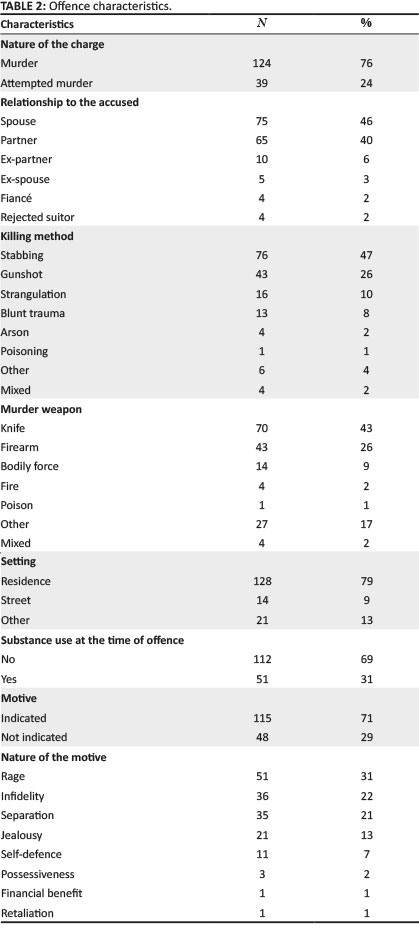
Prior to the current admission, 45.7% of the population had previous arrests, 47.9% had no arrests and for 6.4% it was unknown. Those who were convicted of a crime prior to admission accounted for 15.7%, with 37.9% having no previous convictions and 46.4% being of unknown status. The majority of those admitted in the study period were charged with sexual offences (39.3%), murder (27.9%) and attempted murder (10.7%).
The forensic data including weapons used in the commission of the crime and the relationship of the victim with the state patient are presented in Table 3.
Figure 4 shows that those who committed sexual assault and murders were represented by a larger proportion of numbers throughout the 10-year period. The 10-year trend showed that the crime of murder was the leading charge at admission between 2006 and 2007. It was surpassed by sexual assault crimes when it became the most common charge at admission after 2007, except for 2009 when murder was again the most common offence for a 1-year period. From 2010 onwards, sexual assault remained the most common offence leading to admission as a state patient.
Discussion
Psychiatric disorders have a notable prevalence amongst prisoners and other offenders.151617,1816,17,19,20
Psychotic disorders were measured as a broad category and constituted 82% of psychiatric diagnoses in our study, and it remained consistently high throughout the study period. The dominance of psychotic disorders amongst perpetrators of violent crimes is a well-reported phenomenon, but the number we found is higher than the norm.17,18,19,2017182021199,109,10
Substances use is a general problem in society and our study also reflected this as a stand-alone phenomenon in our sample.22172224,7,813,23
Individuals with personality disorders with co-morbid substance abuse were not evaluated in our study. This patient population generally accounts for a greater portion of those who commit violent crime in mentally ill offenders.24241313,18,25
Almost half (46%) of our sample had previously been on psychiatric treatment, which implied that there was a pre-existing psychiatric diagnosis. A pre-existing psychiatric diagnosis was found in 59% of patients by Marais et al.172627
A previous study from the Free State province of South Africa found that sexual assaults were the reason for 45.8% of their forensic admissions, followed by murder at 19.8%.181717,18,1928
Study limitations
The retrospective record-based nature of this study was a limiting factor as there were a number of files that could not be located and in many of the files the quality of the information recorded was insufficient. The small sample size, the lack of a control group and conducting the study in only one geographical location will limit the generalisability of the findings of this study. The factors investigated in this study were limited by the information available in the clinical files and other factors that might have contributed to the crimes committed, such as housing, family supervision and family structure, which were not within the scope of this study. Considering the complexities of forensic psychiatry, there is still value in sharing these findings and it might be valuable to replicate this study in other forensic psychiatry units in South Africa.
Conclusion
In South Africa, similar studies of profiles of forensic patients have been performed, but our study offered a wider 10-year period looking into the profiles and trends of state patients admitted in a different geographical location in the country. Most of the characteristics of the state patient population found in this study are in line with those found in local and international literature. The consistent finding of high rates of individuals with a history of previous psychiatry treatment and substance use highlights this as an important area of future research, where the focus could be on possible interventions to minimise violent behaviour in this population. An analysis of the trends in the different categories variables showed that the overall patterns varied over the 10-year period. As there were no studies to compare this with, interpretation and implications of these findings will require further investigation. Despite it being so, our research may serve to highlight emerging trends in the forensic population. This provides opportunity for further research into this topic. For future research, prospective, longitudinal studies on a national level are recommended to look at changes over time in the characteristics of this patient population and the crimes committed by them.
Competing interests
The authors have declared that no competing interests exist.
Authors' contributions
All authors contributed equally to this work.
Funding information
This research received no specific grant from any funding agency in the public, commercial or not-for-profit sectors.
Data availability statement
The data will be stored in the Department of Psychiatry, University of Pretoria for a period of 15 years. Data sharing is not applicable to this article.
Disclaimer
The views and opinions expressed in this article are those of the authors and do not necessarily reflect the official policy or positions of any affiliated agency of the authors.
Acknowledgements
References
- 1.Kirsten A, Bruce D. Why South Africa is so violent and what we should be doing about it. Braamfontein, The Centre for the Study of Violence and Reconciliation, Tuesday; 2010.
-
2.Institute for Security Studies. National and provincial crime stats. Available from: https://issafrica.org/crimehub/facts-and-figures/national-crime.
» https://issafrica.org/crimehub/facts-and-figures/national-crime - 3.Masuku S. Prevention is better than cure: Addressing violent crime in South Africa. South African Crime Quarterly. 2002;(2):5-12.
-
4.Sirotich F. Correlates of crime and violence among persons with mental disorder: An evidence-based review. Brief Treatment and Crisis Intervention. 2008;8(2):171. https://doi.org/10.1093/brief-treatment/mhn006
» https://doi.org/10.1093/brief-treatment/mhn006 -
5.Varshney M, Mahapatra A, Krishnan V, Gupta R, Deb KS. Violence and mental illness: What is the true story? J Epidemiol Community Health. 2016;70(3):223-225. https://doi.org/10.1136/jech-2015-205546
» https://doi.org/10.1136/jech-2015-205546 -
6.Parcesepe AM, Cabassa LJ. Public stigma of mental illness in the United States: A systematic literature review. Admin Pol Ment Health. 2013;40(5):384-399. https://doi.org/10.1007/s10488-012-0430-z
» https://doi.org/10.1007/s10488-012-0430-z -
7.Elbogen EB, Johnson SC. The intricate link between violence and mental disorder: Results from the National Epidemiologic Survey on Alcohol and Related Conditions. Arch Gen Psychiatr. 2009;66(2):152-161. https://doi.org/10.1001/archgenpsychiatry.2008.537
» https://doi.org/10.1001/archgenpsychiatry.2008.537 -
8.Morgan V, Morgan F, Valuri G, Ferrante A, Castle D, Jablensky A. A whole-of-population study of the prevalence and patterns of criminal offending in people with schizophrenia and other mental illness. Psychol Med. 2013;43(9):1869-1880. https://doi.org/10.1017/S0033291712002887
» https://doi.org/10.1017/S0033291712002887 -
9.Laajasalo T, Häkkänen H. Background characteristics of mentally ill homicide offenders-a comparison of five diagnostic groups. J Forensic Psychiatr Psychol. 2004;15(3):451-474. https://doi.org/10.1080/1478994042000226750
» https://doi.org/10.1080/1478994042000226750 -
10.Wallace C, Mullen PE, Burgess P. Criminal offending in schizophrenia over a 25-year period marked by deinstitutionalization and increasing prevalence of comorbid substance use disorders. Am J Psychiatr. 2004;161(4):716-727. https://doi.org/10.1176/appi.ajp.161.4.716
» https://doi.org/10.1176/appi.ajp.161.4.716 -
11.Munetz MR, Grande TP, Chambers MR. The incarceration of individuals with severe mental disorders. Community Ment Health J. 2001;37(4):361-372. https://doi.org/10.1023/A:1017508826264
» https://doi.org/10.1023/A:1017508826264 -
12.Nagdee M, Artz L, Corral-Bulnes C, et al. The psycho-social and clinical profile of women referred for psycho-legal evaluation to forensic mental health units in South Africa. S Afr J Psychiatr. 2019;25(1):1-8. https://doi.org/10.4102/sajpsychiatry.v25i0.1230
» https://doi.org/10.4102/sajpsychiatry.v25i0.1230 -
13.Morgan N, Del Fabbro G. Factors associated with recidivism at a South African forensic psychiatric hospital. S Afr J Psychiatr. 2018;24:1125:1-9. https://doi.org/10.4102/sajpsychiatry.v24i0.1125
» https://doi.org/10.4102/sajpsychiatry.v24i0.1125 - 14.Criminal Procedure Act no 55, (1977).
-
15.Naidoo S, Mkize D. Prevalence of mental disorders in a prison population in Durban, South Africa. S Afr J Psychiatr. 2012;15(1):30-35. https://doi.org/10.4314/ajpsy.v15i1.4
» https://doi.org/10.4314/ajpsy.v15i1.4 -
16.Houidi A, Paruk S, Sartorius B. Forensic psychiatric assessment process and outcome in state patients in KwaZulu-Natal, South Africa. S Afr J Psychiatr. 2018;24:1-6. https://doi.org/10.4102/sajpsychiatry.v24i0.1142
» https://doi.org/10.4102/sajpsychiatry.v24i0.1142 -
17.Marais B, Subramaney U. Forensic state patients at Sterkfontein Hospital: A 3-year follow-up study. S Afr J Psychiatr. 2015;21(3):86-92. https://doi.org/10.4102/sajpsychiatry.v21i3.708
» https://doi.org/10.4102/sajpsychiatry.v21i3.708 -
18.Barrett S, Du Toit J, Wilmans S, Joubert G, Calitz F, Du Plooy J. Profile of mentally ill offenders referred to the free state psychiatric complex. S Afr J Psychiatr. 2007;13(2):56-58. https://doi.org/10.4102/sajpsychiatry.v13i2.29
» https://doi.org/10.4102/sajpsychiatry.v13i2.29 -
19.Fioritti A, Ferriani E, Rucci P, Melega V. Characteristics of homicide perpetrators among Italian forensic hospital inmates. Int J Law Psychiatr. 2006;29(3):212-219. https://doi.org/10.1016/j.ijlp.2005.10.002
» https://doi.org/10.1016/j.ijlp.2005.10.002 -
20.Kumar D, Viswanath B, Sebestian A, et al. Profile of male forensic psychiatric inpatients in South India. Int J Soc Psychiatr. 2014;60(1):55-62. https://doi.org/10.1177/0020764012461334
» https://doi.org/10.1177/0020764012461334 -
21.Ibishi NF, Musliu NR, Hundozi Z, Citaku K. Prevalence of the hospitalisation of mentally ill offenders in the Forensic Unit of the Clinic of Psychiatry in Pristina over a three-year period and long-term strategy implications for the management of the Forensic Mental Health System Service. Medicine, Science and the Law. 2015;55(3):201-207. https://doi.org/10.1177/0025802414532247
» https://doi.org/10.1177/0025802414532247 -
22.Peltzer K, Ramlagan S. Illicit drug use in South Africa: Findings from a 2008 national population-based survey. S Afr J Psychiatr. 2010;16(1); 8-15. https://doi.org/10.4102/sajpsychiatry.v16i1.230
» https://doi.org/10.4102/sajpsychiatry.v16i1.230 -
23.Prinsloo RG, Swanepoel A, Lippi G. Identifying factors associated with the discharge of male state patients from Weskoppies Hospital. S Afr J Psychiatr. 2017;23(1): 1-6. https://doi.org/10.4102/sajpsychiatry.v23i0.1083
» https://doi.org/10.4102/sajpsychiatry.v23i0.1083 -
24.Valença AM, Moraes TMd. Relationship between homicide and mental disorders. Rev Bras Psiquiatr. 2006;28(2):s62-s68. https://doi.org/10.1590/S1516-44462006000600003
» https://doi.org/10.1590/S1516-44462006000600003 -
25.Strydom N, Pienaar C, van der Merwe L, et al. Profile of forensic psychiatric inpatients referred to the free state psychiatric complex, 2004-2008. S Afr J Psychiatr. 2011;17(2):40-43. https://doi.org/10.4102/sajpsychiatry.v17i2.274
» https://doi.org/10.4102/sajpsychiatry.v17i2.274 -
26.Silver E, Felson RB, Vaneseltine M. The relationship between mental health problems and violence among criminal offenders. Crim Justice Behav. 2008;35(4):405-426. https://doi.org/10.1177/0093854807312851
» https://doi.org/10.1177/0093854807312851 - 27.Lund C, Petersen I, Kleintjes S, Bhana A. Mental health services in South Africa: Taking stock. Afr J Psychiatr. 2012;15(6):402-405.
-
28.Houidi A, Paruk S. Profile of forensic state patients at a psychiatric unit in KwaZulu Natal, South Africa: Demographic, clinical and forensic factors. J Forensic Psychiatr Psychol. 2018;29(4):544-556. https://doi.org/10.1080/14789949.2018.1425471
» https://doi.org/10.1080/14789949.2018.1425471

Accepted: 18 Aug. 2020
Published: 02 Nov. 2020