Substance and alcohol use in pregnant women attending antenatal care at a tertiary hospital in Johannesburg, South Africa
Abstract
BACKGROUND: Substance and alcohol use during pregnancy confers significant risk to the mother and foetus. Substance and alcohol use is common in South African general population. However, there is a paucity of literature on the extent of the problem among pregnant women AIM: This study assessed the prevalence of substance use and its predictors among pregnant women attending antenatal care (ANC) at a tertiary hospital in Johannesburg, South Africa SETTING: This study was conducted at Rahima Moosa hospital, Johannesburg METHODS: This study was a retrospective record review of 399 consecutively selected pregnant women attending ANC. Socio-demographic, clinical, and substance use data were extracted and analysed using descriptive statistics and multivariate analyses RESULTS: Most pregnant women (84%) were aged between 20 years and 40 years. Substance use was documented in 45% (N = 178) of the records. Of these, concurrent use of alcohol and tobacco was 63% (n = 113). Factors that predicted the use of substances in pregnancy were low birth weight (aOR = 2.5, 95% CI = 1.23, 5.16, p = 0.01) and a positive HIV status (aOR = 0.6. 95% CI = 0.35, 0.96, p = 0.04 CONCLUSION: There was a high prevalence of substance use among pregnant women in the context of this study CONTRIBUTION: The increased risk of contracting HIV and having babies with low birth weights when substances are used in pregnancy highlights the need for appropriate behaviour modification for these women during antenatal care and this is in line with the health belief model
substance use; pregnancy; prevalence; antenatal care; foetus; South Africa
Introduction
The use of substances, especially during pregnancy, is a significant public health problem and this includes substances such as alcohol, tobacco, cannabis, amphetamine-type stimulants, cocaine, opioids, benzodiazepines, solvents, inhalers, and illicit and prescription drugs.1,2,31,2,34,5,6,7,8,9,10,11,12139,14
The harm associated with maternal use and intrauterine exposure to alcohol, tobacco and illicit substances in pregnancy is well documented in the literature, extensive, and intergenerational.5,7,9,10,15,164,5,15,16,17,18,19,20
A common condition that has been widely reported in the literature that is associated with the use of alcohol in pregnancy is foetal alcohol spectrum disorder (FASD), a leading cause of non-inherited intellectual disability in the world, despite being 100% preventable through maternal abstinence from alcohol.8,21,221,8,21,228,9,22235,8,24,25
Cannabis, the most reported illicit drug used in pregnancy, and others such as cocaine, nonprescription opioids, and methamphetamine have been linked with preterm labour, low birth weight, anencephaly (a condition in which the forebrain fails to form), and later development of attention deficit hyperactivity disorder, learning disabilities, memory impairment, depression and aggression.1,10,26
Despite widespread public knowledge and awareness of its deleterious health effects, substance use in pregnancy continues and has been implicated in the development of maternal psychological, behavioural and socio-economic problems such as anxiety disorders or depression, problematic relationships, risky health behaviours, maladaptive functioning, low educational levels, single parenthood and low-income levels.27,281,27,28
In terms of screening for substance use in pregnancy, it is known that the use of substances in pregnancy is associated with preventable deleterious maternal and foetal outcomes, and this has necessitated the recommendation for the routine screening of all pregnant women as the standard of care.29,30,3133,29,30,3129,30,31
Substance use in pregnancy is a health-compromising, risky, and behavioural problem. Therefore, designing an effective intervention may require using the individual behavioural theoretical framework, and the health belief model (HBM) offers this opportunity.32,33,3432,33,3432,33,3432,33,34
Studies have been done on the use of substances in pregnancy globally, and data from most of these studies may not be adequate in highlighting the extent of the problem in other contexts that are different from where these studies were done.4,5,6,7,8,9,10,11,124,5,6,7,8,9,10,11,124,13,14,15
Research methods and design
Study design and setting
This was a cross-sectional retrospective review of maternity or antenatal case records of pregnant women who attended antenatal care (ANC) and delivered at Rahima Moosa Mother and Child Hospital from the first to the third week in January 2013. This hospital is situated in Coronation Ville, Johannesburg, Gauteng, South Africa, and provides inpatient and outpatient tertiary-level obstetric and paediatric services to the inhabitants of that area. Furthermore, the hospital is a clinical training site for medical students, interns, and the University of the Witwatersrand registrars. Data collection was from April 2014 to September 2014. It is acknowledged that there may be a minor overlap of information in this article with a previous report on this topic used for postgraduate study.35
Study population, sample size, and sampling methods
The study included all the socio-demographic and clinical information documented in the maternity or antenatal case records of pregnant women, irrespective of age, who delivered at Rahima Moosa Hospital, between 01 January 2013 and 21 January 2013. According to their records, approximately 970 pregnant women delivered their babies at this hospital in January 2013. Therefore, assuming a margin of sample error of 5%, a confidence level of 95%, and a response distribution of 50%, a sample size of 399 pregnant women was found to be adequate, and these maternity case records or antenatal cards were consecutively selected for the study.36
Data collection
Data were collected manually from the pregnant women's maternity or antenatal case records and entered on an Excel® data collection sheet. This maternity or antenatal case record is the recommended data collection and documentation tool for all pregnant women in South African public health institutions. Specifically, the maternity or antenatal case records have sections that collect data for both the dependent and independent variables used for this study. Usually, these data are collected routinely as a standard practice by self-reporting during medical and general history taking when a pregnant woman enrols for antenatal care in any South African public health institution designed for this purpose. These data are also updated regularly throughout the pregnancy. Therefore, for this study and based on the documentation on the maternity or antenatal records at the study site, information on socio-demographic data (age, race, relationship status, employment status and level of education), clinical data (gestational age at delivery, parity, booking status, human immunodeficiency virus [HIV] status, method of delivery, birth weight of baby and follow-up with psychological or psychiatric services), and substance use data (alcohol, tobacco, cannabis, other, unknown) were collected and subsequently used for data analysis.
Data analysis
Data were analysed using STATA® version 13.0 (StataCorp LLC [Limited Liability Company] College Station, Texas, United States). All descriptive statistics were done using categorical data and presented as percentages and frequencies. The age of the pregnant women, which is continuous data, was also presented as a median. For inferential statistics, a preliminary test of association between independent variables and substance use in pregnancy was done using the Chi-square test. This is justified because it is the initial test for statistical significance between two categorical variables.37,38,3937,38,3937,38,39p-value less than 0.05.
Ethical considerations
Permission for the study was obtained from the Chief Executive Officer of Rahima Moosa Mother and Child Hospital. Ethical approval was obtained from the Human Research Ethics Committee of the University of the Witwatersrand, South Africa (Certificate number: M131188). All identifying data in the reviewed files, including patients' names, were coded to maintain confidentiality.
Results
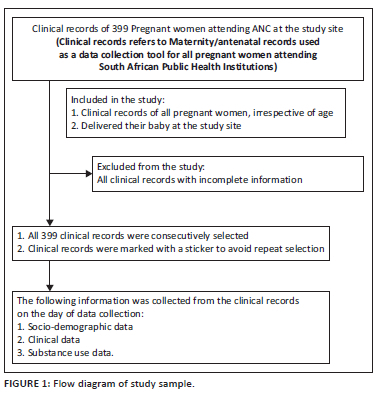
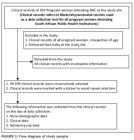
Figure 1 illustrates the flow diagram of the study sample.
Socio-demographic characteristics
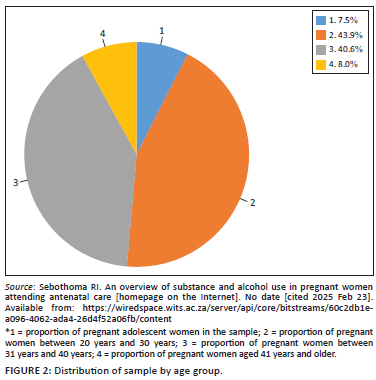
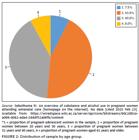
Pregnant women who were aged between 20 years and 30 years, 43.9% (n = 175) with a median age of 25 years, and those who were aged between 31 years and 40 years, 40.6% (n = 162) with a median age of 36 years were in the majority, 84.5% (n = 337). Adolescents with a median age of 16 years accounted for 7.5% (n = 30) of the sample, and pregnant women aged 41 years and older accounted for 8% (n = 32). The details of the distribution of the sample by age group are shown in Figure 2.40
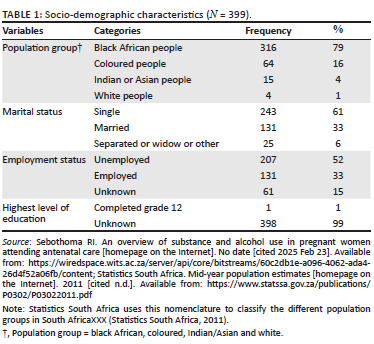
As shown in Table 1,35,40n = 316) were black African, 16% (n = 64) were coloured, 3.8% (n = 15) were Indian or Asian, and 1% (n = 4) were white. Almost two-thirds, 61%, (n = 243) were single, 33% (n = 131) were married and 6% (n = 25) were either separated, divorced, or had no information on marital status. As regards employment, over half (52%, n = 207) of the pregnant women in this study were unemployed. There was no information on the level of education in almost all the files or clinical records used for this study.
Clinical characteristics
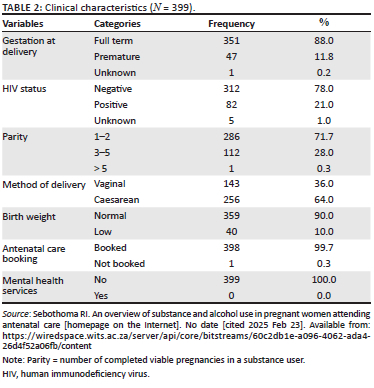
The clinical characteristics of the pregnant women are shown in Table 2.35n = 351) delivered their baby at full term by caesarean section (64%, n = 25), and had 1-2 children (71.7%, n = 286). Incidentally, 21% (n = 82) of the pregnant women were HIV positive, and a small proportion gave birth to children with low birth weight (10%, n = 40). Almost all the pregnant women in this study were booked for antenatal care (99.7%, n = 398), and none were recorded to have ever had contact with psychological or psychiatric services.
Prevalence, types, and characteristics of substance use
Of the 399 pregnant women whose maternity case records or clinical records were used for this study, 45% (n = 178) were documented as using substances. No record of substance use was found in 55% (n = 221). Tobacco use was documented in 37% (n = 149) of the clinical records, alcohol use in 35% (n = 138) and cannabis in 1% (n = 4). The use of illicit substances was not documented in any patient files/clinical records.
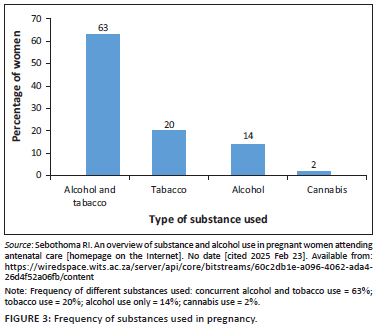
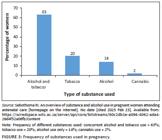
As shown in Figure 3,35n = 113) of the pregnant women used both alcohol and tobacco, 20% (n = 36) used only tobacco, 14% (n = 25) used alcohol, and 2% (n = 4) used cannabis.
Determinants of substance use in pregnancy
Initial bivariate analysis using the Chi-square test indicated that none of the socio-demographic variables were significantly associated with substance use.
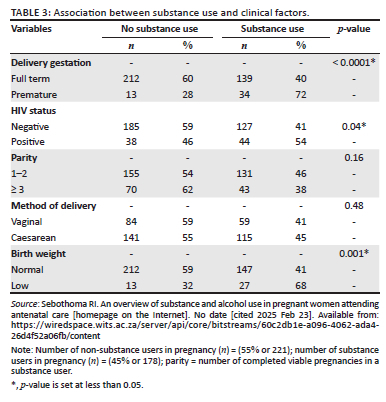
However, as shown in Table 3,35p < 0.0001), HIV status (p = 0.04) and birth weight (p = 0.001) in bivariate analysis.
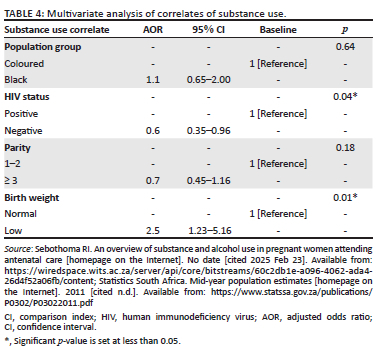
These significant variables were then included in a stepwise multivariate logistic regression analysis model to determine which factors predicted substance use in pregnancy (Table 4).35,4037,38,39p = 0.04) than women who were HIV positive. Additionally, women using substances were 2.5 times more likely to have a child with low birth weight than non-users (aOR = 2.5, 95% CI: 1.23-5.16, p = 0.01).
Discussion
In this study, 45% of the pregnant women who delivered their babies at Rahima Moosa Mother and Child Hospital were found to have used substances. Specifically, 37% used tobacco, 35% used alcohol, 1% used cannabis and 63% used tobacco and alcohol concurrently. There was no record of the use of illicit substances among the study samples. These findings are concerning because the deleterious outcomes associated with substance use in pregnancy are well reported in the literature.4,5,15,16,17,18,19,20238,21,22,235,6,7,8,11,15,22,27,41,42,434,5,6,7,8,9,10,11,12134,10,12,14,18,234,10,12,14,18,23444,5,6,7,8,9,10,11,122629,30,31
In our study, black Africans (79%), single mothers (61%) and those who are unemployed (52%) or whose education level is unknown are the socio-demographic groups with the highest frequency of use of substances during pregnancy. Although these variables did not achieve statistical significance in our study, they have important public health implications. However, we do not have data on how socio-demographic conditions affect pregnant women using substances. However, in a study done by Ünver and Alkan45454,5,15,16,17,18,19,204,5,15,16,17,18,19,204,5,15,16,17,18,19,20271,27,28,45
This study found that the use of substances in pregnancy is significantly associated with being HIV positive. Our finding is in line with previous studies,46,47474846,484932,33,34
Another important finding of this study is that substance use is associated with low birth weight in infants. Specifically, we found that women using substances were 2.5 times more likely to have a child with low birth weight than non-users (aOR = 2.5, p = 0.01), and this is consistent with the report of several studies.50,51,52,53,541,5,8,9,10,15,16,22,26,2850,51,52,53
A substantial number of women who used substances during pregnancy in this study were teenagers/adolescents (7.5%; n = 30), and when extrapolated to the population level, it has important implications for public health. Although we did not find any association between socio-demographic variables and substance use in pregnancy, in one study, teenage pregnancy was found to be associated with substance use and poor socio-economic status, thus, highlighting its huge public health implications.5556,5756,5755,56,57
From a public health perspective, it is, therefore, essential that strategies are put in place to target this unique population of pregnant mothers even before they get pregnant. Extensive education and campaigns on the dangers of teenage pregnancy need to be prioritised as a prevention approach in schools, places of religious worship and communities.55,56,5755,56,5755,56,5724,28,55,56,5724,25,55,56,57
Strengths and limitations
This retrospective cross-sectional study involved a review of patient records selected consecutively and may be limited by misclassification of data, inadequate data, selection and information bias. Specifically, there was no record of documentation of the use of illicit drugs among pregnant women, which is due to under-reporting.265946,47,48,50,51,52,53,5437,3837,38
Conclusion
This study found that there was a high prevalence of substance use among pregnant women, and this has important implications for public health. The increased risk of contracting HIV and having babies with low birth weights and who may potentially have FASD or FAS when substances are used in pregnancy highlights the need for interventions to be started earlier, even before pregnancy, for better outcomes. Those missed should be targeted at their first antenatal visit. Specifically, because substance use is behavioural and modifiable, ongoing screening, primary prevention, counselling, health education and promotion and appropriate behaviour change intervention need to be the standard of care for all pregnant women.24,25,28,5832,33,3432,33,3432,33,3432,33,3456,57
Recommendations
The findings of this study indicate that risk stratification, screening, counselling, health education and promotion and behaviour modification for substance use should be the pivot of interventions for pregnant women accessing ANC services. The evidence-based health belief model should be the cornerstone for these interventions, which should be ongoing because of the identified risks and health consequences associated with substance use in pregnancy. Additional consideration should be given to teenagers who were found substantially to be using substances in pregnancy in this study. Healthcare professionals who provide care to pregnant women using substances should aim to understand their risk perception and why they are indulging in risky behaviour in line with HBM and patient-centredness. Specifically, antenatal care providers should adopt the WHO's recommendation for the routine screening of all pregnant women for substance use as a primary prevention standard of care.30,3130,3130,31
Competing interests
The authors declare that they have no financial or personal relationships that may have inappropriately influenced them in writing this article.
Authors' contributions
R.I.S. was involved in the conception of the study, design, data collection, analysis, interpretation of results, and writing of the article. S.C.O. participated in the data re-analysis, interpretation of results, and drafting the article. R.I.S. and S.C.O. gave final approval for the submission of the article for publication.
Funding information
This research received no specific grant from any funding agency in the public, commercial, or not-for-profit sectors.
Data availability
The data supporting this study's findings are available upon reasonable request from the corresponding author. However, the data are not publicly available due to institutional restrictions that may compromise data privacy.
Disclaimer
The views and opinions expressed in this article are those of the authors and are the product of professional research. It does not necessarily reflect the official policy or position of any affiliated institution, funder, agency, or that of the publisher. The authors are responsible for this article's results, findings, and content.
Acknowledgements
This article is partially based on the author's thesis 'An overview of substance and alcohol use in pregnant women attending antenatal care' towards the degree of Master of Medicine in the branch of Psychiatry, Faculty of Health Science at the University of the Witwatersrand in February 2021, with supervisors Prof. L. Robertson and Dr N. Tema. It is available here: https://wiredspace.wits.ac.za/server/api/core/bitstreams/60c2db1e-a096-4062-ada4-26d4f52a06fb/content.
References
-
1. Cook JL. Epidemiology of opioid use in pregnancy. Best Pract Res Clin Obstet Gynaecol. 2022;85(pt. B):12-17. https://doi.org/10.1016/j.bpobgyn.2022.07.008
» https://doi.org/10.1016/j.bpobgyn.2022.07.008 - 2. Hasin DS, Larson FR. Substance use disorder diagnoses in DSM-5. In: Brady KT, Levin FR, Galanter M, Kleber HD, editors. The American Psychiatric Association publishing textbook of substance use disorder treatment. 6th ed. Washington, DC: American Psychiatric Association Publishing; 2021.
-
3. World Health Organization. Guidelines for the identification and management of substance use and substance use disorders in pregnancy [homepage on the Internet]. 2014 [cited 2025 Feb 23]. Available from: https://www.who.int/publications/i/item/9789241548731
» https://www.who.int/publications/i/item/9789241548731 -
4. Brink LT, Springer PE, Nel DG, Potter MD, Odendaal HJ. The tragedy of smoking, alcohol, and multiple substance use during pregnancy. S Afr Med J. 2022;112(8):526-538. https://doi.org/10.7196/SAMJ.2022.v112i8.16480
» https://doi.org/10.7196/SAMJ.2022.v112i8.16480 -
5. Fetene MT, Teji K, Assefa N, Bayih WA, Tsehaye G, Hailemeskel HS. Magnitude and associated factors of substance use among pregnant women attending antenatal care in public hospitals of eastern Ethiopia. BMC Psychiatry. 202121(1):1-2. https://doi.org/10.1186/s12888-021-03078-5
» https://doi.org/10.1186/s12888-021-03078-5 -
6. Gómez-Ruiz LM, Marchei E, Rotolo MC, et al. Prevalence of licit and illicit drugs use during pregnancy in Mexican women. Pharmaceuticals. 2022;15(3):382. https://doi.org/10.3390/ph15030382
» https://doi.org/10.3390/ph15030382 -
7. Hartel TC, Turawa EB, Oelofse A, De Smidt JJ. Effect of maternal cigarette smoking and alcohol consumption during pregnancy on birth weight and cardiometabolic risk factors in infants, children and adolescents: A systematic review protocol. BMJ Open. 2022;12(7):e061811. https://doi.org/10.1136/bmjopen-2022-061811
» https://doi.org/10.1136/bmjopen-2022-061811 -
8. Mravčík V, Nechanská B, Gabrhelík R, Handal M, Mahic M, Skurtveit S. Socioeconomic characteristics of women with substance use disorder during pregnancy and neonatal outcomes in their newborns: A national registry study from the Czech Republic. Drug Alcohol Depend. 2020;209:107933. https://doi.org/10.1016/j.drugalcdep.2020.107933
» https://doi.org/10.1016/j.drugalcdep.2020.107933 -
9. Odendaal HJ, Kruger M, Botha MH. Dangers of smoking cigarettes and drinking alcohol during pregnancy. S Afr Med J. 2020;110(11):1066-1067. https://doi.org/10.7196/SAMJ.2020.v110i11.14738
» https://doi.org/10.7196/SAMJ.2020.v110i11.14738 -
10. Alabi OJ, Jacob M. Foetal alcohol syndrome disorder in South Africa: Understanding the enablers of alcohol consumption during pregnancy. Interdiscip J Social Stud. 2025;5(1):a01. https://doi.org/10.38140/ijss-2025.vol5.1.01
» https://doi.org/10.38140/ijss-2025.vol5.1.01 -
11. Ogbuabor DC, Ogbuabor AO, Igwe MC. Determinants of cigarette smoking and smoking frequency among women of reproductive age in Nigeria: Evidence from a nationwide cross-sectional survey. Subst Abuse Treat Prev Policy. 2023;18(1):20. https://doi.org/10.1186/s13011-023-00530-5
» https://doi.org/10.1186/s13011-023-00530-5 -
12. Phaswana-Mafuya N, Peltzer K, Pengpid S. Maternal tobacco use during pregnancy in South Africa: Results from a national population-based survey. Int J Prev Med. 2019;10(1):99. https://doi.org/10.4103/ijpvm.IJPVM_212_18
» https://doi.org/10.4103/ijpvm.IJPVM_212_18 -
13. Dukes K, Tripp T, Willinger M, et al. Drinking and smoking patterns during pregnancy: Development of group-based trajectories in the Safe passage study. Alcohol. 2017;62:49-60. https://doi.org/10.1016/j.alcohol.2017.03.001
» https://doi.org/10.1016/j.alcohol.2017.03.001 -
14. Manguvhewa M, Florence M, Yu M. A bio-ecological perspective on risk awareness and factors associated with substance use during pregnancy in communities of the Western Cape province, South Africa [serial online]. World Acad Sci Eng Technol Int J Psychol Behav Sci. 2021 [updated 2025 Feb 23];15(1):63-69. Available from: https://publications.waset.org/10011743/a-bio-ecological-perspective
» https://publications.waset.org/10011743/a-bio-ecological-perspective -
15. Dhir D, Kumari S, Devi V, et al. Prevalence of tobacco and alcohol use among pregnant women in India: A systematic review and meta-analysis. J Subst Use. 2025;30:1-9. https://doi.org/10.1080/14659891.2024.2448806
» https://doi.org/10.1080/14659891.2024.2448806 -
16. Wimberly CE, Gulrajani NB, Russ JB, et al. Maternal prenatal use of alcohol, tobacco, and illicit drugs and associations with childhood cancer subtypes. Cancer Epidemiol Biomarkers Prev. 2024;33(3):347-354. https://doi.org/10.1158/1055-9965.EPI-23-1027
» https://doi.org/10.1158/1055-9965.EPI-23-1027 -
17. Shuffrey LC, Myers MM, Isler JR, et al. Association between prenatal exposure to alcohol and tobacco and neonatal brain activity: Results from the safe passage study. JAMA Netw Open. 2020;3(5):e204714. https://doi.org/10.1001/jamanetworkopen.2020.4714
» https://doi.org/10.1001/jamanetworkopen.2020.4714 -
18. Tanaka K, Miyake Y, Furukawa S, Arakawa M. Secondhand smoke exposure and risk of wheeze in early childhood: A prospective pregnancy birth cohort study. Tob Induc Dis. 2017;15(1):1-7. https://doi.org/10.1186/s12971-017-0138-7
» https://doi.org/10.1186/s12971-017-0138-7 -
19. Paradis AD, Shenassa ED, Papandonatos GD, Rogers ML, Buka SL. Maternal smoking during pregnancy and offspring antisocial behaviour: Findings from a longitudinal investigation of discordant siblings. J Epidemiol Community Health. 2017;71(9):889-896. https://doi.org/10.1136/jech-2016-208511
» https://doi.org/10.1136/jech-2016-208511 -
20. Odendaal H, Geerts L, Nel D, Brink LT, Hitchcock E, Groenewald CA. Effects of alcohol, cigarettes, methamphetamine and marijuana exposure during pregnancy on maternal serum alpha-fetoprotein levels at 20-24 weeks' gestation. J Pediatr Neonatal Care. 2018;8(1):73-82. https://doi.org/10.15406/jpnc.2018.08.00314
» https://doi.org/10.15406/jpnc.2018.08.00314 -
21. Tong F, Wang Y, Gao Q, et al. The epidemiology of pregnancy loss: Global burden, variable risk factors, and predictions. Hum Reprod. 2024;39(4):834-848. https://doi.org/10.1093/humrep/deae008
» https://doi.org/10.1093/humrep/deae008 -
22. Ghosh A, Verma A, Choudhury S, Dhawan P. Regional disparities and correlates of alcohol use during pregnancy in India: Insights from the national family health survey-5. Drug Alcohol Rev. 2025;44(2):576-587. https://doi.org/10.1111/dar.13995
» https://doi.org/10.1111/dar.13995 -
23. May PA, De Vries MM, Marais AS. The prevalence of fetal alcohol spectrum disorders in rural communities in South Africa: A third regional sample of child characteristics and maternal risk factors. Alcohol: Clin Exp Res. 2022;46(10):1819-1836. https://doi.org/10.1111/acer.14922
» https://doi.org/10.1111/acer.14922 -
24. Petersen Williams P, Erasmus-Claassen LA, Taylor S, et al. Perceptions of perinatal alcohol use and treatment needs in Cape Town, South Africa: A qualitative study. Front Psychiatry. 2024;15:1199647. https://doi.org/10.3389/fpsyt.2024.1199647
» https://doi.org/10.3389/fpsyt.2024.1199647 -
25. Washio Y, Erasmus-Claassen LA, Taylor SN. An incentive-based text-messaging intervention to reduce maternal alcohol use during pregnancy and lactation in South Africa (MaRISA study): Findings from a single-arm pilot study. Alcohol: Clin Exp Res. 2024;48(8):1600-1609. https://doi.org/10.1111/acer.15392
» https://doi.org/10.1111/acer.15392 -
26. McMillin GA, Morad AW, Boyd JM, et al. Biological testing and interpretation of laboratory results associated with detecting newborns with substance exposure. Clin Chem. 202470(7):934-947. https://doi.org/10.1093/clinchem/hvae018
» https://doi.org/10.1093/clinchem/hvae018 -
27. Ragsdale AS, Al-Hammadi N, Bass S, Chavan NR. Racial and ethnic disparities among pregnancies with substance use disorder: Impact on perinatal outcomes. J Women's Health. 2024;33(9):1166-1174. https://doi.org/10.1089/jwh.2023.0619
» https://doi.org/10.1089/jwh.2023.0619 -
28. Crisóstomo BD, Nascimento AS, Oliveira RA. Social determinants of health and psychoactive drug use in pregnancy. Acta Paulista de Enfermagem. 2022;35:eAPE0340345. https://doi.org/10.37689/acta-ape/2022AO0340345
» https://doi.org/10.37689/acta-ape/2022AO0340345 -
29. Stevens MW, Cooper M, Cusack L, Ali RL, Holmwood C, Briley AL. Screening and early intervention for substance use during pregnancy: A retrospective case note review of antenatal care records. Drug Alcohol Rev. 2024;43(7):1817-1828. https://doi.org/10.1111/dar.13927
» https://doi.org/10.1111/dar.13927 -
30. Pautrat M, Barbier E, Lebeau JP. Identifying available substance use disorder screening tests feasible for use in primary care: A systematic review. Prev Med Rep. 2024;38:102610. https://doi.org/10.1016/j.pmedr.2024.102610
» https://doi.org/10.1016/j.pmedr.2024.102610 - 31. Reichert RA, Lopes FM, Scatena A, De Micheli D, Andrade AL. Drug Screening Instruments for Substance Abuse (ASI, ASSIST, AUDIT, DUSI). In: Andrade AL, De Micheli D, da Silva EA, Lopes FM, de Oliveira Pinheiro B, Reichert RA, editors. Psychology of substance abuse: Psychotherapy, clinical management and social intervention. Cham: Springer Nature; 2021.
-
32. Acquavita SP, Talks A, Fiser K. Facilitators and barriers to cigarette smoking while pregnant for women with substance use disorders. Nicotine Tob Res. 2017;19(5):555-561. https://doi.org/10.1093/ntr/ntw268
» https://doi.org/10.1093/ntr/ntw268 -
33. Haryanti P, Pandugaran SL, Aljaberi MA. The application of the health belief model in improving healthy behaviors among pregnant women: A literature review. Int J Health Sci. 2024;2(1):325-337. https://doi.org/10.59585/ijhs.v2i1.301
» https://doi.org/10.59585/ijhs.v2i1.301 -
34. Rosenstock IM. Historical origins of the health belief model. Health Educ Monogr. 1974;2(4):328-335. https://doi.org/10.1177/109019817400200403
» https://doi.org/10.1177/109019817400200403 -
35. Sebothoma RI. An overview of substance and alcohol use in pregnant women attending antenatal care [homepage on the Internet]. No date [cited 2025 Feb 23]. Available from: https://wiredspace.wits.ac.za/server/api/core/bitstreams/60c2db1e-a096-4062-ada4-26d4f52a06fb/content
» https://wiredspace.wits.ac.za/server/api/core/bitstreams/60c2db1e-a096-4062-ada4-26d4f52a06fb/content -
36. Sample size calculator [homepage on the Internet]. [cited 2025 Apr 13]. Available from: https://www.calculator.net/sample-size-calculator.html
» https://www.calculator.net/sample-size-calculator.html - 37. Johnson RB, Christensen LB. Educational research: Quantitative, qualitative, and mixed approaches. 8th ed. Thousand Oaks, CA: Sage; 2024.
- 38. Bruce N, Pope D, Stanistreet D. Quantitative methods for health research: A practical interactive guide to epidemiology and statistics. Chichester: John Wiley & Sons; 2017.
-
39. Slater P, Hasson F. Quantitative research designs, hierarchy of evidence and validity. J Psychiatr Ment Health Nurs. 2024;0:1-5. https://doi.org/10.1111/jpm.13135
» https://doi.org/10.1111/jpm.13135 -
40. Statistics South Africa. Mid-year population estimates [homepage on the Internet]. 2011 [cited n.d.]. Available from: https://www.statssa.gov.za/publications/P0302/P03022011.pdf
» https://www.statssa.gov.za/publications/P0302/P03022011.pdf -
41. Kar P, Tomfohr-Madsen L, Giesbrecht G, Bagshawe M, Lebel C. Alcohol and substance use in pregnancy during the COVID-19 pandemic. Drug Alcohol Depend. 2021;225:108760. https://doi.org/10.1016/j.drugalcdep.2021.108760
» https://doi.org/10.1016/j.drugalcdep.2021.108760 -
42. Powell M, Pilkington R, Ahmed T, et al. Prevalence of maternal substance use problems during pregnancy and the first 2 years of life: a whole-population birth cohort of 970 470 Australian children born 2008-2017. J Epidemiol Community Health. 2025;0:1-11. https://doi.org/10.1136/jech-2024-223439
» https://doi.org/10.1136/jech-2024-223439 -
43. Young-Wolff KC, Oberman N, Alexeeff SE, et al. Alcohol, cannabis, and nicotine use during early pregnancy and infant hearing loss. Prev Med. 2025;192:108242. https://doi.org/10.1016/j.ypmed.2025.108242
» https://doi.org/10.1016/j.ypmed.2025.108242 -
44. Raggio GA, Psaros C, Fatch R, et al. High rates of biomarker-confirmed alcohol use among pregnant women living with HIV in South Africa and Uganda. J Acquir Immune Defic Syndr. 2019;82(5):443. https://doi.org/10.1097/QAI.0000000000002156
» https://doi.org/10.1097/QAI.0000000000002156 -
45. Ünver Ş, Alkan Ö. Sociodemographic factors associated with alcohol use in Turkish women. J Subst Use. 2024;29(4):495-500. https://doi.org/10.1080/14659891.2023.2284942
» https://doi.org/10.1080/14659891.2023.2284942 -
46. Schumann H, Rubagumya K, Rubaihayo J, Harms G, Wanyenze RK, Theuring S. The incidence of HIV and associated risk factors among pregnant women in Kabarole District, Uganda. PLoS One. 2020;15(6):e0234174. https://doi.org/10.1371/journal.pone.0234174
» https://doi.org/10.1371/journal.pone.0234174 -
47. Rodriguez EM, Mofenson LM, Chang BH, et al. Association of maternal drug use during pregnancy with maternal HIV culture positivity and perinatal HIV transmission. Aids. 1996;10(3):273-282. https://doi.org/10.1097/00002030-199603000-00006
» https://doi.org/10.1097/00002030-199603000-00006 -
48. Shuper PA, Neuman M, Kanteres F, Baliunas D, Joharchi N, Rehm J. Causal considerations on alcohol and HIV/AIDS - A systematic review. Alcohol & Alcohol. 2010;45(2):159-166. https://doi.org/10.1093/alcalc/agp091
» https://doi.org/10.1093/alcalc/agp091 -
49. Pandrea I, Happel KI, Amedee AM, Bagby GJ, Nelson S. Alcohol's role in HIV transmission and disease progression [serial online]. Alcohol Res Health. 2010 [cited 2025 Feb 23];33(3):203. Available from: https://pmc.ncbi.nlm.nih.gov/articles/PMC3860502/
» https://pmc.ncbi.nlm.nih.gov/articles/PMC3860502/ -
50. Doğan NN, Salihoğlu Ö. Prenatal Substance Abuse: A 1-year single-center experience at a tertiary neonatal intensive care unit. Türkiye Çocuk Hastalıkları Dergisi. 2024;18(1):7-12. https://doi.org/10.12956/tchd.1284603
» https://doi.org/10.12956/tchd.1284603 -
51. Michalski CA, Hung RJ, Seeto RA. Association between maternal cannabis use and birth outcomes: An observational study. BMC Pregnancy Childb. 2020;20:1-9. https://doi.org/10.1186/s12884-020-03371-3
» https://doi.org/10.1186/s12884-020-03371-3 -
52. Oni HT, Buultjens M, Mohamed AL, Islam MM. Neonatal outcomes of infants born to pregnant women with substance use disorders: A multilevel analysis of linked data. Subst Use Misuse. 2022;57(1):1-0. https://doi.org/10.1080/10826084.2021.1958851
» https://doi.org/10.1080/10826084.2021.1958851 -
53. Bailey BA, Wood DL, Shah D. Impact of pregnancy marijuana use on birth outcomes: Results from two matched population-based cohorts. J Perinatol. 2020;40(10):1477-1482. https://doi.org/10.1038/s41372-020-0643-z
» https://doi.org/10.1038/s41372-020-0643-z -
54. Gabrhelík R, Mahic M, Lund IO, et al. Cannabis use during pregnancy and risk of adverse birth outcomes: A longitudinal cohort study. Eur Addict Res. 2021;27(2):131-141. https://doi.org/10.1159/000510821
» https://doi.org/10.1159/000510821 -
55. Wong SP, Twynstra J, Gilliland JA, Cook JL, Seabrook JA. Risk factors and birth outcomes associated with teenage pregnancy: A Canadian sample. J Pediatr Adolesc Gynecol. 2020;33(2):153-159. https://doi.org/10.1016/j.jpag.2019.10.006
» https://doi.org/10.1016/j.jpag.2019.10.006 -
56. Diabelková J, Rimárová K, Dorko E, Urdzík P, Houžvičková A, Argalášová Ľ. Adolescent pregnancy outcomes and risk factors. Int J Environ Res Public Health. 2023;20(5):4113. https://doi.org/10.3390/ijerph20054113
» https://doi.org/10.3390/ijerph20054113 -
57. Ursache A, Lozneanu L, Bujor I, et al. Epidemiology of adverse outcomes in teenage pregnancy - A northeastern Romanian tertiary referral center. Int J Environ Res Public Health. 2023;20(2):1226. https://doi.org/10.3390/ijerph20021226
» https://doi.org/10.3390/ijerph20021226 -
58. Chang G. Maternal substance use: Consequences, identification, and interventions. Alcohol Res: Curr Rev. 2020;40(2):06. https://doi.org/10.35946/arcr.v40.2.06
» https://doi.org/10.35946/arcr.v40.2.06 -
59. Näher AF, Vorisek CN, Klopfenstein SA, et al. Secondary data for global health digitalisation. Lancet Digit Health. 2023;5(2):e93-e101. https://doi.org/10.1016/S2589-7500(22)00195-9
» https://doi.org/10.1016/S2589-7500(22)00195-9

Accepted: 27 Feb. 2025
Published: 14 May 2025