Working memory and set-shifting in school-aged children classified as having attention-deficit hyperactivity disorder
Abstract
BACKGROUND: Attention-deficit hyperactivity disorder (ADHD) is a common psychiatric disorder reported in both children and adults; it is often associated with a variety of executive functioning deficits. AIM: This study investigated the extent to which working memory and set-shifting are impaired in school children with and without ADHD. SETTING: This included primary schools in Lepelle-Nkumpi Municipality in Limpopo province, South Africa. METHODS: A total of 216 children (108 screened positive for ADHD and 108 matched controls without ADHD symptoms), aged between 6 and 15 years, participated in the study. The performance of the two groups was compared on tests of working memory (Forward and Backward Digit Span subtests of the Wechsler Intelligence Scale for Children - Fourth Edition) and set-shifting (Trail Making Test Part B). The scores were analysed as a function of gender and age. RESULTS: The group with possible ADHD performed worse than the neurotypical control group on tasks of working memory and set-shifting. The results did not indicate that gender affected performance. However, the younger age group performed worse than the older children CONCLUSION: Children classified as ADHD showed significantly more impairments in working memory and set-shifting than neurotypical controls. Neither test showed any significant difference between male and female performance, whilst age was shown to affect performance on both tests. Early identification and treatment of children with attention-deficit hyperactivity disorder are crucial to their well-being.
ADHD; age; digit backward; digit forward; gender; set-shifting; trail making-B; working memory
Introduction
Attention-deficit hyperactivity disorder (ADHD) is a debilitating neurodevelopmental disorder, characterised by extreme inattention and hyperactivity impulsiveness (HI), which interfere with daily functioning.121
The male-to-female ratio of ADHD in the general population is 2:1 in children and 1.6:1 in adults.23,42
Some studies have shown more symptoms of hyperactivity in younger children, and more impulsiveness in adolescents.2,45678,9
Executive functions refer to a set of interconnected, higher order cognitive processes that control goal-directed behaviours and problem-solving.10,1110,1210,1314
Working memory refers to systems that are necessary to enable the individual to remember information over the short-term and mentally use this information to learn, understand and reason.11,171819,202121,2223
Working memory functions are located in the mid-lateral prefrontal cortex and the interconnected networks, which involve updating, dual processing and serial or temporal recording.2413,2522623
In terms of gender differences in WM, a meta-analysis of 11 studies by Maric et al.272628
There have been mixed opinions as to whether age affects WM functions amongst children with ADHD. Maric et al.27298
Set-shifting is 'the ability to shift between tasks, to strategize diverse ways to resolve a problem, and to look at events from a different angle.'30,31,32233,343026,28,33,34,3528
Some studies35,3628,3633,34,3731
The reported deficits in WM1333,343839404,40
The main aims of this study were to establish whether children with possible ADHD symptoms have deficits in WM and set-shifting as measured by the Digit Span and Trail-making Test Part B, respectively, and to examine their within-group gender and age differences in performance.
Research method and design
Study design
A case-controlled, quantitative, experimental design was employed to establish whether children who screened positive for ADHD are impaired in WM and set-shifting. The sample was divided into participants classified as ADHD and matched controls without symptoms of ADHD.
Setting
Eleven primary schools from rural areas of the Limpopo province of South Africa were selected for the study.
Study population and sampling strategy
Participants were Sepedi-speaking, Grade 1-7 learners, aged 6-15 years, whose teachers and parents completed the Disruptive Behaviour Disorders (DBD) rating scale43,4415,4241
The resulting sample (N = 216) comprised 100 male and 116 female participants, and contained children who screened positive for ADHD symptoms (n = 108:50 males and 58 females) and a matched control group (n = 108:50 males and 58 females). Based on collateral information obtained from parents, teachers and school records, children with cerebral palsy, severe psychopathology, auditory and visual impairments, and intellectual disabilities were excluded from participation in the study.
Data collection
This study was conducted in primary schools in the Lepelle-Nkumpi Municipality of the Capricorn district, Limpopo province, South Africa, during the year 2016. School principals provided consent for the study to be undertaken at their school. Informed, written consent was obtained from parents. The response rate for the DBD questionnaires was 96%. The testing procedure was explained to all learners selected for testing. The assessments were administered by clinical psychologists, with the help of field workers with psychology qualifications and who were conversant in Sepedi. Participants were individually assessed in a quiet, well-ventilated room. The test battery was administered during school hours, in accordance with the Department of Education's regulations, in two sessions each lasting for approximately 60 min per participant. The total number of correct responses for the Digits subtest and the time taken to complete the Trail making test part B (TMT-B) were recorded.
Instruments
Disruptive Behaviour Disorders: The teachers screened the children for the presence of ADHD symptoms using the 18-item DBD rating scale43,442,45245,464147,48
Each respondent was asked to rate the behaviour of the child on a four-point Likert scale: not at all (0), just a little (1), pretty much (2) and very much (3). Cronbach's α for the targeted population was calculated at 0.92 for the inattention scale and 0.90 for the HI scale.41
Digit span
Both Digits Forward and Digits Backward from the Wechsler Intelligence Scale for Children - Fourth Edition (WISC-IV)4911,184950
Trail making test part B
Participants were instructed to work as quickly as possible, without lifting their pen or pencil from the paper. Whenever the child made an error, this was pointed out immediately, and they were allowed to self-correct. Errors affected the score as their correction increased the completion time of the task. Higher scores indicate difficulties in set-shifting.3432 The Cronbach's α for the present sample was 0.67 and 0.72 for Part A and B, respectively.
Data analysis
Statistica 12.7 (Dell, 2015)52Between-group differences were established using a 2 × 2 × 2 (ADHD group × gender × age) multifactorial ANOVA. Post hoc analysis (Bonferroni) was used to determine within-group differences (differences in gender and age).
Ethical considerations
Ethical clearance was obtained from the Biomedical Research Ethics Committee of University of KwaZulu-Natal, Durban, South Africa (reference number HSS/1446/015D) and the Department of Education, Limpopo province, South Africa. Principals of the selected schools provided their verbal consent for the study to be undertaken in their schools. Written, informed consent was obtained from parents or legal guardians of the learners to participate in the study. The researchers read out the assent form to children, and, after it was established that they had understood and agreed with the content, they were asked to assent to take part in the study. All children irrespective of age were treated in the same way. Voluntary participation was ensured, as participants were informed that they could withdraw at any stage should they want to do so. Parents of children who obtained positive scores were referred to the nearest hospital for further assessments and management.
Results
Digit span
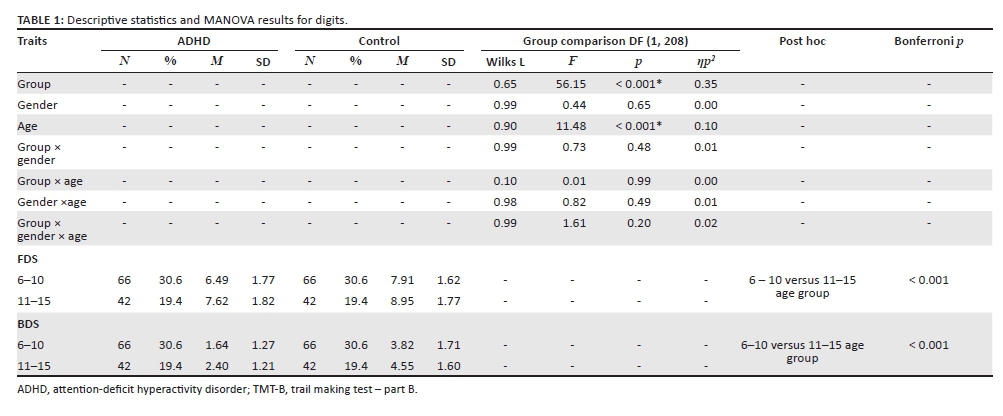
Descriptive statistics, the MANOVA and the post hoc results for Digit Span are shown in Table 1. No main or interactions effect was found for gender. Statistical differences were found in performance between the ADHD and control group: Wilks L = 0.65, F = 56.15, p < 0.001, ƞp2F = 11.48, p < 0.001, ƞp2p < 0.001). An effect size (partial eta squared, ƞp253
Trails-B
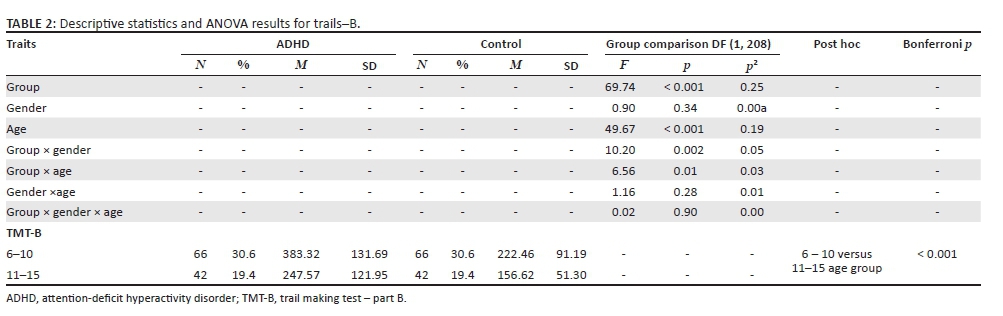
Descriptive statistics, the ANOVA and the post hoc results for Trails-B are shown in Table 2. No main or interactions effect was indicated for gender. Statistical differences were found in performance between the ADHD and control group: F = 69.74, p < 0.001, ƞp2F = 49.67, p < 0.001, ƞp2p < 0.001). Effect sizes (partial eta squared, ƞp253
Discussion
This study investigated whether gender and age differences in performance in children with and without possible ADHD may be because of the specific components of the WM system, namely, the active versus passive processing, or the coding, namely, the visuo-spatial or verbal coding, and whether the ability to keep other details in mind whilst attending to other tasks (set-shifting) may be affected by gender and age. In order to achieve these aims, two standard instruments were employed, namely, the two processing conditions of the DS (i.e. forward and backward repetition) that measure passive and active components of WM, respectively,4951
It was found that children who screened positive for ADHD symptomatology performed more poorly than the controls in respect of both WM and set-shifting. Gender did not affect their performance on either the DS or TMT-B; however, specific age differences were detected by both tests.
Working memory deficits in attention-deficit hyperactivity disorder
The results reveal that children with symptoms of ADHD, when compared with controls, showed significantly more WM deficits. This finding is in accordance with those of previous studies,54,551532
This study showed no gender differences in WM deficits in either the group with possible ADHD or the neurotypical controls. This finding contradicts previous findings by Skogli et al.562726,2857
The findings of this study indicate the group independent age differences in WM functions, by showing that older children outperformed their younger peers on the Digits Span measurements, irrespective of whether they have possible symptoms of ADHD. This finding is contrary to some studies, which found that age did not affect the ability of children (viz. possible ADHD and controls) to sustain memory functions whilst engaging in cognitive activities.26,27,3413,2423,5825227,592423
Set-shifting in attention-deficit hyperactivity disorder
Consistent with some previous studies,32,3433,3428,3030
This study found no gender differences in set-shifting performance, which suggests that although behaviour is influenced by environment or culture, the neuropsychological mechanisms underlying behaviour are the same across genders.8,2428,3528,2637
Overall, these findings suggest that children with putative ADHD displayed more EF deficits, which supports Barkley's model211560388285977
The implications of this study are that children with putative ADHD symptoms are significantly impaired in WM and set-shifting skills. The literature suggests that children with possible ADHD, and with deficits in WM2633,352,4
Limitations
Firstly, the homogeneity of the sample, as our mean age was 10 years, limited a significant representation for adolescents. Secondly, the sample only represented Sepedi-speaking children from one specific area in Limpopo, and therefore, cannot be generalised. For further investigation, heterogeneous samples, where different measurements are used, should be considered.
Conclusion
The current study showed that children with possible ADHD symptomatology display more deficits in WM and set-shifting when compared with controls without putative ADHD. Amongst children classified as ADHD, no gender differences were found in their performance on the selected tasks of EFs, whilst the younger children appeared to be significantly impaired on both WM and set-shifting, compared with the older ones. Children with possible ADHD and executive dysfunction are more likely to be significantly impaired in both academic and social functioning, given their poorer attention, concentration, memory and impulsiveness2
This debilitating effect of executive dysfunction in children with putative ADHD has been demonstrated in the literature,2,4
Competing interests
The authors declare that they have no financial or personal relationships that may have inappropriately influenced them in writing this article.
Authors' contributions
R.M.M. contributed to data collection, concept and design, drafting of the article and finalising the version to be published; A.M. conducted data analysis, constructed tables, revised the article and approved the version to be published; B.J.P. served as overseer, made substantial remarks on the prepared article, supervised and approved the final version to be published.
Funding information
This project was funded by the College of Health Sciences Research Office of the University of KwaZulu-Natal.
Data availability
Data that support the findings of this study are available from the corresponding author, R.M.M., upon reasonable request.
Disclaimer
The views and opinions expressed in this article are those of the authors and do not represent any official position of the institution or funder.
Acknowledgements
The authors are grateful to the following fieldworkers who assisted with the data collection: Mampe Phoshoko, Dipuo Rapetswa, Magoale Matlala, Terrence Monyetshwale and Kwete Thopola.
References
-
1.Polanczyk GV, Willcutt EG, Salum GA, Kieling C, Rohde LA. ADHD prevalence estimates across three decades: An updated systematic review and meta-regression analysis. Int J Epidemiol. 2014;43(2):434-442. https://doi.org/10.1093/ije/dyt261
» https://doi.org/10.1093/ije/dyt261 - 2.American Psychiatric Association. Diagnostic and statistical manual of mental disorders: DSM-5. Washington, DC: American Psychiatric Association; 2013.
-
3.Slobodin O, Davidovitch M. Gender differences in objective and subjective measures of ADHD among clinic-referred children. Front Hum Neurosci. 2019;13:441-454. https://doi.org/10.3389/fnhum.2019.00441
» https://doi.org/10.3389/fnhum.2019.00441 - 4.Barkley RA. Attention-deficit hyperactivity disorder: A handbook for diagnosis and treatment. New York, NY: Guilford Publications; 2014.
-
5.Willcutt EG. The prevalence of DSM-IV attention-deficit/hyperactivity disorder: A meta-analytic review. Neurotherapeutics. 2012;9(3):490-499. https://doi.org/10.1007/s13311-012-0135-8
» https://doi.org/10.1007/s13311-012-0135-8 -
6.Mizuno Y, Kagitani-Shimono K, Jung M, et al. Structural brain abnormalities in children and adolescents with comorbid autism spectrum disorder and attention-deficit/hyperactivity disorder. Transl Psychiatry. 2019;9(1):Article 332. https://doi.org/10.1038/s41398-019-0679-z
» https://doi.org/10.1038/s41398-019-0679-z -
7.Dir AL, Hummer TA, Aalsma MC, Hulvershorn LA. Pubertal influences on neural activation during risky decision-making in youth with ADHD and disruptive behavior disorders. Dev Cog Neurosci. 2019;36:100634. https://doi.org/10.1016/j.dcn.2019.100634
» https://doi.org/10.1016/j.dcn.2019.100634 -
8.Seidman LJ. Neuropsychological functioning in people with ADHD across the lifespan. Clin Psychol Rev. 2006;26(4):466-485. https://doi.org/10.1016/j.cpr.2006.01.004
» https://doi.org/10.1016/j.cpr.2006.01.004 -
9.Yarmolovsky J, Szwarc T, Schwartz M, Tirosh E, Geva R. Hot executive control and response to a stimulant in a double-blind randomized trial in children with ADHD. Eur Arch Psychiatry Clin Neurosci. 2017;267(1):73-82. https://doi.org/10.1007/s00406-016-0683-8
» https://doi.org/10.1007/s00406-016-0683-8 -
10.Miyake A, Friedman NP, Emerson MJ, et al. The unity and diversity of executive functions and their contributions to complex "frontal lobe" tasks: A latent variable analysis. Cogn Psychol. 2000;41(1):49-100. https://doi.org/10.1006/cogp.1999.0734
» https://doi.org/10.1006/cogp.1999.0734 - 11.Baddeley A. Working memory, thought, and action. Oxford: Oxford University Press; 2007.
-
12.Miyake A, Friedman NP. The nature and organization of individual differences in executive functions: Four general conclusions. Curr Dir Psychol Sci. 2012;21(1):8-14. https://doi.org/10.1177/0963721411429458
» https://doi.org/10.1177/0963721411429458 -
13.Kofler MJ, Sarver DE, Harmon SL, et al. Working memory and organizational skills problems in ADHD. J Child Psychol Psychiatry. 2018;59(1):57-67. https://doi.org/10.1111/jcpp.12773
» https://doi.org/10.1111/jcpp.12773 -
14.Marco R, Miranda A, Schlotz W, et al. Delay and reward choice in ADHD: An experimental test of the role of delay aversion. Neuropsychology. 2009;23(3):367-380. https://doi.org/10.1037/a0014914
» https://doi.org/10.1037/a0014914 -
15.Barkley RA. Behavioral inhibition, sustained attention, and executive functions: Constructing a unifying theory of ADHD. Psychol Bull. 1997;121(1):65-94. https://doi.org/10.1037/0033-2909.121.1.65
» https://doi.org/10.1037/0033-2909.121.1.65 -
16.Geurts HM, Verté S, Oosterlaan J, Roeyers H, Sergeant JA. How specific are executive functioning deficits in attention deficit hyperactivity disorder and autism? J Child Psychol Psychiatry. 2004;45(4):836-854. https://doi.org/10.1111/j.1469-7610.2004.00276.x
» https://doi.org/10.1111/j.1469-7610.2004.00276.x -
17.Repovš G, Baddeley A. The multi-component model of working memory: Explorations in experimental cognitive psychology. Neuroscience. 2006;139(1):5-21. https://doi.org/10.1016/j.neuroscience.2005.12.061
» https://doi.org/10.1016/j.neuroscience.2005.12.061 -
18.Baddeley A. Working memory. Science. 1992;255(5044):556-559. https://doi.org/10.1126/science.1736359
» https://doi.org/10.1126/science.1736359 -
19.Rapport MD, Alderson RM, Kofler MJ, et al. Working memory deficits in boys with attention-deficit/hyperactivity disorder (ADHD): The contribution of central executive and subsystem processes. J Abnorm Child Psychol. 2008;36(6):825-837. https://doi.org/10.1007/s10802-008-9215-y
» https://doi.org/10.1007/s10802-008-9215-y -
20.Rapport MD, Bolden J, Kofler MJ, et al. Hyperactivity in boys with attention-deficit/hyperactivity disorder (ADHD): A ubiquitous core symptom or manifestation of working memory deficits? J Abnorm Child Psychol. 2009;37(4):521-534. https://doi.org/10.1007/s10802-008-9287-8
» https://doi.org/10.1007/s10802-008-9287-8 -
21.Kofler MJ, Rapport MD, Bolden J, Sarver DE, Raiker JS. ADHD and working memory: The impact of central executive deficits and exceeding storage/rehearsal capacity on observed inattentive behavior. J Abnorm Child Psychol. 2010;38(2):149-161. https://doi.org/10.1007/s10802-009-9357-6
» https://doi.org/10.1007/s10802-009-9357-6 -
22.Orban SA, Rapport MD, Friedman LM, Eckrich SJ, Kofler MJ. Inattentive behavior in boys with ADHD during classroom instruction: The mediating role of working memory processes. J Abnorm Child Psychol. 2018;46(4):713-727. https://doi.org/10.1007/s10802-017-0338-x
» https://doi.org/10.1007/s10802-017-0338-x -
23.Karalunas SL, Gustafsson HC, Dieckmann NF, et al. Heterogeneity in development of aspects of working memory predicts longitudinal attention deficit hyperactivity disorder symptom change. J Abnorm Psychol. 2017;126(6):774-792. https://doi.org/10.1037/abn0000292
» https://doi.org/10.1037/abn0000292 -
24.Wager TD, Smith EE. Neuroimaging studies of working memory. Cogn Affect Behav Neurosci. 2003;3(4):255-274. https://doi.org/10.3758/CABN.3.4.255
» https://doi.org/10.3758/CABN.3.4.255 -
25.Kasper LJ, Alderson RM, Hudec KL. Moderators of working memory deficits in children with attention-deficit/hyperactivity disorder (ADHD): A meta-analytic review. Clin Psychol Rev. 2012;32(7):605-617. https://doi.org/10.1016/j.cpr.2012.07.001
» https://doi.org/10.1016/j.cpr.2012.07.001 -
26.Fried R, Chan J, Feinberg L, et al. Clinical correlates of working memory deficits in youth with and without ADHD: A controlled study. J Clin Exp Neuropsychol. 2016;38(5):487-496. https://doi.org/10.1080/13803395.2015.1127896
» https://doi.org/10.1080/13803395.2015.1127896 -
27.Maric M, Bexkens A, Bögels SM. Is clinical anxiety a risk or a protective factor for executive functioning in youth with ADHD? A meta-regression analysis. Clin Child Fam Psychol Rev. 2018;21(3):340-353. https://doi.org/10.1007/s10567-018-0255-8
» https://doi.org/10.1007/s10567-018-0255-8 - 28.Savci M, Aysan F. Evaluation, and reward and punishment as predictors of social media addiction and their accuracy in classifying adolescent social media users and non-users. Curr Approach Psychiatry. 2019;11(2):223-238.
-
29.Skogli EW, Andersen PN, Hovik KT, Øie M. Development of hot and cold executive function in boys and girls with ADHD: A 2-year longitudinal study. J Attent Disord. 2017;21(4):305-315. https://doi.org/10.1177/1087054714524984
» https://doi.org/10.1177/1087054714524984 -
30.Irwin LN, Kofler MJ, Soto EF, Groves NB. Do children with attention-deficit/hyperactivity disorder (ADHD) have set-shifting deficits? Neuropsychology. 2019;33(4):470-481. https://doi.org/10.1037/neu0000546
» https://doi.org/10.1037/neu0000546 -
31.Luna-Rodriguez A, Wendt M, auch Koerner JK, Gawrilow C, Jacobsen T. Selective impairment of attentional set shifting in adults with ADHD. Behav Brain Funct. 2018;14(1):18-27. https://doi.org/10.1186/s12993-018-0150-y
» https://doi.org/10.1186/s12993-018-0150-y -
32.Elosúa MR, Del Olmo S, Contreras MJ. Differences in executive functioning in children with attention deficit and hyperactivity disorder (ADHD). Front Psychol. 2017;8:Article 976. https://doi.org/10.3389/fpsyg.2017.00976
» https://doi.org/10.3389/fpsyg.2017.00976 -
33.Huang F, Sun L, Qian Y, et al. Cognitive function of children and adolescents with attention deficit hyperactivity disorder and learning difficulties: A developmental perspective. Chin Med J. 2016;129(16):1922-1930. https://doi.org/10.4103/0366-6999.187861
» https://doi.org/10.4103/0366-6999.187861 -
34.Ledochowski J, Andrade BF, Toplak ME. A novel unstructured performance-based task of executive function in children with attention-deficit/hyperactivity disorder. J Clin Exp Neuropsychol. 2019;41(5):445-459. https://doi.org/10.1080/13803395.2019.1567694
» https://doi.org/10.1080/13803395.2019.1567694 - 35.Kercood S, Lineweaver TT, Frank CC, Fromm ED. Cognitive flexibility and its relationship to academic achievement and career choice of college students with and without Attention Deficit Hyperactivity Disorder. J Postsec Educ Disabil. 2017;30(4):329-344.
-
36.Hongwanishkul D, Happaney KR, Lee WS, Zelazo PD. Assessment of hot and cool executive function in young children: Age-related changes and individual differences. Dev Neuropsychol. 2005;28(2):617-644. https://doi.org/10.1207/s15326942dn2802_4
» https://doi.org/10.1207/s15326942dn2802_4 - 37.Rose MC, Ober TM, MacNamara AP, et al., editors. The effect of hot versus cool game character designs on the training of executive functions. Annual meeting of the American Educational Research Association; 2018 Apr 13-17; New York, NY, p. 1-17.
-
38.Gracia-Tabuenca Z, Díaz-Patiño JC, Arelio I, Alcauter S. Topological data analysis reveals robust alterations in the whole-brain and frontal lobe functional connectomes in Attention-Deficit/Hyperactivity Disorder Eneuro. 2020;7(3):1-10. https://doi.org/10.1523/ENEURO.0543-19.2020
» https://doi.org/10.1523/ENEURO.0543-19.2020 -
39.Hu Z, Barkley CM, Marino SE, et al. Working memory capacity is negatively associated with memory load modulation of alpha oscillations in retention of verbal working memory. J Cogn Neurosci. 2019;31(12):1933-1945. https://doi.org/10.1162/jocn_a_01461
» https://doi.org/10.1162/jocn_a_01461 -
40.Luo Y, Weibman D, Halperin JM, Li X. A review of heterogeneity in attention deficit/hyperactivity disorder (ADHD). Front Hum Neurosci. 2019;13(42): 1-12. https://doi:10.3389/fnhum.2019.00042
» https://doi:10.3389/fnhum.2019.00042 -
41.Meyer A, Eilertsen D-E, Sundet JM, Tshifularo J, Sagvolden TJ. Cross-cultural similarities in ADHD-like behaviour amongst South African primary school children. S Afr J Psychol. 2004;34(1):122-138. https://doi.org/10.1177/008124630403400108
» https://doi.org/10.1177/008124630403400108 - 42.Barkley RA, Murphy KR. Attention-deficit hyperactivity disorder: A clinical workbook. New York, NY: Guilford Press; 2006.
-
43.Pelham Jr WE, Gnagy EM, Greenslade KE, Milich R. Teacher ratings of DSM-III-R symptoms for the disruptive behavior disorders. J Am Acad Child Adolesc Psychiatry. 1992;31(2):210-218. https://doi.org/10.1097/00004583-199203000-00006
» https://doi.org/10.1097/00004583-199203000-00006 -
44.Pillow DR, Pelham WE, Hoza B, Molina BS, Stultz CH. Confirmatory factor analyses examining attention deficit hyperactivity disorder symptoms and other childhood disruptive behaviors. J Abnorm Child Psychol. 1998;26(4):293-309. https://doi.org/10.1023/A:1022658618368
» https://doi.org/10.1023/A:1022658618368 - 45.American Psychiatric Association. Diagnostic and statistical manual of mental disorders (DSM-IV-TR). Washington, DC: American Psychiatric Association; 2000.
-
46.Doernberg E, Hollander E. Neurodevelopmental disorders (ASD and ADHD): DSM-5, ICD-10, and ICD-11. CNS Spectr. 2016; 21(Special issue 4):295-299. https://doi.org/10.1017/S1092852916000262
» https://doi.org/10.1017/S1092852916000262 -
47.Boshomane TT, Pillay BJ, Meyer A. Mental flexibility (set-shifting) deficits in children with ADHD: A replication and extension study. J Psychol Afr. 2021;31(4):344-349. https://doi.org/10.1080/14330237.2021.1952637
» https://doi.org/10.1080/14330237.2021.1952637 -
48.Pila-Nemutandani RG, Pillay BJ, Meyer A. Visuo-motor characteristics of children with attention deficit/hyperactivity disorder on the NEPSY-II design copying subtest. Early Child Dev Care. 2018;190(12):1983-1990. https://doi.org/10.1080/03004430.2018.1553875
» https://doi.org/10.1080/03004430.2018.1553875 - 49.Wechsler D. Wechsler intelligence scale for children - Fourth edition (WISC-IV). San Antonio, TX: The Psychological Corporation; 2003.
- 50.Cockroft K. The Senior South African Individual Scales - Revised: A review. In: Laher S, Cockcroft K, editors. Psychological assessment in South Africa: Research and applications. Johannesburg: WITS University Press, 2013; p. 48-57.
- 51.Reitan RM, Wolfson D. The Halstead-Reitan neuropsychological test battery: Theory and clinical interpretation. Tucson, AZ: Neuropsychology Press; 1985.
- 52.Statistica, Version 12.7. Dell Software; 2015.
-
53.Richardson JT. Eta squared and partial eta squared as measures of effect size in educational research. Educ Res Rev. 2011;6(2):135-147. https://doi.org/10.1016/j.edurev.2010.12.001
» https://doi.org/10.1016/j.edurev.2010.12.001 -
54.Ortega R, López V, Carrasco X, et al. Neurocognitive mechanisms underlying working memory encoding and retrieval in Attention-Deficit/Hyperactivity Disorder. Sci Rep. 2020;10(1):Article 7771. https://doi.org/10.1038/s41598-020-64678-x
» https://doi.org/10.1038/s41598-020-64678-x - 55.Sadeghi M, McAuley T, Sandberg S. Examining the impact of motivation on working memory training in youth with ADHD. J Can Acad Child Adolesc Psychiatry. 2020;29(1):4-14.
- 56.Skogli EW, Teicher MH, Andersen PN, Hovik KT, Øie M. ADHD in girls and boys - Gender differences in co-existing symptoms and executive function measures. BMC Psychiatry. 2013;13(1):298-325. https://doi.org/10.1186/1471-244X-13-298
-
57.Piccardi L, D'Antuono G, Marin D, et al. New evidence for gender differences in performing the Corsi test but not the digit span: Data from 208 individuals. Psychol Stud. 2019;64(4):411-419. https://doi.org/10.1007/s12646-019-00512-3
» https://doi.org/10.1007/s12646-019-00512-3 -
58.Poon K. Hot and cool executive functions in adolescence: Development and contributions to important developmental outcomes. Front Psychol. 2018;8:2311-2328. https://doi.org/10.3389/fpsyg.2017.02311
» https://doi.org/10.3389/fpsyg.2017.02311 -
59.Farrell Pagulayan K, Busch RM, Medina KL, Bartok JA, Krikorian R. Developmental normative data for the Corsi Block-tapping task. J Clin Exp Neuropsychol. 2006;28(6):1043-1052. https://doi.org/10.1080/13803390500350977
» https://doi.org/10.1080/13803390500350977 - 60.Minervino C, Pereira E, editors. Executive functions in children with neurodevelopment disorders. Proceedings of the 30th European Neuropsychopharmacology Congress; 2017 Sept 02- 05, Paris

Accepted: 04 Oct. 2021
Published: 28 Jan. 2022