Systematic review on the prevalence of perinatal depression in Malawi
BACKGROUND: Perinatal depression causes significant burden to women and their families during the perinatal period. However, there is no reliable national prevalence data on perinatal depression in Malawi. AIM: This systematic review aimed at establishing the pooled prevalence of perinatal depression. SETTING: The study setting is Malawi. METHODS: Two reviewers conducted the search, selection, quality evaluation and data abstraction. Appropriate terms were used to search the CINAHL, PsychINFO, PubMed and ScienceDirect databases. The relevance and the quality of the studies were assessed. The prevalence of prenatal depression was pooled using a random-effects model, which was used to synthesise the data. RESULTS: The review included a total of eight articles of fair and good quality. This review found a pooled prevalence of antenatal depression of 17.1% (95.0% confidence interval [CI]: 12.5-22.2) and postnatal depression of 19.8% (95.0% CI: 4.6-42.1) with an overall pooled prevalence of perinatal depression of 18.9% (95.0% CI: 14.5-23.8). CONCLUSION: This systematic review provided a pooled prevalence of perinatal depression which may be used in the absence of national prevalence data on perinatal depression. CONTRIBUTION: This systematic review found a high a pooled prevalence of perinatal depression in Malawi suggesting that mental health should be a key component of maternal health programmes, policies and activities in the local setting.
perinatal depression; antenatal depression; postnatal depression; prevalence; Malawi
Introduction
Perinatal depression is a depressive mood disorder that affects women during pregnancy or in the first 12 months after the birth of a child.1234567
There is no routine screening for perinatal depression in primary care settings in the country.89105
Literature suggests that perinatal depression has a substantial impact on women during pregnancy51110,12,13141516171819,20
Perinatal depression may increase the risk of anxiety, depression, attention deficit hyperactivity disorder and conduct disorder in a child.21222322,23,24,252426
Methods
The Preferred Reporting Items for Systematic Reviews and Meta-Analysis (PRISMA) guidelines were used to conduct the systematic review27
Search process
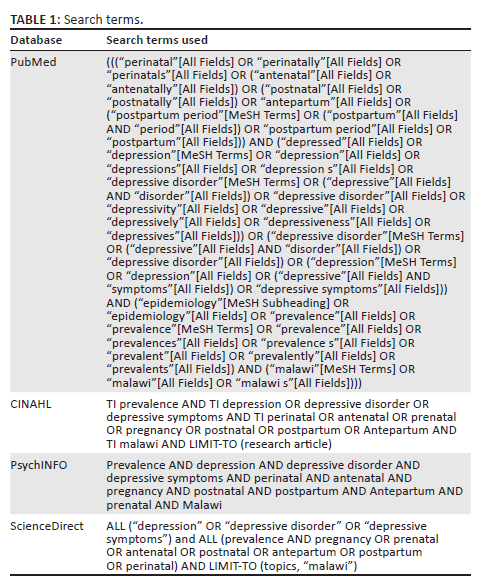
To find relevant terms in the title, abstract and subject descriptors, a limited search of PubMed and ScienceDirect was conducted. After that, search phrases and synonyms were identified for use in searching various databases for prevalence studies conducted in Malawi. No date limits were set, in anticipation that a wider period to be searched from the inception of each database will yield many relevant studies for possible inclusion in this systematic review. However, the search focused on articles that were written in English only. Search terms that were used are presented in Table 1.
Using all identified search terms, electronic databases were searched for primary studies (PubMed, CINAHL, PsychINFO and ScienceDirect), and the results were imported into EndNote. Reference lists of key articles identified were hand-searched to identify additional articles. Manual searches of indexes and 'grey' literature databases were not carried out. The preliminary searches were conducted between July and August 2020, and the final search was done in October 2021.
Data Collection
Upon completion of the search, duplicates and irrelevant articles (abstracts, conferences, congresses, editorials, commentaries, reviews, news and irrelevant records) were removed from the EndNote database, and later the search data was exported into Excel. The selection of articles for review was then conducted in three phases.
Abstract screeningThis first phase involved reviewers independently scrutinising the titles and abstracts and indicating which articles were relevant in Excel. When the abstract did not provide enough information or the reviewers were undecided, the full-text articles were evaluated, and a consensus was reached between the reviewers on whether the article should be included or excluded. To determine the level of agreement for eligibility for inclusion at this step, a kappa statistic was calculated.
Screening based on participant, intervention, comparison, outcome and setting criteria
In the second phase of the selection process, articles were independently reviewed by two reviewers by applying and extracting the participant, intervention, comparison, outcome and setting (PICOS) criteria as follows: Participants (P) (pregnant women and mother of infants ≤ 12 months), Intervention (I) (any studies reporting the prevalence of perinatal depression), Outcome measures (O) (the measured prevalence of perinatal depression) and study setting (S) (Malawi). In addition, all primary quantitative studies that measured the prevalence of perinatal depression were considered for inclusion in the systematic review. Studies conducted outside Malawi were excluded.
Article review
Reviewers independently scrutinised full texts selected to confirm their inclusion by checking if an article reported the prevalence of perinatal depression in Malawi. Eligibility for full article review, assessment of study characteristics and relevant data extraction were assessed using a standard tool in Excel, and data were entered into a database. For each eligible study, the reviewers extracted information about the author, year of publication, title, setting, study design sample, assessment tool and prevalence rate of depression. Prevalence, measured based on a diagnostic assessment tool (Mini International Neuropsychiatric Interview [MINI] or Structured Clinical Interview for DSM [SCID]), was extracted from an article that reported multiple prevalence rates. All results were subject to double data entry.
Assessment of methodological quality of studies
The critical appraisal tool for scoring methodological rigour of studies2828
Data analysis
Quantitative data analysis was conducted using MedCalc software.29I2I230
Review process and results
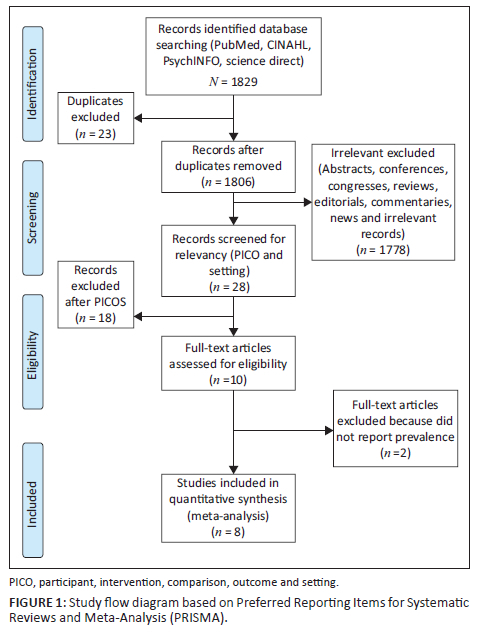
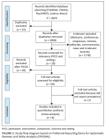
The electronic search yielded 1829 published records from PubMed, CINAHL, PsychINFO and ScienceDirect (Figure 1). A total of 23 duplicates were removed, resulting in 1806 records that were scrutinised. A further 1778 records were removed because they were irrelevant (conferences, congresses, editorials, commentaries, reviews and news). The remaining 28 articles were assessed for relevancy by the reviewers using the PICOS criteria, excluding a further 18 articles, leaving 10 articles. The reviewers' ratings for inclusion or exclusion of studies agreed with a kappa = 0.94. Of the 10 articles that remained, two were excluded31,32
The methodological quality of reviewed studies
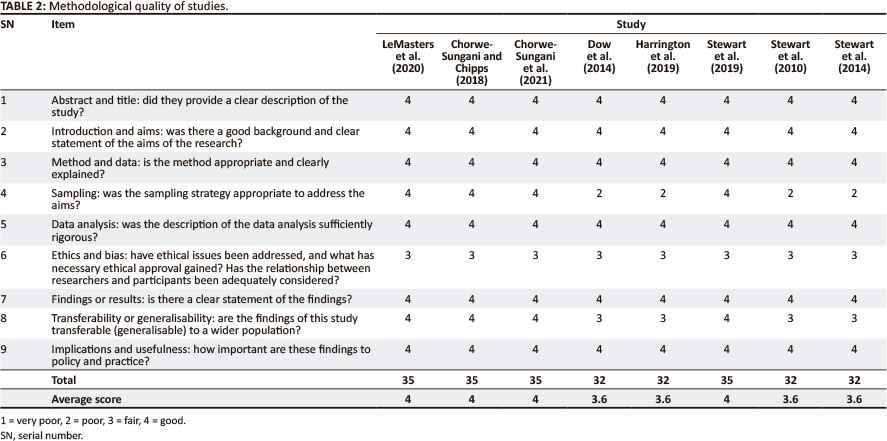
All the eight included articles were rated for quality independently by G.C. and K.W. Overall, the quality was satisfactory with four articles4,33,34,355,20,36,37 were fair (Table 2).
Findings from studies for inclusion in the review (n = 8)
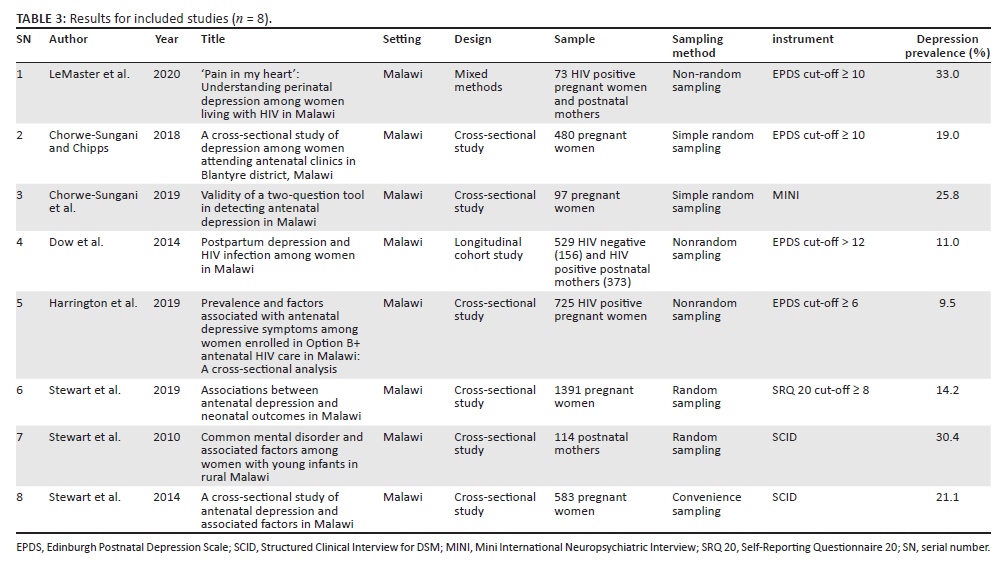
Of the eight articles that were included in this systematic review, seven articles were published in medical journals and one in a nursing journal, and their years of publication ranged from 2010 to 2021 (Table 1). Most of the articles were for cross-sectional studies (n = 6).
Instruments that were used to measure perinatal depression
The systematic review revealed that various instruments were used to assess for perinatal depression in Malawi (Table 3). The most-used instrument of the articles was Edinburgh Postnatal Depression Scale (n = 4), whose cut-off points ranged from ≥ 6 to >12. The second most-used instrument was SCID (n = 2), followed by the Self-Reporting Questionnaire 20 (n = 1), with a cut-off point ≥ 8, and the MINI (n = 1) (Table 3).
Prevalence of perinatal depression in Malawi
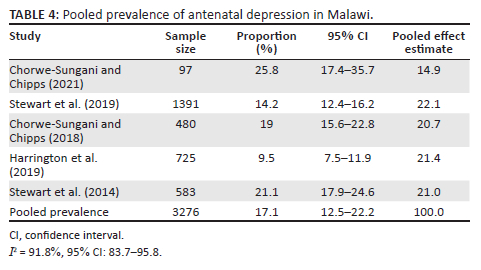
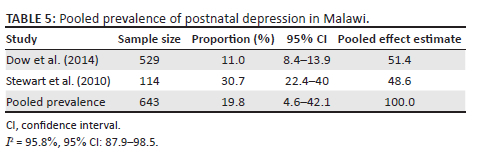
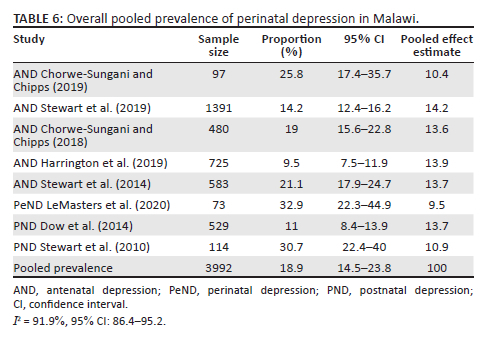
The systematic review found that pooled prevalence of antenatal depression (17.1% [95.0% CI: 12.5-22.2]) (Table 4), postnatal depression (19.8% [95% CI: 4.6-42.1]) (Table 5) and the overall pooled prevalence of perinatal depression (18.9% [95.0% CI: 14.5-23.8]) (Table 6) were comparable. However, the pooled prevalence of postnatal depression was higher than the overall pooled prevalence.
Discussion
Depression is the most common mental health condition that affects women worldwide during the perinatal period.9,10,38,39,4043,7,41,424344
This systematic review suggests that the prevalence of perinatal depression in Malawi is high with an overall pooled prevalence of 18.9%. This pooled prevalence for perinatal depression in Malawi is lower compared to the one that was found in Ethiopia (25.8%).4534,5,4647
Literature suggests that violence, anxiety, life stress, prior depression and lack of social support are some of the risk factors for perinatal depression.484950742
Study limitations
This systematic review is limited in that there is a shortage of studies in Malawi to produce generalisability evidence. There is also a difference in the depression assessment tools, which may also have contributed to the detected heterogeneity in this review. Hence, caution should be taken during the interpretation of the results.
Conclusion
This systematic review generated a pooled prevalence of perinatal depression for Malawi, which may be used by clinicians, researchers and policymakers in the absence of national prevalence data on perinatal depression. The review suggests that perinatal depression is highly prevalent in Malawi, based on a few published studies with inherently heterogeneous estimates. Based on this review, maternal health programme policies and activities should incorporate maternal mental health as a core component to promote early detection of perinatal depression and prompt interventions that would save the mother and her baby from different forms of morbidity and mortality.
Competing interests
The authors declare that they have no competing interests.
Authors' contributions
G.C.-S. drafted the manuscript with support from K.W., P.M., M.P. and D.N. G.C.-S. designed the study, and searches for records were performed by K.W. and P.M. Data extraction was carried out by G.C.-S. and K.W. All authors participated in the review and revision of the manuscript and have approved the final manuscript to be published.
Ethical considerations
This systematic review was registered in the PROSPERO international prospective register of systemic reviews (ref. no.: CRD42019142723).
Funding information
This research received no specific grant from any funding agency in the public, commercial, or not-for-profit sectors.
Data availability
The authors confirm that the data supporting the findings of this study are available within the article.
Disclaimer
The views and opinions expressed in this article are those of authors and do not necessarily reflect the official policy or position of any affiliated agency of the author.
Acknowledgements
The authors acknowledge all colleagues who offered guidance and technical support to the project and drafting of this manuscript.
References
-
1.National Institute of Mental Health. Perinatal depression [homepage on the Internet]. n.d., [cited 2021 Sep 12]. Available from: https://www.nimh.nih.gov/health/publications/perinatal-depression/index.shtml
» https://www.nimh.nih.gov/health/publications/perinatal-depression/index.shtml -
2.Chorwe-Sungani G, Mwagomba M, Kulisewa K, Chirwa E, Jere D, Chipps J. Protocol for assessing feasibility, acceptability and fidelity of screening for antenatal depression (FAFSAD) by midwives in Blantyre District, Malawi. Pilot Feasibility Stud. 2021;7(1):32. https://doi.org/10.1186/s40814-021-00775-6
» https://doi.org/10.1186/s40814-021-00775-6 -
3.Woody C, Ferrari A, Siskind D, Whiteford H, Harris M. A systematic review and meta-regression of the prevalence and incidence of perinatal depression. J Affect Disord. 2017;219:86-92. https://doi.org/10.1016/j.jad.2017.05.003
» https://doi.org/10.1016/j.jad.2017.05.003 -
4.Chorwe-Sungani G, Chipps J. A cross-sectional study of depression among women attending antenatal clinics in Blantyre district, Malawi. S Afr J Psychiatr. 2018;24(1):1-6. https://doi.org/10.4102/sajpsychiatry.v24i0.1181
» https://doi.org/10.4102/sajpsychiatry.v24i0.1181 -
5.Stewart RC, Umar E, Tomenson B, Creed F. A cross-sectional study of antenatal depression and associated factors in Malawi. Arch Womens Ment Health. 2014;17(2):145-154. https://doi.org/10.1007/s00737-013-0387-2
» https://doi.org/10.1007/s00737-013-0387-2 -
6.Stewart RC, Kauye F, Umar E, et al. Validation of a Chichewa version of the self-reporting questionnaire (SRQ) as a brief screening measure for maternal depressive disorder in Malawi, Africa. J Affect Disord. 2009;112(1):126-134. https://doi.org/10.1016/j.jad.2008.04.001
» https://doi.org/10.1016/j.jad.2008.04.001 -
7.Dadi AF, Akalu TY, Baraki AG, Wolde HF. Epidemiology of postnatal depression and its associated factors in Africa: A systematic review and meta-analysis. PLoS One. 2020;15(4):e0231940. https://doi.org/10.1371/journal.pone.0231940
» https://doi.org/10.1371/journal.pone.0231940 -
8.Gondwe KW, Brandon D, Yang Q, Malcom WF, Small MJ, Holditch-Davis D. Emotional distress in mothers of early-preterm infants, late-preterm infants, and full-term infants in Malawi. Nurs Outlook. 2020;68(1):94-103. https://doi.org/10.1016/j.outlook.2019.05.013
» https://doi.org/10.1016/j.outlook.2019.05.013 - 9.Muzik M, Borovska S. Perinatal depression: Implications for child mental health. Ment Health Fam Med. 2010;7(4):239.
-
10.Dagher RK, Bruckheim HE, Colpe LJ, Edwards E, White DB. Perinatal depression: Challenges and opportunities. J Womens Health. 2020;30(2):154-159. https://doi.org/10.1089/jwh.2020.8862
» https://doi.org/10.1089/jwh.2020.8862 -
11.Clarke K, King M, Prost A. Psychosocial interventions for perinatal common mental disorders delivered by providers who are not mental health specialists in low-and middle-income countries: A systematic review and meta-analysis. PLoS Med. 2013;10(10):e1001541. https://doi.org/10.1371/journal.pmed.1001541
» https://doi.org/10.1371/journal.pmed.1001541 -
12.Mathibe-Neke JM, Rothberg A, Langley G. The perception of midwives regarding psychosocial risk assessment during antenatal care. Health SA Gesondheid (Online). 2014;19(1):1-9. https://doi.org/10.4102/hsag.v19i1.742
» https://doi.org/10.4102/hsag.v19i1.742 -
13.Milgrom J, Gemmill AW. Screening for perinatal depression. Best Pract Res Clin Obstet Gynaecol. 2014;28(1):13-23. https://doi.org/10.1016/j.bpobgyn.2013.08.014
» https://doi.org/10.1016/j.bpobgyn.2013.08.014 -
14.Milia G, Noonan M. Experiences and perspectives of women who have committed neonaticide, infanticide and filicide: A systematic review and qualitative evidence synthesis. J Psychiatr Ment Health Nurs. 2022;00:1-16. https://doi.org/10.1111/jpm.12828
» https://doi.org/10.1111/jpm.12828 -
15.Abrahams N, Mathews S, Martin LJ, Lombard C, Nannan N, Jewkes R. Gender differences in homicide of neonates, infants, and children under 5 y in South Africa: Results from the cross-sectional 2009 National Child Homicide Study. PLoS Med. 2016;13(4):e1002003. https://doi.org/10.1371/journal.pmed.1002003
» https://doi.org/10.1371/journal.pmed.1002003 -
16.Rochat TJ, Tomlinson M, Newell M-L, Stein A. Detection of antenatal depression in rural HIV-affected populations with short and ultrashort versions of the Edinburgh Postnatal Depression Scale (EPDS). Arch Womens Ment Health. 2013;16(5): 401-410. https://doi.org/10.1007/s00737-013-0353-z
» https://doi.org/10.1007/s00737-013-0353-z -
17.Kinser PA, Lyon DE. A conceptual framework of stress vulnerability, depression, and health outcomes in women: Potential uses in research on complementary therapies for depression. Brain Behav. 2014;4(5):665-674. https://doi.org/10.1002/brb3.249
» https://doi.org/10.1002/brb3.249 -
18.Stewart RC. Maternal depression and infant growth - A review of recent evidence. Matern Child Nutr. 2007;3(2):94-107. https://doi.org/10.1111/j.1740-8709.2007.00088.x
» https://doi.org/10.1111/j.1740-8709.2007.00088.x -
19.Stewart RC, Umar E, Kauye F, et al. Maternal common mental disorder and infant growth - A cross-sectional study from Malawi. Matern Child Nutr. 2008;4(3):209-219. https://doi.org/10.1111/j.1740-8709.2008.00147.x
» https://doi.org/10.1111/j.1740-8709.2008.00147.x -
20.Stewart RC, Bunn J, Vokhiwa M, et al. Common mental disorder and associated factors amongst women with young infants in rural Malawi. Soc Psychiatr Psychiatr Epidemiol. 2010;45(5):551-559. https://doi.org/10.1007/s00127-009-0094-5
» https://doi.org/10.1007/s00127-009-0094-5 -
21.Herba CM, Glover V, Ramchandani PG, Rondon MB. Maternal depression and mental health in early childhood: An examination of underlying mechanisms in low-income and middle-income countries. Lancet Psychiatry. 2017;3(10): 983-992. https://doi.org/10.1016/S2215-0366(16)30148-1
» https://doi.org/10.1016/S2215-0366(16)30148-1 -
22.Stringer EM, Meltzer-Brody S, Kasaro M, et al. Depression, pregnancy, and HIV: The case to strengthen mental health services for pregnant and post-partum women in sub-Saharan Africa. Lancet Psychiatry. 2014;1(2):159-162. https://doi.org/10.1016/S2215-0366(14)70273-1
» https://doi.org/10.1016/S2215-0366(14)70273-1 -
23.Howard LM, Piot P, Stein A. No health without perinatal mental health. Lancet. 2014;384(9956):1723-1724. https://doi.org/10.1016/S0140-6736(14)62040-7
» https://doi.org/10.1016/S0140-6736(14)62040-7 -
24.Gelaye B, Rondon M, Araya R, Williams MA. Epidemiology of maternal depression, risk factors, and child outcomes in low-income and middle-income countries. Lancet Psychiatry. 2016;3(10):973-982. https://doi.org/10.1016/S2215-0366(16)30284-X
» https://doi.org/10.1016/S2215-0366(16)30284-X -
25.Rondon MB, Stewart DE. Disentangling the heterogeneity of perinatal depression. Lancet Psychiatry. 2017;4(6):432-433. https://doi.org/10.1016/S2215-0366(17)30192-X
» https://doi.org/10.1016/S2215-0366(17)30192-X -
26.Noordzij M, Dekker FW, Zoccali C, Jager KJ. Measures of disease frequency: Prevalence and incidence. Nephron Clin Pract. 2010;115(1):c17-c20. https://doi.org/10.1159/000286345
» https://doi.org/10.1159/000286345 -
27.Moher D, Liberati A, Tetzlaff J, Altman DG. Preferred reporting items for systematic reviews and meta-analyses: The PRISMA statement. Ann Intern Med. 2009;151(4):264-269. https://doi.org/10.7326/0003-4819-151-4-200908180-00135
» https://doi.org/10.7326/0003-4819-151-4-200908180-00135 -
28.Hawker S, Payne S, Kerr C, Hardey M, Powell J. Appraising the evidence: Reviewing disparate data systematically. Qual Health Res. 2002;12(9):1284-1299. https://doi.org/10.1177/1049732302238251
» https://doi.org/10.1177/1049732302238251 -
29.Garber C. MedCalc software for statistics in medicine. MedCalc software, Broekstraat 52, 9030 Mariakerke, Belgium, $399.00. Clin Chem. 1998;44(6):1370. https://doi.org/10.1093/clinchem/44.6.1370
» https://doi.org/10.1093/clinchem/44.6.1370 -
30.Zhang Z-L, Hou Y-L, Li D-T, Li F-Z. Laboratory findings of COVID-19: A systematic review and meta-analysis. Scand J Clin Lab Invest. 2020;80(6):441-447. https://doi.org/10.1080/00365513.2020.1768587
» https://doi.org/10.1080/00365513.2020.1768587 -
31.Lee B, Park HJ. Differences in infant development by trajectories of maternal perinatal depression: Based on Malawi mothers and children. Early Child Dev Care. 2020;190(9):1441-1454. https://doi.org/10.1080/03004430.2018.1538978
» https://doi.org/10.1080/03004430.2018.1538978 -
32.Stewart RC, Ashorn P, Umar E, et al. The impact of maternal diet fortification with lipid-based nutrient supplements on postpartum depression in rural Malawi: A randomised-controlled trial. Matern Child Nutr. 2017;13(2):e12299. https://doi.org/10.1111/mcn.12299
» https://doi.org/10.1111/mcn.12299 -
33.Stewart RC, Ashorn P, Umar E, et al. Associations between antenatal depression and neonatal outcomes in Malawi. Matern Child Nutr. 2019;15(2):e12709. https://doi.org/10.1111/mcn.12709
» https://doi.org/10.1111/mcn.12709 - 34.Chorwe-Sungani G, Chipps J, Jere D. Validity of a two-question tool in detecting antenatal depression in Malawi. Ment Health Pract. 2019;24(1):1-7
-
35.LeMasters K, Dussault J, Barrington C, et al. 'Pain in my heart': Understanding perinatal depression among women living with HIV in Malawi. PLoS One. 2020;15(6):e0227935. https://doi.org/10.1371/journal.pone.0227935
» https://doi.org/10.1371/journal.pone.0227935 -
36.Dow A, Dube Q, Pence BW, Van Rie A. Postpartum depression and HIV infection among women in Malawi. J Acquir Immune Defic Syndr. 2014;65(3):359. https://doi.org/10.1097/QAI.0000000000000050
» https://doi.org/10.1097/QAI.0000000000000050 -
37.Harrington BJ, Pence BW, John M, et al. Prevalence and factors associated with antenatal depressive symptoms among women enrolled in Option B+ antenatal HIV care in Malawi: A cross-sectional analysis. J Ment Health. 2019;28(2): 198-205. https://doi.org/10.1080/09638237.2018.1487542
» https://doi.org/10.1080/09638237.2018.1487542 -
38.Hanlon C. Maternal depression in low-and middle-income countries. Int Health. 2013;5(1):4-5. https://doi.org/10.1093/inthealth/ihs003
» https://doi.org/10.1093/inthealth/ihs003 -
39.Umuziga MP, Adejumo O, Hynie M. A cross-sectional study of the prevalence and factors associated with symptoms of perinatal depression and anxiety in Rwanda. BMC Pregnancy Childbirth. 2020;20(1):68. https://doi.org/10.1186/s12884-020-2747-z
» https://doi.org/10.1186/s12884-020-2747-z -
40.Curry SJ, Krist AH, Owens DK, et al. Interventions to prevent perinatal depression: US Preventive Services Task Force recommendation statement. J Am Med Assoc. 2019;321(6):580-587. https://doi.org/10.1001/jama.2019.0007
» https://doi.org/10.1001/jama.2019.0007 -
41.Chorwe-Sungani G, Chipps J. A systematic review of screening instruments for depression for use in antenatal services in low resource settings. BMC Psychiatry. 2017;17(1):112. https://doi.org/10.1186/s12888-017-1273-7
» https://doi.org/10.1186/s12888-017-1273-7 -
42.Dadi AF, Wolde HF, Baraki AG, Akalu TY. Epidemiology of antenatal depression in Africa: A systematic review and meta-analysis. BMC Pregnancy Childbirth. 2020;20(1):251. https://doi.org/10.1186/s12884-020-02929-5
» https://doi.org/10.1186/s12884-020-02929-5 -
43.Gartlehner G, West SL, Mansfield AJ, et al. Clinical heterogeneity in systematic reviews and health technology assessments: Synthesis of guidance documents and the literature. Int J Technol Assess Health Care. 2012;28(1):36. https://doi.org/10.1017/S0266462311000687
» https://doi.org/10.1017/S0266462311000687 -
44.Kriston L. Dealing with clinical heterogeneity in meta-analysis. Assumptions, methods, interpretation. Int J Methods Psychiatr Res. 2013;22(1):1-15. https://doi.org/10.1002/mpr.1377
» https://doi.org/10.1002/mpr.1377 -
45.Mersha AG, Abebe SA, Sori LM, Abegaz TM. Prevalence and associated factors of perinatal depression in Ethiopia: A systematic review and meta-analysis. Depress Res Treat. 2018;2018:1813834. https://doi.org/10.1155/2018/1813834
» https://doi.org/10.1155/2018/1813834 -
46.Stewart RC, Umar E, Gleadow-Ware S, Creed F, Bristow K. Perinatal distress and depression in Malawi: An exploratory qualitative study of stressors, supports and symptoms. Arch Womens Ment Health. 2015;18(2):177-185. https://doi.org/10.1007/s00737-014-0431-x
» https://doi.org/10.1007/s00737-014-0431-x - 47.Sonja A Rasmussen, Richard A Goodman, Centers for Disease Control and Prevention (U.S.). The CDC field epidemiology manual. 4th ed. New York, NY: Oxford University Press; 2019.
-
48.Lancaster CA, Gold KJ, Flynn HA, Yoo H, Marcus SM, Davis MM. Risk factors for depressive symptoms during pregnancy: A systematic review. Am J Obstet Gynecol. 2010;202(1):5-14. https://doi.org/10.1016/j.ajog.2009.09.007
» https://doi.org/10.1016/j.ajog.2009.09.007 -
49.Stewart RC, Umar E, Tomenson B, Creed F. Validation of screening tools for antenatal depression in Malawi - A comparison of the Edinburgh Postnatal Depression Scale and Self Reporting Questionnaire. J Affect Disord. 2013;150(3):1041-1047. https://doi.org/10.1016/j.jad.2013.05.036
» https://doi.org/10.1016/j.jad.2013.05.036 - 50.Chan J, Natekar A, Einarson A, Koren G. Risks of untreated depression in pregnancy. Can Fam Physician. 2014;60(3):242-243.

Accepted: 24 June 2022
Published: 20 Oct. 2022