Profile of suicide within the northern part of Ghana: A decade under review
Abstract
BACKGROUND: Several reports show that suicide is the second and third leading cause of untimely death in young people below the age of 30. Little, however, is known about the profile and trend of suicide in this country due to lack of systematic studies and a lack of national statistics on suicide. This study seeks to examine the profile and pattern of suicide cases recorded within northern Ghana for the past decade. AIM: This study aimed to report the prevalence of suicide as an independent cause of death; the choice of suicide method and the alleged reasons for suicide within the northern part of Ghana. SETTING: Retrospective review of coroners' reports within the northern part of Ghana. METHOD: In this descriptive study, 309 completed suicides as archived by the office of the coroner were examined. The coroners' reports of 309 individuals, whose deaths received a suicide verdict or an open verdict in which the cause of death was likely to be suicide from 2008 to 2017, were examined. Student's t-test was used to ascertain significant age differences between the genders involved. RESULTS: Amongst the 309 decedents examined, approximately, 61% were male, with ages ranging from 5 to 81 years. Hanging and poisoning were the most commonly used methods to complete suicide accounting for 124 (40.1%) and 102 (33.0%) deaths, respectively. Regarding the reasons for completed suicide, 78 (25.2%) were because of unknown reasons and 66 (21.4%) were because of social stigma. There was a notable decline in the prevalence of suicide from 2014 to 2017 compared with the years from 2010 to 2013 CONCLUSION: Suicide was highest in the 30-39 year age group with hanging and poisoning being the most common method employed. Stigmatisation and psychosocial problems arising from chronic illness and economic hardship were significant triggers of suicide amongst the suicide decedents in the northern part of Ghana.
medico-legal; suicide; methods of suicide; poisoning; hanging
Introduction
The global phenomenon of suicide is disconcerting. Reports show that suicide is the second and third leading cause of untimely death in persons between the ages of 15 to 29 (preceded only by road accidents in this category) and 15 to 44 years age groups, respectively.12,3
Amongst the reasons for completed suicide, studies on suicide ideations show that suicide has been the manner of death of many who suffer from depression,45,6,7
According to the 1960 Criminal Code Act 29, Section 57 of Ghana, attempted suicide is considered a crime.8
Alluding to this, the WHO has encouraged countries such as Ghana (who according to situational analysis has close to 650 000 people suffering from a severe mental disorder and another 2 166 000 suffering from a moderate to mild mental disorder91011,12
Method and subjects
The data for this study were abstracted from the coroners' case records. Details of all inquests on people who had died between January 2008 and December 2017 in which a verdict of suicide or likely suicide was made, were retrieved from coroner's offices within the northern part (Ashanti region, Brong-Ahafo Region, and some parts of the Savannah region) of Ghana. Together, the study area covers nearly 42.0% of Ghana's total land surface, with more than 8.9 million inhabitants as of 2019.13
Variables
Methods of suicide as stated by the International Classification of Disease version 10 (ICD-100)14
Demographic details, mode of suicide (firearm, poisoning, hanging, etc.) and circumstances leading to the death as documented in the statements for the coroner of relatives, police or witnesses were accessed for the study.
Within the reports, witness accounts of discrimination or prejudiced attitudes directed at individuals with certain health or societal labels were classed as stigmatisation. Reports having a missing or incomplete record of the alleged cause of suicide were classified as not recorded in this study. The data were organised and analysed using Microsoft Excel and GraphPad Prism 8.
Results
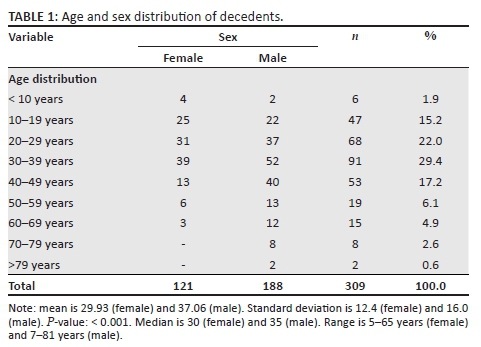
The study showed a mean and median age of 34 years 99 days (34.27 years) and 32 years, respectively, ranging from 5 to 81 years. Most of the suicide victims were under the age of 39 (68.5%) years, with the age group 30-39 years recording the highest proportion of cases 91 (29.4%). Males were the predominant victims, accounting for 188 (60.8%) of the cases with a ratio of 1.55:1 female. The 309 cases of suicidal deaths represent a prevalence rate of 3.94% in northern Ghana. Hanging accounted for the most common means of suicide 124 (40.1%) followed by poisoning 99 (32.0%) of all the cases. Collectively these two most common means of suicide represents 71.8% of all cases within the 10 years. The results are summarised in Table 1.
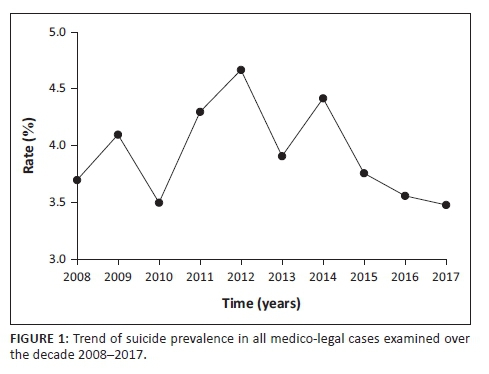
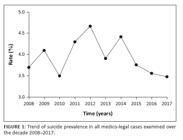
The yearly trend of suicide prevalence rates for the decade in the review is shown in Figure 1. The year 2012 recorded the highest rate (4.67%) of suicides of all medico-legal cases within that year, followed by 4.42% in 2014, 4.30% for 2011 and 4.10% in 2009, 3.91% in 2013, 3.76% in 2015, 3.70% in 2008, 3.56%, 3.50% and 3.48% in the years 2016, 2010 and 2017, respectively.
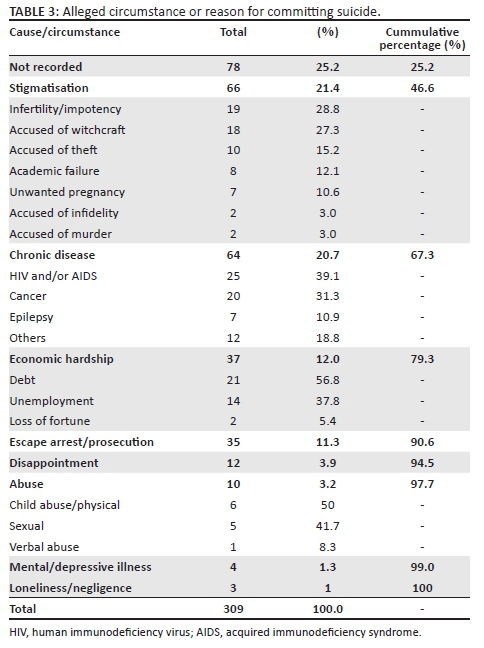
As shown in Table 3, 78 (25.2%) of all the suicides were because of unknown causes or had missing information, 66 (21.4%) were allegedly because of stigmatisation followed by debilitating chronic illnesses suffered by victims 64 (20.7%). Economic hardship accounted for 37 (12.0%) and escape from prosecution 35 (11.3%) in that order as shown in Table 3.
Discussion
In our study, 60.8% of suicide decedents were male. This gender disparity is consistent with results from wider studies conducted in the United States of America, which found that nearly 77% of all suicide deaths occur amongst men.15,16
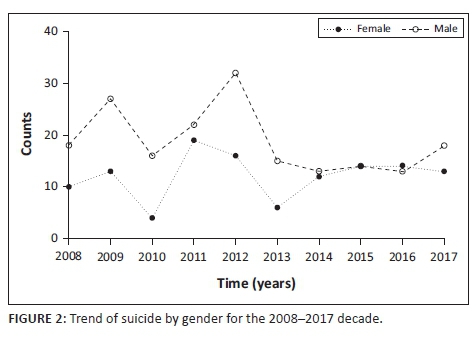
Similarly, Kolves et al.1718Figure 2. Thus, Figure 2 highlights the higher risk of suicide amongst males.
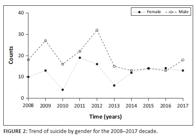
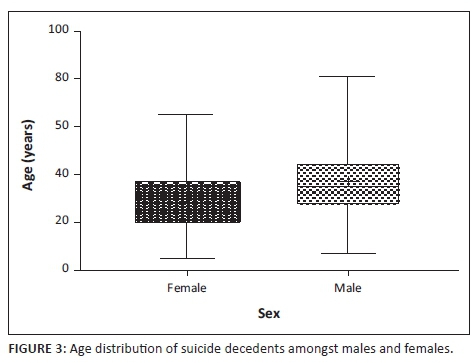
Table 1 shows the age-related rates of suicide cases. The rates show an increase from adolescence peaking at ages 30-39, with a gradual decline to old age. Suicide amongst adolescents has shown an upward trend as observed by Quarshie et al.19Figure 3), this disparity was statistically significant (p < 0.0001) Table 1.
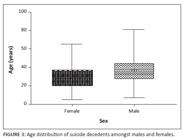
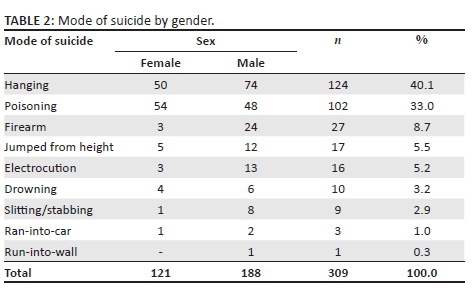
From our results, hanging (which include suffocation) accounted for 124 (40.1%) of all the cases followed by poisoning in 102 (33.0%) Table 2. Collectively these two methods of suicide represented 72.1% of all deaths. Whilst the prevalence of suicide methods, varies by country, hanging remains the most common method of suicide for both sexes even in high-income countries320,21
Poisoning, mainly by ingestion of agrochemicals (organophosphates), is reckoned amongst the most common means of suicide in Asia2218,203
Present studies have shown that jumping from a height as a method of suicide is very common in highly urbanised cities such as Singapore and Hong Kong23,24Table 2). Eleven of those who jumped from height occurred in metropolitan areas. This finding is coherent with Kõlves et al.17
Electrocution is a rare mode of suicide, and deaths due to electrocution from the domestic supply of 220 volts are usually due to accidents. However, in this report, 16 (5.2%) of the cases had the verdict of suicide. whereas the medical records of these numbers were inaccessible for the study, Fernando et al.25Table 2) collectively represent 7.4% of all suicide methods.
The motivation or reason for committing suicide is enigmatic and variable. Our analysis showed that 78 (25.2%) of the cases were for unknown reasons. Another 66 (21.4%) were tied to stigmatisation. This is consistent with other Ghanaian studies.12,2627,2829
Chronic diseases are a major source of stress because of the effects they have on the individual's life; disrupting his or her harmony of life, symptom-related problems, loss of certain physical abilities and the treatment process alone coupled with financial constraints can trigger suicidal behaviours. As reported by Misono et al.3031
On the other hand, Economic hardship accounted for 37 (12.0%). Another 35 (11.0%) chose to escape arrest/prosecution by committing suicide. Disappointment (mainly from failed relationships), abuse (sexual, physical and verbal), depression and loneliness collectively were the cause of 9.4% of suicide cases in this study as shown in Table 3. Whilst these findings are upsetting, solace can be taken from the trend of suicide prevalence amongst medico-legal cases within the decade. Suicide prevalence appears to be decreasing since the year 2015 after reaching a peak in the year 2012 (Figure 1).
In this study, the mental health aspects (such as depressive illness and schizophrenia amongst others) of the suicide decedents could not be ascertained from chart abstractions or the coroners' reports. Thus, research on uncompleted or attempted suicides on whom mental health assessments can be made is highly recommended.
Conclusion
Suicide rates were highest among those aged 30-39 years, with hanging and poisoning being the domineering methods of suicide among the residents of Northern Ghana. Amongst the reasons for committing suicide, nearly one-fourth of all suicides were because of unknown causes, the remaining three-fourths of the cases were as a result of social stigma, chronic or debilitating illness, economic hardship and other psychosocial factors.
Competing interests
The authors declare that they have no financial or personal relationships that may have inappropriately influenced them in writing this article.
Authors' contributions
P.P.S.O., N.N., W.G.A., E.A., F.K.S. and A.S. contributed to the design and implementation of the research, to the analysis of the results and to the writing of the manuscript.
Funding information
This research received no specific grant from any funding agency in the public, commercial or not-for-profit sectors.
Data availability
Data sharing is not applicable to this article as no new data were created or analysed in this study.
Disclaimer
The views and opinions expressed in this article are those of the authors and do not necessarily reflect the official policy or position of any affiliated agency of the authors.
Acknowledgements
The authors would like to acknowledge the cooperation of the regional police units for the provision of information on the coroner's inquest forms.
References
-
1.Bertolote JM, Fleischmann A. A global perspective in the epidemiology of suicide. Suicidologi. 2002;7(2):6-8. https://doi.org/10.5617/suicidologi.2330
» https://doi.org/10.5617/suicidologi.2330 -
2.WHO Mental Health. Prevention of suicidal behaviours: A task for all [homepage on the Internet]. [cited 2020 Jan 22]. Available from: http://www.who.Int/mental_health/prevention/suicide/background
» http://www.who.Int/mental_health/prevention/suicide/background - 3.World Health Organization (WHO). Preventing suicide: A global imperative. Geneva: WHO; 2014.
-
4.Ferrari AJ, Charlson FJ, Norman RE, et al. Burden of depressive disorders by country, sex, age, and year: Findings from the global burden of disease study 2010. PLoS Med. 2013;10(11):e1001547. https://doi.org/10.1371/journal.pmed.1001547
» https://doi.org/10.1371/journal.pmed.1001547 -
5.Patel V, Chisholm D, Parikh R, et al. Global priorities for addressing the burden of mental, neurological, and substance use disorders. In: Mental, Neurological, and Substance Use Disorders: Disease Control Priorities, Third Edition (Volume 4). Washington (DC): The International Bank for Reconstruction and Development / The World Bank; 2016 Mar 14. Chapter 1. https://doi.org/10.1596/978-1-4648-0426-7_ch1
» https://doi.org/10.1596/978-1-4648-0426-7_ch1 -
6.Bertolote JM, Fleischmann A, De Leo D, et al. Suicide attempts, plans, and ideation in culturally diverse sites: The WHO SUPRE-MISS community survey. Psychol Med. 2005;35(10):1457-1465. https://doi.org/10.1017/S0033291705005404
» https://doi.org/10.1017/S0033291705005404 -
7.Weissman MM, Bland RC, Canino GJ, et al. Prevalence of suicide ideation and suicide attempts in nine countries. Psychol Med. 1999;29(1):9-17. https://doi.org/10.1017/S0033291798007867
» https://doi.org/10.1017/S0033291798007867 - 8.Adinkrah M. Criminal prosecution of suicide attempt survivors in Ghana. Int J Offender Ther Comp Criminol. 2013;57(12):1477-1497.
-
9.WHO. Ghana [homepage on the Internet]. n.d. [cited 2020 Feb 27]. Available from: https://www.who.int/mental_health/policy/country/ghana/en/
» https://www.who.int/mental_health/policy/country/ghana/en/ -
10.World Health Organization. Mental health and substance abuse. Fact and figures. Suicide prevention: Emerging from darkness [homepage on the Internet]. n.d. [cited 2020 Feb 25]. Available from: http://www.searo.who.int/en/Section1174/Section1199/Section1567/Section1824_8089.htm
» http://www.searo.who.int/en/Section1174/Section1199/Section1567/Section1824_8089.htm -
11.Andoh-Arthur J, Knizek BL, Osafo J, Hjelmeland H. Suicide among men in Ghana: The burden of masculinity. Death Stud. 2018;42(10):658-666. https://doi.org/10.1080/07481187.2018.1426655
» https://doi.org/10.1080/07481187.2018.1426655 -
12.Osafo J, Akotia CS, Andoh-Arthur J, Quarshie ENB. Attempted suicide in Ghana: Motivation, stigma, and coping. Death Stud. 2015;39(5):274-280. https://doi.org/10.1080/07481187.2014.991955
» https://doi.org/10.1080/07481187.2014.991955 -
13.Ghana Statistical Services. Ghana's population by region. n.d. [cited 2020 Jun 2]. Available from: https://www.statsghana.gov.gh/regionalpopulation.php?population=MTgyMTA wODAwNS45Nzg1&&Savannah®id=13
» https://www.statsghana.gov.gh/regionalpopulation.php?population=MTgyMTA wODAwNS45Nzg1& & Savannah& regid=13 - 14.World Health Organization. The ICD-10 classification of mental and behavioural disorders: Clinical descriptions and diagnostic guidelines. Wkly Epidemiol Rec. 1992;67(30):227.
-
15.Stone DM, Simon TR, Fowler KA, et al. Vital signs: Trends in state suicide rates - United States, 1999-2016 and circumstances contributing to suicide - 27 states, 2015. Morb Mortal Wkly Rep. 2018;67(22):617. https://doi.org/10.15585/mmwr.mm6722a1
» https://doi.org/10.15585/mmwr.mm6722a1 -
16.McLone SG, Loharikar A, Sheehan K, Mason M. Suicide in Illinois, 2005-2010: A reflection of patterns and risks by age groups and opportunities for targeted prevention. J Trauma Acute Care Surg. 2016;81(4):S30-S35. https://doi.org/10.1097/TA.0000000000001141
» https://doi.org/10.1097/TA.0000000000001141 -
17.Kõlves K, McDonough M, Crompton D, De Leo D. Choice of a suicide method: Trends and characteristics. Psychiatry Res. 2018;260:67-74. https://doi.org/10.1016/j.psychres.2017.11.035
» https://doi.org/10.1016/j.psychres.2017.11.035 -
18.Keugoung B, Kongnyu ET, Meli J, Criel B. Profile of suicide in rural Cameroon: Are health systems doing enough? Trop Med Int Health. 2013;18(8):985-992. https://doi.org/10.1111/tmi.12140
» https://doi.org/10.1111/tmi.12140 -
19.Nii-Boye Quarshie E, Osafo J, Akotia CS, Peprah J. Adolescent suicide in Ghana: A content analysis of media reports. Int J Qual Stud Health Well-being. 2015;10(1):27682. https://doi.org/10.3402/qhw.v10.27682
» https://doi.org/10.3402/qhw.v10.27682 -
20.Ajdacic-Gross V, Weiss MG, Ring M, et al. Methods of suicide: International suicide patterns derived from the WHO mortality database. Bull World Health Organ. 2008;86:726-732. https://doi.org/10.2471/BLT.07.043489
» https://doi.org/10.2471/BLT.07.043489 -
21.Centers for Disease Control and Prevention. CDC fatal injury reports 2016 [homepage on the Internet]. 2016 [cited 2020 May 19]. Available from: https://www.cdc.gov/injury/wisqars/fatal_injury_reports.html
» https://www.cdc.gov/injury/wisqars/fatal_injury_reports.html -
22.Wu KCC, Chen YY, Yip PS. Suicide methods in Asia: Implications in suicide prevention. Int J Environ Res Public Health. 2012;9(4):1135-1158. https://doi.org/10.3390/ijerph9041135
» https://doi.org/10.3390/ijerph9041135 -
23.Chia BH, Chia A, Ng WY, Tai BC. Suicide methods in Singapore (2000-2004): Types and associations. Suicide Life Threat Behav. 2011;41(5):574-583. https://doi.org/10.1111/j.1943-278X.2011.00055.x
» https://doi.org/10.1111/j.1943-278X.2011.00055.x -
24.Wong PW, Caine ED, Lee CK, Beautrais A, Yip PS. Suicides by jumping from a height in Hong Kong: A review of coroner court files. Social Psychiatry Psychiatr Epidemiol, 2014;49(2):211-219. https://doi.org/10.1007/s00127-013-0743-6
» https://doi.org/10.1007/s00127-013-0743-6 -
25.Fernando R, Liyanage SS. Suicide by electrocution. Med Sci Law. 1990;30(3):219-220. https://doi.org/10.1177/002580249003000309
» https://doi.org/10.1177/002580249003000309 -
26.Knizek BL, Akotia CS, Hjelmeland H. A qualitative study of attitudes toward suicide and suicide prevention among psychology students in Ghana. Omega. 2011;62(2):169-186. https://doi.org/10.2190/OM.62.2.e
» https://doi.org/10.2190/OM.62.2.e -
27.Iemmi V, Bantjes J, Coast E, et al. Suicide and poverty in low-income and middle-income countries: A systematic review. Lancet Psychiatry. 2016;3(8):774-783. https://doi.org/10.1016/S2215-0366(16)30066-9
» https://doi.org/10.1016/S2215-0366(16)30066-9 -
28.Vijayakumar L, John S, Pirkis J, Whiteford H. Suicide in developing countries (2) risk factors. Crisis. 2005;26(3):112-119. https://doi.org/10.1027/0227-5910.26.3.112
» https://doi.org/10.1027/0227-5910.26.3.112 - 29.Özdemir Ü, Taşçı S. Kronik Hastaliklarda Psikososyal Sorunlar ve Bakim. Erciyes Üniversitesi Sağlık Bilimleri Fakültesi Dergisi. 2013;1(1):57-72.
-
30.Misono S, Weiss NS, Fann JR, Redman M, Yueh B. Incidence of suicide in persons with cancer. J Clin Oncol. 2008;26(29):4731-4738. https://doi.org/10.1200/JCO.2007.13.8941
» https://doi.org/10.1200/JCO.2007.13.8941 -
31.Pompili M, Lester D, Innamorati M, et al. Quality of life and suicide risk in patients with diabetes mellitus. Psychosomatics. 2009;50(1):16-23. https://doi.org/10.1176/appi.psy.50.1.16
» https://doi.org/10.1176/appi.psy.50.1.16

Accepted: 28 July 2021
Published: 27 Jan. 2022