Psychometric evaluation of personal evaluation of transitions in treatment amongst patients with schizophrenia
Abstract
BACKGROUND: Monitoring the antipsychotic medication adherence of outpatients with schizophrenia has focused majorly on the medication construct of adherence, whilst neglecting its psychosocial construct. AIM: The aim of this study was to provide the psychometric properties of personal evaluation of transitions in treatment (PETiT) SETTING: This study was conducted at the Neuropsychiatric Hospital, Aro, Abeokuta, Ogun State, Nigeria. METHODS: This is a study of diagnostic accuracy of patients with a diagnosis of schizophrenia. Calculation of the sample size and oversampling was calculated as proposed by Cochrane.. RESULTS: The Cronbach's α in this study at baseline was 0.82. Intra-class correlation coefficient was 0.81 (p ≤ 0.001). Medication construct was loaded into two factors or components whilst the psychosocial construct was loaded into four factors CONCLUSION: The data depicted here indicated a successful validation and presentation of psychometric properties of PETiT which is self-administered, user friendly, psychometrically sound and sensitive to changes associated with treatment over time.
adherence; schizophrenia; PETiT; validation; Nigeria; Aro
Introduction
In the management of patients with schizophrenia, one of the main targets after diagnosis is treatment which may include physical, psychological or social interventions.1,2,3,4,56,7,8
Monitoring the antipsychotic medication adherence of outpatients with schizophrenia has remained a major challenge because mental health practitioners usually rely on patients' self-report of adherence. Although various methods have been advocated none is without its own particular shortcoming.2,3,4,5,92,3,4,5,9
Be that as it may, the outcome or solution proposed need to have adequately considered the proximal and distal side treatment outcome as proposed by Voruganti and Awad.103
Most of the earlier tools used in Nigeria have only evaluated the proximal side of adherence, none has used an instrument that evaluated both the proximal and distal outcome of antipsychotic treatment inpatient suffering from schizophrenia. Although the use of self-administered questionnaires has remained common in Nigeria, previous studies11,12,13
Methodology
Study site
The study was carried out at the outpatient clinic of the Neuropsychiatric Hospital, Aro, Abeokuta, Ogun State. The hospital initially started at its annex in 1944 as an asylum for soldiers who were repatriated home because of mental illness after the Second World War. The current main site, Aro was built in 1954 when the need for a modern psychiatric hospital arose. The hospital renders services to patients from all over Nigeria and from the neighboring West African countries. It has a total capacity of 546 beds for inpatient care, 153 beds at the main hospital and 393 beds at the Lantoro annex.6
All new patients are seen at the Assessment or Emergency unit of the hospital from where they are transferred to either the out-patient clinic or the wards. Those discharged from the wards are also subsequently followed-up at the out-patient clinic. No new patient is seen at the out-patient clinic of the hospital. The clinic runs on Mondays, Tuesdays, Thursdays and Fridays, and a Senior Registrar's clinic on Wednesdays.66
Sample size determination
Calculation of the sample size and oversampling was calculated as proposed by Cochrane.14n) of 220.
The instrument
Personal evaluation of transitions in treatment was originally designed for use in acute or persistently psychotic disorders requiring or already receiving antipsychotic drug treatment as a structured, self-report evaluation tool containing a total of 69 items, with four items in each of the 12 domains. Subsequently, using factor analysis and other standard statistical techniques, a 30-item questionnaire without subscales (Symptom subscale, Functional Status subscale and Standard of Living subscale) was produced. Items from the previous domains were presented randomly, often reversing the wordings of the sentences. It has an introductory aspect which outlines the purpose of the questionnaire and the need to consider their health in the last 1 week and a choice of one of three response ('often', 'sometimes' or 'never').4,10,15
These responses represent the frequency of experiencing a specific item during the period of 1 week and the answer assigned a rating of 2, 1 and 0. A score of 2 represents a positive change, and '0' a change in the negative direction, which is subject to the way the words in the items are framed. Total scores are derived from the summation of the individual items and the authors ensured that attention was given to exclude any cultural and health-services related items, so that the scale could be used in a variety of health care facilities.4,10,15
The total number of participants used in the initial study by Voruganti and Awad104,10,15
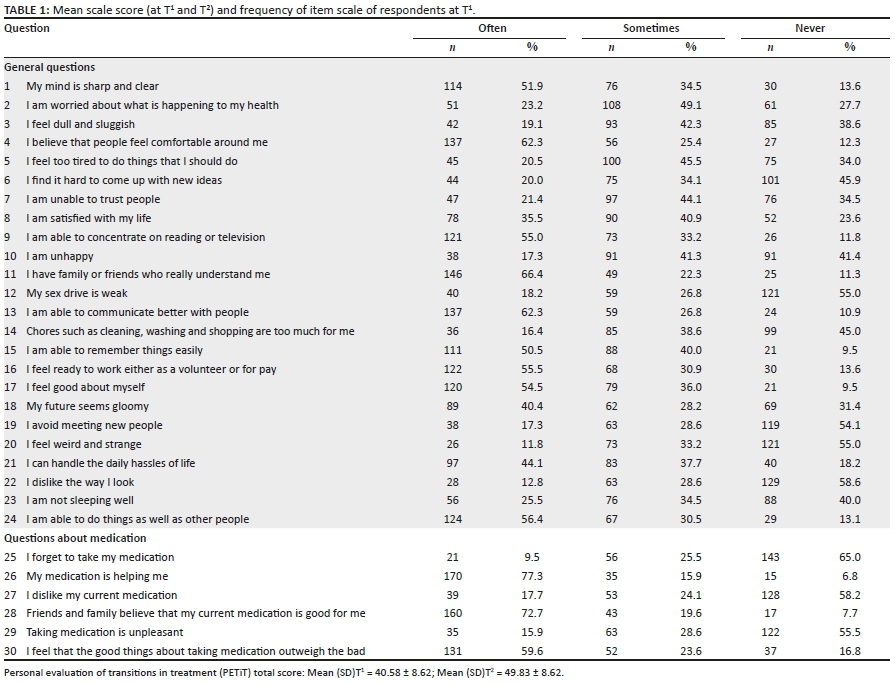
Psychosocial functioning can be assessed further within four subdomains: social functioning (four items on trust, confidence and interactions), activity (seven items reflecting energy and ability to conduct daily tasks), cognitive (seven items on clarity, concentration and communication) and dysphoria (six items on happiness, future and self-esteem). The PETiT total score ranges from 0 to 60, with higher scores denoting better patient health-related quality of life (HRQoL). The scale has high internal consistency (Cronbach's α = 0.92) and high test-retest reliability (0.97; p < 0.001).4,10,15 The 30-item PETiT can be found in Table 1.
Study design
This is a study to determine the psychometric properties of PETiT. Respondents were recruited using a systematic random sampling of every fourth patient registered to be seen at the outpatient clinic of the hospital. Respondents with a diagnosis of schizophrenia, aged 18 years and above, and who were able to read and write in English were recruited. The study spanned the period June 2016 to June 2017. The retest was conducted after 1 year (over 4-8 weeks) of the initial test because of the difference in the duration of clinic visit given in the different unit of the hospital.
Data analysis
Data were analysed using the Statistical Package for Social Science (SPSS version 23) computer software. The level of significance was set at p ≤ 0.05. Intra-class correlation coefficient (ICC) was used to determine the internal consistency of the instrument using responses from the first test and Cronbach's alpha for the entire scale. Intra-class correlation coefficient was also used to determine the test-retest reliability of the instrument using total scores at test and retest. Factor analysis using principal component analysis with Varimax rotation was used to confirm the robustness of the original construct. In order to confirm the robustness of the original construct, the items were split into two (medication domain and psychosocial domain) and extraction was done based on fixed number of factors (which is four) as was done by the original author.5,10
Ethical consideration
Ethical approval was obtained from the research and ethics committee of the Neuropsychiatric Hospital, Aro, Abeokuta, Ogun State, Nigeria and permission was obtained from the managing consultants. Consent was obtained from all participants and attention of the managing consultants was drawn to the corresponding patients who had problems with medication adherence. Ethical clearance number was NHREC/24/07/2013.
Result
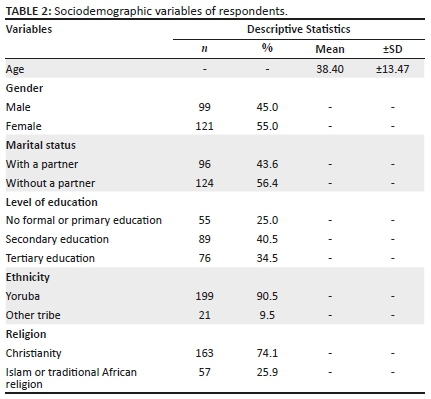
Table 2 shows the socio-demographic variables of respondents. The mean age of participants in this study was 38.40 ± 13.47. The rest of the socio-demographic variables are depicted on Table 2. Table 1 shows the frequency of response of each of the items of the PETiT questionnaire. The mean total scale score of respondents in this study was 40.58 ± 8.62. Other details are highlighted on Table 1.
The questionnaire was administered to 220 respondents with a mean duration of 5 min (range 3-12 min) for completion. Patients with acute and severe psychotic symptoms were unable to participate because of poor concentration, aggression, restlessness and irritability. The Cronbach's α in this study at Test 1 (T1α if item deleted was not significant for any of the 30-item analysed) with an ICC of 0.81 and a p value of < 0.001. The Cronbach's α for the test-retest was 0.22 with an ICC of 0.16 and a p value of 0.03. Other details can be found on Table 3.
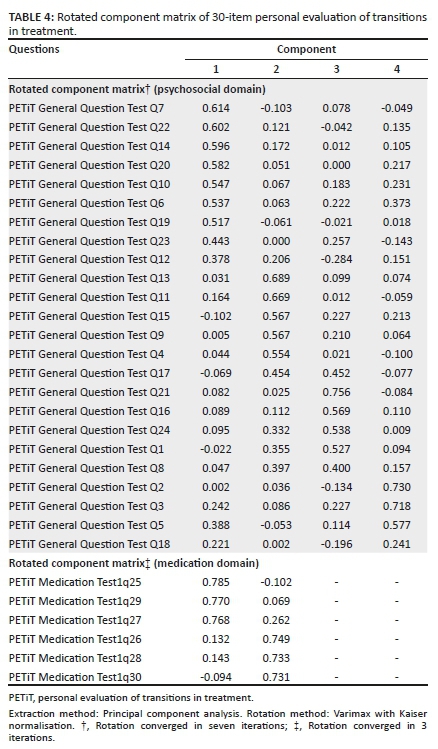
As mentioned earlier, the factor analysis was done in two stages: medication construct and psychosocial construct. Medication construct loaded into two factors or components which were as follows: factor 1 was made up of questions 25, 27 and 29 whilst factor 2 was made up of questions 26, 28 and 30. The psychosocial construct loaded into four factors and are as follows: factor 1 was made up of questions 6, 7, 8, 10, 14, 19, 20 22 and 23; factor 2 was made up of questions 4, 9, 11, 12, 13, 15 17 and 18; factor 3 was made up of questions 1, 16, 21 and 24 whilst factor 4 was made up of questions 2, 3 and 5. Other detail can be seen on Table 4.
Discussion
The personal evaluation of transition in treatment was designed to explicitly monitor subjective changes in adherence attitude and psychosocial functioning in the context of antipsychotic drug therapy in patients diagnosed with schizophrenia. Overall, we observed that PETiT had valid and reliable psychometric properties when compared to those performed outside of Nigeria. The Cronbach's alpha and ICC were also comparable to those outside Nigeria and subjective assessment of changes in adherence attitude and psychosocial functioning in the context of antipsychotic drug therapy in patients diagnosed with schizophrenia showed improvement over 1 year as reported by the respondents.
The mean scores at baseline and at 1 year (40.58 ± 8.62; 49.83 ± 8.62) observed in this study was higher than that reported in a previous study15
The Cronbach's alpha in this study was moderate to high which is similar to what was achieved by the initial authors whilst validating the 30-item instrument.10
Furthermore, as regards the psychosocial construct, the 26-items loaded four factors. Factor 1 was made up of questions 6, 7, 8, 10, 14, 19, 20 22 and 23 which is in keeping with the cognitive scale (which evaluated clarity, concentration and communication) of the initial authors and both cases were made up of seven items. The second factor was made up of questions 4, 9, 11, 12, 13, 15 17 and 18 appeared to be like the social functioning subscale, which measured trust, confidence and interaction. However, unlike the initial validation, our subscale was made up of eight items rather than the four-item subscale of the initial authors. This, in our assessment, appears to be related to cultural interpretations of some items which may account for the observed loading in factor 2. Factor 3 was populated with questions 1, 16, 21 and 24 which are keeping with the subscale on activity. None the less, our own subscale was made up of four items, whilst the original subscale was made up of seven items. In addition, the fourth factor, made up of questions 2, 3 and 5 is akin to the dysphoric subscale, was made up of three items rather than the six items found in the original validation.
Conclusion
These results were critical in establishing the subjective dimension of patients as the missing link between antipsychotic drug treatment, problems with treatment adherence, clinical stability and increased resource utilisation. In conclusion, the data depicted here indicated a successful validation and presentation of psychometric properties of PETiT which is self-administered, user friendly, psychometrically sound and sensitive to changes associated with treatment over time. To the best of our knowledge, this is the first time this instrument has been validated in Nigeria and in Africa. This study provides a standardised instrument for the evaluation of psychosocial issues in antipsychotic treatment in patient diagnosed with schizophrenia. This is likely to impact psychosocial interventions such as psychoeducation, family therapy and cognitive behavioural therapy to mention a few. Furthermore, it could complement the subject evaluation given by the nursing staff of patients diagnosed with schizophrenia during ward rounds. This might serve as objective complement to subject reports of patients with schizophrenia.
However, this study is not without its limitations. This study was only conducted in a single psychiatric setting in Nigeria and although it serves patients all over the country and its adjourning countries like the Republic of Benin and Cameroon. The report should be taken with caution in terms of generalisation to other countries in West Africa or Africa at large. Future studies should evaluate improvements based on specific medication used at baseline as this is likely to produce an optimal result. In addition, future studies should evaluate the correlation of subject reports of nursing contribution to the evaluation of improvement of patients on antipsychotic drug therapy with a diagnosis of schizophrenia. This will determine if this instrument could be a reliable guide during ward rounds and thus help in policy formation and hospital legislation. Finally, it is hoped that this instrument can be pushed as a tool that will incorporate client-centred measure in our quality assurance packages.
Competing interests
The authors have declared that no competing interests exist.
Authors' contributions
All authors contributed equally to this work.
Funding information
This research received no specific grant from any funding agency in the public, commercial, or not-for-profit sectors.
Data availability statement
Data sharing is not applicable to this article as no new data were created or analysed in this study.
Disclaimer
The views and opinions expressed in this article are those of the authors and do not necessarily reflect the official policy or position of any affiliated agency of the authors.
Acknowledgements
References
-
1.Samstag LW. Review of selecting effective treatments: A comprehensive, systematic guide to treating mental disorders. J Psychother Integr. 2001;11(3):421-425. https://psycnet.apa.org/doi/10.1023/A:1016614519375
» https://psycnet.apa.org/doi/10.1023/A:1016614519375 - 2.Seligman L, Reichenberg LW. Selecting effective treatments: A comprehensive, systematic guide to treating mental disorders. Hoboken, New Jersey, USA: John Wiley & Sons, 2011.
-
3.Catts SV, O'Toole BI. The treatment of schizophrenia: Can we raise the standard of care? Aust N Z J Psychiatry. 2016;50(12):1128-1138. https://doi.org/10.1177/0004867416672725
» https://doi.org/10.1177/0004867416672725 -
4.García S, Martínez-Cengotitabengoa M, López-Zurbano S, et al. Adherence to antipsychotic medication in bipolar disorder and schizophrenic patients. J Clin Psychopharmacol. 2016;36(4):355-371. https://doi.org/10.1097/JCP.0000000000000523
» https://doi.org/10.1097/JCP.0000000000000523 -
5.MacEwan JP, Forma FM, Shafrin J, Hatch A, Lakdawalla DN, Lindenmayer JP. Patterns of adherence to oral atypical antipsychotics among patients diagnosed with schizophrenia. J Manage Care Specialty Pharm. 2016;22(11):1349-1361. https://doi.org/10.18553/jmcp.2016.22.11.1349
» https://doi.org/10.18553/jmcp.2016.22.11.1349 -
6.Sowunmi OA, Onifade PO. Psychometric evaluation of medication adherence rating scale (MARS) among Nigerian patients with Schizophrenia. Niger J Clin Pract. 2019;22(9):201-205. https://doi.org/10.4103/njcp.njcp_325_18
» https://doi.org/10.4103/njcp.njcp_325_18 -
7.Phan SV. Medication adherence in patients with schizophrenia. Int J Psychiatr Med. 2016;51(2):211-219. https://doi.org/10.1177/0091217416636601
» https://doi.org/10.1177/0091217416636601 -
8.Staring ABP, Van der Gaag M, Mulder CL. Schizophrenia and antipsychotic medication - Better adherence, better outcomes? Schizophr Res. 2013;151(1-3):296-297. https://doi.org/10.1016/j.schres.2013.10.035
» https://doi.org/10.1016/j.schres.2013.10.035 -
9.Byerly MJ, Nakonezny PA, Rush AJ. The Brief Adherence Rating Scale (BARS) validated against electronic monitoring in assessing the antipsychotic medication adherence of outpatients with schizophrenia and schizoaffective disorder. Schizophr Res. 2008;100(1-3):60-69. https://doi.org/10.1016/j.schres.2007.12.470
» https://doi.org/10.1016/j.schres.2007.12.470 -
10.Voruganti LNP, Awad AG. Personal evaluation of transitions in treatment (PETiT): A scale to measure subjective aspects of antipsychotic drug therapy in schizophrenia. Schizophr Res. 2002;56(1-2):37-46. https://doi.org/10.1016/S0920-9964(01)00161-X
» https://doi.org/10.1016/S0920-9964(01)00161-X -
11.Igbinomwanhia NG, Olotu SO, James BO. Prevalence and correlates of antipsychotic polypharmacy among outpatients with schizophrenia attending a tertiary psychiatric facility in Nigeria. Therap Adv Psychopharmacol. 2017;7(1):3-10. https://doi.org/10.1177/2045125316672134
» https://doi.org/10.1177/2045125316672134 -
12.Olisah VO, Sheikh TL, Abah ER, Mahmud-Ajeigbe AF. Sociodemographic and clinical correlates of sexual dysfunction among psychiatric outpatients receiving common psychotropic medications in a Neuropsychiatric Hospital in Northern Nigeria. Niger J Clin Pract. 2016;19(6):799-806. https://doi.org/10.4103/1119-3077.180063
» https://doi.org/10.4103/1119-3077.180063 -
13.Ogunnubi OP, Olagunju AT, Aina OF, Okubadejo NU. Medication adherence among Nigerians with schizophrenia: Correlation between clinico-demographic factors and quality of life. Ment Ill. 2017;9(1):6889. https://doi.org/10.4081/mi.2017.6889
» https://doi.org/10.4081/mi.2017.6889 - 14.Cochran WG. Sampling techniques. 3rd ed. John Wiley & Sons, 1977; p. 428.
-
15.Awad G, Ng-Mak D, Rajagopalan K, Hsu J, Pikalov A, Loebel A. Long-term health-related quality of life improvements among patients treated with lurasidone: Results from the open-label extension of a switch trial in schizophrenia. BMC Psychiatry. 2016;16(1):176. https://doi.org/10.1186/s12888-016-0879-5
» https://doi.org/10.1186/s12888-016-0879-5

Accepted: 13 Nov. 2020
Published: 05 Mar. 2021