Prevalence and predictors of postpartum depression among women attending clinics in Gaborone
Abstract
BACKGROUND: Untreated postpartum depression (PPD) has the potential to cause significant distress or impairment in functioning with a consequent negative impact on a developing child. AIM: This study aimed to determine the prevalence of PPD and its associated factors in women attending postpartum primary care clinics. SETTING: The study setting involved randomly selected three 24-h clinics in Gaborone, the capital city of Botswana. METHODS: A cross-sectional study was conducted among 295 conveniently sampled postpartum mothers. The Edinburgh Postnatal Depression Scale (EPDS) questionnaire, researcher-designed socio-demographic questions and the Oslo Social Support Scale 3 (OSSS-3) were utilised to collect data on the PPD, demographic factors and social support, respectively. Variables identified to be associated with PPD on bivariate analyses were entered into multivariate analysis to determine factors associated with PPD RESULTS: The prevalence of PPD was 33.9% (95% CI 28.5% - 39.6%). Factors predictive of PPD included the history of being involved in intimate partner violence (AOR = 4.789 95% CI [2.276-10.077]), poor relationship with the partner's mother (AOR 2.657, [1.080-6.538]), poor and moderate social support (AOR 2.685 [1.013-7.111] and AOR 5.897 [2.140-16.248]), respectively. CONCLUSION: The high prevalence of PPD highlights the need for routine screening for PPD and its associated factors in antenatal and postnatal clinics. Continued practice of traditional postpartum cultural practices can be recommended as these promote social support and can potentially decrease PPD in our setting. CONTRIBUTION: This is the first study to report on the prevalence and factors associated with PPD in Botswana, thus useful in tailoring culturally appropriate interventions.
postpartum depression; maternal mental health; Botswana; risk factors; prevalence; protective factors
Introduction
Postpartum depression (PPD) is defined as an episode of depression with onset of symptoms 4 weeks and up to 1 year following delivery with no psychotic features.1,2,324
A systemic review 291 PPD prevalence studies from 56 countries found that the global pool prevalence of PPD was approximately 17.7%, with significant variations. Chile is a less developed country, having the highest prevalence of 38% PPD and Singapore is a well-developed country, having one of the lowest prevalence of 3% PPD.56
In sub-Saharan Africa, PPD among adult women ranged from 33.2% in Southwest Ethiopia,789101112
The actual cause of PPD is not known but hormonal factors, genetics and immune function have evidently been found to play a role in the development of PPD.44
Globally, factors that have been found to predispose new mothers to developing PPD include a history of depression or anxiety before pregnancy and antepartum, previous premenstrual dysphoria, stressful life events during pregnancy, poor social support, marital conflict, low income, immigrant status, a lack of postnatal parental competence, low parenting self-efficacy and young maternal age.13,14
Most of the risk factors for PPD in developing countries are similar to those identified in developed nations.131514
Women with inadequate social support, a short inter-pregnancy interval, high levels of family stress and a perceived economic hardship have also been found to be at increased risk of PPD.16711,17,18
A systematic review by Slomian and colleagues19
Maternal depression has the ability to compromise the ability of expectant mothers to adopt a healthy lifestyle, impair breastfeeding and disrupt the caregiving roles of mothers during the postpartum period.9
This can have a significant impact on the infant and young child's growth, health and nutritional status. Postpartum depression has also been shown to negatively affect the infant's cognitive and language development.2099
The World Health Organization (WHO) considers maternal mental health problems a major public health challenge globally. There is therefore a need to incorporate mental health assessment when delivering services for maternal and child healthcare. This highlights the need to determine the prevalence of PPD, a disorder that impacts not only the mother but also the growing infant and close family members, and its associated factors. Therefore, the aim of this study was to determine the prevalence, protective factors and risk factors of PPD among women attending child wellness clinics in greater Gaborone District Health Management Team (DHMT) clinics.
Methods
Study design and setting
A cross-sectional study was conducted in Gaborone, the capital and largest city of Botswana with a population of 244, 107, which is about 10% of the total population of Botswana.21
Study population and sampling strategy
The study population consisted of postnatal mothers coming for their sixth-week check-up and those bringing their children to under-five wellness and immunisation check-ups at the second and third months of the postpartum period. To be included in the study, participants had to sign an informed consent form and be at least 18 years of age. Convenience sampling was used to recruit participants.
The sample size was calculated using the Cochrane formula2223
Data collection
Selected clinics were visited concurrently, and the number of participants interviewed on each visit depended on the number of mothers seen monthly in each clinic. All mothers in the line, who presented to the clinic each day, meeting the inclusion criteria, were approached by the first author or research assistant and recruited into the study.
Data were collected between December 2021 and February 2022. Data collection was carried out by the author with the help of two nursing assistants as research assistants. The research assistants underwent a 1-day orientation and training by the first author. All mothers in the line coming for review each day were addressed and informed about the purpose of the study by the researcher or trained research assistants. Those consenting to participate in the study were taken to a separate room for an interview after signing an informed consent form. The study adhered to COVID-19 protocols.
On a weekly basis, 10% of completed questionnaires were randomly selected to audit for completeness, missing variables and consistency on days data were collected. Each week after data collection, a team meeting was held virtually and filled questionnaires were cross-checked. Possible non-responses were identified, discussed and noticed.
Translation of all questionnaires was performed by an independent bilingual (Setswana and English) translator and verified by back translation by a different translator who was blinded to the original version. After the back translation, the two versions were compared for any significant differences and the final version was reached through a consensus.
Measures
A socio-demographic questionnaire was used to determine demographic and social factors that possibly predispose mothers to developing PPD. Close-ended questions to determine age, gender, marital status, unplanned pregnancy, number of children, level of education, employment status, history of mental disorder, subjective history of antepartum depression, relationship with partner's mother, current or history of intimate partner violence and partner support were posed to the participants.
Edinburg Postnatal Depression Scale (EDPS) is a 10-item, widely used screening scale for PPD in outpatient or home visit settings. It is used to ascertain whether one has depression or not. The scores on each of the 10 items are added up giving a minimum score of 0 and a maximum score of 30.242526
Oslo Social Support Scale-3 (OSSS-3) was used to assess the level of social support. The OSSS-3 consists of only three items that ask for the number of close confidants, the sense of concern from other people and the relationship with neighbours with a focus on the accessibility of practical help.2728
Data analysis
Microsoft Excel was used to capture data and IBM SPSS 28 statistical package version was used to statistically analyse data for the study. The socio-demographic data were analysed by descriptive analysis and expressed as mean, median and standard deviation. Frequency distributions of categorical variables and ranges of continuous variables were calculated. Normally distributed continuous data were summarised using mean and standard deviation. Continuous data that were not normally distributed were summarised using median and interquartile ranges (IQR). Associations between PPD and categorical variables were assessed using chi-square test, Fisher's exact test or likelihood ratio where applicable. The chi-square test or Fisher's exact test was used to compare categorical variables and check the bivariate relationship between PPD and relevant risk factors. Risk factors identified in the bivariate analysis were analysed in the multivariable model.
Logistic regression using a forward likelihood ratio approach was conducted to identify associations between PPD and key confounding predictor variables and results were presented in the form of an adjusted odds ratio (AOR). 'Statistical associations and significance between variables were determined by using a 95% confidence interval, with a significance level of (p ≤ 0.05)'.10
Ethical considerations
The Botswana Ministry of Health and the University of Botswana Institutional Review Board approved the study on 24 September 2021 and 21 September 2021, respectively (Reference numbers HPDME: 13/18/1 and UBR/RES/IRB/BIO/GRAD/155, respectively). Respondents gave written consent before starting interviews.
Results
Participants' characteristics
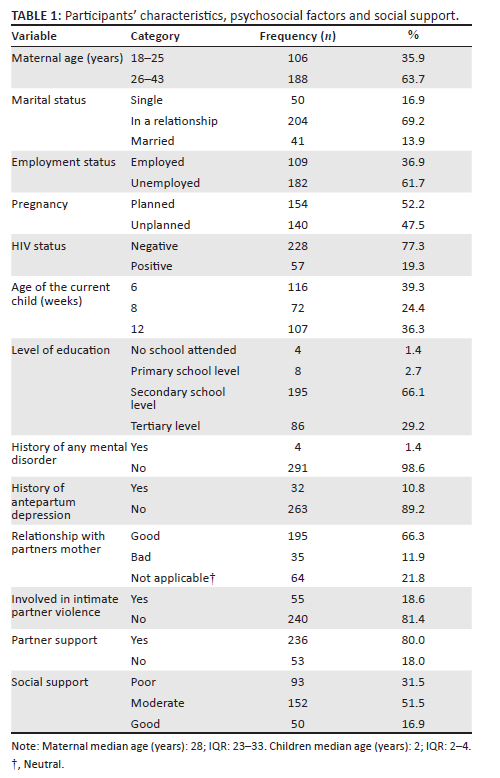
A total of 295 postpartum women participated in this study. The median age of participants was 28 years (IQR: 2-33). Most participants (n = 154, 52.2%) had planned their pregnancy and more than a third of the mothers were primigravida (n = 105, 35.6%).
Antepartum depression was reported by 10.8% (n = 32) of participants, while only 1.4% (n = 4) participants had a history of being diagnosed with a mental disorder. Based on the OSSS-3, 31.5% (n = 93) of participants reported poor social support. Participants' socio-demographic and clinical characteristics are depicted in Table 1.
Prevalence of postpartum depression
The prevalence of PPD was found to be 33.9% (95% CI-28.5% - 39.6%). A total of 7.8% (n = 23) of participants had suicide ideation (thoughts of harming themselves), and 139 (47.1%) of mothers reported having been anxious or worried for no good reason.
Factors associated with postpartum depression
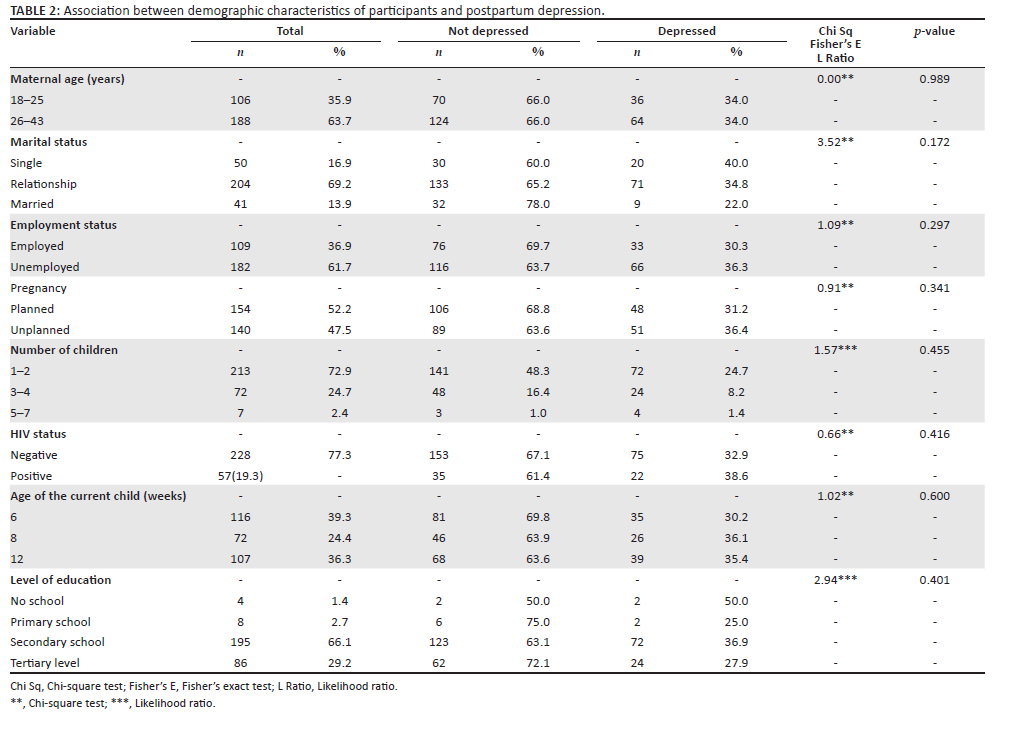
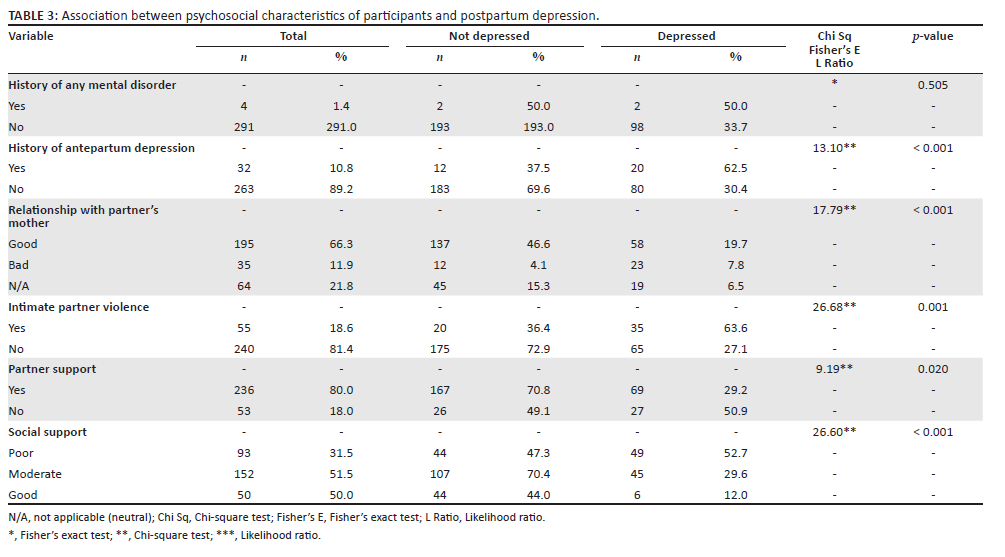
The majority of the mothers with history of antepartum depression (62.5%), bad relationship with partner's mother (64.7%), history of intimate partner violence (63.6%) and poor social support (52.7%) screened positive for PPD. History of antepartum depression (p = 0.001), bad relationship with partner's mother (p ≤ 0.001), current and past experience of IPV (p < 0.001) and social support (p ≤ 0.001) were significantly associated with PPD (Table 2). Postpartum depression was, however, not significantly associated with other participants' characteristics such as age, marital status, planned pregnancy, employment status, HIV status or level of education. This is demonstrated in Table 2 and Table 3.
Multivariate analysis of factors associated with postpartum depression
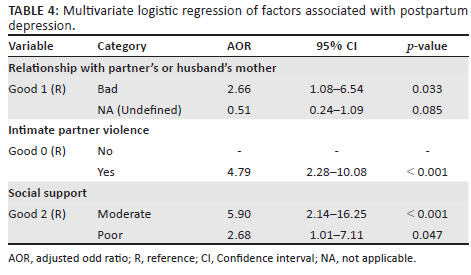
Participants with moderate social support (AOR: 5.897, CI: 2.140-16.248, p ≤ 0.001) and poor social support (AOR: 2.685, CI: 1.013-7.111, p = 0.047) were more likely to be depressed compared to those with good social support. Those with history of intimate partner violence were four times more likely to be depressed (AOR: 4.789, CI: 2.276-10.077; p ≤ 0.001) (Table 4).
Compared to a good relationship with the partner's or husband's mother, participants with a bad relationship with the husband's mother were about two times more likely to develop PPD (AOR: 2.657, CI: 1.080-6.538, p = 0.033) (Table 4). Other participants' characteristics and psychosocial factors did not contribute significantly to the final model fit, hence were not included in the model as predictors of PPD.
Discussion
This study was carried out to determine the prevalence and risk factors of PPD in women attending under-five wellness clinics in three government clinics in Gaborone. This study showed that the prevalence of PPD is 33.9% in our setting. The study also established that participants who have a history of intimate partner violence, a poor relationship with the partner's mother or mother-in-law, and a moderate and poor social support were at risk of developing PPD.
The prevalence from our study was similar to the prevalence (33.82%) that was reported in Southwest Ethiopia75,14,285
African countries such as Ghana88
The prevalence in our study was, however, lower when compared to Eswatini 47.4%121111,1711,1710,11,1229
History of and current experience of intimate partner violence were found to be a predictor of PPD in this study, with verbal abuse being the most self-reported form of IPV in participants with PPD in this study. These findings are similar to findings in previous studies.15,16,28,3028,31
The effects of interpersonal relationship with partner's mother or mother-in-law play a key role in the mental health of women in the postpartum period. Previous studies have shown that maternal stress because of poor relationships can predispose mothers to PPD.323332
Participants with poor and moderate social support were significantly predisposed to PPD in our study. This finding is similar to findings in other different studies.17,29,32,353736
We did not find any significant association between unplanned pregnancy and the occurrence of PPD. This was consistent with a study conducted in Eswatini,127,11,12,29,32
History of being diagnosed with a psychiatric disorder did not predict PPD despite being significantly associated with PPD in the bivariate analysis, unlike in other studies.11,287,31
Furthermore, there was no significant association between maternal age, marital status, employment status, HIV status, age of current child, number of children and education level. Similar findings were reported in different studies for maternal age and marital status,15,161016151516
Strengths and limitations
This is the first study to determine the prevalence of depression in the postpartum period, and findings from this research can serve as baseline information on PPD for further research to be performed on this topic in our setting. The power of the study was improved by increasing the sample size by adding more participants than the calculated sample size using the Cochrane formula. Two clinics included in the study were in densely populated slums in Gaborone. These areas have many people who have migrated from rural areas to urban Gaborone for employment purposes and have lower rental fees compared to other areas in Gaborone, possibly improving the variability of social status within the participant group in the study.
The findings of this study should be interpreted in the light of some limitations. There was the risk of recall bias when answering questions from EPDS as it required participants to recall events over the past 7 days. Pseudodementia known to occur in patients with depression could have also affected recalling past events when responding to the EPDS questionnaire. Depressed women tend to self-isolate and stay home and may have poor health-seeking behaviour, hence not present to local clinics affecting the overall prevalence. Data collected do not capture mothers who sought medical care from private health facilities. The convenient sampling method used does not favour generalisation of results because participants recruited were readily available and may not be representative of the population being studied. There is an inherent tendency of overestimation in cross-sectional study types, and this is a major limitation.
Conclusion
There is a high prevalence of PPD in women attending under-five clinics in Gaborone. Moderate and poor social support, experiencing intimate partner violence and bad relationship with partner's/husband's mother are significant predictors of PPD development.
Routine screening for IPV and depression symptoms at every opportune antenatal, postnatal and outpatient presentation would enable prevention and early management of PPD. Encouraging an interpersonal relationship psychotherapy focusing on partners' mothers /mother-in-laws and the new mothers as an intervention for PPD should be recommended. Continued practice of traditional postpartum cultural practices can be recommended to promote social support.
Further research on the prevalence of PPD across the country taking into consideration both rural and urban areas is recommended. Research assessing other types of relationships with the potential to decrease the chances of developing PPD is recommended. Carrying out further research using a prospective study design is recommended.
Competing interests
The authors declare that they have no financial or personal relationship(s) that may have inappropriately influenced them in writing this article.
Authors' contributions
A.M.M., K.M. and D.O.M. contributed to the conception of the work. A.M.M. and D.O.M. were involved in the analysis and interpretation of data, while A.M.M. contributed to data acquisition. All three authors, A.M.M., K.M. and D.O.M., participated in drafting and reviewing the manuscript.
Funding information
This research received no specific grant from any funding agency in the public, commercial or not-for-profit sectors.
Data availability
Raw data that were analysed for this study are available from the corresponding author, A.M.M., at reasonable request.
Disclaimer
The views and opinions expressed in this article are those of the authors and are the product of professional research. They do not necessarily reflect the official policy or position of any affiliated institution, funder, agency or that of the publisher. The authors are responsible for this study's results, findings and content.
Acknowledgements
References
-
1.O'Hara MW, Mc Cabe JE. Postpartum depression: Current status and future directions. Annu Rev Clin Psychol. 2013;9:379-407. https://doi.org/10.1146/annurev-clinpsy-050212-185612
» https://doi.org/10.1146/annurev-clinpsy-050212-185612 - 2.American Psychiatric Association. Diagnostic and statistical manual of mental disorders. 5th ed. Arlington, VA: American Psychiatric Association; 2013.
-
3.Buttner M, O'Hara MW, Watson D. The structure of women's mood in the early postpartum. Assessment. 2012;19(2):247-256. https://doi.org/10.1177/1073191111429388
» https://doi.org/10.1177/1073191111429388 -
4.Stewart DE, Vigod SN. Annual review of medicine postpartum depression: Pathophysiology, treatment, and emerging therapeutics. Annu Rev Med. 2019;70:183-196. https://doi.org/10.1146/annurev-med-041217-011106
» https://doi.org/10.1146/annurev-med-041217-011106 -
5.Hahn-Holbrook J, Cornwell-Hinrichs T, Anaya I. Economic and health predictors of national postpartum depression prevalence: A systematic review, meta-analysis, and meta-regression of 291 studies from 56 countries. Front Psychiatry. 2018;8:00248. https://doi.org/10.3389/fpsyt.2017.00248
» https://doi.org/10.3389/fpsyt.2017.00248 -
6.O'Hara MW, Swain AM. Rates and risk of postpartum depression - A meta-analysis. Int Rev Psychiatry. 1996;8(1):37-54. https://doi.org/10.3109/09540269609037816
» https://doi.org/10.3109/09540269609037816 -
7.Kerie S, Menberu M, Niguse W. Prevalence and associated factors of postpartum depression in Southwest, Ethiopia, 2017: A cross-sectional study. BMC Res Notes. 2018;11(1):623. https://doi.org/10.1186/s13104-018-3730-x
» https://doi.org/10.1186/s13104-018-3730-x -
8.Khalifa DS, Glavin K, Bjertness E, Lien L. Postnatal depression among Sudanese women: Prevalence and validation of the Edinburgh Postnatal Depression Scale at 3 months postpartum. Int J Womens Health. 2015;7:677. https://doi.org/10.2147/IJWH.S81401
» https://doi.org/10.2147/IJWH.S81401 -
9.Anokye R, Acheampong E, Budu-Ainooson A, Obeng EI, Akwasi AG. Prevalence of postpartum depression and interventions utilized for its management. Ann Gen Psychiatry. 2018;17(1):1-8. https://doi.org/10.1186/s12991-018-0188-0
» https://doi.org/10.1186/s12991-018-0188-0 -
10.Verkuijl NE, Richter L, Norris SA, Stein A, Avan B, Ramchandani PG. Postnatal depressive symptoms and child psychological development at 10 years: A prospective study of longitudinal data from the South African Birth to Twenty cohort. Lancet Psychiatry. 2014;1(6):454-460. https://doi.org/10.1016/S2215-0366(14)70361-X
» https://doi.org/10.1016/S2215-0366(14)70361-X -
11.Stellenberg EL, Abrahams JM. Prevalence of and factors influencing postnatal depression in a rural community in South Africa. Afr J Prim Health Care Fam Med. 2015;7(1):a874. https://doi.org/10.4102/phcfm.v7i1.874
» https://doi.org/10.4102/phcfm.v7i1.874 -
12.Dlamini LP, Mahanya S, Dlamini SD, Shongwe MC, Shongwe M. Prevalence and factors associated with postpartum depression at a primary healthcare facility in Eswatini. S Afr J Psychiatry. 2019;25:a1404. https://doi.org/10.4102/sajpsychiatry.v25i0.1404
» https://doi.org/10.4102/sajpsychiatry.v25i0.1404 - 13.Mehta ND, Chen KK, Monzon C, Rosene-Montella K. Common medical problems in pregnancy, postpartum blues, depression, and psychosis. In: McKean SC, Ross JJ, Dressler DD, Scheurer DB, editors. Principles and practice of hospital medicine, 2e. New York, NY: The McGraw-Hill Companies, 2017; p. 1860.
-
14.Guintivano J, Manuck T, Meltzer-Brody S. Predictors of postpartum depression: A comprehensive review of the last decade of evidence. Clin Obstet Gynecol. 2018;61(3):591-603. https://doi.org/10.1097/GRF.0000000000000368
» https://doi.org/10.1097/GRF.0000000000000368 -
15.Dadi AF, Akalu TY, Baraki AG, Wolde HF. Epidemiology of postnatal depression and its associated factors in Africa: A systematic review and meta-analysis. PLoS One. 2020;15(4):e0231940. https://doi.org/10.1371/journal.pone.0231940
» https://doi.org/10.1371/journal.pone.0231940 -
16.Barthel D, Kriston L, Fordjour D, et al. Trajectories of maternal ante- and postpartum depressive symptoms and their association with child- and mother-related characteristics in a West African birth cohort study. PLoS One. 2017;12(11):e0187267. https://doi.org/10.1371/journal.pone.0187267
» https://doi.org/10.1371/journal.pone.0187267 -
17.January J, Chimbari MJ. Prevalence and factors associated with postnatal depression among women in two rural districts of Manicaland, Zimbabwe. S Afr J Psychiatry. 2018;24:a1176. https://doi.org/10.4102/sajpsychiatry.v24i0.1176
» https://doi.org/10.4102/sajpsychiatry.v24i0.1176 -
18.Garman EC, Schneider M, Lund C. Perinatal depressive symptoms among low-income South African women at risk of depression: Trajectories and predictors. BMC Pregnancy Childb. 2019;19(1):202. https://doi.org/10.1186/s12884-019-2355-y
» https://doi.org/10.1186/s12884-019-2355-y -
19.Slomian J, Honvo G, Emonts P, Reginster JY, Bruyère O. Consequences of maternal postpartum depression: A systematic review of maternal and infant outcomes. Women's Health. 2019;15:1745506519844044. https://doi.org/10.1177/1745506519844044
» https://doi.org/10.1177/1745506519844044 -
20.Grace SL, Evindar A, Stewart DE. The effect of postpartum depression on child cognitive development and behavior: A review and critical analysis of the literature. Arch Womens Ment Health. 2003; 6:263-274. https://doi.org/10.1007/s00737-003-0024-6
» https://doi.org/10.1007/s00737-003-0024-6 -
21.Statistics Botswana. 2022 Population and housing census preliminary results V2 [serial on the Internet]. 2022 [cited 2022 May 10]. Available from: https://www.statsbots.org.bw/sites/default/files/2022%20Population%20and%20Housing%20Census% 20Preliminary%20Results.pdf
» https://www.statsbots.org.bw/sites/default/files/2022%20Population%20and%20Housing%20Census% 20Preliminary%20Results.pdf - 22.Cochran WG. Sampling techniques. 3rd ed. New York, NY: John Wiley & Sons, 1977; p. 428.
- 23.Prevention of mother to child Transmission program. Annual greater Gaborone District Health Management Team PMTCT statistics. Gaborone: Ministry of Health; 2021.
-
24.Cox JL, Holden JM, Sagovsky R. Detection of postnatal depression: Development of the 10-item Edinburgh Postnatal Depression Scale. Br J Psychiatry. 1987;150(6):782-786. https://doi.org/10.1192/bjp.150.6.782
» https://doi.org/10.1192/bjp.150.6.782 - 25.Lawrie T, Hofmeyr G, De Jager M, Berk M. Validation of the Edinburgh Postnatal Depression Scale on a cohort of South African women. S Afr Med J. 1998;88:1340-1344.
-
26.Chibanda D, Mangezi W, Tshimanga M, et al. Validation of the Edinburgh Postnatal Depression Scale among women in a high HIV prevalence area in urban Zimbabwe. Arch Womens Ment Health. 2010;13(3):201-206. https://doi.org/10.1007/s00737-009-0073-6
» https://doi.org/10.1007/s00737-009-0073-6 -
27.Kocalevent RD, Berg L, Beutel ME, et al. Social support in the general population: Standardization of the Oslo social support scale (OSSS-3). BMC Psychol. 2018;6(1):31. https://doi.org/10.1186/s40359-018-0249-9
» https://doi.org/10.1186/s40359-018-0249-9 -
28.Olashore AA, Molebatsi K, Musindo O, et al. Psychosocial predictors of anxiety and depression in a sample of healthcare workers in Botswana during the COVID-19 pandemic: A multicenter cross-sectional study. SAGE Open Med. 2022;10:205031212210850. https://doi.org/10.1177/20503121221085095
» https://doi.org/10.1177/20503121221085095 -
29.Dadi AF, Miller ER, Mwanri L. Postnatal depression and its association with adverse infant health outcomes in low- and middle-income countries: A systematic review and meta-analysis. BMC Pregnancy Chidb. 2020;20:416. https://doi.org/10.1186/s12884-020-03092-7
» https://doi.org/10.1186/s12884-020-03092-7 -
30.Phukuta NSJ, Omole OB. Prevalence and risk factors associated with postnatal depression in a South African primary care facility. Afr J Prim Health Care Fam Med. 2020;12(1):a2538. https://doi.org/10.4102/phcfm.v12i1.2538
» https://doi.org/10.4102/phcfm.v12i1.2538 -
31.Howard LM, Molyneaux E, Dennis CL, Rochat T, Stein A, Milgrom J. Non-psychotic mental disorders in the perinatal period. Lancet. 2014;384(9956):1775-1788. https://doi.org/10.1016/S0140-6736(14)61276-9
» https://doi.org/10.1016/S0140-6736(14)61276-9 -
32.Abdollahi F, Zarghami M, Azhar MZ, Sazlina SG, Lye MS. Predictors and incidence of postpartum depression: A longitudinal cohort study. J Obstet Gynaecol Res. 2014;40(12):2191-2200. https://doi.org/10.1111/jog.12471
» https://doi.org/10.1111/jog.12471 -
33.DeMontigny F, Gervais C, Pierce T, Lavigne G. Perceived paternal involvement, relationship satisfaction, mothers' mental health and parenting stress: A multi-sample path analysis. Front Psychiatry. 2020;11:578682. https://doi.org/10.3389/fpsyt.2020.578682
» https://doi.org/10.3389/fpsyt.2020.578682 -
34.Qi W, Liu Y, Lv H, et al. Effects of family relationship and social support on the mental health of Chinese postpartum women. BMC Pregnancy Childb. 2022;22(1):1-10. https://doi.org/10.1186/s12884-022-04392-w
» https://doi.org/10.1186/s12884-022-04392-w -
35.Hain S, Oddo-Sommerfeld S, Bahlmann F, Louwen F, Schermelleh-Engel K. Risk and protective factors for antepartum and postpartum depression: A prospective study. J Psychosom Obstet Gynecol. 2016;37(4):119-129. https://doi.org/10.1080/0167482X.2016.1197904
» https://doi.org/10.1080/0167482X.2016.1197904 -
36.Varin M, Palladino E, Orpana HM, et al. Prevalence of positive mental health and associated factors among postpartum women in Canada: Findings from a national cross-sectional survey. Matern Child Health J. 2020;24(6):759. https://doi.org/10.1007/s10995-020-02920-8
» https://doi.org/10.1007/s10995-020-02920-8 -
37.Pao C, Guintivano J, Santos H, Meltzer-Brody S. Postpartum depression and social support in a racially and ethnically diverse population of women. Arch Womens Ment Health. 2019;22(1):105. https://doi.org/10.1007/s00737-018-0882-6
» https://doi.org/10.1007/s00737-018-0882-6

Accepted: 10 May 2025
Published: 18 July 2025