Gambling and its associated factors among students of the University of Ilorin, Nigeria
Abstract
BACKGROUND: Studies have revealed a global surge in gambling and gambling disorders, particularly among young adults, including university students. This disturbing trend poses significant risks not only to individual's mental well-being but also to the wider community AIM: The objectives of the study were to determine the prevalence of gambling, gambling disorder and the associated socio-demographic factors among undergraduate students of University of Ilorin SETTING: The study was conducted at the University of Ilorin, a federal government owned tertiary educational institution located in Kwara State, North-Central Nigeria METHODS: A pro forma questionnaire was used to obtain socio-demographic information about the students. Respondents who had gambled in their lifetime proceeded to complete the self-administered South Oaks Gambling Screen (SOGS). Score of at least 1 out of 20 on the SOGS indicated gambling disorder, having met the criteria for either problem gambling (score 1-4) or pathological gambling (score ≥ 5 RESULTS: Responses of 2044 of the respondents were analysed. Their mean age was 21.74 ± 2.64 years, and male respondents accounted for 54.5%. A total of 409 (20%) of respondents had ever gambled in their lifetime, with sports betting been the most gambled activity. About 14.9% of the respondents had gambling disorders (10.5% problem gambling; 4.4% pathological gambling). Male gender, positive family history of mental illness, a lack of adequate financial support and staying off-campus were significantly associated with presence of gambling disorders. Logistic regression revealed that only positive family history of mental illness was predictive of gambling disorder (OR = 6.987, 95% CI [2.119-23.038], p = 0.001 CONCLUSION: This study revealed that three-quarters of respondents with a lifetime history of gambling developed gambling disorder CONTRIBUTION: This implies that a significant proportion of individuals who initially engage in social gambling may have a propensity to develop gambling disorder overtime
gambling; sport betting; gambling disorder; university students; Nigeria
Introduction
The term gambling refers to the act of playing a game for money or property, making a bet on an uncertain outcome, or taking something on a contingency.1234
Gambling is a global phenomenon with different level of acceptance in different societies. Some culture and religion frown at the act of gambling, which might explain the lower prevalence in those environments, while some cultures are more tolerant.567891011
The Diagnostic and Statistical Manual of Mental Disorders, Fifth Edition (DMS-5) adopted the term gambling disorder and classified gambling disorder under substance-related and addictive disorders because it has clinical features that are similar to substance use disorder.1213,14613,14,151617
A very important factor that might contribute to high rates of gambling is the versatility of the youths with Information and Communication Technology.1819
Levels of involvement in gambling have been described to include the social gambling, which is considered to be a benign form of entertainment, often occurring during festive periods such as weddings and birthdays. It mainly happens amid friends, colleagues and relatives, and only lasts for a few hours and not driven by the gains expected from gambling.2021,2219,23,24
Factors such as early exposure to gambling, easy accessibility to gambling venues and increased gambling options have been identified to be associated with the development of gambling disorder. Early exposure to gambling has been found to increase the likelihood of developing gambling problems later in life.25262728
It is observed that there is dearth of studies on gambling and gambling disorders in this part of the country especially among undergraduate students. Therefore, this study aimed to identify gambling disorder and its associated factors among students of University of Ilorin, Nigeria, with specific objectives, which were to determine the prevalence of and socio-demographic factors associated with gambling disorders among students of University of Ilorin.
Research methods and design
Study's setting and location
The study was carried out at the University of Ilorin, which is a Federal Government-owned tertiary institution of education in Kwara State, North-Central geopolitical zone, Nigeria. University of Ilorin has 15 faculties with 94 academic departments. The total undergraduate enrolment for the 2018/2019 academic year was 44 919 students. The duration of undergraduate degree programmes ranges from 3 years to 6 years depending on the mode of entry and the course of study.
Study design
This study was a school-based cross-sectional study.
Study population
All registered and consenting undergraduate students of the University of Ilorin for the 2019/2020 academic session constituted the study population. The sample size was 2150 undergraduates cutting across all faculties.
Sampling method
The subjects of this study were selected from the 15 faculties of the University using a multistage sampling technique. A simple random sampling method using ballot was used to select 25% of the departments in each of the 15 faculties. Proportional allocation technique was used to determine the number of students who were recruited from each department. Within each department, one compulsory course was randomly selected from the list of compulsory courses for each academic level, where respondents were addressed regarding the conduct of the study. Subjects were stratified based on gender to allow for proportional representation of male and female students. This was performed using the male-female representation per faculty. This sampling method has been used by Sajo29
Inclusion and exclusion criteria
The main inclusion criterion was being an undergraduate student of the University of Ilorin. Those excluded from study were those who refused to give their consent and those who are not mentally or physically fit to participate in the study.
Instruments
Data collection was carried out by the following instruments.
Pro forma questionnaire
This was designed by the researchers to obtain the socio-demographic variables such as age, gender, faculty, department, academic level, marital status and religion.
South Oaks Gambling Screen
The South Oaks Gambling Screen (SOGS) is a validated and reliable instrument for detecting gambling problems. Developed in 1987 by Lesieur and Blume,3031,3230
Procedure for the main study
The number of departments sampled was 25% of the number of departments per faculty. Questionnaires were administered to the recruited students during a compulsory lecture after the nature and purpose of the research had been duly explained to them. Exclusion criteria were expressly stated before the questionnaires were administered. Students who did not consent to the study, as well as those who were excluded were separated from the participants to prevent communication and undue distractions from these categories of students.
Data collection commenced in January 2021 and ended in May 2021. The pro forma and the SOGS were self-administered. Any respondent without gambling history did not proceed to fill the SOGS questionnaire.
Data analysis
Completed questionnaires were sorted out and coded serially. Raw data were first imputed into the Statistical Package for Social Sciences version 25, which was used for data analyses. Distribution of socio-demographic variables was analysed with the use of percentages. Associations between gambling disorder and socio-demographic variables were compared using Chi-square and where necessary logistic regression was applied to determine the predictors of gambling disorder. A statistically significance level of less than 0.05 was used.
Ethical considerations
Ethical clearance to undertake the study was obtained from the Ethics and Research Committee of the University of Ilorin Teaching Hospital (UITHERC) with approval number NHREC/02/05/2010. Approval was sought and obtained from the Dean of Student Affairs of the University of Ilorin for the conduct of the study. Permission was granted from departmental heads and lecturers to use their classes for the administration of the questionnaire. The students were duly informed about the study, and those who gave their written informed consent were recruited for the study.
Results
Socio-demographic characteristics of respondents
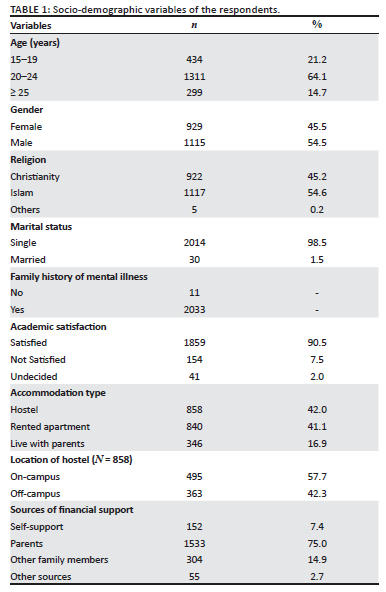
A total of 2044 out of 2150 questionnaire were analysed, giving a response rate of 95.1% for the study. The mean age of the respondents was 21.74 (± 2.64) years. Majority of them were in the age group 20-24 years, which accounted for 64.1% followed by those aged between 15 years and 19 years, which were 434 (21.2%). Respondents who were single accounted for 98.5%. Male respondents accounted for 54.5%. Of the 15 faculties of the institution, the faculty of Education accounted for one-fifth of the population of respondents while veterinary medicine, was the least in terms of representation and accounted for about 0.3% of the study population. The 200 level classes had slight preponderance of 557 (27.1%), while 500 level classes accounted for the least 66 (3.2%). A total of 1859 students (90.5%) were satisfied with their academic performance, while 41 (2.0%) were undecided. A total of 858 (42%) students lived within the hostels, 146 (16.9%) lived with their parents, while the remaining lived in rented apartments. Of those who lived in the hostels, 57.7% lived on-campus, while 42.3% lived off-campus hostels. About 75% were supported financially by their parents, while as few as 55 (2.7%) had other sources of financial support other than self-support and support from other family members. Majority of the respondents (65.1%) were from monogamous family setting. A total of 1413 (69.1%) were satisfied with their social support (Table 1).
Prevalence of gambling among respondents and responses on the South Oaks Gambling Screen
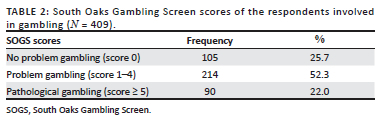
Of the 2044 respondents, 409 (20%) had a lifetime history of gambling, who responded 'yes' to the question 'have you ever gambled'. Responses on the SOGS revealed that out of the 409 respondents who had ever gambled, 105 had no gambling problem, although they scored zero on the SOGS. Of the 409 respondents, 214 (10.5%) had 'problem gambling' score between 1 and 4 on the SOGS screen, while 90 (4.4%) had 'pathological gambling' score of minimum 5 on the SOGS, giving a prevalence rate of 14.9% as those having gambling disorder (Table 2).
Relationship between demographic characteristics of respondents and gambling disorder
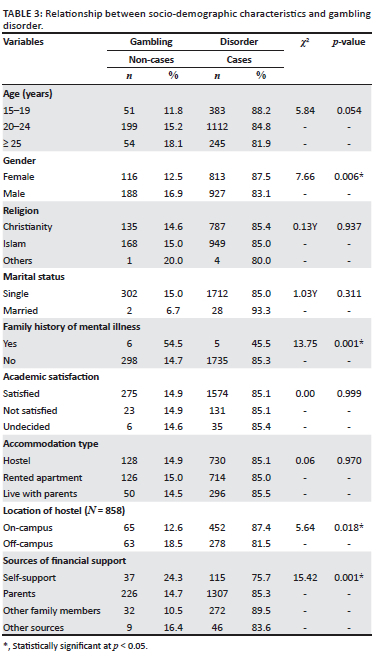
A comparison of age groups showed there were more cases of gambling disorder in respondents of age 25 years and beyond, which represents 54 (18.1%) compared to other age groups, however, it was not statistically significant (χ2p = 0.054). There were statistically significant positive associations between gambling disorder and male gender, those with positive family history of mental illness, those living at off-campus hostel, and the respondents who had to support themselves financially. There was no statistical significance between the marital status, religion, family setting and level of academic satisfaction (Table 3).
Predictors of gambling disorders
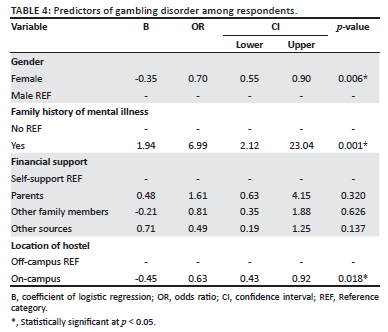
All variables with statistically significant association at the univariate analysis were subjected to logistic regression analysis to ascertain possible predictors of gambling disorder (Table 4). An outcome of each variable was used as a reference category against which other outcomes of the same variable were compared. Male gender and staying at the off-campus hostel were significant predictors of gambling disorder with p-values 0.006 and 0.018, respectively.
Discussion
Socio-demographic characteristics of respondents
This study showed more male respondents 55.5% than female 44.5% which is reflective of the enrolment profile of 27 914 (62.1%) male and 17 005 (37.9%) female students for the year 2018/2019 academic session. Over the years, although female enrolment in the university has increased, there is still a relatively predominant number of male students.33 Majority of students lived in hostels and rented apartments around the university, which accounted for 42.0% and 41.1%, respectively. Although the University of Ilorin authority provided some accommodation within the campus, these were grossly inadequate, hence the need for some students to opt for rented apartments close to the campus. Students generally prefer to be close to the academic environment as this is believed to help them in their academic pursuits and ease any potential difficulties that might result from transportation to and from the campus.
Prevalence of gambling
The lifetime prevalence of gambling in this study was 20%. This is similar to a study in India among college students where a lifetime prevalence of 19.5% was reported.343536
Prevalence of gambling disorder
The prevalence of gambling disorder is 14.9% of the respondents' population. This is similar to a study by Oyebisi et al.,37383916
The prevalence of problem gambling which is of a milder severity of gambling disorder was 10.5%. This finding was similar to that found in KwaZulu-Natal region of South Africa where 11% of the general population had problem gambling.8272840
Prevalence of pathological gambling, which is a more severe form along the spectrum of gambling disorder was 4.4%. This is close to a prevalence of 5.1% as reported by Yokomitsu et al.412123
Demographic factors associated with gambling disorder
The highest percentage of gambling disorder in this study was found among respondents with age range 25-34 years. This later age bracket could be explained in the light of natural progression of gambling, which is from the period of introduction to the period of gambling and thereafter the onset of the disorder. A Nigerian study reported highest percentage of 78.6% among respondents above 30 years of age.38
In our study, a significant gender difference was observed regarding gambling disorder between both genders. Male participants had more cases of gambling disorder than female participants with 1.5 times more male than female participants. The reason might be that in the African society males tend to engage in more adventurous and risky behaviours that create more financial pressure on them. Even after logistic regression, gender was still significant. This is similar to findings reported by Gupta and Derevensky21428
Living on-campus appeared to be 'protective' against gambling disorder than off-campus living. Factor responsible for this could be restrictions of gambling by school authority through prohibition of gambling houses within the school campus. Students who lived off-campus were likely to enjoy more freedom, external influences and as such more prone to gambling, which may later progress to gambling disorder. Another factor found to be associated with gambling disorder was financial support for students during the course of their study. There were more cases of gambling disorder in respondents that financially self-supported themselves compared to those supported by parents or by other family members. Their financial autonomy could make them less accountable to anyone concerning how they spend their money, hence they might not exercise restraints on venturing into gambling. Parental financial support appears to be somewhat protective against gambling disorder, something similarly reported in a United States study by Welte et al.4344
Conclusion
The study revealed an overall lifetime prevalence of gambling as 20% while that of gambling disorder was 14.9%, comprising of problem gambling (10.5%) and pathological gambling (4.4%). Gambling disorder was associated with male gender, off-campus hostel accommodation, and self-financial support.
Strengths of the study
To the best of our knowledge, this was the first study on the gambling and gambling disorder in this part of the country. It also has large sample size, which gave it advantage over other studies with smaller sample sizes.
Limitations of the study
The data were obtained from self-reported questionnaire, which is not free of response bias. Also, this study was a cross-sectional study and thus cannot establish causality and direction of relationship. The study result may also not be generalisable to the larger Nigerian population as it was conducted among tertiary institution students.
Competing interests
The authors declare that they have no financial or personal relationships that may have inappropriately influenced them in writing this article.
CRediT authorship contribution
Oludolapo Oladeji: Conceptualisation, Funding acquisition, Investigation, Methodology, Resources, Writing - original draft. Mosunmola F. Tunde-Ayinmode: Formal analysis, Project administration, Supervision, Visualisation, Writing - review & editing. Amudalat T. Kuranga: Conceptualisation, Data curation, Methodology, Project administration, Resources, Supervision. Adebusola J. Ogunmodede: Conceptualisation, Formal analysis, Resources, Supervision, Visualisation. Dauda Sulyman: Data curation, Funding acquisition, Project administration, Visualisation, Writing - review & editing. All authors reviewed the article, contributed to the discussion of results, approved the final version for submission and publication, and take responsibility for the integrity of its findings.
Funding information
This research received no specific grant from any funding agency in the public, commercial or not-for-profit sectors.
Data availability
The data that support the findings of this study are available from the corresponding author, Oludolapo Oladeji, upon reasonable request.
Disclaimer
The views and opinions expressed in this article are those of the authors and are the product of professional research. It does not necessarily reflect the official policy or position of any affiliated institution, funder, agency or that of the publisher. The authors are responsible for this article's results, findings and content.
Acknowledgements
The authors would like to acknowledge Jide Oyebiyi and Yemi Adegboye for their relentless efforts with data collection and analyses.
References
- 1. Ferentzy P, Turner NE. A history of problem gambling. Berlin: Springer-Verlag; 2013.
-
2. Potenza MN, Kosten TR, Rounsaville BJ. Pathological gambling. J Am Med Assoc. 2001;286(2):141-144. https://doi.org/10.1001/jama.286.2.141
» https://doi.org/10.1001/jama.286.2.141 -
3. California Council on Problem Gambling. Impacted youth: Common types of gambling [homepage on the Internet]. 2019 [cited 2019 Feb 01]. Available from: http://calp.org
» http://calp.org -
4. National Lottery Act. Law regulating lottery business in Nigeria [homepage on the Internet]. 2005 [cited 2019 Feb 09]. Available from: http://natlotregcom.gov.ng/downloads/NLA_2005.pdf
» http://natlotregcom.gov.ng/downloads/NLA_2005.pdf -
5. Ellison, CG, McFarland, MJ. Religion and gambling among US adults: Exploring the role of traditions, beliefs, practices, and networks. J Sci Stud Relig. 2011;50(1):82-102. https://doi.org/10.1111/j.1468-5906.2010.01553.x
» https://doi.org/10.1111/j.1468-5906.2010.01553.x -
6. Dowling NA, Youssef GJ, Jackson AC, et al. National estimates of Australian gambling prevalence: Findings from a dual-frame omnibus survey. Addiction. 2015;111(3):420-435. https://doi.org/10.1111/add.13176
» https://doi.org/10.1111/add.13176 - 7. Neal P, Delfabbro P, O'Neil M. Problem gambling and harm: Towards a national definition. Adelaide: Office of Gaming and Racing, Victorian Government Department of Justice; 2005.
-
8. Dellis A, Spurrett D, Hofmeyr A, Sharp C, Ross D. Gambling participation and problem gambling severity among rural and peri-urban poor South African adults in KwaZulu-Natal. J Gambl Stud. 2013;29:417-433. https://doi.org/10.1007/s10899-012-9324-y
» https://doi.org/10.1007/s10899-012-9324-y - 9. Ahaibwe G, Lakuma CP, Katunze M, Mawejje J. Socio economic effects of gambling: Evidence from Kampala City, Uganda. Kampala: Economic Policy Research Center; 2016.
- 10. Wangari N. Mobile gambling among youth in sub-Saharan Africa. Denver: GeoPoll; 2017.
- 11. Bankole ET. Patterns and prevalence of gambling behaviour among youths in south-west Nigeria: A case study of youths in Oyo and Ekiti State. Br J Psychol Res. 2019;7:22-46.
- 12. American Psychiatric Association. Diagnostic and statistical manual of mental disorders. 5th ed. Arlington, VA: American Psychiatric Publishing; 2013.
- 13. Shaffer HJ, Hall MN, Bilt JV. Estimating the prevalence of disordered gambling behavior in the United States and Canada: A research synthesis. Boston: Harvard Medical School, Division of Addictions; 1999.
- 14. Clarke D, Tse S, Abott M, Townsend S, Kingi P, Manaia W. Religion, spirituality and association with problem gambling. New Zeal J Psychol. 2006;35:1-8.
- 15. American Psychiatric Association. Diagnostic and statistical manual of mental disorders 4th ed. text revision. Washington DC: American Psychiatric Association; 2000.
-
16. Calado F, Griffiths M. Problem gambling worldwide: An update and systematic review of empirical research (2000-2015). J Behav Addict. 2016;5:592-613. https://doi.org/10.1556/2006.5.2016.073
» https://doi.org/10.1556/2006.5.2016.073 -
17. Potenza MN, Balodis IM, Derevensky J, et al. Gambling disorder. Nat Rev Dis Primers. 2019;5:1-20. https://doi.org/10.1038/s41572-019-0099-7
» https://doi.org/10.1038/s41572-019-0099-7 -
18. International Telecommunications Indicator: 'Africa, ICT Indicators, 2007' [homepage on the Internet]. 2007 [cited 2019 May 19]. Available from: http://www.itu.int/ITU-D/ict/statistics/at_glance/af_indicators_2007.htm
» http://www.itu.int/ITU-D/ict/statistics/at_glance/af_indicators_2007.htm -
19. Castren S, Grainger M, Lahti T, Alho, Salonen AH: At-risk and problem gambling among adolescents: A convenience sample of first-year junior high school students in Finland. Subst Abuse Treat Prev Policy. 2015;10:1-9. https://doi.org/10.1186/s13011-015-0003-8
» https://doi.org/10.1186/s13011-015-0003-8 -
20. Loo JMY, Oei TP, Raylu N. Problem gambling, gambling correlates, and help-seeking attitudes in a Chinese sample. Sci Res. 2011;2:342-352. https://doi.org/10.4236/psych.2011.24054
» https://doi.org/10.4236/psych.2011.24054 -
21. Gupta R, Derevensky JL. Adolescent gambling behavior: A prevalence study and examination of the correlates associated with problem gambling. J Gambl Stud. 1998;14(4):319-345. https://doi.org/10.1023/A:1023068925328
» https://doi.org/10.1023/A:1023068925328 -
22. Abbott MW, Volberg RA. The measurement of adult problem and pathological gambling. Int Gambl Stud. 2006;6:175-200. https://doi.org/10.1080/14459790600928678
» https://doi.org/10.1080/14459790600928678 -
23. Calado F, Alexandre J, Griffiths MD. Prevalence of adolescent problem gambling: A systematic review of recent research. J Gambl Stud. 2017;33:397-424. https://doi.org/10.1007/s10899-016-9627-5
» https://doi.org/10.1007/s10899-016-9627-5 -
24. Brewer JA, Potenza MN, Desai RA. Differential associations between problem and pathological gambling and psychiatric disorders in individuals with and without alcohol abuse or dependence. CNS Spectr. 2010;15(1):33-44. https://doi.org/10.1017/S1092852900000286
» https://doi.org/10.1017/S1092852900000286 -
25. Blanco C, Hanania J, Petry NM, et al. Towards a comprehensive developmental model of pathological gambling. Addiction. 2015;110:1340-1351. https://doi.org/10.1111/add.12946
» https://doi.org/10.1111/add.12946 -
26. Fröberg F, Modin B, Rosendahl IK, Tengström A, Hallqvist J. The association between compulsory school achievement and problem gambling among Swedish young people. J Adolesc Health. 2015;56:420-428. https://doi.org/10.1016/j.jadohealth.2014.12.007
» https://doi.org/10.1016/j.jadohealth.2014.12.007 - 27. Delfabbro P, Lahn J, Grabosky P. Adolescent gambling in the Australian capital territory. Canberra: Australian University Center for Gambling Research; 2005.
- 28. Sauer RD. The political economy of gambling regulation. Clemson: University of Clemson, Department of Economics; 2000.
- 29. Sajo S. Substance use and psychiatric morbidity among University of Ilorin undergraduates. Ilorin: Faculty of Psychiatry; 2013.
-
30. Lesieur HR, Blume SB. Revising South Oaks gambling screen in different settings. J Gambl Stud. 1992;9:213-223. https://doi.org/10.1007/BF01015919
» https://doi.org/10.1007/BF01015919 -
31. Holtgraves T. Evaluating the problem gambling severity index. J Gambl Stud. 2009, 25:105-120. https://doi.org/10.1007/s10899-008-9107-7
» https://doi.org/10.1007/s10899-008-9107-7 - 32. Stinchfield R. The Wiley-Blackwell handbook of disordered gambling. A review of problem gambling assessment instruments and brief screens, Boston: Harvard Medical School; 1999.
- 33. Makanjuola AB, Abiodun OA, Sajo S. Alcohol and psychoactive substance use among medical students of the University of Ilorin, Nigeria. Eur Sci J. 2014;10:69-83.
-
34. George S, Jaisoorya TS, Nair S, et al. A cross-sectional study of problem gambling and its correlates among college students in South India. Br J Psychiatry. 2016, 2:119-203. https://doi.org/10.1192/bjpo.bp.115.002519
» https://doi.org/10.1192/bjpo.bp.115.002519 -
35. Orjinta N, Udenze V, Ogunla O, Anazodo I, Ukpoju J, Naibo A. Understanding the prevalence of gambling in Nigeria: A comprehensive investigation. World Soc Psychiatry. 2025;7:29-38. https://doi.org/10.4103/wsp.wsp_4_24
» https://doi.org/10.4103/wsp.wsp_4_24 - 36. Oster S, Knapp T. Sports betting by college students: Who bets and how often? Coll Stud J. 1998;32:289.
- 37. Oyebisi EO, Alao KA, Popoola BI. Gambling behaviour of university students in South western Nigeria. Ife Psychologia. 2012;20:252-262.
-
38. Aderinto N, Babalola A, Olatunji G, et al. Online gambling and its prevalence among Nigerian medical and dental students. J Gambl Stud. 2025;41:1-30. https://doi.org/10.1007/s10899-025-10393-z
» https://doi.org/10.1007/s10899-025-10393-z -
39. Afe T, Ogunsemi O, Daniel O, Ale A, Adeleye O. Prevalence of and factors associated with disordered gambling, and use of DSM-5 based sports betting questionnaire, in a Southwest Nigerian community. Indian J Psychol Med. 2022;44(3):02537176211023809. https://doi.org/10.1177/02537176211023809
» https://doi.org/10.1177/02537176211023809 -
40. Skaal L, Sinclair H, Stein DJ, Myers B. Problem gambling among urban and rural gamblers in Limpopo Province, South Africa: Associations with hazardous and harmful alcohol use and psychological distress. J Gambl Stud. 2016;32:217-230. https://doi.org/10.1007/s10899-015-9522-5
» https://doi.org/10.1007/s10899-015-9522-5 -
41. Yokomitsu K, Sakai T, Irie T, et al. Gambling symptoms, behaviors, and cognitive distortions in Japanese university students. Subst Abuse Treat Prev Policy. 2019;14:51. https://doi.org/10.1186/s13011-019-0230-5
» https://doi.org/10.1186/s13011-019-0230-5 -
42. Kam SM, Wong ILK, So EMT, Un DKC, Chan CHW. Gambling behaviour among Macau college and university students. Asian J Gambl Issues Public Health. 2017;7:1-12. https://doi.org/10.1186/s40405-017-0022-7
» https://doi.org/10.1186/s40405-017-0022-7 -
43. Welte JW, Barnes GM, Tidwell MO, Hoffman JH. Gambling and problem gambling across the lifespan. J Gambl Stud. 2011;27:49-61. https://doi.org/10.1007/s10899-010-9195-z
» https://doi.org/10.1007/s10899-010-9195-z -
44. Odame SK, Quarshie ENB, Boadi MO, Andoh-Arthur J, Asante KO. Adolescent problem gambling in rural Ghana: Prevalence and gender differentiation. J Gambl Stud. 2021;37:83-105. https://doi.org/10.1007/s10899-020-09987-6
» https://doi.org/10.1007/s10899-020-09987-6

Accepted: 11 Dec. 2025
Published: 28 Jan. 2026