Current state of the literature on mental health in Liberia: A systematic review
Abstract
BACKGROUND: The Republic of Liberia recently experienced several events that resulted in wide-ranging societal impacts, including long-term civil war and an outbreak of Ebola. These types of events are linked to higher prevalence of mental disorders and psychosocial distress. As a result, it is likely that there is an increased prevalence of mental health disorders in the population AIM: To assess and review the recent mental health literature in order to provide insight into existing mental health needs and effective or recommended interventions in post-conflict Liberia SETTING: Articles included in this study enrolled Liberians living in Liberia METHODS: A search of four databases was conducted for studies of any type that assessed mental health in Liberia between 01 January 2003 and 27 March 2019. After reviewing 363 articles, 21 articles were included in the final analysis. Articles were coded to identify common themes and needs. RESULTS: The majority of studies used qualitative designs and were conducted in Monrovia, the capital city of Liberia. Common topics included adolescent mental health, intervention and assessment and post-conflict impacts. One article focused on mental health impacts after recovery from Ebola. CONCLUSION: Overall, there is a dearth of mental health literature that focuses on Liberia. This suggests ample opportunity for researchers to investigate mental health needs amongst the Liberian population and effective psychiatric interventions. Existing recommendations often focus on addressing adolescent health needs, including substance use practices. Opportunities for future research particularly related to needs of adult populations and to mental health impacts of Ebola, abound
Ebola; mental health disorders; Liberia; intervention and assessment; psychiatric interventions; substance use practices; adolescent
Introduction
The Republic of Liberia, located on the coast of West Africa, recently endured several significant events that resulted in wide-ranging societal impacts. A longstanding 14-year civil war resulted in the loss of 250 000 lives and displaced 1.3 million people123456
Disasters, such as civil wars and public health events, often divert resources away from mental healthcare to address immediate needs and disaster relief. As war and life-threatening events are linked to higher prevalence of mental disorders and psychosocial distress2,6,738
In order to rebuild infrastructure and improve accessibility of mental health resources, it is necessary to take stock of the current landscape of mental health training, research and other initiatives. To our knowledge, no reviews have been conducted on previous mental health research in Liberia. In this study, we examine the existing evidence base and present findings on the current state of the literature regarding mental health and substance use in post-conflict Liberia, discuss gaps in knowledge and treatment and suggest future directions for research.
Methods
With the assistance of an experienced health services librarian, a systematic review of the current literature contained within PubMed, PsycINFO, Embase and Web of Science (last updated on March 27, 2019) was conducted. Search terms included the following phrases: 'mental health and Liberia' and 'substance abuse and Liberia'. Additionally, associated MeSH terms were included to account for variances in language; categories included substance-related disorders (all subheadings), mental health (all subheadings) and Liberia (all subheadings). This search returned 361 titles; two additional titles known to the authors were also included. We followed PRISMA guidelines9
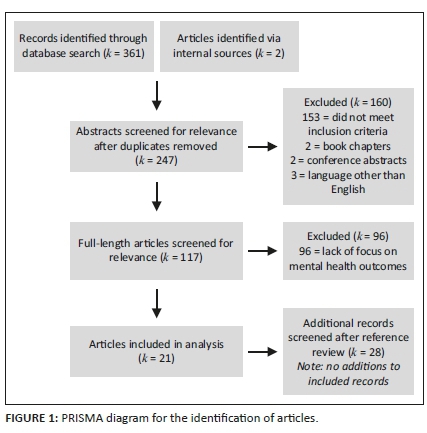
Reference lists of included articles were also double-screened by the authors; 28 additional abstracts were assessed as a result of this process, though no further publications were added for inclusion in the analysis. After duplicates were removed, 247 publications were screened at the level of title and abstract. Articles were independently screened and assessed for inclusion in this study by authors (KH and KA); any disagreements were resolved through discussion and consensus.
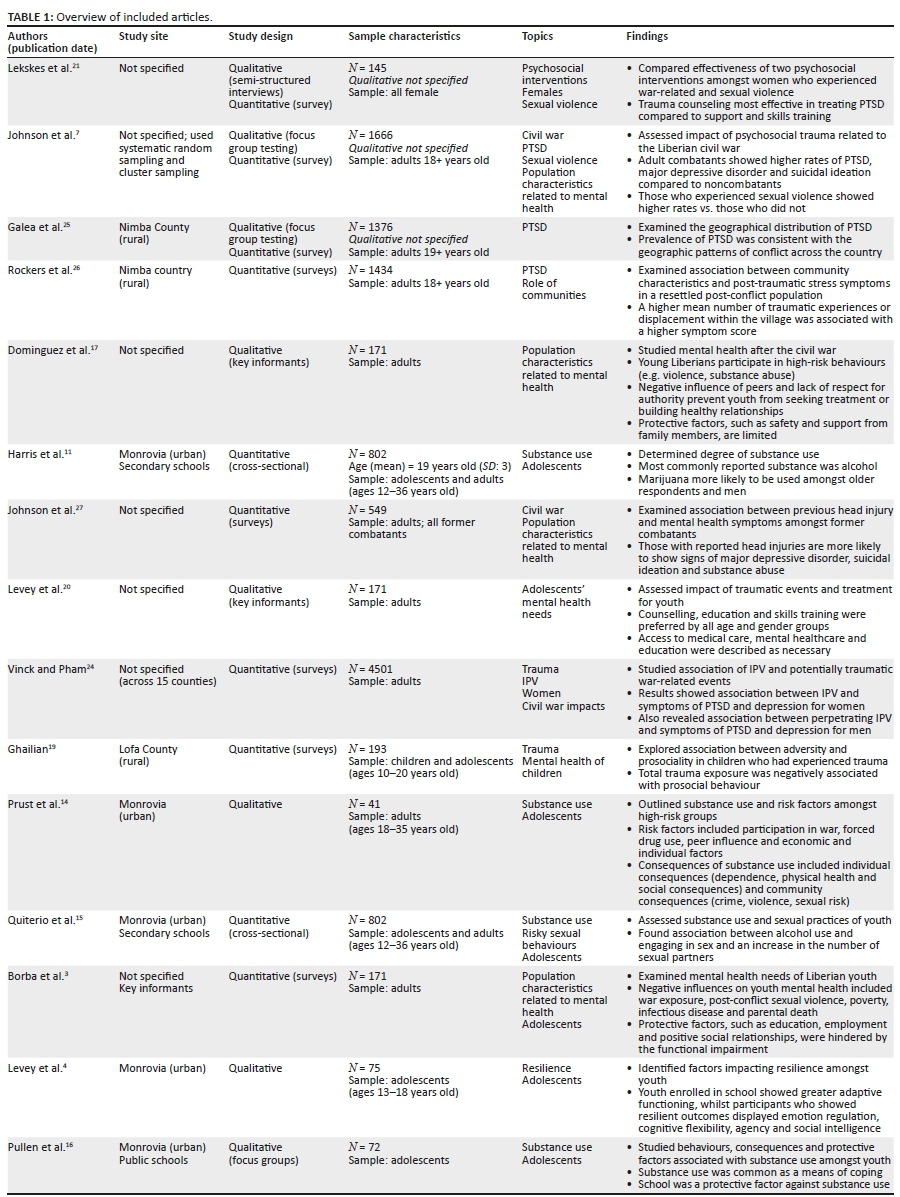
Full-length articles were pulled for review if inclusion criteria were met. Inclusion criteria were as follows: (1) full-length article written in English; (2) published in a peer-reviewed journal or published dissertation; (3) published between 01 January 2003 and 27 March 2019 (i.e. to capture the literature in the immediate post-conflict to present range); (4) primary outcomes of the article focused on substance use and/or mental health, knowledge that impacted substance use or mental healthcare and/or mental health of the Liberian population, which excluded studies with a focus on policy or only indirect reference to mental health; (5) enrolled participants living in Liberia (i.e. not Liberian refugees in another country, in order to not be confounded by effects of migration on mental health) and (6) specific to the Liberian population (e.g. not foreign aid workers). Studies that grouped many countries together without differentiation (e.g. used the phrase 'sub-Saharan Africa' without further delineation between groups) or had a sole focus on child soldiers were excluded. In sum, 21 articles were included in this review. Figure 1 provides the synthesis of the review process, and Table 1 describes summary characteristics of included publications.
Articles were coded to capture main themes and characteristics. To ensure that data were accurately extracted, 50% (n = 11) of the articles were randomly selected and double-coded (KH and KA). Minimal discrepancies between coders arose and were discussed and resolved via consensus. After ensuring consistency between coders, the remaining 50% of articles (n = 10) were single-coded (KH or KA).
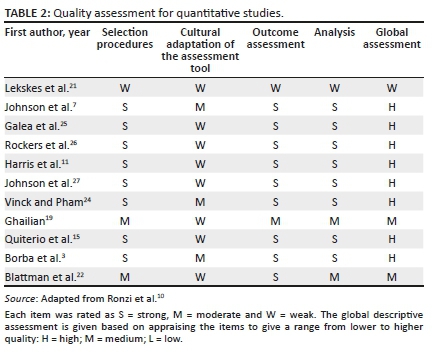
To describe the quality of the included studies, we modified an existing appraisal tool10Tables 2 and 3 for a full description of the assessment parameters and ratings for each article.
Results
Publication years of the primary citations ranged from 2007 to 2018. The majority of the studies were qualitative in nature (k = 9, 42.9%), and the remainder used mixed methods (k = 6, 28.6%) or quantitative designs (k = 6, 28.6%). Many studies were conducted in Monrovia (Montserrado County), the capital city of Liberia (k = 10, 47.6%), whilst others were completed in Lofa (k = 1, 4.76%), Nimba (k = 2, 9.52%) and Maryland counties (k = 1, 4.76%). One study noted that respondents came from 15 counties (k =1, 4.76%), and other articles did not further specify locations of respondents (k = 5, 23.8%). One study (k = 1, 4.76%) noted that participants were selected from both urban and rural settings.
Number of participants in the studies ranged from 17 to 4501. Articles highlighted notable characteristics of the study participants, including: individuals from an Ebola treatment unit (k = 1, 4.76%), key informants selected by study staff and local organisations (k = 3, 14.29%), individuals selected from areas of high crime (k = 1, 4.76%),), individuals identified as current and former substance users (k =1, 4.76%), former combatants (k = 1, 4.76%) and students from local schools (k = 5, 23.81%). See Table 1 for study-specific details.
Regarding quality assessment, 11 articles were evaluated using the quantitative assessment tool. Of these, eight (72.7%) were considered high quality, two (18.2%) were designated as medium quality and one (9.1%) was assessed as low quality. For the primarily qualitative articles (n = 10), seven articles (70%) were determined to be high quality, and three articles (30%) were categorised as medium quality. No qualitative articles were classified as low quality.
Common topics covered in the articles included adolescent mental health, intervention and assessment and post-conflict impacts. One article focused on mental health impacts after recovery from Ebola. Each of these themes will be discussed further below.
Adolescent mental health
Emphasis on adolescent mental health comprised a significant bulk of the included literature (k = 12; 57.14%). Subcategories that were frequently explored included substance use and vulnerabilities of youth as associated with mental health outcomes. In addition, one article focused on resilience factors amongst Liberian adolescents.
Adolescent substance use
Six articles11,12,13,14,15,161012,13,14,151614,161511,161614151312
Vulnerabilities of youth associated with mental health outcomes
Five manuscripts3,17,18,19,203,17,18191733182019
Resilience
One article reported factors that increase resilience amongst youth, observing that school enrollment resulted in greater adaptive functioning and better ability to manage emotion regulation, cognitive flexibility and social intelligence.4
Interventions and assessment
Post-conflict impacts
Trauma
Three articles24,25,2624n = 664) was consistent with the geographic patterns of conflict across the country.2526
Former combatants
Ebola
One article focused on the mental health impacts of Ebola.6
Discussion
This study presents findings on the current state of the literature regarding mental health and substance use in post-conflict Liberia. Of note, review of four databases resulted in only 21 articles that captured these concepts, suggesting that there is a dearth of literature about the current landscape of mental healthcare in Liberia. This offers ample opportunity for researchers to investigate mental health needs amongst the Liberian population and current practices, as well as a need to strengthen the cadre of researchers who are interested in and prepared to address these questions. After a significant disruption of its education system, Liberia has made gains in increasing access to and opportunities for schooling, which in turn promotes advancement in education and a subsequent pathway for research capability.28293031
In our review, one of the most common topics addressed in the existing literature was adolescent mental health, particularly themes associated with vulnerabilities that youth face because of conflict exposure and issues related to youth substance use. Emphasis on adolescent needs is critical as it is estimated that 10% - 20% of children worldwide experience mental health disorders323334,35
Such focus is critically important in light of the recent events that Liberia has faced. Adolescents impacted by conflict commonly experience distress and are at risk for the development of subsequent symptoms of mental illness and negative impacts on well-being.36,37,3834373,17,1836,383,20
Substance use behaviours, as well as risk factors for use initiation, were also commonly discussed in the literature. It is known that adolescents exposed to violence and conflict are more likely to engage in substance use,39,4012,13,14,1541,4216
Whilst there is significant focus on youth, further assessment and exploration of the mental health needs of adult and elderly populations are also warranted. Past research on the effects of traumatic events, including conflict, on middle- and older-aged adults is mixed. Although it is generally suggested that older adults are more resilient in the face of such stressful experiences,43,4443,4546,47
Our review also demonstrates that there are many topics that remain unexplored. For example, whilst three articles focused on adapted interventions and measures that are used in Liberia, there is little evidence of other interventions that may assist in mental health recovery efforts. Adaptation is a key feature in ensuring that interventions are: (1) relevant and efficient in varying cultures and contexts; (2) aligned with existing community understanding of mental health48,49,502616,18
Surprisingly, there is very little literature specifically assessing mental health outcomes associated with exposure to Ebola (i.e. personal, societal and/or medical impacts). The one article included in this review was also limited to individuals released from Ebola Treatment Units, though impacts from Ebola rippled throughout the entire population. Mass disaster and community upheaval are often associated with negative mental health impacts51,52
Limitations of this work include its inclusion criteria, namely the requirement that sources for this review exist as empirical articles. Whilst it is possible that other literature relating to mental health exists (e.g. governmental documents, works outside of formal databases), the purpose of this review was to specifically assess the empirical literature focusing on Liberian mental health, in part to gauge scholarly activity focused on these topics. Another consideration is that this work required that included articles be written in English. Whilst English is commonly spoken in Liberia, it is possible that other authors or organisations may have published in other languages. Lastly, the quality appraisal of the included articles was conducted by one reviewer; however, we specifically included only peer-reviewed articles to provide an initial layer of quality assurance.
In summary, our review indicates that there is a small, but growing and quality literature regarding mental health and substance-use care, needs and practices in Liberia. Expansion beyond these domains is needed, both to guide Liberia's current needs, and to provide practitioners with guidance for practice. Continued investment in psychiatric care and research will be an important component of recovery efforts in Liberia.
Competing interests
The authors declare that they have no financial or personal relationships that may have inappropriately influenced them in writing this article.
Authors' contributions
K.H. and K.A. conducted the literature review and analysis. K.H. and K.A. prepared the manuscript draft. S.G., B.H., B.O., H.S., D.H. and C.B. provided theoretical contributions and consultation on the project. All authors read and approved the final manuscript.
Ethical consideration
This article followed all ethical standards for carrying out research without direct contact with human or animal subjects.
Funding information
The preparation of the present manuscript was supported by the Boston University Medical Campus-Massachusetts General Hospital Global Psychiatric Clinical Research Training Program (T32 MH116140-02). The sponsors had no role in study design, in the collection, analysis and interpretation of data, in the writing of the articles and in the decision to submit it for publication.
Data availability statement
The dataset used and/or analysed during the current study is available from the corresponding author on reasonable request.
Disclaimer
The views and opinions expressed in this article are those of the authors and do not necessarily reflect the official policy or position of any affiliated agency of the authors.
Acknowledgements
We would like to thank David Flynn at the Boston University Alumni Medical Library for the consultation provided on search procedures.
References
-
1.United Nations. Acting high commissioner for human rights submits emergency report on Liberia to commission on human rights. c2003. [cited 2019 Dec 10]. Available from: https://www.un.org/press/en/2003/hrcn1051.doc.htm
» https://www.un.org/press/en/2003/hrcn1051.doc.htm -
2.Kruk M, Rockers P, Williams E, et al. Availability of essential health services in post-conflict Liberia. Bull World Health Organ. 2010;88(7):527-534. https://doi.org/10.2471/BLT.09.071068
» https://doi.org/10.2471/BLT.09.071068 -
3.Borba C, Ng L, Stevenson A, et al. A mental health needs assessment of children and adolescents in post-conflict Liberia: Results from a quantitative key-informant survey. Int J Cult Ment Health. 2015;9(1):56-70. https://doi.org/10.1080/17542863.2015.1106569
» https://doi.org/10.1080/17542863.2015.1106569 -
4.Levey E, Oppenheim C, Lange B, et al. A qualitative analysis of factors impacting resilience among youth in post-conflict Liberia. Child Adolesc Psychiatry Ment Health. 2016;10(1):26. https://doi.org/10.1186/s13034-016-0114-7
» https://doi.org/10.1186/s13034-016-0114-7 -
5.Weissbecker I, Roshania R, Cavallera V, et al. Integrating psychosocial support at Ebola treatment units in Sierra Leone and Liberia. Intervention. 2018;16(2):69. https://doi.org/10.4103/INTV.INTV_8_18
» https://doi.org/10.4103/INTV.INTV_8_18 -
6.Rabelo I, Lee V, Fallah M, et al. Psychological distress among Ebola survivors discharged from an Ebola treatment unit in Monrovia, Liberia - A qualitative study. Front Public Health. 2016;4(1):142. https://doi.org/10.3389/fpubh.2016.00142
» https://doi.org/10.3389/fpubh.2016.00142 -
7.Johnson K, Asher J, Rosborough S, et al. Association of combatant status and sexual violence with health and mental health outcomes in postconflict Liberia. JAMA. 2008;300(6):676. https://doi.org/10.1001/jama.300.6.676
» https://doi.org/10.1001/jama.300.6.676 -
8.Gwaikolo W, Kohrt B, Cooper J. Health system preparedness for integration of mental health services in rural Liberia. MC Health Serv Res. 2017;17(1):508. https://doi.org/10.1186/s12913-017-2447-1
» https://doi.org/10.1186/s12913-017-2447-1 -
9.Moher D, Liberati A, Tetzlaff J, Altman D. Preferred reporting items for systematic reviews and meta-analyses: The PRISMA statement. BMJ. 2009;339(1):b2535-b2535. https://doi.org/10.1371/journal.pmed.1000097
» https://doi.org/10.1371/journal.pmed.1000097 -
10.Ronzi S, Orton L, Pope D, Valtorta NK, Bruce NG. What is the impact on health and well-being of interventions that foster respect and social inclusion in community-residing older adults? A systematic review of quantitative and qualitative studies. Syst Rev. 2018;7(1):26. https://doi.org/10.1186/s13643-018-0680-2
» https://doi.org/10.1186/s13643-018-0680-2 -
11.Harris B, Levey E, Borba C, Gray D, Carney J, Henderson D. Substance use behaviors of secondary school students in post-conflict Liberia: A pilot study. Int J Cult Ment Health. 2012;5(3):190-201. https://doi.org/10.1080/17542863.2011.583737
» https://doi.org/10.1080/17542863.2011.583737 -
12.Lange B, Pullen S, Petruzzi L, et al. A qualitative investigation of the perceived role of peers in influencing substance use among youth in Monrovia, Liberia. Vulnerable Child Youth Stud. 2018;13(4):357-367. https://doi.org/10.1080/17450128.2018.1425517
» https://doi.org/10.1080/17450128.2018.1425517 -
13.Petruzzi L, Pullen S, Lange B, et al. Contributing risk factors for substance use among youth in postconflict Liberia. Qual Health Res. 2018;28(12):1827-1838. https://doi.org/10.1177/1049732318761863
» https://doi.org/10.1177/1049732318761863 -
14.Prust M, Curry L, Callands T, et al. Risk factors for and consequences of substance use in post-conflict Liberia: A qualitative study. Community Ment Health J. 2017;54(4):438-449. https://doi.org/10.1007/s10597-017-0154-3
» https://doi.org/10.1007/s10597-017-0154-3 - 15.Quiterio N, Harris B, Borba C, Henderson D. Substance use and sexual risk behaviours amongst in-school youth and young adults living in Liberia. Afr J Drug Alcohol Stud. 2013;12(2):75-91.
-
16.Pullen S, Petruzzi L, Lange B, et al. A qualitative analysis of substance use among Liberian youth: Understanding behaviors, consequences, and protective factors involving school youth and the school milieu. Int J Ment Health Psychiatry. 2016;2(1):116. https://doi.org/10.4172/2471-4372.1000116
» https://doi.org/10.4172/2471-4372.1000116 -
17.Dominguez S, Borba C, Fatima B, et al. Mental health and adaptation of young Liberians in post-conflict Liberia: A key informant's perspective. Int J Cult Ment Health. 2013;6(3):208-224. https://doi.org/10.1080/17542863.2012.683158
» https://doi.org/10.1080/17542863.2012.683158 -
18.Levey E, Oppenheim C, Lange B, et al. A qualitative analysis of parental loss and family separation among youth in post-conflict Liberia. Vulnerable Child Youth Stud. 2016;12(1):1-16. https://doi.org/10.1080/17450128.2016.1262978
» https://doi.org/10.1080/17450128.2016.1262978 - 19.Ghailian MC. Association between adversity and prosociality in children exposed to trauma in four sites in West Africa [dissertation]. Ann Arbor, MI: ProQuest; 2013.
-
20.Levey E, Borba C, Harris B, et al. Assessment of the needs of vulnerable youth populations in post-conflict Liberia. Afr J Psychiatry. 2013;16(5):349-355. https://doi.org/10.4314/ajpsy.v16i5.47
» https://doi.org/10.4314/ajpsy.v16i5.47 -
21.Lekskes J, van Hooren S, De Beus J. Appraisal of psychosocial interventions in Liberia. Intervention. 2007;5(1):18-26. https://doi.org/10.1097/WTF.0b013e3280be5b47
» https://doi.org/10.1097/WTF.0b013e3280be5b47 -
22.Blattman C, Jamison J, Sheridan M. Reducing crime and violence: Experimental evidence from cognitive behavioral therapy in Liberia. Am Eco Rev. 2017;107(4):1165-1206. https://doi.org/10.1257/aer.20150503
» https://doi.org/10.1257/aer.20150503 -
23.Fabian K, Fannoh J, Washington G, et al. 'My heart die in me': Idioms of distress and the development of a screening tool for mental suffering in southeast Liberia. Cult Med Psychiatry. 2018;42(3):684-703. https://doi.org/10.1007/s11013-018-9581-z
» https://doi.org/10.1007/s11013-018-9581-z -
24.Vinck P, Pham P. Association of exposure to intimate-partner physical violence and potentially traumatic war-related events with mental health in Liberia. Soc Sci Med. 2013;77(1):41-49. https://doi.org/10.1016/j.socscimed.2012.10.026
» https://doi.org/10.1016/j.socscimed.2012.10.026 -
25.Galea S, Rockers P, Saydee G, Macauley R, Varpilah S, Kruk M. Persistent psychopathology in the wake of civil war: Long-term posttraumatic stress disorder in Nimba county, Liberia. Am J Public Health. 2010;100(9):1745-1751. https://doi.org/10.2105/AJPH.2009.179697
» https://doi.org/10.2105/AJPH.2009.179697 -
26.Rockers P, Kruk M, Saydee G, Varpilah S, Galea S. Village characteristics associated with posttraumatic stress symptoms in postconflict Liberia. Epidemiology. 2010;21(4):454-458. https://doi.org/10.1097/EDE.0b013e3181df5fae
» https://doi.org/10.1097/EDE.0b013e3181df5fae -
27.Johnson K, Asher J, Kisielewski M, Lawry L. Former combatants in Liberia: The burden of possible traumatic brain injury among demobilised combatants. Mil Med. 2012;177(5):531-540. https://doi.org/10.7205/MILMED-D-11-00185
» https://doi.org/10.7205/MILMED-D-11-00185 -
28.Barrios-Tao H, Siciliani-Barraza J, Bonilla-Barrios B. Education programs in post-conflict environments: A review from Liberia, Sierra Leone, and South Africa. Rev Electrón Edu. 2016;21(1):1. https://doi.org/10.15359/ree.21-1.11
» https://doi.org/10.15359/ree.21-1.11 -
29.Shoman H, Karafillakis E, Rawaf S. The link between the West African Ebola outbreak and health systems in Guinea, Liberia and Sierra Leone: A systematic review. Global Health. 2017;13(1). https://doi.org/10.1186/s12992-016-0224-2
» https://doi.org/10.1186/s12992-016-0224-2 -
30.World Health Organization. Monitoring the building blocks of health systems: A handbook of indicators and their measurement strategies. c2010. [cited 2019 Dec 10]. Available from: https://www.who.int/healthinfo/systems/WHO_MBHSS_2010_full_web.pdf
» https://www.who.int/healthinfo/systems/WHO_MBHSS_2010_full_web.pdf -
31.Boozary A, Farmer P, Jha A. The Ebola outbreak, fragile health systems, and quality as a cure. JAMA. 2014;312(18):1859. https://doi.org/10.1001/jama.2014.14387
» https://doi.org/10.1001/jama.2014.14387 -
32.World Health Organization. Adolescent mental health. c2018. [cited 2019 Dec 10]. Available from https://www.who.int/news-room/fact-sheets/detail/adolescent-mental-health
» https://www.who.int/news-room/fact-sheets/detail/adolescent-mental-health -
33.Weissman M, Wolk S, Wickramaratne P, et al. Children with prepubertal-onset major depressive disorder and anxiety grown up. Arch Gen Psychiatry. 1999;56(9):794. https://doi.org/10.1001/archpsyc.56.9.794
» https://doi.org/10.1001/archpsyc.56.9.794 -
34.Karam E, Mneimneh Z, Dimassi H, et al. Lifetime prevalence of mental disorders in Lebanon: First onset, treatment, and exposure to war. PLoS Med. 2008;5(4):e61. https://doi.org/10.1371/journal.pmed.0050061
» https://doi.org/10.1371/journal.pmed.0050061 -
35.Kieling C, Baker-Henningham H, Belfer M, et al. Child and adolescent mental health worldwide: Evidence for action. Lancet. 2011;378(9801):1515-1525. https://doi.org/10.1016/S0140-6736(11)60827-1
» https://doi.org/10.1016/S0140-6736(11)60827-1 -
36.Ehntholt K, Yule W. Practitioner review: Assessment and treatment of refugee children and adolescents who have experienced war-related trauma. J Child Psychol Psychiatry. 2006;47(12):1197-1210. https://doi.org/10.1111/j.1469-7610.2006.01638.x
» https://doi.org/10.1111/j.1469-7610.2006.01638.x -
37.Miller K, Rasmussen A. War exposure, daily stressors, and mental health in conflict and post-conflict settings: Bridging the divide between trauma-focused and psychosocial frameworks. Soc Sci Med. 2010;70(1):7-16. https://doi.org/10.1016/j.socscimed.2009.09.029
» https://doi.org/10.1016/j.socscimed.2009.09.029 -
38.Werner E. Children and war: Risk, resilience, and recovery. Dev Psychopathol. 2012;24(2):553-558. https://doi.org/10.1017/S0954579412000156
» https://doi.org/10.1017/S0954579412000156 -
39.McAloney K, McCrystal P, Percy A, McCartan C. Damaged youth: Prevalence of community violence exposure and implications for adolescent well-being in post-conflict Northern Ireland. J Community Psychol. 2009;37(5):635-648. https://doi.org/10.1002/jcop.20322
» https://doi.org/10.1002/jcop.20322 -
40.Schiff M, Pat-Horenczyk R, Benbenishty R, Brom D, Baum N, Astor R. High school students' posttraumatic symptoms, substance abuse and involvement in violence in the aftermath of war. Soc Sci Med. 2012;75(7):1321-1328. https://doi.org/10.1016/j.socscimed.2012.05.010
» https://doi.org/10.1016/j.socscimed.2012.05.010 -
41.Brady K, Tuerk P, Back S, Saladin M, Waldrop A, Myrick H. Combat posttraumatic stress disorder, substance use disorders, and traumatic brain injury. J Addict Med. 2009;3(4):179-188. https://doi.org/10.1097/ADM.0b013e3181aa244f
» https://doi.org/10.1097/ADM.0b013e3181aa244f -
42.McCauley J, Killeen T, Gros D, Brady K, Back S. Posttraumatic stress disorder and co-occurring substance use disorders: Advances in assessment and treatment. Clin Psychol (New York). 2012;19(3):283-304. https://doi.org/10.1111/cpsp.12006
» https://doi.org/10.1111/cpsp.12006 -
43.Acierno R, Ruggiero K, Kilpatrick D, Resnick H, Galea S. Risk and protective factors for psychopathology among older versus younger adults after the 2004 Florida hurricanes. Am J Geriatr Psychiatry. 2006;14(12):1051-1059. https://doi.org/10.1097/01.JGP.0000221327.97904.b0
» https://doi.org/10.1097/01.JGP.0000221327.97904.b0 -
44.Cohen M. Acute stress disorder in older, middle-aged and younger adults in reaction to the second Lebanon war. Int J Geriatr Psychiatry. 2007;23(1):34-40. https://doi.org/10.1002/gps.1832
» https://doi.org/10.1002/gps.1832 -
45.Pietrzak R, Van Ness P, Fried T, Galea S, Norris F. Trajectories of posttraumatic stress symptomatology in older persons affected by a large-magnitude disaster. J Psychiatr Res. 2013;47(4):520-526. https://doi.org/10.1016/j.jpsychires.2012.12.005
» https://doi.org/10.1016/j.jpsychires.2012.12.005 -
46.Dybdahl R. Children and mothers in war: An outcome study of a psychosocial intervention program. Child Dev. 2001;72(4):1214-1230. https://doi.org/10.1111/1467-8624.00343
» https://doi.org/10.1111/1467-8624.00343 -
47.Smith P, Perrin S, Yule W, Hacam B, Stuvland R. War exposure among children from Bosnia-Hercegovina: Psychological adjustment in a community sample. J Trauma Stress. 2002;15(2):147-156. https://doi.org/10.1023/A:1014812209051
» https://doi.org/10.1023/A:1014812209051 -
48.Benish S, Quintana S, Wampold B. Culturally adapted psychotherapy and the legitimacy of myth: A direct-comparison meta-analysis. J Couns Psychol. 2011;58(3):279-289. https://doi.org/10.1037/a0023626
» https://doi.org/10.1037/a0023626 -
49.Nation M, Crusto C, Wandersman A, et al. What works in prevention: Principles of effective prevention programs. Am Psychol. 2003;58(6-7):449-456. https://doi.org/10.1037/0003-066X.58.6-7.449
» https://doi.org/10.1037/0003-066X.58.6-7.449 -
50.Reese L, Vera E. Culturally relevant prevention. Couns Psychol. 2007;35(6):763-778. https://doi.org/10.1177/0011000007304588
» https://doi.org/10.1177/0011000007304588 -
51.Fergusson D, Horwood L, Boden J, Mulder R. Impact of a major disaster on the mental health of a well-studied cohort. JAMA Psychiatry. 2014;71(9):1025. https://doi.org/10.1001/jamapsychiatry.2014.652
» https://doi.org/10.1001/jamapsychiatry.2014.652 -
52.Neria Y, Nandi A, Galea S. Post-traumatic stress disorder following disasters: A systematic review. Psychol Med. 2007;38(4):467-480. https://doi.org/10.1017/S0033291707001353
» https://doi.org/10.1017/S0033291707001353

Accepted: 05 Aug. 2020
Published: 26 Oct. 2020