Factors associated with long hospitalisation for psychotic disorder patients in an acute ward: Tertiary care hospital
Abstract
BACKGROUND: The average length of stay is often used to indicate health system efficiency; shorter stays are associated with reduced costs. In South Africa, mental healthcare expenditure is spent on inpatient care AIM: To identify factors associated with a long stay in an acute psychiatric unit SETTING: A tertiary hospital METHODS: A case-control study review of inpatients diagnosed with psychotic symptoms was used. Sample was divided into two groups, length of stay (LOS) (LOS greater than 21 days, LOS less than 14 days). Total of 82 patients were divided into short stay group (SSG, n = 23) and long stay group (LSG) (n = 59). A comparison of demographic, clinical and system variables was conducted RESULTS: In demographics, LSG had fewer men compared to SSG (78.3%) and differed statistically from LSG with p = 0.05. Long stay groups were older in comparison to SSG with a p = 0.02. Illicit substance use in LSG was 44.1% and statistically less than SSG (73.91%; p = 0.02). A high proportion of LSG had medical or surgical and psychiatric comorbidities (67.8%) compared to SSG (43.5%) (p = 0.04). A total of 95% patients in SSG had family support CONCLUSION: Longer stay was found to be associated with older females with primary psychotic disorders. Comorbidities with less availability of family support were associated with younger males presenting with psychotic symptoms that may be related to illicit substances that respond to rapid stabilisation CONTRIBUTION: Active surveillance of medical comorbidities amongst older female patients is necessary for early liaison services to reduce their length of stay
mental health; psychiatry; acute psychiatry; length of stay; inpatient
Introduction
The number of beds available per unit of population is an important indicator of the level of inpatient mental healthcare capacity in a community.11222
Length of stay (LOS) in hospital encompasses the number of days between admissions and discharge.34567
In Africa, ALOS in psychiatric units in Ethiopia and Malawi has been reported as 22 days, while Nigerian psychiatric wards had an ALOS of 23 and 28 days in two acute psychiatric units.5,7 In psychiatry wards, the longest LOS is usually associated with psychosis, in particular schizophrenia, while patients with personality disorders and substance use disorders usually have shorter hospitalisations.3,6,8 Patients with substance-induced psychotic symptoms are usually treated rapidly to control the acute symptoms and discharged, while psychotic schizophrenia patients are often admitted for longer days as they may pose a threat to self or others.8
Currently, little is known about the determinants of ALOS in LMICs.5,7 Similarly, there is no agreement on an acceptable recommended admission time for a psychiatric episode in LMICs.53
Aims and objectives
Aims
To evaluate measurable variables that are associated with a long duration of hospitalisation (>21 days) in an acute psychiatric unit at Biko Academic Hospital.
Objectives
The study investigated factors that influence ALOS in an acute psychiatric unit among psychotic mental healthcare users (MHCUs). The secondary objective was to identify common psychotic diagnosis related to the length of psychiatric hospitalisation.
Research methods and design
Study design
This was a comparative, quantitative case-control study.
Setting
The research was conducted at Steve Biko Academic Hospital (SBAH) acute psychiatry ward situated in Pretoria, Gauteng, in South Africa.
Study population and sampling strategy
Initially, the sample size consisted of 100 admitted patients with 28 files in the short stay group (SSG) and 72 files in the long stay group (LSG). However, only 82 patients' files were included because some files were not available; diagnoses were not correctly recorded or the patients did not meet the inclusion criteria. Data were collected from the clinical files of MHCUs who met the inclusion criteria.
The inclusion criteria were MHCUs receiving inpatient care under legal status (voluntary, assisted and involuntary) at SBAH psychiatry unit above the age of 18 years with a clinical or psychiatric diagnosis presenting with any disorder with psychotic symptoms. Exclusion criteria were all psychiatric patients who were transferred to other medical or surgical disciplines. The MHCUs who spent less than 14 days in the ward were assigned the label SSG, and those who were admitted for more than 21 days in the ward were assigned the LSG title. We compared the demographic, clinical and health system variables between these two groups.
Data collection
Data were recorded into a specially designed questionnaire. Data charting was completed by a medical professional who evaluated each clinical file, extracting patients' age, psychiatric diagnosis, substance use history, choice of antipsychotic and whether the patient was discharged or transferred to another facility. This questionnaire was used to measure the psychiatric patient's stay in hospital during admission, the factors associated with the length of hospitalisation and the reasons for transfer and referral to other facilities.
Data management and analysis
Data were collected and recorded on a data collection sheet. The assistance of a statistician was obtained in the form of a statistician's report. Data were captured electronically onto Microsoft Excel by the researcher. Data were further analysed by a statistician using SAS version 9.4. Descriptive statistics, frequencies and percentages were calculated for categorical data, and medians and percentiles for numerical data. The Shapiro-Wilk test was performed to ensure normal distribution of numerical data.910
Ethical considerations
The study was approved by the Faculty of Health Sciences Research Ethics Committee of the University (ethics number [446/2020]). Permission was also obtained from the appropriate management executives to use the clinical files. Informed consent was obtained from patients; this was waived, as it was a retrospective file review.
Results
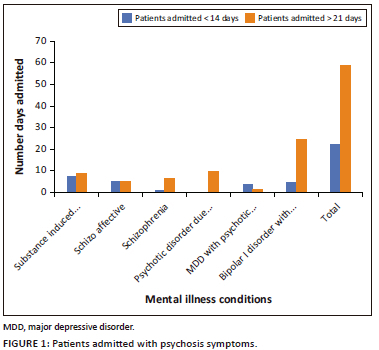
The study selected 100 files and reviewed 82 patient files: 28.05% (n = 23) in SSG (<14 days) and 72% (n = 59) in LSG (> 21 days). The other files were invalid because of lack of information. More than 80% of patients were South African and nearly 30% of participants in the study had higher qualifications. There was no significant difference in terms of nationality or educational level among the two groups the results can be seen in Figure 1.
The age of participants was not normally distributed (SSG: W = 0.884, p = 0.0177; LSG W = 0.928, p = 0.0020). Consequently, median and interquartile range (IQR) of ages were reported. Participants in the SSG had a median age of 33 years (quartile IQR of 21 and quartile IQR 46), while participants in LSG had a median age of 35.5 years (lower IQR of 24 and upper IQR of 46). The oldest patient in LSG was 71 years, which was almost the same as the patient in SSG, who was 62 years. There was a significant difference in the age of patients between the SSG and LSG (p = 0.02).
In SSG, there were more men participants than women participants (men 78.3%, women 21.8%). While the LSG had equal proportions of men and women (men 49.2%, women 50.9%), there was a significant gender difference between SSG and LSG (p < 0.05).
In the SSG, 87% of patients were dominantly single compared to 64% of patients in LSG. The number of married people in the LSG was double that of single participants, and the number of widowed people in the LSG was tripled compared with the number of widowed people in SSG. Relationship status did not differ significantly between the two groups.
About 95% of patients from the SSG received support from their families, while 85% of patients in LSG received support from families (p < 0.05). Most of the patients had stable accommodation, and only about 8.5% in LSG were homeless. There were no homeless people in SSG. More than 60% of the patients were unemployed.
Clinical variables
Legal status was similar for MHCUs in both groups. According to the Mental Health Care Act, patients can be admitted in one of the three categories, namely voluntary, assisted or involuntary.11
Short stay group had a higher proportion of patients who presented for the first time (index presentations = 39%), while 33% of patients in LSG were index presentations. Long stay group had a higher proportion of known MHCUs (66.10%) compared to SSG (56.62%). The two groups did not differ in terms of the number of the index cases or the number of known MHCUs.
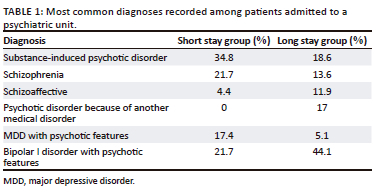
The study identified 10 diagnoses in the patient files. The most common diagnosis in SSG was substance-induced psychotic disorder, and the most common diagnosis in LSG was bipolar I disorder with psychotic features (Table 1). The Fisher's exact test showed that the SSG and the LSG had different proportions of psychotic disorders (p < 0.05).
Table 1 reflects the most common diagnoses recorded among patients admitted to a psychiatric unit. Short stay group refers to patients who were discharged within 14 days and LSG indicates patients who had long hospitalisations.
A large proportion of patients in SSG used illicit substances (73.9%) compared to LSG (44.1%) (p = 0.02). A larger proportion of patients in LSG had medical/surgical and psychiatric comorbidities (67.8%) compared to SSG (43.5%) (p < 0.04). The two groups had similar rates of second-generation antipsychotic use (SSG = 90%; LSG = 98.3%). More than 90% of patients (excluding patients who were index cases), irrespective of group, were known to have defaulted on their medication. Both groups had similar low incidence of complications from antipsychotic medications (SSG = 4.4%; LSG = 8.5%). More than 80% of patients were discharged from the acute unit in both groups.
System or organisational variables
Only 16% of patients from both groups were severely ill and required longer-term care. These patients needed to be transferred to the next level of care, which is Weskoppies Psychiatric Hospital. On average, patients had to wait an additional 3 weeks before being transferred to the next level of care. No MHCUs were deported to other countries from the unit. There was no notable erratic drug supply that impacted LOS.
Discussion
The study compared two groups of patients to establish differences between patients who had prolonged hospital stay beyond 21 days and patients who were discharged within 14 days. Patients who spent less time in the acute psychiatric unit tended to be young, medically healthy males presenting with acute substance-related disorders that were stabilised quickly.12
Long hospitalisation seemed to be more common among female patients who were presented with primary psychiatric disorders and different medical, surgical or obstetric comorbidities.
Family support was associated with shorter hospitalisation.1314
Depending on the severity of illness, having family support results in a quicker turnaround time because of family support and care beyond psychiatric hospitalisation.14
Although homelessness did not emerge as the main challenge in this study, it was noted among the patients in the long hospitalisation group that a large proportion of patients were also admitted under assisted or involuntary sections. The discharging of homeless patients is a challenge because it requires that social workers organise a suitable place that is licensed to look after MHCUs. Delaying the discharge of these patients results in 'bed blocking', where stable patients occupy beds in acute facilities when they should be transferred to a community mental healthcare facility. In this study, the problem was inadequate or unavailable community-based healthcare facilities.
Long hospitalisation seemed to be associated with certain conditions. In this study, substance-induced psychosis was more common in the SSG than in the long hospitalisation group. Surprisingly, patients with schizophrenia were more commonly diagnosed in the SSG than in the long hospitalisation group, which could be attributed to patients being transferred or discharged earlier than 2 weeks because medication could have been introduced at the referral site prior to admission. As the study group had older patients with more comorbidities, it made sense that psychosis because of another medical condition was common in the long hospitalisation patients.15
In the case where patients required rapid tranquillisation, doctors in this setting primarily used first-generation antipsychotic medication as Haloperidol 5 mg intramuscularly in combination with a short-acting benzodiazepine such as Lorazepam 4 mg.165
Limitations
There was no validated scale or tool. Some clinical files were excluded because of errors in the recorded final diagnoses or missing data, thus reducing the sample size. Clinicians could not accurately record disease severity, which could explain the reasons for longer hospitalisation or the need for transfer to higher levels of care. Poor record-keeping also reduced the amount of raw data that were available for analysis and interpretation.
Strengths
To our knowledge, this is the first study to examine the factors affecting long hospitalisation in MHCU at an acute psychiatry unit in South Africa.
Conclusion
Shorter stays in psychiatry wards at SBAH were associated with younger males presenting with conditions that require rapid stabilisation. Long stay was found to be associated with older females with primary psychotic disorders and comorbidities. In this setting, a digital system that records data to avoid missing files and loss of information is needed. Although deinstitutionalisation remains a challenge in South Africa, patients' family members assist with continuation of care; hence, 95% of patients in the SSG had family support.
Competing interests
The authors declare that they have no financial or personal relationship(s) that may have inappropriately influenced them in writing this article.
Authors' contributions
T.P.Z. contributed the conception of the article. L.N.M. reviewed the article and G.P.G. revised the draft.
Funding information
The authors received no financial support for the research, authorship, and/or publication of this article.
Data availability
The data set is not available for publicity because of the agreement with the participants.
Disclaimer
The views and opinions expressed in this article are those of the authors and are the product of professional research. It does not necessarily reflect the official policy or position of any affiliated institution, funder, agency, or that of the publisher. The authors are responsible for this article's results, findings, and content.
Acknowledgements
The University of Pretoria for supporting and participants who took part in the study.
References
-
1. Lund C, Flisher AJ. Norms for mental health services in South Africa. Soc Psychiatry Psychiatr Epidemiol. 2006;41(7):587-594. https://doi.org/10.1007/s00127-006-0057-z
» https://doi.org/10.1007/s00127-006-0057-z -
2. Docrat S, Besada D, Cleary S, Daviaud E, Lund C. Mental health system costs, resources and constraints in South Africa: A national survey. Health Policy Plan. 2019;34(9):706-719. https://doi.org/10.1093/heapol/czz085
» https://doi.org/10.1093/heapol/czz085 -
3. Newman L, Harris V, Evans LJ, Beck A. Factors associated with length of stay in psychiatric inpatient services in London, UK. Psychiatr Q. 2018;89(1):33-43. https://doi.org/10.1007/s11126-017-9498-7
» https://doi.org/10.1007/s11126-017-9498-7 -
4. Ranchod S, Childs B, Abraham M, Taylor R. International benchmarking of hospital utilisation: How does the South African private sector compare? S Afr Actuar. 2016;16(1):69-90. https://doi.org/10.4314/saaj.v16i1.3
» https://doi.org/10.4314/saaj.v16i1.3 -
5. Baeza FL, Da Rocha NS, Fleck MP. Predictors of length of stay in an acute psychiatric inpatient facility in a general hospital: A prospective study. Braz J Psychiatry. 2017;40:89-96. https://doi.org/10.1590/1516-4446-2016-2155
» https://doi.org/10.1590/1516-4446-2016-2155 -
6. Barnett BS, Kusunzi V, Magola L, et al. Factors associated with long length of stay in an inpatient psychiatric unit in Lilongwe, Malawi. Soc Psychiatry Psychiatr Epidemiol. 2019;54(2):235-242. https://doi.org/10.1007/s00127-018-1611-1
» https://doi.org/10.1007/s00127-018-1611-1 -
7. Addisu F, Wondafrash M, Chemali Z, Dejene T, Tesfaye M. Length of stay of psychiatric admissions in a general hospital in Ethiopia: A retrospective study. Int J Ment Health Syst. 2015;9(1):1-9. https://doi.org/10.1186/s13033-015-0006-x
» https://doi.org/10.1186/s13033-015-0006-x -
8. Zhang J, Harvey C, Andrew C. Factors associated with length of stay and the risk of readmission in an acute psychiatric inpatient facility: A retrospective study. Aust NZ J Psychiat. 2011;45(7):578-585. https://doi.org/10.3109/00048674.2011.585452
» https://doi.org/10.3109/00048674.2011.585452 -
9. González-Estrada E, Villaseñor JA, Acosta-Pech R. Shapiro-Wilk test for multivariate skew-normality. Comput Stat. 2022;37(4):1985-2001. https://doi.org/10.1007/s00180-021-01188-y
» https://doi.org/10.1007/s00180-021-01188-y - 10. Preacher KJ, Briggs NE. Calculation for Fisher's exact test. Nashville, TN: The Guilford Press; 2015.
-
11. Ramlall S. The Mental Health Care Act No 17-South Africa: Trials and triumphs: 2002-2012. Afr J Psychiatry. 2012;15(6):407-410. https://doi.org/10.4314/ajpsy.v15i6.49
» https://doi.org/10.4314/ajpsy.v15i6.49 -
12. Weissinger GM, Carthon JMB, Brawner BM. Non-psychiatric hospitalization length-of-stay for patients with psychotic disorders: A mixed methods study. Gen Hosp Psychiatry. 2020;67:1-9. https://doi.org/10.1016/j.genhosppsych.2020.07.007
» https://doi.org/10.1016/j.genhosppsych.2020.07.007 -
13. Weissinger GM, Brooks Carthon JM, Ahmed C, Brawner BM. Experiences of hospitalization of patients with psychotic disorders on medical-surgical units: A thematic analysis. J Am Psychiatr. 2021;27(4):306-321. https://doi.org/10.1177/1078390319892313
» https://doi.org/10.1177/1078390319892313 -
14. Keshavan MS, Davis B, Friedman-Yakoobian M, Mesholam-Gately RI. What is my diagnosis, Doc?: Discussing psychosis diagnosis with patients and families. Schizophr Res. 2022;239:92-94. https://doi.org/10.1016/j.schres.2021.10.009
» https://doi.org/10.1016/j.schres.2021.10.009 -
15. Ferrara M, Guloksuz S, Hazan H, et al. The effect of duration of untreated psychosis (DUP) on the risk for hospitalization after admission to a first episode service. Schizophr Res. 2023;260:198-204. https://doi.org/10.1016/j.schres.2023.08.005
» https://doi.org/10.1016/j.schres.2023.08.005 -
16. Kim HK, Leonard JB, Corwell BN, Connors NJ. Safety and efficacy of pharmacologic agents used for rapid tranquilization of emergency department patients with acute agitation or excited delirium. Exp Opin Drug Saf. 2021;20(2):123-138. https://doi.org/10.1080/14740338.2021.1865911
» https://doi.org/10.1080/14740338.2021.1865911

Accepted: 07 Mar. 2024
Published: 23 Apr. 2024