Validation of the Whooley questions for antenatal depression and anxiety among low-income women in urban South Africa
Abstract
BACKGROUND/OBJECTIVE: In South Africa, approximately 40% of women suffer from depression during pregnancy. Although perinatal depression and anxiety are significant public health problems impacting maternal and infant morbidity and mortality, no routine mental health screening programmes exist in the country. A practical, accurate screening tool is needed to identify cases in these busy, resource-scarce settings. METHOD: A convenience sample of 145 women between 22 and 28 weeks gestation was recruited from Rahima Moosa Hospital antenatal clinic in Johannesburg. All women completed a biographical interview, the Edinburgh Postnatal Depression Scale (EPDS), the Whooley questions and a structured clinical interview. RESULTS: The results demonstrate the sensitivity and specificity of the Whooley questions and the EPDS in identifying depression, anxiety and stress disorders of varying severity. The importance of personal, social and cultural context in influencing the content and expression of these common perinatal conditions was also identified. DISCUSSION AND CONCLUSION: The validity of the Whooley questions in the context of urban South Africa, and the importance of ensuring clinical interviews to supplement any screening tools, is emphasised.
Introduction
The rate of perinatal depression among South African women living in relative poverty is approximately 40.0%,1,2,32,45,678,91011,12,13,141516,1718191,2021,222,2324
Choosing the best screening tool for a screening programme depends on the context. One needs to consider the population being screened, as well as who will be administering and interpreting the results. As depression screening becomes more routine, the length of the tool also becomes important. Shorter tools, which are less time-consuming, are favoured over longer tools. Case finding questions can identify anxiety and depression with reasonable accuracy.25
The National Institute of Clinical Excellence (NICE) 2014 Service Guidelines recommend the use of the Whooley case finding questions for screening.2626,272728,29,30
Gaps exist in the detection of mental illness at the primary care level in South Africa, partly as a result of ineffective screening tools.3132,3334,3532
The aim of the study reported in this article was to evaluate the Whooley case finding questions as a potential screening tool, against a clinical interview and the Edinburgh Postnatal Depression Scale (EPDS). The study was conducted in a state hospital in Johannesburg. We determined whether the Whooley questions can be used as a practical, accurate screening tool and whether the addition of the 'help' question enhanced its utility.
Method
Sample size
A sample size of 145 patients was required to estimate sensitivity and specificity at 75% with 11% precision (rather than 10%), which is reasonable, given the exploratory nature of the study, with a 95% confidence interval, and the prevalence of the diagnosis of 40%.
Study design
The study was conducted at Rahima Moosa Hospital in Johannesburg, South Africa. Rahima Moosa is a tertiary level mother and child hospital, and a training hospital affiliated with the University of the Witwatersrand. Women who attend the antenatal clinic in this setting all have high-risk pregnancies, defined as a condition that puts the mother and developing foetus at higher-than-normal-risk for complications during birth and pregnancy.23
A convenience sample of women attending the antenatal clinic at Rahima Moosa Hospital was used as only the principal investigator was collecting data, and the volume of women seen daily was high, making consecutive sampling difficult. The inclusion criteria were women able to communicate in English attending the antenatal clinic, 18 years or older, between 22 and 28 weeks pregnant, willing to participate and who provided informed consent forms.
Of a total of 149 women approached to partake, four were not able to communicate adequately in English and thus their interviews were terminated. The remaining 145 patients provided informed consent and participated in the interview. Data were collected between July 2015 and April 2016.
Assessments
The Whooley questions and the EPDS are screening tools used to detect possible perinatal depression.
Edinburgh Postnatal Depression Scale
The most widely recognised screening instrument for perinatal depression is the EPDS. This scale was validated in South Africa, with a group of postnatal women at Rahima Moosa Hospital in 1998.3637373636
Whooley questions
The Whooley questions address core symptoms of depression (low mood and lack of interest):
1. During the past month, have you often been bothered by feeling down, depressed or hopeless?
2. During the past month, have you often been bothered by having little interest or pleasure in doing things?
3. A positive test is a 'yes' answer to either of those questions, and then a third question is posed:
4. Do you think it is something you want help with?
This third question provides an opportunity for the patient to request help with these symptoms.29
Clinical interview
The clinical interviews were undertaken by the principal investigator, a psychiatrist, using the NetSCID, an electronic research version, non-patient edition of the Structure Interview of DSM (SCID) as a guide and aligning the diagnoses with the DSM-5 classification. Only the mood and anxiety disorder modules, including stress/trauma related disorders, were administered. The DSM-5 categories of unspecified anxiety and depression were used to categorise subsyndromal but clinically significant symptoms of anxiety and depression, respectively. This is important because subsyndromal symptoms of anxiety and depression can cause similar levels of distress as reported in women with a clear diagnosis3839
Ethical consideration
Ethics clearance was granted by the Human Research Ethics Committee of the University of the Witwatersrand.
Analysis
Categorical variables were summarised by frequency and percentage tabulation. Continuous variables were described by the mean, standard deviation (SD), median and interquartile range (IQR). For the comparison between demographic and risk factor and diagnosis, patients were classified as having no diagnosis, a diagnosis of depression or a diagnosis of trauma-related/anxiety disorder. The χ22d.
The sensitivity and specificity (together with 95% confidence intervals) of the Whooley test, EPDS and EPDS anxiety subscale in identifying the various diagnoses were calculated, with the diagnostic interview used as the reference standard. Here, the diagnoses were considered as follows: (1) any diagnosis versus no diagnosis, (2) anxiety/trauma versus no/any other diagnosis and (3) depressive disorders versus no/any other diagnosis. Trauma-related disorders were grouped with anxiety disorders as there were very few to analyse separately. By considering different cut points for the scales, receiver-operating characteristic (ROC) curves were generated. The impact of the Whooley questions, including the 'help' question, on the diagnosis of depression was determined by log-binomial regression. Data analysis was carried out using SAS Version 9.4 for Windows. The 5% significance level was used.
Results
The mean age of the sample was 31.1 years (range 18-42 years; s.d. = 6.0 year). The majority of women were married/cohabiting (77.9%). Sixty-three (43.5%) women had completed school and 36 (24.8%) had some form of tertiary education, while four (2.8%) women had only attended primary school. The majority of women were working (52.4%), either full-time (39.3%) or part-time (13.1%), 25.0% were unemployed and looking for work, consistent with the general unemployment rate in South Africa,2340
Participants were fairly evenly spread between 22 and 28 weeks of pregnancy. The antenatal clinic sees women who have high-risk pregnancies, and in this sample, 95.2% of participants were defined as high risk. It is not unexpected then that 41.4% of these women had experienced a previous miscarriage or stillbirth. Most women (91.0%) in the study group reported that they were happy about the pregnancy, illustrating that mostly the babies were wanted, even if they were unexpected pregnancies. Approximately 19.0% of the participants were HIV-positive; the rest were HIV-negative. This is in contrast to much higher rates of HIV infection recorded in women in antenatal clinics in the rest of the country.23
Overall, on the basis of the clinical interview, 56 (38.6%) of the participants were found to have at least one diagnosis of a perinatal mental disorder. Twenty-eight (19.3%) had depression, of whom 16 (11.0%) had major depression. Thirty-two women had diagnosis of either an anxiety disorder (21; 14.5%) or a trauma-related disorder (11; 7.6%). Only 20.0% of women felt that they needed help according to the 'help' questions of the Whooley questions, thus having a positive screen. Twenty-seven (18.6%) women had a diagnosis of a past mental illness on the clinical interview, although only 19 (13.1%) received treatment in the past, while eight (30.0%) of these women were untreated for their previous mental illness.
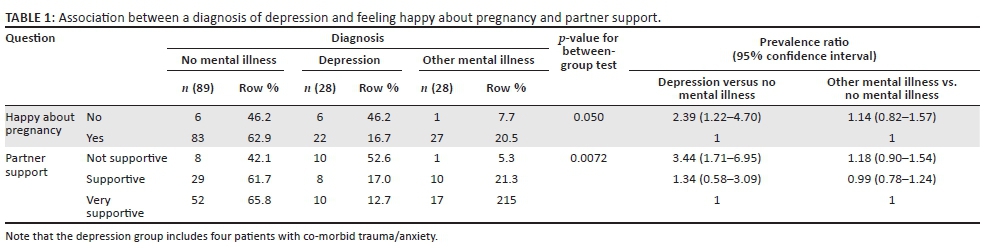
The mean age of those with trauma/anxiety (29.0 years; s.d. = 6.5 y) was significantly lower than that for those without any diagnosis (32.1 years; s.d. = 5.5 y; p = 0.040). The effect size was moderate (Cohen's d = 0.55). There were no other significant associations between any other social and demographic variables and having a diagnosis. There was a marginal, weak, association between happiness about pregnancy and diagnosis of depression (Fisher's exact test; p = 0.050; phi coefficient = 0.21); 16.7% of those who are happy about the pregnancy have depression, compared with 46.2% of those who are not happy about the pregnancy. There was also a significant, moderate, association between partner support and diagnosis of depression (Fisher's exact test; p = 0.0072; phi coefficient = 0.34), 12.7% of those who have very supportive partners have depression compared with 52.6% of those who do not have supportive partners. Women diagnosed with depression had a higher proportion of unsupportive partners compared with those not diagnosed with depression (Table 1).
Whooley questions
To establish a diagnosis (a positive screen) using the Whooley questions excluding the 'help' question, the optimal cut-off point is a score of 2, that is, answering 'yes' to the first two questions, giving a sensitivity and specificity of 64.3% and 79.8%, respectively. To establish a diagnosis (a positive screen) using the Whooley questions including the 'help' question, the optimal cut-off point is a score of ≥ 2, that is, answering 'yes' to two or more of the questions, including the 'help' question, giving a sensitivity and specificity of 73.2% and 76.4%, respectively. The sensitivity increased when the 'help' question was added (p = 0.31) (Figure 1a). The Whooley questions, including the 'help' question, had greater discrimination for depression than for anxiety/trauma disorders (Figure 1b).
The specificity of the Whooley questions, including the 'help' question (63.2%), was significantly higher than that of the Whooley questions, excluding the 'help' question (42.1%) for a diagnosis of trauma/anxiety (p = 0.0014). There was a significant association between the 'help' question and diagnosis (chi-squared test; p < 0.0001; Cramer's V = 0.48). Those who indicated that they wanted help were more likely to have a diagnosis of depression (51.7%) or anxiety/trauma (31.0%) compared with those who indicated that they did not want help (11.2% and 16.4%, respectively). The impact of the Whooley questions, including the 'help' question, on the diagnosis of depression as determined by log-binomial regression is shown in Table 2. The first Whooley question and the 'help' question were both significant. The prevalence ratios indicate that 'yes' answers for each of these questions are associated with an increased likelihood of a diagnosis of depression. The second Whooley question was not significant. This shows that the 'help' question is useful in screening for depression.
Edinburgh Postnatal Depression Scale
The median EPDS score was 10 (IQR 6-14; range 0-25). To establish a diagnosis, the optimal cut-off point is a score of ≥ 12, giving a sensitivity and specificity of 78.6% and 84.3% respectively. Although the optimal cut-off points differed (≥ 14 for depression and ≥ 11 for trauma/anxiety), the EPDS seemed to have greater discrimination towards depression than towards anxiety/trauma. There was no significant difference between the Whooley questions, excluding or including the 'help' question, and the EPDS when it came to sensitivity for depression. The EPDS had significantly higher specificity for depression (88.0%) than the Whooley questions, whether excluding or including the 'help' question (72.6 and 68.4, respectively; Table 3a and Table 3b). The EPDS had slightly lower specificity (60.5%) for anxiety/trauma than the Whooley questions, excluding the 'help' question (42.1%).
Edinburgh Postnatal Depression Scale anxiety subscale
The median EPDS anxiety subscale score was 5 (IQR 3-7; range 0-9). For the anxiety/trauma diagnosis, the optimal cut-off point is a score of ≥ 7, giving a sensitivity and specificity of 54.8% and 81.6%, respectively. The EPDS anxiety subscale had significantly lower sensitivity (54.8%) for anxiety/trauma than the Whooley questions, excluding the 'help' question, (80.6%) and EPDS (80.6%), but significantly higher specificity (81.6%) for anxiety/trauma, than the Whooley questions, excluding the 'help' question (42.1%) and EPDS (60.5%).
Discussion
Screening for anxiety is as important as screening for depression. Despite this, there are few studies on perinatal anxiety and no adequately validated screening tool for anxiety in South Africa. In this study, the rate of perinatal mental disorder was 38.6%. Of those women with disorders, 19.0% had a depressive disorder and 21.4% had trauma/anxiety disorder. This is comparable with other studies that report that anxiety disorders are more prevalent than depressive disorders in women antenatally.32,411,2,323
A weak association was noted between younger age and a diagnosis. This is in keeping with other literature that describes younger age as a risk factor. There was also a weak association between being happy about the pregnancy, partner support and depression, again in keeping with other South African studies.1,2,42
In the original validation study of the Whooley questions, the sensitivity and specificity were 96.0% and 57.0%, respectively, making it a promising screening tool.4344,4545,46
The EPDS anxiety subscale performed poorly as a screening tool for anxiety/trauma disorders with a sensitivity of 54.8%; however, it showed a good specificity of 81.6%. The Whooley questions, excluding the 'help' question, show greater sensitivity for the anxiety/trauma diagnosis than the EPDS anxiety subscale. For this reason, the Whooley questions could be used to screen for all perinatal mental disorders including anxiety disorders.
Conclusion
There is currently no policy on routine screening for perinatal depression and anxiety in South Africa.35
Competing interests
The authors declare that they have no financial or personal relationships which may have inappropriately influenced them in writing this article.
Authors' contributions
C.M., L.M. and U.S. equally contributed to the research and writing of this article.
Acknowledgements
The publication emanated from funding provided by the SAMRC in terms of the Clinician Researcher PhD Programme.
References
-
1. Hartley M, Tomlinson M, Greco E, et al. Depressed mood in pregnancy: Prevalence and correlates in two Cape Town peri-urban settlements. Reprod Health. 2011;8:9. https://doi.org/10.1186/1742-4755-8-9
» https://doi.org/10.1186/1742-4755-8-9 -
2. Manikkam L, Burns JK. Antenatal depression and its risk factors: An urban prevalence study in KwaZulu-Natal. SAMJ. 2012;102(12):940-944. https://doi.org/10.7196/SAMJ.6009
» https://doi.org/10.7196/SAMJ.6009 -
3. Rochat TJ, Tomlinson M, Bärnighausen T, Newell M-L, Stein A. The prevalence and clinical presentation of antenatal depression in rural South Africa. J Affect Disord. 2011;135(1):362-373. https://doi.org/10.1016/j.jad.2011.08.011
» https://doi.org/10.1016/j.jad.2011.08.011 - 4. World Health Organisation, United Nations Population Fund, Key Centre for Women's Health in Society. Mental health aspects of women's reproductive health: A global review of the literature. Geneva: World Health Organization Press; 2009.
-
5. O'Hara MW, Wisner KL. Perinatal mental illness: Definition, description and aetiology. Best Pract Res Clin Obstet Gynaecol. 2014;28(1):3-12. https://doi.org/10.1016/j.bpobgyn.2013.09.002
» https://doi.org/10.1016/j.bpobgyn.2013.09.002 - 6. Meltzer-Brody S. New insights into perinatal depression: Pathogenesis and treatment during pregnancy and postpartum. Dialogues Clin Neurosci. 2011;13(1):89.
-
7. Grote NK, Bridge JA, Gavin AR, Melville JL, Iyengar S, Katon WJ. A meta-analysis of depression during pregnancy and the risk of preterm birth, low birth weight, and intrauterine growth restriction. Arch Gen Psychiatry. 2010;67(10):1012-1024. https://doi.org/10.1001/archgenpsychiatry.2010.111
» https://doi.org/10.1001/archgenpsychiatry.2010.111 -
8. Rahman A, Iqbal Z, Bunn J, Lovel H, Harrington R. Impact of maternal depression on infant nutritional status and illness: A cohort study. Arch Gen Psychiatry. 2004;61(9):946-952. https://doi.org/10.1001/archpsyc.61.9.946
» https://doi.org/10.1001/archpsyc.61.9.946 -
9. Stewart RC. Maternal depression and infant growth - A review of recent evidence. Matern Child Nutr. 2007;3(2):94-107. https://doi.org/10.1111/j.1740-8709.2007.00088.x
» https://doi.org/10.1111/j.1740-8709.2007.00088.x -
10. Hanlon C, Medhin G, Alem A, et al. Impact of antenatal common mental disorders upon perinatal outcomes in Ethiopia: The P-MaMiE population - Based cohort study. Trop Med Int Health. 2009;14(2):156-166. https://doi.org/10.1111/j.1365-3156.2008.02198.x
» https://doi.org/10.1111/j.1365-3156.2008.02198.x -
11. Jones NA, Field T, Fox NA, Davalos M, Lundy B, Hart S. Newborns of mothers with depressive symptoms are physiologically less developed. Infant Behav Dev. 1998;21(3):537-541. https://doi.org/10.1016/S0163-6383(98)90027-3
» https://doi.org/10.1016/S0163-6383(98)90027-3 -
12. Patel V, DeSouza N, Rodrigues M. Postnatal depression and infant growth and development in low income countries: A cohort study from Goa, India. Arch Dis Child. 2003;88(1):34-37. https://doi.org/10.1136/adc.88.1.34
» https://doi.org/10.1136/adc.88.1.34 -
13. Glover V. Maternal depression, anxiety and stress during pregnancy and child outcome: What needs to be done. Best Prac Res Clin Obstet Gynaecol. 2014;28(1):25-35. https://doi.org/10.1016/j.bpobgyn.2013.08.017
» https://doi.org/10.1016/j.bpobgyn.2013.08.017 -
14. King S, Laplante DP. The effects of prenatal maternal stress on children's cognitive development: Project Ice Storm. Stress. 2005;8(1):35-45. https://doi.org/10.1080/10253890500108391
» https://doi.org/10.1080/10253890500108391 -
15. Deyessa N, Berhane Y, Emmelin M, Ellsberg MC, Kullgren G, Högberg U. Joint effect of maternal depression and intimate partner violence on increased risk of child death in rural Ethiopia. Arch Dis Child. 2010;95(10):771-775. https://doi.org/10.1136/adc.2009.165571
» https://doi.org/10.1136/adc.2009.165571 -
16. Oates M. Perinatal psychiatric disorders: A leading cause of maternal morbidity and mortality. Br Med Bull. 2003;67(1):219-229. https://doi.org/10.1093/bmb/ldg011
» https://doi.org/10.1093/bmb/ldg011 - 17. World Health Organisation. Maternal mental health and child health and development in low and middle income countries: Report of the meeting; 2008 30 Jan-1 Feb; Geneva, Switzerland: World Health Organisation; 2008.
-
18. Abrahams N, Mathews S, Martin LJ, Lombard C, Nannan N, Jewkes R. Gender differences in homicide of neonates, infants, and children under 5 y in South Africa: Results from the cross-sectional 2009 National Child Homicide Study. PLoS Med. 2016;13(4):e1002003. https://doi.org/10.1371/journal.pmed.1002003
» https://doi.org/10.1371/journal.pmed.1002003 -
19. Kathree T, Selohilwe OM, Bhana A, Petersen I. Perceptions of postnatal depression and health care needs in a South African sample: The 'mental' in maternal health care. BMC Women's Health. 2014;14(1):140. https://doi.org/10.1186/s12905-014-0140-7
» https://doi.org/10.1186/s12905-014-0140-7 - 20. Mathews S, Abrahams N, Martin LJ, Vetten L, Van Der Merwe L, Jewkes R. A national study of female homicide in South Africa. CiteSeerX; 2004.
- 21. Mfecane S. Living with HIV as a man: Implications for masculinity. Psychol Soc. 2008;36:45-59.
- 22. Wilson F. On being a father and poor in southern Africa today. In Richtes L, Morrell R editors. Baba: Men and fatherhood in South Africa. Cape Town: HSRC Press, 2006; p. 26-37.
-
23. National Department of Health. The 2013 National Antenatal Sentinel HIV Prevalence Survey, South Africa. 2013 [cited 2017 Feb 10]. Available from: https://www.health-e.org.za/wp-content/uploads/2016/03/Dept-Health-HIV-High-Res-7102015.pdf
» https://www.health-e.org.za/wp-content/uploads/2016/03/Dept-Health-HIV-High-Res-7102015.pdf - 24. Milgrom J, Gemmill AW, editors. Identifying perinatal depression and anxiety evidence-based practice in screening psychosocial assessment, and management. Sussex, NJ: John Wiley & Sons, 2015; p. 7.
- 25. Mitchell AJ, Coyne JC. Do ultra-short screening instruments accurately detect depression in primary care? Br J Gen Pract. 2007;57(535):144-151.
-
26. Howard LM, Megnin-Viggars O, Symington I, Guideline Development Group. Antenatal and postnatal mental health: Summary of updated NICE guidance. BMJ. 2014;349:g7394. https://doi.org/10.1136/bmj.g7394
» https://doi.org/10.1136/bmj.g7394 -
27. Bosanquet K, Bailey D, Gilbody S, et al. Diagnostic accuracy of the Whooley questions for the identification of depression: A diagnostic meta-analysis. BMJ Open. 2015;5(12):e008913. https://doi.org/10.1136/bmjopen-2015-008913
» https://doi.org/10.1136/bmjopen-2015-008913 -
28. Hill C. An evaluation of screening for postnatal depression against NSC criteria. London: UK National Screening Committee [homepage on the Internet]. 2010 [cited 17 Apr 2012]. Available from: http://www.screening.nhs.uk/postnataldepression
» http://www.screening.nhs.uk/postnataldepression - 29. National Collaborating Centre for Mental Health, editor. Antenatal and postnatal mental health: The NICE guideline on clinical management and service guidance 2007. Leicester: British Psychological Society; 2007.
-
30. Hewitt CE, Gilbody SM, Brealey S, et al. Methods to identify postnatal depression in primary care: An integrated evidence synthesis and value of information analysis. Health Technol Assess. 2009;13(36):1-145. https://doi.org/10.3310/hta13360
» https://doi.org/10.3310/hta13360 -
31. Demyttenaere K, Bruffaerts R, Posada-Villa J, et al. Prevalence, severity, and unmet need for treatment of mental disorders in the World Health Organization World Mental Health Surveys. JAMA. 2004;291(21):2581-2590. https://doi.org/10.1001/jama.291.21.2581
» https://doi.org/10.1001/jama.291.21.2581 -
32. van Heyningen T, Baron E, Field S, et al. Screening for common perinatal mental disorders in low-resource primary care antenatal settings in South Africa [homepage on the Internet]. 2014 [cited 2015 Jan 15]. Available from: http://www.pmhp.za.org/images/websiteMedia/documents/Policy/CPMH_ShortScreeningTool-PMHP.pdf
» http://www.pmhp.za.org/images/websiteMedia/documents/Policy/CPMH_ShortScreeningTool-PMHP.pdf -
33. Vythilingum B, Field S, Kafaar Z, et al. Screening and pathways to maternal mental health care in a South African antenatal setting. Arch Women's Ment Health. 2013;16(5):371-379. https://doi.org/10.1007/s00737-013-0343-1
» https://doi.org/10.1007/s00737-013-0343-1 -
34. Miller L, Shade M, Vasireddy V. Beyond screening: Assessment of perinatal depression in a perinatal care setting. Arch Women's Ment Health. 2009;12(5):329-334. https://doi.org/10.1007/s00737-009-0082-5
» https://doi.org/10.1007/s00737-009-0082-5 -
35. Honikman S, van Heyningen T, Field S, Baron E, Tomlinson M. Stepped care for maternal mental health: A case study of the perinatal mental health project in South Africa. PLoS Med. 2012;9(5):e1001222. https://doi.org/10.1371/journal.pmed.1001222
» https://doi.org/10.1371/journal.pmed.1001222 - 36. Lawrie TA, Hofmeyr GJ, De Jager M, Berk M. Validation of the Edinburgh Postnatal Depression Scale on a cohort of South African women. South Afr Med J. 1998;88(10):1340-1344.
-
37. Cox JL, Holden JM, Sagovsky R. Detection of postnatal depression. Development of the 10-item Edinburgh Postnatal Depression Scale. Br J Psychiatry. 1987;150(6):782-786. https://doi.org/10.1192/bjp.150.6.782
» https://doi.org/10.1192/bjp.150.6.782 -
38. Rucci P, Gherardi S, Tansella M, et al. Subthreshold psychiatric disorders in primary care: Prevalence and associated characteristics. J Affect Disord. 2003;76(1):171-181. https://doi.org/10.1016/S0165-0327(02)00087-3
» https://doi.org/10.1016/S0165-0327(02)00087-3 -
39. Rakofsky JJ, Schettler PJ, Kinkead BL, et al. The prevalence and severity of depressive symptoms along the spectrum of unipolar depressive disorders: A post hoc analysis. J Clin Psychiatry. 2013;74(11):1084-1091. https://doi.org/10.4088/JCP.12m08194
» https://doi.org/10.4088/JCP.12m08194 - 40. Basic services publication. Comparative information on basic services. Pretoria: Department of Cooperative Governance and Traditional Affairs; 2009.
-
41. Lee AM, Lam SK, Lau SMSM, Chong CSY, Chui HW, Fong DYT. Prevalence, course, and risk factors for antenatal anxiety and depression. Obstet Gynecol. 2007;110(5):1102-1112. https://doi.org/10.1097/01.AOG.0000287065.59491.70
» https://doi.org/10.1097/01.AOG.0000287065.59491.70 -
42. Project. PMH. Maternal mental health: Addressing key vulnerabilities. Policy Brief 15. [cited 2016 June 04]. Available from: http://pmhp.za.org/wp-content/uploads/2015/01/PolicyBrief_PMHP_0710.pdf
» http://pmhp.za.org/wp-content/uploads/2015/01/PolicyBrief_PMHP_0710.pdf -
43. Whooley MA, Avins AL, Miranda J, Browner WS. Case-finding instruments for depression. J Gen Intern Med. 1997;12(7):439-445. https://doi.org/10.1046/j.1525-1497.1997.00076.x
» https://doi.org/10.1046/j.1525-1497.1997.00076.x -
44. Arroll B, Smith FG, Kerse N, Fishman T, Gunn J. Effect of the addition of a 'help' question to two screening questions on specificity for diagnosis of depression in general practice: Diagnostic validity study. BMJ. 2005;331(7521):884. https://doi.org/10.1136/bmj.38607.464537.7C
» https://doi.org/10.1136/bmj.38607.464537.7C -
45. Gjerdingen D, Crow S, McGovern P, Miner M, Center B. Postpartum depression screening at well-child visits: Validity of a 2-question screen and the PHQ-9. Ann Fam Med. 2009;7(1):63-70. https://doi.org/10.1370/afm.933
» https://doi.org/10.1370/afm.933 -
46. Mann R, Adamson J, Gilbody SM. Diagnostic accuracy of case-finding questions to identify perinatal depression. CMAJ. 2012;184(8):E424-E30. https://doi.org/10.1503/cmaj.111213
» https://doi.org/10.1503/cmaj.111213

Accepted: 30 Jan. 2017
Published: 11 Apr. 2017