Demographic and clinical correlates of depression among older adults with arthritis in Nigeria
Abstract
BACKGROUND: Older adults have a high prevalence of chronic conditions like arthritis with morbidities, especially depression ranging up to 40% - 70%. Therefore, it is important to explore depression in older adults with arthritis AIM: This study aimed to determine if any demographic and clinical factors are associated with depression in older adults aged ≥ 60 years with arthritis attending a rheumatology clinic SETTING: This is a cross-sectional study conducted over 6 months among 127 older adults on follow-up care in a university teaching hospital in the North-Eastern region of Nigeria METHODS: A clinical proforma with information about the type of arthritis, duration of illness, hospitalisation, use of medications, co-morbidity was utilised for the data collection. The Geriatric Depression Scale (GDS-30), sociodemographic questionnaire and clinical proforma were administered. Data were analysed using Statistical Product and Service Solutions (SPSS) version 26.0 with the level of significance set as 0.05 RESULTS: The mean age (± standard deviation [s.d.]) was 66.6 (± 5.5) years, with males constituting 57.5%. The prevalence of depression was 57.8%. Osteoarthritis 30.2%, while 69.8% had rheumatoid arthritis. Sociodemographic factors associated with depression include age (p = 0.049), marital status (p = 0.001), and level of education (p = 0.001). Duration of illness (p = 0.02), hospitalisation (p = 0.03), and number of medications (p = 0.01) were clinical factors associated with depression score CONCLUSION: The prevalence of depression in older people with arthritis is high and was associated with females, the widowed, no formal education; and those with long duration of illness, those using multiple medications, and those with repeated hospitalisation CONTRIBUTION: This finding can enhance the suspicion index for depression to establish standard operating procedures, which will help to improve therapeutic practice for caring for the older adult age group
demographic; clinical; correlates; depression; older adults
Introduction
Older adults are a population of people above 60 years of age. Their population is on the increase because of the advances in medical treatment, with consequent reduction in death on account of communicable and non-communicable diseases.1,2 In fact, this decade, namely 2021-2030 has been declared as the decade of healthy ageing by the World Health Organization (WHO).3 4
Arthritis is a disabling condition, and often refers to a group of disorders associated with damage to the joints and surrounding tissues. It is a leading cause of disability globally, especially among the older adult population.5 6 7 5 8 9
Older adults that have arthritis, just like other chronic medical conditions, are at risk of developing neuropsychiatric morbidities. Depression has been described as the most common neuropsychiatric morbidity associated with this group of people.10 11 7 2
The relationship between depression and arthritis in older adults is multidirectional. First of all, the excruciating pain, stiffness and limitation of functioning associated with arthritis can lead to frustration, negative thoughts and reduced quality of life, which can result in depressed feelings and depressive disorder with time. Medications used to treat arthritis, like steroids have also been identified as risk factors for developing depression.10 12 13 14
Sociodemographic characteristics such as patient gender, level of education, employment status have been recognised as likely determinants of depression in individuals with rheumatoid arthritis.15 16 17 18
Occurrence of depression in older adults with arthritis has been found to be associated with poorer quality of life, poorer functioning and response to treatment, higher economic burden and increase in mortality.19
This study in North-eastern Nigeria draws attention to the prevalence of depression, and the sociodemographic and clinical factors that are associated with depression in older adults with arthritis in this region. It has a possible overreaching impact that may be achieved to increase awareness and management of depression among older adults with arthritis.
This study aimed to estimate the prevalence and severity of depression, and to determine the demographic and clinical correlates associated with depression in older adults with arthritis attending the rheumatology clinic.
Research methods and design
This research is a cross-sectional study conducted in the speciality clinics in the Maiduguri Metropolis, Borno State. Consecutive older adults ≥ 60 years who presented at the rheumatology clinic in the study location University of Maiduguri Teaching Hospital (UMTH), Maiduguri, Nigeria, were recruited over a 6-month period. The G*power version 3.1 software 19 was employed for the sample size estimation.20 21
Rheumatologists made the diagnosis of arthritis, and these diagnoses were retrieved from the medical records.22 23 24 13 25
Data collected were subjected to integrity and consistency tests before coding. Data collected were then double entered into the Statistical Product and Service Solutions (SPSS) version 26 using a well-defined codebook.26 p-value < 0.05 was considered significant. The univariate analysis measured the independent variables (age, gender, marital status, education, illness duration, medications, and hospitalisation) and the dependent variable (depression classified into no, mild and severe depression). Data were first tested for normality using the Kolmogorov-Smirnov test and then for equality of variance using the Levene test of variance. Where the data did not follow a normal distribution, a non-parametric test of Mann-Whitney U was utilised for two group variables (gender, co-morbidity) and the Kruskal Wallis H test for ≥ 3 groups (marital status, education, duration, medications, and hospitalisation) to compare the median scores across these independent variables. The higher the GDS-30 depression score, the more the severity of the depression.
Ethical considerations
This study was conducted after obtaining ethics approval from the Research and Ethics Committee (REC) of the study site UMTH with ethical clearance number UMTH/REC/21/779. The purpose, procedure, benefits, and other information on the study were explained to the participants to obtain their written informed consent. The information sheet explained the research procedure, while international ethical norms and standards were strictly adhered to. This procedure was used to ensure adherence to ethical guidelines on informed consent, and the protocol is consistent with the principles of the 1964 Declaration of Helsinki and its later amendments in 2013.
Results
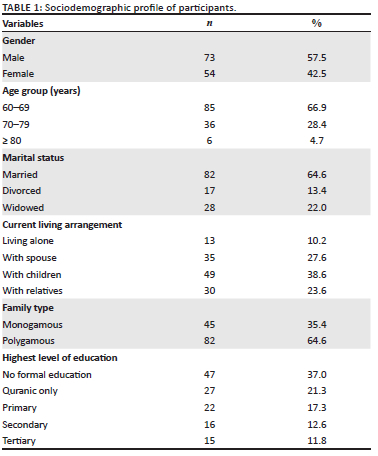
A total of 127 older adults participated in the survey. The age range was 60-82 years, with a median age (interquartile range [IQR]) of 66.0 (± 8.0) years (see Table 1). The mean age (± standard deviation [s.d.]) was 66.6 (± 5.5) years. About 85 (66.9%) participants were aged between 60 and 69 years, with male predominance constituting 73 (57.5%).
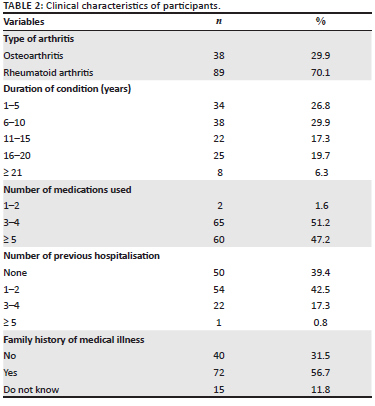
Among the 127 participants, osteoarthritis was present in 38 (29.9%), while 89 (70.1%) had rheumatoid arthritis (see Table 2). Of the total participants, 72 (56.7%) have been suffering from arthritis for 10 years or less, with 77 (60.8%) previously admitted for medical condition, while 65 (51.2%) were using between 3 and 4 medications for the arthritis.
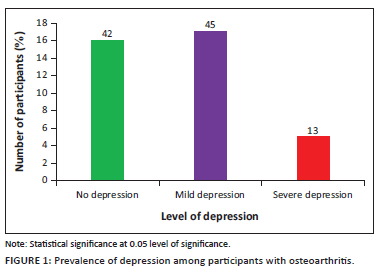
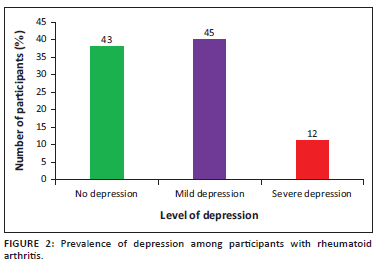
The rates of depression in the different populations with osteoarthritis and those with rheumatoid arthritis are as shown in Figure 1 and Figure 2.
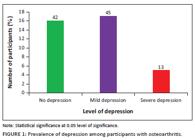
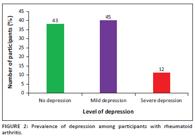
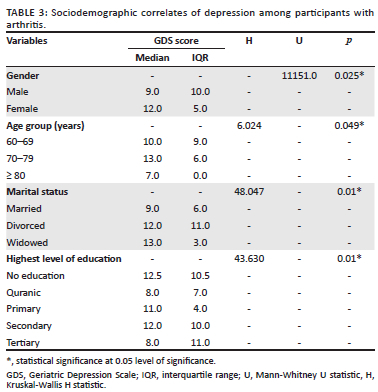
Table 3 shows the sociodemographic correlates of depression in the study. Depression was more common among the age group 70-79 years with median GDS score (and H value) of 13.0 (6.024), and a barely significant p-value = 0.049. The widowed had the median GDS score (and H value) of 13.0 (48.047) and p-value = 0.001; and those with no formal education had the median GDS score (and H value) of 12.5 (43.630) and p-value = 0.01.
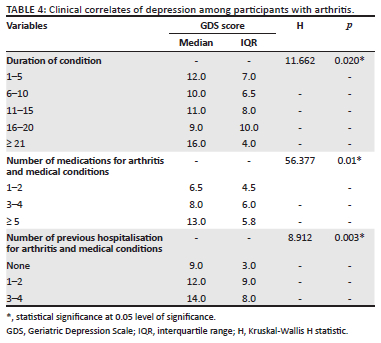
Table 4 shows the clinical correlates of depression in the study. Geriatric Depression Scale scores were also significantly higher among those with the longest duration of the medical condition for 21 years and above, with a median of 16.0 and p-value of 0.020; those taking five or more medications with a median of 13.0 and p-value of 0.001; and those with 3-4 admissions with a median of 14.0 and p-value of 0.003.
Discussion
This study assessed the prevalence of depression and its sociodemographic and clinical correlates among older adults with arthritis attending the rheumatology clinic.
Our study shows that depression rate is high among patients with arthritis with a rate of 57.8% (25.8% for OA, and 32.0% for RA). This may be because of the effects of monoaminergic neurotransmission and the production of neurotrophic factors in arthritis. Also, some of the musculoskeletal clinical features of arthritis, such as fatigue, chronic pain27 2816 29
The age distribution of patients in this study showed that patients were between the age of 60 and 82 years. The median age (IQR) was 66.0 (8.0) years. A large proportion (67%) of patients were 60-69 years old, while about 6 in 10 (57.5%) of them were males. Generally, the males in the North-eastern region present more at the hospital partly because of socio-cultural reasons because they have the opportunity to move around, unlike the females, who need permission to do so, and thus may be relatively isolated.30
Depression was more common among the females than the males in the study. This concurs with the WHO report that women are 2-3 times more likely than males to suffer from depression.2632 33,34
Although our study found a relationship between age and depression, some other studies did not. These include the study by Majekodunmi et al. who did not find a significant relationship between the age of the respondents and depression25 35
In this study, the widowed were also more depressed than the others, while the least depressed were the married. This is comparable with the observation of Gureje et al.36 33
The participants with tertiary education were the least depressed in this study. This may be because individuals with higher educational attainment are more enlightened with respect to their health and can better understand the disease state and instructions given concerning healthy living and drug usage.374
In line with a previous study by Mohammed et al. in Maiduguri, the finding of longer duration of illness being associated with depression in this study conforms with that of the previous finding of depression among the patients of a general hospital.3839
Study limitations
The study was limited because it was hospital-based and employed screening tools. Therefore, diagnostic instruments such as the Mini International Neuropsychiatric Interview (MINI) and Composite International Diagnostic Interview (CIDI) were not used which would have enhanced the credibility of the depression found in the study. Also, the cross-sectional study design was adequate for detecting associations; however, it could not permit the determination of the direction of causality between the outcome and explanatory variables. In addition, a multivariate analysis model was not fitted to control for confounders. However, the study is strengthened by the considerably adequate sample size, while the tools used are internationally recognised and valid. Finally, a study of such magnitude involves participants with heterogeneous people with different backgrounds.
These limitations have implications on the findings of this study. For example, the cross-sectional design is faced with an inability to establish causality while the hospital-based nature sets a caution on generalising the findings for the populace. These call for a need for community-based longitudinal studies to examine the causal links and more predictive value of the factors investigated.
Conclusion and recommendations
This study found that depression is common among older adults with arthritis, with increased prevalence and severity among those with rheumatoid type, and that sociodemographic factors like female gender, age between 70 and 79 years, having Western education and being widowed were associated with depression. Also, clinical factors like longer duration of illness, larger number of hospital admissions and higher number of medications were associated with depression among older adults with arthritis.
In addition, age, marital status, and education are sociodemographic factors that affect the development of depression among older adults with arthritis, while medications, hospitalisation and duration of the condition are some clinical factors associated with depression among older adults with arthritis.
We thereby recommend a proactive routine use of assessment tools in rheumatology clinics to screen older adults with arthritis to raise the index of suspicion for depression for prompt diagnosis. Also, there should be policy formulation to enhance this practice for early intervention to address the identified factors associated with depression in this study. Furthermore, there should be more extensive and longitudinal research works to support the relationships discovered in this study and possibly establish causality. Finally, there is a need for interdisciplinary team management that might involve a geriatric psychiatrist, a rheumatologist, clinical psychologist, and a social worker to liaise and collaborate effectively to provide diverse perspectives in working on the findings from this study.
Competing interests
The authors declare that they have no financial or personal relationships that may have inappropriately influenced them in writing this article.
Authors' contributions
Y.A.K. devised the project, the main conceptual ideas, and the proof outline. Y.A.K. and P.N.O. worked out almost all the technical details. Y.A.K., T.A.A. and I.O.A. performed the data curation and interpretation with help from R.U. F.A.A. and K.A.A. verified the results by an independent implementation. T.A.A., F.A.A., P.N.O. and R.U. ensured project administration and supervision. All the authors provided critical feedback and helped shape the research, analysis and the manuscript.
Funding information
The authors received no financial support for the research, authorship, and/or publication of this article.
Data availability
The data supporting this study's findings are available on request from the corresponding author (Y.A.K.). The data are not publicly available because of their containing information that could compromise the privacy of research participants.
Disclaimer
The views and opinions expressed in this article are those of the authors and are the product of professional research. It does not necessarily reflect the official policy or position of any affiliated institution, funder, agency, or that of the publisher. The authors are responsible for this article's results, findings, and content.
Acknowledgements
We thank the management, staff and patients of the rheumatology clinic of the study location, the research assistants, Dr Galadima and Dr Sham, and the Head of research and training and Chairman of the Health Research and Ethics Committee, Dr Umar Baba Musami.
References
-
1. Cadmus E, Adebusoye L, Olowookere O, Oluwatosin O, Owoaje E, Alonge T. A descriptive study of the morbidity pattern of older persons presenting at a Geriatric Centre in Southwestern Nigeria. Niger J Clin Pract. 2017;20(7):873-878. https://doi.org/10.4103/njcp.njcp_362_16
» https://doi.org/10.4103/njcp.njcp_362_16 -
2. Moussavi S, Chatterji S, Verdes E, Tandon A, Patel V, Ustun B. Depression, chronic diseases, and decrements in health: Results from the World Health Surveys. Lancet. 2007;370(9590):851-858. https://doi.org/10.1016/S0140-6736(07)61415-9
» https://doi.org/10.1016/S0140-6736(07)61415-9 -
3. WHO. The Global strategy and action plan on ageing and health 2016-2020: Towards a world in which everyone can live a long and healthy life. World Health Assembly, 73 [homepage on the Internet]. 2020 [cited 2024 Apr 15];20(February):1-24. Available from: https://www.who.int/initiatives/decade-of-healthy-ageing%0Ahttps://www.who.int/initiatives/decade-of-healthy-ageing/connection-series%0Ahttps://www.who.int/ageing/decade-of-healthy-ageing
» https://www.who.int/initiatives/decade-of-healthy-ageing%0Ahttps://www.who.int/initiatives/decade-of-healthy-ageing/connection-series%0Ahttps://www.who.int/ageing/decade-of-healthy-ageing -
4. Baiyewu O, Esan O, Elugbadebo O. Mental health of older adults. In: Innovations in global mental health [homepage on the Internet]. Cham: Springer International Publishing, 2021; p. 1379-1397. [cited 2024 Apr 15]. Available from: https://link.springer.com/10.1007/978-3-030-57296-9_119
» https://link.springer.com/10.1007/978-3-030-57296-9_119 -
5. Arthritis Foundation. Arthritis support, resources, research & advocacy [homepage on the Internet] [cited 2024 Apr 15]. Available from: https://www.arthritis.org/
» https://www.arthritis.org/ -
6. Whiteford HA, Ferrari AJ, Degenhardt L, Feigin V, Vos T. The global burden of mental, neurological and substance use disorders: An analysis from the Global Burden of Disease Study 2010. PLoS One. 2015;10(2):e0116820. https://doi.org/10.1371/journal.pone.0116820
» https://doi.org/10.1371/journal.pone.0116820 -
7. Gureje O, Ademola A, Olley BO. Depression and disability: Comparisons with common physical conditions in the Ibadan study of aging. J Am Geriatr Soc. 2008;56(11):2033-2038. https://doi.org/10.1111/j.1532-5415.2008.01956.x
» https://doi.org/10.1111/j.1532-5415.2008.01956.x -
8. Wertheimer A, Morlock R, Becker MA. A revised estimate of the burden of illness of gout. Curr Ther Res Clin Exp. 2013;75:1-4. https://doi.org/10.1016/j.curtheres.2013.04.003
» https://doi.org/10.1016/j.curtheres.2013.04.003 -
9. Hootman JM, Helmick CG, Barbour KE, Theis KA, Boring MA. Updated projected prevalence of self-reported doctor-diagnosed arthritis and arthritis-attributable activity limitation among US adults, 2015-2040. Arthritis Rheumatol. 2016;68(7):1582-1587. https://doi.org/10.1002/art.39692
» https://doi.org/10.1002/art.39692 -
10. Gold SM, Köhler-Forsberg O, Moss-Morris R, et al. Comorbid depression in medical diseases. Nat Rev Dis Primers. 2020;6(1):69. https://doi.org/10.1038/s41572-020-0200-2
» https://doi.org/10.1038/s41572-020-0200-2 - 11. Ogualili PN, Ibrahim AW, Pindar SK, Ezejiofor OI, Fugu MA. An appraisal of clinical diagnosis and management of dementia patients in a public hospital. Orient J Med. 2017;34(1-2): 28-34.
-
12. Shimura Y, Kurosawa H, Tsuchiya M, et al. Serum interleukin 6 levels are associated with depressive state of the patients with knee osteoarthritis irrespective of disease severity. Clin Rheumatol. 2017;36(12):2781-2787. https://doi.org/10.1007/s10067-017-3826-z
» https://doi.org/10.1007/s10067-017-3826-z -
13. Wang L, Chen H, Lu H, et al. The effect of transtheoretical model-lead intervention for knee osteoarthritis in older adults: A cluster randomized trial. Arthritis Res Ther. 2020;22(1):134. https://doi.org/10.1186/s13075-020-02222-y
» https://doi.org/10.1186/s13075-020-02222-y -
14. Kohring JM, Erickson JA, Anderson MB, Gililland JM, Peters CL, Pelt CE. Treated versus untreated depression in total joint arthroplasty impacts outcomes. J Arthroplasty. 2018;33(7S):S81-S85. https://doi.org/10.1016/j.arth.2018.01.065
» https://doi.org/10.1016/j.arth.2018.01.065 -
15. Taylor-Gjevre R, Gjevre JA, Skomro R, Nair B V. Depression in patients with rheumatoid arthritis: Description, causes and mechanisms. Int J Clin Rheumtol [serial online]. 2011 [cited 2024 Apr 15];6(6):207-218. Available from: https://pubmed.ncbi.nlm.nih.gov/22211138/
» https://pubmed.ncbi.nlm.nih.gov/22211138/ -
16. Chimbo C, Oriji S, Erohubie P, James B, Lawani A. Pain and depression among adult outpatients with osteoarthritis in Nigeria: A cross-sectional study. Asian J Soc Health Behav. 2021;4(3):116-121. https://doi.org/10.4103/shb.shb_15_21
» https://doi.org/10.4103/shb.shb_15_21 -
17. Fakra E, Marotte H. Rheumatoid arthritis and depression. Joint Bone Spine. 2021;88(5):105200. https://doi.org/10.1016/j.jbspin.2021.105200
» https://doi.org/10.1016/j.jbspin.2021.105200 -
18. Wang ST, Ni GX. Depression in osteoarthritis: Current understanding. Neuropsychiatr Dis Treat. 2022;18:375-389. https://doi.org/10.2147/NDT.S346183
» https://doi.org/10.2147/NDT.S346183 -
19. Sambamoorthi U, Shah D, Zhao X. Healthcare burden of depression in adults with arthritis. Expert Rev Pharmacoecon Outcomes Res. 2017;17(1):53-65. https://doi.org/10.1080/14737167.2017.1281744
» https://doi.org/10.1080/14737167.2017.1281744 -
20. Erdfelder E, Faul F, Buchner A. GPOWER: A general power analysis program. Behav Res Methods Instr Comp. 1996;28(1):1-11. https://doi.org/10.3758/BF03203630
» https://doi.org/10.3758/BF03203630 - 21. Oyeyemi OK, Machina BK, Awunor NS. Geriatric Depression among patients attending general medical outpatients' clinic in a tertiary hospital setting in Damaturu, North East Nigeria. J. Hosp Pract Admin. 2021;1(2):23-27.
- 22. University of Maiduguri Teaching Hospital. Health information management of older adult outpatients seen in the general outpatient department. Unimaid Records (1); 2020.
-
23. Yesavage JA, Brink TL, Rose TL, et al. Development and validation of a geriatric depression screening scale: A preliminary report. J Psychiatr Res. 1982;17(1):37-49. https://doi.org/10.1016/0022-3956(82)90033-4
» https://doi.org/10.1016/0022-3956(82)90033-4 -
24. Sokoya OO, Baiyewu O. Geriatric depression in Nigerian primary care attendees. Int J Geriatr Psychiatry. 2003;18(6):506-510. https://doi.org/10.1002/gps.837
» https://doi.org/10.1002/gps.837 - 25. Majekodunmi M, Baiyewu O. Cognitive impairment, depressive symptoms and tooth loss among attendees at the outpatient clinic of a geriatric centre in ibadan. Dissertation to the National Postgraduate Medical College of Nigeria; 2017.
-
26. IBM Statistical Package for Social Sciences. Statistics version 26 [homepage on the Internet]. [cited 2023 Jan 15]. Available from: https://www.ibm.com/support/pages/downloading-ibm-spss-statistics-26
» https://www.ibm.com/support/pages/downloading-ibm-spss-statistics-26 -
27. Parmelee PA, Behrens EA, Costlow Hill K, et al. Momentary associations of osteoarthritis pain and affect: Depression as moderator. J Gerontol Series B. 2022;77(7):1240-1249. https://doi.org/10.1093/geronb/gbab221
» https://doi.org/10.1093/geronb/gbab221 -
28. Nerurkar L, Siebert S, McInnes IB, Cavanagh J. Rheumatoid arthritis and depression: An inflammatory perspective. Lancet Psychiatry. 2019;6(2):164-173. https://doi.org/10.1016/S2215-0366(18)30255-4
» https://doi.org/10.1016/S2215-0366(18)30255-4 -
29. Abdel-Nasser AM, Abd El-Azim S, Taal E, El-Badawy SA, Rasker JJ, Valkenburg HA. Depression and depressive symptoms in rheumatoid arthritis patients: An analysis of their occurrence and determinants. Br J Rheumatol. 1998;37(4):391-397. https://doi.org/10.1093/rheumatology/37.4.391
» https://doi.org/10.1093/rheumatology/37.4.391 -
30. Overview of contemporary women's issues in North-Eastern Nigeria. European Academic Research [homepage on the Internet]. [cited 2024 Apr 15]: 2662-2672. Available from: https://www.researchgate.net/publication/335813076_Overview_of_Contemporary_Women's_Issues_in_North-Eastern_Nigeria
» https://www.researchgate.net/publication/335813076_Overview_of_Contemporary_Women's_Issues_in_North-Eastern_Nigeria - 31. Depression and Other Common Mental Disorders: Global Health Estimates. Geneva: World Health Organization; 2017.
-
32. Bergdahl E, Gustavsson JMC, Kallin K, et al. Depression among the oldest old: The Umeå 85+ study. Int Psychogeriatr. 2005;17(4):557-575. https://doi.org/10.1017/S1041610205002267
» https://doi.org/10.1017/S1041610205002267 - 33. Olugbenga A, Ojagbemi AA, Baiyewu O. Management of older adult mental health conditions in sub-Saharan Africa. In: O Omigbodun, F Oyebode, O Adedeji, editors. Contemporary issues in mental health care in sub-Saharan Africa. Ibadan: Ibadan Medical Specialists Group, 2017; p. 177-201.
-
34. Gureje O, Uwakwe R, Oladeji B, Makanjuola VO, Esan O. Depression in adult Nigerians: Results from the Nigerian Survey of Mental Health and Well-being. J Affect Disord. 2010;120(1-3):158-164. https://doi.org/10.1016/j.jad.2009.04.030
» https://doi.org/10.1016/j.jad.2009.04.030 -
35. Baiyewu O, Smith-Gamble V, Lane KA, et al. Prevalence estimates of depression in elderly community-dwelling African Americans in Indianapolis and Yoruba in Ibadan, Nigeria. Int Psychogeriatr. 2007;19(4):679-689. https://doi.org/10.1017/S1041610207005480
» https://doi.org/10.1017/S1041610207005480 -
36. Gureje O, Kola L, Afolabi E. Epidemiology of major depressive disorder in elderly Nigerians in the Ibadan Study of Ageing: A community-based survey. Lancet. 2007;370(9591):957-964. https://doi.org/10.1016/S0140-6736(07)61446-9
» https://doi.org/10.1016/S0140-6736(07)61446-9 -
37. Uwakwe R, Modebe I. Medical and mental disorders in elderly patients seen at the outpatients' clinic of a teaching hospital in Eastern Nigeria - Prevalence and sociodemographic characteristics. Orient J Med. 2006;18(1):35-42. https://doi.org/10.4314/ojm.v18i1.29103
» https://doi.org/10.4314/ojm.v18i1.29103 -
38. Mohammed A, Said JM, Wakil MA, Rabbebe IB, Sheikh T, Agunbiade S. Unrecognized psychiatric disorders among adult patients admitted into a general hospital in Maiduguri, Northeastern Nigeria. Pan Afr Med J. 2014;19:1-10. https://doi.org/10.11604/pamj.2014.19.197.4531
» https://doi.org/10.11604/pamj.2014.19.197.4531 -
39. Baiyewu O, Yusuf AJ, Ogundele A, et al. Depression in elderly people living in rural Nigeria and its association with perceived health, poverty, and social network. Int Psychogeriatr. 2015;27(12):2009-2015. https://doi.org/10.1017/S1041610215001088
» https://doi.org/10.1017/S1041610215001088

Accepted: 21 May 2024
Published: 28 June 2024