Prevalence and clinical correlates of substance use amongst acute psychiatric inpatients in Gauteng, South Africa
Abstract
BACKGROUND: Mental disorders and substance use disorders (SUD) commonly occur together, impacting healthcare outcomes. The diagnosis of substance use is often inadequate when comorbidity is present. It is vital to understand the prevalence of substance use amongst psychiatric patients to inform both clinical practice and service development in South Africa. AIM: To ascertain the prevalence and clinical correlates of SUD amongst acute psychiatric inpatients. SETTING: The setting for this study was Helen Joseph Hospital acute psychiatric ward. METHODS: A cross-sectional study was conducted whereby consecutively admitted patients were invited to participate in a structured clinical interview utilising the alcohol use disorders identification test (AUDIT) and drug use disorders identification test (DUDIT) questionnaires. Statistical comparisons were made between those with and without SUD. RESULTS: Of 150 participants, 100 (67%) were identified with a SUD. Those with SUD were younger (p = 0.0010), more often male (p = 0.012), less likely to have a disability grant (p = 0.015) and more likely to be brought to hospital by police, ambulance or self than by a family member (p = 0.025). Almost half of people with bipolar disorder (47.3%) and schizophrenia (41.4%) had comorbid SUD. Twenty-three (15%) participants identified with SUD on questionnaire had been missed clinically. Only two participants were referred for inpatient substance rehabilitation on discharge. CONCLUSION: Substance use disorders are highly prevalent amongst psychiatric inpatients. The AUDIT and DUDIT are potentially useful screening tools in routine clinical practice. Greater collaboration between psychiatric and substance rehabilitation services is recommended.
substance use; AUDIT; DUDIT; Helen Joseph Hospital; mental disorders
Introduction
Mental illness and substance use disorders (SUD) are estimated to affect 16% of the world's population1122
There is a well-established relationship between mental disorders and SUD, including high levels of comorbidity recorded between the two conditions,3,4,5,6,74784910,11,12,131415,16,17,18,19,20
There is a need to establish prevalence rates of substance use amongst psychiatric patients in South Africa to inform both clinical practice and service development. However, Morojele, Saban and Seedat7
Using their own data collection tool in a prospective survey amongst acute admissions at a psychiatric hospital, Weich and Pienaar212223
The primary aim of this study was to determine the prevalence of SUD using standardised screening instruments, and to describe their clinical correlates, amongst patients admitted to an acute psychiatric ward in a general hospital. A secondary objective was to compare the prevalence rates of SUD according to the clinical records with prevalence rates when using screening questionnaires. In terms of clinical presentation, we hypothesised that those with SUD would show higher rates of psychosis and aggressive symptoms.
Methods
A cross-sectional study was conducted amongst patients admitted to the acute psychiatric unit at Helen Joseph Hospital, a tertiary academic general hospital in Johannesburg, Gauteng province, South Africa. The unit is a 30-bed, mixed male and female, acute adult assessment ward accepting referrals from surrounding clinics as well as the casualty. The city areas served by the hospital are well known for a high level of crime and drug-related problems.24
The inclusion criteria required the participants to be 18 years or older, conversant in English or Afrikaans, and have capacity to consent. All patients admitted to the unit between 01 February and 31 May 2016 were approached by the principal investigator (A.A.) as soon as they were clinically stable enough to provide informed consent.
Study tools
Following written informed consent, the patients were interviewed and the socio-demographic and clinical information, in accordance with a questionnaire developed by the researcher (A.A.), was obtained. The socio-demographic details obtained included gender, race, relationship status, highest level of education, employment status, whether receiving a disability grant, religion and handedness.
This was then followed by the administration of both the alcohol use disorders identification test (AUDIT) and drug use disorders identification test (DUDIT) by the principal investigator. The hospital's clinical records were used to establish the date of admission and discharge, admission status in accordance with the Mental Health Care Act, who had brought them to hospital, presenting symptoms, the discharge diagnosis (including medical, substance-related and psychiatric diagnoses), treatment prescribed, number of psychiatric admissions and disposition following the current admission.
The AUDIT and DUDIT questionnaires have both been confirmed as valid and reliable tools amongst acute psychiatric inpatients internationally252627272828
In this article, participants were considered to have a SUD if they screened positive for hazardous, harmful or dependent alcohol on the AUDIT, or screened positive for hazardous, harmful or dependent drug use on the DUDIT, or clinically met the DSM-5 criteria for SUD by their treating doctor.
Data analysis
Categorical variables were summarised by frequency and percentage tabulation, and continuous variables were described by the mean, standard deviation, median and interquartile range. These study variables were compared between the groups of patients with and without a SUD. The χ2Χ2t-test. Where the data did not meet the assumptions of the test, a non-parametric alternative, the Wilcoxon rank sum test, was used. Data analysis was carried out using Statistical Analysis System (SAS) version 9.4 for Windows. The 5% significance level was used, meaning a p-value < 0.05 implies statistical significance.
Ethical considerations
Ethical clearance was obtained from the Human Research Ethics Committee of the University of the Witwatersrand (HREC M151013).
Results
A total of 177 patients were admitted over the 4-month period, from 01 February to 31 May 2016. Of these admissions, 10 had severe behavioural disturbance warranting immediate transfer to a specialist hospital for further involuntary care, four did not speak either English or Afrikaans, three lacked capacity to consent because of neurocognitive disorders and two were under the age of 18 years and thus were excluded and eight declined to participate. Following informed consent, the study population consisted of 150 participants.
Demographic and clinical characteristics of the study population
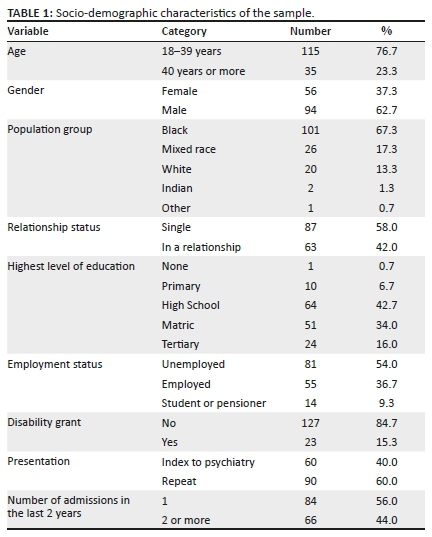
Of the 150 participants, 62.7% (n = 94) were men, 76.7% (n = 115) were under the age of 40 years and 67.3% (n = 101) were black. Two-thirds (n = 99) of the participants were brought to hospital by a relative, parent or spouse; 16.0% (n = 24) by the police; and 7.3% (n = 11) by the ambulance (Table 1). For 40% (n = 60) of the participants this was their first psychiatric presentation. The remaining 60% (n = 90) were repeat presentations, with 44.0% (n = 66) of the study sample having two or more admissions in the last 2 year (Table 1).
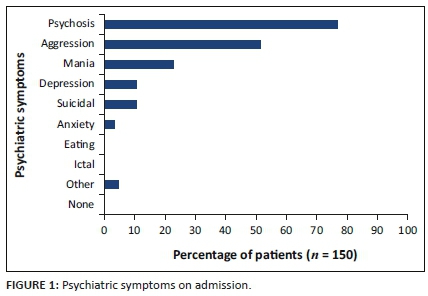
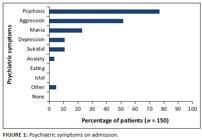
Almost 80% (n = 115) of the participants presented with psychotic symptoms on admission and over 50% (n = 77) were aggressive (Figure 1). Rapid tranquillisation was necessary in 67% (n = 101) of the participants, of which approximately 15% (n = 22) required combinations of three or four tranquillising agents. According to the Mental Health Care Act, the admissions were predominately involuntary (58.7%, n = 88) or assisted (36.0%, n = 54), and the mean duration of hospital stay was 14 days (median 11). The most frequently occurring medical condition was HIV and AIDS, diagnosed in 20 participants, followed by hypertension (n = 6), epilepsy (n = 5), head injury (n = 4) and diabetes mellitus (n = 3).
Clinical diagnosis of substance use disorders
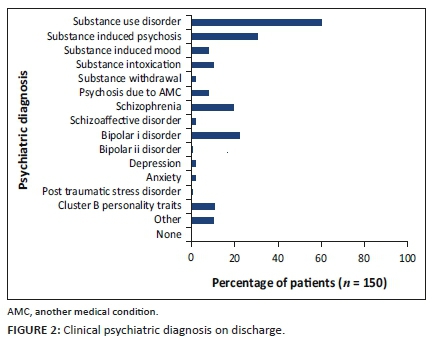
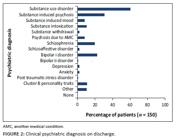
From the clinical notes by the treating doctor, it was observed that SUD was diagnosed in 60.0% (n = 90) of the participants. Substance-related conditions were the most frequent discharge diagnoses, with 30.7% (n = 46) of participants diagnosed with substance-induced psychotic disorder, 12.0% (n = 18) with intoxication or withdrawal, and 8.0% (n = 12) with substance-induced mood disorder (figure 2).
Substance use disorders as determined by the AUDIT and DUDIT instruments
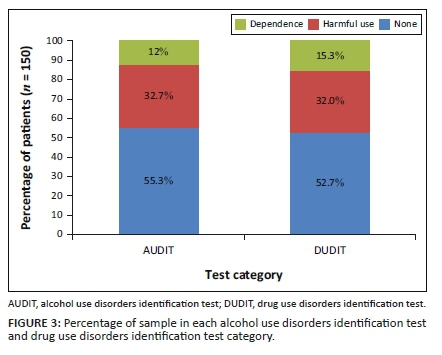
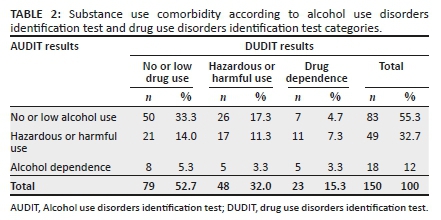
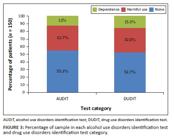
Administration of the AUDIT showed that 44.6% (n = 67) of participants had an alcohol use disorder, and the DUDIT showed that 47.3% (n = 71) had a drug use disorder (Figure 3). A total of 25.2% (n = 38) of participants had both alcohol and drug use disorders. Overall, the AUDIT and DUDIT tools identified two-thirds of the participants (67.0%, n = 100) as having a current SUD (Table 2).
Comparison between AUDIT and DUDIT assessment with clinical diagnosis of substance use disorder
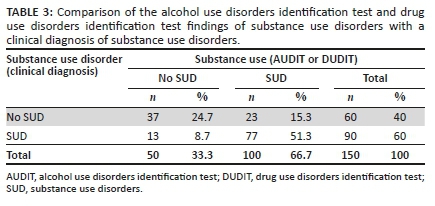
The findings of the two methods did not correspond in 23% (n = 36) of the participants: 15.3% (n = 23) of participants were identified with SUD by the questionnaire, but not clinically diagnosed with SUD. A total of 8.7% (n = 13) participants were clinically diagnosed with SUD, but did not have evidence of SUD on administration of the questionnaire (Table 3). Had the clinical diagnosis of SUD been augmented with the questionnaires, the overall yield would have been 75.3% (n = 113) SUD.
Demographic and clinical characteristics associated with substance use disorders indicated on alcohol use disorders identification test and drug use disorders identification test
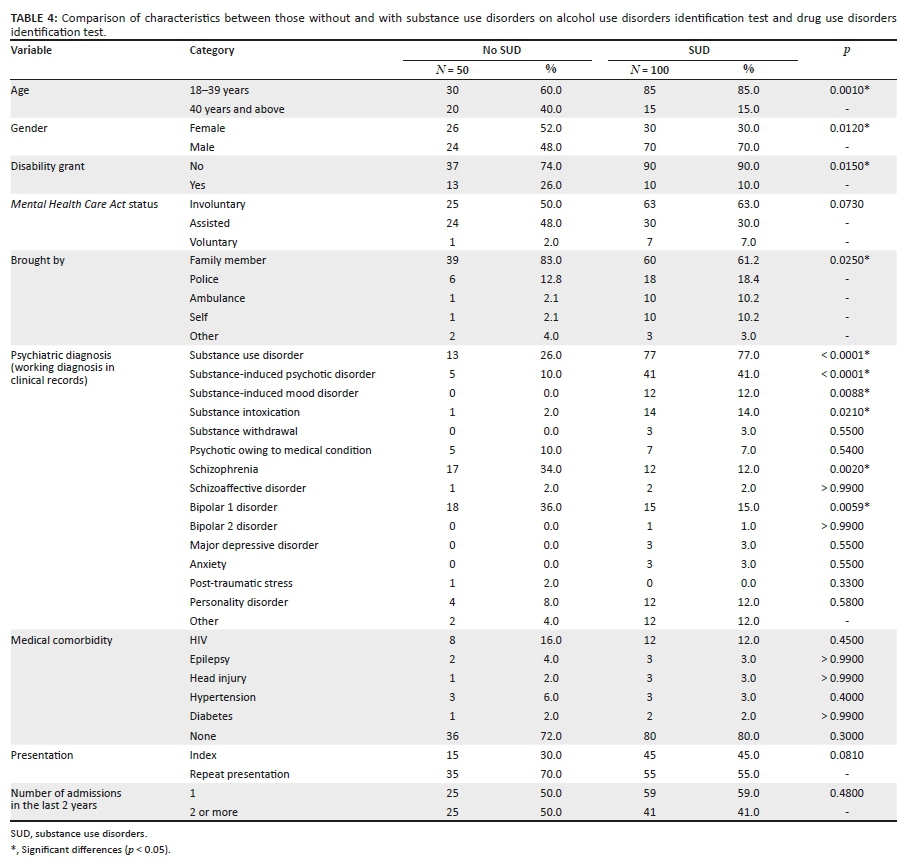
The demographic and clinical characteristics of those who screened positive for SUD by the AUDIT and DUDIT tools were compared with the group who did not (see Table 4).
There was a statistically significant association between SUD and younger age (p = 0.0010), male gender (p = 0.012) and being more likely to arrive at hospital with police or ambulance escort, or patients by themselves rather than by a family member (p = 0.025). Although unemployment was similar amongst those with SUD (56%) and those without SUD (50%), those with a SUD were significantly less likely to receive a disability grant (10% vs. 26%) (p = 0.015). There was no statistical difference in mental healthcare act status between the two groups (p = 0.073).
Those with a SUD on AUDIT or DUDIT were more likely to have a clinical diagnosis of SUD or a substance-related condition (p < 0.0001). Although those with SUD were less frequently diagnosed with schizophrenia or bipolar I disorder than those without SUD (p = 0.002 and p = 0.0059, respectively), 41.4% of participants with schizophrenia and 47.1% of with bipolar disorder admitted to have comorbid SUD.
A total of 72.7% participants (n = 72 SUD, n = 37 non-SUD) were discharged to home, 10.7% (n = 14 SUD, n = 2 non-SUD) were transferred to Sterkfontein Hospital (a restrictive psychiatric institution) for further involuntary care, 7.3% were transferred for further inpatient care at a less restrictive psychiatric hospital (n = 6 SUD, n = 5 non-SUD) and 8.0% (n = 7 SUD, n = 5 non-SUD) went to a long-stay medium-care facility. Two participants were referred to an inpatient substance rehabilitation centre upon discharge from hospital, which was arranged privately by the family members of the participants.
Discussion
In this cross-sectional study of 150 acute psychiatric inpatients, we aimed to describe the prevalence of SUD and their clinical correlates using standardised screening instruments. A total of 67% of participants were identified as having SUD upon administration of the AUDIT and DUDIT questionnaires. Alcohol use was identified in 45% patients, other drug use in 47%, with evidence of comorbid use of alcohol and other drugs in 25% patients.
In South Africa, variable prevalence rates of SUD amongst psychiatric inpatients have been found.10,14,29,30,31291422
This study revealed a higher prevalence of SUD than that found in a previous study conducted in the same unit.3131
However, the prevalence in our sample was less than the 81.2% found amongst patients admitted with first episode psychosis in the Eastern Cape.3032n = 45) had a SUD, bringing the prevalence rate closer to that found in the Eastern Cape study.30
When comparing to international prevalence rates of SUD, the prevalence of SUD in this study is higher than that reported in Iceland, which reported SUD in 58% of male and 32% of female psychiatric inpatients.333435
In the overall sample, schizophrenia was diagnosed in 19.3% (n = 29) and bipolar disorder in 22.7% (n = 34) of the participants. Both were more frequently diagnosed amongst those without substance use; however, it is possible that some of the substance-induced psychotic (n = 46) and substance-induced mood (n = 12) disorders could be comorbid rather than induced. Nevertheless, the fact that 41.4% of those participants diagnosed with schizophrenia were found to have SUD is consistent with the finding of 41.7% prevalence rate of SUD amongst people with schizophrenia found by Hunt et al.554
In contrast, amongst general medical or surgical admissions, prevalence rates for alcohol (10%), cannabis (7%) and other substances (4.5%) have been reported36
Characteristics of those with substance use disorders
We found that those with SUD were more likely to be male and single person, which is consistent with the findings of local and international studies.21,37383940
Whilst the SUD group was more likely to be brought to hospital by police or ambulance, there was no increased rate of aggression, psychosis or mania, which are conditions that could result in a need for police or ambulance escort. Estrangement from family members as a result of the negative effects of SUD may be a possibility. Even though we did not confirm higher rates of psychosis and aggressive symptoms amongst those with SUD, 14 of the 16 participants referred for further involuntary care (usually related to aggressive, disruptive behaviour) screened positive for SUD. It is also not known if any of the 10 participants who were ineligible for study inclusion because of immediate transfer to Sterkfontein Hospital had used substances.
Despite high rates of substance use, only two participants were referred to inpatient rehabilitation centres upon discharge, which was arranged privately by their families This finding is consistent with the low referral rate described by the South African Community Epidemiology Network on Drug Use (SACENDU).41
Psychiatric services generally do not offer substance rehabilitation. In South Africa, substance use management falls under the National Department of Social Development, which is obliged to implement inter-sectoral strategies for early detection and treatment under the Prevention of and Treatment of Substance Use Act No. 70 of 2008.4243
Clients with both psychiatric and SUD have reported greater satisfaction with an integrated dual diagnosis treatment approach.44
Consistency between questionnaire and clinical diagnosis of substance use disorders
In 76% (n = 114) of the participants, the questionnaire and clinical diagnosis were consistent; 24.7% (n = 37) of the participants were non-SUD and 51.3% (n = 77) were SUD. However, 15.3% (n = 23) of patients screened positive for SUD upon administration of the questionnaire but were not identified clinically, and 8.7% (n = 13) of patients were not screened positive by the questionnaire but identified so on clinical assessment. Augmentation of clinical screening with a questionnaire would have improved the detection of SUD, a finding that is consistent with the recommendations made by Morejele et al. and WHO.7,27,28
Limitations
Generalisability may be limited as this study was conducted at only one acute centre with a small sample size. A larger sample size could also have revealed more significant differences in clinical correlates. The screening tools used did not assess for which drugs were used. This is an important information as the wide range of available substances cause varying risks of addiction, severity of tolerance and different symptoms. The tools have been validated in English; however, the investigator's translating the tool into Afrikaans is not a standardised practice. Language considerations should be made according to the centre's needs.
Conclusion and recommendations
Notwithstanding the limitations, our study adds to the growing body of evidence of a high prevalence of SUD amongst patients admitted to psychiatric units in South Africa, particularly young men. Two-thirds of the participants were identified with SUD. The AUDIT and DUDIT questionnaires are cost-effective and quick to administer. Consideration should be given to their routine use to enhance the clinical identification in populations with high numbers of substance users.
Despite the high prevalence of SUD, only two participants went to an inpatient rehabilitation facility following discharge. The severity of the SUD was not consistently noted by clinicians, which could inform whether inpatient or outpatient SUD rehabilitation services are required. Thus, we encourage the specification of disorders to improve clinical services. Further research should explore the referrals and follow-up to outpatient services. Although not all substance users require inpatient rehabilitation, the low referral rate may be partly because of psychiatric services and substance rehabilitation facilities being managed by different governmental departments. Thus, improved collaboration of services is recommended.
Competing interests
The authors declare that they have no financial or personal relationships that may have inappropriately influenced them in writing this article.
Authors' contributions
A.A. designed the study and was the principal investigator. L.J.R. assisted with protocol and write-up of the article.
Funding information
This research received no specific grant from any funding agency in the public, commercial or not-for-profit sectors.
Data availability statement
Data sharing is not applicable to this article as no new data were created or analysed in this study.
Disclaimer
The views and opinions expressed in this article are those of the authors and do not necessarily reflect the official policy or position of any affiliated agency of the authors.
Acknowledgements
The authors thank Diagnostic Management and Statistical Analysis (DMSA) for the data analysis.
References
- 1.Rehm J, Shield KD. Global burden of disease and the impact of mental and addictive disorders. Volume 21. Current psychiatry reports. Current Medicine Group LLC 1, Ontario, Canada. 2019.
-
2.Health - United Nations sustainable development 2016. [homepage on the Internet]. [cited 2020 Feb 09]. Available from: https://www.un.org/sustainabledevelopment/health/.
» https://www.un.org/sustainabledevelopment/health/ -
3.Hunt GE, Malhi GS, Cleary M, Lai HMX, Sitharthan T. Comorbidity of bipolar and substance use disorders in national surveys of general populations, 1990-2015: Systematic review and meta-analysis. J Affect Disord. 2016;206:321-330. https://doi.org/10.1016/j.jad.2016.06.051
» https://doi.org/10.1016/j.jad.2016.06.051 -
4.Hunt GE, Malhi GS, Cleary M, Lai HMX, Sitharthan T. Prevalence of comorbid bipolar and substance use disorders in clinical settings, 1990-2015: Systematic review and meta-analysis. J Affect Disord. 2016;206:331-349. https://doi.org/10.1016/j.jad.2016.07.011
» https://doi.org/10.1016/j.jad.2016.07.011 -
5.Hunt GE, Large MM, Cleary M, Lai HMX, Saunders JB. Prevalence of comorbid substance use in schizophrenia spectrum disorders in community and clinical settings, 1990-2017: Systematic review and meta-analysis. Drug Alcohol Depend. 2018;191:234-258. https://doi.org/10.1016/j.drugalcdep.2018.07.011
» https://doi.org/10.1016/j.drugalcdep.2018.07.011 -
6.Lai HMX, Cleary M, Sitharthan T, Hunt GE. Prevalence of comorbid substance use, anxiety and mood disorders in epidemiological surveys, 1990-2014: A systematic review and meta-analysis. Drug Alcohol Depend. 2015;154:1-13. https://doi.org/10.1016/j.drugalcdep.2015.05.031
» https://doi.org/10.1016/j.drugalcdep.2015.05.031 -
7.Morojele NK, Saban A, Seedat S. Clinical presentations and diagnostic issues in dual diagnosis disorders. Curr Opin Psychiatry. 2012;25(3):181-186. https://doi.org/10.1097/YCO.0b013e328351a429
» https://doi.org/10.1097/YCO.0b013e328351a429 -
8.Bruwer B. Barriers to mental health care and predictors of treatment dropout in the South African stress and health study. Psychiatr Serv. 2011;62(7):774. https://doi.org/10.1176/ps.62.7.pss6207_0774
» https://doi.org/10.1176/ps.62.7.pss6207_0774 -
9.Shmidt LM, Hesse M, Lykke J. The impact of substance use disorders on the course of schizophrenia: A 15-year follow-up study: Dual diagnosis over 15 years. Schizophr Res. 2011;130(1-3):228-233. https://doi.org/10.1016/j.schres.2011.04.011
» https://doi.org/10.1016/j.schres.2011.04.011 -
10.Wicomb R, Jacobs L, Ebrahim N, Rensburg M, Macharia M. Illicit drug use and violence in acute psychosis among acute adult admissions at a South African psychiatric hospital. Afr Health Sci. 2018;18(1):132-136. https://doi.org/10.4314/ahs.v18i1.17
» https://doi.org/10.4314/ahs.v18i1.17 -
11.van Dorn RA, Grimm KJ, Desmarais SL, Tueller SJ, Johnson KL, Swartz MS. Leading indicators of community-based violent events among adults with mental illness. Psychol Med. 2017;47(7):1179-1191. https://doi.org/10.1017/S0033291716003160
» https://doi.org/10.1017/S0033291716003160 -
12.Johnson KL, Desmarais SL, Grimm KJ, Tueller SJ, Swartz MS, van Dorn RA. Proximal risk factors for short-term community violence among adults with mental illnesses. Psychiatr Serv. 2016;67(7):771-778. https://doi.org/10.1176/appi.ps.201500259
» https://doi.org/10.1176/appi.ps.201500259 -
13.Iozzino L, Ferrari C, Large M, Nielssen O, De Girolamo G. Prevalence and risk factors of violence by psychiatric acute inpatients: A systematic review and meta-analysis. PLoS One. 2015;10(6):e0128536. https://doi.org/10.1371/journal.pone.0128536
» https://doi.org/10.1371/journal.pone.0128536 -
14.Prinsloo RG, Swanepoel A, Lippi G. Identifying factors associated with the discharge of male State patients from Weskoppies Hospital. S Afr J Psychiat. 2017;23(0):a1083. https://doi.org/10.4102/sajpsychiatry.v23i0.1083
» https://doi.org/10.4102/sajpsychiatry.v23i0.1083 -
15.Heiberg IH, Jacobsen BK, Nesvåg R, et al. Total and cause-specific standardized mortality ratios in patients with schizophrenia and/or substance use disorder. PLoS One. 2018;13(8):e0202028. https://doi.org/10.1371/journal.pone.0202028
» https://doi.org/10.1371/journal.pone.0202028 -
16.Messer T, Lammers G, Müller-Siecheneder F, Schmidt RF, Latifi S. Substance abuse in patients with bipolar disorder: A systematic review and meta-analysis. Psychiatry Res. 2017;253:338-350. https://doi.org/10.1016/j.psychres.2017.02.067
» https://doi.org/10.1016/j.psychres.2017.02.067 -
17.Østergaard MLD, Nordentoft M, Hjorthøj C. Associations between substance use disorders and suicide or suicide attempts in people with mental illness: A Danish nation-wide, prospective, register-based study of patients diagnosed with schizophrenia, bipolar disorder, unipolar depression or personality disorder. Addiction. 2017;112(7):1250-1259. https://doi.org/10.1111/add.13788
» https://doi.org/10.1111/add.13788 -
18.Aagaard J, Buus N, Wernlund AG, Foldager L, Merinder L. Clinically useful predictors for premature mortality among psychiatric patients visiting a psychiatric emergency room. Int J Soc Psychiatry. 2016;62(5):462-470. https://doi.org/10.1177/0020764016642490
» https://doi.org/10.1177/0020764016642490 -
19.Schaffer A, Isometsä ET, Tondo L, et al. International Society for Bipolar Disorders Task Force on Suicide: Meta-analyses and meta-regression of correlates of suicide attempts and suicide deaths in bipolar disorder. Bipolar Disord. 2015;17(1):1-16. https://doi.org/10.1111/bdi.12271
» https://doi.org/10.1111/bdi.12271 -
20.Uwakwe R, Gureje O. The relationship of comorbidity of mental and substance use disorders with suicidal behaviors in the Nigerian survey of mental health and wellbeing. Soc Psychiatry Psychiatr Epidemiol. 2011;46(3):173-180. https://doi.org/10.1007/s00127-009-0178-2
» https://doi.org/10.1007/s00127-009-0178-2 -
21.Weich L, Pienaar W. Occurrence of comorbid substance use disorders among acute psychiatric inpatients at Stikland Hospital in the Western Cape, South Africa. Afr J Psychiatry. 2009;12(3):213-217. https://doi.org/10.4314/ajpsy.v12i3.48496
» https://doi.org/10.4314/ajpsy.v12i3.48496 -
22.Davis GP, Tomita A, Baumgartner JN, et al. Substance use and duration of untreated psychosis in KwaZulu-Natal, South Africa. S Afr J Psychiatr. 2016;22(1):a852. https://doi.org/10.4102/sajpsychiatry.v22i1.852
» https://doi.org/10.4102/sajpsychiatry.v22i1.852 -
23.Sowunmi OA, Amoo G, Onifade PO, Ogunwale A, Babalola E. Psychoactive substance use among outpatients with severe mental illness: A comparative study. S Afr J Psychiatr. 2019;25:a1111. https://doi.org/10.4102/sajpsychiatry.v25i0.1111
» https://doi.org/10.4102/sajpsychiatry.v25i0.1111 -
24.Crime Stats SA - Crime Stats simplified 2020. [homepage on the Internet]. c [cited 2020 Feb 09]. Available from: https://www.crimestatssa.com/precinct.php?id=294.
» https://www.crimestatssa.com/precinct.php?id=294 -
25.Gunderson OH, Mordal J, Berman AH, Bramness JG. Evaluation of the alcohol use disorders identification test and the drug use disorders identification test amongst patients at a Norwegian psychiatric emergency ward. Eur Addict Res. 2013;19(5):252-260. https://doi.org/10.1159/000343485
» https://doi.org/10.1159/000343485 -
26.Kader R, Seedat S, Koch JR, Parry CD. A preliminary investigation of the AUDIT and DUDIT in comparison to biomarkers for alcohol and drug use among HIV-infected clinic attendees in Cape Town, South Africa. Afr J Psychiatr. 2012;15(5):346-351. https://doi.org/10.4314/ajpsy.v15i5.43
» https://doi.org/10.4314/ajpsy.v15i5.43 - 27.Babor T, Higgins-Biddle JC, Saunders JB, Monteiro MG. The alcohol use disorder identification test. Geneva, Second edition: World Health Organisation; 2001.
- 28.Berman A, Bergman H, Palmstierna T, Schlyter F. The drug use disorders identification test manual. Stockholm, Karolinska Institute. Department of clinical neuroscience. 2003.
-
29.Franken H, Parker J, Allen R, Wicomb RA. A profile of adult acute admissions to Lentegeur psychiatric hospital, South Africa. S Afr J Psychiatr. 2019;25:a1244. https://doi.org/10.4102/sajpsychiatry.v25i0.1244
» https://doi.org/10.4102/sajpsychiatry.v25i0.1244 -
30.Thungana Y, Zingela Z, van Wyk S. First-episode psychosis and substance use in Nelson Mandela Bay: Findings from an acute mental health unit. S Afr J Psychiatr. 2019;25:1372. https://doi.org/10.4102/sajpsychiatry.v25i0.1372
» https://doi.org/10.4102/sajpsychiatry.v25i0.1372 -
31.Janse van Rensburg A. Acute mental health care and South African mental health legislation Part 1: Morbidity, treatment and outcome. Afr J Psychiatr. 2011;13(5):382-389. https://doi.org/10.4314/ajpsy.v13i5.63104
» https://doi.org/10.4314/ajpsy.v13i5.63104 -
32.Barnett JH, Werners U, Secher SM, et al. Substance use in a population-based clinic sample of people with first-episode psychosis. Br J Psychiatry. 2007;190(6):515-520. https://doi.org/10.1192/bjp.bp.106.024448
» https://doi.org/10.1192/bjp.bp.106.024448 -
33.Steingrímsson S, Sigurdsson MI, Aspelund T, Sigfússon S, Magnússon A. Total population-based study of the impact of substance use disorders on the overall survival of psychiatric inpatients. Nord J Psychiatry. 2016;70(3):161-166. https://doi.org/10.3109/08039488.2015.1062143
» https://doi.org/10.3109/08039488.2015.1062143 -
34.Steingrímsson S, Carlsen HK, Sigfússon S, Magnússon A. The changing gender gap in substance use disorder: A total population-based study of psychiatric in-patients. Addiction. 2012 Nov;107(11):1957-1962. https://doi.org/10.1111/j.1360-0443.2012.03954.x
» https://doi.org/10.1111/j.1360-0443.2012.03954.x - 35.Dixon L, McNary S, Lehman A. Remission of substance use disorder among psychiatric inpatients with mental illness. Am J Psychiatr. 1998;155(2):239-243.
-
36.Scheibe AP, Gloeck NR, Shelly S, Marcus TS, Hugo J. The prevalence and characteristics of moderate- to high-risk regulated and unregulated substance use among patients admitted to four public hospitals in Tshwane, South Africa. S Afr Med J. 2019;109(12):971. https://doi.org/10.7196/SAMJ.2019.v109i12.13870
» https://doi.org/10.7196/SAMJ.2019.v109i12.13870 -
37.Wustoff LE, Waal H, Ruud T, Grawe RW. A cross-sectional study of patients with and without substance use disorders in community mental health services. BMC Psychiatry. 2011;11(93):1-9. https://doi.org/10.1186/1471-244X-11-93
» https://doi.org/10.1186/1471-244X-11-93 -
38.Local Municipality | Statistics South Africa; 2011 [homepage on the Internet]. c [cited 2020 Feb 09]. Available from: https://www.statssa.gov.za/?page_id=993&id=city-of-johannesburg-municipality.
» https://www.statssa.gov.za/?page_id=993& id=city-of-johannesburg-municipality - 39.O'Conner K, Kline A, Sawh L, et al. Unemployment and co-occurring disorders among homeless veterans. J Dual Diagn. 2013;9(2):134-138.
- 40.Artazcoz L, Benach J, Borrell C, Cortes I. Unemployment and mental health; understanding the interactions among gender, family roles, and social class. Am J Public Health. 2004;94(1):82-88.
- 41.Dada S, Harker Burnhams N, Erasmus J, Lucas Charles Parry W, Bhana Sandra Pretorius A, Weimann Helen Keen R. Monitoring alcohol, tobacco and other drug abuse treatment admissions in South Africa. SACENDU (South African Community Epidemiology Network on Drug Use) April 2018; phase 44, pp. 1-72.
- 42.Government Gazette, Notice G. Prevention of and treatment for Substance Abuse Act 70 of 2008. The presidency. 2009;526 Republic of South Africa. Cape Town.
- 43.Department of Social Development. National drug master plan. Republic of South Africa. Durban. 2013-2017. 2013.
- 44.Schulte SJ, Meier PS, Stirling J. Dual diagnosis clients' treatment satisfaction: A systemic review. BMC Psychiatry. 2011;11(64):1-12.

Accepted: 04 July 2020
Published: 25 Sept. 2020