Junior medical students' knowledge about and attitudes towards electroconvulsive therapy in a South African setting
Abstract
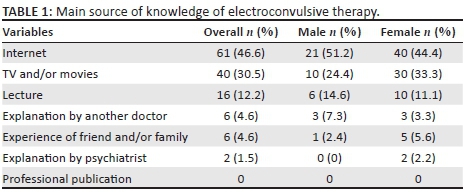
BACKGROUND: Although electroconvulsive therapy (ECT) is a safe and effective treatment modality with a long history of use in psychiatry, it remains controversial owing to misconceptions and negative attitudes among the public and medical profession. The aim of this study was to explore the state of knowledge and attitudes towards ECT among a sample of South African medical students. METHOD: Prior to their theoretical psychiatry module, 131 second-year medical students responded to an anonymous online survey designed to assess the source and extent of their ECT knowledge as well as their attitude towards ECT and psychiatry in general. RESULTS: The Internet (46.6%) and TV and/or movies (30.5%) were the principal sources of knowledge of ECT while 'professional publication' was the least common (0%). The students' attitudes towards psychiatry were generally positive and nearly one-third (29.8%) would consider specialising in the field. Overall, perception towards ECT was mixed, with many respondents approving of its use albeit only as a last resort. Notably, low ECT knowledge scores were associated with more negative attitudes towards this treatment modality and a lower perception of psychiatry as a medical speciality. CONCLUSION: The findings indicate that for these students, media is the main source of ECT knowledge. While they are generally knowledgeable about ECT, they still harbour some misconceptions and negative attitudes about the treatment. Knowledge appears able to amend these attitudes, thus underlining the importance of integrating accurate information about ECT into the preclinical medical curriculum rather than leaving it to mass media to forge warped perceptions and attitudes for these future clinicians.
Introduction
Electroconvulsive therapy (ECT) is a technique used to treat mental illnesses by applying electric current through the brain to induce generalised seizures. It is used worldwide as one of the most effective treatments for several treatment-resistant psychiatric disorders, particularly major depressive disorder, which forms about 80% of patients treated with this procedure.122,3
Convulsive therapy was first introduced in 1934 by Meduna who used chemically induced seizures to treat schizophrenia.456,76
The use of ECT gradually declined from the 1970s, such that in the USA, for example, only 36 558 patients were treated in 1986, compared to 58 667 in 1975.8,98110111,12,13
The ambivalence and misinformation about ECT among medical personnel is largely a consequence of inadequate education in medical schools.14,15
A key reason for assessing the views and attitudes of medical students towards ECT is to inform teaching of medical curricula by uncovering deficits and areas that can be addressed to reduce the stigma against ECT and promote its perception by the public and non-psychiatric health professionals.
Evidence from several countries indicates that medical students generally have negative attitudes towards ECT which, however, can be improved through knowledge. These attitudes are better when the source of knowledge is a health professional,12
Methods
All second-year medical (MB, ChB) students (n = 259) were invited via email to participate in the anonymous online survey in the months of October and November, 2015. The MB, ChB is a 6-year programme involving theoretical rotations from the first year and clinical rotations from the third year. The invitation email contained a consent and participation information sheet outlining the aims and objectives of the study along with a link to the online questionnaire. The survey was based on a self-selected sample as only those who accepted our request participated in the survey. Anonymity was assured as there were no identifiers used. The online questionnaire was live for 8 weeks and a repeat email was sent every 2 weeks. Once completed, students could not resubmit a new or alternative questionnaire.
The survey was designed and released using SUrvey, an online-based survey tool developed by Stellenbosch University and maintained by the university's Department of Information Technology. The content and format of the questions were based on previous similar studies. In addition to sex and age, the participants were asked to identify their main source of information on ECT in the first section. The next five questions assessed their general attitude towards psychiatry, which was rated on a Likert Scale as was the next 10-question section assessing their attitudes towards ECT. The last section had 10 'true/false' questions evaluating their knowledge of ECT.
Frequency counts and percentages were used to summarise qualitative variables, while chi-square test was used to compare them within gender categories. Analysis of the variance was used to compare mean knowledge scores across the three response categories for the ECT and/or psychiatry attitudinal questions.
Ethical considerations
Ethics approval was obtained from the University of Stellenbosch Human Research Ethics Committee to conduct the survey at the Tygerberg Medical campus.
Results
General characteristics and main sources of knowledge of electroconvulsive therapy
The survey was completed by 131 (50.5%) of the 259 second-year medical students invited to participate. The mean (standard deviation) age of the respondents was 20.4 (1.8) years and the majority (69.0%) were women. The main sources of knowledge of ECT are shown in Table 1. Overall, the Internet (46.6%) and TV and/or movies (30.5%) were the principal sources. Other sources of knowledge of ECT that were identified included lectures (12.2%), explanation by a professional (4.6%) and experience of ECT (4.6%) while 'professional publication' was the least common, with no respondent identifying with it.
Attitudes towards psychiatry
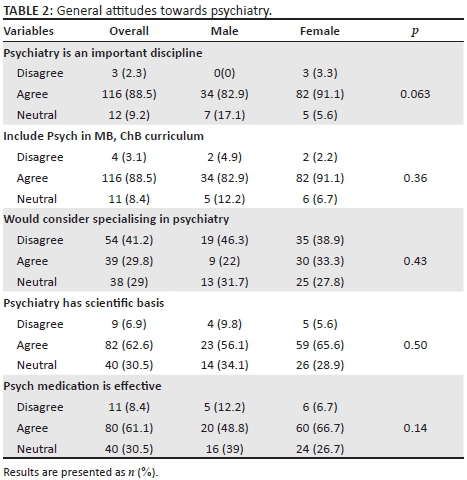
Attitude towards psychiatry was generally positive with no significant gender differences (Table 2). The majority of respondents agreed that psychiatry is an important medical discipline (88.5%) warranting inclusion in the MB, ChB curriculum (88.5%). Although the majority thought that it has a scientific basis (62.6%) and that psychiatric medication is effective (61.1%), only a third of female respondents (33.3%) and about one-fifth of male respondents (22.0%) would consider specialising in the discipline.
Attitudes towards electroconvulsive therapy
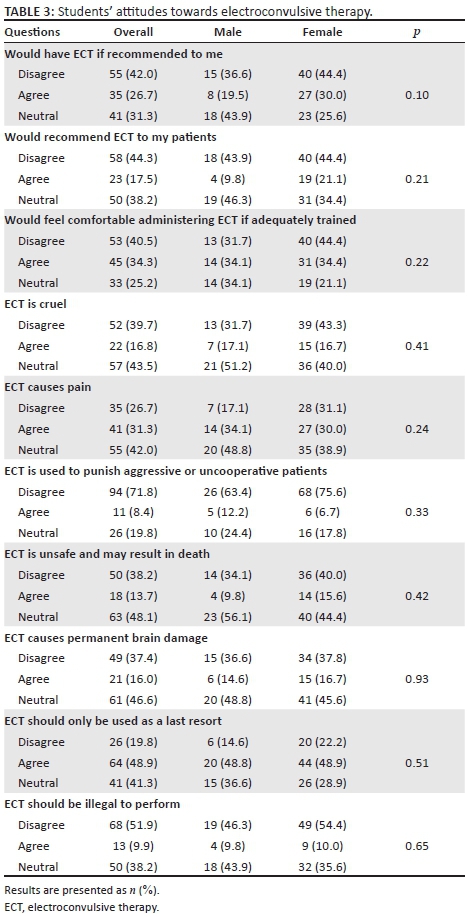
Responses to questions regarding attitudes towards ECT were mixed and gender was not a significant factor (Table 3). The majority of respondents disagreed that ECT should be illegal to perform (51.9%) but thought it should only be used as a last resort (48.9%). The largest proportion did not think that ECT is cruel (39.7%) or a form of punishment (71.8%), or that it can cause permanent brain damage (37.4%) or death (38.2%). Many of the respondents, however, would not have ECT if it was recommended to them (42.0%), would not recommend it to their patients (44.3%) and would not be comfortable performing it even after receiving adequate training (40.5%).
Knowledge of electroconvulsive therapy
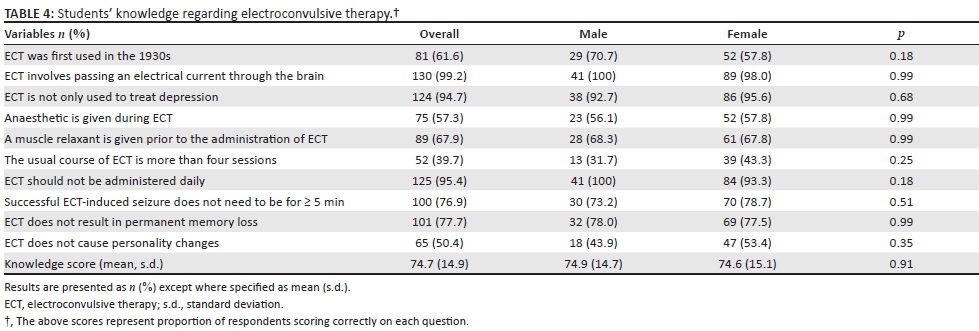
Responses to questions regarding knowledge on ECT are presented in Table 4. The overall mean knowledge score was 74.7% (14.9) and there was no significant difference between the genders. The questions with lower scores were mostly related to the technical aspects of administering ECT. For example, only 39.7% of respondents knew that the usual course of ECT was more than four sessions and only 57.3% knew that an anaesthetic is administered prior to administration of ECT. However, an overwhelming majority of the respondents knew that ECT involves passing an electrical current through the brain (99.2%), not usually administered daily (95.4%) and is used to treat conditions other than depression (94.7%).
Relationship between electroconvulsive therapy knowledge score and attitude towards electroconvulsive therapy
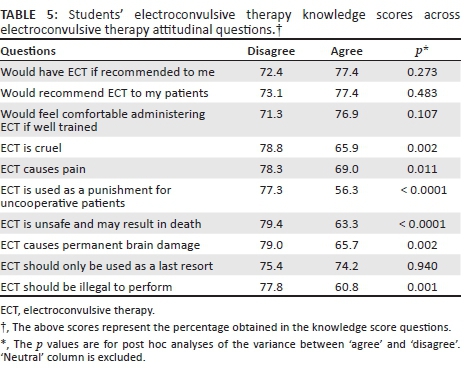
The relationship between participants' ECT knowledge scores and attitudes towards the treatment is shown in Table 5. Low mean ECT knowledge score was generally associated with less favourable attitudes towards ECT. Compared to respondents in disagreement, significantly lower scores were noted in students agreeing that ECT is cruel (78.8% vs. 65.9%; p = 0.002), causes pain (78.3 vs. 69.0; p = 0.011) and could result in permanent brain damage (79.0 vs. 65.7; p = 0.002) or death (79.4 vs. 63.3; p < 0.0001). Mean ECT scores were also significantly different in responses to the questions of ECT being used as a punishment for uncooperative patients and as a last-resort treatment.
Relationship between electroconvulsive therapy knowledge score and attitude and psychiatry
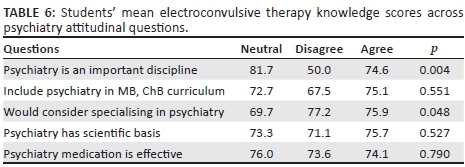
Students who viewed psychiatry as an 'important' discipline had significantly higher (p = 0.004) mean ECT knowledge scores compared to those who did not (Table 6). ECT knowledge scores were not significantly different on the three questions pertaining to scientific basis of psychiatry, its inclusion in the medical curriculum or effectiveness of medication. However, those opting to remain neutral to the question of considering specialising in psychiatry had a significantly lower mean ECT knowledge score (69.7; p = 0.048) compared to those disagreeing (77.2%) or agreeing (75.9%).
Discussion
This survey assessed the knowledge and attitudes towards psychiatry and ECT among medical students without formal psychiatry training at a South African medical school. The students' attitudes towards psychiatry were generally positive and their indicated preference for it as a potential career choice was quite high. Most students obtained their information about ECT from mass media - specifically the Internet and TV, with fewer students obtaining their knowledge of ECT from lectures and professionals. The least common source of knowledge was from professional publications. Overall, perception towards ECT was mixed, with many respondents approving of its use but only as a last resort. Finally, and most notable, low ECT knowledge scores were overwhelmingly associated with more negative attitudes towards this treatment modality.
Attitude towards psychiatry was generally positive and, in contrast to numerous past findings as reviewed by Lyons,1617,18
As in previous studies, mass media remained the most popular source of information,19,20,2122,23,2425One Flew Over the Cuckoo's Nest is credited with irredeemably denting the public perception of ECT and hastening its demise as a treatment of choice for mental illness.
It is therefore worthwhile encouraging medical students to utilise scientific sources of information. Yet none of the students cited journals/professional literature as their main source of knowledge, which is nonetheless unsurprising as these learners were yet to receive formal lectures in psychiatry. The limited use of academic journals by undergraduate medical students, despite an awareness of these sources, has been previously documented.26
The students' attitude towards ECT was more mixed and less confident with 'neutral' making 30% - 48% of the responses in all but two section questions. Most students committing to a polarised response approved the use of ECT but many suggested it should only be a last resort. This is possibly an extension of a widely entrenched but inaccurate presumption that ECT should only be used in medication-resistant patients.2714,28,2930
Limitations
The present study had some limitations. It only involved students from one medical school and therefore the findings cannot be extrapolated to all medical students in the country. Furthermore, the response rate was quite modest (50.5%), thus casting a shadow on the representativeness of the sample. The final sample size, however, compared well with most other similar studies.
Conclusion
The results provide insights on how junior South African medical students, without formal exposure to psychiatry training, perceive psychiatry as a career and ECT as a treatment modality. The students view psychiatry positively, both as a discipline and as a potential career. While they were generally knowledgeable about ECT, they have reservations and still harbour misconceptions about the treatment. It appears that knowledge/education can produce some changes to the students' attitudes regarding ECT and, by extension, psychiatry, which underline the importance of integrating accurate information about ECT into the preclinical medical curriculum rather than leaving it to mass media as the main source of knowledge and perception for these future clinicians. Given that these students had no formal exposure to psychiatry, it would be useful to establish how psychiatry education would influence their knowledge and attitude towards ECT and psychiatry in general.
Competing interests
The authors declare that they have no financial or personal relationships which may have inappropriately influenced them in writing this article.
Authors' contributions
M.M, M.B.M. and G.P.J. equally contributed to the research and writing of this article.
Acknowledgements
The authors would like to acknowledge the help of the staff at Stellenbosch University's Department of Information Technology for availing and running the online survey as well as all students for taking their time to complete the survey.
References
-
1. Payne NA, Prudic J. Electroconvulsive therapy part II: A biopsychosocial perspective. J Psychiatr Pract. 2009;15(5):369. https://doi.org/10.1097/01.pra.0000361278.73092.85
» https://doi.org/10.1097/01.pra.0000361278.73092.85 -
2. Rasmussen K. The practice of electroconvulsive therapy: Recommendations for treatment, training, and privileging. J ECT. 2002;18(1):58-59. https://doi.org/10.1097/00124509-200203000-00015
» https://doi.org/10.1097/00124509-200203000-00015 - 3. Sackeim HA, Devanand DP, Nobler MS. Electroconvulsive therapy. In: Bloom F, Kupfer D, editors. Psychopharmacology: The fourth generation of progress. New York: Raven, 1995; p. 1123-1142.
- 4. Endler NS. The origins of electroconvulsive therapy (ECT). Convuls Ther. 1988;4(1):5-23.
- 5. Accornero F. An eyewitness account of the discovery of electroshock. Convuls Ther. 1988;4:40-49.
-
6. Leiknes KA, Schweder LJ, Høie B. Contemporary use and practice of electroconvulsive therapy worldwide. Brain Behav. 2012;2(3):283-344. https://doi.org/10.1002/brb3.37
» https://doi.org/10.1002/brb3.37 -
7. Avery D, Winokur G. Mortality in depressed patients treated with electroconvulsive therapy and antidepressants. Arch Gen Psychiatry. 1976;33(9):1029-1037. https://doi.org/10.1001/archpsyc.1976.01770090019001
» https://doi.org/10.1001/archpsyc.1976.01770090019001 -
8. McCall WV. Electroconvulsive therapy in the era of modern psychopharmacology. Int J Neuropsychop. 2001;4:315-324. https://doi.org/10.1017/S1461145701002437
» https://doi.org/10.1017/S1461145701002437 -
9. Thompson JW, Weiner RD, Myers CP. Use of ECT in the United States in 1975, 1980, and 1986. Am J Psychiatry. 1994;151(11):1657-1661. https://doi.org/10.1176/ajp.151.11.1657
» https://doi.org/10.1176/ajp.151.11.1657 - 10. Szasz T. The myth of mental illness: Foundations of a theory of personal conduct. New York: Harper & Row; 1974.
- 11. Breggin P. Toxic psychiatry: Why therapy, empathy and love must replace the drugs, electroshock, and biochemical theories of the 'New Psychiatry'. New York: St. Martin's Press; 1991.
-
12. Kerr RA, McGrath JJ, O'Kearney RT, Price J. ECT: Misconceptions and attitudes. Aust N Z J Psychiatry. 1982;16(1):43-49. https://doi.org/10.3109/00048678209159469
» https://doi.org/10.3109/00048678209159469 -
13. Dowman J, Patel A, Rajput K. Electroconvulsive therapy: Attitudes and misconceptions. J ECT. 2005;21(2):84-87. https://doi.org/10.1097/01.yct.0000161043.00911.45
» https://doi.org/10.1097/01.yct.0000161043.00911.45 -
14. Clothier JL, Freeman T, Snow L. Medical student attitudes and knowledge about ECT. J ECT. 2001;17(2):99-101. https://doi.org/10.1097/00124509-200106000-00003
» https://doi.org/10.1097/00124509-200106000-00003 -
15. Duffett R, Lelliott P. Junior doctors' training in the theory and the practice of electroconvulsive therapy. J ECT. 1998;14(2):127-130. https://doi.org/10.1192/pb.21.9.563
» https://doi.org/10.1192/pb.21.9.563 -
16. Lyons Z. Attitudes of medical students toward psychiatry and psychiatry as a career: A systematic review. Acad Psychiatry. 2013;37(3):150-157. https://doi.org/10.1176/appi.ap.11110204.
» https://doi.org/10.1176/appi.ap.11110204 -
17. Eagle PF, Marcos LR. Factors in medical students' choice of psychiatry. Am J Psychiatry. 1980;137(4):423-427. https://doi.org/10.1176/ajp.137.4.423
» https://doi.org/10.1176/ajp.137.4.423 -
18. Creed F, Goldberg D. Students' attitudes towards psychiatry. Educ. 1987;21(3):227-234. https://doi.org/10.1111/j.1365-2923.1987.tb00695.x
» https://doi.org/10.1111/j.1365-2923.1987.tb00695.x -
19. Dawood E, Selim A, Khalil A. Electroconvulsive therapy: Effect of an educational experience on nursing students' knowledge and attitudes. Nurse Educ Pract. 2013;3(9):123. https://doi.org/10.5430/jnep.v3n9p123
» https://doi.org/10.5430/jnep.v3n9p123 -
20. James BO, Omoaregba JO, Olotu OS. Nigerian medical students' attitudes to unmodified electroconvulsive therapy. J ECT. 2009;25(3):186-189. https://doi.org/10.1097/YCT.0b013e31818c7701
» https://doi.org/10.1097/YCT.0b013e31818c7701 -
21. Warnell RL, Duk AD, Christison GW, Haviland MG. Teaching electroconvulsive therapy to medical students: Effects of instructional method on knowledge and attitudes. Acad Psychiatry. 2005; 29(5):433-436. https://doi.org/10.1176/appi.ap.29.5.433
» https://doi.org/10.1176/appi.ap.29.5.433 -
22. Chakrabarti S, Grover S, Rajagopal R. Electroconvulsive therapy: A review of knowledge, experience and attitudes of patients concerning. World J Biol Psychiatry. 2010;11(3):525-537. https://doi.org/10.3109/15622970903559925
» https://doi.org/10.3109/15622970903559925 - 23. Maguire S, Rea SM, Convery P. Electroconvulsive therapy-what do patients think of their treatment? Ulster Med J. 2016;85(3):182-186.
-
24. Flamarique I, Castro-Fornieles J, de la Serna E, Pons A, Bernardo M, Baeza I. Patients' opinions about electroconvulsive therapy: What do adolescents with schizophrenia spectrum disorders think? J Child Adolesc Psychopharmacol. 2015;25(8):641-648. https://doi.org/10.1089/cap.2015.0113
» https://doi.org/10.1089/cap.2015.0113 -
25. McDonald A, Walter G. The portrayal of ECT in American movies. J ECT. 2001;17(4):264-274. https://doi.org/10.1097/00124509-200112000-00006
» https://doi.org/10.1097/00124509-200112000-00006 - 26. Basu S, Chakraborty A, Parmar VR, Mishra K. Journal-reading habits of undergraduate medical students. Natl Med J India. 2014;28(2):105.
-
27. Prudic J, Haskett RF, Mulsant B, et al. Resistance to antidepressant medications and short-term clinical response to ECT. Am J Psychiatry. 1996;153(8):985-992. https://doi.org/10.1176/ajp.153.8.985
» https://doi.org/10.1176/ajp.153.8.985 -
28. Gazdag G, Kocsis-Ficzere N, Tolna J. Hungarian medical students' knowledge about and attitudes toward electroconvulsive therapy. J ECT. 2005;21(2):96-99. https://doi.org/10.1097/01.yct.0000165502.06410.d7
» https://doi.org/10.1097/01.yct.0000165502.06410.d7 - 29. Andrade C, Kumar NS. Medical students' attitudes toward electroconvulsive therapy: An Indian perspective. J ECT. 1996;12(2):86-90.
- 30. Janicak PG, Mask J, Trimakas KA, Gibbons R. ECT: An assessment of mental health professionals' knowledge and attitudes. J Clin Psychiatry. 1985;46(7):262-266.

Accepted: 19 May 2017
Published: 03 July 2017