Systematic mapping on availability, extent and distribution of mental health research in Malawi
BACKGROUND: Mental health research is essential in the implementation of evidence-based interventions. This can be impeded by unavailability or limited access to local evidence in low- and middle-income countries (LMICs) such as Malawi. AIM: The aim of this systematic mapping was to describe the availability, extent and distribution of mental health research conducted in Malawi. SETTING: The study was conducted at Kamuzu University of Health Sciences in Malawi. METHODS: A systematic search of four electronic databases from inception to September 2021 was carried out. All published and unpublished mental health studies in all languages were eligible for inclusion. Studies were screened against inclusion and exclusion criteria, and data were extracted, analysed and presented in tables and as a narrative synthesis. RESULTS: Cross-sectional studies (33.6%, n = 76) were found to be the most common study design for mental health research in Malawi. More studies were conducted on women (21.2%, n = 48) compared to men (1.3%, n = 3). Mental health research was concentrated in the southern region of the country (44.8%, n = 120) and in the three cities of Lilongwe (17.9%, n = 48), Blantyre (16.4%, n = 44) and Zomba (9.0%, n = 24. CONCLUSION: This systematic mapping suggests that there are few studies on mental health in Malawi which are not equally distributed across the country. There is a pressing need to conduct more mental health research using robust designs across disciplines CONTRIBUTION: Research on mental health is urgently needed to produce culturally acceptable data in Malawi.
Malawi; systematic mapping; mental health; research; evidence
Systematic mapping on availability, extent and distribution of mental health research in Malawi
Genesis Chorwe-SunganiI; Felix ChisoniII; Ditress NyirongoI; Japhet MyabaI; Anthony SefasiI; Jonas SagawaIII; Grace SibandeIII; Costantine ChaimaII; Eluby N. KatolaIII; Febbie JamiesonIII; Lucy KululangaIII; Diana JereI
IDepartment of Mental Health, School of Nursing, Kamuzu University of Health Sciences, Blantyre, Malawi
IILibrary Department, Kamuzu University of Health Sciences, Blantyre, Malawi
IIIDepartment of Community Health, School of Nursing, Kamuzu University of Health Sciences, Blantyre, Malawi
BACKGROUND: Mental health research is essential in the implementation of evidence-based interventions. This can be impeded by unavailability or limited access to local evidence in low- and middle-income countries (LMICs) such as Malawi.
AIM: The aim of this systematic mapping was to describe the availability, extent and distribution of mental health research conducted in Malawi.
SETTING: The study was conducted at Kamuzu University of Health Sciences in Malawi.
METHODS: A systematic search of four electronic databases from inception to September 2021 was carried out. All published and unpublished mental health studies in all languages were eligible for inclusion. Studies were screened against inclusion and exclusion criteria, and data were extracted, analysed and presented in tables and as a narrative synthesis.
RESULTS: Cross-sectional studies (33.6%, n = 76) were found to be the most common study design for mental health research in Malawi. More studies were conducted on women (21.2%, n = 48) compared to men (1.3%, n = 3). Mental health research was concentrated in the southern region of the country (44.8%, n = 120) and in the three cities of Lilongwe (17.9%, n = 48), Blantyre (16.4%, n = 44) and Zomba (9.0%, n = 24.
CONCLUSION: This systematic mapping suggests that there are few studies on mental health in Malawi which are not equally distributed across the country. There is a pressing need to conduct more mental health research using robust designs across disciplines
CONTRIBUTION: Research on mental health is urgently needed to produce culturally acceptable data in Malawi.
Keywords: Malawi; systematic mapping; mental health; research; evidence.
Introduction
Mental health research contributes to the provision of solutions for health problems and to the development of any country. However, unavailability of local evidence is often reported as a key barrier to improving health status and introducing new interventions in low- and middle-income countries (LMICs).1211
Mental health issues have been researched using various quantitative and qualitative research designs. Nevertheless, some research work in mental health that was conducted in Malawi remains as grey literature or is not published in peer-reviewed journals, and it may not be easily accessed by academics, clinicians and policymakers because most local universities only keep hardcopies of theses (not yet digitised) in the libraries. This may have a domino effect in decision-making because local evidence may not be readily obtainable13
Systematic mapping gathers, collates, describes and catalogues available evidence on a topic of interest.45
What is systematic mapping?
Systematic mapping is similar to systematic review in many ways.545,64
In systematic mapping, inclusion criteria may not be distinct; information describing a study and its method (metadata only) is extracted; critical appraisal is optional; and there is no synthesis of research findings.54,644,6
Main question for the systematic mapping
The main question for this systematic mapping was: what is the availability, extent and distribution of mental health research conducted in Malawi?
Aim of the systematic mapping
The aim of this systematic mapping was to describe the availability, extent and distribution of mental health research conducted in Malawi.
Specific objectives of the systematic mapping
The following were the specific objectives for this systematic mapping:
• to document types of mental health research and locations that were conducted in Malawi
• to collate metadata for published research articles on mental health research in Malawi
• to identify knowledge gaps that may be suitable for primary mental health research in Malawi
• to provide digital object identifiers (DOIs) or Uniform Resource Locators (URLs) for locating mental health research that was conducted in Malawi
• to create a searchable database for mental health research that was conducted in Malawi.
Research methods and design
Criteria for considering studies for this systematic mapping
Selection of studies for inclusion in the systematic mapping was done by applying and extracting the PICOS criteria: participants (P), intervention (I), comparator (C), outcome measures (O), and study setting (S). In addition, all types of studies (quantitative, qualitative, mixed methods studies and systematic reviews) were considered for inclusion in the systematic mapping. Multicentre studies that were conducted in Malawi and other countries were also included. Studies conducted outside Malawi were excluded.
Types of participants
Participants were any group(s) of people or population(s). Categories considered included children, adolescents, youths, adults or elderly people living, working and accessing any services in various settings in Malawi.
Types of interventions
The authors included any studies reporting on prevalence of mental health problems; assessment, screening and diagnosis of mental health problems; treatment of mental health problems; psychosocial interventions; beliefs, perceptions and stigma about mental health; training related to mental health; mental health services; and ethical or legal issues.
Types of comparators
Where applicable, comparators included: (1) control group versus intervention group; (2) group with exposure versus group without exposure; and (3) index test versus reference test.
Outcome measures
The studies that were considered for inclusion in this systematic mapping were those that measured: prevalence of mental health problems and/or associated risk or protective factors; effectiveness of treatment of mental health problems or psychosocial interventions; knowledge, attitudes and skills related to mental health care; beliefs, perceptions, stigma and culture associated with mental health; training of mental health professionals and lay mental health workers; quality of mental health services; ethical and legal issues related to mental health; and accessibility, affordability and distribution of mental health services.
Search methods for identification of studies
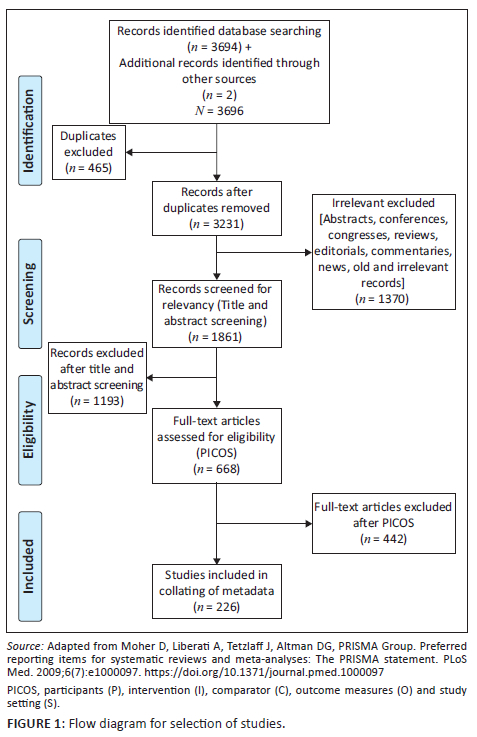
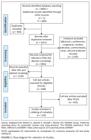
The search strategies for identifying primary studies incorporated the methodological component of the research recommended by Clapton et al. to establish a review team comprising all authors before systematic mapping was started.6Figure 1).7
Electronic searches
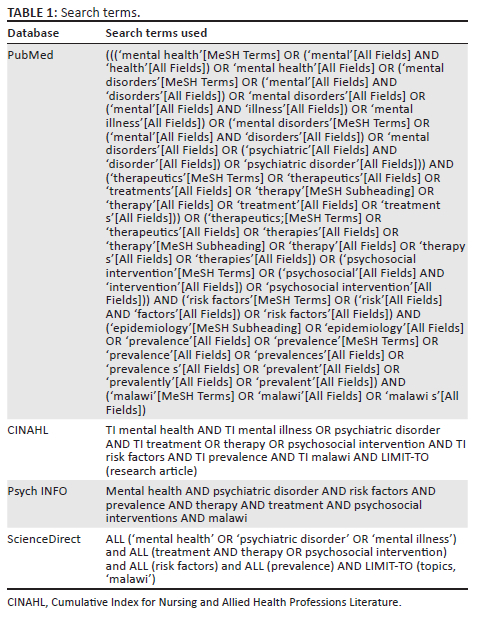
The following electronic databases were searched for primary studies: (1) PubMed, Cumulative Index for Nursing and Allied Health Professions Literature (CINAHL), (2) Psych INFO and (3) ScienceDirect (Table 1).
The authors searched for published articles about the biopsychosocial factors (how biological, psychological and social functioning interact), trends and social determinants in population mental health treatment of mental disorders and psychosocial interventions in Malawi. An initial search firstly involved a search across all databases that were included using all identified keywords and index terms. Secondly, additional studies were sought from the reference list of all identified articles. The systematic mapping included studies that were published in English. The first author, together with an information scientist (F.C.), constructed the following search terms that were initially used to conduct a search: (Mental health OR Mental illness Or Mental Disorders OR Mental Health problems) AND (prevalence OR treatment OR psychosocial intervention) AND (Malawi OR 'Name of specific district'). The final search for each database was done using search terms that are presented in Table 1.
Searching other resources
Reference lists of the included studies were hand searched by the first author (G.C.-S.). Experts with a master's or doctorate degree in mental health nursing, psychology and psychiatry from within Malawi and around the world who had published at least one mental health research conducted in Malawi were also contacted. These experts were requested to provide names of persons or institutions that might have expert knowledge regarding relevant publications for mental health in Malawi.
Data collection
Studies retrieved from the final search were uploaded onto the Reference Manager in Endnote (Clarivate Plc, London, United Kingdom) and screened for duplicates. The inclusion and exclusion criteria were then independently applied by three authors (G.C.-S.).
Data analysis
Synthesis of evidence
In this systematic mapping, a synthesis of trends in the literature, knowledge gaps and clusters identified was carried out without synthesising study results.4
Outputs
The systematic mapping process achieved the following outputs: the status of local evidence on mental health issues was described; the geographical distribution of mental health research conducted in Malawi was described; the knowledge gaps related to mental health issues in Malawi were identified; and a searchable list of studies on mental health issues in Malawi was created (Online Appendix 1).
Ethical considerations
No ethical clearance was needed and/or required for this study as it involved review of data from primary studies which had previously received ethics approval.
Results
Review process and results
The electronic search yielded 3694 published records from Pubmed, CINAHL, PsychINFO and ScienceDirect, (Figure 1). Two articles were sourced from authors, resulting in a total of 3696 records (Figure 1). A total of 465 duplicates were removed, resulting in 3231 records that were scrutinised. A further 1370 records were removed because they were irrelevant, conferences, congresses, editorials, commentaries, reviews and news, resulting in 1861 articles that were assessed for relevancy. A further 1193 articles were excluded after reviewers screened their titles and abstracts for relevancy, resulting in 668 that were scrutinised using the PICOS criteria. The application of the PICOS criteria resulted in excluding a further 442 articles, leaving 226 articles that were included in this systematic mapping (Online Appendix 1). The reviewers' ratings for inclusion or exclusion of studies agreed with a kappa = 0.94.
Findings from studies for inclusion in the systematic mapping (n = 226)
Of the 226 articles that were included in this systematic mapping, most of them were published in English (n = 225) between 1988 and 2021. There was only one article that was published in Norwegian (n = 1).
Status of local evidence on mental health issues
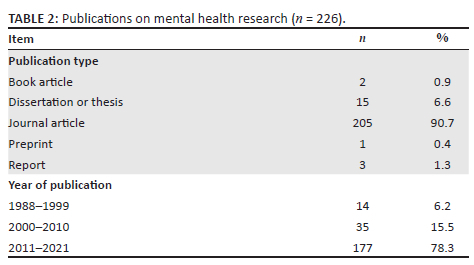
Publications on mental health research: The decadal categorisation of publications was used for easy categorisation of mental health research in this study. This systematic mapping showed that there were few research studies on mental health issues in Malawi that were published before the year 2000 (Table 2). However, the mapping also revealed that there has been a plethora of scientific publications on mental health issues (78.3%, n = 177) in the country since 2011. This systematic mapping further found that many research studies that were conducted in Malawi were published in peer-reviewed journals (90.7%, n = 205) (Table 2). The mapping also showed that some studies were available online in the form of dissertations or theses (6.6%, n = 15).
Methodologies used to conduct mental health research: The systematic mapping revealed that quantitative studies (75.2%, n = 170) dominated mental health research in Malawi, followed by qualitative methods (18.6%, n = 42). Furthermore, some mental health research (6.2%, n = 14) had used mixed methods.
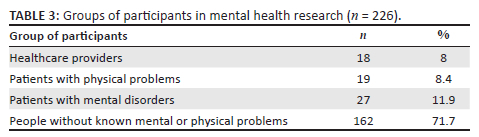
Groups of participants in mental health research: This systematic mapping revealed that people without known mental or physical problems (71.7%, n = 162) were the group that participated in most mental health research in Malawi (Table 3).
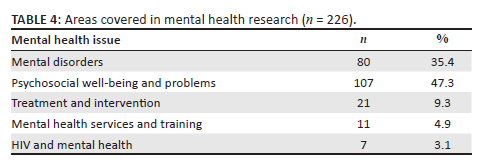
Areas covered in mental health research: This systematic mapping showed that psychosocial well-being and problems (47.3%, n = 107) was the area that was most covered in mental health research in Malawi (Table 4). There was less than 10.0% of mental health research that focused on treatment and interventions in the country.
Geographical distribution of mental health research in Malawi
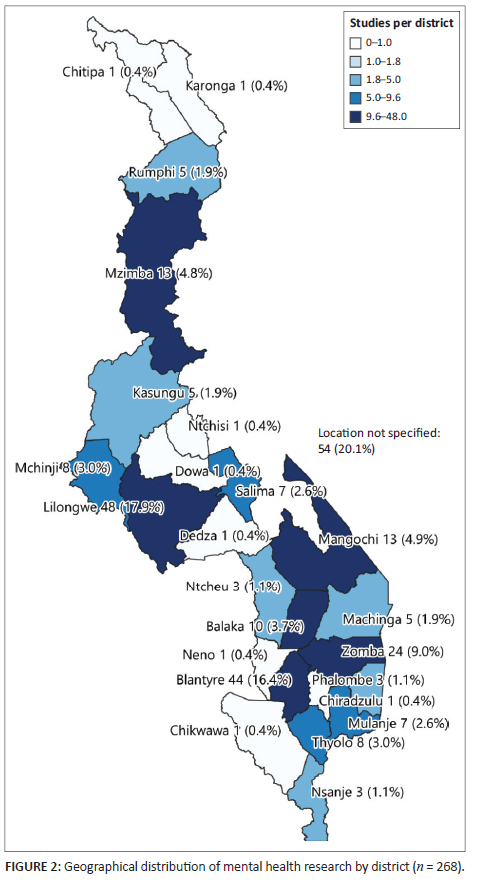
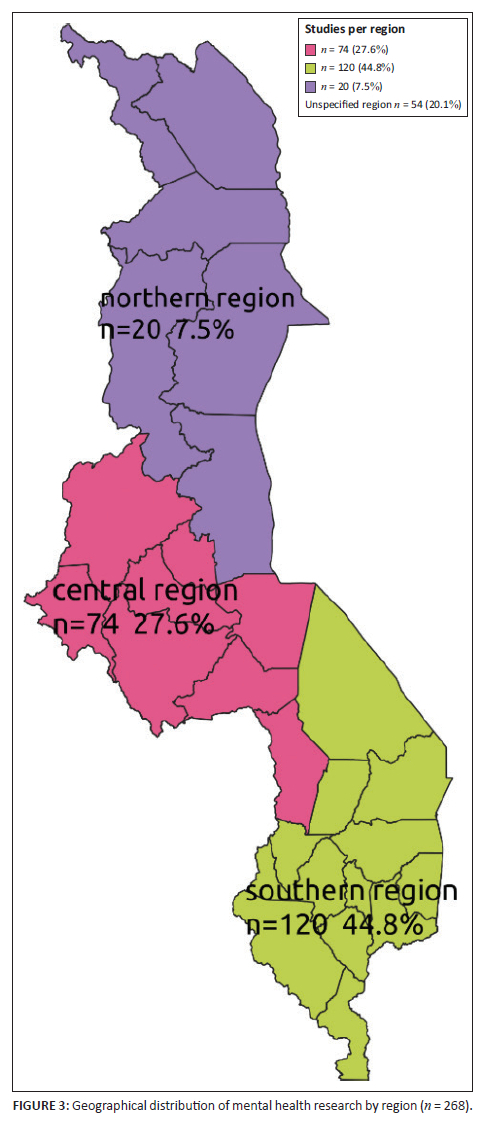
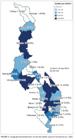
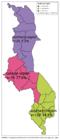
This systematic mapping found that research on mental health issues was concentrated in the three cities of Lilongwe (17.9%, n = 48), Blantyre (16.4%, n = 44) and Zomba (9.0%, n = 24), with minimal studies conducted in other districts across the country (Figure 2). Some studies were conducted in multiple districts (42), increasing n to 268 when each district was counted alone against a particular study (Figure 2). However, no published studies on mental health issues from Likoma, Nkhotakota and Mwanza districts were found. Furthermore, the systematic mapping showed that many studies (44.8%, n = 120) were conducted in the southern region of the country (Figure 3).
Discussion
This first systematic mapping on mental health research has showed the availability, distribution and status of local evidence in Malawi. The systematic mapping suggests that mental health is relatively under-researched. This is corroborated by Read and Doku,89
This systematic mapping has shown that quantitative studies dominated research that was conducted in Malawi. It is possible that quantitative methods are used more compared to qualitative methods because the questions being asked require quantitative methods to answer. Some quantitative designs (cross-sectional designs) may be preferred to answer questions because they are also easier to develop, easier to assess what a researcher would like to measure and easier to administer, as they require less training, take less time and can be used with bigger samples.109n = 14). It is necessary that all health professionals must be trained to conduct clinically based research8
The sparse distribution of research in other regions of the country may imply that the available evidence may not be representative for the country. There is a need to conduct mental health research in the central and northern regions of the country. In addition, there is a need for future studies to use representative samples from across the country to ensure that cross-cultural and culturally relevant evidence is generated locally. This will help to produce the much-needed evidence to understand the complex mental disorders in the country. For instance, this systematic mapping showed that mental disorders constituted only one third of mental health research (35.4%, n = 80) that was conducted in the country. This may be attributed to challenges which researchers encounter to recruit clients with mental disorders in mental health research.111213
Despite limitations mentioned before, psychosocial well-being and problems covered nearly half of the mental health research (47.3%, n = 107) that was conducted in Malawi. This can be explained by literature which showed crosscutting efforts from stakeholders who are interested in implementing evidence-based interventions for dealing with psychosocial problems such as violence to uphold the human rights of women and children.14,15,16,17
Study limitations
This systematic mapping is limited because these sources of data may not have been exhaustive, and some relevant search terms may have been left out. It is possible that this systematic mapping did not identify all published studies and grey literature through these search methods. However, this systematic mapping can be updated in future to include studies that were not accessible during the data collection period and those studies that will be conducted in future.
Conclusion
This systematic mapping has provided important insights into the research of mental health issues in Malawi and suggested directions for future research. There is an urgent need for mental health research using robust study designs and representative samples to generate useful, local and culturally acceptable evidence across disciplines. Based on this systematic mapping, it is suggested that population-based epidemiological studies of mental disorders, research on mental disorders and studies on psychosocial interventions should be prioritised in Malawi.
Competing interests
The authors have declared that no competing interest exists.
Authors' contributions
G.C.-S. drafted the manuscript with support from J.M. and D.N. G.C. designed the study and collaborated with D.N., F.C., L.C., J.S., A.S., E.N.K., G.S., D.J., C.C, J.M. and F.J. to execute the study. The search for records and data extraction were performed by F.C and G.C. All authors participated in the review and revision of the manuscript and have approved the final manuscript to be published.
Funding information
This research received no specific grant from any funding agency in the public, commercial or not-for-profit sectors.
Data availability
Data from this study is available as a supplementary file.
Disclaimer
The views and opinions expressed in this article are those of the authors and do not necessarily reflect the official policy or position of any affiliated agency of the authors, and the publisher.
Acknowledgements
The authors acknowledge all the colleagues who offered guidance and technical support to the project and drafting of this manuscript.
References
-
1.Lahariya C. Introducing healthcare in low-resource settings. Healthcare Low Resour Sett. 2013;1(1):1. https://doi.org/10.4081/hls.2013.e1
» https://doi.org/10.4081/hls.2013.e1 -
2.Herba CM, Glover V, Ramchandani PG, Rondon MB. Maternal depression and mental health in early childhood: An examination of underlying mechanisms in low-income and middle-income countries. Lancet Psychiatry. 2017;3(10):983-992. https://doi.org/10.1016/S2215-0366(16)30148-1
» https://doi.org/10.1016/S2215-0366(16)30148-1 -
3.Bhakta S. The importance of mental health research and evaluation. Mental Health First Aid [serial on the Internet]. 2021 [cited 2021 Aug 5]. Available from: https://www.mentalhealthfirstaid.org/external/2021/04/the-importance-of-mental-health-research-and-evaluation/.
» https://www.mentalhealthfirstaid.org/external/2021/04/the-importance-of-mental-health-research-and-evaluation/ -
4.James KL, Randall NP, Haddaway NR. A methodology for systematic mapping in environmental sciences. Environ Evid. 2016;5(1):7. https://doi.org/10.1186/s13750-016-0059-6
» https://doi.org/10.1186/s13750-016-0059-6 -
5.Haddaway NR, Bernes C, Jonsson B-G, Hedlund K. The benefits of systematic mapping to evidence-based environmental management. Ambio. 2016;45(5):613-620. https://doi.org/10.1007/s13280-016-0773-x
» https://doi.org/10.1007/s13280-016-0773-x - 6.Clapton J, Rutter D, Sharif N. SCIE systematic mapping guidance. London: SCIE; 2009.
-
7.Moher D, Liberati A, Tetzlaff J, Altman DG, PRISMA Group. Preferred reporting items for systematic reviews and meta-analyses: The PRISMA statement. PLoS Med. 2009;6(7):e1000097. https://doi.org/10.1371/journal.pmed.1000097
» https://doi.org/10.1371/journal.pmed.1000097 - 8.Read UM, Doku V. Mental health research in Ghana: A literature review. Ghana Med J. 2012;46(2):29-38.
-
9.Razzouk D, Sharan P, Gallo C, et al. Scarcity and inequity of mental health research resources in low-and-middle income countries: A global survey. Health Policy. 2010;94(3):211-220. https://doi.org/10.1016/j.healthpol.2009.09.009
» https://doi.org/10.1016/j.healthpol.2009.09.009 - 10.Kielmann K, Cataldo F, Seeley J. Introduction to qualitative research methodology: A training manual. pp. 1-4. London: Department for International Development (DfID); 2012.
-
11.Bucci S, Butcher I, Hartley S, Neil ST, Mulligan J, Haddock G. Barriers and facilitators to recruitment in mental health services: Care coordinators' expectations and experience of referring to a psychosis research trial. Psychol Psychother Theory Res Pract. 2015;88(3):335-350. https://doi.org/10.1111/papt.12042
» https://doi.org/10.1111/papt.12042 -
12.Adjorlolo S, Setordzi M. Psychosis in adolescents in Africa: A scoping review for current understanding and future directions. Cogent Psychol. 2021;8(1):1949173. https://doi.org/10.1080/23311908.2021.1949173
» https://doi.org/10.1080/23311908.2021.1949173 -
13.Witcomb GL, Bouman WP, Claes L, Brewin N, Crawford JR, Arcelus J. Levels of depression in transgender people and its predictors: Results of a large matched control study with transgender people accessing clinical services. J Affect Disord. 2018;235:308-315. https://doi.org/10.1016/j.jad.2018.02.051
» https://doi.org/10.1016/j.jad.2018.02.051 -
14.Ameli V, Meinck F, Munthali A, Ushie B, Langhaug L. Associations between adolescent experiences of violence in Malawi and gender-based attitudes, internalizing, and externalizing behaviors. Child Abuse Negl. 2017;67:305-314. https://doi.org/10.1016/j.chiabu.2017.02.027
» https://doi.org/10.1016/j.chiabu.2017.02.027 -
15.Banks LM, Kelly SA, Kyegombe N, Kuper H, Devries K. 'If he could speak, he would be able to point out who does those things to him': Experiences of violence and access to child protection among children with disabilities in Uganda and Malawi. PLoS One. 2017;12(9):e0183736. https://doi.org/10.1371/journal.pone.0183736
» https://doi.org/10.1371/journal.pone.0183736 -
16.Mkandawire-Valhmu L, Bauer WS, Stevens PE, et al. Rural Malawian women's resistance to systematic oppression, violence, and abuse by their husbands. J Interpers Violence. 2020;35(1-2):268-293. https://doi.org/10.1177/0886260516682518
» https://doi.org/10.1177/0886260516682518 -
17.Palermo T, Pereira A, Neijhoft N, et al. Risk factors for childhood violence and polyvictimization: A cross-country analysis from three regions. Child Abuse Negl. 2019;88:348-361. https://doi.org/10.1016/j.chiabu.2018.10.012
» https://doi.org/10.1016/j.chiabu.2018.10.012

Accepted: 22 Aug. 2022
Published: 07 Dec. 2022