An assessment of voting knowledge and related decisions amongst hospitalised mental healthcare users in South Africa
Abstract
BACKGROUND: The South African Constitution protects the right to vote for every citizen. The Electoral Act (No. 73 of 1998) limits registration on the voter's roll on the basis of being declared of 'unsound mind' or 'mentally disordered' by the high court or detention under the Mental Health Care Act (No. 17 of 2002). There is limited information regarding voting knowledge and subsequent voting-related decisions amongst South African involuntary mental healthcare users (MHCUs) AIM: To compare voting knowledge and related decisions between hospitalised MHCUs and non-psychiatric hospitalised patients (controls) SETTING: Participants were recruited from Sterkfontein Psychiatric Hospital (MHCUs) and Chris Hani Baragawanth Academic Hospital orthopaedic wards (controls) in Gauteng, South Africa. METHOD: A cross-sectional survey was conducted using a modified Cognitive Assessment Tool for Voting (MCAT-V) questionnaire. Scores on the MCAT-V were compared between the MHCU and control groups, along with socio-demographic variables and clinical variables RESULTS: There was a significant association between group (MHCU vs. control) and HLOE (p = 0.016). Although the median overall score for the controls (11; interquartile range [IQR] 10-12) was significantly higher than that for the MHCUs (10; IQR 8-12) (p = 0.043), when controlling for education level, there was no significant association between group (MHCU/control) and MCAT-V scores (p = 0.011). The MCAT-V scores of the 'Doe questions' between the MHCUs and controls were not significantly different (p = 0.063). There was a difference in 'reasoning scores' between MHCUs and controls (p = 0.0082) and this was associated with level of educational attainment (p = 0.013). CONCLUSION: The limitations regarding voter registration legislated in the South African Electoral Act, are not supported by the findings of this study. The MCAT-V demonstrates a possible educational bias and therefore is not recommended as a screening tool for assessing voting competency.
CAT-V questionnaire; cognitive assessment tool; doe scoring; schizophrenia; voting
Introduction
'Universal adult suffrage, a national common voter roll, regular elections and a multi-party system of democratic government' are a few of the fundamental principles mentioned in the 1996 Constitution of South Africa.1Electoral Act (No. 73 of 1998) sets limitations on certain mental healthcare users (MHCUs) to register to vote in the South African General elections.2Electoral Act of 1998, with the most recent publication being made in 2019, regulations pertaining to the voting rights of South Africa's MHCUs have not been revised.3
The transgression of human rights with regard to psychiatric patients is not a new concept.455
There is evidence to suggest that despite being mentally unwell, MHCUs still retain their political sense.66
The concept of 'capacity' is complex and task specific, and thus there are many ethical and legal factors to consider when attempting to address the idea of voting capacity.75
The current South African Electoral Act denies 'detained' MHCUs and those who have been declared by the high court to be of 'unsound mind' the ability to be registered on the national voters roll and subsequently vote.22
There can be no single test to determine 'voting competency'; however, it is possible to examine individual voting knowledge and decision-making.88
Those with moderate Alzheimer's displayed variable scores, and thus screening tools such as the CAT-V were suggested as useful when assessing their voting competency.8
Israeli Election Law makes provisions for hospitalised psychiatric patients to participate in the voting process.
Given the current legislation in South Africa, which at present limits voting registration in persons detained under the MHCA, the focus of this study was to assess voting knowledge and related voting decisions in hospitalised MHCUs in South Africa.
Objectives
We aimed to compare voting knowledge and related decisions between a group of MHCU and controls, by using a modified CAT-V (MCAT-V) screening tool. We sought to determine if there were any significant differences between the two groups and to determine if there were any additional clinical or other factors, which might influence test scores in the South African context.
Method
Participants
This study was conducted as a cross-sectional comparative survey. Data were collected between January 2018 and April 2018. Convenience sampling was used. The MHCU group consisted of 60 patients (26 involuntary MHCUs and 34 state patients) from the psychiatric wards at Sterkfontein Psychiatric Hospital (SPH). A state patient is an individual who has committed an offence of a serious nature and has been deemed by a High Court as suffering from a mental disorder and found therefore not fit to stand trial and/or not responsible for the offence and therefore requiring treatment in a psychiatric hospital.11Electoral Act, although it is not entirely clear which MHCUs the Electoral Act is referring to.2121213
Questionnaire
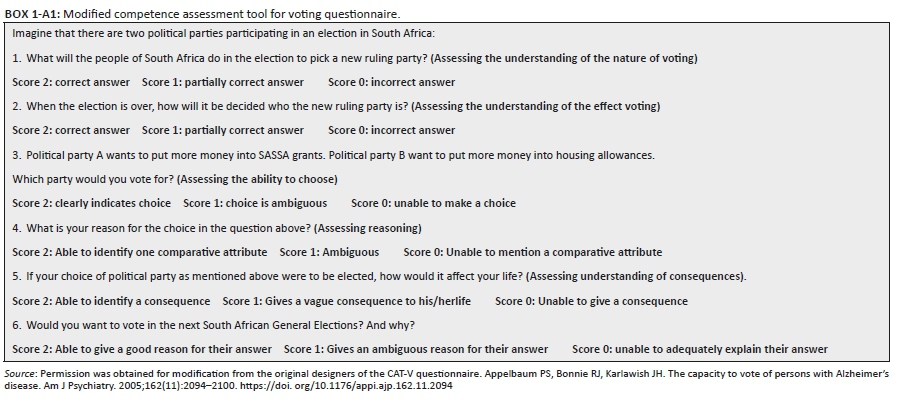
The CAT-V questionnaire needed to be adapted for the South African population. The unique political, cultural and social situation in South Africa was considered to ensure that the questionnaire would be unbiased and coherent. Permission was obtained to use and modify the CAT-V questionnaire to the South African setting. The MCAT-V required the participant to envision it was the day of the national South African elections. They were obligated to vote for a new political party, not a governor scenario as in the original CAT-V questionnaire.88Appendix). Differences between political party A and B in the hypothetical scenarios were kept vague, with an attempt to avoid any similarities with real political parties and agendas.
Procedure
Participants were required to understand and speak English, be over the age of 18 years and to hold a valid South African identity document. Participants in the MHCU group were required to be admitted under the Mental Care Act 17 of 2002 as an involuntary MHCU or state patient. The control group participants had to be hospitalised for a general orthopaedic condition. Vital signs and physical state were screened to exclude delirium. It was also ensured that the control group had no history of recent head injury (within the last 6 months) and no known psychiatric illness. The usage of benzodiazepines within 8 hours of the interview excluded patients from participating in the study in both the groups.
Informed consent was secured from each candidate prior to participation in the study. The MCAT-V questionnaire was administered by the same investigator for all the participants, and the participant's answers and scores were documented. Scoring was rated from 0 to 2 points, where 0 was allocated for an inadequate answer, 1 point for a partially correct answer and 2 points for a satisfactory answer. Information pertaining to their allocated ward, the mental healthcare act section under which the user was detained and their diagnosis based on DSM 5 criteria was obtained from hospital records. Age, gender, highest level of education (HLOE) and prior participation in voting (voting status) were captured during the interview.
Contact details of the Independent Electoral Committee were made available to those wishing to enquire about the South African voting process. Provisions were made for referral to the psychology departments of the respective hospitals for participants who were unsettled by the interview process and politically associated questions.
Data analysis
Data analysis was carried out by using SAS version 9.4 for Windows. The 5% significance level was used.
Descriptive analysis of the data was carried out. An overall score for each participant was calculated (range: 0-12).
The gamma coefficient was used when looking at the association between the questionnaire scores for the control and sample groups as well as the strength of this association. A 'Doe score' (sum of question 1-3) and a 'reasoning score' (sum of questions 4-6) were calculated for each participant. The chi-squared test was used when calculating the association between gender, HLOE, voting status, categorised scores and groups.
Fisher's exact test was applied when the requirements for the chi-squared test could not be met. The significance of the association between the two groups was then further calculated by Cramer's V and the phi coefficient. The association between HLOE and voting status was calculated in a similar manner. The relationship between age, total score and group was analysed by using the t-test. Where the data did not meet the assumptions of these tests, the Wilcoxon rank-sum test was used. The strength of the associations was measured by the Cohen's d for parametric tests and the r value for the non-parametric tests.
Ethical consideration
This study was approved by the University of the Witwatersrand post-graduate committee and the Human Research Ethics Committee. Permission was also obtained from SPH and CHBAH. The specialist psychiatrist from each ward involved in the study oversaw the consenting process in the MHCU group (Ethical clearance number: M170730).
Results
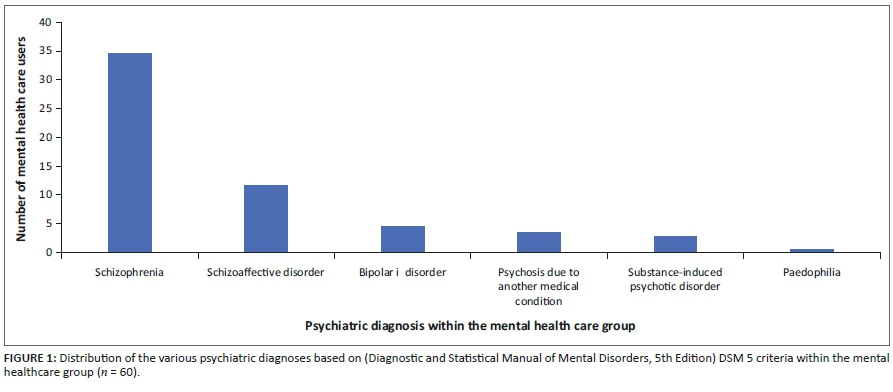
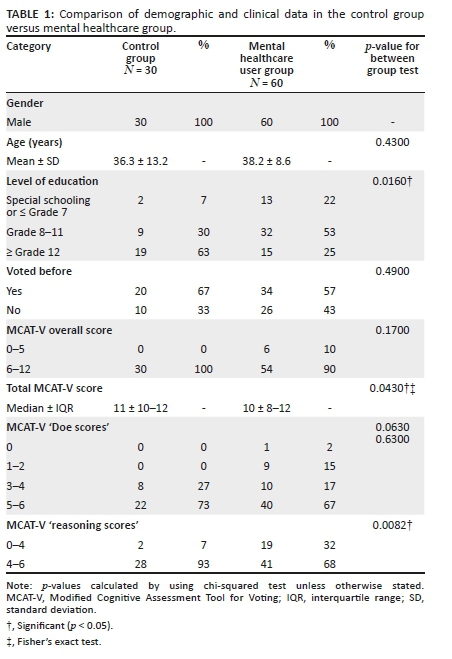
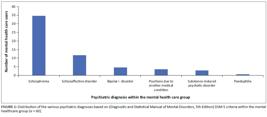
There were 90 participants in this study. All participants consented and answered the questionnaire. No patients refused to participate. Of the sample MHCU group, 57% were state patients; the rest (43%) were involuntary MHCUs. The predominant DSM 5 diagnosis in the MHCU group was found to be schizophrenia (58%) (Figure 1). The control group had a diverse range of injuries, with 83% having incurred fractural damage. The participants were all male, and the mean ages of the two groups did not differ significantly (p = 0.43) (Table 1). There was a significant association between group and HLOE (p = 0.0016) (Table 1); the effect size was moderate (Cramér's V = 0.38). The control group had a higher proportion of patients with Grade 12 qualification or higher education (63%) compared with the mental healthcare group (25%) (Table 1). There was no significant difference in the percentage of patients who had voted before in the control group (67%) compared with the mental healthcare group (57%) (p = 0.49) (Table 1).
There was no significant association between HLOE and voting status (p = 0.23).
Considering the categorised overall score, all control group participants (100%) scored six or more, compared with only 90% of the MHCU group. The difference, however, was not statistically significant (p = 0.17) (Table 1). The median overall score for the control group (11; interquartile range [IQR] 10-12) was significantly higher than that for the MHCU group (10; IQR 8-12) (p = 0.043) (Table 1). However, the effect size was small (r = 0.22). There was a difference in median scores between involuntary MHCUs (10; IQR 7-11) and state patients (11; IQR 9-12); however, this difference was not significant (p = 0.19). No further analysis was conducted on the MHCU subgroups.
When assessing categorised 'Doe scores' between the control and MHCU group, the difference was not found to be significant (p = 0.063) (Table 1). The proportion of scores five or greater on the Doe questions also did not differ significantly between the two groups (p = 0.63) (Table 1). A significant difference was found between the categorised reasoning scores of the two groups (p = 0.0082) (Table 1). The proportion of patients with high reasoning scores (i.e. scores of either five or six) was lower in the MHCU group (68%) compared with the control group (93%) (Table 1).
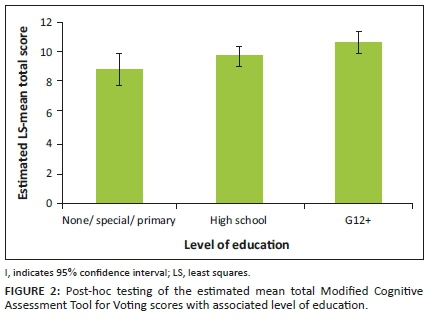
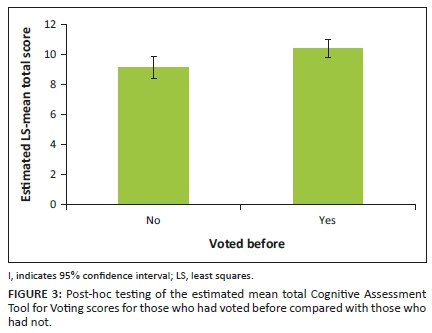
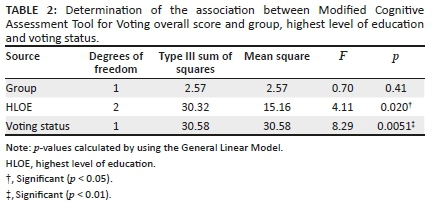
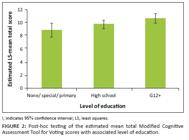
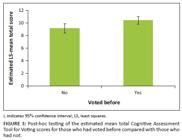
On further analysis of the scores and confounding factors, it was found that the HLOE (p = 0.020) and voting status (p = 0.0051) had a significant effect on the overall MCAT-V score but group did not (p = 0.41) (Table 2). Post-hoc tests showed that the estimated mean total score, across groups and voting status, was significantly higher for those with Grade 12 or higher education compared with those with no schooling/special schooling or primary-level education (p = 0.017) (Figure 2). Similarly, post-hoc tests revealed that the estimated mean total score, across groups and HLOE, was significantly higher for those who had voted before compared with those who had not (p = 0.0051) (Figure 3).
Discussion
The predominant diagnosis amongst the mental healthcare participants in this study was found to be schizophrenia. This was comparable with the study by Raad et al., who reported that 72% of their sample group had a primarily psychotic diagnosis10914
In the 2016 Annual Meeting of the American Psychiatry Association, it was construed that despite the cognitive impairments experienced by patients suffering from mental illnesses, such as schizophrenia, the ability to make insightful decisions and choices is retained.1415
No significant difference was found between the Doe scores of the MHCU group and the control group (p = 0.063). The percentage of scores of 5 or greater also did not differ significantly between the two groups (p = 0.63). Involuntary and state psychiatric patients thus retained their understanding of voting and demonstrated an ability to make a choice despite current hospitalisation for mental illness, relative to a control group. This finding does not support the suggestion that voting knowledge and choice are determined by hospitalisation for psychiatric illnesses. The reasoning and appreciation questions (i.e. questions 4, 5 and 6) showed greater variability between the two groups. Mental healthcare users obtained lower scores than controls. Similar findings were found by Applebaum et al. with regard to CAT-V score patterns in patients with very mild to mild Alzheimer's disease.88
A significant difference in level of education was found in our study between the control group and the MHCUs with 63% of the control group completing at least 12 years of schooling versus 25% of the MHCU group. A higher number of MHCUs (22%) obtained special schooling or a Grade 7 or less (p = 0.0016). This pattern of education is not consistent with previous research in hospitalised MHCUs in South Africa, where it was noted that 63% of acute male admissions in Lentegeur Psychiatric Hospital in the Western Cape Province were educated to a secondary level.168,9,10
Previous research on the use of the CAT-V has been conducted in population groups with relatively high levels of education with Applebaum et al. reporting a mean of 14.0 years of education in patients with Alzheimer's disease, and Doron et al. reporting that 89.9% of MHCUs in their study had a minimum of a high school level of education.8,917181919
It is also noted that despite current restrictions on voting registration in South Africa, there was no difference in previous participation in the voting process between the two study groups (p = 0.49). The timeline of hospitalisation and voting history was not obtained. Previous participation in voting in an election is thought to have a strong influence on one's ability to vote in future.20
Study limitations
This study covered a small number of involuntary MHCUs and state patients and was also restricted in that all MHCU participants were admitted at Sterkfontein Psychiatric Hospital (SPH). Results can therefore not be generalised to the South African psychiatric population. This study used convenience sampling, which is also a limitation.
The sample group consisted of both involuntary MHCUs and state patients, and although there was no significant difference in median MCAT-V scores between the two MHCU sub-groups, further differences between these two groups were not explored. The duration of hospital admission between the involuntary users versus state patients may differ, as state patients would have a longer admission duration than involuntary MHCUs, and this could have an impact on mental state, acute illness severity and the subsequent test results.2122
Objective cognitive testing (such as the MMSE and MOCA) was not carried out as compared with other similar international studies. This added a further limitation to the study as these screening tools may have provided validity for the MCAT-V questionnaire. Cognitive impairment is common in those with severe psychiatric illnesses and may serve as an independent factor when assessing voting capability.2324
It was noted that despite a proportion of MHCUs having a Grade 7 level of education or less, intellectual disability was not mentioned as a DSM 5 diagnosis. Whilst level of education was obtained from the patient directly during the interview, the DSM 5 diagnoses were captured from the patients' files. This serves as a limitation with regard to discrepancies with diagnosis and possibly indicates poor record-keeping of long-term patients.
Control for level of education by the usage of patients in both groups who obtained a matric certificate or higher may have clarified the impact of MHCU status on MCAT-V scores. However, the finding of a possible educational bias in the MCAT-V is an important finding as it limits the usefulness of the MCAT-V as a screening tool.
The MCAT-V was adjusted for our South African population. However, the reliability and validity of this modification were not confirmed. The adjustment in the first three 'Doe' questions was to replace the usage of the word 'governor' with that of 'party' as it was thought to be a more relatable term to the South African population. Choice of replacement questions and situations were further carried out for the 'reasoning' questions 4-6 to assist the South African participants to identify with the questionnaire. The attempts were to retain the basic 'Doe principles' (assessing understanding of the nature and the effect of voting), as well as 'reasoning' themes, in the modified questionnaire. The impact of this modification on the participants understanding of the phrasing of the questions or impact on overall scores was not established. This limits the usefulness of the results and any comparison with international studies that used an unmodified CAT-V, and any subsequent conclusions regarding voting competency. A larger validity and reliability study is needed.
Language served as a limiting factor as only those who were English-speaking were selected to participate.
Conclusion
The findings from this study suggest that current legislative restrictions on voting registration for MHCUs may not be justified. Limitations such as the inclusion of both state patients and involuntary MHCUs, lack of use of cognitive screening tools and validation of the MCAT-V make it difficult for definite conclusions to be drawn. However, this study is the first to investigate voting knowledge and related decisions amongst hospitalised MHCUs in South Africa. Based on the Doe voting capacity standard, South African MHCUs do not have significantly different patterns of voting knowledge and choice demonstration when compared with a control group, but differences between the groups were noted on reasoning scores. The differences in total MCAT-V scores between the groups were further found to be associated with education level and not membership of the MHCU group. It is therefore recommended that because of the educational bias, this MCAT-V questionnaire in its current format should not be used as a screening tool in the South African setting. There is a need for further research, addressing the above limitations.
We extend our gratitude to the staff of CHBAH and SPH as well as the study participants for their involvement in this venture. We hope that this research will assist in broadening people's views on the voting rights of South Africa's MHCUs.
Thank you to Petra Gaylard for her assistance with the data analysis.
Competing interests
The authors declare no conflict of interest in this research.
Authors' contributions
F.M. was responsible for data collection and initial draft of the manuscript. Y.N. was the supervisor of the project and contributed to the study design and editing.
Funding information
This research received no specific grant from any funding agency in the public, commercial or non-profit sectors.
Data availability statement
Data sharing is not applicable to this article as no new data were created or analysed in this study.
Disclaimer
The views and opinions expressed in this article are those of the authors and do not necessarily reflect the official policy or position of any affiliated agency of the authors.
Acknowledgements
This article stemmed from the research of Dr F. Marcus entitled 'An assessment of voting knowledge and related decisions amongst hospitalized mental health care users in South Africa' that was presented in partial fulfilment for the degree of Master's of Medicine in the Department of Psychiatry at the University of the Witwatersrand, Johannesburg, in 2019.
References
-
1.Constitution of the Republic of South Africa No. 108 of 1996 [homepage on the Internet]. [cited 2017 Jul 20]. Available from: https://www.justice.gov.za/legislation/constitution/SAConstitution-web-eng.pdf
» https://www.justice.gov.za/legislation/constitution/SAConstitution-web-eng.pdf -
2.Electoral Act, 1998 (Act No. 73 of 1998). [cited 2017 Jul 20]. Available from: http://www.saflii.org/za/legis/num_act/ea1998103.pdf
» http://www.saflii.org/za/legis/num_act/ea1998103.pdf -
3.Republic of South Africa. Electoral Law Amendment Act 2019, Act No. 1 of 2019 [statute on the Internet]. Government Gazette (January 2019). Volume 643. 2019, p. 2-16. [cited 2019 Mar 20]. Available from: https://www.gov.za/documents/electoral-laws-amendment-act-1-2019-english-afrikaans-21-jan-2019-0000
» https://www.gov.za/documents/electoral-laws-amendment-act-1-2019-english-afrikaans-21-jan-2019-0000 -
4.Poreddi V, Ramachandra, Reddemma K, Math SB. People with mental illness and human rights: A developing countries perspective. Indian J Psychiatry. 2013;55(2):117-124. https://doi.org/10.4103/0019-5545.111447
» https://doi.org/10.4103/0019-5545.111447 -
5.Bhurga D, Pathare S, Gosavi C, et al. Mental illness and the right to vote: A review of legislation across the world. Int Rev Psychiatry. 2016;28(4):395-399. https://doi.org/10.1080/09540261.2016.1211096
» https://doi.org/10.1080/09540261.2016.1211096 - 6.Bhopal J, Meagher J, Soos J. Political awareness of psychiatric patients. CMAJ. 1988;139(11):10339.
-
7.Moberg P, Kniele K. Evaluation of competency: Ethical considerations for neuropsychologists. Appl Neuropsychol. 2006;13(2):101-114. https://doi.org/10.1207/s15324826an1302_5
» https://doi.org/10.1207/s15324826an1302_5 -
8.Appelbaum PS, Bonnie RJ, Karlawish JH. The capacity to vote of persons with Alzheimer's disease. Am J Psychiatry. 2005;162(11):2094-2100. https://doi.org/10.1176/appi.ajp.162.11.2094
» https://doi.org/10.1176/appi.ajp.162.11.2094 - 9.Doron A, Kurs R, Stolvoy T, Secker-Einbinder A, Raba A. Voting rights for psychiatric patients: Compromise of the integrity of elections, or the empowerment and integration into the community? Isr J Psychiatr Relat Sci. 2014;51(3):169-174.
-
10.Raad R, Karlawish J, Appelbaum PS. The capacity to vote of persons with serious mental illness. Psychiatr Serv. 2009;60(5):624-628. https://doi.org/10.1176/ps.2009.60.5.624
» https://doi.org/10.1176/ps.2009.60.5.624 -
11.Republic of South Africa. Mental Health Care Act 17 of 2002, p. 7. [cited 2017 Jul 20]. Available from: https://www.justice.gov.za/legislation/acts/2002-017_mentalhealthcare.pdf
» https://www.justice.gov.za/legislation/acts/2002-017_mentalhealthcare.pdf - 12.Woodward M. Epidemiology: Study design and data analysis. 3rd ed. Boca Raton: CRC Press, Taylor & Francis Group; 2013.
-
13.Faul F, Erdfelder E, Lang AG, Buchner A. G*Power 3: A flexible statistical power analysis program for the social, behavioral, and biomedical sciences. Behav Res Methods. 2007;39:175-191. https://doi.org/10.3758/BF03193146
» https://doi.org/10.3758/BF03193146 - 14.Munjal S. Assessment of decision-making capacity in a psychiatric patient: A common myth. Poster presentation at: 2016 Annual Meeting of the American Psychiatric Association; 2016 May 14-18; Atlanta, GA. P1-119.
-
15.Jeste D, Depp CA, Palmer BW. Magnitude of impairment in decisional capacity in people with schizophrenia compared to normal subjects: An overview. Schizophr Bull. 2006;32(1):121-128. https://doi.org/10.1093/schbul/sbj001
» https://doi.org/10.1093/schbul/sbj001 -
16.Franken H, Wicomb R, Allen R, Parker J. A profile of adult acute admissions to Lentegeur Psychiatric Hospital, South Africa. S Afr J Psychiatr. 2018;24:1282. https://doi.org/10.4102/sajpsychiatry.v24i0.1282
» https://doi.org/10.4102/sajpsychiatry.v24i0.1282 -
17.Ryan C, Bauman K. Educational attainment in the United States. 2015 [cited 2018 Jul 15]. Current Population Reports. Available from: https://www.census.gov
» https://www.census.gov -
18.Matric results and South Africa's unemployment crisis [homepage on the Internet]. [cited 2018 Aug 19]. Available from: https://equaleducation.org.za/2017/01/09/matric-results-and-south-africas-youth-unemployment-crisis/
» https://equaleducation.org.za/2017/01/09/matric-results-and-south-africas-youth-unemployment-crisis/ -
19.Rasul S, Bakhsh Q. A study of factors affecting students' performance in examination at university level. Proc Soc Behav Sci. 2011;15:2042-2047. https://doi.org/10.1016/j.sbspro.2011.04.050
» https://doi.org/10.1016/j.sbspro.2011.04.050 -
20.Gerber A, Green D, Shachar R. Voting may be habit-forming: Evidence from a randomized field experiment. Am J Political Sci. 2003;47(3):540-550. https://doi.org/10.1111/1540-5907.00038
» https://doi.org/10.1111/1540-5907.00038 -
21.Saya A, Brugnoli C, Piazzi G, et al. Criteria, procedures and future prospects of involuntary treatment in psychiatry around the world: A narrative review. Front Psychiatry. 2019;10:271. https://doi.org/10.3389/fpsyt.2019.00271
» https://doi.org/10.3389/fpsyt.2019.00271 -
22.Marais B, Subramaney U. Forensic state patients at Sterkfontein Hospital: A 3 year follow up study. S Afr J Psychiatry. 2015;21(3):a708. https://doi.org/10.4102/sajpsychiatry.v21i3.708
» https://doi.org/10.4102/sajpsychiatry.v21i3.708 -
23.Trivedi JK. Cognitive deficits in psychiatric disorders: Current status. Indian J Psychiatry. 2006;48(1):10-20. https://doi.org/10.4103/0019-5545.31613
» https://doi.org/10.4103/0019-5545.31613 -
24.Tiraboschi P, Chito E, Sacco L, Sala M, Stefanini S, Defanti C. Evaluating voting competence in persons with Alzheimer disease. Int J Alzheimers Dis. 2011;2011:983895. https://doi.org/10.4061/2011/983895
» https://doi.org/10.4061/2011/983895

Accepted: 18 Oct. 2020
Published: 29 Jan. 2021