Digital psychiatry in Nigeria: A scoping review
Abstract
BACKGROUND: Mental healthcare workforce shortage in Nigeria poses a major obstacle to mental health services scale-up. Digital psychiatry may provide a veritable platform to bridge treatment gaps. AIM: To provide an overview of quantity and range of peer-reviewed publications on digital psychiatry in Nigeria. SETTING: A comprehensive literature search encompassed all original, peer-reviewed research articles on digital psychiatry in Nigeria. PubMed, Google Scholar, and a direct exploration of relevant journal article reference lists were utilised. Inclusion criteria covered peer-reviewed original articles conducted in Nigeria between January 2013 and January 2023, regardless of quality. Exclusions comprised case reports, reviews, dissertations, and abstracts. METHODS: Preferred Reporting Items for Systematic Reviews and Meta-Analyses Extension for Scoping Reviews (PRISMA-ScR) guidelines were adhered to, while methodological framework of Arksey and O'Malley was used to describe the review. RESULTS: Fourteen studies meeting inclusion criteria exhibited two primary research areas: implementation and intervention. Most studies focused on intervention strategies, showcasing efficacy of digital devices in enhancing outcomes in depression and clinic appointments. Implementation studies indicated favorable acceptance by both clients and healthcare practitioners. CONCLUSION: Digital technology seems acceptable to Nigerian patients and clinicians. Policies to operationalise provision of digital healthcare services will have positive impact in addressing unmet mental health needs. Finally, the quality of the evidence from majority of studies has to be enhanced, and additional studies are required to uncover gaps in some regions of the country. CONTRIBUTION: This research demonstrates that, despite some drawbacks, digital methods of providing mental healthcare are practical in Nigeria.
digital psychiatry; digital healthcare; telemedicine; mental health services; Nigeria
Introduction
In sub-Saharan Africa (SSA), mental, neurological and substance (MNS) use disorders account for over 350 million disability-adjusted life years (DALYs) lost each year, which is more than the 150 million DALYs experienced in industrialised nations.1234,5555666
Major challenges to providing appropriate mental healthcare and expanding services to overcome treatment gaps in Nigeria are posed by labour shortages.578967101011,12,13
Despite this acknowledgement of robust digital penetration in Nigeria and the limited number of studies that have looked at the use of digital technologies in mental health services in Nigeria, there is a dearth of an integrative synthesis of the body of literature. The authors think that a scoping review is an ideal first step towards identifying existing gaps in the literature and that the scoping review process helps in refining the inclusion and exclusion criteria for the systematic review. By conducting a scoping review, researchers can assess the feasibility of conducting a systematic review, in relation to sufficient volume of literature on the topic, whether the available evidence is diverse enough, and whether the research question is answerable through a systematic review. In addition, findings from a scoping review can inform the development of the systematic review protocol.14
Information sources, search strategy and selection criteria
In accordance with the Preferred Reporting Items for Systematic Reviews and Meta-Analyses Extension for Scoping Reviews (PRISMA-ScR) guidelines,15161617
• Step 1 - Identifying the research question: For the purpose of this scoping review, an all-embracing research question was chosen to ensure that all pertinent publications were included. The question was related to the aim of the review, which is to describe the amount of research and the breadth of published peer-reviewed articles on digital psychiatry in Nigeria.
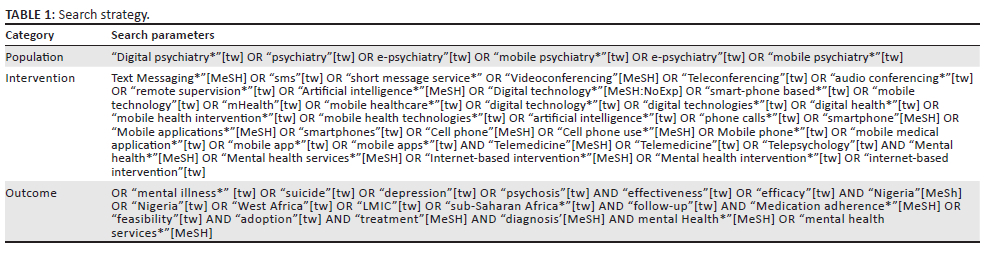
• Step 2 - Identifying relevant studies: Each author independently performed searches in PubMed for all peer-reviewed original research articles published in the past decade relating to digital psychiatry in Nigeria which met the eligibility criteria. The inclusion criteria covered peer-reviewed original articles conducted in Nigeria from January 2013 to January 2023, regardless of their quality. Excluded were case reports, reviews, dissertations and abstracts. Searches were also conducted on Google Scholar, and direct searches of reference lists of pertinent journal articles were also carried out. Thereafter, a joint search was conducted to ensure rigour. Specific words and phrases like digital psychiatry, telemental health, telemedicine, telepsychiatry, short message service (SMS), text messages, voice messages, smartphones, phone calls, mental health apps, video conference, training, intervention, treatment, diagnosis, prevention, follow-up, missed appointment, adherence, mental health, mental healthcare services, suicide, depression, anxiety, psychosis and Nigeria were combined with Boolean operators for the searches in Google Scholar. In PubMed, the building block approach (i.e. the three-step process) was used to conduct the search: firstly, each search term and phrase was sought for individually using the MeSH subject heading; secondly, the MeSH terms and keywords were added to the history; and lastly, a chart builder was used to combine the histories created (Table 1).
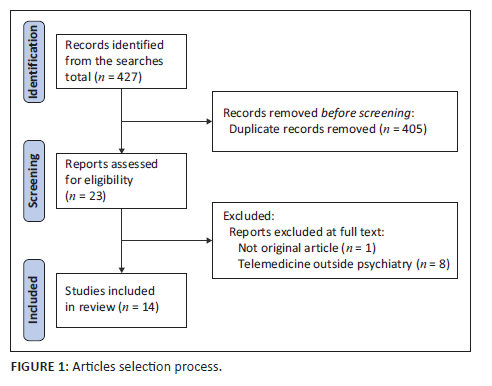
• Step 3 - Study selection: Because of the need to quantify the volume and breadth of the literature, articles were not excluded on the basis of quality. However, case-based reports and review articles were excluded. Citations were imported into EndNote and 405 duplicate articles were filtered out. Relevant publications identified after removing duplicates were screened for other eligibility criteria (Figure 1). The authors (J.U.O. and T.C.O.) independently reviewed each title and abstract for inclusion. When a decision was not possible at this point, the entire article was read and a decision was made. The writers convened jointly and reached a consensus on the final papers to be included in this review. All publications that met the inclusion criteria had their full texts reviewed, and the selection process is shown in Figure 1.
• Step 4 - Charting the data: After assembling and reading through full texts of all eligible articles, the authors (J.U.O. and T.C.O.) agreed on two major domains of fit, namely, implementation and interventions. Extracted data (first author name, year of publication, study characteristics, summary of main findings and area of focus) from each of the article was entered in Microsoft Excel data collection sheet.
• Step 5 - Synthesis of findings: After carefully reading an article, each author used one phrase - a code - to distil the main conclusions. A number of virtual platform-based meetings were used to reconcile the summary of findings that each author had independently made through a consensus.
Ethical considerations
This article followed all ethical standards for research without direct contact with human or animal subjects. The scoping review protocol was submitted to the Ethics Committee, and because the approach primarily consisted of a literature review rather than the use of human subjects, ethical clearance was waived.
Results
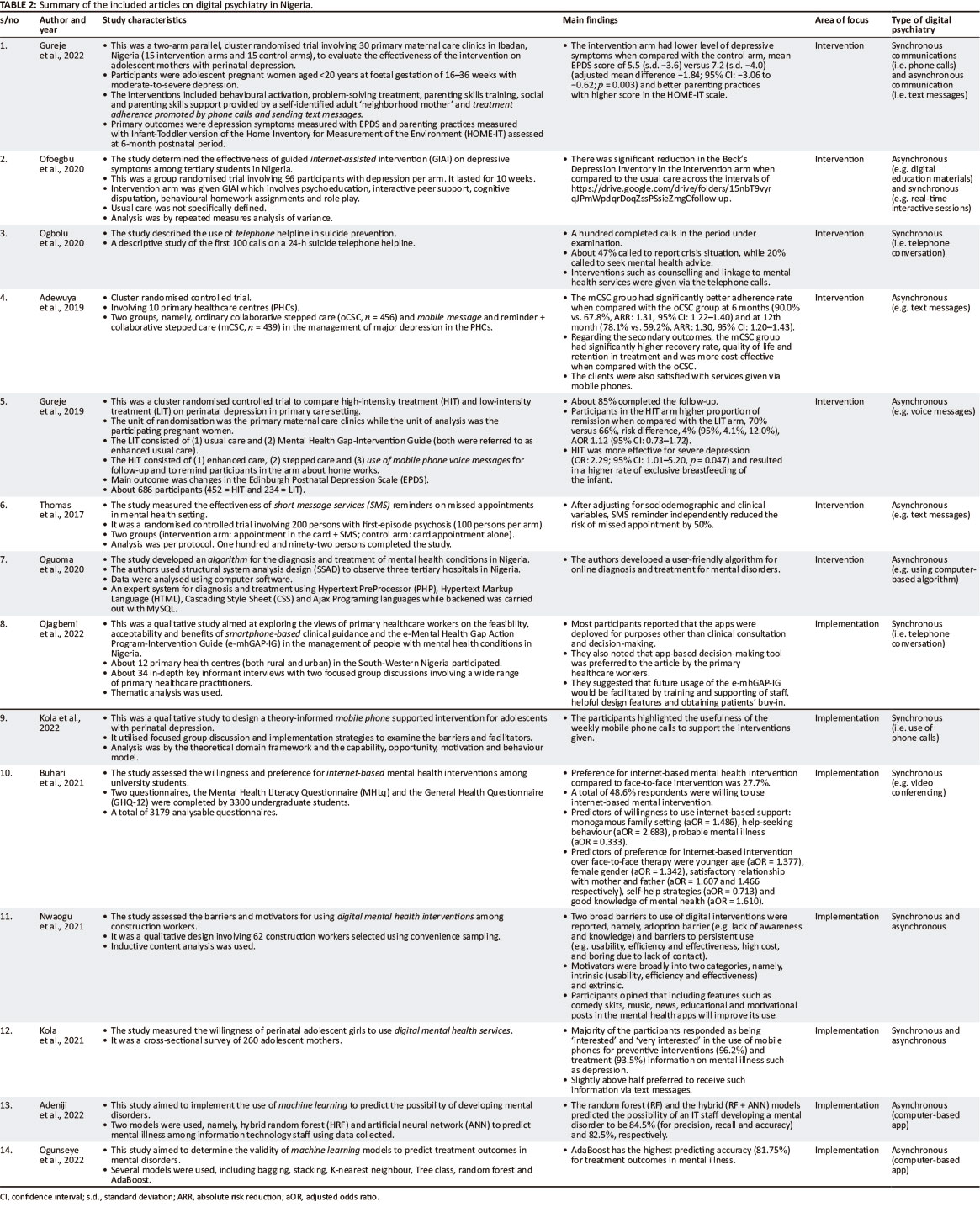
A total of 427 relevant titles were retrieved at the initial search. Following removal of duplicates, the search was further refined to produce 23 publications which were screened against the inclusion criteria. Finally, 14 publications (randomised controlled trials [n = 6], cross-sectional studies [n = 6] and qualitative design [n = 2]) meeting the eligibility criteria were selected. Table 2 contains the description of these studies.
Main findings and thematic areas
Majority (77.8%) of publications were conducted in the South West region of the study country, while the South East and South South regions had one publication each originating from those zones. There were no studies identified to have been conducted in any of the northern regions of the country. All, with the exception of one (internet-based), were studies utilising phone calls or SMS. Two themes were evident, namely, implementation and interventions. These areas of focus are summarised in the following sections.
Theme 1: Intervention studies on the use of digital psychiatry in mental healthcare services in Nigeria
A total of seven studies (n = 7) were found in this area. Most of these studies used phone calls and text messages in addition to other interventions to improve perinatal depression11,12,1813131920
Theme 2: Implementation studies on the use digital psychiatry in mental healthcare services in Nigeria
Seven studies (n = 7) focused on various implementation outcomes, namely, acceptability and feasibility of the use of digital platforms for mental healthcare services in Nigeria. A good number of these studies (n = 4) reported on the acceptability and preference of the use of digital technology for treatment by the patients,21,22,23,24n = 1) reported feasibility and acceptability of same digital resource among primary healthcare workers.25n = 2) reported on the feasibility of using machine learning models to predict mental disorders and treatment outcomes.26,27
Discussion
The major takeaways from this scoping review are twofold: firstly, intervention studies consistently noted the advantages of using digital technologies to offer care, reduce mental health symptoms and increase clinic attendance. Secondly, implementation studies demonstrate that despite certain difficulties encountered, the use of digital technologies in Nigeria to make diagnoses, increase clinic attendance and provide mental health treatments is acceptable and practicable.
The finding that digital mental healthcare services are useful is in line with global studies.21,2221,2228,2930,31,323333,34,35
The results of this review are consistent with earlier studies showing that telehealth, including telephone-based services, is feasible and acceptable for patients with severe mental illness and may be an important teaching tool for mental health professionals.29,3036,37
The findings of this review have implications for mental healthcare services in Nigeria. For example, utilising the opportunities provided by the usage of digital psychiatry may help close the treatment gap for mental, neurological and substance use disorders, which still surpasses 80%.381010
Concerns about client privacy and rights when providing mental healthcare services online are a major problem. Nigeria currently has no defined policies, protocols or procedures in place. The Nigeria Data Protection Regulation (NDPR) was released in 2019 by the National Information Technology Development Agency (NITDA), a federal organisation tasked with overseeing electronic governance and monitoring in Nigeria.394040
Based on the aforementioned, the authors recommend using digital technologies to enhance mental healthcare services for all age groups. In addition, a legislative framework must be established in Nigeria to take advantage of the media's potential for improving the provision of mental healthcare there in the face of a severe dearth of mental health professionals. Also, more study is required to evaluate various models for combining digital tools with Nigeria's standard face-to-face delivery of healthcare.
Limitations
While the scoping review methodology provided a comprehensive overview of the existing literature on digital psychiatry in Nigeria, some limitations must be acknowledged. The absence of a rigorous quality assessment of the included studies may impact the overall reliability of study findings. The scoping review design prioritises breadth over depth, thus not allowing for an exhaustive analysis of the methodologies, results or limitations of individual studies. The scoping review is a snapshot of the literature at a specific point in time. Given the rapidly evolving nature of digital psychiatry interventions and research, some newer studies or emerging trends may not be adequately captured in our review.
Conclusion
Digital technology seems acceptable to Nigerian patients and clinicians and its approaches have been successfully used in the treatment of common mental health conditions and to improve clinic attendance. An important step in facilitating its use in routine care of Nigerians with mental health disorders would be to first engage in research to address several notable implementation barriers. More studies are needed to identify regional gaps, and the quality of evidence from the bulk of studies needs to be improved upon.
Competing interests
The authors declare that they have no financial or personal relationship(s) that may have inappropriately influenced them in writing this article.
Authors' contributions
J.U.O. and T.C.O both contributed equally to the conceptualisation and writing of the article. The introduction and method sections were written by T.C.O., while J.U.O. wrote the background literature section. The results section was jointly written by T.C.O. and J.U.O. The discussion section was written by T.C.O.
Funding information
This research received no specific grant from any funding agency in the public, commercial or not-for-profit sectors.
Data availability
Data sharing is not applicable to this article as no new data were created or analysed in this study.
Disclaimer
The views and opinions expressed in this article are those of the authors and do not necessarily reflect the official policy or position of any affiliated agency of the authors.
Acknowledgements
References
-
1.Whiteford HA, Ferrari AJ, Degenhardt L, Feigin V, Vos T. The global burden of mental, neurological and substance use disorders: An analysis from the Global Burden of Disease Study 2010. PLoS One. 2015;10(2):e0116820. https://doi.org/10.1371/journal.pone.0116820
» https://doi.org/10.1371/journal.pone.0116820 -
2.The World Health Report 2001: Mental disorders affect one in four people [homepage on the Internet] [cited 2023 April 02]. Available from: https://www.who.int/news/item/28-09-2001-the-world-health-report-2001-mental-disorders-affect-one-in-four-people
» https://www.who.int/news/item/28-09-2001-the-world-health-report-2001-mental-disorders-affect-one-in-four-people -
3.Charlson FJ, Diminic S, Lund C, Degenhardt L, Whiteford HA. Mental and substance use disorders in Sub-Saharan Africa: Predictions of epidemiological changes and mental health workforce requirements for the next 40 years. PLoS One. 2014;9(10):e110208. https://doi.org/10.1371/journal.pone.0110208
» https://doi.org/10.1371/journal.pone.0110208 -
4.mhGAP: Mental Health Gap Action Programme: Scaling up care for mental, neurological and substance use disorders [homepage on the Internet] [cited 2023 April 02]. Available from: https://apps.who.int/iris/handle/10665/43809
» https://apps.who.int/iris/handle/10665/43809 -
5.Wang PS, Aguilar-Gaxiola S, Alonso J, et al. Use of mental health services for anxiety, mood, and substance disorders in 17 countries in the WHO world mental health surveys. Lancet. 2007;370(9590):841-850. https://doi.org/10.1016/S0140-6736(07)61414-7
» https://doi.org/10.1016/S0140-6736(07)61414-7 -
6.Wada YH, Rajwani L, Anyam E, et al. Mental health in Nigeria: A neglected issue in public health. Public Health Pract. 2021;2:100166. https://doi.org/10.1016/j.puhip.2021.100166
» https://doi.org/10.1016/j.puhip.2021.100166 -
7.Brown FW. Rural telepsychiatry. Psychiatr Serv. 1998;49(7):963-964. https://doi.org/10.1176/ps.49.7.963
» https://doi.org/10.1176/ps.49.7.963 -
8.Wies B, Landers C, Ienca M. Digital mental health for young people: A scoping review of ethical promises and challenges. Front Digit Health. 2021;6(3):697072. https://doi.org/10.3389/fdgth.2021.697072
» https://doi.org/10.3389/fdgth.2021.697072 -
9.Yellowlees PM, Parish MB, Gonzalez AD, et al. Clinical outcomes of asynchronous versus synchronous telepsychiatry in primary care: Randomized controlled trial. J Med Internet Res. 2021;23(7):e24047. https://doi.org/10.2196/24047
» https://doi.org/10.2196/24047 -
10.Global System for Mobile Communication. The mobile economy sub-Saharan Africa [homepage on the Internet] [cited 2023 April]. Global System for Mobile Communication; 2019. Available at http://www.gsma.com.
» http://www.gsma.com -
11.Gureje O, Oladeji BD, Montgomery AA, et al. High- versus low-intensity interventions for perinatal depression delivered by non-specialist primary maternal care providers in Nigeria: Cluster randomised controlled trial (the EXPONATE trial). Br J Psychiatry. 2019;215(3):528-535. https://doi.org/10.1192/bjp.2019.4
» https://doi.org/10.1192/bjp.2019.4 -
12.Adewuya AO, Momodu O, Olibamoyo O, Adegbaju A, Adesoji O, Adegbokun A. The effectiveness and acceptability of mobile telephone adherence support for management of depression in the Mental Health in Primary Care (MeHPriC) project, Lagos, Nigeria: A pilot cluster randomised controlled trial. J Affect Disord. 2019;253:118-125. https://doi.org/10.1016/j.jad.2019.04.025
» https://doi.org/10.1016/j.jad.2019.04.025 -
13.Thomas IF, Lawani AO, James BO. Effect of short message service reminders on clinic attendance among outpatients with psychosis at a psychiatric hospital in Nigeria. Psychiatr Serv. 2017;68(1):75-80. https://doi.org/10.1176/appi.ps.201500514
» https://doi.org/10.1176/appi.ps.201500514 -
14.Munn Z, Peters MDJ, Stern C, et al. Systematic review or scoping review? Guidance for authors when choosing between a systematic or scoping review approach. BMC Med Res Methodol. 2018;18:143. https://doi.org/10.1186/s12874-018-0611-x
» https://doi.org/10.1186/s12874-018-0611-x -
15.Tricco AC, Lillie E, Zarin W, et al. PRISMA Extension for Scoping Reviews (PRISMA-ScR): Checklist and Explanation. Ann Intern Med. 2018;169(7):467-473. https://doi.org/10.7326/M18-0850
» https://doi.org/10.7326/M18-0850 -
16.Sargeant JM, O›Connor AM. Scoping reviews, systematic reviews, and meta-analysis: Applications in veterinary medicine. Front Vet Sci. 2020;7:11. https://doi.org/10.3389/fvets.2020.00011
» https://doi.org/10.3389/fvets.2020.00011 -
17.Arksey H, O›Malley L. Scoping studies: Towards a methodological framework. Int J Soc Res Methodol. 2005;8(1):19-32. https://doi.org/10.1080/1364557032000119616
» https://doi.org/10.1080/1364557032000119616 -
18.Gureje O, Oladeji BD, Kola L, et al. Effect of intervention delivered by frontline maternal care providers to improve outcome and parenting skills among adolescents with perinatal depression in Nigeria (the RAPiD study): A cluster randomized controlled trial. J Affect Disord. 2022;312:169-176. https://doi.org/10.1016/j.jad.2022.06.032
» https://doi.org/10.1016/j.jad.2022.06.032 -
19.Oguoma SI, Uka KK, Chukwu CA, Nwaoha EC. An expert system for diagnosis and treatment of mental ailment. Open Access Libr J [serial online]. 2020;7:e6166 [cited 2023 April 03]. Available from: https://www.scirp.org/pdf/oalibj_2020041516184743.pdf
» https://www.scirp.org/pdf/oalibj_2020041516184743.pdf -
20.Ogbolu RE, Oyatokun BO, Ogunsola K, et al. The pattern of crisis calls to a suicide telephone helpline service in Nigeria. Ann Health Res. 2020;6(3):246-257. https://doi.org/10.30442/ahr.0603-01-87
» https://doi.org/10.30442/ahr.0603-01-87 -
21.Kola L, Abiona D, Adefolarin AO, Ben-Zeev D. Mobile phone use and acceptability for the delivery of mental health information among perinatal adolescents in Nigeria: Survey study. JMIR Ment Health. 2021;8(1):e20314. https://doi.org/10.2196/20314
» https://doi.org/10.2196/20314 -
22.Kola L, Abiona D, Oladeji BD, Ayinde O, Bello T, Gureje O. Theory-driven development of a mobile phone supported intervention for adolescents with perinatal depression. Soc Psychiatry Psychiatr Epidemiol. 2022;57(6):1201-1210. https://doi.org/10.1007/s00127-021-02198-3
» https://doi.org/10.1007/s00127-021-02198-3 -
23.Buhari O, Bolarinwa O, Adegoke A, et al. Internet-based psychological interventions to improve mental health: Preference for and willingness to use among students in a Nigerian university. East Afr Med J [serial online]. 2021 [cited 2023 April 03]; 98(9):4151-4159. Available from: https://www.ajol.info/index.php/eamj/article/view/215167
» https://www.ajol.info/index.php/eamj/article/view/215167 -
24.Nwaogu JM, Chan APC, Naslund JA, Hon CKH, Belonwu C, Yang J. Exploring the barriers to and motivators for using digital mental health interventions among construction personnel in Nigeria: Qualitative study. JMIR Form Res. 2021;5(11):e18969. https://doi.org/10.2196/18969
» https://doi.org/10.2196/18969 -
25.Ojagbemi A, Daley S, Kola L, et al. Perception of providers on use of the WHO mental health Gap Action Programme-Intervention Guide (mhGAP-IG) electronic version and smartphone-based clinical guidance in Nigerian primary care settings. BMC Prim Care. 2022;23(1):1-11. https://doi.org/10.1186/s12875-022-01869-7
» https://doi.org/10.1186/s12875-022-01869-7 -
26.Adeniji OD, Adeyemi SO, Ajagbe SA. An improved bagging ensemble in predicting mental disorder using hybridized random forest - Artificial neural network model. Informatica (Slovenia). 2022;46(4):543-550. https://doi.org/10.31449/inf.v46i4.3916
» https://doi.org/10.31449/inf.v46i4.3916 -
27.Ogunseye EO, Adenusi CA, Nwanakwaugwu AC, Ajagbe SA, Akinola S. Predictive analysis of mental health conditions using AdaBoost Algorithm. ParadigmPlus. 2022;3(2):11-26. https://doi.org/10.55969/paradigmplus.v3n2a2
» https://doi.org/10.55969/paradigmplus.v3n2a2 -
28.Schaffer CT, Nakrani P, Pirraglia PA. Telemental health care: A review of efficacy and interventions. Telehealth Med Today. 2020;5(4). https://doi.org/10.30953/tmt.v5.218
» https://doi.org/10.30953/tmt.v5.218 -
29.Hilty DM, Ferrer DC, Parish MB, Johnston B, Callahan EJ, Yellowlees PM. The effectiveness of telemental health: A 2013 review. Telemed J e-Health. 2013;19(6):444. https://doi.org/10.1089/tmj.2013.0075
» https://doi.org/10.1089/tmj.2013.0075 -
30.Li J. Digital technologies for mental health improvements in the COVID-19 pandemic: A scoping review. BMC Public Health. 2023;23(1):413. https://doi.org/10.1186/s12889-023-15302-w
» https://doi.org/10.1186/s12889-023-15302-w -
31.Taylor CB, Fitzsimmons-Craft EE, Graham AK. Digital technology can revolutionize mental health services delivery: The COVID-19 crisis as a catalyst for change. Int J Eat Disord. 2020;53(7):1155-1157. https://doi.org/10.1002/eat.23300
» https://doi.org/10.1002/eat.23300 -
32.Abraham A, Jithesh A, Doraiswamy S, Al-Khawaga N, Mamtani R, Cheema S. Telemental health use in the COVID-19 pandemic: A scoping review and evidence gap mapping. Front Psychiatry. 2021;12:748069. https://doi.org/10.3389/fpsyt.2021.748069
» https://doi.org/10.3389/fpsyt.2021.748069 -
33.Tremain H, McEnery C, Fletcher K, Murray G. The therapeutic alliance in digital mental health interventions for serious mental illnesses: Narrative review. JMIR Ment Health. 2020;7(8):e17204. https://doi.org/10.2196/17204
» https://doi.org/10.2196/17204 -
34.Berger T. The therapeutic alliance in internet interventions: A narrative review and suggestions for future research. Psychother Res. 2017;27(5):511-524. https://doi.org/10.1080/10503307.2015.1119908
» https://doi.org/10.1080/10503307.2015.1119908 -
35.Cavanagh K, Millings A. (Inter) personal computing: The role of the therapeutic relationship in E-mental health. J Contemp Psychother. 2013;43(4):197-206. https://doi.org/10.1007/s10879-013-9242-z
» https://doi.org/10.1007/s10879-013-9242-z -
36.Tse J, LaStella D, Chow E, et al. Telehealth acceptability and feasibility among people served in a community behavioral health system during the COVID-19 pandemic. Psychiatr Serv. 2021;72(6):654-660. https://doi.org/10.1176/appi.ps.202000623
» https://doi.org/10.1176/appi.ps.202000623 -
37.Cosh S, Rice K, Bartik W, et al. Acceptability and feasibility of telehealth as a training modality for trainee psychologist placements: A COVID-19 response study. Aust Psychol. 2021;57(1):28-36. https://doi.org/101080/0005006720211968275
» https://doi.org/101080/0005006720211968275 -
38.World Health Organization. Mental health gap action programme: Scaling up care for mental, neurological, and substance use disorders [homepage on the Internet]. World Health Organization, 2008; p. 1-36 [cited 2023 December 07]. Available from: https://apps.who.int/iris/bitstream/handle/10665/43809/9789241596206_eng.pdf?sequence=1&isAllowed=y
» https://apps.who.int/iris/bitstream/handle/10665/43809/9789241596206_eng.pdf?sequence=1& isAllowed=y -
39.National Information Technology Development Agency. Nigeria data protection regulation 2019: Implementation framework [homepage on the Internet]. 2020 [cited 2023 December 07]. Available from: https://nitda.gov.ng/wp-content/uploads/2021/01/NDPR-Implementation-Framework.pdf
» https://nitda.gov.ng/wp-content/uploads/2021/01/NDPR-Implementation-Framework.pdf -
40.Boum Y. Beyond COVID-19: Scaling up and sustaining mobile health in Africa. Lancet. 2021;398(10315):1962-1963. https://doi.org/10.1016/S0140-6736(21)02349-7
» https://doi.org/10.1016/S0140-6736(21)02349-7

Accepted: 22 Jan. 2024
Published: 21 Mar. 2024