Locally relevant, ethically urgent: Defending SASOP's stance on transgender and non-binary youth
Introduction
In the Global North, access to gender-affirming care for transgender and non-binary youth is increasingly undermined by politically motivated attacks that ignore clinical evidence and patient rights.1234,5
Bias and methodological limitations of The Cass Review and other sources
Donkin et al.'s letter centres much of its case on the findings of The Cass Review, a report on gender identity services for children and young people in England commissioned by National Health Service (NHS) England and NHS Improvement, whose content primarily comprises policy recommendations specific to the NHS.6The Cass Review has been widely criticised for methodological opacity, a lack of stakeholder accountability, and the exclusion of affirming outcome data.7,8,9The Cass Review acknowledges the importance of 'research evidence, clinical expertise and patient values',67,910
Moreover, much of The Cass Review's framing and conclusions align closely with talking points advanced by US- and UK-based groups that actively oppose gender-affirming care.81112131415
Global consensus confirms gender-affirming care is effective and necessary
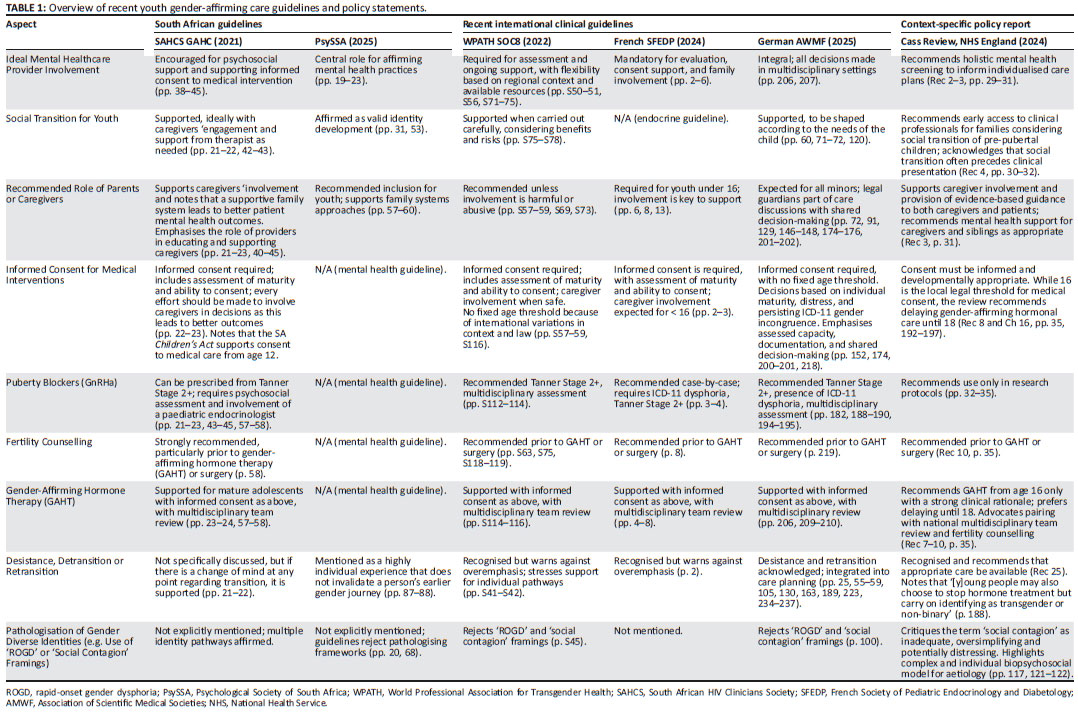
Donkin et al. criticise the SASOP position statement for supporting clinical guidelines issued by WPATH1617Table 1). They take particular issue with the South African guidelines' legal alignment with the Children's Act18
Donkin et al. also fail to engage with recent guidelines from the French Society of Pediatric Endocrinology and Diabetology (SFEDP)45 Both were developed through robust, multidisciplinary and transparent processes. These guidelines conclude that gender-affirming care for adolescents, when provided with comprehensive psychosocial support and informed consent, is effective and appropriate. They explicitly reject the discredited notions of 'rapid-onset gender dysphoria' (ROGD) and 'social contagion', both invoked in Donkin et al.'s critique.19,20,214,5
Donkin et al.'s letter complains that no explicit mention is made in these guidelines of 'exploratory therapy', an undefined process with no established long-term outcome data and informed by a focus on seeking traumatic or pathological roots for gender identity rather than treating it as a neutral outcome.22Table 1) recognise that desistance and retransition occur and are valid outcomes within a gender-affirming framework. These trajectories are supported without pathologisation or coercion, underscoring the role of clinicians as facilitators of care rather than gatekeepers of identity. By contrast, Donkin et al. focus narrowly on the small minority of patients who have detransitioned with regret, thereby erasing the experiences of the overwhelming majority of transgender youth who benefit from access to care or experience harm and distress when care is denied or made inaccessible.23,24
Ethical and professional responsibilities call for context-sensitive, affirming care
Focusing solely on narratives of regret, while ignoring affirming experiences and the harms resulting from denied care, is ethically indefensible. Such a narrow lens distorts the clinical landscape, violates principles of evidence-based medicine, and disregards the human rights of patients. The Psychological Society of South Africa's (PsySSA) updated 2025 guidelines2525
This context includes South Africa's rich cultural heritage. Many precolonial societies understood gender as fluid, socially situated, and relational - embedded in roles, responsibilities, and community recognition rather than fixed identity categories.2627mkhulu [grandfather], or someone assigned male as gogo [grandmother].28
Crucially, objections such as those raised by Donkin et al. obscure the actual crisis: the widespread lack of access to gender-affirming healthcare for transgender and non-binary youth in South Africa. Gender-affirming care has been available in South Africa since the 1970s, yet services remain overstretched, under-resourced, and inaccessible to most - especially economically marginalised youth and those outside major urban centres.29,302930
The South African Society of Psychiatrists' position statement is clinically rigorous, legally sound and ethically urgent
The 2024 South African Position Statement on Evidence-Based Care for Transgender and Gender-Diverse Young People - endorsed by a wide coalition of 32 medical, legal and rights organisations, plus over 150 individual clinicians and scholars - affirms the need for accessible, evidence-based and non-discriminatory care, as well as the need to deconstruct rigid gender binaries.31
In addition to this ethical and legal grounding, SASOP's endorsement of gender-affirming care is supported by data. International longitudinal studies, although imperfect, demonstrate that access to puberty blockers and gender-affirming hormones can reduce rates of depression, anxiety and suicidality among youth.32The Cass Review,6161754
Against this backdrop, the claim that SASOP's position is driven by 'activism' rather than science is misguided. The statement was developed by child and adolescent psychiatrists drawing on a robust body of evidence and clinical guidelines.2
Finally, the assertion that youth are incapable of informed consent underestimates the capacity of adolescents, contradicts South African law, and infantilises youth who are navigating their identities. Similar claims have historically been used to deny adolescents' access to abortion care - arguments ultimately rejected in favour of upholding bodily autonomy and health rights.33Children's Act affirms that minors deemed competent may consent to medical treatment. The South African Society of Psychiatrists' position statement aligns with this legal standard while emphasising the role of caregivers and mental health professionals in facilitating informed decisions.
In conclusion, SASOP's position statement on the care of transgender and non-binary youth is clinically rigorous, legally sound and contextually rooted. The statement's emphasis on psychosocial support, staged interventions and informed consent reflects global best practices - not ideological extremism. Donkin et al.'s critique relies on discredited sources produced by well-documented Global North anti-LGBTQ+ groups, which are out of step with clinical consensus and have been superseded by robust evidence syntheses. It offers no viable alternative beyond delaying or withholding care - approaches that are not neutral but constitute a form of clinical neglect for young people requiring timely, gender-affirming support.
We urge psychiatric professionals to stand firmly in support of an evidence-based, human rights-driven future for transgender youth care in South Africa. This requires structural support and systemic alignment: embedding gender-affirming care into clinical training across levels, expanding rural access through decentralised models, and explicitly including gender-affirming care alongside other key areas such as mental health, sexual and reproductive health, and social support in national adolescent strategies. Finally, this work should meaningfully partner with trans-led organisations in service design and delivery - its raison d'être is to serve, not invalidate, transgender youth.
Competing interests
The authors reported that several of them are involved in guideline development and professional bodies related to transgender health that may be affected by the research reported in the enclosed publication. They have disclosed those interests fully and have in place an approved plan for managing any potential conflicts arising from that involvement.
Authors' contributions
KL.D., I.L., S.M., R.A.-v.S., P.B., J.d.B.-P., N.M., C.M., M.M., S.P.-T., M.P., A.S., A.T., and E.d.V. contributed to conceptualisation, reviewing and editing the final draft. KL.D., I.L. and E.d.V. wrote the first draft.
Funding information
This research received no specific grant from any funding agency in the public, commercial or not-for-profit sectors.
Data availability
Data sharing is not applicable to this article as no new data were created or analysed in this study.
Disclaimer
The views and opinions expressed in this article are those of the authors and are the product of professional research. They do not necessarily reflect the official policy or position of any affiliated institution, funder, agency or that of the publisher. The authors are responsible for this article's results, findings and content.
Acknowledgements
References
-
1. Taylor JF, Konnoth C, Marshall MF. Courageous providers, principled institutions, and threats to gender-affirming care. Am J Bioeth. 2025;25(6):1-4. https://doi.org/10.1080/15265161.2025.2504275
» https://doi.org/10.1080/15265161.2025.2504275 -
2. SASOP. SASOP CAPSIG position statement on the care of transgender and non-binary youth [homepage on the Internet]. [cited 2025 July 31] South African Society of Psychiatrists; 2024. Available from: https://www.sasop.co.za/position-statements
» https://www.sasop.co.za/position-statements -
3. Donkin A, Rodseth R, Giddy J. A call for SASOP to review their position on the care of 'transgender and non-binary youth'. S Afr J Psychiatry. 2025;31:4. https://doi.org/10.4102/sajpsychiatry.v31i0.2381
» https://doi.org/10.4102/sajpsychiatry.v31i0.2381 - 4. Brezin F, Busiah K, Leroy C, et al. Endocrine management of transgender adolescents: Expert consensus of the French Society of Pediatric Endocrinology and Diabetology Working Group. Arch Pediatr Organe Off Soc Francaise Pediatr. 2024;16:S0929-693X(24)00176-3.
-
5. AWMF (German Association of Scientific Medical Societies). Gender Incongruence and Gender Dysphoria in Childhood and Adolescence - Diagnosis and Treatment (S2k) AWMF Registry No. 028 - 014. [homepage on the Internet]. 2025. [cited 2025 July 31]. Available from: https://register.awmf.org/assets/guidelines/028_D_G_f_Kinder-_und_Jugendpsychiatrie_und_-psychotherapie/028-014eng_S2k_Geschlechtsinkongruenz-Geschlechtsdysphorie-Kinder-Jugendliche_2025-06.pdf
» https://register.awmf.org/assets/guidelines/028_D_G_f_Kinder-_und_Jugendpsychiatrie_und_-psychotherapie/028-014eng_S2k_Geschlechtsinkongruenz-Geschlechtsdysphorie-Kinder-Jugendliche_2025-06.pdf -
6. Cass H. Independent review of gender identity services for children and young people: Final report [homepage on the Internet]. 2024 [cited 2025 May 06]. Available from: https://webarchive.nationalarchives.gov.uk/ukgwa/20250310143933/https://cass.independent-review.uk/home/publications/final-report/
» https://webarchive.nationalarchives.gov.uk/ukgwa/20250310143933/https://cass.independent-review.uk/home/publications/final-report/ -
7. Aaron DG, Konnoth C. The future of gender-affirming care: A law and policy perspective on the Cass Review. N Engl J Med. 2025;392(6):526-528. https://doi.org/10.1056/NEJMp2413747
» https://doi.org/10.1056/NEJMp2413747 -
8. Horton C. The Cass review: Cis-supremacy in the UK's approach to healthcare for trans children. Int J Transgender Health. 2024;1-25. https://doi.org/10.1080/26895269.2024.2328249
» https://doi.org/10.1080/26895269.2024.2328249 -
9. Noone C, Southgate A, Ashman A, et al. Critically appraising the Cass report: methodological flaws and unsupported claims. BMC Med Res Methodol. 2025;25(1):128. https://doi.org/10.1186/s12874-025-02581-7
» https://doi.org/10.1186/s12874-025-02581-7 -
10. World Health Organization. WHO handbook for guideline development [homepage on the Internet]. 2nd ed. Geneva: World Health Organization; 2014 [cited 2025 May 08]. Available from: https://www.who.int/publications/i/item/9789241548960
» https://www.who.int/publications/i/item/9789241548960 -
11. Boulware S, Kamody R, Kuper L, et al. Biased science: The Texas and Alabama measures criminalizing medical treatment for transgender children and adolescents rely on inaccurate and misleading scientific claims. SSRN Electron J [serial online]. 2022 [cited 2025 May 11]. Available from: https://www.ssrn.com/abstract=4102374
» https://www.ssrn.com/abstract=4102374 -
12. Southern Poverty Law Center. Anti-LGBTQ hate groups [homepage on the Internet]. 2023. [cited 2025 July 31]. Available from: https://www.splcenter.org/resources/extremist-files/anti-lgbtq/#2023-anti-lgbtq-hate-groups
» https://www.splcenter.org/resources/extremist-files/anti-lgbtq/#2023-anti-lgbtq-hate-groups -
13. Southern Poverty Law Center. Dynamics within the anti-LGBTQ+ pseudoscience network [homepage on the Internet]. Montgomery, Alabama: Southern Poverty Law Center; 2023 [cited 2025 Jul 31]. Available from: https://www.splcenter.org/resources/reports/defining-pseudoscience-network/
» https://www.splcenter.org/resources/reports/defining-pseudoscience-network/ -
14. Reed E. Fact check: 216 instances of factual errors found in right-wing 'WPATH files' document [homepage on the Internet]. 2024 [cited 2025 Jul 31]. Available from: https://www.erininthemorning.com/p/fact-check-216-instances-of-factual
» https://www.erininthemorning.com/p/fact-check-216-instances-of-factual -
15. Wuest J, Last BS. Agents of scientific uncertainty: Conflicts over evidence and expertise in gender-affirming care bans for minors. Soc Sci Med. 2024;344:116533. https://doi.org/10.1016/j.socscimed.2023.116533
» https://doi.org/10.1016/j.socscimed.2023.116533 - 16. Coleman E, Radix AE, Bouman WP, et al. Standards of care for the health of transgender and gender diverse people, version 8. Int J Transgender Health. 2022;23(Suppl. 1):S1-259.
-
17. Tomson A, McLachlan C, Wattrus C, et al. Southern African HIV Clinicians Society gender-affirming healthcare guideline for South Africa - Expanded version [homepage on the Internet]. SAHCS; 2021. [cited 2025 July 31]. Available from: https://sahivsoc.org/Subheader/Index/sahcs-guidelines
» https://sahivsoc.org/Subheader/Index/sahcs-guidelines - 18. Republic of South Africa. The Children's Act. Act No. 38 of 2005. Pretoria: Government Printer 2005.
-
19. Ashley F. A critical commentary on 'rapid-onset gender dysphoria'. Sociol Rev. 2020;68(4):779-99. https://doi.org/10.1177/0038026120934693
» https://doi.org/10.1177/0038026120934693 -
20. Bauer GR, Lawson ML, Metzger DL. Do clinical data from transgender adolescents support the phenomenon of "Rapid Onset Gender Dysphoria"? J Pediatr. 2022;243:224-227.e2. https://doi.org/10.1016/j.jpeds.2021.11.020
» https://doi.org/10.1016/j.jpeds.2021.11.020 -
21. Turban JL, Dolotina B, King D, Keuroghlian AS. Sex assigned at birth ratio among transgender and gender diverse adolescents in the United States. Pediatrics. 2022;150(3):e2022056567. https://doi.org/10.1542/peds.2022-056567
» https://doi.org/10.1542/peds.2022-056567 -
22. Ashley F. Interrogating gender-exploratory therapy. Perspect Psychol Sci. 2023;18(2):472-81. https://doi.org/10.1177/17456916221102325
» https://doi.org/10.1177/17456916221102325 -
23. Olson KR, Durwood L, Horton R, Gallagher NM, Devor A. Gender identity 5 years after social transition. Pediatrics. 2022;150(2):e2021056082. https://doi.org/10.1542/peds.2021-056082
» https://doi.org/10.1542/peds.2021-056082 -
24. Expósito-Campos P, Pérez-Fernández JI, Salaberria K. A qualitative metasummary of detransition experiences with recommendations for psychological support. Int J Clin Health Psychol. 2024;24(2):100467. https://doi.org/10.1016/j.ijchp.2024.100467
» https://doi.org/10.1016/j.ijchp.2024.100467 -
25. PsySSA. Practice guidelines for psychology professionals working with sexually and gender-diverse people [homepage on the Internet]. Johannesburg: Psychological Society of South Africa (PsySSA); 2025. [cited 2025 July 31]. Available from: https://www.psyssa.com/practice-guidelines-for-psychology-professionals-working-with-sexually-and-gender-diverse-people-2nd-ed/
» https://www.psyssa.com/practice-guidelines-for-psychology-professionals-working-with-sexually-and-gender-diverse-people-2nd-ed/ -
26. Matebeni Z. Nongayindoda: Moving beyond gender in a South African context. J Contemp Afr Stud. 2021;39(4):565-575. https://doi.org/10.1080/02589001.2021.1914825
» https://doi.org/10.1080/02589001.2021.1914825 -
27. Shingange T, Mavhandu-Mudzusi AH. A decolonial analysis of religious medicalisation of same-sex practices in South African Pentecostalism. HTS Teol Stud Theol Stud. 2024;80(1):8. https://doi.org/10.4102/hts.v80i1.9014
» https://doi.org/10.4102/hts.v80i1.9014 -
28. Mnyadi KR. The influence of ancestral spirits on sexual identity amongst Traditional Healers (iZangoma) in South Africa: A discourse analysis. Inkanyiso J Humanit Soc Sci. 2020;12(2):159-77. https://doi.org/10.4102/ink.v12i2.40
» https://doi.org/10.4102/ink.v12i2.40 -
29. Zambezi D, Viljoen F. Access to healthcare services for transgender people in South Africa: Assessing healthcare experiences and human rights. Int J Transgender Health. 2024;25(4):791-803. https://doi.org/10.1080/26895269.2023.2273364
» https://doi.org/10.1080/26895269.2023.2273364 -
30. Jessani A, Berry-Moreau T, Parmar R, Athanasakos A, Prodger JL, Mujugira A. Healthcare access and barriers to utilization among transgender and gender diverse people in Africa: A systematic review. BMC Glob Public Health. 2024;2(1):44. https://doi.org/10.1186/s44263-024-00073-2
» https://doi.org/10.1186/s44263-024-00073-2 -
31. PATHSA. Embracing diversity, upholding rights: A South African position statement on evidence-based care for transgender and gender-diverse young people [homepage on the Internet]. Cape Town: PATHSA; 2024. [cited 2025 July 31]. Available from: https://pathsa.org.za/wp-content/uploads/2024/10/SA-EBC-Position-Statement-2024-b.pdf
» https://pathsa.org.za/wp-content/uploads/2024/10/SA-EBC-Position-Statement-2024-b.pdf -
32. Christensen JA, Oh J, Linder K, et al. Systematic review of interventions to reduce suicide risk in transgender and gender diverse youth. Child Psychiatry Hum Dev. 2025;56(1):88-100. https://doi.org/10.1007/s10578-023-01541-w
» https://doi.org/10.1007/s10578-023-01541-w -
33. Kangaude GD, Macleod C, Coast E, Fetters T. Integrating child rights standards in contraceptive and abortion care for minors in Africa. Int J Gynaecol Obstet. 2022;159(3):998-1004. https://doi.org/10.1002/ijgo.14502
» https://doi.org/10.1002/ijgo.14502

Accepted: 07 Aug. 2025
Published: 23 Jan. 2026