Prevalence of substance use and knowledge of its effects among secondary school students in Lagos, Nigeria
Abstract
BACKGROUND: World Health Organization defines substance use as harmful or hazardous use of psychoactive substances, including alcohol and illicit drugs. There is an increased rate of substance use among youths and adolescents. Substance use significantly increases the risk for mental disorders. AIM: The aim of this study was to determine the prevalence of substance use and knowledge of its effects among secondary school students in Lagos, Nigeria. SETTING: The study was conducted among Secondary schools in Lagos, Nigeria. METHODS: We conducted a cross-sectional, descriptive study among 800 participants who were selected using a multi-stage sampling method. The instrument for data collection was the amended WHO students' drug-use questionnaire. The data were analysed using Epi Info 7 software. RESULTS: The lifetime prevalence of substance use was 13.6%, while current users' prevalence was 6.9%. Apart from alcohol consumption, the substance most frequently used was tramadol (52.7%), followed by marijuana (36.4%). Almost all the participants (98.1%) were aware of substance use. Most students (88.7%) were able to identify the effects of substance use, including short-term complications (79.1%) and long-term complications (61.1%). CONCLUSION: The high prevalence of alcohol and tramadol use among the participants underscores the need for stricter government policies on the accessibility of these products to adolescents and the need for increased awareness of their effects. CONTRIBUTION: The lower knowledge of long-term complications of substance use (61.1%) in comparison to short-term complications (79.1%) underscores the need for further research and increased advocacy on long-term complications of substance use among youths and adolescents.
substance use; drugs; adolescents; youths; students; psychoactive substances; alcohol; marijuana; tramadol
Introduction
Background
The World Health Organization (WHO) defines substance use as the 'harmful or hazardous use of psychoactive substances, including alcohol and illicit drugs'.12222
According to the United Nations Office on Drugs and Crime (UNODC) World Drug Report 2023, drug use remains prevalent globally.3333
According to the report, in 2021, it was estimated that 36 million people had used amphetamines, 22 million had used cocaine, and 20 million had used substances similar to 'ecstasy' within the previous year. Female participation is notably higher among users of amphetamine-type stimulants (45%) and non-medical pharmaceuticals (between 45% and 49%), whereas the majority of users of opiates (75%) and cocaine (73%) are male.33
In Nigeria, the legal age for purchasing and consuming alcohol is 18 years,4567
The United Nations defines adolescence as the phase of life between childhood and adulthood, from ages 10-19891010111212
Studies conducted in various African countries, including Nigeria, indicate a rising incidence and decreasing age of onset of substance use.13,14,15 This underscores the urgent need for ongoing research to address this issue comprehensively within society.13,14,15 Furthermore, while numerous studies have explored drug and substance abuse among Nigerian youths and adolescents13,14,15 there remains a gap in understanding the knowledge of the effects of substance use among secondary school students. This study aims to assess both the prevalence of substance use and knowledge of the effects of substance use among secondary school students in Lagos State, Nigeria. The findings will inform future research directions, policy development and intervention strategies.
Research methods and design
Study design
This study was a cross-sectional study aimed at characterising the prevalence of substance use and knowledge of its effects, specifically among secondary school students in Lagos State, Nigeria.
Setting
The study was conducted among secondary schools in Education District 1, Lagos State, Nigeria. Education District 1 in Lagos State comprises both urban and peri-urban schools, reflecting the diverse urbanisation levels of the region. Specific classifications of all schools within the district are not readily available. Regarding student demographics, data from the Lagos State School Census Report for the 2018-2019 academic year indicate that across all educational levels in Lagos State, female students slightly outnumber male students.1617,18 and houses one of the largest and busiest seaports on the continent.19,20,21 It is one of the fastest growing cities in the world.22
Study population and sampling strategy
The study was conducted between March and September 2022. The study population was secondary school students in Lagos State, Nigeria. The study included secondary school students in public senior secondary schools in Lagos State who consented to be a part of the study. The study excluded students who were unable to make informed decisions because of severe health, functional or cognitive impairment. The sample size for the study was determined through the Cochran formula for prevalence studies23242525
Data collection techniques
Data were collected through an adapted and well-expanded WHO students' drug-use questionnaire, which has been previously validated in Nigeria.26
Data analysis
Data collected were analysed using Epi Info software (version 7). Descriptive statistics of frequency, percentage, mean and standard deviation were used to summarise the results. Categorical variables such as gender and class were presented as frequency tables and figures such as bar chart, pie chart etc. The chi-squared test was used to determine the association between variables. Level of significance was set at p < 0.05.
Ethical considerations
Ethical clearance to conduct this study was obtained from the Lagos University Teaching Hospital Health Research Ethics Committee (No. ADM/DSCST/HREC/ APP/4309). Official approval was sought and received from the management of Lagos State Education District 1. The details of the study were fully explained to all the students and only students who consented to be a part of the study were included in the study. A written informed consent was obtained from participants who are above 18 years of age. A written parental consent and a written participant assent were obtained for participants under 18 years of age. The privacy of the participants and confidentiality of the information obtained were strictly ensured. There are no immediate or long-term risks to the participants because of this study.
Results
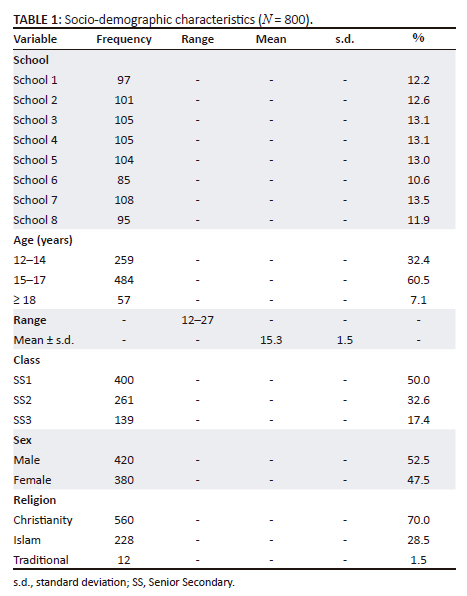
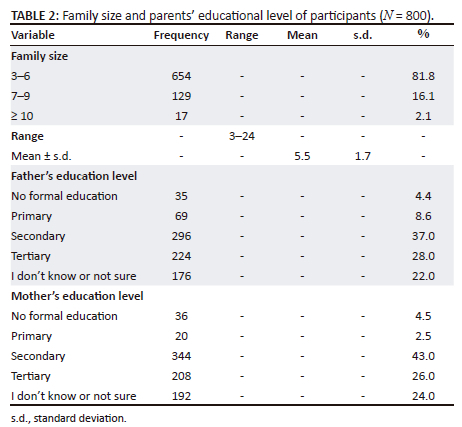
In this study, 800 senior secondary school students completed their questionnaires out of the 820 questionnaires administered, resulting in a response rate of 97.6%. The mean age of the participants was 15.3 ± 1.5 years with a range of 12-27 years. Over half of the participants were male (52.5%). All were Nigerian (100.0%). The majority of the participants (70.0%) were Christians (Table 1). The mean family size of the participants was 5.5 ± 1.7 years, with a range of 3-24. Most of the participants (81.8%) had a family size within the range of 3-6. Over a third of the participants (37.0%) had secondary education as the fathers' highest level of education. Over two-fifths of the participants (43.0%) had secondary education as the mothers' highest level of education (Table 2).
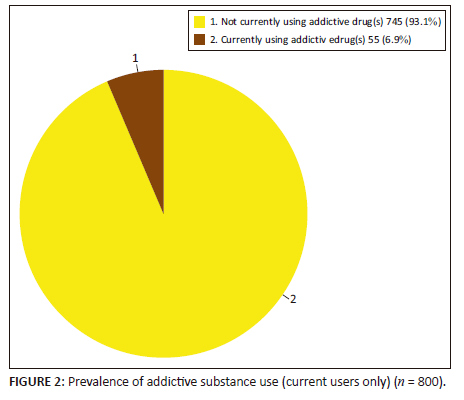
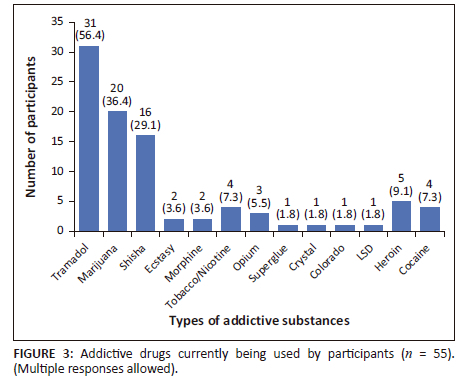
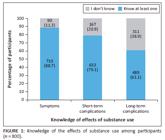
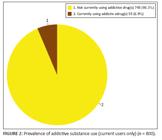
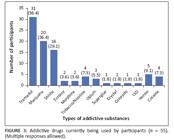
The lifetime prevalence of substance use among the participants was 13.9% (Figure 1). The current prevalence of substance use among the participants was 6.9% (Figure 2). Substances currently being used by the participants included tramadol (52.7%), marijuana (36.4%), shisha (29.1%), heroin (9.1%), cocaine (7.3%), tobacco or nicotine (7.3%), ecstasy (3.6%), morphine (3.6%), opium (5.5%), superglue (1.8%), crystal meth (1.8%), colorado (1.8%) and LSD (1.8%) (Figure 3).
Over a fifth (22.6%) of all the participants had drunk more than a sip of alcohol, with almost half (51.9%) having drunk alcohol within the past 12 months. The highest frequency (44.2%) of participants who drank alcohol started within the age range of 13-14 years (Table 2).
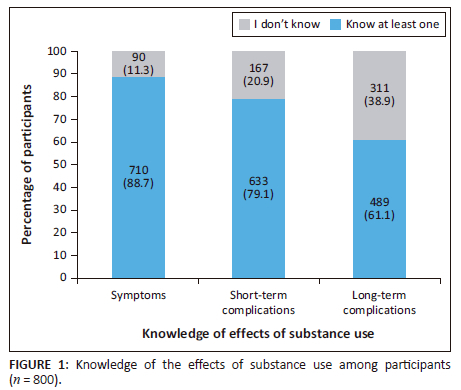
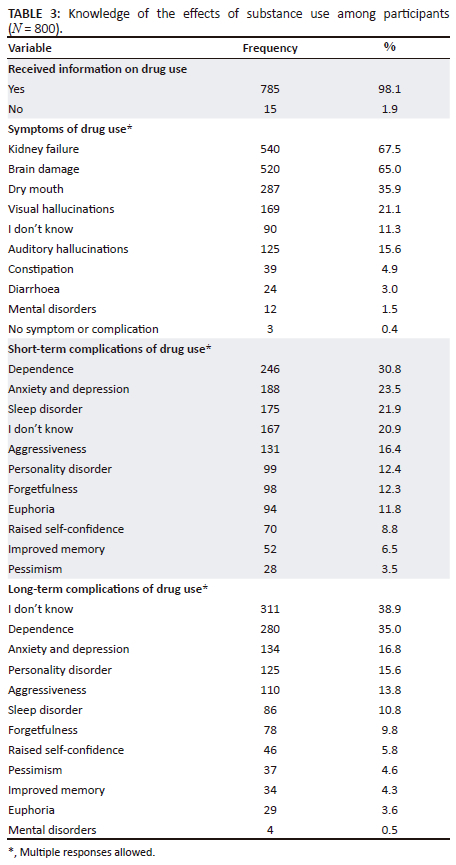
Almost all the participants (98.1%) had received information on substance use. Effects of substance use most frequently highlighted by the participants included kidney failure (67.5%), brain damage (65.0%), dry mouth (35.9%), visual hallucinations (21.1%) and auditory hallucinations (15.6%). Over a tenth of the participants (11.3%) did not report being aware of the negative effects of substance use. Short-term complications of substance use reported by the participants included dependence (30.8%), anxiety and depression (23.5%), sleep disorder (21.9%), aggressiveness (16.4%), personality disorder (12.4%) and forgetfulness (12.3%). Just over a fifth of the participants (20.9%) did not report knowing of any short-term complications of drug use. Long-term complications of substance use were similarly identified and included dependence (35.0%), anxiety and depression (16.8%), personality disorder (15.6%), aggressiveness (13.8%) and sleep disorder (10.8%). Over a third of the participants (38.9%) did not report knowing of any long-term complications associated with substance use. The majority of the participants were able to identify effects (88.7%), short- (79.1%) and long-term complications (61.1%) of substance use (Figure 1 and Table 3).
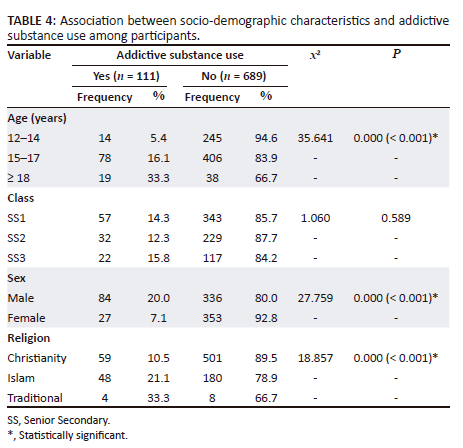
The study found notable differences in addictive substance use based on age, sex and religion. A total of 5.4% of participants aged 12-14, 16.1% of those aged 15-17 and 33.3% of those aged 18+ had used addictive substances. A statistically significant association was found between age and substance use (p < 0.001). A total of 20.0% of male participants had used addictive substances, compared to 7.1% of female participants. A statistically significant association was observed between sex and substance use (p < 0.001). A total of 10.5% of Christian participants, 21.1% of Muslim participants and 33.3% of participants practising African traditional religion had used addictive substances. A statistically significant association was observed between religion and substance use (p < 0.001) (Table 4).
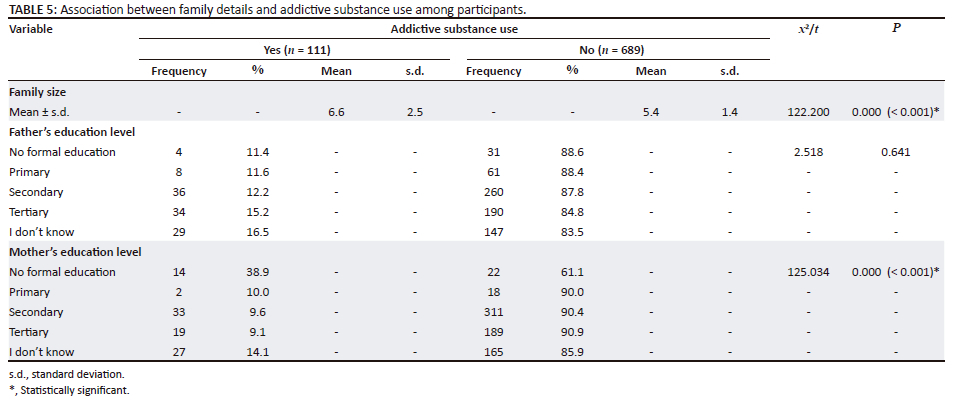
The study revealed that participants who used addictive substances had a higher mean family size (6.6 ± 2.5) compared to those who did not use substances (5.4 ± 1.4), with this difference being statistically significant (p < 0.001). In addition, over a third (38.9%) of participants whose mothers had no formal education used addictive substances, while less than a tenth (14.1%) of participants whose mothers had attained tertiary education did so. A statistically significant association was found between the mother's education level and the participant's substance use history (p < 0.001) (Table 5).
Discussion
The results of the study showed that awareness of substance use was high among participants, with 98.1% reporting awareness. The study also found a strong level of knowledge about the effects of substance use. Most participants were able to identify the effects (88.7%) of substance use, both short-term (79.1%) and long-term (61.1%), complications associated with substance use. The negative effects most commonly recognised by participants included kidney failure, brain damage, dry mouth, visual hallucinations and auditory hallucinations. These findings align with similar studies conducted in Nigeria and other countries, which also report high levels of awareness regarding substance use.14,27,28,29
The prevalence of substance use among the participants in this study was 6.9% (current users only). About 13.9% of the participants had a history of substance use (lifetime prevalence). The prevalence of substance use in this study was lower than similar studies carried out in secondary schools in Jos, Plateau State and Oshogbo, Osun State, Nigeria, which revealed a substance abuse prevalence of 22.1% for a private school in Jos, 15.3% for a public school in Jos and 20.3% for Oshogbo secondary schools.14,30 Another study revealed a high prevalence of 47.9% with a lifetime prevalence of 65.4%.31
The lower prevalence of addictive substance use identified among participants in this study may be because of the continuous efforts of the Lagos State Government, Nigeria, in creating awareness about the dangers of substance use and training of teachers and school administrators on substance abuse prevention among secondary school students.323233p = 0.000), gender (p = 0.000), religion (p = 0.000), the size of the family (p = 0.000) and the highest educational level of the mother (p = 0.000). Increasing age, male gender and increasing size of the family were seen to be positively associated with substance use, while the Christian religion and higher educational level of the mother were seen to be negatively associated with substance use.
The most common substances currently being used by the participants included tramadol, marijuana and shisha with a prevalence of 3.9%, 2.5% and 2%, respectively. Alcohol was the most frequently used substance, with over a fifth of the participants (22.6%) having ever drunk more than a sip of alcohol at one time or the other. Over a twentieth of the alcohol users (5.5%) drank alcohol for at least 20 days in the last 30 days before the study. A similar study in Southwest Nigeria also revealed tramadol as the most commonly abused substance apart from alcohol.1427
The Youth Risk Behavior study conducted in 2015 in the United States also reported a prevalence of alcohol intake as high as 32.8%, which constituted respondents who had used alcohol on or before 30 days prior to the time of the study.343514,24,34
Strengths
The large sample size of 800 participants, the highly structured multistage sampling method and the use of previously validated WHO questionnaires are considered as strengths of this study.
Limitations
This study was conducted among public secondary school students in Lagos State, a cosmopolitan and highly commercial state. The findings might not be exactly applicable to students in private schools and other states in Nigeria, thus limiting the generalisability of the study.
Conclusion
The study shows a low prevalence of current substance use among the participants, although the lifetime prevalence is significantly higher. Apart from alcohol, tramadol was the most commonly used substance, followed by marijuana. This reiterates the need for stricter government policies regarding the accessibility of alcohol and tramadol to adolescents. This study revealed a high awareness of substance use and good knowledge of the effects of substance use among the participants. However, the knowledge of the long-term effects of substance use among the participants was lower than the knowledge of the short-term effects of substance use. The study reiterates the need for continuous awareness of the effects of substance abuse among adolescents, especially as it relates to long-term complications of substance use.
Recommendations
Addressing the menace of substance use among youths and adolescents must be a holistic approach with government, schools, parents, non-governmental organisations (NGOs), religious bodies, communities and the entire society contributing their respective quota in creating an environment where substance abuse among youths and adolescents becomes totally eradicated or reduced to the minimum possible. Particularly, there is a need for further research and increased advocacy on the long-term complications of substance use among youths and adolescents. It is recommended that this study be replicated in different settings across Nigeria, such as rural areas and private schools, to explore variations in substance use patterns. Additionally, incorporating a qualitative component in future research would help identify the underlying reasons for substance use, offering deeper insights into the factors influencing students' substance-use behaviour and informing more effective interventions.
Competing interests
The authors declare that they have no financial or personal relationships that may have inappropriately influenced them in writing this article.
Authors' contributions
T.O.K. conceptualised the idea, developed the methodology, collected the data, analysed the data and drafted the article. A.O.O., and A.R.L. were involved in the conceptualisation, methodology, supervision and editing of the article.
Funding information
The author received no financial support for the research, authorship or publication of this article. This study was self-funded by the authors.
Data availability
The data that support the findings of this study are not openly available because of ethical reasons. The data are available from the corresponding author, T.O.K. upon reasonable request.
Disclaimer
The views and opinions expressed in this article are those of the authors and are the product of professional research. It does not necessarily reflect the official policy or position of any affiliated institution, funder, agency or that of the publisher. The authors are responsible for this article's results, findings and content.
Acknowledgements
The authors would like to appreciate the research assistants who administered the survey materials to the participants at the different schools. The authors would like to also appreciate the leadership and management of all the secondary schools that participated in the study.
References
-
1. World Health Organization. Regional Office for Africa. Substance abuse [homepage on the Internet]. World Health Organization; 2024 [cited 2024 May 05]. Available from: https://www.afro.who.int/health-topics/substance-abuse
» https://www.afro.who.int/health-topics/substance-abuse -
2. Wright JD, Pear L. Knowledge and experience of young people regarding drug misuse, 1969-1994. Med J. 1995;310:20-24. https://doi.org/10.1136/bmj.310.6971.20
» https://doi.org/10.1136/bmj.310.6971.20 -
3. UNODC. World drug report 2023 [homepage on the Internet]. [cited 2024 Jul 24]. Available from: https://www.unodc.org/res/WDR-2023/WDR23_Exsum_fin_SP.pdf
» https://www.unodc.org/res/WDR-2023/WDR23_Exsum_fin_SP.pdf -
4. BusinessDay. Underage drinking: Protecting Nigeria's future [homepage on the Internet]. [cited 2025 Feb 17]. Available from: https://businessday.ng/features/article/underage-drinking-protecting-nigerias-future/
» https://businessday.ng/features/article/underage-drinking-protecting-nigerias-future/ -
5. Gatefield. Alcohol policy in Nigeria [homepage on the Internet]. [cited 2025 Feb 17]. Available from: https://gatefield.co/wp-content/uploads/2023/11/Alcohol-Policy-Brief.pdf
» https://gatefield.co/wp-content/uploads/2023/11/Alcohol-Policy-Brief.pdf -
6. National Drug Law Enforcement Agency. National drug law enforcement agency act [homepage on the Internet]. [cited 2025 Feb 17]. Available from: https://lawsofnigeria.placng.org/laws/NATIONAL%20DRUG%20LAW%20ENFORCEMENT%20AGENCY%20ACT.pdf
» https://lawsofnigeria.placng.org/laws/NATIONAL%20DRUG%20LAW%20ENFORCEMENT%20AGENCY%20ACT.pdf -
7. Nelson E-U, Klantschnig G. Contesting cannabis legalization in Nigeria: Hidden narratives of illicit farmers and traders. Sociol Inq. 2025;95(2):235-251. https://doi.org/10.1111/soin.12649
» https://doi.org/10.1111/soin.12649 -
8. UNICEF. Adolescents [homepage on the Internet]. [cited 2025 Feb 17]. Available from: https://data.unicef.org/topic/adolescents/overview/#:~:text=Defined%20by%20the%20United%20Nations,the%20Rights%20of%20the%20Child
» https://data.unicef.org/topic/adolescents/overview/#:~:text=Defined%20by%20the%20United%20Nations,the%20Rights%20of%20the%20Child -
9. United Nations. Youth definition [homepage on the Internet]. [cited 2025 Feb 17]. Available from: https://www.un.org/esa/socdev/documents/youth/fact-sheets/youth-definition.pdf
» https://www.un.org/esa/socdev/documents/youth/fact-sheets/youth-definition.pdf -
10. Winters KC, Tanner-Smith EE, Bresani E, Meyers K. Current advances in the treatment of adolescent drug use. Adolesc Health Med Ther. 2014;5:199-210. https://doi.org/10.2147/AHMT.S48053
» https://doi.org/10.2147/AHMT.S48053 -
11. Hser YI, Grella CE, Hubbard RL, et al. An evaluation of drug treatments for adolescents in four U.S. cities. Arch Gen Psychiatry. 2001;58(7):689-695. https://doi.org/10.1001/archpsyc.58.7.689
» https://doi.org/10.1001/archpsyc.58.7.689 -
12. Shadow AJ, McCart M, Zaja CK, Davis M. Prevalence and impact of substance use among emerging adults with serious mental health conditions. Psychiatr Rehabil J. 2012;35(3):235-243. https://doi.org/10.2975/35.3.2012.235.243
» https://doi.org/10.2975/35.3.2012.235.243 -
13. Oshodi OY, Aina OF, Onajole AT. Substance use among secondary school students in an urban setting in Nigeria: Prevalence and associated factors. Afr J Psychiatr. 2010;13(1):52-57. https://doi.org/10.4314/ajpsy.v13i1.53430
» https://doi.org/10.4314/ajpsy.v13i1.53430 -
14. Idowu A, Aremu AO, Olumide A, Ogunlaja AO. Substance abuse among students in selected secondary schools of an urban community of Oyo State, South West Nigeria: Implications for policy action. Afr Health Sci. 2018;18(3):776-785. https://doi.org/10.4314/ahs.v18i3.36
» https://doi.org/10.4314/ahs.v18i3.36 - 15. Oliha JA. Adolescent and drug use in tertiary institution. Implication for counseling. Br J Educ. 2014;2(1):1-9.
-
16. Lagos State Universal Basic Education Board. Student demography: Lagos State 2018-2019 ASC report [homepage on the Internet]. [cited 2025 Feb 17]. Available from: https://lasubeb.fra1.cdn.digitaloceanspaces.com/EmisReport/EmisData2018/Lagos%202018-2019%20ASC%20Report%20for%20edition-converted.pdf
» https://lasubeb.fra1.cdn.digitaloceanspaces.com/EmisReport/EmisData2018/Lagos%202018-2019%20ASC%20Report%20for%20edition-converted.pdf -
17. Big Think. These cities are the hubs of Africa's economic boom [homepage on the Internet]. 2018 [cited 2024 Jul 24]. Available from: https://www.bigthink.com
» https://www.bigthink.com -
18. Nwagwu I, Oni T. Lagos and its potentials for economic growth [homepage on the Internet]. Heinrich Böll Stiftung; 2015 [cited 2025 May 05]. Available from: https://www.wathi.org/lagos-and-its-potentials-for-economic-growth/
» https://www.wathi.org/lagos-and-its-potentials-for-economic-growth/ -
19. Businestech. Africa's biggest shipping ports [homepage on the Internet]. 2015 [cited 2024 Jul 24]. Available from: https://www.businestech.com
» https://www.businestech.com - 20. Rajewski B. Africa. Vol 1 of: Cities of the World: A Compilation of current information on cultural, geographical, and political conditions in the countries and cities of six continents based on the Department of State's 'Post Reports'. Detroit: Gale Research International Ltd.; 1998.
- 21. Lees L, Shin HB, Morás EL. Global gentrifications: Uneven development and displacement. Bristol: Policy Press, 2015; p. 315.
- 22. UN-HABITAT. African cities driving the NEPAD initiative. Nairobi: United Nations Human Settlements Programme (UN-HABITAT), 2006; p. 202.
-
23. Statisticshowto. Find sample size [homepage on the Internet]. [cited 2024 Jul 24]. Available from: https://www.statisticshowto.com/probability-and-statistics/find-sample-size/
» https://www.statisticshowto.com/probability-and-statistics/find-sample-size/ -
24. Soremekun RO, Folorunso BO, Adeyemi OC. Prevalence and perception of drug use amongst secondary school students in two local government areas of Lagos State, Nigeria. S Afr J Psychiatr. 2020;26:1428. https://doi.org/10.4102/sajpsychiatry.v26i0.1428
» https://doi.org/10.4102/sajpsychiatry.v26i0.1428 -
25. Ministry of Education - Lagos State Government [homepage on the Internet]. [cited 2024 Jul 24]. Available from: https://education.lagosstate.gov.ng
» https://education.lagosstate.gov.ng -
26. Adelekan ML, Odejide OA. The reliability and validity of the WHO student drug-use questionnaire among Nigerian students. Drug Alcohol Depend. 1989;24(3):245-249. https://doi.org/10.1016/0376-8716(89)90062-8
» https://doi.org/10.1016/0376-8716(89)90062-8 - 27. Johnston LD, O'Malley PM, Bachman JG, Schulenberg JE. Monitoring the future national results on adolescent drug use: Overview of key findings, 2010. Ann Arbor: Institute for Social Research, The University of Michigan; 2010.
-
28. Ogochukwu AM, Gloria AOC, Uchenna IN, Chibueze A. Knowledge, attitude, and practice of substance use in Nigeria among secondary school students. CHRISMED J Health Res. 2022;9(1):23-30. https://doi.org/10.4103/cjhr.cjhr_180_20
» https://doi.org/10.4103/cjhr.cjhr_180_20 -
29. Addiction Center. Over-the-counter (OTC) drug addiction, abuse and treatment [homepage on the Internet]. [cited 2024 Jul 24]. Available from: https://www.addictioncenter.com/drugs/over-the-counter-drugs/
» https://www.addictioncenter.com/drugs/over-the-counter-drugs/ -
30. Charles N, Zuhumnan N, Mafai D, Samuel D, Christopher P, Aishetu A. Substance use pattern among nursing students in Jos, North Central Nigeria. Open J Psychiatry. 2021;11:80-90. https://doi.org/10.4236/ojpsych.2021.112008
» https://doi.org/10.4236/ojpsych.2021.112008 -
31. Birhanu AM, Bisetegn TA, Woldeyohannes SM. High prevalence of substance use and associated factors among high school adolescents in Woreta Town, Northwest Ethiopia: Multi-domain factor analysis. BMC Public Health. 2014;14:1186. https://doi.org/10.1186/1471-2458-14-1186
» https://doi.org/10.1186/1471-2458-14-1186 -
32. Vanguard News. GISA trains 72 teachers, counselors on substance use prevention [homepage on the Internet]. [cited 2024 Jul 24]. Available from: https://www.vanguardngr.com/2021/03/gisa-trains-72-teachers-counselors-on-substance-use-prevention/
» https://www.vanguardngr.com/2021/03/gisa-trains-72-teachers-counselors-on-substance-use-prevention/ -
33. Nigeria Health Watch. MTN launches Anti Substance Abuse Programme (ASAP) to curb first-time drug usage and addiction [homepage on the Internet]. Nigeria Health Watch; 2018 [cited 2025 May 05]. Available from: https://articles.nigeriahealthwatch.com/mtn-launches-anti-substance-abuse-programme-asap-to-curb-first-time-drug-usage-and-addiction/
» https://articles.nigeriahealthwatch.com/mtn-launches-anti-substance-abuse-programme-asap-to-curb-first-time-drug-usage-and-addiction/ -
34. Kann L, McManus T, Harris WA, et al. Youth risk behavior surveillance - United States, 2015. MMWR Surveill Summ. 2016;65(SS-6):1-174. https://doi.org/10.15585/mmwr.ss6506a1
» https://doi.org/10.15585/mmwr.ss6506a1 -
35. Boun SS, Omonaiye O, Yaya S. Prevalence and health consequences of nonmedical use of tramadol in Africa: A systematic scoping review. PLoS Glob Public Health. 2024;4(1):e0002784. https://doi.org/10.1371/journal.pgph.0002784
» https://doi.org/10.1371/journal.pgph.0002784

Accepted: 21 Feb. 2025
Published: 30 May 2025