Social anxiety disorder and childhood trauma in the context of anxiety (behavioural inhibition), impulsivity (behavioural activation) and quality of life
Abstract
BACKGROUND: Social anxiety disorder (SAD) is one of the most prevalent psychiatric disorders in South Africa. Previous studies have linked childhood trauma with the development of SAD. The behavioural inhibition system (BIS) and the behavioural activation system (BAS), two dimensions of personality related to anxiety and impulsivity, respectively, are said to influence the development of psychopathology, including SAD. Both SAD and childhood trauma have an impact on quality of life. This study investigated the relationship between BIS, BAS and quality of life in patients with SAD with and without exposure to childhood trauma, compared to healthy controls. METHOD: Data were collected for 102 adults. A total of 76 participants met SAD criteria, of which 51 were exposed to childhood trauma and 25 were not. The remaining 26 participants were demographically matched healthy controls. Measures of anxiety, impulsivity and quality of life were obtained by administering Carver and White's BIS/BAS scales and the Quality of Life Enjoyment and Satisfaction Questionnaire - Self Report. RESULTS: A positive correlation was found between the severity of SAD symptoms and the amount of childhood trauma exposure. No significant differences in impulsivity were found across the three groups. Healthy controls reported significantly lower anxiety and a better quality of life than both groups with SAD, while no differences were found between patients with SAD and childhood trauma and those without childhood trauma. CONCLUSION: More childhood trauma exposure appears to be associated with greater SAD severity. The lack of differences in BIS, BAS and quality of life in patients with SAD with or without childhood trauma requires further investigation.
Introduction
With a lifetime prevalence of 15.8%, anxiety disorders are the most prevalent class of psychiatric disorders among South Africans, closely followed by substance use disorders (13.3%) and mood disorders (9.9%). The lifetime prevalence of social anxiety disorder (SAD) in adults is 2.8%.12
Childhood trauma is associated with increased risk of developing psychopathology later in life. Swain et al.34
Research suggests that childhood trauma, in the context of SAD specifically, has desensitising effects on cortisol reactivity.5,6,7,8 Maeda et al.699
Behavioural inhibition appears to constitute a specific marker of risk for social phobia in middle childhood or adolescence; however, longer term follow-up is needed to elucidate the full spectrum of risk conferred by behavioural inhibition in adulthood.14151617161819
Social anxiety disorder also impacts quality of life. Safren et al.2021222324
This study investigated the relationship between SAD and childhood trauma with regard to the BIS and BAS and quality of life. Firstly, we hypothesised that there would be a positive correlation between the level of exposure to childhood trauma and the severity of SAD symptoms. Secondly, we hypothesised that participants with SAD and childhood trauma would have higher BIS activity and lower BAS activity compared to individuals with SAD without childhood trauma, who we expected to have higher BIS activity compared to HCs. Thirdly, we hypothesised that participants with SAD and childhood trauma would report the lowest quality of life, followed by participants with SAD without childhood trauma and HCs, respectively.
Methods
Participants
A total of 102 participants were included in the study, of which 51 met criteria for SAD and childhood trauma (SAD+), 25 met criteria for SAD but not for childhood trauma (SAD−) and 26 participants were age- and gender-matched HCs.
Procedure
After clearance was obtained, participants were recruited through referrals from psychiatrists and psychologists in the Western Cape (contact details of clinicians were provided by the Mental Health Group database at Tygerberg Campus, Stellenbosch University). Furthermore, the Cape Town Trauma Centre and the South African Depression and Anxiety Group (SADAG) assisted in recruitment through placement of advertisements in their monthly newsletters and contact with potential participants with SAD through their databases and support groups. Further recruitment methods consisted of convenience sampling through plasma screen advertisements and local anxiety disorder support groups in the Cape Town area. Contact information of individuals who showed an interest in participating was forwarded to a research assistant telephonically or through an email. All interested individuals were contacted by a research assistant via telephone or email and were screened with a standardised screening questionnaire. A consultation was scheduled for all eligible participants during which informed consent was obtained and a full diagnostic assessment using the Mini International Neuropsychiatric Interview25 was undertaken. Exclusion criteria were as follows: any personality disorder or intellectual disability, a previous diagnosis of any neurological disorder or any psychotic disorder according to DSM-5 criteria,2 and reported substance abuse or dependence (drug, alcohol, prescription and/or other). Cannabis users were included if they were completely abstinent for at least 2 weeks prior to study entry.
Materials
Once the diagnostic assessment was completed, the participants were assessed for SAD, childhood trauma, impulsivity and anxiety (BIS and BAS) and quality of life with the following instruments:
1. Liebowitz Social Anxiety Scale:2627
2. Childhood Trauma Questionnaire - Short Form:28293029
3. Carver and White's BIS/BAS Scales:17103132
4. Quality of Life Enjoyment and Satisfaction Questionnaire - Self Report:3334
Statistical analysis
Firstly, missing values were imputed by calculating the participants' mean score on the corresponding (subscales of the) questionnaire. Imputing missing values made all data complete, except for one scale of the QLESQ-SR, which was not answered by one participant. This participant was excluded from analyses involving the QLESQ-SR.
Patient characteristics are reported as appropriate. To examine any differences between groups (HC, SAD- and SAD+), chi-square tests (Monte Carlo adjusted Fisher's exact tests, because of unequal groups, large contingency tables and sparse distribution of frequencies) with a two-tailed confidence interval of the p-value of 99.0% were used. The significance level was set at p (two-tailed) = 0.05. Correlations were calculated using Pearson's correlations.
Multivariate analyses of variance (MANOVAs) were used to compare the BIS/BAS scale and BAS factors (drive, fun seeking and reward responsiveness), respectively, between groups (HC, SAD- and SAD+), with Bonferroni adjusted post-hoc test. Univariate analyses of variance (ANOVAs) were used to compare quality of life between groups (HC, SAD- and SAD+), for the eight-scale total of the QLESQ-SR and a five-scale total (excluding participants for whom work, household duties and/or school or course work did not apply). All data were analysed using SPSS version 24.0 for Windows.
Ethical consideration
Permission to conduct the study and ethical clearance were obtained from the University of Stellenbosch Health Research Ethics Committee at Tygerberg Campus.
Results
Patient characteristics
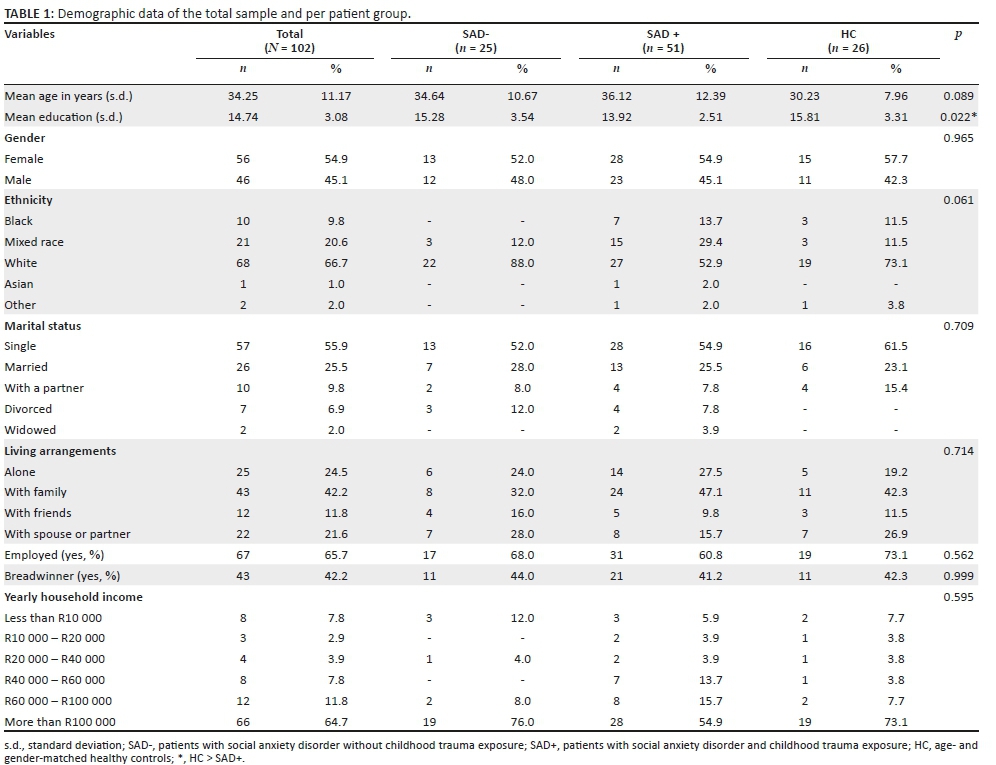
All participants were between 20 and 72 years of age, with an average age of 34.25 years (standard deviation [s.d.] = 11.17), and an average of 14.74 years of education (s.d. = 3.08). There were 46 men (45.1%).
There were no significant group differences for patients with SAD and childhood trauma, patients with SAD without childhood trauma or HCs on the following variables: age (F2,99 = 2.49, p = 0.089), gender (χ2p = 0.965), ethnicity (χ2p = 0.061), marital status (χ2p = 0.709), living arrangements (χ2p = 0.714), employment (χ2p = 0.562), being the breadwinner (χ2p > 0.999) or yearly household income (χ2p = 0.595). Next, there was no significant difference in comorbid anxiety disorders (χ2p = 0.449) or mood disorders (χ2p = 0.446) in patients with SAD with childhood trauma and those without childhood trauma. There was, however, a significant group difference for education (F2,99 = 3.96, p = 0.022) and post-hoc tests showed that HCs had significantly more years of education than patients with SAD and childhood trauma (Mdiff = 1.89, p = 0.031; Table 1). All of the analyses that follow were therefore controlled for education.
Social anxiety disorder and childhood trauma
The severity of SAD symptoms was significantly correlated with the level of reported childhood trauma (r = 0.42, p < 0.001).
Social anxiety disorder and behavioural inhibition or behavioural activation
A significant main effect of group on total BIS and total BAS scores was revealed (Λ = 0.64, F4,19 = 12.36, p < 0.001). Tests of between-subject effects revealed a significant effect for BIS (F3,98 = 19.20, p < 0.001), but not for BAS (F3,98 = 2.56, p =0.059). Post-hoc tests further showed that HCs scored lower on the BIS than both patients with SAD without childhood trauma (Mdiff = 5.16, p < 0.001), and patients with SAD and childhood trauma (Mdiff = 4.80, p < 0.001). The difference between patients with SAD and childhood trauma and those without childhood trauma were not significant (Mdiff = 0.37, p > 0.999). For the BAS, none of the differences were significant (HC vs. SAD−: Mdiff = 4.41, p = 0.065; HC vs. SAD+: Mdiff = 2.41, p = 0.462; SAD− vs. SAD+: Mdiff = 2.00, p = 0.703). No significant main effect of group on the BAS factors was revealed (Λ = 0.94, F6,19 = 0.98, p = 0.438).
Social anxiety disorder and quality of life
A significant effect of group on quality of life was found (F3,97 = 30.85, p < 0.001), and post-hoc tests further showed that HCs reported a significantly better quality of life than both patient groups (HC vs. SAD+: Mdiff = 107.08, p < 0.001; HC vs. SAD−: Mdiff = 98.04, p < 0.001). The difference between patients with SAD and childhood trauma and those without childhood trauma was not significant (Mdiff = 9.04, p > 0.999).
To control for participants for whom work, household duties and/or school or course work did not apply, the same analysis was repeated without these scales. The main effect of group remained significant (F3,97 = 37.34, p < 0.001), and post-hoc tests did not differ much from the previous analysis. HCs still reported a significantly better quality of life than both patients with SAD without childhood trauma (Mdiff = 61.71, p < 0.001) and those with childhood trauma (Mdiff = 70.68, p < 0.001), and the difference between both patient groups was still not significant (Mdiff = 8.97, p = 0.639).
Conclusion and discussion
Little is known about SAD in the context of early childhood trauma. The literature shows that childhood trauma can have a great impact on the future of a child's life.4,5,9 This study investigated the potential relationship between SAD and childhood trauma with regard to behavioural inhibition, behavioural activation and quality of life. In line with the literature, we found a strong positive relationship between SAD symptom severity and the extent of reported childhood trauma.3,4,9,27,35
With regard to behavioural inhibition, we hypothesised that patients with SAD and childhood trauma would score higher than patients with SAD without childhood trauma, and that HCs would report the lowest scores. Our findings replicate the findings of Morgan et al.1636
In terms of perceived quality of life, both patients with SAD and childhood trauma and those without childhood trauma rated their quality of life significantly lower than HCs. These findings are in line with research by Safren et al.20424
Limitations of the study include the presence of comorbidity, which may have confounded the findings. Participants with other psychiatric disorders (e.g. post-traumatic stress disorder, major depressive disorder or lifetime substance use disorder) were included, provided that SAD was the primary diagnosis. Yoon et al.3738,39 Secondly, there is reason to believe that non-significant group findings may be a function of the small group sizes and other confounding factors in non-treatment-seeking individuals. It is likely that non-treatment-seeking individuals are better functioning than treatment-seeking individuals, accounting for fewer and less pronounced deficits.40
This was the first study to examine the contribution of childhood trauma to behavioural inhibition, behavioural activation and quality of life in patients with SAD. There is a clear and profound relationship between SAD symptom severity and childhood trauma exposure. Furthermore, anxiety, or behavioural inhibition, is more pronounced in patients with SAD compared to HCs; however, impulsivity, or behavioural activation, is not. Not surprisingly, HCs report a significantly better quality of life than individuals suffering from SAD, although patients with SAD who endured childhood trauma reported a slightly better quality of life than patients with SAD who were not exposed to childhood trauma, albeit non-significantly. It is possible that childhood trauma desensitises a child to what is 'normal' in life. Another possibility is that these individuals may have perceived their lives as being of better quality now compared to when they were children exposed to trauma. In conclusion, our research suggests that there is a relationship between SAD, an individual's perceived quality of life and the level of experienced anxiety. The occurrence of childhood trauma in SAD did not significantly differ in impact on these aspects. This is not to say that childhood trauma does not pervasively impact SAD and other psychopathology - its prevention may be critical in reducing the incidence of many common psychiatric disorders, including SAD.9
Competing interests
The authors declare that they have no conflict of interests. Furthermore, the authors declare that the research was conducted in the absence of any commercial or financial relationships that could be construed as a potential conflict of interest.
Authors' contributions
C.J.W.H.B. made substantial contributions to the study conception and design; acquisition, analysis and interpretation of data; and drafting of the manuscript and its critical revision for important intellectual content. S.Y.Y. and M.M. made substantial contributions to the conception and design, acquisition and interpretation of data, and critical revision of the manuscript for important intellectual content. S.S. made substantial contributions to the conception and design, analysis and interpretation of data, and drafting of the manuscript and its critical revision for important intellectual content and provided final approval of the version to be published. All authors have read and approved the final manuscript.
Acknowledgements
References
- 1. Herman AA, Stein DJ, Seedat S, Heeringa SG, Moomal H, Williams DR. The South African Stress and Health (SASH) study: 12-month and lifetime prevalence of common mental disorders. S Afr Med J. 2009;99(5):339-344.
- 2. American Psychiatric Association. Diagnostic and statistical manual of mental disorders. 5th ed. Washington, DC: American Psychiatric Publishing; 2013.
-
3. Swain KD, Pillay BJ, Kliewer W. Traumatic stress and psychological functioning in a South African adolescent community sample. S Afr J Psychiatr. 2017;23:1-6. https://doi.org/10.4102/sajpsychiatry.v23i0.1008
» https://doi.org/10.4102/sajpsychiatry.v23i0.1008 -
4. Simon NM, Herlands NN, Marks EH, et al. Childhood maltreatment linked to greater symptom severity and poorer quality of life and function in social anxiety disorder. Depress Anxiety. 2009;26(11):1027-1032. https://doi.org/10.1002/da.20604
» https://doi.org/10.1002/da.20604 -
5. Elzinga BM, Spinhoven P, Berretty E, Jong Pd, Roelofs K. The role of childhood abuse in HPA-axis reactivity in social anxiety disorder: A pilot study. Biol Psychol. 2010;83(1):1-6. https://doi.org/10.1016/j.biopsycho.2009.09.006
» https://doi.org/10.1016/j.biopsycho.2009.09.006 -
6. Maeda S, Sato T, Shimada H, Tsumura H. Post-event processing predicts impaired cortisol recovery following social stressor: The moderating role of social anxiety. Front Psychol. 2017;8:1919. https://doi.org/10.3389/fpsg.2017.01919
» https://doi.org/10.3389/fpsg.2017.01919 -
7. Shirotsuki K, Izawa S, Sugaya N, et al. Salivary cortisol and DHEA reactivity to psychosocial stress in socially anxious males. Int J Psychophysiol. 2009;72(2):198-203. https://doi.org/10.1016/j.ijpsycho.2008.12.010
» https://doi.org/10.1016/j.ijpsycho.2008.12.010 -
8. Zorn JV, Schür RR, Boks MP, Kahn RS, Joëls M, Vinkers CH. Cortisol stress reactivity across psychiatric disorders: A systematic review and meta-analysis. Psychoneuroendocrinology. 2017;77:25-36. https://doi.org/10.1016/j.psyneuen.2016.11.036
» https://doi.org/10.1016/j.psyneuen.2016.11.036 -
9. Keyes KM, Eaton NR, Krueger RF, et al. Childhood maltreatment and the structure of common psychiatric disorders. Br J Psychiatry. 2012;200(2):107-115. https://doi.org/10.1192/bjp.bp.111.093062
» https://doi.org/10.1192/bjp.bp.111.093062 - 10. Gray JA. Causal theories of personality and how to test them. In: Royce JR, editor, Multivariate analysis and psychological theory. New York: Academic Press, 1973; pp.409-463.
-
11. Kasch KL, Rottenberg J, Arnow BA, Gotlib IH. Behavioral activation and inhibition systems and the severity and course of depression. J Abnorm Psychol. 2002;111(4):589-597. https://doi.org/10.1037/0021-843X.111.4.589
» https://doi.org/10.1037/0021-843X.111.4.589 -
12. Meyer B, Johnson SL, Winters R. Responsiveness to threat and incentive in bipolar disorder: Relations of the BIS/BAS scales with symptoms. J Psychopathol Behav Assess. 2001;23(3):133-143. https://doi.org/10.1023/A:1010929402770
» https://doi.org/10.1023/A:1010929402770 - 13. Gomez R, Francis LM. Generalised anxiety disorder: Relationships with Eysenck's, Gray's and Newman's theories. Pers Individ Diff. 2003;34:3-17.
-
14. Hirshfeld-Becker DR, Micco J, Henin A, Bloomfield A, Biederman J, Rosenbaum J. Behavioral inhibition. Depress Anxiety. 2008;25:357-367. https://doi.org/10.1002/da.20490
» https://doi.org/10.1002/da.20490 -
15. Clauss JA, Blackford JU. Behavioral inhibition and risk for developing social anxiety disorder: A meta-analytic study. J Am Acad Child Adolesc Psychiatry. 2012;51(10):1066.e1061-1075.e1061. https://doi.org/10.1016/j.jaac.2012.08.002
» https://doi.org/10.1016/j.jaac.2012.08.002 -
16. Morgan BE, Honk Jv, Hermans EJ, Scholten MRM, Stein DJ, Kahn RS. Gray's BIS/BAS dimensions in non-comorbid, non-medicated social anxiety disorder. World J Biol Psychiatry. 2009;10(4):925-928. https://doi.org/10.1080/15622970802571695
» https://doi.org/10.1080/15622970802571695 -
17. Carver CS, White TL. Behavioural inhibition, behavioural activation, and affective responses to impending reward and punishment. The BIS/BAS Scales. J Pers Soc Psychol. 1994;67(2):319-333. https://doi.org/10.1037/0022-3514.67.2.319
» https://doi.org/10.1037/0022-3514.67.2.319 -
18. Lochner C, Hemmings S, Seedat S, et al. Genetics and personality traits in patients with social anxiety disorder: A case-control study in South Africa. Eur Neuropsychopharmacol. 2007;17(5):321-327. https://doi.org/10.1016/j.euroneuro.2006.06.010.
» https://doi.org/10.1016/j.euroneuro.2006.06.010 - 19. Cloninger CR, Prybeck TR, Svrakic DM, Wetzel RD. The temperament and character inventory: A guide to its development and use. St. Louis, MO: Center for Psychobiology of Personality, Washington University; 1994.
- 20. Safren SA, Heimberg RG, Brown EJ, Holle C. Quality of life in social phobia. Depress Anxiety. 1997;4:126-133.
-
21. Frisch MB, Cornell J, Villanueva M, Retzlaff PJ. Clinical validation of the quality of life inventory: A measure of life satisfaction for use in treatment planning and outcome assessment. Psychol Assess. 1992;4(1):92-101. https://doi.org/10.1037/1040-3590.4.1.92
» https://doi.org/10.1037/1040-3590.4.1.92 - 22. Frisch MB. Quality of Life Inventory (QOLI). Unpublished.
-
23. Wittchen HU, Fuetsch M, Sonntag H, Müller N, Liebowitz M. Disability and quality of life in pure and comorbid social phobia. Findings from a controlled study. Eur Psychiatry. 2000;15(1):46-58. https://doi.org/10.1016/S0924-9338(00)00211-X
» https://doi.org/10.1016/S0924-9338(00)00211-X -
24. Rapaport MH, Clary C, Fayyad R, Endicott J. Quality-of-life impairment in depressive and anxiety disorders. Am J Psychiatry. 2005;162(6):1171-1178. https://doi.org/10.1176/appi.ajp.162.6.1171
» https://doi.org/10.1176/appi.ajp.162.6.1171 - 25. Sheehan DV, Lecrubier Y, Harnett-Sheehan K, et al. The Mini-International neuropsychiatric interview (M.I.N.I.): The development and validation of a structured diagnostic psychiatric interview for DSM-IV and ICD-10. J Clin Psychiatry. 1998;59(Suppl 20):22-33.
-
26. Liebowitz MM. Social phobia. Mod Probl Pharmacopsychiatry. 1987;22:141173. https://doi.org/10.1159/000414022
» https://doi.org/10.1159/000414022 -
27. Heimberg RG, Horner KJ, Juster HR, et al. Psychometric properties of the Liebowitz Social Anxiety Scale. Psychol Med. 1999;29(1):199-212. https://doi.org/10.1017/S0033291798007879
» https://doi.org/10.1017/S0033291798007879 -
28. Bernstein DP, Fink L, Handelsman L, et al. Initial reliability and validity of a new retrospective measure of child abuse and neglect. Am J Psychiatry. 1994;151(8):1132-1136. https://doi.org/10.1176/ajp.151.8.1132
» https://doi.org/10.1176/ajp.151.8.1132 -
29. Bernstein DP, Ahluvalia T, Pogge D, Handelsman L. Validity of the childhood Trauma Questionnaire in an adolescent psychiatric population. J Am Acad Child Adolesc Psychiatry. 1997;36(3):340-348. https://doi.org/10.1097/00004583-199703000-00012
» https://doi.org/10.1097/00004583-199703000-00012 - 30. Bernstein DP, Fink L. Childhood trauma questionnaire: A retrospective self-report: Manual. New York: Psychological Corporation; 1998.
-
31. Poythress NG, Skeem JL, Weir J, et al. Psychometric properties of BIS/BAS Scales in a large sample of offenders. Pers Individ Dif. 2008;45(8):732-737. https://doi.org/10.1016/j.paid.2008.07.021
» https://doi.org/10.1016/j.paid.2008.07.021 -
32. Vandeweghe L, Matton A, Beyers W, Vervaet M, Braet C, Goossens L. Psychometric properties of the BIS/BAS Scales and the SPSRQ in Flemish adolescents. Psychol Belgica. 2016;56(4):406-420. https://doi.org/10.5334/pb.298
» https://doi.org/10.5334/pb.298 - 33. Endicott J, Nee J, Harrison W, Blumenthal R. Quality of life enjoyment and satisfaction questionnaire: A new measure. Psychopharmacol Bull. 1993;29(2):321-326.
-
34. Ritsner M, Kurs R, Gibel A, Ratner Y, Endicott J. Validity of an abbreviated Quality of Life Enjoyment and Satisfaction Questionnaire (Q-LES-Q-18) for schizophrenia, schizoaffective, and mood disorder patients. Qual Life Res. 2005;141693-141703. https://doi.org/10.1007/s11136-005-2816-9
» https://doi.org/10.1007/s11136-005-2816-9 -
35. Safren SA, Gershuny BS, Marzol P, Otto MW, Pollack MH. History of childhood abuse in panic disorder, social phobia, and generalized anxiety disorder. J Nerv Ment Dis. 2002;190(7):453-456. https://doi.org/10.1097/01.NMD.0000022445.62652.82
» https://doi.org/10.1097/01.NMD.0000022445.62652.82 -
36. Essex MJ, Klein MH, Slattery MJ, Goldsmith HH, Kalin NH. Early risk factors and developmental pathways to chronic high inhibition and social anxiety disorder in adolescence. Am J Psychiatry. 2010;167(1):40-46. https://doi.org/10.1176/appi.ajp.2009.07010051
» https://doi.org/10.1176/appi.ajp.2009.07010051 -
37. Yoon KL, Joormann J. Stress reactivity in social anxiety disorder with and without comorbid depression. J Abnorm Psychol. 2012;121(1):250-255. https://doi.org/10.1037/a0025079
» https://doi.org/10.1037/a0025079 -
28. Danese A, Baldwin JR. Hidden wounds? Inflammatory links between childhood trauma and psychopathology. Ann Rev Psychol. 2017;68:517-544. https://doi.org/10.1146/annurev-psych-010416-044208
» https://doi.org/10.1146/annurev-psych-010416-044208 -
39. Lupien SJ, McEwen BS, Gunnar MR, Heim C. Effects of stress throughout the lifespan on the brain, behaviour and cognition. Nat Rev Neurosci. 2009;10:434-445. https://doi.org/10.1038/nrn2639
» https://doi.org/10.1038/nrn2639 -
40. Horner MD, Hamner MB. Neurocognitive functioning in posttraumatic stress disorder. Neuropsychol Rev. 2002;12(1):15-30. https://doi.org/10.1023/A:1015439106231
» https://doi.org/10.1023/A:1015439106231

Accepted: 29 Oct. 2018
Published: 28 Jan. 2019