Prevalence of cannabis use in people with psychosis in KwaZulu-Natal, South Africa
Abstract
BACKGROUND: There is a high prevalence of cannabis use in patients with schizophrenia spectrum and other psychotic disorders, with comorbid cannabis use in this population being associated with poorer long-term outcomes AIM: To determine the prevalence of cannabis use in patients with a schizophrenia spectrum and other psychotic disorders. SETTING: The study was conducted at a psychiatric hospital in Durban, KwaZulu-Natal Province, South Africa. METHODS: A review of clinical records of patients admitted to the hospital for the period, June 2018 to June 2020, was conducted. RESULTS: A total of 370 clinical records were reviewed, of which 48.9% reported current and 51.1% lifetime cannabis use. Being male was significantly associated with current and lifetime cannabis use (OR = 4.90, 95% CI 2.49-9.62 and OR = 6.27, 95% CI 3.28-11.95, respectively). Current alcohol use was also associated with current cannabis use (CCU) (OR = 3.06, 95% CI 1.78-5.28), and age 45 years and older was associated with a lower odds of cannabis use (OR = 0.30, 95% CI 0.09-0.96). Forty-eight per cent of participants were admitted three or more times, and readmission was associated with cannabis use (p = 0.01). There was a lack of association between cannabis use, readmission and human immunodeficiency virus (HIV) status, after controlling for variables such as alcohol use and gender CONCLUSION: Almost 50% of people admitted with schizophrenia spectrum and other psychotic disorders have comorbid current and lifetime cannabis use. There is a need for dual diagnosis units to address comorbid substance use in people with psychotic disorders, as it leads to poorer outcomes. CONTRIBUTION: The study found that there is a high prevalence of cannabis use in people with psychosis. Therefore, it is imperative that we revise treatment programs in our psychiatric units and there is an urgent need for dual diagnosis programs that address substance use in this group of patients.
schizophrenia spectrum disorder; psychotic disorders; cannabis use; South Africa; alcohol use
Introduction
Illicit substance use is a worldwide problem and contributes significantly to the global burden of disease.12
Schizophrenia is a chronic and severe mental illness that is characterised by positive, negative, affective and cognitive symptoms. It runs an often-disabling course and places a considerable burden on patients, their families, the healthcare system and society at large.3,45,6,7,8,9,10,114,12,13,14
The literature suggests a high prevalence of comorbid cannabis use among people with psychotic disorders,15,1610171819,20,2115
Recent studies show that the use of high potency cannabis increases the risk of FEP and subsequent schizophrenia, and that psychosis and prodromal schizophrenia symptoms may also exacerbate cannabis use.222324,255,15,16,19,26,27
Hence we note a high comorbidity between cannabis use and psychosis, and that the dual diagnosis of a cannabis use and psychotic disorder is a poor prognostic factor. A study conducted in India had similar findings where cannabis use had a high prevalence for psychotic disorder and this co-occurrence is a poor prognostic factor.28202930
This research aimed to describe the socio-demographic and clinical profiles of patients admitted with schizophrenia spectrum and other psychotic disorders to a psychiatric hospital. The study also aimed to determine the prevalence and pattern of cannabis use (current vs. lifetime) in this population and to describe any associations between cannabis use and socio-demographic and clinical variables.
Aim
The association between cannabis use and psychosis has been established in recent years, but there has been a move to decriminalise personal cannabis use globally and in SA; hence the authors aimed to review the prevalence of current and lifetime cannabis use in people living with psychosis.
Methods
A retrospective chart review was conducted at a tertiary psychiatric hospital that offers psychiatric services in the eThekwini District, KZN Province, SA.
Study population
All in-patients 13 years and older meeting the DSM-5 criteria for schizophrenia spectrum and other psychotic disorders who were admitted between 01 June 2018 and 31 June 2020 were included. Clinical records were obtained from the hospital registry of admissions, with those with incomplete or missing data being excluded from the study.
Data collection
A structured socio-demographic and clinical data questionnaire was used to collate data from the clinical records, the former including age, gender, marital status, education level, current employment status and place of residence. The clinical data collected included family history of psychotic and non-psychotic illness and substance use, Diagnostic and Statistical Manual of Mental Disorders (DSM-5) diagnostic categories,3132
For the study, the following terminology is defined based on a review of the literature and consensus by the research team:
• Schizophrenia spectrum and other psychotic disorders include schizophrenia, other psychotic disorders and schizotypal personality disorder and are defined by the presence of at least one of the following domains: hallucinations, delusions, disorganised thinking or behaviour and negative symptoms.31
• Lifetime cannabis use: A positive report of lifetime cannabis exposure before or after seeking treatment.
• Current cannabis use (CCU): Cannabis use in the 3 months prior to first presentation for treatment.
• No cannabis use (NCU): Not having any lifetime cannabis exposure.33
• Substance use: A positive report of lifetime substance exposure before or after seeking treatment.
• Substance use disorder: A maladaptive pattern of substance use that results in behavioural, psychical and psychological symptoms and causes distress or impairment.31
Data analysis
Stata version 15.1 was used to analyse the data, with descriptive statistics, such as frequencies and percentages, being used to summarise the results. McNemar's chi-square test was used to test for associations between current and lifetime cannabis use and patient socio-demographic and clinical characteristics. Logistic regression models were used to test for associations cannabis use, controlling for socio-demographic and clinical variables such as age, gender, number of readmissions and HIV status, with the significance level being set at p = 0.05.
Sample size
Davis et al.34n = z22n: sample size, z: standard deviation set at 95% standard value of 1.96, p: prevalence and d: error margin), the researchers aimed to reach a target sample size of 349 participants, which was adequate to achieve a 95% confidence interval at an error margin of 5.25% in this study.35
Ethical considerations
Ethical approval was obtained from the Biomedical Research Ethics Committee of the University of Kwa-Zulu Natal (BREC/00002640/2021) and the Kwa-Zulu Natal Department of Health. The study is a retrospective chart review and therefore did not require consent from participants.
Results
Patient socio-demographic profile
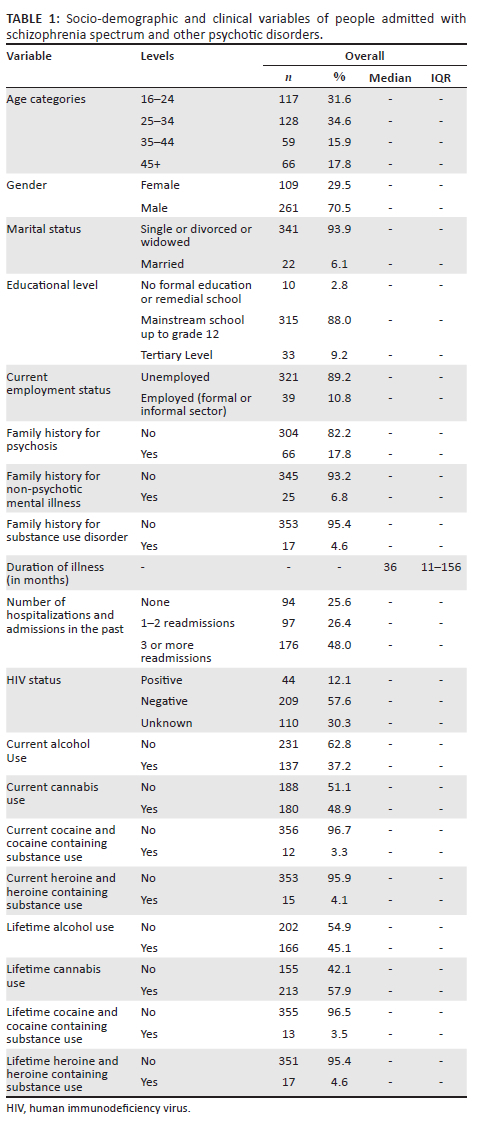
A total of 370 patient clinical records were included in the study, with two being excluded because of inadequate information. The socio-demographic and clinical information is presented in Table 1; 66.2% of participants were between the ages 16 and 34 years; most were male (70.5%), unmarried (93.9%), had a highest level of education of grade school (88.0%) and were unemployed (89.2%). The median duration of the psychotic illness was three years; 48% had been admitted three or more times, while the current and lifetime cannabis use was at 48.9% and 51.1%, respectively.
Factors associated with cannabis use
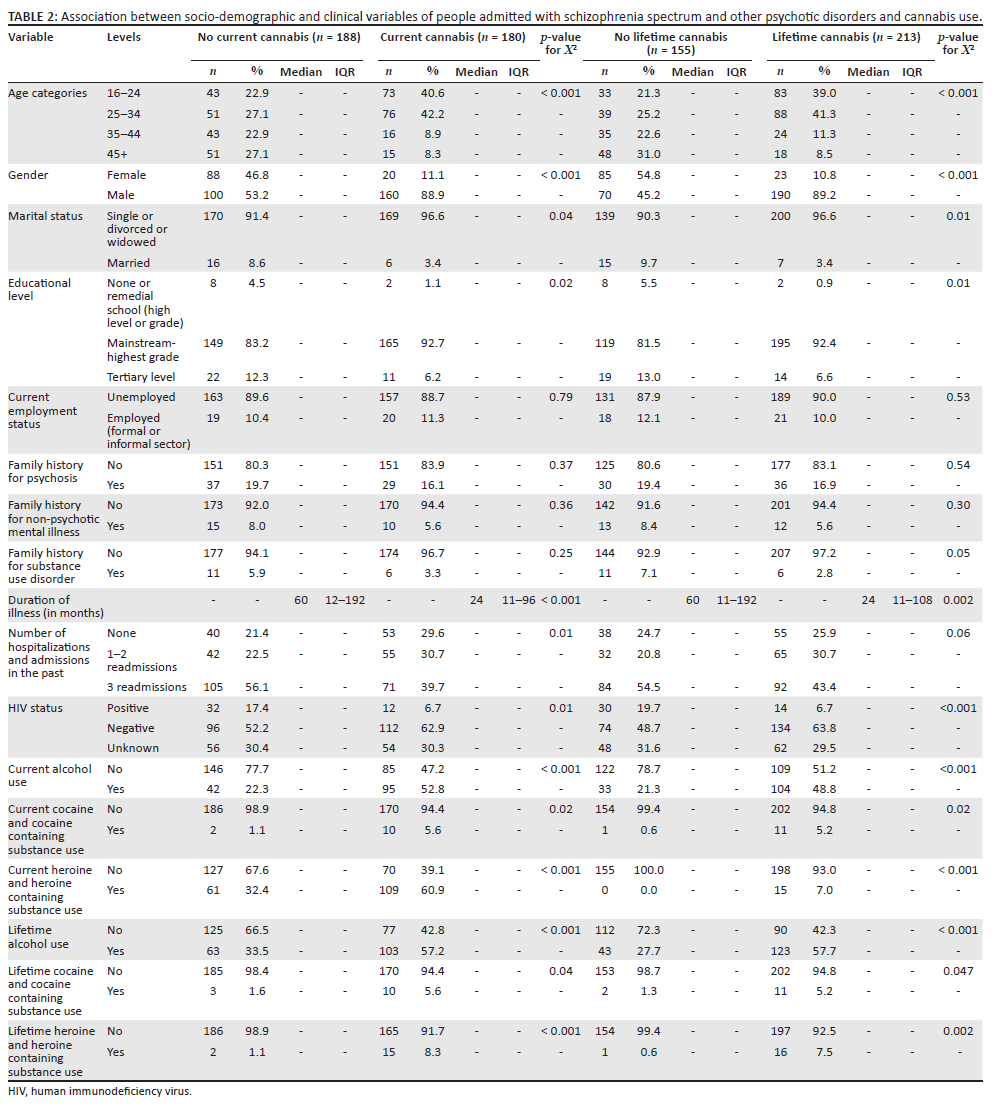
Table 2 details the socio-demographic and clinical variable based on current and lifetime cannabis use. Being in the 14-24 and 25-34-year age groups, male gender was significantly associated with current and lifetime cannabis use (p = < 0.001). Not having a partner, grade school as the highest level of education in mainstream school, shorter duration of illness, negative HIV status was also associated with current and lifetime cannabis use. A history of three or more admissions was associated with lower prevalence CCU compared to no previous admission.
Regression results
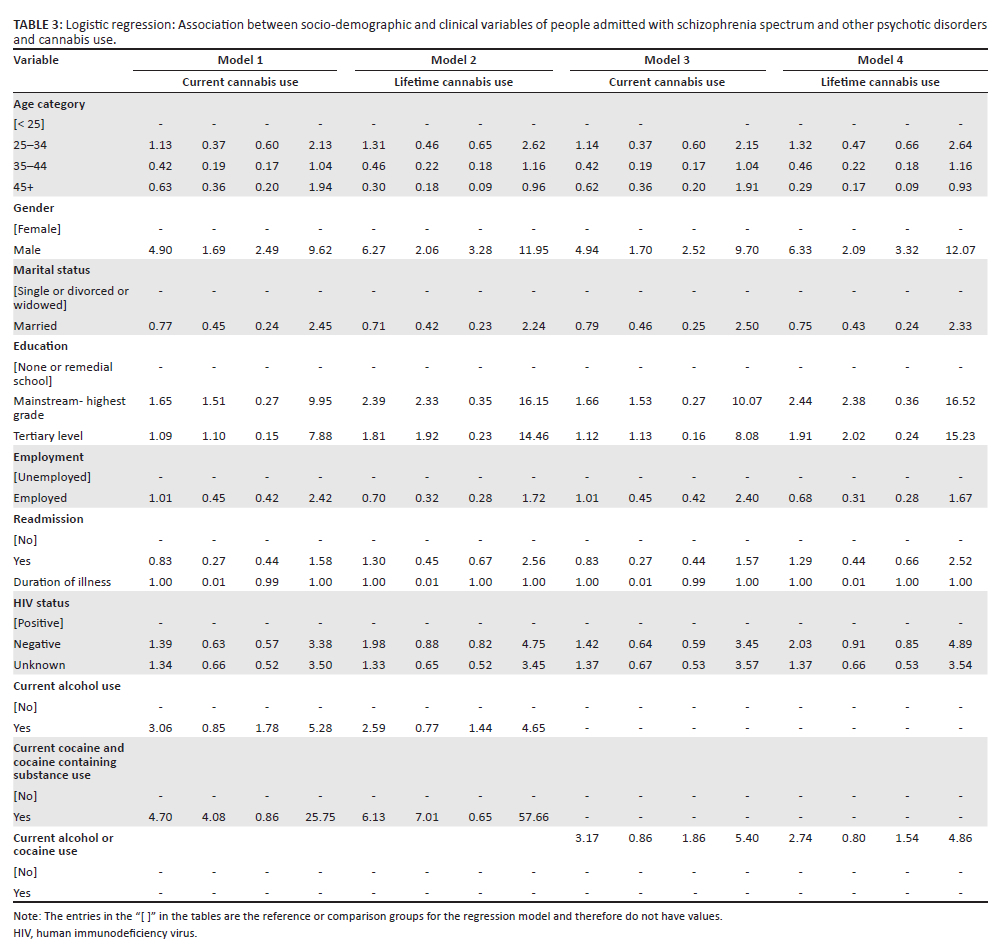
The logistic regression models are presented in Table 3, with being male again being significantly associated with current cannabis and lifetime cannabis use (OR = 4.90, 95% CI 2.49-9.62 and OR = 6.27, 95% CI 3.28-11.95 respectively). Current alcohol use was associated CCU (OR = 3.06, 95% CI 1.78-5.28), and being 45 years and older was associated with a lower odds of cannabis use (OR = 0.30, 95% CI 0.09-0.96)
Discussion
The main findings of this study were the high prevalence of current (48.9%) and lifetime (51.1%) cannabis use among people with schizophrenia spectrum and other psychotic disorders, and that being male, of younger age and current alcohol use were associated with ongoing cannabis use.
Our study showed that CCU in psychosis is high at 48.9% but slightly lower compared with a study conducted in the Eastern Cape Province of SA, which showed a prevalence of 59.8%.191521
Similar to our findings, other studies have also consistently reported cannabis users in populations with psychosis to be predominantly male, of young age, having a low level of education and unemployed.5,15,16,19,24,25,264142435,19
Our study found that 52.8% of current cannabis users were also using alcohol, which is consistent with an international study conducted in Canada, where people with psychosis were likely to have an alcohol and cannabis use disorders at 21% and 27%, respectively. Rates of substance use were highest in the first five years of psychotic illness at 20% - 33% for alcohol and 21% - 45% for cannabis. Alcohol use was associated with higher social functioning and less negative symptoms,101941
The finding that almost 50% of our study population had more than three or more admissions was also concerning. While on logistic regression this study did not find any associations between cannabis use and re-hospitalisation, suggesting that the findings were compounded by other factors such as poorer access to healthcare in the province where patients were possibly not admitted to hospital and managed in the community. This finding is, however, contrary to findings in the literature where studies have consistently found that schizophrenia and continued cannabis use leads to poorer outcomes, such as a more complicated course of illness, as evidenced by frequent relapses, shorter periods of time between relapses, longer hospitalisations and more intensive psychiatric care.5,11,19,2727,44,4511
There was a lack of association between the clinical variable HIV infection with cannabis use in people with psychosis in this study, which is consistent with another local study, but inconsistent with international research.46,47,4849,50,51
Limitations
The limitations of this study include its retrospective nature, where the data rely on the quality of record keeping, which may not be consistent or detailed well. This was a hospital-based study, which may introduce sample bias and limit generalisability to community samples. In addition, cannabis use reporting was subjective from the patient and collateral information available and not verified by urine toxicology.
However, the strength of study is that this study reflects the persistent high prevalence of cannabis use and that young males remain most vulnerable. There is a need for programmes promoting greater awareness on potential harms of cannabis use in young people particularly those who may be at risk for psychosis.
Conclusion
The high rates of cannabis use, with almost half the people in the study with psychosis still reporting current use, is an important public health concern. Cannabis use was associated with a vulnerable group of young males with lower education and comorbid alcohol use, and with over 50% having more than three or more admissions; the data suggest that its continuous use leads to a poorer prognosis. The findings highlight the need to review treatment programmes offered at psychiatry units, with an urgent need for dual diagnosis programme that addresses substance use in people living with psychosis in a comprehensive and integrated manner.
Recommendations
Further longitudinal studies are required to better understand association between ongoing cannabis use and psychosis outcomes, including intervention studies. Clinically we need to address cannabis use with a more concerted effort and to develop dual diagnosis units to address comorbid substance use.
Competing interests
The authors have declared that no competing interest exists.
Authors' contributions
K.M. was the principal investigator and conceptualised the study and research design, developed the protocol, performed data collection, did the initial write-up for this study and subsequent manuscript revisions. S.P. supervised the project and assisted with study conceptualisation, protocol development and write-up of this study. V.N. made conceptual contributions to study design, assisted with protocol development and editorial manuscript revisions and supervised the project. A.M.T. was responsible for data analysis and made conceptual contributions to study design and editorial manuscript revisions.
Funding information
This research received no specific grant from any funding agency in the public, commercial, or not-for-profit sectors.
Data availability
The data that supports the findings of this study is available from the corresponding author, K.M., upon reasonable request.
Disclaimer
The views and opinions expressed in this article are those of the authors and do not necessarily reflect the official policy or position of any affiliated agency of the authors.
Acknowledgements
The authors acknowledge Mr L Biyela, Ms N Khathi and Ms T Blose for assistance with accessing patient clinical files.
References
-
1.Peltzer K, Phaswana-Mafuya N. Drug use among youth and adults in a population-based survey in South Africa. S Afr J Psychiatry. 2018;24(1):1-6. https://doi.org/10.4102/sajpsychiatry.v24i0.1139
» https://doi.org/10.4102/sajpsychiatry.v24i0.1139 - 2.Hansford B. UNODC world drug report 2020: Global drug use rising; while COVID-19 has far reaching impact on global drug markets. Vienna, Austria: UNODC Advocacy Section; 2020.
-
3.Emsley R, Chiliza B, Asmal L, et al. A randomized, controlled trial of omega-3 fatty acids plus an antioxidant for relapse prevention after antipsychotic discontinuation in first-episode schizophrenia. Schizophr Res. 2014;158(1-3):230-235. https://doi.org/10.1016/j.schres.2014.06.004
» https://doi.org/10.1016/j.schres.2014.06.004 -
4.Yerriah J, Tomita A, Paruk S. Surviving but not thriving: Burden of care and quality of life for caregivers of patients with schizophrenia spectrum disorders and comorbid substance use in South Africa. Early Interv Psychiatry. 2022;16(2):153-161. https://doi.org/10.1111/eip.13141
» https://doi.org/10.1111/eip.13141 -
5.Scheffler F, Phahladira L, Luckhoff H, et al. Cannabis use and clinical outcome in people with first-episode schizophrenia spectrum disorders over 24 months of treatment. Psychiatry Res. 2021;302:114022. https://doi.org/10.1016/j.psychres.2021.114022
» https://doi.org/10.1016/j.psychres.2021.114022 -
6.Ringen P, Nesvåg R, Helle S, et al. Premorbid cannabis use is associated with more symptoms and poorer functioning in schizophrenia spectrum disorder. Psychol Med. 2016;46(15):3127-3136. https://doi.org/10.1017/S0033291716001999
» https://doi.org/10.1017/S0033291716001999 -
7.Murray RM, Englund A, Abi-Dargham A, et al. Cannabis-associated psychosis: Neural substrate and clinical impact. Neuropharmacology. 2017;124:89-104. https://doi.org/10.1016/j.neuropharm.2017.06.018
» https://doi.org/10.1016/j.neuropharm.2017.06.018 -
8.Foglia E, Schoeler T, Klamerus E, Morgan K, Bhattacharyya S. Cannabis use and adherence to antipsychotic medication: A systematic review and meta-analysis. Psychol Med. 2017;47(10):1691-1705. https://doi.org/10.1017/S0033291717000046
» https://doi.org/10.1017/S0033291717000046 -
9.Patel RS, Sreeram V, Vadukapuram R, Baweja R. Do cannabis use disorders increase medication non-compliance in schizophrenia?: United States nationwide inpatient cross-sectional study. Schizophr Res. 2020;224:40-44. https://doi.org/10.1016/j.schres.2020.11.002
» https://doi.org/10.1016/j.schres.2020.11.002 -
10.Cookey J, McGavin J, Crocker CE, Matheson K, Stewart SH, Tibbo PG. A retrospective study of the clinical characteristics associated with alcohol and cannabis use in early phase psychosis. Can J Psychiatry. 2020;65(6):426-435. https://doi.org/10.1177/0706743720905201
» https://doi.org/10.1177/0706743720905201 -
11.Murray R, Mondelli V, Stilo S, et al. The influence of risk factors on the onset and outcome of psychosis: What we learned from the GAP study. Schizophr Res. 2020;225:63-68. https://doi.org/10.1016/j.schres.2020.01.011
» https://doi.org/10.1016/j.schres.2020.01.011 -
12.Helle S, Ringen PA, Melle I, et al. Cannabis use is associated with 3 years earlier onset of schizophrenia spectrum disorder in a naturalistic, multi-site sample (N = 1119). Schizophr Res. 2016;170(1):217-221. https://doi.org/10.1016/j.schres.2015.11.027
» https://doi.org/10.1016/j.schres.2015.11.027 -
13.Hunt GE, Large MM, Cleary M, Lai HMX, Saunders JB. Prevalence of comorbid substance use in schizophrenia spectrum disorders in community and clinical settings, 1990-2017: Systematic review and meta-analysis. Drug Alcohol Depend. 2018;191:234-258. https://doi.org/10.1016/j.drugalcdep.2018.07.011
» https://doi.org/10.1016/j.drugalcdep.2018.07.011 -
14.Coronado-Montoya S, Morissette F, Abdel-Baki A, et al. Preventive interventions targeting cannabis use and related harms in people with psychosis: A systematic review. Early Interv Psychiatry. 2021;15(6):1439-1453. https://doi.org/10.1111/eip.13081
» https://doi.org/10.1111/eip.13081 -
15.Temmingh HS, Mall S, Howells FM, Sibeko G, Stein DJ. The prevalence and clinical correlates of substance use disorders in patients with psychotic disorders from an upper-middle-income country. S Afr J Psychiatry. 2020;26(1):1-9. https://doi.org/10.4102/sajpsychiatry.v26i0.1473
» https://doi.org/10.4102/sajpsychiatry.v26i0.1473 -
16.Lasebikan V, Aremu OO. Cannabis use and associated harms among schizophrenia patients in a Nigerian clinical setting: A case-control study. Front Psychiatry. 2016;7:136. https://doi.org/10.3389/fpsyt.2016.00136
» https://doi.org/10.3389/fpsyt.2016.00136 -
17.Hirschtritt ME, Young-Wolff KC, Mathalon DH, Satre DD. Cannabis use among patients with psychotic disorders. Perm J. 2021;25(3):179. https://doi.org/10.7812/TPP/20.179
» https://doi.org/10.7812/TPP/20.179 -
18.Rup J, Freeman TP, Perlman C, Hammond D. Cannabis and mental health: Prevalence of use and modes of cannabis administration by mental health status. Addict Behav. 2021;121:106991. https://doi.org/10.1016/j.addbeh.2021.106991
» https://doi.org/10.1016/j.addbeh.2021.106991 -
19.Thungana Y, Zingela Z, Van Wyk S. First-episode psychosis and substance use in Nelson Mandela Bay: Findings from an acute mental health unit. S Afr J Psychiatry. 2019;25(1):1-6. https://doi.org/10.4102/sajpsychiatry.v25i0.1372
» https://doi.org/10.4102/sajpsychiatry.v25i0.1372 -
20.Paruk S, Burns JK, Caplan R. Cannabis use and family history in adolescent first episode psychosis in Durban, South Africa. J Child Adolesc Ment Health. 2013;25(1):61-68. https://doi.org/10.2989/17280583.2013.767264
» https://doi.org/10.2989/17280583.2013.767264 -
21.Lachman A, Nassen R, Hawkridge S, Emsley RA. A retrospective chart review of the clinical and psychosocial profile of psychotic adolescents with co-morbid substance use disorders presenting to acute adolescent psychiatric services at Tygerberg Hospital. S Afr J Psychiatry. 2012;18(2):53-60. https://doi.org/10.4102/sajpsychiatry.v18i2.351
» https://doi.org/10.4102/sajpsychiatry.v18i2.351 -
22.Gillespie NA, Kendler KS. Use of genetically informed methods to clarify the nature of the association between cannabis use and risk for schizophrenia. JAMA Psychiatry. 2021;78(5):467-468. https://doi.org/10.1001/jamapsychiatry.2020.3564
» https://doi.org/10.1001/jamapsychiatry.2020.3564 -
23.Ferdinand RF, Sondeijker F, Van Der Ende J, Selten JP, Huizink A, Verhulst FC. Cannabis use predicts future psychotic symptoms, and vice versa. Addiction. 2005;100(5):612-618. https://doi.org/10.1111/j.1360-0443.2005.01070.x
» https://doi.org/10.1111/j.1360-0443.2005.01070.x -
24.Di Forti M, Quattrone D, Freeman TP, et al. The contribution of cannabis use to variation in the incidence of psychotic disorder across Europe (EU-GEI): A multicentre case-control study. Lancet Psychiatry. 2019;6(5):427-436. https://doi.org/10.1016/S2215-0366(19)30048-3
» https://doi.org/10.1016/S2215-0366(19)30048-3 - 25.Padhi D, Shukla P, Chaudhury S. Sociodemographic and clinical profile of cannabis-induced psychosis: A comparative study. Ind Psychiatry J. 2021;30(suppl_1):S132.
-
26.Green B, Young R, Kavanagh D. Cannabis use and misuse prevalence among people with psychosis. Br J Psychiatry. 2005;187(4):306-313. https://doi.org/10.1192/bjp.187.4.306
» https://doi.org/10.1192/bjp.187.4.306 -
27.Temmingh H, Susser E, Mall S, Campbell M, Sibeko G, Stein DJ. Prevalence and clinical correlates of substance use disorders in South African Xhosa patients with schizophrenia. Soc Psychiatry Psychiatr Epidemiol. 2021;56(4):695-706. https://doi.org/10.1007/s00127-020-01942-5
» https://doi.org/10.1007/s00127-020-01942-5 -
28.Singh S, Balhara YPS. A review of Indian research on co-occurring cannabis use disorders & psychiatric disorders. Indian J Med Res. 2017;146(2):186. https://doi.org/10.4103/ijmr.IJMR_791_15
» https://doi.org/10.4103/ijmr.IJMR_791_15 -
29.Burns J, Jhazbhay K, Emsley R. Cannabis use predicts shorter duration of untreated psychosis and lower levels of negative symptoms in first-episode psychosis: A South African study. Afr Jo Psychiatry. 2010;13(5):395-399. https://doi.org/10.4314/ajpsy.v13i5.63106
» https://doi.org/10.4314/ajpsy.v13i5.63106 - 30.Zondo A. Minister of Justice and Constitutional Development and Others v Prince (Clarke, Stobbs and Thorpe Intervening) [Doctors of Life International Inc. as Amicus Curiae]. Pretoria, South Africa: National Director of Public Prosecutions and Others v Rubin, National Director of Public Prosecutions and Others v Acton and Others; 2017.
- 31.Association AP. Diagnostic and statistical manual of mental disorders (DSM-5®). Washington, WA: American Psychiatric Publishing; 2013.
-
32.Harris PA, Taylor R, Minor BL, et al. The REDCap consortium: Building an international community of software platform partners. J Biomed Inform. 2019;95:103208. https://doi.org/10.1016/j.jbi.2019.103208
» https://doi.org/10.1016/j.jbi.2019.103208 - 33.Humeniuk R, Henry-Edwards S, Ali R, Poznyak V, Monteiro MG, World Health Organisation (WHO). The Alcohol, Smoking and Substance Involvement Screening Test (ASSIST): Manual for use in primary care. Vienna, Austria: World Health Organisation (WHO); 2010.
-
34.Davis GP, Tomita A, Baumgartner JN, et al. Substance use and duration of untreated psychosis in KwaZulu-Natal, South Africa. S Afr J Psychiatry. 2016;22(1):a852. https://doi.org/10.4102/sajpsychiatry.v22i1.852
» https://doi.org/10.4102/sajpsychiatry.v22i1.852 -
35.Maple Tech International [homepage on the Internet]. Houston, TX: c2020 [cited n.d.] Available from: https://www.calculator.net/sample-size-calculator
» https://www.calculator.net/sample-size-calculator -
36.Burns J, Jhazbhay K, Emsley R. Cannabis use predicts shorter duration of untreated psychosis and lower levels of negative symptoms in first-episode psychosis: A South African study. Afr J Psychiatry. 2010;13(5):395-399. https://doi.org/10.4314/ajpsy.v13i5.63106
» https://doi.org/10.4314/ajpsy.v13i5.63106 -
37.Hyman SM, Sinha R. Stress-related factors in cannabis use and misuse: Implications for prevention and treatment. J Subst Abuse Treat. 2009;36(4):400-413. https://doi.org/10.1016/j.jsat.2008.08.005
» https://doi.org/10.1016/j.jsat.2008.08.005 -
38.Kiburi SK, Molebatsi K, Ntlantsana V, Lynskey MT. Cannabis use in adolescence and risk of psychosis: Are there factors that moderate this relationship? A systematic review and meta-analysis. Subst Abuse. 2021:42(4);1-25. https://doi.org/10.1080/08897077.2021.1876200
» https://doi.org/10.1080/08897077.2021.1876200 -
39.Blest-Hopley G, Colizzi M, Giampietro V, Bhattacharyya S. Is the adolescent brain at greater vulnerability to the effects of cannabis? A narrative review of the evidence. Front Psychiatry. 2020;11:859. https://doi.org/10.3389/fpsyt.2020.00859
» https://doi.org/10.3389/fpsyt.2020.00859 -
40.Dhein S. Different effects of cannabis abuse on adolescent and adult brain. Pharmacology. 2020;105(11-12):609-617. https://doi.org/10.1159/000509377
» https://doi.org/10.1159/000509377 -
41.Olayinka O, Ojimba C, Alemu B, et al. Cannabis use in inpatients with schizophrenia spectrum disorders at a community hospital. J Clin Med Res. 2020;12(4):243. https://doi.org/10.14740/jocmr4110
» https://doi.org/10.14740/jocmr4110 -
42.Arranz S, Mané A, Bergé D, Monserrat C, Vilella E, Sanchez-Gistau V. The impact of sex and cannabis on clinical features in first-admitted patients with psychosis. Eur Neuropsychopharmacol. 2020;36:235-243. https://doi.org/10.1016/j.euroneuro.2020.03.003
» https://doi.org/10.1016/j.euroneuro.2020.03.003 - 43.Bouri S, Hanane H, Idrissi KEA, et al. Determining factors for cannabis use among Moroccans schizophrenic patients: A cross sectional study. Avicenna J Phytomed. 2020;10(1):89-100.
- 44.Gerlach J, Koret B, Gereš N, et al. Clinical challenges in patients with first episode psychosis and cannabis use: Mini-review and a case study. Psychiatria Danubina. 2019;31(suppl_2):162-170.
-
45.Patel R, Wilson R, Jackson R, et al. Association of cannabis use with hospital admission and antipsychotic treatment failure in first episode psychosis: An observational study. BMJ Open. 2016;6(3):e009888. https://doi.org/10.1136/bmjopen-2015-009888
» https://doi.org/10.1136/bmjopen-2015-009888 -
46.Sewell DD. Schizophrenia and HIV. Schizophr Bull. 1996;22(3):465-473. https://doi.org/10.1093/schbul/22.3.465
» https://doi.org/10.1093/schbul/22.3.465 - 47.Nebhinani N, Mattoo SK. Psychotic disorders with HIV infection: A review. German J Psychiatry. 2013;16(1):43-48.
-
48.Mere SM, Paruk S. A chart review of human immunodeficiency virus status in patients admitted with psychosis in Durban, South Africa. S Afr J Psychiatry. 2018;24(1):1-7. https://doi.org/10.4102/sajpsychiatry.v24i0.1129
» https://doi.org/10.4102/sajpsychiatry.v24i0.1129 -
49.Strandberg A, Skoglund C, Gripenberg J, Kvillemo P. Alcohol and illicit drug consumption and the association with risky sexual behaviour among Swedish youths visiting youth health clinics. Nord Stud Alcohol Drugs. 2019;36(5):442-459. https://doi.org/10.1177/1455072519845970
» https://doi.org/10.1177/1455072519845970 -
50.Buckner JD, Lewis EM, Shah SM, Walukevich KA. Risky sexual behavior among cannabis users: The role of protective behavioral strategies. Addict Behav. 2018;81:50-54. https://doi.org/10.1016/j.addbeh.2018.01.039
» https://doi.org/10.1016/j.addbeh.2018.01.039 -
51.Slavin MN, Hochstatter K, Kraus SW, Earleywine M, El-Bassel N. Associations between cannabis use and sexual risk behavior among women under community supervision: A brief report. Int J Sex Health. 2021;33(2):123-130. https://doi.org/10.1080/19317611.2020.1864558
» https://doi.org/10.1080/19317611.2020.1864558

Accepted: 22 Aug. 2022
Published: 21 Oct. 2022