Mothers' psychopathology and their adult offspring's cortisol level in a Rwandan sample
Abstract
BACKGROUND: Most studies on the influence of mothers' trauma-related psychopathology on their offspring's hypothalamic-pituitary-adrenal (HPA) axis functioning have been conducted in Western contexts. Furthermore, those studies have focused on the association between mothers' post-traumatic stress disorder (PTSD) and their offspring's HPA axis functioning. More research is needed among African populations exposed to mass violence to mitigate the intergenerational transmission of trauma AIM: To investigate the link between mothers' PTSD and depression and their offspring's basal cortisol level SETTING: This cross-sectional study was conducted in two provinces of Rwanda (Kigali City and the Southern Province) among families of survivors of the 1994 genocide perpetrated against the Tutsi METHODS: A total of 45 dyads of mothers and their adult offspring were recruited. They answered questionnaires that measured sociodemographic characteristics, trauma exposure, PTSD and depression symptoms. Participants also provided saliva samples for cortisol extraction RESULTS: Mothers' depression was negatively associated with their offspring's overall basal cortisol level. There was no link between mothers' PTSD and their offspring's overall basal cortisol level. The relationship between the offspring's overall basal cortisol level and their own psychopathology was not significant CONCLUSION: These preliminary findings showed an HPA axis disruption among offspring of mass violence-exposed and depressed mothers CONTRIBUTION: This study contributes to the literature by showing that depression is a relevant correlate of neuroendocrine functioning and should be investigated more consistently in research on the intergenerational consequences of trauma exposure
PTSD; depression; psychopathology; cortisol; intergenerational transmission of trauma
Introduction
Africa is plagued by instances of mass violence, such as armed conflicts and ethnic cleansing, that expose the civil populations to traumatic events. Exposure to traumatic events can trigger the onset of post-traumatic stress disorder (PTSD) and depression.1,234,56,7
The genocide against the Tutsi and related mental health problems
The 1994 genocide perpetrated against the Tutsi in Rwanda cost the lives of around a million people and exposed the population to traumatic events such as the death of loved ones and sexual violence.8910,112
Intergenerational transmission of trauma and underlying mechanisms
Parents' PTSD, particularly mothers' PTSD, has been associated with an elevated risk of PTSD and other psychopathological disorders among children of Holocaust survivors12,1314415,16
Psychological17186,19,204,212222,23
Several studies have shown lower basal cortisol levels among offspring of Holocaust survivors whose parents had PTSD in comparison to control groups of Jews.6,24,252644,24,2527
Intergenerational transmission of trauma and depression
Most studies have focused on the intergenerational influence of maternal PTSD.202,2829,3024,31
A few studies have investigated the association between maternal depression and their offspring's cortisol levels. Among samples of Holocaust survivors and American women exposed to the 9/11 terrorist attack, maternal depression was not associated with children's basal cortisol levels.24,262730,32
Additional research is needed to understand better the link between mothers' PTSD and depression and offspring's cortisol level among trauma-exposed populations. This field of investigation is quasi-inexistent in Africa despite a high occurrence of mass violence on that continent.3334,35,36
This study aimed to contribute to the literature by examining the relationship between mothers' PTSD and depression and their offspring's basal cortisol level in a sample of genocide survivors, where children were conceived and born after the genocide. Based on prior research, we hypothesised that (1) mothers' PTSD would be negatively linked to their offspring's basal cortisol level; (2) mothers' depression would be positively linked to their offspring's basal cortisol level and (3) offspring's basal cortisol level would be negatively linked to their own PTSD symptoms and positively linked to their own depression symptoms.
Research methods and design
Study design
This cross-sectional study was conducted among families of survivors of the 1994 genocide against the Tutsi. The study was part of a larger project examining the intergenerational transmission of trauma in Rwanda. We previously reported, among the full sample of 181 dyads, the link between mothers' trauma exposure and PTSD, and their offspring' psychopathology, cognitive functioning and attitudes towards reconciliation.37,38
Setting
Participants in this study were recruited from several communities in two provinces of Rwanda, namely Kigali City (69%) and the Southern province (31%).
Study population and sampling
The study population was genocide survivors. The sample of 45 mother-child dyads was randomly selected among the participants of a larger sample of 181 dyads (recruited conveniently). If a dyad declined the invitation to provide saliva samples (10 out of 181 dyads declined), the recruitment continued until the targeted sample size was reached. The sample size was determined based on previous similar studies4,26
Data collection
Data were collected in July and August 2018 and 2019 by the first author and an experienced research assistant. A mother and her child came together to the research venue but completed the questionnaires in two separate rooms to ensure confidentiality. All questionnaires were translated into Kinyarwanda, the local language and presented on a computer using E-Prime software. Participants took home the tubes for collecting saliva and submitted them to the first author once saliva was collected.
Instruments
Sociodemographic questionnaire
A socio-demographic questionnaire previously used in Rwanda39
Harvard Trauma Questionnaire
The Harvard Trauma Questionnaire, Part I (HTQ)4041
Post-traumatic Stress Disorder Checklist-5
The PTSD Checklist, version 5 (PCL-5),4243not at all) to 4 (extremely). We calculated a total score for each participant (possible range: 0-80), with higher scores indicating a higher PTSD symptom severity. A cut-off score of 33 was used to determine probable PTSD.4444,45
Hopkins Symptom Checklist
The Hopkins Symptom Checklist (HSC)46not at all) to 4 (extremely). A total percentage score was calculated for each participant, with higher scores indicating higher symptom severity. A mean percentage cut-off score of 55 was used to determine probable depression.4748
Saliva collection and cortisol extraction
Saliva was collected, and cortisol was extracted following procedures used in previous studies.49,50
Data analysis
Data were transposed from Excel to IBM Statistical Package for the Social Sciences (SPSS) version 29 (IBM Corp., Released 2023, Armonk, NY) for analysis. Data cleaning showed that cortisol data were positively skewed; a log transformation was used to correct the data distribution. Given the relatively small size of our sample, deviation from a normal distribution (trauma exposure, PTSD and depression) and the presence of outliers, we also used a bias-corrected and accelerated bootstrap with 5000 samples and 95% confidence intervals (CIs).51n = 90) were missing as follows: trauma exposure: 6.6%, PTSD: 10%, depression: 2.2% and cortisol levels (mean score): 4.4%. The multiple imputation method was used to account for missing data. Means (with standard deviations) and frequency analyses were used to describe the data. We ran two independent t- tests to test the influence of mothers' PTSD (PTSD compared to without PTSD) and depression (depression compared to without depression) on their offspring's cortisol levels. We also examined the relationship between offspring's cortisol levels and mothers' level of PTSD and depression symptoms as continuous variables by performing correlational analyses. All analyses involving cortisol levels were performed on log-transformed data; however, we report raw values for ease of interpretation.
Ethical considerations
Each participant was given an information letter detailing the study and its objectives. Participants were offered verbal explanations when needed. Participants gave written consent for participating in the study in general and specific consent about providing saliva samples. Each participant received 14 000 FRW (~20$ CAD) for their time. Ethical clearance to conduct this study was obtained from the Republic of Rwanda National Ethics Committee (No. 165/RNEC/2018).
Results
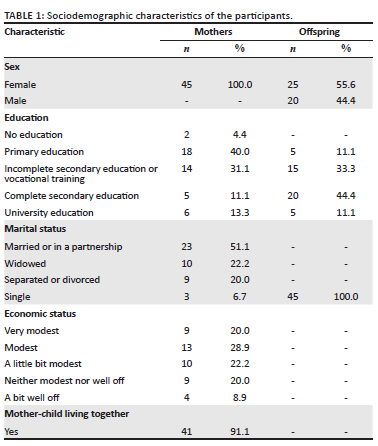
The description of the participants' sociodemographic data is presented in Table 1. Mothers' mean age was 45.13 years (standard deviation [s.d.] = 6.21; range: 35-62 years), and offspring's mean age was 20.27 years (s.d. = 1.75; range: 18-24 years). All offspring were single, and 91% (n = 41) lived in the same household as their mothers. Most households (n = 32; 71%) reported a modest socioeconomic status.
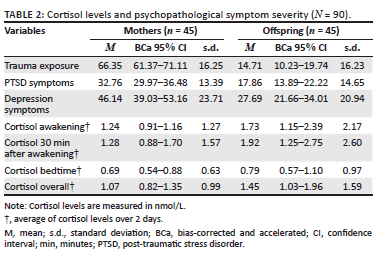
Participants' mean scores of trauma exposure, PTSD and depression symptoms and untransformed cortisol levels are summarised in Table 2. Mothers had significantly higher levels of trauma exposure, t(88) = 15.41 (bias-corrected and accelerated [BCa] 95% CI: 13.42 to 17.35), p < 0.001; PTSD symptoms, t(88) = 5.09 (BCa 95% CI: 3.12 to 7.04), p < 0.001 and depression symptoms, t(88) = 3.82 (BCa 95% CI: 1.89 to 5.82), p < 0.001 compared to their offspring (see Table 2 for descriptive statistics). In all, 21 mothers (47%) and 8 offspring (18%) met the criteria for probable PTSD; 15 mothers (33%) and 5 offspring (11%) scored above the cut-off score for probable depression.
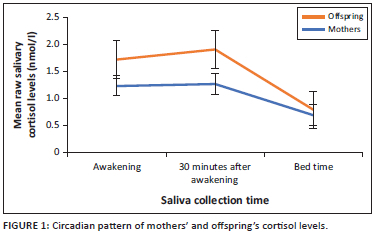
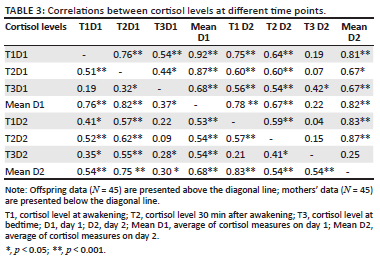
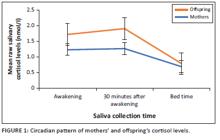
Cortisol levels of both mothers and offspring followed the typical circadian rhythm, with higher levels in the morning and lower levels at bedtime (see Figure 1). Among offspring, the overall cortisol level of men, M = 1.39, s.d. = 1.73, did not differ significantly from that of women, M = 1.50, s.d. = 1.51; t(43) = −1.04 (BCa 95% CI: −2.93 to 0.92), p = 0.29. Correlations between cortisol levels of mothers and their offspring are presented in Table 3. Overall, cortisol levels upon awakening and 30 m later correlated moderately or highly. There was a small or no correlation between bedtime cortisol levels and cortisol levels at awakening and 30 m after awakening. There was no correlation between age and overall cortisol level among offspring, r = −0.20, (BCa 95% CI: −0.44 to 0.05), p = 0.18 or among mothers, r = −0.13 (BCa 95% CI: −0.34 to 0.12), p = 0.39. Furthermore, mothers' overall cortisol level did not differ significantly from their offspring's overall cortisol level, t(88) = −0.90 (BCa 95% CI: −0.25 to 1.02), p = 0.37 (see Table 2 for descriptive statistics).
Associations between psychopathology and cortisol levels in each generation
Among offspring, trauma exposure correlated with both PTSD symptoms, r = 0.32 (BCa 95% CI: 0.10 to 0.62), p = 0.03, and depression symptoms, r = 0.38 (BCa 95% CI: 0.12 to 0.63), p = 0.01. Post-traumatic stress disorder symptoms highly correlated with depression symptoms, r = 0.71, p < 0.001 (BCa 95% CI: 0.50 to 0.87). The overall cortisol level did not correlate with trauma exposure, r = 0.05 (BCa 95% CI: −0.29 to 0.28), p = 0.72; PTSD symptoms r = −0.06 (BCa 95% CI: −0.28 to 0.17), p = 0.67 or depression symptoms, r = −0.17 (BCa 95 % CI −0.38 to 0.07), p = 0.26. Among mothers, trauma exposure did not correlate significantly with PTSD symptoms, r = 0.22 (BCa 95% CI: −0.08 to 0.47), p = 0.14 or depression symptoms, r = 0.15 (BCa 95% CI: −0.16 to 0.44), p = 0.31. There was a high correlation between PTSD symptoms and depression symptoms, r = 0.81, (BCa 95% CI: 0.72 to 0.88), p < 0.001. The overall cortisol level did not correlate with trauma exposure, r = 0.08 (BCa 95% CI: −0.17 to 0.31), p = 0.59; PTSD symptoms, r = 0.07 (BCa 95% CI: −0.36 to 0.22), p = 0.66 or depression symptoms, r = −0.21 (BCa 95% CI: −0.49 to 0.08), p = 0.17.
Associations between mothers' post-traumatic stress disorder and depression and their offspring's overall cortisol level
Offspring of mothers with depression had a lower overall cortisol level (n = 15; M = 0.88, s.d. = 0.87) than the offspring of mothers without depression (n = 30; M = 1.74, s.d. = 1.79), t(43) = 2.33 (BCa 95% CI: 0.41 to 4.30), p = 0.03, Cohen's d = 0.80. The results showed no significant differences in the overall cortisol level between the offspring of mothers with PTSD (n = 21; M = 1.28, s.d. = 1.22) and those without PTSD (n = 24; M = 1.60, s.d. = 1.86), t(43) = 0.45 (BCa 95% CI: −1.45 to 2.46), p = 0.65, Cohen's d = 0.13. In correlational analyses, mothers' PTSD symptoms did not correlate with their offspring's overall cortisol level, r = −0.15 (BCa 95% CI: −0.37 to 0.10), p = 0.33, but mothers' depression symptoms negatively correlated with their offspring's overall cortisol level, r = −0.36 (BCa 95% CI: −0.57 to −0.07), p = 0.02. Furthermore, partial correlations showed that the relationship between mothers' depression symptoms and their offspring's overall cortisol level remained significant after controlling for mothers' PTSD, r = −0.41 (BCa 95% CI: −0.61 to −0.16), p = 0.005 and mothers' trauma exposure, r = −0.33 (BCa 95% CI: −0.56 to −0.07), p = 0.03.
Discussion
The primary objective of this study was to examine the intergenerational link between mothers' PTSD and depression and their offspring's basal cortisol level and whether the offspring's basal cortisol level was linked to their own psychopathology. The findings revealed a negative link between mothers' depression and their offspring's basal cortisol level but not between mothers' PTSD and their offspring's cortisol level. No association was found between the offspring's basal cortisol level and their own PTSD or depression symptoms.
The findings showed that mothers' depression was associated with a lower overall cortisol level among their offspring. To our knowledge, this is the first study to find a negative relationship between mothers' depression and offspring's cortisol level in an African sample. This result contrasts with previous studies that reported higher basal cortisol levels in children of mothers suffering from depression.30,3224,26
Contrary to previous studies,4,64264
The results showed no link between offspring's overall basal cortisol level and their PTSD or depression symptoms. This result is consistent with the current literature's mixed findings on HPA axis dysfunction and trauma-related psychopathology.52535452,5556,5753,58458
Limitations
This study is not without limitations. Although comparable to those of earlier studies,4,65554,5926
Conclusion
In conclusion, this study contributes to the literature by examining the mechanisms underlying the intergenerational transmission of trauma in an African sample. The findings showed a relationship between mothers' depression, but not PTSD, and their adult offspring's basal cortisol level. These results suggest that, in addition to PTSD, more empirical attention should be devoted to maternal depression in the study of intergenerational consequences of trauma. Considering the heterogeneity of the findings on the relationship between cortisol levels and trauma-related psychopathology, there is a need for standardising research protocols. More research on neuroendocrine correlates of trauma-related psychopathology is needed among the African populations, given the high occurrence of mass violence in Africa. This knowledge may aid in preventing the transmission of trauma from one generation to the next and in elaborating therapeutic interventions.
This article is partially based on the author M.C.I.'s thesis titled 'La transmission intergénerationelle des traumatismes au Rwanda' towards the degree of PhD in Psychology, at the Département de Psychologie Université du Québec à Trois-Rivières, Canada on 01 June 2023 with supervisors Prof. Colette Jourdan-Ionescu and Prof. Isabelle Blanchette. It is available here: https://depot-e.uqtr.ca/id/eprint/10974.
Competing interests
The authors declare that they have no financial or personal relationship(s) that may have inappropriately influenced them in writing this article.
Authors' contributions
M.C.I. conceptualised the study, collected and analysed the data and wrote and edited the article. I.B. obtained the funding. I.B., S.C. and E.R. were involved in the conceptualisation, supervision and editing of the article.
Funding information
This study was funded by a grant awarded to Isabelle Blanchette by the Social Sciences and Humanities Research Council of Canada (090-2016-0083) on 15 March 2017.
Data availability
The data that support the findings of this study are available from the corresponding author, M.C.I., upon reasonable request.
Disclaimer
The views and opinions expressed in this article are those of the authors and are the product of professional research. The article does not necessarily reflect the official policy or position of any affiliated institution, funder, agency or that of the publisher. The authors are responsible for this article's results, findings and content.
Acknowledgements
The authors would like to thank the research assistants, Jean-Baptiste Uwanjye and Justine Mukamwezi. They would also like to thank the Centre for Studies on Human Stress in Montreal, particularly Helen Findlay, for her role in cortisol extraction and calculations.
References
-
1. Hoppen TH, Morina N. The prevalence of PTSD and major depression in the global population of adult war survivors: A meta-analytically informed estimate in absolute numbers. Eur J Psychotraumatol. 2019;10(1):1578637. https://doi.org/10.1080/20008198.2019.1578637
» https://doi.org/10.1080/20008198.2019.1578637 -
2. Munyandamutsa N, Nkubamugisha PM, Gex-Fabry M, Eytan A. Mental and physical health in Rwanda 14 years after the genocide. Soc Psychiatry Psychiatr Epidemiol. 2012;47:1753-1761. https://doi.org/10.1007/s00127-012-0494-9
» https://doi.org/10.1007/s00127-012-0494-9 -
3. Shrira A, Mollov B, Mudahogora C. Complex PTSD and intergenerational transmission of distress and resilience among Tutsi genocide survivors and their offspring: A preliminary report. Psychiatry Res. 2019;271(October 2018):121-123. https://doi.org/10.1016/j.psychres.2018.11.040
» https://doi.org/10.1016/j.psychres.2018.11.040 -
4. Perroud N, Rutembesa E, Paoloni-Giacobino A, et al. The Tutsi genocide and transgenerational transmission of maternal stress: Epigenetics and biology of the HPA axis. World J Biol Psychiatry. 2014;15:334-345. https://doi.org/10.3109/15622975.2013.866693
» https://doi.org/10.3109/15622975.2013.866693 -
5. Yehuda R, Daskalakis NP, Lehrner A, et al. Influences of maternal and paternal PTSD on epigenetic regulation of the glucocorticoid receptor gene in Holocaust survivor offspring. Am J Psychiatry. 2014;171:872-880. https://doi.org/10.1176/appi.ajp.2014.13121571
» https://doi.org/10.1176/appi.ajp.2014.13121571 -
6. Yehuda R, Teicher MH, Seckl JR, Grossman RA, Morris A, Bierer LM. Parental posttraumatic stress disorder as a vulnerability factor for low cortisol trait in offspring of holocaust survivors. Arch Gen Psychiatry. 2007;64(9):1040-1048. https://doi.org/10.1001/archpsyc.64.9.1040
» https://doi.org/10.1001/archpsyc.64.9.1040 -
7. Yehuda R, Bierer LM. Transgenerational transmission of cortisol and PTSD risk. Prog Brain Res. 2008;167:121-135. https://doi.org/10.1016/S0079-6123(07)67009-5
» https://doi.org/10.1016/S0079-6123(07)67009-5 -
8. Neugebauer R, Fisher PW, Turner JB, Yamabe S, Sarsfield JA, Stehling-Ariza T. Post-traumatic stress reactions among Rwandan children and adolescents in the early aftermath of genocide. Int J Epidemiol. 2009;38(4):1033-1045. https://doi.org/10.1093/ije/dyn375
» https://doi.org/10.1093/ije/dyn375 -
9. Musanabaganwa C, Jansen S, Fatumo S, et al. Burden of post-traumatic stress disorder in postgenocide Rwandan population following exposure to 1994 genocide against the Tutsi: A meta-analysis. J Affect Disord. 2020;275(December 2019):7-13. https://doi.org/10.1016/j.jad.2020.06.017
» https://doi.org/10.1016/j.jad.2020.06.017 -
10. Kayiteshonga Y, Sezibera V, Mugabo L, Iyamuremye JD. Prevalence of mental disorders, associated co-morbidities, health care knowledge and service utilization in Rwanda - Towards a blueprint for promoting mental health care services in low- and middle-income countries? BMC Public Health. 2022;22(1):1-13. https://doi.org/10.1186/s12889-022-14165-x
» https://doi.org/10.1186/s12889-022-14165-x -
11. Schaal S, Dusingizemungu JP, Jacob N, Elbert T. Rates of trauma spectrum disorders and risks of posttraumatic stress disorder in a sample of orphaned and widowed genocide survivors. Eur J Psychotraumatol. 2011;2(1):6343. https://doi.org/10.3402/ejpt.v2i0.6343
» https://doi.org/10.3402/ejpt.v2i0.6343 -
12. Dashorst P, Mooren TM, Kleber RJ, De Jong PJ, Huntjens RJC. Intergenerational consequences of the Holocaust on offspring mental health: A systematic review of associated factors and mechanisms. Eur J Psychotraumatol. 2019;10(1):1654065. https://doi.org/10.1080/20008198.2019.1654065
» https://doi.org/10.1080/20008198.2019.1654065 -
13. Yehuda R, Bell A, Bierer LM, Schmeidler J. Maternal, not paternal, PTSD is related to increased risk for PTSD in offspring of Holocaust survivors. J Psychiatr Res. 2008;42:1104-1111. https://doi.org/10.1016/j.jpsychires.2008.01.002
» https://doi.org/10.1016/j.jpsychires.2008.01.002 -
14. Solomon Z, Zerach G. The Intergenerational transmission of trauma: When children bear their father's traumatic past. Neuropsychiatr Enfance Adolesc. 2020;68(2):65-75. https://doi.org/10.1016/j.neurenf.2020.01.004
» https://doi.org/10.1016/j.neurenf.2020.01.004 -
15. Burchert S, Stammel N, Knaevelsrud C. Transgenerational trauma in a post-conflict setting: Effects on offspring PTSS/PTSD and offspring vulnerability in Cambodian families. Psychiatry Res. 2017;254:151-157. https://doi.org/10.1016/j.psychres.2017.04.033
» https://doi.org/10.1016/j.psychres.2017.04.033 -
16. Roth M, Neuner F, Elbert T. Transgenerational consequences of PTSD: Risk factors for the mental health of children whose mothers have been exposed to the Rwandan genocide. Int J Ment Health Syst. 2014;8:12. https://doi.org/10.1186/1752-4458-8-12
» https://doi.org/10.1186/1752-4458-8-12 -
17. Enlow MB, Egeland B, Carlson E, Blood E, Wright RJ. Mother-infant attachment and the intergenerational transmission of posttraumatic stress disorder. Dev Psychopathol. 2014;26(1):41-65. https://doi.org/10.1017/S0954579413000515
» https://doi.org/10.1017/S0954579413000515 -
18. Yehuda R, Lehrner A. Intergenerational transmission of trauma effects: Putative role of epigenetic mechanisms. World Psychiatry. 2018;17:243-257. https://doi.org/10.1002/wps.20568
» https://doi.org/10.1002/wps.20568 -
19. Danielson CK, Hankin BL, Badanes LS. Youth offspring of mothers with posttraumatic stress disorder have altered stress reactivity in response to a laboratory stressor. Psychoneuroendocrinology. 2015;53:170-178. https://doi.org/10.1016/j.psyneuen.2015.01.001
» https://doi.org/10.1016/j.psyneuen.2015.01.001 -
20. Lehrner A, Bierer LM, Passarelli V, et al. Maternal PTSD associates with greater glucocorticoid sensitivity in offspring of Holocaust survivors. Psychoneuroendocrinology. 2014;40:213-220. https://doi.org/10.1016/j.psyneuen.2013.11.019
» https://doi.org/10.1016/j.psyneuen.2013.11.019 -
21. Bowers ME, Yehuda R. Intergenerational transmission of stress in humans. Neuropsychopharmacology. 2016;41:232-244. https://doi.org/10.1038/npp.2015.247
» https://doi.org/10.1038/npp.2015.247 -
22. Raison CL, Miller AH. When not enough is too much: The role of insufficient glucocorticoid signaling in the pathophysiology of stress-related disorders Charles. Am J Psychiatry. 2003;160:1554-1565. https://doi.org/10.1176/appi.ajp.160.9.1554
» https://doi.org/10.1176/appi.ajp.160.9.1554 -
23. Morris MC, Compas BE, Garber J. Relations among posttraumatic stress disorder, comorbid major depression, and HPA function: A systematic review and meta-analysis. Clin Psychol Rev. 2012;32(4):301-315. https://doi.org/10.1016/j.cpr.2012.02.002
» https://doi.org/10.1016/j.cpr.2012.02.002 -
24. Yehuda R, Halligan SL, Bierer LM. Cortisol levels in adult offspring of Holocaust survivors: Relation to PTSD symptom severity in the parent and child. Psychoneuroendocrinology. 2002;27(1-2):171-180. https://doi.org/10.1016/S0306-4530(01)00043-9
» https://doi.org/10.1016/S0306-4530(01)00043-9 -
25. Yehuda R, Bierer LM, Schmeidler J, Aferiat DH, Breslau I, Dolan S. Low cortisol and risk for PTSD in adult offspring of Holocaust survivors. Am J Psychiatry. 2000;157(8):1252-1259. https://doi.org/10.1176/appi.ajp.157.8.1252
» https://doi.org/10.1176/appi.ajp.157.8.1252 -
26. Yehuda R, Engel SM, Brand SR, Seckl J, Marcus SM, Berkowitz GS. Transgenerational effects of posttraumatic stress disorder in babies of mothers exposed to the World Trade Center attacks during pregnancy. J Clin Endocrinol Metab. 2005;90(7):4115-4118. https://doi.org/10.1210/jc.2005-0550
» https://doi.org/10.1210/jc.2005-0550 -
27. Castro-Vale I, Van Rossum EFC, Staufenbiel SM, Severo M, Mota-Cardoso R, Carvalho D. Hair cortisol as a marker of intergenerational heritage of war? A study of veterans and their offspring. Psychiatry Investig. 2020;17(10):976-986. https://doi.org/10.30773/pi.2020.0212
» https://doi.org/10.30773/pi.2020.0212 -
28. D'Elia ATD, Juruena MF, Coimbra BM, Mello MF, Mello AF. Posttraumatic stress disorder (PTSD) and depression severity in sexually assaulted women: Hypothalamic-pituitary-adrenal (HPA) axis alterations. BMC Psychiatry. 2021;21(1):1-12. https://doi.org/10.1186/s12888-021-03170-w
» https://doi.org/10.1186/s12888-021-03170-w -
29. Dienes KA, Hazel NA, Hammen CL. Cortisol secretion in depressed, and at-risk adults. Psychoneuroendocrinology. 2013;38(6):927-940. https://doi.org/10.1016/j.psyneuen.2012.09.019
» https://doi.org/10.1016/j.psyneuen.2012.09.019 -
30. LeMoult J, Chen MC, Foland-Ross LC, Burley HW, Gotlib IH. Concordance of mother-daughter diurnal cortisol production: Understanding the intergenerational transmission of risk for depression. Biol Psychol. 2015;108:98-104. https://doi.org/10.1016/j.biopsycho.2015.03.019
» https://doi.org/10.1016/j.biopsycho.2015.03.019 -
31. Hjort L, Rushiti F, Wang SJ, et al. Intergenerational effects of maternal post-traumatic stress disorder on offspring epigenetic patterns and cortisol levels. Epigenomics. 2021;13(12):967-980. https://doi.org/10.2217/epi-2021-0015
» https://doi.org/10.2217/epi-2021-0015 -
32. Halligan SL, Herbert J, Goodyer I, Murray L. Disturbances in morning cortisol secretion in association with maternal postnatal depression predict subsequent depressive symptomatology in adolescents. Biol Psychiatry. 2007;62(1):40-46. https://doi.org/10.1016/j.biopsych.2006.09.011
» https://doi.org/10.1016/j.biopsych.2006.09.011 -
33. Ng LC, Stevenson A, Kalapurakkel SS, et al. National and regional prevalence of posttraumatic stress disorder in sub-Saharan Africa: A systematic review and meta-analysis. PLoS Med. 2020;17(5):1-30. https://doi.org/10.1371/journal.pmed.1003090
» https://doi.org/10.1371/journal.pmed.1003090 -
34. Brown ED, Anderson KE, Garnett ML, Hill EM. Economic instability and household chaos relate to cortisol for children in poverty. J Fam Psychol. 2019;33(6):629-639. https://doi.org/10.1037/fam0000545
» https://doi.org/10.1037/fam0000545 -
35. Stachowicz M, Lebiedzińska A. The effect of diet components on the level of cortisol. Eur Food Res Technol. 2016;242(12):2001-2009. https://doi.org/10.1007/s00217-016-2772-3
» https://doi.org/10.1007/s00217-016-2772-3 -
36. Steudte S, Kolassa IT, Stalder T, Pfeiffer A, Kirschbaum C, Elbert T. Increased cortisol concentrations in hair of severely traumatized Ugandan individuals with PTSD. Psychoneuroendocrinology. 2011;36(8):1193-1200. https://doi.org/10.1016/j.psyneuen.2011.02.012
» https://doi.org/10.1016/j.psyneuen.2011.02.012 -
37. Ingabire MC, Caparos S, Rutembesa E, Habimana E, Ndushabandi E, Blanchette I. Intergenerational transmission of trauma and its association with attitudes toward reconciliation. Psychol Trauma. 2023;15(S2):S393-S400. https://doi.org/10.1037/tra0001416
» https://doi.org/10.1037/tra0001416 -
38. Ingabire MC, Caparos S, Rutembesa E, Habimana E, Blanchette I. Maternal trauma exposure is linked to adult offspring's cognitive functioning in the context of mass violence. Psychol Trauma Theory, Res Pract Policy. 2024. Advance Online Publication. https://doi.org/10.1037/tra0001807
» https://doi.org/10.1037/tra0001807 -
39. Caparos S, Giroux SV, Rutembesa E, Habimana E, Blanchette I. Twenty years later, the cognitive portrait of openness to reconciliation in Rwanda. Br J Psychol. 2018;109(2):362-385. https://doi.org/10.1111/bjop.12275
» https://doi.org/10.1111/bjop.12275 -
40. Mollica R, Caspi-Yavin Y, Bollini P, Truang T, Tor S, Lavelle J. The Havard Trauma Questionnaire: Validating a cross-cultural instrument for measuring torture, trauma, and Posttraumatic Stress Disorder in Indochinese refugees. J Nerv Ment Dis. 1992;180:111-116. https://doi.org/10.1097/00005053-199202000-00008
» https://doi.org/10.1097/00005053-199202000-00008 -
41. Rugema L, Mogren I, Ntaganira J, Krantz G. Traumatic episodes and mental health effects in young men and women in Rwanda, 17 years after the genocide. BMJ Open. 2015;5(6):e006778. https://doi.org/10.1136/bmjopen-2014-006778
» https://doi.org/10.1136/bmjopen-2014-006778 -
42. Weathers FW, Bovin MJ, Lee DJ, et al. The Clinician-Administered PTSD Scale for DSM-5 (CAPS-5): Development and initial psychometric evaluation in military veterans. Psychol Assess. 2018;30(3):383-395. https://doi.org/10.1037/pas0000486
» https://doi.org/10.1037/pas0000486 - 43. American Psychiatric Association. Diagnostic and statistical manual of mental disorders. 5th ed. Arlington, TX: American Psychiatric Association; 2013.
-
44. Verhey R, Chibanda D, Gibson L, Brakarsh J, Seedat S. Validation of the posttraumatic stress disorder checklist - 5 (PCL-5) in a primary care population with high HIV prevalence in Zimbabwe. BMC Psychiatry. 2018;18:109. https://doi.org/10.1186/s12888-018-1688-9
» https://doi.org/10.1186/s12888-018-1688-9 -
45. Ibrahim H, Ertl V, Catani C, Ismail AA, Neuner F. The validity of Posttraumatic Stress Disorder Checklist for DSM-5 (PCL-5) as screening instrument with Kurdish and Arab displaced populations living in the Kurdistan region of Iraq. BMC Psychiatry. 2018;18(1):259. https://doi.org/10.1186/s12888-018-1839-z
» https://doi.org/10.1186/s12888-018-1839-z -
46. Derogatis LR, Lipman R s., Uhlenhuth EH, Covi L. The Hopkins Symptom Checklist (HSCL): A self-report symptom inventory. Behav Sci. 1974;19(1):1-15. https://doi.org/10.1002/bs.3830190102
» https://doi.org/10.1002/bs.3830190102 -
47. Ertl V, Pfeiffer A, Saile R, Schauer E, Elbert T, Neuner F. Validation of a mental health assessment in an African conflict population. Int Perspect Psychol Res Pract Consult. 2011;1:19-27. https://doi.org/10.1037/2157-3883.1.S.19
» https://doi.org/10.1037/2157-3883.1.S.19 -
48. Schaal S, Weierstall R, Dusingizemungu JP, Elbert T. Mental health 15 years after the killings in Rwanda: Imprisoned perpetrators of the genocide against the Tutsi versus a community sample of survivors. J Trauma Stress. 2012;25:446-453. https://doi.org/10.1002/jts.21728
» https://doi.org/10.1002/jts.21728 - 49. Alpers GW, Abelson JL, Wilhelm FH, Roth WT. Salivary cortisol response during exposure treatment in driving phobics. Psychosom Med. 2003;65(4):679-687.
-
50. Wahbeh H, Oken BS. Salivary cortisol lower in posttraumatic stress disorder. J Trauma Stress. 2013;26(2):241-248. https://doi.org/10.1002/jts.21798
» https://doi.org/10.1002/jts.21798 -
51. Puth MT, Neuhäuser M, Ruxton GD. On the variety of methods for calculating confidence intervals by bootstrapping. J Anim Ecol. 2015;84(4):892-897. https://doi.org/10.1111/1365-2656.12382
» https://doi.org/10.1111/1365-2656.12382 -
52. Speer KE, Semple S, Naumovski N, D'Cunha NM, McKune AJ. HPA axis function and diurnal cortisol in post-traumatic stress disorder: A systematic review. Neurobiol Stress. 2019;11(December 2018):100180. https://doi.org/10.1016/j.ynstr.2019.100180
» https://doi.org/10.1016/j.ynstr.2019.100180 -
53. Pan X, Wang Z, Wu X, Wen SW, Liu A. Salivary cortisol in post-traumatic stress disorder: A systematic review and meta-analysis. BMC Psychiatry. 2018;18(1):1-10. https://doi.org/10.1186/s12888-018-1910-9
» https://doi.org/10.1186/s12888-018-1910-9 -
54. Dettenborn L, Muhtz C, Skoluda N, et al. Introducing a novel method to assess cumulative steroid concentrations: Increased hair cortisol concentrations over 6 months in medicated patients with depression. Stress. 2012;15(3):348-353. https://doi.org/10.3109/10253890.2011.619239
» https://doi.org/10.3109/10253890.2011.619239 -
55. Eckart C, Engler H, Riether C, Kolassa S, Elbert T, Kolassa IT. No PTSD- related differences in diurnal cortisol profiles of genocide survivors. Psychoneuroendocrinology. 2009;34(4):523-531. https://doi.org/10.1016/j.psyneuen.2008.10.012
» https://doi.org/10.1016/j.psyneuen.2008.10.012 -
56. Alenko A, Markos Y, Fikru C, Tadesse E, Gedefaw L. Association of serum cortisol level with severity of depression and improvement in newly diagnosed patients with major depressive disorder in Jimma medical center, Southwest Ethiopia. PLoS One. 2020;15(10 October 2020):1-12. https://doi.org/10.1371/journal.pone.0240668
» https://doi.org/10.1371/journal.pone.0240668 -
57. Islam MR, Islam MR, Ahmed I, et al. Elevated serum levels of malondialdehyde and cortisol are associated with major depressive disorder: A case-control study. SAGE Open Med. 2018;6:1-7. https://doi.org/10.1177/2050312118773953
» https://doi.org/10.1177/2050312118773953 -
58. Ryan R, Booth S, Spathis A, Mollart S, Clow A. Use of salivary diurnal cortisol as an outcome measure in randomised controlled trials: A systematic review. Ann Behav Med. 2016;50(2):210-236. https://doi.org/10.1007/s12160-015-9753-9
» https://doi.org/10.1007/s12160-015-9753-9 -
59. Staufenbiel SM, Andela CD, Manenschijn L, Pereira AM, Van Rossum EFC, Biermasz NR. Increased hair cortisol concentrations and BMI in patients with pituitary-adrenal disease on hydrocortisone replacement. J Clin Endocrinol Metab. 2015;100(6):2456-2462. https://doi.org/10.1210/jc.2014-4328
» https://doi.org/10.1210/jc.2014-4328

Accepted: 18 Mar. 2025
Published: 15 May 2025