Factors associated with patient readmission to a specialised psychiatric hospital in the Eastern Cape
Abstract
BACKGROUND: Hospital readmissions increase healthcare system costs and can place additional strain on already sparse government funds and under-resourced hospitals. Few studies have investigated readmission of patients in mental health facilities in South Africa AIM: The study aimed to identify the factors associated with readmission of patients discharged from an acute psychiatric public hospital in South Africa. SETTING: The study was conducted at an acute psychiatric public hospital. METHOD: A retrospective review of medical records was conducted for all patients admitted and readmitted between January 2018 and December 2019. RESULTS: From the pool of patient records analysed (n = 516), 93 (18.02%) were readmitted, of which the majority (75.27%) were male. The average age of patients readmitted was 27.24 ± 11.16 years, which was significantly younger than the total sample (p < 0.05; CI 1.095-7.105). Findings indicated that patients who completed lower levels of education, were unemployed and were diagnosed with substance (mono- or polysubstance) use disorder (n = 93; 100%), schizophrenia (n = 33; 35.48%), bipolar disorder (n = 9; 9.68%) or intellectual disability (n = 9; 9.68%) were more frequently readmitted, with the average length of stay varying widely between patients. CONCLUSION: Younger patients and those living with more complex psychiatric conditions, particularly those who are substance abusers, were readmitted more frequently, indicating that these patients may require special consideration for management. CONTRIBUTION: The study revealed that patients living with complex psychiatric conditions such as schizophrenia and bipolar disorder were readmitted to hospital more frequently, indicating that management of these patients at the community level is challenging.
psychiatry; readmission; health; Eastern Cape; South Africa
Introduction
Mental health disorders negatively impact the well-being of the individual and society in a variety of ways. Those affected are more likely to be unemployed,1233,4567
While the concept of 'recovery' in the context of mental health disorders needs to be understood as a journey rather than as an endpoint,899
Hospital readmissions increase public healthcare costs. In countries like South Africa and other low- and middle-income countries with limited health resources, readmissions can place an added strain on an already overburdened healthcare system.1010,11,12,13
Although mental health is recognised as a public health crisis in South Africa, the amount of resources allocated to and policymaker concern over mental health services in South Africa is insufficient.1415,161717,181817,18
The heading of Aim can be inserted above this paragraph readmissions to a specialised public psychiatric hospital located in the Nelson Mandela Bay Municipality in the Eastern Cape province, South Africa. The specific objectives were to examine whether sociodemographic characteristics, geographic residence, diagnoses and the medication prescribed to each patient were related to readmissions.
Research methods and design
The study was descriptive and quantitative in nature and employed a retrospective review of medical records. The study was conducted at an acute psychiatric public hospital that serves as the main mental health service facility in the metropolitian area. The hospital has 193 beds and comprises six wards, including a small intensive care unit for acute psychiatric episodes.
The medical records of all patients admitted to the facility between January 2018 and December 2019 were anonymised and included in the study. As per facility policy, a readmission is any admission of a patient within a period of 2 years after discharge.
All medical records of patients admitted between January 2018 and December 2019 were retrospectively reviewed by a trained research assistant for the date of first admission and subsequent readmission(s). Demographic data were extracted, as well as diagnoses and medication prescribed, including psychiatric and other chronic medications. In addition, the patients' area of residence was recorded for geographic mapping to identify potential hotspots.
The residence of the patient was geolocated using a geographical information systems (GIS) database using ArcGIS 10.5 (Esri Software, Redlands, California, United States). Data on the retrospectively reviewed medical files were captured on Microsoft Excel (Microsoft Corporation, Redmond, Washington, United States). Data were analysed using descriptive statistics. Chi-square statistics were used to examine categorical variables. T-tests were used to examine continuous variables. A confidence interval of 95% was used for all statistical tests, and the significant level (α) was set at 0.05. Statistical tests were conducted using Stata version 15.0 (StataCorp LLC, College Station, Texas, United States).
Ethical considerations
The study obtained ethics approval from the Nelson Mandela University Research Ethics Committee (REC) Human (ref. no. H20-ENG-ITE-003) and the Eastern Cape Department of Health (EC_202101_009).
Results
A total of 516 patient records were analysed between July 2021 and August 2021. The average age of the population was 31.3 ± 13.9 years (range = 13-72 years), with 45.93% of the population aged between 16 and 25 years. Male patients were on average younger than female patients at 28.5 ± 12.5 years compared to 36.6 ± 4.9 years, respectively. Most patients had completed up to a secondary level education (n = 244; 47.29%), and the majority were unemployed (n = 408; 79.07%).
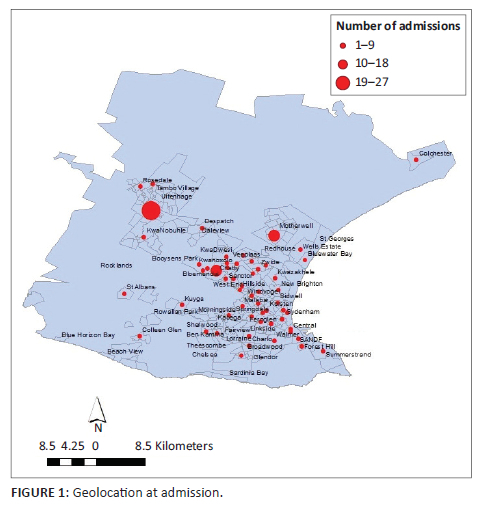
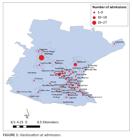
The data set contained 516 records, of which only 109 could be geolocated. See Figure 1. The reasons were that a vast majority of patients were either not resident in the district or that address data were incomplete. The majority of the records in the data set could be geolocated to various suburbs in the Nelson Mandela Bay health district, with slightly higher than average admission rates being seen in Bloemendal, the informal settlement area of Motherwell and the neighbouring town of Uitenhage (Kariega). Still other patients travelled from the town of Colchester, located in the north-east of the map, approximately 40 km from the study site. All patients were admitted involuntarily, which means that the patient was transferred from another hospital or admitted by police decision.
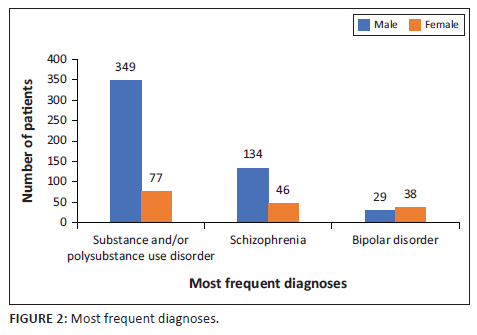
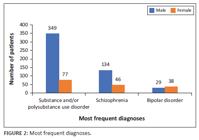
The most frequently recorded diagnoses are shown in Figure 2. The most common diagnosis was substance (mono- and polysubstance) induced psychotic episodes (n = 426; 82.56%) and was more common among male patients (n = 349; 81.9%) compared to female patients (n = 77; 18.1%). This was followed by schizophrenia, including schizophreniform and schizoaffective disorder, treatment-resistant schizophrenia, paranoid schizophrenia and schizophrenia with catatonia and/or fixed delusion (n = 180; 34.89%) and bipolar disorder, including Type 1 and Type 2 and bipolar disorder with depression and/or manic or psychotic features (n = 67; 12.98%). This clustering is based on diagnoses as noted in the records and not on DSM-V definitions. While 181 (35.08%) patients had just one diagnosis, 270 (52.33%) had two and the remainder (n = 65; 12.60%) had three diagnoses.
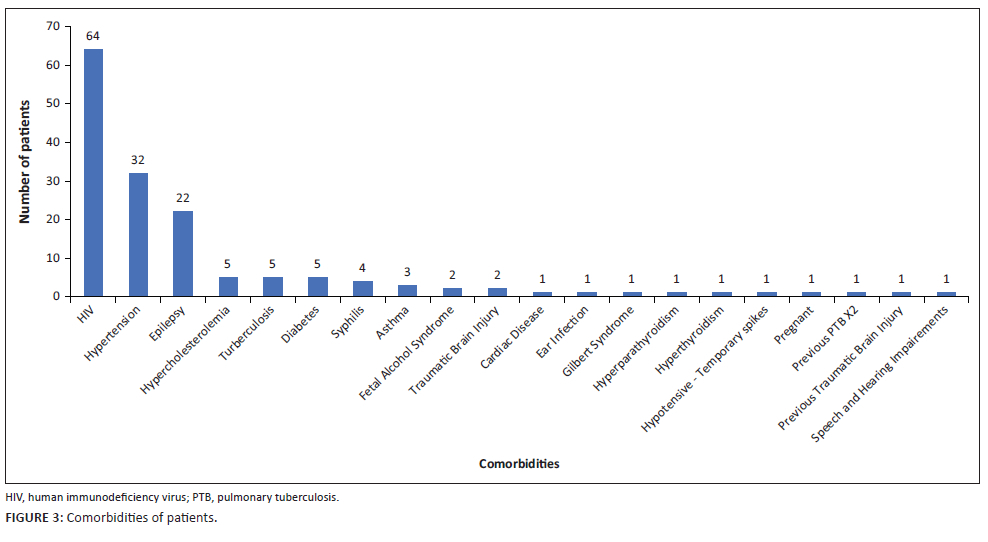
Comorbidities were recorded for 167 patients (32.40%) and are summarised in Figure 3.
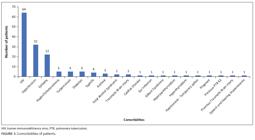
The three most frequently reported comorbidities were HIV (n = 64; 12.40%), hypertension (n = 32; 6.20%) and epilepsy (n = 22; 4.26%). An average of 1.01 ± 1.46 chronic (nonpsychiatric) medications was prescribed per patient (range = 0-11).
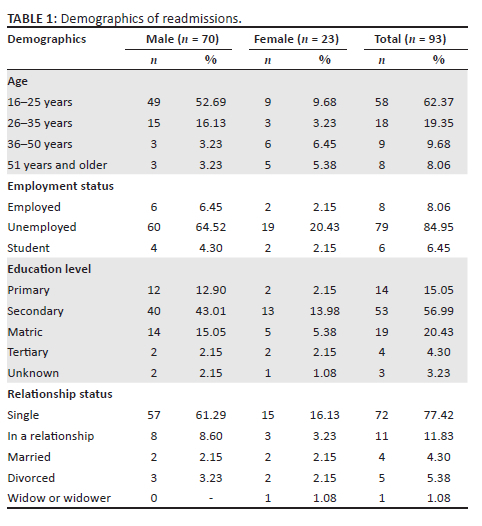
A total of 93 (18.02%) patients were admitted to the facility more than once between January 2018 and December 2019, of which 70 were male patients (75.27%). The average age of this group was 27.24 ± 11.16 years, which was significantly younger than the total population (p < 0.05; CI 1.095-7.105). There were 21 (4.07%) patients who were admitted three times during this period, three (0.58%) patients who were admitted four times and a single (0.19%) patient who was admitted seven times during the two year period. The patient who was admitted seven times was in hospital for a period of 264 days (average of 37.71 ± 29.74 days per admission) because of repeated episodes of substance-induced psychotic disorder. The demographics of the readmission population are summarised in Table 1.
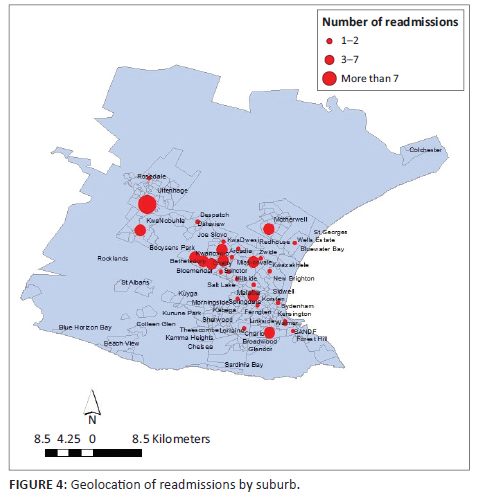
Similar to the general study sample, the majority of patients were unemployed (n = 79; 84.95%), single (n = 72; 77.42%) and had completed a secondary-level education (n = 53; 56.99%). While there was little difference between the average ages of male patients (27.24 ± 11.16 years) and female patients (27.01 ± 10.97 years) who experienced more than one admission in two years, a majority (62.36%) of readmitted patients were between the ages of 16 and 25 years. The suburbs from which patients were readmitted are shown in Figure 4.
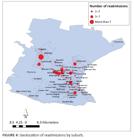
There were, on average, 2.5 readmissions per suburb. Higher than the average number of readmissions were seen from the suburbs of Motherwell, KwaDwesi, Zwide, Booysens Park, Bethelsdorp, Arcadia, Gelvandale, Walmer, Bloemendal and the town of Uitenhage (Kariega) and its surrounding township KwaNobuhle. Table 2 shows the number of readmissions per suburb.
Readmitted patients were prescribed an average of 2.69 ± 1.33 medications (psychiatric medication and chronic (nonpsychiatric) medication) compared to 2.91 ± 1.66 of the overall population (p > 0.05). There were just 22 patients who had recorded comorbidities, which included HIV (n = 11), hypertension (n = 4), diabetes type 2 (n = 2), epilepsy (n = 1), Gilbert syndrome (n = 1), traumatic brain injury (n = 1), tuberculosis (n = 1) and tuberculosis lymphadenopathy (n = 1). The most frequent diagnoses noted among patients who were readmitted were substance (mono- or polysubstance) use disorder (n = 94); followed by schizophrenia (n = 33), including schizophreniform disorder, paranoid schizophrenia and schizophrenia with fixed delusion and/or catatonia; and bipolar disorder (n = 9), including Type 1, Type 2 and bipolar disorder with manic features and intellectual disability (n = 9).
The length of hospital stays varied greatly, with a range of 13-147 days for first admissions (average length of stay 61.70 ± 32.66 days) compared to a second admission where the range was 3-309 days (average length of stay 65.85 ± 52.53 days). Of the 23 patients who were admitted three times, the length of stay ranged from five to 123 days (average length of stay 45.61 ± 34.11 days) while the three patients with four admissions showed a smaller range from 26 to 41 days (average length of stay 34 ± 7.56 days).
Discussion
The readmission rate found in this study was 18.02% (n = 93). Readmission rates vary greatly between countries and settings. While there is a paucity of studies surrounding readmissions, studies in China have found readmission rates of 30% in Beijing,19202122
Readmitted patients were younger than the total population and were diagnosed with substance use with complex psychiatric conditions on the schizophrenia or bipolar disorder spectrum. Similar to other global and South African studies,11,12,1322
While mental health statistics are available for the population covered by medical insurance, statistics in public sector are unavailable.23n = 58%).24242425
Almost two-thirds of the study population were receiving antiretroviral treatment (ART); human immunodeficiency virus HIV infection may result in neuropsychiatric disorders, either due to social factors related to diagnosis such as stigma or the resultant impact of the diagnosis on quality of life and relationships.2627
Upon discharge from the study site, patients are referred to one of 18 decentralised psychiatric clinics where they may collect their medication on a monthly basis. However, geographic location has been shown to influence the accessibility and quality of healthcare received.15,162828
Substance use causes a significant burden on individual productivity, the economy and the social aspects of individuals, as well as families and communities.29303029
Schizophrenia is a severe mental disorder that is associated with significant disability and can affect educational and occupational performance, likely due to the early onset of the disorder, its chronic course, limited mental health resources and social stigma.313231,32,33
Conclusion
While the general readmission rate was not shown to be very high, the study revealed that patients living with complex psychiatric conditions such as schizophrenia and bipolar disorder were readmitted to hospital more frequently, indicating that management of these patients at the community level is challenging. Substance use, prevalent among young male patients, was the most frequent diagnosis in both the total study population as well as patients who were readmitted, which is representative of an ongoing challenge in communities across the Nelson Mandela Bay district.
Reasons as to why these groups of patients are readmitted more frequently need to be explored. Interventions focused at community-level to empower primary healthcare staff with the knowledge, skills and support to manage patients with complex psychiatric conditions and substance use disorders need to be explored and evaluated. These interventions require interprofessional collaboration due to the multifaceted nature of the factors associated with substance use.
Competing interests
The authors declare that they have no financial or personal relationships that may have inappropriately influenced them in writing this article
Authors' contributions
R.G., C.O. and L.J.v.V. conceptualised and developed the methodology for the presented idea. R.G. developed the theory and the protocol with input from A.D., C.O. and L.J.v.V. C.O. and L.J.v.V. assisted with and supervised data collection. R.G. and A.D. conducted the major data analysis. All authors discussed the results and contributed to writing and editing of the final manuscript.
Funding information
The author disclosed receipt of the following financial support for the research, authorship and/or publication of this article: this work was supported by Nelson Mandela University in the form of a postdoctoral fellowship supported by the Office of Research Development.
Data availability
The data that support the findings of this study are available from the corresponding author, R.G., upon written request.
Disclaimer
The findings and conclusions in this report are those of the authors and do not necessarily represent the views of the Centre for Community Technologies and Nelson Mandela Unversity.
Acknowledgements
The authors would like to acknowledge the Centre for Community Technologies Writing Group for their edits and feedback on the manuscript.
References
-
1.Lund C, De Silva M, Plagerson S, Cooper S, Chisholm D, Das J. Poverty and mental disorders: Breaking the cycle in low-income and middle-income countries. Lancet. 2011;378(9801):1502-1514. https://doi.org/10.1016/S0140-6736(11)60754-X
» https://doi.org/10.1016/S0140-6736(11)60754-X -
2.Ardington C, Case A. Interactions between mental health and socioeconomic status in the South African national income dynamics study. Tydskr stud Ekon Ekon. 2010;34(3):69-85. https://doi.org/10.1080/10800379.2010.12097210
» https://doi.org/10.1080/10800379.2010.12097210 -
3.Borenstein J. Stigma, prejudice and discrimination against people with mental illness [homepage on the Internet]. American Psychiatric Association; 2020 [cited 2022 Jan 25]. Available from: https://www.psychiatry.org/patients-families/stigma-and-discrimination
» https://www.psychiatry.org/patients-families/stigma-and-discrimination -
4.De Hert M, Correll CU, Bobes J, et al. Physical illness in patients with severe mental disorders. Prevalence, impact of medications and disparities in health care. World Psychiatry. 2011;10(1):52-77. https://doi.org/10.1002/j.2051-5545.2011.tb00014.x
» https://doi.org/10.1002/j.2051-5545.2011.tb00014.x -
5.Maniglio R. Severe mental illness and criminal victimization: A systematic review. Acta Psychiatr Scand. 2009;119(3):180-191. https://doi.org/10.1111/j.1600-0447.2008.01300.x
» https://doi.org/10.1111/j.1600-0447.2008.01300.x -
6.Matthews C. Putting a number on mental health costs [homepage on the Internet]. Curiosity: University of the Witwatersrand, 2020 [cited 2021 Nov 30]; vol. 10, pp. 12-13. Available from: https://www.wits.ac.za/news/latest-news/research-news/2020/2020-09/putting-a-number-on-mental-health-costs.html
» https://www.wits.ac.za/news/latest-news/research-news/2020/2020-09/putting-a-number-on-mental-health-costs.html - 7.Herman AA, Stein DJ, Seedat S, et al. The South African Stress and Health (SASH) study: 12-month and lifetime prevalence of common mental disorders. S Afr Med J. 2009;99(5 Pt 2):339-344.
-
8. Parker J. Recovery in mental health. S Afr Med J. 2014;104(1):77. https://doi.org/10.7196/SAMJ.7732
» https://doi.org/10.7196/SAMJ.7732 -
9.Docrat S, Besada D, Cleary S, Daviaud E, Lund C. Mental health system costs, resources and constraints in South Africa: A national survey. Health Pol Plan. 2019;34(9):706-719. https://doi.org/10.1093/heapol/czz085
» https://doi.org/10.1093/heapol/czz085 - 10.Amoah D, Mwanri L. Determinants of hospital readmission of medical conditions in developing countries. Austin J Public Health Epidemiol. 2016;3(5):1049.
-
11.Zanardo GLdP, Ferreira GS, Moro LM, Rocha KB. Factors associated with psychiatric readmissions: A systematic review. Paidéia. 2018;28:e2814. https://doi.org/10.1590/1982-4327e2814
» https://doi.org/10.1590/1982-4327e2814 -
12.Vally Z, Cader N. The 'revolving door': A profile of acute admissions at a South African psychiatric hospital. Int Psychiatry. 2012;9(3):66-68. https://doi.org/10.1192/S1749367600003258
» https://doi.org/10.1192/S1749367600003258 -
13.Webb S, Yaguez L, Langdon PE. Factors associated with multiple re-admission to a psychiatric hospital. J Ment Health. 2009;16(5):647-661. https://doi.org/10.1080/09638230701494845
» https://doi.org/10.1080/09638230701494845 -
14.Draper CE, Lund C, Kleintjes S, et al. Mental health policy in South Africa: Development process and content. Health Pol Plan. 2009;24(5):342-356. https://doi.org/10.1093/heapol/czp027
» https://doi.org/10.1093/heapol/czp027 -
15.Sommers I. Geographic location and mental health services utilization among the chronically mentally ill. Community Ment Health J. 1989;5(2):132-144. https://doi.org/10.1007/BF00755385
» https://doi.org/10.1007/BF00755385 -
16.McLaren ZM, Ardington C, Leibbrant M. Distance decay and persistent health care disparities in South Africa. BMC Health Serv Res. 2014;14:514. https://doi.org/10.1186/s12913-014-0541-1
» https://doi.org/10.1186/s12913-014-0541-1 - 17.Patel V, Kleinman A. Poverty and common mental disorders in developing countries. Bull World Health Organ. 2003;81(8):609-615.
-
18.Lund C, Breen A, Flisher AJ, et al. Poverty and common mental disorders in low and middle income countries: A systematic review. Soc Sci Med. 2010;71(3):517-528. https://doi.org/10.1016/j.socscimed.2010.04.027
» https://doi.org/10.1016/j.socscimed.2010.04.027 -
19.Han X, Jiang F, Tang Y, et al. Factors associated with 30-day and 1-year readmission among psychiatric inpatients in Beijing China: A retrospective, medical record-based analysis. BMC Psychiatry. 2020;20(2020):113. https://doi.org/10.1186/s12888-020-02515-1
» https://doi.org/10.1186/s12888-020-02515-1 -
20.Zhou Y, Rosenheck RA, Mohamed S, Fan N, Ning Y, He H. Retrospective assessment of factors associated with readmission in a large psychiatric hospital in Guangzhou, China. Shanghai Arch Psychiatry. 2014;26(3):138-148. https://doi.org/10.1111/appy.12096
» https://doi.org/10.1111/appy.12096 -
21.Singh H, Bhalchandra DA, Sarmukaddam S, Chaturvedi SK. Readmission of psychiatric patients in India: Sociodemographic factors. Int J Cult Ment Health. 2014;7(4):398-409. https://doi.org/10.1080/17542863.2013.835330
» https://doi.org/10.1080/17542863.2013.835330 -
22.Pieterse D, Temmingh H, Vogel W. Factors associated with readmission in South African adolescents discharged from two inpatient psychosocial rehabilitation units. J Child Adolesc Ment Health. 2016;28(3):199-212. https://doi.org/10.2989/17280583.2016.1259165
» https://doi.org/10.2989/17280583.2016.1259165 -
23.Bateman C. Mental health under-budgeting undermining SA's economy. S Afr Med J. 2015;105(1):7-8. https://doi.org/10.7196/SAMJ.9166
» https://doi.org/10.7196/SAMJ.9166 -
24.SADAG. Outcome of using a 24 hour substance abuse helpline [homepage on the Internet]. SADAG; 2014 [cited 2021 Dec 14]. Available from: https://www.sadag.org/index.php?option=com_content&view=article&id=3078:outcome-of-using-a-24-hour-substance-abuse-helpline-2014&catid=153&Itemid=132
» https://www.sadag.org/index.php?option=com_content&view=article&id=3078:outcome-of-using-a-24-hour-substance-abuse-helpline-2014&catid=153&Itemid=132 -
25.SADAG. Metal health fact sheet [homepage on the Internet]. SADAG; 2012 [cited 2021 Dec 14]. Available from: https://www.sadag.org/index.php?option=com_content&view=article&id=2988:mental-health-fact-sheet-2012&catid=153&Itemid=132
» https://www.sadag.org/index.php?option=com_content&view=article&id=2988:mental-health-fact-sheet-2012&catid=153&Itemid=13 -
26.Mthiyane N, Harling G, Chimbindi N, et al. Common mental disorders and HIV status within the context of DREAMS among adolescent girls and young women in rural KwaZulu-Natal, South Africa. BMC Public Health. 2021;21(2021):478. https://doi.org/10.1186/s12889-021-10527-z
» https://doi.org/10.1186/s12889-021-10527-z - 27.Dube B, Benton T, Cruess DG, Evans DL. Neuropsychiatric manifestations of HIV infection and AIDS. J Psychiatry Neurosci. 2005;30(4):237-246.
-
28.Lund C, Brooke-Sumner C, Baigana F, et al. Social determinants of mental disorders and the sustainable development goals: A systematic review of reviews. Lancet Psychiat. 2018;5(4):357-369. https://doi.org/10.1016/S2215-0366(18)30060-9
» https://doi.org/10.1016/S2215-0366(18)30060-9 -
29.Tindimwebwa L, Ajayi AI, Adeniyi OV. Prevalence and demographic correlates of substance use among adults with mental illness in the Eastern Cape, South Africa: A cross-sectional study. Int J Environ. 2021;18(10):5428. https://doi.org/10.3390/ijerph18105428
» https://doi.org/10.3390/ijerph18105428 - 30.Van der Linde I. Substance abuse: The critical need for more usable research. HSRC Rev. 2015;13(2):6-8.
-
31.Singh Bhatia M, Saha R. Role of primary care in the management of schizophrenia. Indian J Med Res. 2017;146(1):5-7. https://doi.org/10.4103/ijmr.IJMR_1557_16
» https://doi.org/10.4103/ijmr.IJMR_1557_16 -
32.Milkowitz DJ, Gitlin MJ. Psychosocial approaches to the treatment of bipolar disorder. Focus. 2015;13:37-46. https://doi.org/10.1176/appi.focus.130106
» https://doi.org/10.1176/appi.focus.130106 -
33.Kilbourne AM, Goodrich DE, O'Donnell AN, Miller CJ. Integrating bipolar disorder management in primary care. Curr Psychiatry Rep. 2012;14(6):687-695. https://doi.org/10.1007/s11920-012-0325-4
» https://doi.org/10.1007/s11920-012-0325-4

Accepted: 22 Aug. 2022
Published: 19 Dec. 2022