A case of schizophrenia refuting mind-body dualism
Abstract
INTRODUCTION: The case report depicts the complex interplay between mental and physical illness and contests the notion of mind-body dualism in medicine. It emphasises the importance of holistic management of patients and the misnomer of schizophrenia as a purely mental illness. PATIENT PRESENTATION: Mr S is a 35-year-old male who presented to a South African specialist psychiatric hospital via the forensic system. He had multiple physical symptoms involving the abdominal, haematological, dermatological and neurological systems, in addition to an eight year duration of untreated psychosis with a marked decline in cognition and functioning. MANAGEMENT AND OUTCOME: An extensive medical examination during his admission excluded conditions such as early onset dementia, Huntington's disease, pellagra, Wilson's disease, autoimmune encephalitis and substance-related complications. A definitive diagnosis of schizophrenia was made, and both physical and psychiatric symptoms responded well to the administration of an antipsychotic resulting in an eventual discharge from the hospital. CONCLUSION: Mind-body dualism can result in a delayed diagnosis of schizophrenia and subsequent increased duration of untreated psychosis and other complications. CONTRIBUTION: This case emphasises the flaws of mind-body dualism, and the interplay of mental and physical illness.
psychiatry; mind-body dualism; duration of untreated psychosis; schizophrenia; holistic medicine; integrated care
Background
Attributed to Descartes in the 1600's, mind-body dualism derived support largely as a model or belief system to explain illness at the time, rather than as a result of robust evidence.1,22
Physical brain abnormalities have been observed in patients with mental illness, for example decreased cerebellar mass and neurological soft signs (NSS) in schizophrenia.3,444
In patients with schizophrenia specifically, a higher prevalence of human immunodeficiency virus (HIV), hepatitis, osteoporosis, altered pain sensitivity, sexual dysfunction, obstetric complications, cardiovascular diseases, obesity, diabetes, dental problems and polydipsia has been noticed compared with the general population.52,5
The case study that follows uniquely illustrates the clear overlap between mental and physical factors on a systemic and individual level. The patient presented to both general and psychiatric services and displayed a complex interplay of mental and physical issues on clinical presentation and one could not be separated from the other.
Case presentation
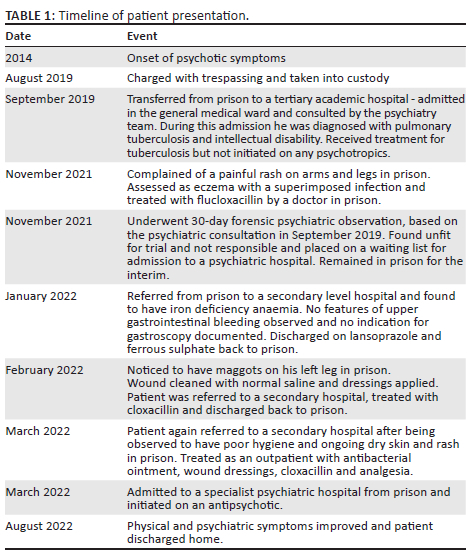
Mr S is a 35-year-old single male with no children residing with his mother and siblings. His highest level of education is matric and he is unemployed. On admission he presented with auditory hallucinations and persecutory delusions since 2014 (see Table 1). He had become withdrawn and began wandering away from home for days at a time. A traditional healer was consulted, with no improvement. These symptoms were accompanied by a decline in functioning. Mr S had reportedly been social, friendly, able to sustain employment, manage finances, navigate to and from places by himself and had a good relationship with his brother prior to the onset of symptoms.
Mr S was arrested in 2019 for a charge of trespassing and had no other forensic history. He was subsequently referred by court for a psychiatric forensic observation in October 2021. The assumption for the delay in his referral for forensic observation, is the long waiting list for observandi at state psychiatric facilities in South Africa. In October 2021, he underwent observation and was found unfit to stand trial and not criminally responsible. The differential diagnosis at the time was a major neurocognitive disorder and psychotic disorder. No psychotropics were initiated at the time and he was sent back to prison with the suggestion to be readmitted as an involuntary mental health care user for treatment. From prison, he was admitted to a psychiatric hospital for treatment in March 2022, after being on the waiting list for admission. This was his index presentation to psychiatry and he was antipsychotic naïve.
Mr S occasionally consumed alcohol. He did not meet the criteria for a substance use disorder on interview and this was confirmed by collateral. He had previously been diagnosed with pulmonary tuberculosis (TB) while in prison and completed six months of treatment (in February 2020). There is no family history of psychiatric or neurological illness.
Upon admission to the psychiatric hospital, Mr S was observed to be physically unwell. He presented with neurological signs (specifically cerebellar signs - ataxia, dysmetria dysdiadochokinesia), anaemia, a maculopapular rash, non-specific gastrointestinal symptoms (nausea, vomiting, abdominal pain and diarrhoea) and cachexia (body mass index 17.78). He scored 18 on the Scale for Assessment and Rating of Ataxia (SARA).
Upon a mental status examination, Mr S displayed a speech fluency disorder (stutter), psychomotor slowing, marked cognitive impairment, anosognosia and persecutory delusions. His mood was euthymic with a restricted affect and he displayed poor insight and impaired judgement. He scored 111 on the Positive and Negative Syndrome Scale (PANNS) and 12/30 on the Montreal Cognitive Assessment Test (MoCA).
Investigations and differential diagnoses
An extensive medical work-up including infective markers, HIV, enzyme-linked immunoassay (ELISA) test, syphilis serology, thyroid function test, Vitamin B12, autoimmune markers, heavy metal studies, tumour markers, ceruloplasmin levels, lumbar puncture, a skin biopsy and electroencephalogram all came back normal. His computed tomography brain scan showed prominent sulci and gyri and cerebellar atrophy. His magnetic resonance imaging brain scan revealed age-inappropriate cortical and cerebellar atrophy. Mr S was consulted by a neurologist as well as neuropsychiatrist. Conditions such as early-onset dementia, Huntington's disease, pellagra, Wilson's disease, TB meningitis and autoimmune encephalitis were ruled out.
Case management
A definitive diagnosis of schizophrenia was made. Mr S was initiated on risperidone 2 mg orally at night after a discussion with him as per National Institute of Clinical Excellence Guidelines,6
Discussion
Another consideration is the initiation of psychotropics indicated on observation of those who are found not fit and/or not responsible due to mental illness.1,788910101111
Mr S had an approximately eight year DUP. During this time, he consulted a traditional healer and various medical doctors in prison and a tertiary medical hospital for physical complaints. Despite this, he was neither diagnosed with schizophrenia nor initiated on an antipsychotic. When he presented to a psychiatric hospital via the forensic system, he was physically ill. He had developed anaemia, cachexia and pulmonary TB likely secondary to the negative symptoms of schizophrenia. Had Mr S's physical and mental health been treated holistically, he would have likely had a reduced DUP and subsequent improved outcome. Another consideration is the initiation of psychotropics on observandi that are found not fit and/or not responsible due to mental illness. Prompt initiation may reduce DUPs and improve outcomes for patients.
The case of Mr S illustrates the integration of physical and mental health. This case study emphasises the flaws of mind-body dualism and the misnomer of schizophrenia as a purely mental illness. The case also highlights the treatment of people with mental illness within the forensic system. Long waiting lists for observation, waiting lists for admission into psychiatric facilities and inadequate medical services in prison are all serious concerns, which need to be addressed.
Competing interests
The authors declare that they have no financial or personal relationships that may have inappropriately influenced them in writing this article.
Authors' contributions
M.C.L. and T.M. contributed to the conceptualisation and writing of the article.
Ethical considerations
Informed consent was obtained from Mr S and assent obtained from his mother. Ethics clearance was obtained from the University of the Witwatersrand Human Research Ethics Committee (clearance certificate M221095).
Funding information
This research received no specific grant from any funding agency in the public, commercial, or not-for-profit sectors.
Data availability
Data sharing is not applicable to this article as no new data were created or analysed in this study.
Disclaimer
The views and opinions expressed in this article are those of the authors and do not necessarily reflect the official policy or position of any affiliated agency of the authors.
Acknowledgements
The authors wish to thank Mr S and his family for consenting to the writing and publication of this case report.
References
-
1.Ventriglio A, Bhugra D. Descartes' dogma and damage to Western psychiatry. Epidemiol Psychiatr Sci. 2015;24(5):368-370. https://doi.org/10.1017/S2045796015000608
» https://doi.org/10.1017/S2045796015000608 -
2.Engel GL. The need for a new medical model: A challenge for biomedicine. Science. 1977;196(4286):129-136. https://doi.org/10.1126/science.847460
» https://doi.org/10.1126/science.847460 -
3.Picard H, Amado I, Mouchet-Mages S, Olie JP, Krebs MO. The role of the Cerebellum in Schizophrenia: An update of clinical, cognitive, and functional evidences. Schizophr Bull. 2007;34(1):155-172. https://doi.org/10.1093/schbul/sbm049
» https://doi.org/10.1093/schbul/sbm049 -
4.Bachmann S, Degen C, Geider FJ, Schröder J. Neurological soft signs in the clinical course of Schizophrenia: Results of a meta-analysis. Front Psychiatry. 2014;5:185. https://doi.org/10.3389/fpsyt.2014.00185
» https://doi.org/10.3389/fpsyt.2014.00185 -
5.De Hert M, Correll CU, Bobes J, Cetkovich-Bakmas M, Cohen D, Asai I, et al. Physical illness in patients with severe mental disorders. I. Prevalence, impact of medications and disparities in health care. World Psychiatry. 2011;10(1):52-77. https://doi.org/10.1002/j.2051-5545.2011.tb00014.x
» https://doi.org/10.1002/j.2051-5545.2011.tb00014.x - 6.Taylor DM, Barnes TR, Young AH. The Maudsley prescribing guidelines in psychiatry, 14th edn. Page 5. West Sussex: Wiley Blackwell; 2021.
-
7.Hickling FW, Abel W, Garner P, Rathbone J. Open general medical wards versus specialist psychiatric units for acute psychoses. Cochrane Schizophrenia Group, editor. Cochrane Database Syst Rev. 2007;4: CD003290. https://doi.org/10.1002/14651858.CD003290.pub2
» https://doi.org/10.1002/14651858.CD003290.pub2 -
8.Elyamani R, Hammoud H. Mental health literacy of healthcare providers in Arab Gulf Countries: A systematic review. J Prim Care & Community Health. 2020; 11:1-10. https://doi.org/10.1177/2150132720972271
» https://doi.org/10.1177/2150132720972271 -
9.Albin K, Albin C, Jeffries CD, Perkins DO. Clinician recognition of first episode psychosis. J Adolesc Health. 2021;69(3):457-464. https://doi.org/10.1016/j.jadohealth.2020.12.138
» https://doi.org/10.1016/j.jadohealth.2020.12.138 -
10.Larsen TK, Joa I, Langeveld J, Johannessen JO. Optimizing health-care systems to promote early detection of psychosis. Early Interv Psychiatry. 2009;3(suppl 1):S13-S16. https://doi.org/10.1111/j.1751-7893.2009.00125.x
» https://doi.org/10.1111/j.1751-7893.2009.00125.x -
11.Oosthuizen P, Emsley RA, Keyter N, Niehaus DJH, Koen L Duration of untreated psychosis and outcome in first-episode psychosis. Perspective from a developing country. Acta Psychiatrica Scandinavica. 2005;111:214-219. https://doi.org/10.1111/j.1600-0447.2004.00448.x
» https://doi.org/10.1111/j.1600-0447.2004.00448.x

Accepted: 25 July 2023
Published: 29 Sept. 2023