Neurocognitive improvement in HIV-positive patients treated with dolutegravir-based regimens
Abstract
BACKGROUND: Neurocognitive disorders due to human immunodeficiency virus (HIV) remain highly prevalent, specifically mild forms despite effective antiretroviral therapy (ART). Dolutegravir-based regimens are the first line of treatment for adult HIV-positive patients. Controversies exist regarding the neurocognitive effects of dolutegravir. Evidence regarding the neurocognitive effects of dolutegravir is important, in support of its use in patients with HIV-associated neurocognitive disorders (HAND). AIM: This study aimed to describe the change in cognitive function using the International HIV Dementia Scale (IHDS) and Brief Neuropsychological Cognitive Examination (BNCE) in HIV positive, treatment naïve patients before and 3 months after initiation of ART using a dolutegravir-based regimen. SETTING: The HIV initiation clinic of Hillbrow Community Health Centre in Johannesburg. METHODS: This prospective, quantitative cohort study assessed adult HIV-positive patients who were ART naïve being initiated on a dolutegravir-based regimen, using the BNCE and IHDS at baseline and after 3 months of treatment. RESULTS: Neurocognitive test results of 26 participants showed significant improvements for IHDS (Z = 1.84, p = 0.033) and time to complete BNCE (Z = 2.47, p = 0.007). BNCE total results showed improvements that were not significant (Z = 1.44, p = 0.075); however, Part 2 of the BNCE reflecting that of executive function showed significant improvements (Z = 66.5, p = 0.043). CONCLUSION: The trend of neurocognitive function is towards improvement in HIV-positive treatment naïve patients who receive 3 months of dolutegravir-based ART. CONTRIBUTION: The findings support the use of dolutegravir-based regimens in the treatment of patients with HIV-associated neurocognitive disorders.
HIV-associated neurocognitive disorders; BNCE; IHDS; dolutegravir; neurocognitive screening; neurocognitive impairment; South Africa
Introduction
Human immunodeficiency virus (HIV) infection leading to acquired immunodeficiency syndrome (AIDS) remains a common cause of neurocognitive impairment despite the increasing availability and use of effective antiretroviral therapy (ART).12,3
Viral invasion of the central nervous system (CNS) occurs early in the course of infection, affecting subcortical areas of the brain.2,4,5677,84
The Frascati criteria are commonly used to categorise HAND based on severity.991052,5
While the introduction of ART has approximately halved the incidence of HAD, cognitive dysfunction in milder forms is persistent and increasing in prevalence in patients receiving virologically suppressive ART regimens.4,5,11124411111344,1313
According to the National Department of Health 2019 ART clinical guidelines, the first-line ART regimen recommended for adults is a combination of tenofovir, lamivudine and dolutegravir.14151613151513
In diagnosing HAND, patients should undergo neuropsychological, psychiatric and medical evaluation.79995551718
Due to the ongoing high incidence of mild neurocognitive dysfunction despite ART and the controversies that exist regarding dolutegravir's effect on neurocognitive function, more research is needed to further understand this relation, given its recent addition to South Africa's first-line regimen.
Aim and objectives
The primary aim of this study was to describe the change, if any, in cognitive function using the IHDS and BNCE in HIV-positive treatment-naïve patients, before and after initiation of treatment with 3 months of ART using a dolutegravir-based regimen. It was hypothesised that results would show improvement. Secondary objectives included to compare patient sociodemographic data (age, gender, race and level of education) as well as blood results, specifically baseline CD4 count and viral load (VL) measured at 3 months post-ART initiation and correlate these findings to change in neurocognitive results.
Research methods and design
Study design and setting
This study was a prospective, quantitative and descriptive cohort study. It was conducted between June 2021 and July 2022 at the HIV initiation clinic at Hillbrow Community Health Centre in Johannesburg. This unit falls under the district level of care in the public health sector of the Gauteng Department of Health in South Africa.
Study population and sampling
The study sample population comprised English-speaking and consenting, adult HIV-positive patients who were ART naive being initiated on a dolutegravir-containing regimen. Exclusion criteria consisted of any previously diagnosed neurocognitive disorder or the presence of other known causes of neurocognitive impairment such as depression, stroke, intellectual disability, traumatic brain injury and current or recent substance use. Patients older than 60 years were excluded from the study to preclude age-appropriate neurocognitive decline as a confounding factor. The calculated required sample size was 33 participants to achieve significant results with a certainty of 95%. The intended sample size was 50 participants to account for participant dropout and other unforeseen circumstances. Patients attending the HIV initiation clinic were chosen by stratified sampling. Adult patients who were ART naïve and to start a dolutegravir-containing regimen were given information regarding the study by use of a pamphlet and provided written consent to participate in various aspects of the study. A screening questionnaire was then provided comprising inclusion and exclusion criteria. Eligible participants were allocated a participant number and included in the study.
Intervention and data collection
The primary investigator collected and documented demographic information and assessed participants using the IHDS and BNCE. The IHDS screening tool is a three-part examiner administered test comprising of a non-dominant finger-tapping test, a non-dominant Luria hand sequence and a four-word recall test.517,1817,1818
Data analysis
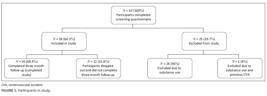
Of the 63 participants that completed the screening questionnaire, data from a total of 26 participants were used in the analyses. These participants completed the 3-month follow-up to produce useable data to address the aims of the study. The data were collated in Microsoft Excel™ and statistically analysed in R software (version 4.00; www.R- project.org).
The data set was screened for departure from normality using Shapiro-Wilk tests. Non-parametric analyses were conducted, including Spearman regressions, Pearson chi-squared analyses (with binary post hocs), logistic regressions for dichotomous outcomes, general linear regressions and Wilcoxon matched pairs tests (with continuity correction for low values, as necessary). Some analyses were one-tailed based on directional hypotheses (e.g. Wilcoxon tests), and all other analyses were two-tailed. Model alpha was set at 0.05. Data are reported as counts and percentages (categorical data) or mean and standard deviation (continuous data) and presented descriptively in the text, tables and figures.
Ethical considerations
Ethics clearance was obtained from the University of Witwatersrand Human Research Ethics Committee (Clearance Certificate No. M201102). All procedures performed were in accordance with the 1964 Helsinki Declaration and it's later amendments.19
Results
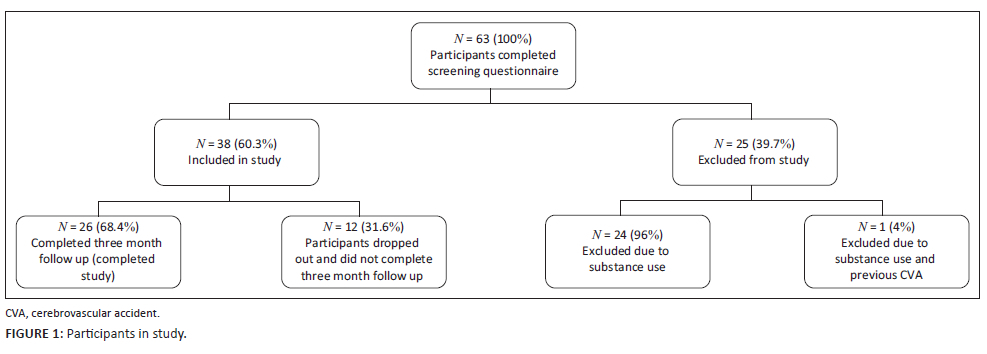
Of the 63 patients screened for participation, 38 were eligible. Excluded participants comprised mostly males and the majority due to substance use. After a loss to follow up drop out rate of 31, 6%, 26 participants completed the study (Figure 1). The days from baseline to 3 month follow-up ranged from 70 to 103 with a mean of 83.7 days.
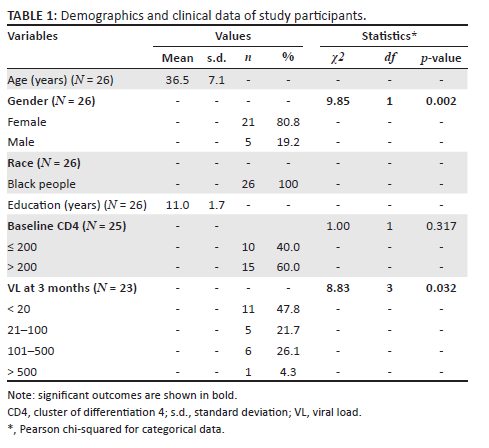
The demographic data as depicted in Table 1 showed that the study population had a mean age of 36.5 (s.d. = 7.1) years, there was significantly more females (χ2df = 1, p = 0.002) and all were black African ethnicity. The years of formal education ranged from 7 to 14 years with a mean of 11.0 (s.d. = 1.7) years. CD4 counts were found to have a mean of 304.1 (s.d. = 228.2) cells/mm332df = 1, p = 0.317). The viral load measured at 3 months varied with significantly more patients showing virological suppression at levels of 0-20 (χ2df = 3, p = 0.032) (Table 1).
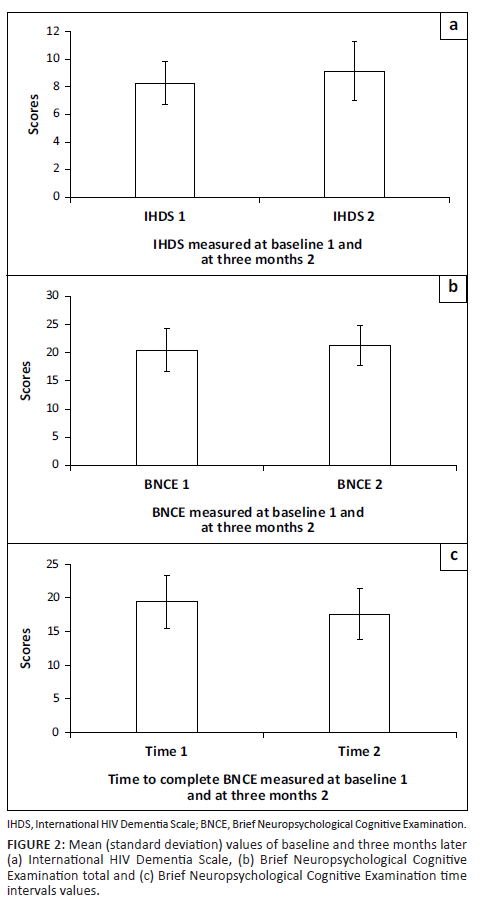
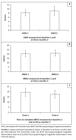
The neurocognitive tests at baseline and at 3 months showed that IHDS results increased significantly from a baseline mean of 8.3 (s.d. = 1.6) to a 3 month mean of 9.1 (s.d. = 2.1) (Wilcoxon test: Z = 1.84, p = 0.033) (Figure 2). The BNCE total scores also increased from a baseline mean of 20.5 (s.d. = ± 3.9) to a 3 month mean of 21.3 (s.d. = ± 3.6), but the change was not statistically significant (Wilcoxon test: Z = 1.44, p = 0.075) (Figure 2). In contrast, BNCE time decreased significantly from baseline of 20.2 minutes (s.d. = ± 4.0) to a 3 month mean of 18.3 min (s.d. = ± 3.9) (Wilcoxon test: Z = -2.47, p = 0.007) (Figure 2).
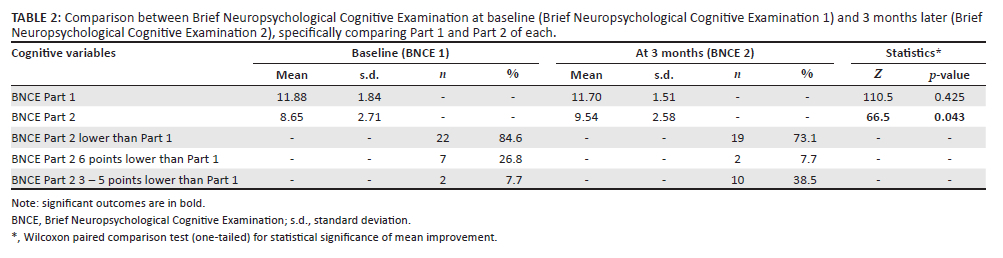
When comparing the two parts of the BNCE, it was found that Part 2 scores were significantly lower than Part 1 scores for both BNCE 1 (Wilcoxon matched pairs test: Z = 297.5, p < 0.001) and BNCE 2 (Wilcoxon matched pairs test: Z = 262.0-, p < 0.001) (Table 2). At baseline, more patients scored six points lower in Part 2 than in Part 1 when compared with those scoring three to five points lower in Part 2 than in Part 1. The opposite is seen in BNCE scores at 3 months (Table 2). When comparing the change in Part 1 and Part 2 scores from baseline to 3 months, Part 2 scores showed higher scores that were clinically significant (Z = 66.5, p = 0.043) (Table 2).
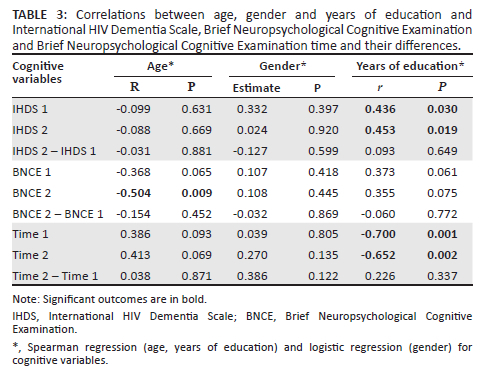
The relationship between socio-demographic variables and cognitive findings revealed some statistically significant correlations (Table 3). With every year of increasing age, the BNCE total score at 3 months decreased by 0.504 points (p = 0.009). The BNCE score at baseline also decreased with every year of increasing age; however, this was not found to be significant (p = 0.065). Years of education were found to be a significant predictor of both IHDS and time taken to complete BNCE. A one year increase in years of education increased the IHDS 1 and 2 scores significantly (p = 0.030 and p = 0.019, respectively). Similarly, with every 1 year increase in years of education, the time taken to complete the BNCE decreased both at baseline and 3 months later (p = 0.001 and p = 0.002, respectively). While BNCE total scores at baseline and 3 months were also found to increase with every year of education, this was not found to be significant (p = 0.061 and p = 0.075, respectively). The correlation between socio-demographic variables and improvement in neurocognitive test scores was not found to be significant (Table 3).
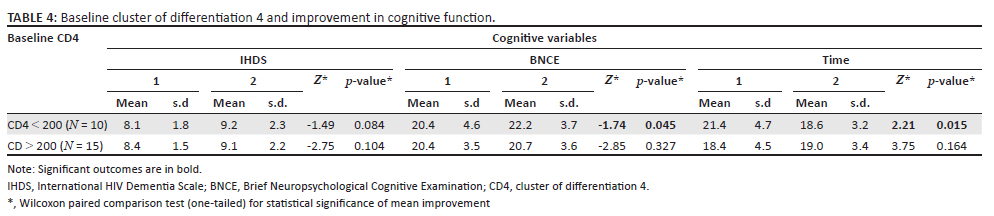
Participants with a baseline CD4 count of < 200 cells/mm3p = 0.045) and decrease in time taken to complete the BNCE (p = 0.015). In comparison, those with CD4 counts of > 200 cells/mm3p = 0.104, p = 0.327 and p = 0.164, respectively) (Table 4).
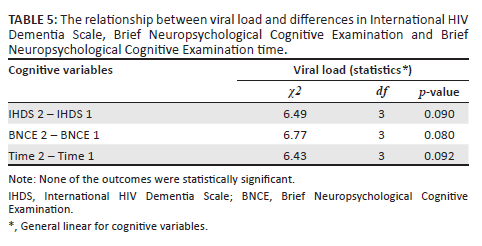
No significant correlation was found between VL measured at 3 months and improvement in neurocognitive test results (Table 5).
Discussion
This study aimed to describe the changes in cognitive function at baseline and 3 months after initiation of ART using a dolutegravir-based regimen with the hypothesis that results would show improvement. Significant improvements were noted in both IHDS scores and time taken to complete the BNCE. This supports improvement in subcortical neurocognitive function tested in the IHDS, as well as processing speed indicated by the time taken to complete the BNCE. While the total BNCE scores did show improvements from baseline, these results were not found to be significant. This is consistent with findings from a study done in 2020 assessing change in cognitive function over a 6 month period of using dolutegravir as assessed by the Montreal Cognitive Assessment (MoCA).2020321522172324
The BNCE's advantage over other screening tests is its ability to assess both conventional, frequently used cognitive functioning as well as more advanced levels of executive functioning allowing for detection of milder forms of cognitive impairment.181818
With the focus of this study on dolutegravir, which when combined in the currently recommended regimen, contributes four points to a total CPE score of seven.2525252626
Cerebrospinal fluid viral escape should also be considered in assessing effects of CPE on neurocognitive function. This occurs when plasma viral suppression is achieved, while CSF viral replication continues.2626
As expected, cognitive test results of BNCE were lower with increasing age. In the ageing HIV population, both accelerated and natural decline can be seen due to multiple factors, with AIDS as the predominant cause and hence expectation is to see a negative effect of age on cognitive function despite adequate treatment.21102726
The cognitive reserve hypothesis holds that factors such as higher levels of education, socioeconomic status and baseline intelligence can be protective against clinical manifestations of brain pathology.27
Research regarding gender as a risk factor for neurocognitive impairment is conflicting.8
Many large studies have confirmed that a low nadir CD4 is an indicator of neurocognitive impairment as well as a predictor for future diagnosis of HAND.24,283293030
This study contributes towards the growing evidence regarding effects of ART on neurocognitive function as well as the need for more evidence around the use of dolutegravir.
Limitations
Limitations included a small sample size with a significant female predominance, which may have impacted on some results noted. Additionally, the BNCE required adjustments to make the test culturally appropriate. While this is the approach taken in practice and necessary to ensure the suitability of the test to South Africans, construct validity of these changes has not been established. Furthermore, a control group for comparison would have been useful to account for practice effects when interpreting improvements in results. This is an area for further research. It is also acknowledged that complex multifactorial factors contribute towards low cognitive test performance, including socioeconomics, quality of education and comorbidities.3131
Conclusion
Based on the findings, one can conclude that the trend of neurocognitive function is towards improvement in HIV positive, treatment naïve patients who receive 3 months of dolutegravir-based ART. While the dolutegravir cannot be implicated as the main factor contributing towards improvement, the findings support the use of dolutegravir-based regimens in the treatment of patients with HIV-associated neurocognitive impairment. Future research should aim at assessing patients over a longer period to confirm clinically significant improvements. Comparison to other regimens would also be beneficial.
Competing interests
The authors declare that they have no financial or personal relationships that may have inappropriately influenced them in writing this article.
Authors' contributions
J.R. conceptualised and designed the study, conducted the neuropsychological testing, scored the testing, collected the data and wrote the manuscript. K.L. supervised the study and contributed to the study design and proposal, critical revision and approval of the final manuscript. All authors have read and approved the final manuscript.
Funding information
The authors received no financial support for the research, authorship and publication of this article.
Data availability
The data that support the findings of this study are available from the corresponding author, J.R., upon reasonable request.
Disclaimer
The views and opinions expressed in this article are those of the authors and do not necessarily reflect the official policy or position of any affiliated agency of the authors.
Acknowledgements
The following contributions towards this study are gratefully acknowledged: the staff of Hillbrow Community Health Centre HIV clinic for their facilitation and assistance; Dr Shona Fraser for BNCE training and adjustments and Professor Neville Pillay for his contributions to statistics and data analysis.
References
-
1.Saylor D, Dickens AM, Sacktor N, et al. HIV-associated neurocognitive disorder - Pathogenesis and prospects for treatment. Nat Rev Neurol. 2016;12(4):234-248. https://doi.org/10.1038/nrneurol.2016.27
» https://doi.org/10.1038/nrneurol.2016.27 -
2.Debalkie Animut M, Sorrie MB, Birhanu YW, Teshale MY. High prevalence of neurocognitive disorders observed among adult people living with HIV/AIDS in Southern Ethiopia: A cross-sectional study. PLoS One. 2019;14(3):e0204636. https://doi.org/10.1371/journal.pone.0204636
» https://doi.org/10.1371/journal.pone.0204636 -
3.Wang Y, Liu M, Lu Q, et al. Global prevalence and burden of HIV-associated neurocognitive disorder: A meta-analysis. Neurology. 2020;95(19):e2610-e2621. https://doi.org/10.1212/WNL.0000000000010752
» https://doi.org/10.1212/WNL.0000000000010752 -
4.Cross HM, Combrinck MI, Joska JA. HIV-associated neurocognitive disorders: Antiretroviral regimen, central nervous system penetration effectiveness, and cognitive outcomes. S Afr Med J. 2013;103(10):758. https://doi.org/10.7196/SAMJ.6677
» https://doi.org/10.7196/SAMJ.6677 -
5.Joska JA, Westgarth-Taylor J, Hoare J, et al. Validity of the International HIV Dementia Scale in South Africa. AIDS Patient Care STDs. 2011;25(2):95-101. https://doi.org/10.1089/apc.2010.0292
» https://doi.org/10.1089/apc.2010.0292 -
6.Williams ME, Stein DJ, Joska JA, Naudé PJW. Cerebrospinal fluid immune markers and HIV-associated neurocognitive impairments: A systematic review. J Neuroimmunol. 2021;358:577649. https://doi.org/10.1016/j.jneuroim.2021.577649
» https://doi.org/10.1016/j.jneuroim.2021.577649 -
7.Joska JA, Westgarth-Taylor J, Myer L, et al. Characterization of HIV-associated neurocognitive disorders among individuals starting antiretroviral therapy in South Africa. AIDS Behav. 2011;15(6):1197-1203. https://doi.org/10.1007/s10461-010-9744-6
» https://doi.org/10.1007/s10461-010-9744-6 -
8.Joska JA, Fincham DS, Stein DJ, Paul RH, Seedat S. Clinical correlates of HIV-associated neurocognitive disorders in South Africa. AIDS Behav. 2010;14(2):371-378. https://doi.org/10.1007/s10461-009-9538-x
» https://doi.org/10.1007/s10461-009-9538-x -
9.Chan LG, Ho MJ, Lin YC, Ong Y, Wong CS. Development of a neurocognitive test battery for HIV-associated neurocognitive disorder (HAND) screening: Suggested solutions for resource-limited clinical settings. AIDS Res Ther. 2019;16(1):9. https://doi.org/10.1186/s12981-019-0224-4
» https://doi.org/10.1186/s12981-019-0224-4 -
10.Cohen RA, Seider TR, Navia B. HIV effects on age-associated neurocognitive dysfunction: Premature cognitive aging or neurodegenerative disease? Alzheimer's Res Ther. 2015;7(1):37. https://doi.org/10.1186/s13195-015-0123-4
» https://doi.org/10.1186/s13195-015-0123-4 -
11.Heaton RK, Clifford DB, Franklin DR, et al. HIV-associated neurocognitive disorders persist in the era of potent antiretroviral therapy: CHARTER Study. Neurology. 2010;75(23):2087-2096. https://doi.org/10.1212/WNL.0b013e318200d727
» https://doi.org/10.1212/WNL.0b013e318200d727 -
12.Wei J, Hou J, Su B, et al. The prevalence of frascati-criteria-based HIV-associated neurocognitive disorder (HAND) in HIV-infected adults: A systematic review and meta-analysis. Front Neurol. 2020;11:581346. https://doi.org/10.3389/fneur.2020.581346
» https://doi.org/10.3389/fneur.2020.581346 - 13.Ances BM, Letendre SL. CROI 2019: Neurologic complications of HIV disease. Top Antiir Med. 2019;27(1):26-33.
-
14.Republic of South Africa National Department of Health. 2019 ART clinical guidelines [homepage on the Internet]. 2019 [cited 2022 Oct 26]. Available from: https://www.health.gov.za/wp-content/uploads/2020/11/2019-art-guideline.pdf
» https://www.health.gov.za/wp-content/uploads/2020/11/2019-art-guideline.pdf -
15.Chan P, Goh O, Kroon E, et al. Neuropsychiatric outcomes before and after switching to dolutegravir-based therapy in an acute HIV cohort. AIDS Res Ther. 2020;17(1):1. https://doi.org/10.1186/s12981-019-0257-8
» https://doi.org/10.1186/s12981-019-0257-8 -
16.Meintjes G, Moorhouse MA, Carmona S, et al. Adult antiretroviral therapy guidelines 2017. S Afr J HIV Med. 2017;18(1):776. https://doi.org/10.4102/sajhivmed.v18i1.776
» https://doi.org/10.4102/sajhivmed.v18i1.776 -
17.Ball TD, Pastore RE, Sollman MJ, Burright RG, Donovick PJ. Evaluation of a neuropsychological screen in an incarcerated population. Clin Neuropsychol. 2009;23(6):1037-1049. https://doi.org/10.1080/13854040902830203
» https://doi.org/10.1080/13854040902830203 - 18.Tonkonogy J. The brief neuropsychological cognitive examination manual. Los Angeles, CA: Western Psychological Services; 1997.
-
19.WMA Declaration of Helsinki - Ethical principles for medical research involving human subjects - WMA - The World Medical Association [homepage on the Internet]. [cited 2023 Feb 25]. Available from: https://www.wma.net/policies-post/wma-declaration-of-helsinki-ethical-principles-for-medical-research-involving-human-subjects/
» https://www.wma.net/policies-post/wma-declaration-of-helsinki-ethical-principles-for-medical-research-involving-human-subjects/ -
20.Adams JL, Choi YC, West M, Pontiggia L, Baxter J, George J. Changes in neurocognitive assessment scores after initiating dolutegravir- versus elvitegravir-based antiretroviral therapy. AIDS Care. 2021;33(11):1507-1513. https://doi.org/10.1080/09540121.2020.1837337
» https://doi.org/10.1080/09540121.2020.1837337 -
21.Damas J, Ledergerber B, Nadin I, et al. Neurocognitive course at 2-year follow-up in a Swiss cohort of people with well-treated HIV. AIDS. 2021;35(15):2469-2480. https://doi.org/10.1097/QAD.0000000000003057
» https://doi.org/10.1097/QAD.0000000000003057 -
22.Rosca EC, Tadger P, Cornea A, Tudor R, Oancea C, Simu M. International HIV dementia scale for HIV-associated neurocognitive disorders: A systematic review and meta-analysis. Diagnostics. 2021;11(6):1124. https://doi.org/10.3390/diagnostics11061124
» https://doi.org/10.3390/diagnostics11061124 -
23.Zhuang Y, Qiu X, Wang L, Ma Q, et al. Combination antiretroviral therapy improves cognitive performance and functional connectivity in treatment-naïve HIV-infected individuals. J Neurovirol. 2017;23(5):704-712. https://doi.org/10.1007/s13365-017-0553-9
» https://doi.org/10.1007/s13365-017-0553-9 -
24.Heaton RK, Franklin DR, Ellis RJ, et al. HIV-associated neurocognitive disorders before and during the era of combination antiretroviral therapy: Differences in rates, nature, and predictors. J Neurovirol. 2011;17(1):3-16. https://doi.org/10.1007/s13365-010-0006-1
» https://doi.org/10.1007/s13365-010-0006-1 - 25.Santos GMA, Locatelli I, Métral M, et al. Cross-sectional and cumulative longitudinal central nervous system penetration effectiveness scores are not associated with neurocognitive impairment in a well treated aging human immunodeficiency virus-positive population in Switzerland. Open Forum Infect Dis. 2019;6(7):ofz277.
-
26.Arentoft A, Troxell K, Alvarez K, et al. HIV antiretroviral medication neuropenetrance and neurocognitive outcomes in HIV+ adults: A review of the literature examining the central nervous system penetration effectiveness score. Viruses. 2022;14(6):1151. https://doi.org/10.3390/v14061151
» https://doi.org/10.3390/v14061151 -
27.Harada CN, Natelson Love MC, Triebel KL. Normal cognitive aging. Clin Geriatr Med. 2013;29(4):737-752. https://doi.org/10.1016/j.cger.2013.07.002
» https://doi.org/10.1016/j.cger.2013.07.002 -
28.McCombe J, Vivithanaporn P, Gill M, Power C. Predictors of symptomatic HIV-associated neurocognitive disorders in universal health care. HIV Med. 2013;14(2):99-107. https://doi.org/10.1111/j.1468-1293.2012.01043.x
» https://doi.org/10.1111/j.1468-1293.2012.01043.x -
29.Azizah N, Machin A, Hamdan M. Low CD4 level increased the risk of cognitive impairment in the HIV patient. Indian J Public Health Res Dev. 2020;11(1):1403-1417. https://doi.org/10.37506/v11/i1/2020/ijphrd/194156
» https://doi.org/10.37506/v11/i1/2020/ijphrd/194156 -
30.Day C, Manning K, Abdullah F, et al. Delirium in HIV-infected patients admitted to acute medical wards post universal access to antiretrovirals in South Africa. S Afr Med J. 2021;111(10):974-980. https://doi.org/10.7196/SAMJ.2021.v111i10.15628
» https://doi.org/10.7196/SAMJ.2021.v111i10.15628 -
31.Nightingale S, Dreyer AJ, Saylor D, Gisslén M, Winston A, Joska JA. Moving on from HAND: Why we need new criteria for cognitive impairment in persons living with human immunodeficiency virus and a proposed way forward. Clin Infect Dis Off Publ Infect Dis Soc Am. 2021;73(6):1113-1118. https://doi.org/10.1093/cid/ciab366
» https://doi.org/10.1093/cid/ciab366

Accepted: 04 Aug. 2023
Published: 28 Sept. 2023