Psychiatric morbidity amongst adolescents in a Nigerian juvenile correctional facility
Abstract
BACKGROUND: The high occurrence of psychiatric disorders amongst adolescents within the Juvenile Justice System (JJS) has been confirmed. Most of the available data are from developed countries and some of them focus on just a single psychiatric disorder which may not be representative of the situation in low-income countries, hence the need for more studies in developing countries, including Nigeria. AIM: The study aimed to determine the prevalence of psychiatric disorders amongst adolescent residents of a correctional facility. SETTING: The study was carried out at a Borstal Institution in North-Central Nigeria. METHODS: A descriptive cross-sectional study design was used. One hundred and twenty adolescents were assessed using the socio-demographic pro forma questionnaire designed by the researcher and the Kiddies Schedule for Affective Disorders and Schizophrenia (KSADS-PL). Data were analysed using EPI-INFO 4.06 d version 6.04 software. RESULTS: A total of 62.5% of the male respondents were older than 15 years. The percentage of respondents with a psychiatric disorder was 82.5%. The rate of psychiatric disorders was high with disruptive behaviour disorders being the most common at 40.8%, others were substance use disorders (15.8%), anxiety disorders (14.2%), psychosis (6.7%) and mood disorders (5%). CONCLUSION: This study has established a high prevalence rate of psychiatric disorders amongst incarcerated adolescents. This is in line with the findings of numerous studies worldwide. This study has identified the need to increase awareness and knowledge about the high morbidity of mental disorders in growing juvenile detainee populations. This will allow early identification of adolescents at risk of psychiatric disorders and ensure efficient resource distribution of both JJS service and mental healthcare. Effective and appropriate interventions have shown to improve overall health, quality of life and reduce the rate of recidivism amongst incarcerated juveniles.
psychiatric morbidity; juveniles; juvenile justice system; adolescents; Borstal Institution; Nigeria
Introduction
Juvenile crime is a perennial public concern.12
Adolescents in the juvenile correctional system are a high-risk population who, in many cases, have unmet physical, developmental and mental health needs, which occur at a higher rate than in the general population.3456
Vander et al.7
Several studies have reported a high prevalence rate of psychiatric disorders amongst adolescents involved with the JJS worldwide, including Africa,8,9,10111213414
Given the growth of the juvenile detainee population, epidemiologic data on their psychiatric disorders are becoming increasingly important,15158
Identifying the broad range of psychiatric morbidity amongst detained adolescents will help in the planning of needed mental health services and improve knowledge of how best to utilise the scarce mental health resources in such settings.
Methods
Study design
This was a descriptive cross-sectional study.
Study setting
The study was carried out at the Borstal Institution, Ganmo, Ifelodun Local Government Area of Kwara State, North-Central Nigeria. It was established on 26 December 2005 by the Federal Government of Nigeria under the Nigerian Prison Service, to see to the training and reformation of delinquent youth. The institution admits two groups of residents, namely, juvenile offenders and children beyond parental control. This restrictive environment operates as a correctional facility with emphasis on educational and vocational training for residents.
Adolescents present to the institution either through their parents or law enforcement agents. The juvenile court warrant is issued for the adolescent to be admitted into the institution if found guilty of the alleged offence for a period of 6-36 months depending on the offence of the adolescent.
Study population
The study included all detained adolescents aged 12-18 years who were incarcerated at the institution during the time of the study who agreed to participate regardless of the nature of their charges.
Inclusion criterion
• This study included all adolescent residents of the Borstal Institution who were aged 12-18 years at the time of the study.
Exclusion criteria
• Residents who did not consent to participate.
• Residents with severe communication disability.
Sample size
One hundred and twenty (120) residents of the Borstal institution met the inclusion criteria and they were all recruited for the study.
Procedure
All consenting adolescents who met inclusion criteria were included in the study. The study was carried out in two stages. In the first stage, all consenting residents who met the inclusion criteria were interviewed by a trained research assistant (Resident Doctor) using the Pro forma questionnaire and the screening aspect of Kiddies Schedule for Affective Disorders and Schizophrenia Present and Lifetime Version (K-SADS-PL)16Diagnostic And Statistical Manual of Mental Disorders 4th Edition (DSM-IV) criteria.17
Data analysis
Data were analysed using EPI-INFO version 6.04 d software. Frequency tables and relevant charts to highlight important and relevant data were generated. Means and standard deviation (SD) of numeric variables were presented. Statistical significance was set at p < 0.05.
Ethical considerations
Approval for the study was obtained from the Ethics and Research Committee (ERC) of the University of Ilorin Teaching Hospital (UITH). Permission and approval to the interview of the Borstal students were obtained from the Controller-General of Nigerian Prison Service, through the Controller of Prison, Kwara State Command, through the principal, borstal training institution, Ilorin, Kwara State. Permission was also obtained from the school principal, who stood in as a legal guardian, to interview the respondents. This was similar to what was performed by other Nigerian researchers because there is no explicit law on obtaining parental consent before this type of study could be performed.1718
Results
Response rate
One hundred and twenty residents met the inclusion criteria and participated in the study, making a response rate of 100%. However, 109 respondents screened positive for psychiatric disorders, of which only 99 of the respondents were found to have psychiatric disorders by the researcher.
Socio-demographic characteristics of respondents
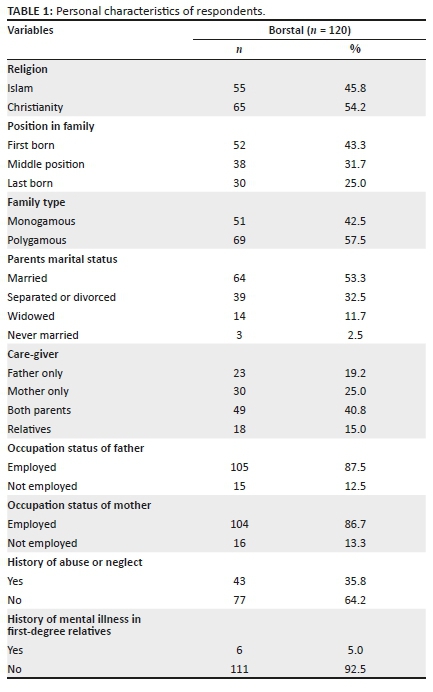
The age range of the respondents was between 12 and 18 years. The majority (62.5%) were above 15 years whilst the remaining were aged 12-15 years. Their mean age was 16.1 years (SD ± 1.8).
There were more Christians amongst the respondents (n = 65, 54.2%) and they were all actively engaged educationally. Sixteen (13.3%) of them were engaged in conventional education only, 44 (36.7%) of them were engaged in vocational education only whilst 60 (50%) of them were engaged in both forms of education (i.e. conventional and vocational).
The majority (57.5%) of the respondents were from polygamous family setting and the remaining 42.5% were from monogamous families. More Borstal respondents were raised by a single parent (19.2% mothers and 25% fathers).
Forty-three (35.8%) respondents reported abuse or neglect in the past as against 77 (64.2%) who did not report abuse or neglect.
Six (5%) of the Borstal institution respondents reported a positive history of mental illness in first degree relatives and 111 (92.5%) had no history.
Prevalence of psychiatric disorders amongst respondents
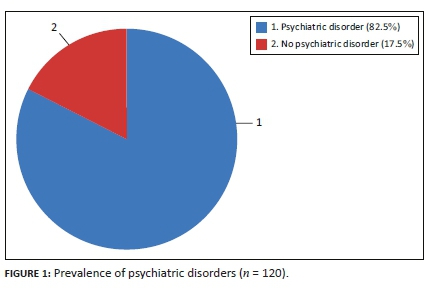
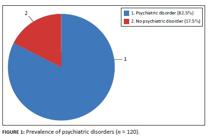
The percentage of respondents with a psychiatric disorder was 82.5%, see Figure 1 for prevalence rate.
Types of psychiatric disorders amongst respondents
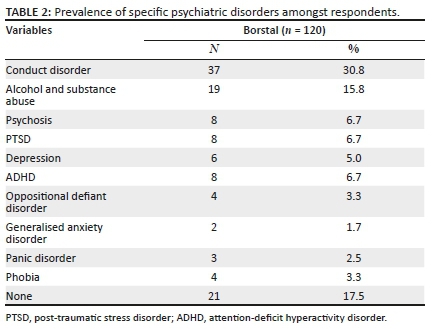
The specific types of psychiatric disorders are shown (Table 2). Amongst the respondents, 30.8% had conduct disorder, 15.8% had alcohol and substance use disorder. And, 6.7% of respondents each had psychosis, post-traumatic stress disorder (PTSD) and attention-deficit hyperactivity disorder (ADHD).
Depression was found in 5.0%, ODD in 3.3%, phobia in 3.3%, panic disorder in 2.5% and generalised anxiety disorder in 1.7% of the respondents (see Table 2).
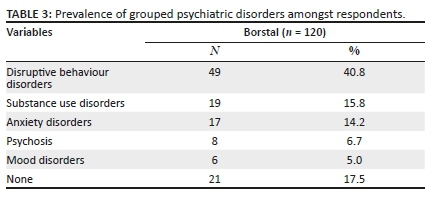
When the psychiatric disorders were grouped, 40.8% of respondents had disruptive behaviour disorders (DBD), 15.8% had substance use disorders, 14.2% had anxiety disorders, 6.7% had psychosis and 5.0% had mood disorders (see Table 3).
Discussion
Prevalence and types of psychiatric disorders amongst respondents
Prevalence of psychiatric disorders
The prevalence of psychiatric disorders in this study was 82.5% for the respondents. This prevalence rate was comparable to the figures of 85.7% and 73% reported by Ulzen and Hamilton181212,18
The prevalence finding of this study was, however, higher than those of Teplin et al.15141919
Specific psychiatric disorders
The types of psychiatric disorders found in this study were conduct disorder, alcohol and substance use disorder, psychosis, PTSD, depression, ADHD, ODD and other anxiety disorders.
Disruptive behaviour disorder has consistently been found to be high in many previous studies of juveniles within the JJS.9,10,1515202122
Conduct disorder was the most common DBD amongst the participants. This is similar to other studies from other African countries14,19,2317,24252620
However, the prevalence for conduct disorder obtained in this study was lower when compared with some other African studies14,1927
It is not surprising that conduct disorder has the highest prevalence in this study. This is because for the juvenile to have been admitted to the Borstal institution, they must have had some unacceptable behaviour severe enough to make it difficult for the parents to handle. Thus, conduct disorder could be the underlying psychopathology responsible for their unacceptable behaviour leading to incarceration. Disruptive behaviour disorder which is the most common psychiatric disorder in this study was the most common reason for the inability of parents to keep their children within control necessitating placement within the JJS.
Similarly, substance use disorder has consistently been found to be high in many previous studies of children and adolescents in the JJS. This study, however, found a prevalence rate of 15.8% for substance use disorder. A study within the JJS in the US reported a higher prevalence rate of 37% for substance use disorder.2822
The present study found a prevalence of 14.2% for anxiety disorders. This comprised of PTSD, phobia, generalised anxiety disorder and panic disorder. This is similar to a previous study amongst juveniles in the JJS where the prevalence of anxiety disorder was 17%, comprising of PTSD (7.5%), panic disorder (5.7%), obsessive compulsive disorder (1.9%) and separation anxiety disorder (1.9%).29302620
The prevalence of psychosis in this study was 6.7%. This is comparable to a Nigerian study that reported a prevalence rate of 3.8% for psychosis.19242521
This study found a prevalence of 5.0% for depression. This is similar to the study by Garland and colleagues,20
Limitations
It may be difficult to generalise the findings of this study because all respondents were males, which precluded the possibility of studying the contribution of gender to juvenile offending as well as to the burden of psychiatric morbidity amongst young offenders, also the sample size was small which could lead to erroneously high or low prevalence rates and the research relied on verbal self-reports from respondents only as parents, caregivers and medical records were not available to confirm some of the information.
Conclusion
This study confirmed the high prevalence rate of psychiatric disorders amongst adolescents involved with the JJS irrespective of the type or geographical location as found in several studies worldwide including sub-Saharan Africa.
A large percentage of adolescents within the Borstal training institution had clinical psychiatric diagnoses and the pattern of psychiatric disorders included DBD, substance use disorder, anxiety disorder, psychotic disorder and mood disorder.
These findings underscore the need for policies to prevent psychiatric disorders amongst at-risk youth and to provide services for those coming in contact with the JJS. Such measures will help reduce psychiatric morbidity in adolescents, improve their quality of life and reduce the risk of reoffending. There is still a knowledge-driven consensus required on the most context-appropriate modality for providing mental health services for adolescents and youth in contact with the JJS in Africa,3132,33
Competing interests
The authors declare that they have no financial or personal relationships that may have inappropriately influenced them in writing this article.
Authors' contributions
A.T.K. was responsible for the research under the supervision of A.D.Y.
Funding information
The authors received no financial support for the research, authorship, and/or publication of this article.
Data availability
Data sharing is not applicable to this article as no new data were created or analysed in this study.
Disclaimer
The views and opinions expressed in this article are those of the authors and do not reflect the official position of any affiliated agency or author.
Acknowledgements
The authors' sincere gratitude goes to the entire administrative staff and students of the Borstal Institution in Kwara State, Nigeria for their support in the organisation of the students for easy questionnaire administration.
References
-
1.Juvenile justice system: Juvenile crime and violence [homepage on the Internet]. Gale Encyclopaedia of Education [updated 2020; cited 2021 Apr 11]. Available from: https://education.stateuniversity.com/pages/2142/Juvenile-Justice-System-JUVENILE-CRIME-VIOLENCE.html
» https://education.stateuniversity.com/pages/2142/Juvenile-Justice-System-JUVENILE-CRIME-VIOLENCE.html -
2.Tarolla SM, Wagner EF, Rabinowitz J, Tubman JG. Understanding and treating juvenile offenders: A review of current knowledge and future directions. Aggress Violent Behav. 2002;7(2):125-143. https://doi.org/10.1016/S1359-1789(00)00041-0
» https://doi.org/10.1016/S1359-1789(00)00041-0 -
3.Braverman PK, Adelman WP, Breuner CC, et al. Health care for youths in the Juvenile justice system. Paediatrics. 2001;128(6):1219-1235. https://doi.org/10.1542/peds.2011-1757
» https://doi.org/10.1542/peds.2011-1757 -
4.Abram KM, Teplin LA, McClellan GM, Dulcan MK. Comorbid psychiatric disorders in youths in juvenile detention. Arch Gen Psychiatry. 2003;60(11):1097-1098. https://doi.org/10.1001/archpsyc.60.11.1097
» https://doi.org/10.1001/archpsyc.60.11.1097 - 5.Elliot DS, Huizinger D, Menard S. Multiple problem youth: Delinquency, substance use and mental health problems. New York, NY: Springer-Verlag; 1989.
-
6.Van der Molen E, Vermeiren R, Krabbendam A, Beekman A, Doreleijers T, Jansen L. Detained adolescent females' multiple mental health and adjustment problems outcomes in young adulthood. J Child Psychol Psychiatry. 2013;54(9);950-957. https://doi.org/10.1111/jcpp.12044
» https://doi.org/10.1111/jcpp.12044 -
7.Vander SA, Evens CC, Taub JI. Risk of juvenile justice system referral among children in a public mental health system. J Ment Health Adm. 1997;24:428-442. https://doi.org/10.1007/BF02790504
» https://doi.org/10.1007/BF02790504 -
8.Atilola O, Abiri G, Ola B. Psychiatric morbidity among adolescents and youth involved with the juvenile justice system in sub-Sahara Africa: Systematic scoping review of current studies and research gaps. Int J Law Psychiatry. 2020;73:101633. https://doi.org/10.1016/j.ijlp.2020.101633
» https://doi.org/10.1016/j.ijlp.2020.101633 -
9.Zhou J, Chen C, Wang X, et al. Psychiatric disorders in adolescent boys in detention: A preliminary prevalence and case-control study in two Chinese provinces. J Forensic Psychiatr Psychol. 2012;23(5-6):664-675. https://doi.org/10.1080/14789949.2012.727452
» https://doi.org/10.1080/14789949.2012.727452 -
10.Kim JI, Kim B, Kim BN, et al. Prevalence of psychiatric disorders, comorbidity patterns, and repeat offending among male juvenile detainees in South Korea: A cross-sectional study. Child Adolesc Psychiatry Ment Health. 2017;11(1):6. https://doi.org/10.1186/s13034-017-0143-x
» https://doi.org/10.1186/s13034-017-0143-x -
11.Grisso T. Adolescent offenders with mental disorders. Future Child. 2008;18(2):143-164. https://doi.org/10.1353/foc.0.0016
» https://doi.org/10.1353/foc.0.0016 -
12.Stahlberg O, Anckarsater H, Nilsson T. Mental health problems in youths committed to juvenile institutions: Prevalence's and treatment needs. Eur Child Adolesc Psychiatry. 2010;19(12):893-903. https://doi.org/10.1007/s00787-010-0137-1
» https://doi.org/10.1007/s00787-010-0137-1 -
13.Collins O, Viermermeiren R, Vreugdenhil C, Vanden BW, Doreleijers T, Broekaert E. Psychiatric disorders in detained male adolescents: A systematic literature review. Can J Psychiatry. 2010;55(4):255-263. https://doi.org/10.1177/070674371005500409
» https://doi.org/10.1177/070674371005500409 -
14.Maru HM, Kathuku DM, Ndetei DM. Psychiatric morbidity among children and young persons appearing in the Nairobi Juvenile Court, Kenya. East Afr Med J. 2003;80(6):226-232. https://doi.org/10.4314/eamj.v80i6.8702
» https://doi.org/10.4314/eamj.v80i6.8702 -
15.Teplin LA, Abram KM, McClelland GM, Dulcan MK, Mericle AA. Psychiatric disorders in youths in juvenile detention. Arch Gen Psychiatry. 2002;59(12);1133-1143. https://doi.org/10.1001/archpsyc.59.12.1133
» https://doi.org/10.1001/archpsyc.59.12.1133 -
16.Kaufman J, Birmaher B, Brent D, Rao U, Ryan N. Kiddie-SADS-present and lifetime version (K-SADS-PL): Initial reliability and validity data. J Am Acad Child Adolesc Psychiatry. 1997;36(7):980-998. https://doi.org/10.1097/00004583-199707000-00021
» https://doi.org/10.1097/00004583-199707000-00021 - 17.American Psychiatric Association. Diagnostic and statistical manual of mental disorders: DSM-IV. 4th ed. Washington, DC: American psychiatric association; 1994.
-
18.Ulzen TP, Hamilton H. The nature and characteristics of psychiatric co-morbidity in incarcerated adolescents. Can J Psychiatry. 1998;43(1):57-63. https://doi.org/10.1177/070674379804300106
» https://doi.org/10.1177/070674379804300106 - 19.Ajiboye PO, Yusuf AD, Issa BA, Adegunloye OA, Buhari OIN. Current and lifetime prevalence of mental disorders in a juvenile borstal institution in Nigeria. Res J Med Sci. 2009;3(1):26-30.
-
20.Garland AF, Hough RL, McCabe KM, Yeh M, Wood PA, Aarons GA. Prevalence of psychiatric disorders in youths across five sectors of care. J Am Acad Child Adolesc Psychiatry. 2001;40(4):409-418. https://doi.org/10.1097/00004583-200104000-00009
» https://doi.org/10.1097/00004583-200104000-00009 -
21.Vreugdenhil C, Doreleijers TA, Vermeiren R, Wouters LF. Psychiatric disorders in a representative sample of incarcerated boys in the Netherlands. J Am Acad Child Adolesc Psychiatry. 2003;43(1):97-104. https://doi.org/10.1097/00004583-200401000-00019
» https://doi.org/10.1097/00004583-200401000-00019 - 22.Yussuf AD, Ajiboye PO, Issa BA, Buhari OIN. Prevalence and risk factors for psychiatric disorders among youths in a borstal institution in Nigeria. J Pak Psychiatr Soc. 2011;8(1):22-28.
- 23.Odejide A, Toye SA. Survey of the inmates of a remand home in Ibadan. Niger J Paediatr. 1976;3(2):52.
-
24.Fazel S, Doll H, Langstrom N. Mental disorders among adolescent in juvenile detention and correctional facilities: A systematic review and meta-regression analysis of 25 surveys. J Am Acad Child Adolesc Psychiatry. 2008;47(9):1010-1019. https://doi.org/10.1097/CHI.ObO13e31817eecf3
» https://doi.org/10.1097/CHI.ObO13e31817eecf3 -
25.McManus M, Alessi NE, Grapentine WL, Brickman A. Psychiatric disturbances in serious delinquents. J Am Acad Child Adolesc Psychiatry. 1984;23(5):602-615. https://doi.org/10.1016/S0002-7138(09)60354-X
» https://doi.org/10.1016/S0002-7138(09)60354-X -
26.McCabe KM, Lansing AE, Garland A, Hough R. Gender differences in psychopathology, functional impairment, and familial risk factors among adjudicated delinquents. J Am Acad Child Adolesc Psychiatry. 2002;41(7):860-867. https://doi.org/10.1097/00004583-200207000-00020
» https://doi.org/10.1097/00004583-200207000-00020 -
27.Bella TT, Atilola O, Omigbodun OO. Children within the juvenile justice system in Nigeria: Psychopathology and psychosocial needs. Ann Ib Postgrad Med. 2010;8(1):34-39. https://doi.org/10.4314/aipm.v8i1.80344
» https://doi.org/10.4314/aipm.v8i1.80344 -
28.Taylor PJ. Motives for offending among violent and psychiatric men. Br J Psychiatry. 1985;147:491-498. https://doi.org/10.1192/bjp.147.5.491
» https://doi.org/10.1192/bjp.147.5.491 -
29.Bickel R, Campbell A. Mental health of adolescents in custody: The use of adolescent psychopathology scale in a Tasmanian context. Aust N Z J Psychiatry. 2002;36(5):603-609. https://doi.org/10.1046/j.1440-1614.2002.01073.x
» https://doi.org/10.1046/j.1440-1614.2002.01073.x -
30.Wasserman G, McReynolds L, Lucas C, Fisher P, Santos L. The voice DISC-IV with incarcerated male youths: Prevalence of disorder. J Am Acad Child Adolesc Psychiatry. 2002;41(3):314-321. https://doi.org/10.1097/00004583-200203000-00011
» https://doi.org/10.1097/00004583-200203000-00011 - 31.Ali ASA. The nature and prevalence of psychiatric disorders in a Sudanese juvenile correctional facility. Sudan J Paediatrics. 2016;16(2):28-40.
-
32.Atilola O, Abiri G, Ola BA. The Nigerian juvenile justice system: From warehouse to uncertain quest for appropriate youth mental health service model. Br J Psychiatr Int. 2019;16(1):19-21. https://doi.org/10.1192/bji.2017.37
» https://doi.org/10.1192/bji.2017.37 -
33.Atilola O, Ola B, Abiri G, et al. Status of mental health services for adolescents with psychiatric A.D.Y. morbidity in youth correctional institutions in Lagos. J Child Adolesc Ment Health. 2017;29(1):63-83. https://doi.org/10.2989/17280583.2017.1321550
» https://doi.org/10.2989/17280583.2017.1321550

Accepted: 20 May 2021
Published: 16 Aug. 2021