Psychiatric nurses' experiences of using a model to improve relationships of couples with borderline personality disorder
Abstract
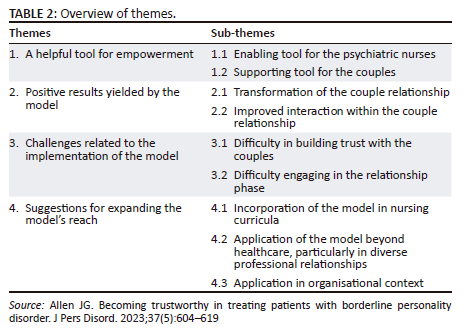
BACKGROUND: Individuals with borderline personality disorder (BPD) struggle with relationships because of impulsivity and emotional regulation difficulties. Specialised skills are needed for care, but existing models are lacking. A new model was developed to help psychiatric nurses support couples with one partner having BPD. This innovative psychiatric nursing model emphasises the need for implementation and evaluation in care. AIM: To explore the psychiatric nurses' experiences of implementation of a model to facilitate constructive intra- and interpersonal relationships for couples in a relationship where one is living with BPD. SETTING: The study was conducted at a mental health institution in Gauteng province where the one partner with BPD receives treatment. METHODS: The study adopted a qualitative, exploratory design conducting in-depth interviews with psychiatric nurses who implemented the model, triangulated with observations and field notes and analysed thematically. RESULTS: Four themes emerged, namely: (1) the model served as a helpful tool for empowerment; (2) the positive results yielded by the model; (3) challenges related to using the model; and (4) suggestions for expanding the model's reach. The psychiatric nurses found the model acceptable and feasible to facilitate the relationships of couples where one is living with BPD. CONCLUSION: Psychiatric nurses need guidelines to enhance care for individuals with BPD, highlighting the importance of implementing supportive models to improve relationships in various settings. CONTRIBUTION: Implementation of this model is unique in the care of persons living with BPD making it a valuable tool for psychiatric nurses in mental health care provision.
borderline personality disorder; experiences; implementation; model; psychiatric nurses; relationships