A systematic review of online depression screening tools for use in the South African context
Abstract
BACKGROUND: According to the World Health Organization, the alarming increase in rates of depression globally has become a serious concern. In 2010, the prevalence rate of depression in South Africa was 4.6%. Given the context of South Africa where the majority of the population have limited access to healthcare facilities and 59.3% of the population have access to the Internet, an online depression screening tool would have much to offer. OBJECTIVE: To determine whether online depression screening tools would be suitable for use in South Africa. METHODS: This study presents a systematic review of online depression screening tools to determine whether one would be suitable for use in South Africa. Articles were accessed from seven electronic databases from 1970 to 2018. All articles included in the review were critically appraised. RESULTS: A total of 17 articles met the inclusion criteria. From the results, there was only one screening tool available on an open access platform for use by the general population. The most common depression online screening tools were the Beck Depression Inventory-II (BDI-II), the Center for Epidemiology Studies Depression Scale (CES-D) and the Patient Health Questionnaire (PHQ-9). It was also evident that there were negligible differences in the psychometric properties of online versus paper versions of the online screening tools. Furthermore, there were very few studies that considered the African or South African population and no online screening tools for major depressive disorder (MDD) developed in these contexts. CONCLUSION: There appears to be a need for a depression screening tool to be adapted for online usage in South Africa. It is recommended that the online screening tool should be adapted from the three commonly used online depression screening tools: PHQ-9, CES-D and BDI-II.
BDI-II; CES-D; depression; major depressive disorder; PHQ-9; screening tool
Introduction
A worldwide increase in depression prevalence rates by more than 18% from 2005 to 2015 has listed depression as a leading cause of disability and ill health.122345
The majority of the paper-based depression screening tools are based on the Diagnostic and Statistical Manual of Mental Disorders (DSM), 4th Edition (DSM-IV) or DSM, 4th Edition, Text Revision (DSM-IV-TR) classification of MDD.5,678
Hence, the applicability of the tools designed using these criteria must be explored.39
South African research on MDD screening has considered the paper versions of the Patient Health Questionnaire 9 (PHQ-9), Center for Epidemiological Studies Depression Scale (CES-D) and Beck Depression Inventory II (BDI-II).10,11,12,13101112
Makhubela et al.13
Using the Internet to screen for a psychological disorder is becoming more common. With the increasing growth in Internet usage, it has become the first source for individuals to search for information.141516
While there are multiple benefits of using the Internet, the wealth of information is often overwhelming for many. Morahan-Martin151718
In a scoping review and evaluation of 32 web-based intervention programmes for depression,19n = 19), while only two studies had a specific target population. Users of these programmes were required to complete a depression assessment either prior to registration, independent of the programme or during the programme, where results were received immediately upon completion. Of the 32 programmes, the authors report only 17 programmes to have used a validated depression screening tool such as the PHQ-9, BDI or the CES-D. However, it has not been stated if these tools were validated for online usage.
Concerns have been raised with regard to the effectiveness of online tests.202020
Therefore, this study used the method of systematic review to establish if there were any appropriate online depression screening tools for use in the South African context. Hence, the specific questions for this study were:
•Which MDD screening tools are available online?
•What are the psychometric properties of these screening tools?
•Have any of these screening tools been used in the South African context?
•Which tool(s) can be adapted for the South African population if none have been used or adapted before?
Methods
Research design
A qualitative systematic review was the chosen method for this study, as a qualitative analysis was conducted on both quantitative and qualitative studies, which were included in this study.2122
Search process
The steps outlined in the Preferred Reporting Items for Systematic Reviews and Meta-Analyses (PRISMA) statement were followed for data collection.23
Study eligibility
To be included in the sample, the following inclusion criteria were used: (1) articles needed to be written in English; (2) only articles published from 1970 to 2017 were considered as the first large-scale online testing and interpretation of psychological assessments occurred in the early 1970s;24
Data analysis, extraction and quality assessment
Data was analysed using content analysis, which proceeded in three phases.25262728Table 1).
Ethical consideration
Articles obtained for analysis in the review were all available in the public domain; as a result no special ethical considerations were required.
Results
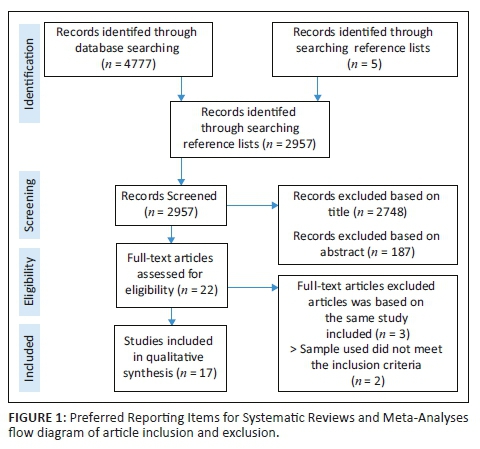
Through the various database searches and additional reference list searches, a total of 4777 articles were identified. After removing duplicates, 2957 article titles were screened. The total number of articles excluded based on titles and abstracts amounted to 2748 and 187, respectively. Seventeen articles were identified for possible inclusion in the study. As such, all 17 articles were used for the review (see Figure 1).
Description of included articles
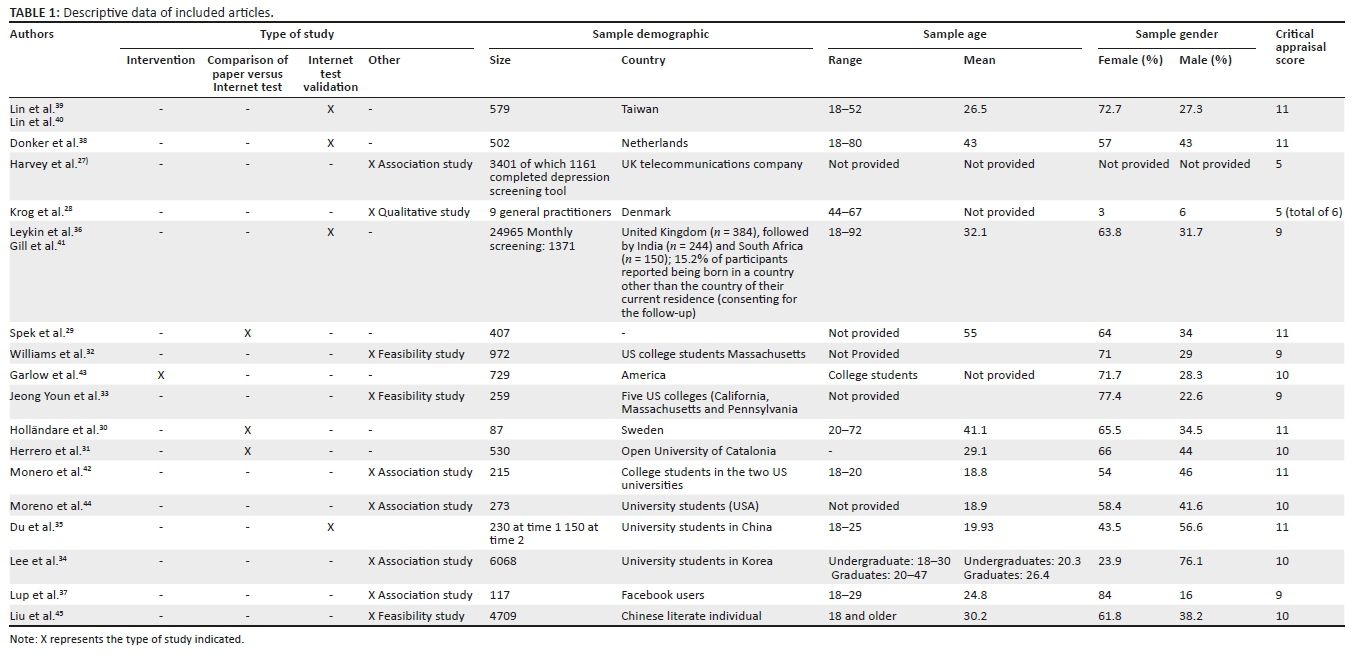
Table 1 provides a brief descriptive overview of the articles. Of the 17 studies, 5 articles looked at the association of depression and another psychological measure, 4 articles assessed the psychometric properties of an online screening tool for depression, 3 articles made a direct comparison of a paper versus Internet version of a depression screening tool,29,30,3132,3333
Sample sizes obtained in each study ranged from 87 to 24 965 individuals, with the exception of the qualitative study. The qualitative study conducted by Krog et al.281528343536n = 150). No other studies were conducted in Africa or South Africa.
Tools available online
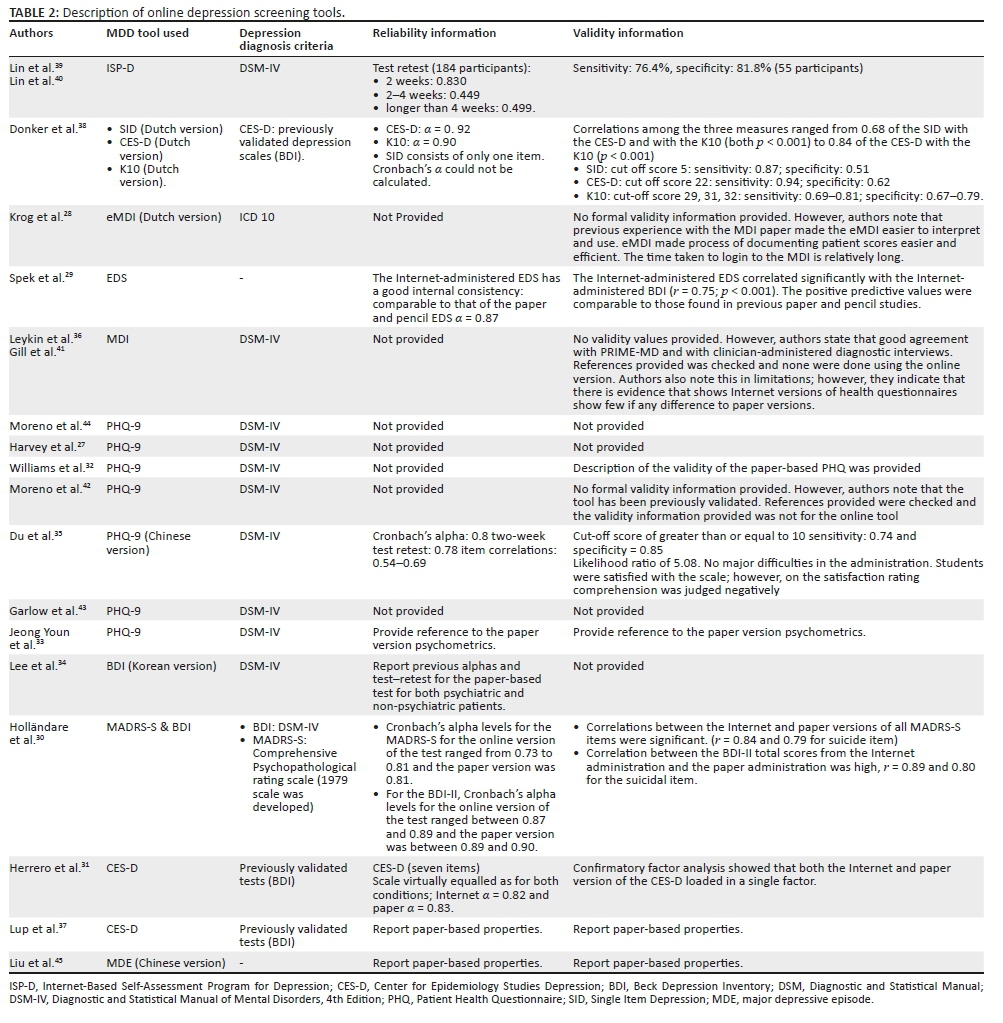
The following screening tools were used in the studies: PHQ-9, CES-D, BDI-II, Edinburgh Depression Scale (EDS), Single Item Depression (SID) Scale (Dutch version), electronic Major Depressive Inventory (eMDI) (Dutch version), Major Depressive Episode (MDE) Screener, Internet-Based Self-Assessment Program for Depression (ISP-D), Kessler Psychological Distress Scale (K10) and the self-rating version of the Montgomery Asberg Depression Rating Scale (MADRS-S) (Table 2). The PHQ-9 was utilised by the majority (n = 7) of studies, followed by the CES-D (n = 3) and BDI-II (n = 3). The remainder of the depression screening tools were only utilised once by their respective studies.
Psychometric properties of tools
Despite being used in the majority of studies, only one of the studies reported on the validity and reliability of the PHQ-9 tool. The study conducted by Du et al.3532,33,42 made mention of psychometric properties of the paper version of the PHQ-9 (see Table 2).
Of the three studies that utilised the CES-D, only one study did not report psychometric properties for the online version of the instrument (see Lup et al.).37313838
Two studies utilised the BDI-II as an online depression screening tool. The study conducted by Holländare et al.3034
Studies which utilised less common depression screening tools have reported some psychometric properties of these tools, with the exception of studies conducted by Krog et al.28364539
For the Dutch version of the SID, Donker et al.3830
The EDS evidenced a good internal consistency (α = 0.87) and displayed a significant correlation when compared to the online version of the BDI-II.29
Applicability for South African population
Based on the review, there were no studies of online MDD screening tools targeting the South African population. It should be acknowledged that a small proportion of the sample in the study by Leykin et al.3613http://sadag.org/images/pdf/sphere_questionnaire.pdf and http://sadag.org/index.php?option=com_content&view=article&id=1877&Itemid=142). The NGO uses the Somatic and Psychological Health Report (SPHERE) questionnaire and the Zung Self-Rating Depression Scale. There are no published psychometric properties for either instrument for the South African population.
Discussion
This systematic review aimed to determine if there is an appropriate online depression screening tool for use in the South African context, either in the primary healthcare sector or by the general public. Of the 17 articles included in the study, only seven articles reported psychometric properties for an online-based depression screening tool. In addition, only one article out of the 17 articles targeted a global Internet population when screening for depression. The remainder of the studies targeted very specific populations (college students, primary care patients as well as individuals diagnosed with depression).
The most commonly used online depression screening tools were the PHQ-9, CES-D and BDI-II. These results are in accordance with the most common paper-based depression screening tools, as noted by Smarr et al.5 In addition, despite being one of the most commonly used paper and online depression screening tools, only one article reported psychometric properties for the PHQ-9 on the general population.
The CES-D and BDI-II have been validated and compared to the paper-based version of the tool. As described by Buchanan,20203110
The screening tools that were not among the commonly utilised depression screening tools showed relatively high psychometric properties; however, one should again be mindful of the fact that these tests were targeted to a very specific population and these results cannot be generalised to the general population. Finally, all of the screening tools utilised were based on the DSM-IV criteria and the articles included no discussion on the cross-cultural utility of the instruments used.
Conclusion
From the study results it is evident that a space exists for an online depression screening tool, specifically for the South African context. Given the more than adequate psychometric properties exhibited by the tools, it is recommended that the online screening tool should be adapted from the three most commonly used tools: PHQ-9, CES-D and BDI-II. The items in these tools will have to be assessed for cross-cultural applicability and linguistic appropriateness. Furthermore, the ethics of online screening for MDD will have to be further explored together with issues around the accuracy and privacy of individual outcomes on online MDD screening. Given the accessibility of such tools to a global population, there will be a need to clearly state the intended target population of the screening tool.
Competing interest
The authors have declared that no competing interests exist.
Author contributions
T.H. was responsible for the write-up of the article under the supervision of S.L. S.L. was the supervisor of this project and provided guidelines for this review article. In addition, S.L. is credited with the conclusion points.
Funding
This work is based on the research supported wholly or in part by the National Research Foundation of South Africa (Grant Number:112948).
Data availability statement
Data sharing is not applicable to this article as no new data were created or analysed in this study.
Disclaimer
The views and opinions expressed in this article are those of the authors and do not necessarily reflect the official policy or position of any affiliated agency of the authors.
Acknowledgement
References
-
1.World Health Organisation. Depression: Fact sheet [homepage on the Internet]. c2017 [cited 2017 July 06]. Available from: http://apps.who.int/iris/bitstream/10665/254610/1/WHO-MSD-MER-2017.2-eng.pdf
» http://apps.who.int/iris/bitstream/10665/254610/1/WHO-MSD-MER-2017.2-eng.pdf -
2.Ferrari AJ, Charlson FJ, Norman RE, et al. Burden of depressive disorders by country, sex, age, and year: Findings from the global burden of disease study 2010. PLOS Med. 2013 Nov 5;10(11):e1001547. https://doi.org/10.1371/journal.pmed.1001547
» https://doi.org/10.1371/journal.pmed.1001547 -
3.Kerr LK, Kerr LD. Screening tools for depression in primary care. West J Med. 2001 Nov;175(5):349-52. https://doi.org/10.1136/ewjm.175.5.349
» https://doi.org/10.1136/ewjm.175.5.349 -
4.Ali G-C, Ryan G, Silva MJD. Validated screening tools for common mental disorders in low and middle income countries: A systematic review. PLOS ONE. 2016 Jun 16;11(6):e0156939. https://doi.org/10.1371/journal.pone.0156939
» https://doi.org/10.1371/journal.pone.0156939 -
5.Smarr KL, Keefer AL. Measures of depression and depressive symptoms: Beck Depression Inventory-II (BDI-II), Center for Epidemiologic Studies Depression Scale (CES-D), Geriatric Depression Scale (GDS), Hospital Anxiety and Depression Scale (HADS), and Patient Health Questionnaire-9 (PHQ-9). Arthritis Care Res. 2011 Nov 1;63(S11):S454-S466. https://doi.org/10.1002/acr.20556
» https://doi.org/10.1002/acr.20556 -
6.Nabbe P, Reste JYL, Guillou-Landreat M, et al. Which DSM validated tools for diagnosing depression are usable in primary care research? A systematic literature review. Eur Psychiatry. 2017 Jan 01;39:99-105. https://doi.org/10.1016/j.eurpsy.2016.08.004
» https://doi.org/10.1016/j.eurpsy.2016.08.004 -
7.American Psychiatric Association. Diagnostic and statistical manual of mental disorders [Internet]. 5th ed. American Psychiatric Association [homepage on the Internet]. c2013 [cited 2019 Jan 03]. Available from: https://psychiatryonline.org/doi/book/10.1176/appi.books.9780890425596
» https://psychiatryonline.org/doi/book/10.1176/appi.books.9780890425596 - 8.Gotlib IH, Hammen CL. Handbook of depression. 2nd ed. New York: Guilford Press; 2008, p. 721.
-
9.Crawford TA, Lipsedge M. Seeking help for psychological distress: The interface of Zulu traditional healing and Western biomedicine. Ment Health Relig Cult. 2004;7(2):131-148. https://doi.org/10.1080/13674670310001602463
» https://doi.org/10.1080/13674670310001602463 -
10.Smit J, Myer L, Middelkoop K, et al. Mental health and sexual risk behaviours in a South African township: A community-based cross-sectional study. Public Health. 2006 Jun;120(6):534-542. https://doi.org/10.1016/j.puhe.2006.01.009
» https://doi.org/10.1016/j.puhe.2006.01.009 -
11.Kagee A, Nel A, Saal W. Factor structure of the Beck Depression Inventory-II among South Africans receiving antiretroviral therapy. AIDS Care. 2014 Feb 01;26(2):257-262. https://doi.org/10.1080/09540121.2013.802278
» https://doi.org/10.1080/09540121.2013.802278 -
12.Baron EC, Davies T, Lund C. Validation of the 10-item Centre for Epidemiological Studies Depression Scale (CES-D-10) in Zulu, Xhosa and Afrikaans populations in South Africa. BMC Psychiatry. 2017 Jan 09;17(1):6. https://doi.org/10.1186/s12888-016-1178-x
» https://doi.org/10.1186/s12888-016-1178-x -
13.Makhubela M., Mashegoane S. Validation of the Beck Depression Inventory-II in South Africa: Factorial validity and longitudinal measurement invariance in university students. South Afr J Psychol. 2016 Jun 01;46(2):203-217. https://doi.org/10.1177/0081246315611016
» https://doi.org/10.1177/0081246315611016 -
14.Estabrook LS, Witt GE, Rainie H. Information searches that solve problems: How people use the internet, libraries, and government agencies when they need help [homepage on the Internet]. c2007 [cited 2018 Nov 13]. Available from: https://www.pewinternet.org/2007/12/30/information-searches-that-solve-problems/
» https://www.pewinternet.org/2007/12/30/information-searches-that-solve-problems/ -
15.Morahan-Martin JM. How Internet users find, Evaluate, and use online health information: A cross-cultural review. Cyberpsychol Behav. 2004 Oct 01;7(5):497-510. https://doi.org/10.1089/1094931042403082
» https://doi.org/10.1089/1094931042403082 -
16.Barney LJ, Griffiths KM, Christensen H, Jorm AF. Exploring the nature of stigmatising beliefs about depression and help-seeking: Implications for reducing stigma. BMC Public Health. 2009 Feb 20;9(1):61. https://doi.org/10.1186/1471-2458-9-61
» https://doi.org/10.1186/1471-2458-9-61 -
17.Africa SS. General Household Survey Statistics South Africa [homepage on the Internet]. c2016 [cited 2018 Nov 13]. Available from: http://www.statssa.gov.za/?p=9922
» http://www.statssa.gov.za/?p=9922 -
18.The MHaPP Research Programme Consortium, Lund C, Kleintjes S, Kakuma R, Flisher AJ. Public sector mental health systems in South Africa: Inter-provincial comparisons and policy implications. Soc Psychiatry Psychiatr Epidemiol. 2010 Mar;45(3):393-404. https://doi.org/10.2196/jmir.3147
» https://doi.org/10.2196/jmir.3147 -
19.Renton T, Tang H, Ennis N, et al. Web-based intervention programs for depression: A scoping review and evaluation. J Med Internet Res. 2014 Sep 23;16(9):e209. https://doi.org/10.2196/jmir.3147
» https://doi.org/10.2196/jmir.3147 -
20.Buchanan T. Internet-based questionnaire assessment: Appropriate use in clinical contexts. Cogn Behav Ther. 2003 Jan;32(3):100-119. https://doi.org/10.1080/16506070310000957
» https://doi.org/10.1080/16506070310000957 -
21.Grant MJ, Booth A. A typology of reviews: An analysis of 14 review types and associated methodologies: A typology of reviews, Maria J. Grant & Andrew Booth. Health Inf Libr J. 2009 Jun;26(2):91-108. https://doi.org/10.1111/j.1471-1842.2009.00848.x
» https://doi.org/10.1111/j.1471-1842.2009.00848.x - 22.Uman LS. Systematic reviews and meta-analyses. J Can Acad Child Adolesc Psychiatry. 2011 Feb;20(1):57-59.
-
23.Moher D, Liberati A, Tetzlaff J, Altman DG, Group TP. Preferred reporting items for systematic reviews and meta-analyses: The PRISMA statement. PLOS Med. 2009 Jul 21;6(7):e1000097. https://doi.org/10.1371/journal.pmed.1000097
» https://doi.org/10.1371/journal.pmed.1000097 -
24.Fowler, R.D. Landmarks in computer-assisted… - Google scholar [homepage on the Internet]. c1985. [cited 2019 Jan 03]. Available from: https://scholar.google.co.za/scholar?hl=en&as_sdt=0%2C5&q=Fowler%2C+R.+D.+%281985%29.+ Landmarks+in+computer-assisted+psychological+assessment.+Journal+of+Consulting+and+Clinical+Psychology %2C+53%286%29%2C+748.&btnG=
» https://scholar.google.co.za/scholar?hl=en& as_sdt=0%2C5& q=Fowler%2C+R.+D.+%281985%29.+ Landmarks+in+computer-assisted+psychological+assessment.+Journal+of+Consulting+and+Clinical+Psychology %2C+53%286%29%2C+748.& btnG= -
25.Elo S, Kyngäs H. The qualitative content analysis process. J Adv Nurs. 2008;62(1):107-115. https://doi.org/10.1111/j.1365-2648.2007.04569.x
» https://doi.org/10.1111/j.1365-2648.2007.04569.x -
26.CASP. CASP checklists [homepage on the Internet]. CASP: Critical appraisal skills programme. [cited 2018 Nov 13]. Available from: https://casp-uk.net/casp-tools-checklists/
» https://casp-uk.net/casp-tools-checklists/ -
27.Harvey SB, Glozier N, Henderson M, et al. Depression and work performance: An ecological study using web-based screening. Occup Med Oxf Engl. 2011 May;61(3):209-211. https://doi.org/10.1016/j.jad.2007.07.003
» https://doi.org/10.1016/j.jad.2007.07.003 - 28.Krog MD, Nielsen MG, Le JV, Bro F, Christensen KS, Mygind A. Barriers and facilitators to using a web-based tool for diagnosis and monitoring of patients with depression: A qualitative study among Danish general practitioners. BMC Health Serv Res. 2018 Jun 27;18(1):503-503.
-
29.Spek V, Nyklíček I, Cuijpers P, Pop V. Internet administration of the Edinburgh Depression Scale. J Affect Disord. 2008 Mar;106(3):301-305. https://doi.org/10.1016/j.jad.2007.07.003
» https://doi.org/10.1016/j.jad.2007.07.003 -
30.Holländare F, Andersson G, Engström I. A comparison of psychometric properties between Internet and paper versions of two depression instruments (BDI-II and MADRS-S) administered to clinic patients. J Med Internet Res [serial online]. 2010 Dec 19 [cited 2018 Oct 31];12(5). Available from: https://www.ncbi.nlm.nih.gov/pmc/articles/PMC3057311/
» https://www.ncbi.nlm.nih.gov/pmc/articles/PMC3057311/ -
31.Herrero J, Meneses J. Short Web-based versions of the perceived stress (PSS) and Center for Epidemiological Studies-Depression (CESD) scales: A comparison to pencil and paper responses among Internet users. Comput Hum Behav. 2006 Sep;22(5):830-846. https://doi.org/10.1016/j.chb.2004.03.007
» https://doi.org/10.1016/j.chb.2004.03.007 -
32.Williams A, Larocca R, Chang T, et al. Web-based depression screening and psychiatric consultation for college students: A feasibility and acceptability study. Int J Telemed Appl. 2014 Jan 1;2014:580786-580786. https://doi.org/10.1155/2014/580786
» https://doi.org/10.1155/2014/580786 -
33.Jeong Youn S, Trinh N-H, Shyu I, et al. Using online social media, Facebook, in screening for major depressive disorder among college students.. Int J Clin Health Psychol [serial online]. 2013 [cited 2018 Oct 31];13(1):74-80. Available from: http://www.redalyc.org/resumen.oa?id=33725623009
» http://www.redalyc.org/resumen.oa?id=33725623009 -
34.Lee J-S, Jeong B. Having mentors and campus social networks moderates the impact of worries and video gaming on depressive symptoms: A moderated mediation analysis. BMC Public Health. 2014 May 05;14:426-426. https://doi.org/10.1186/1471-2458-14-426
» https://doi.org/10.1186/1471-2458-14-426 -
35.Du N, Yu K, Ye Y, Chen S. Validity study of patient health questionnaire-9 items for Internet screening in depression among Chinese university students. Asia-Pac Psychiatry Off J Pac Rim Coll Psychiatry. 2017 Sep;9(3):1-5. https://doi.org/10.1111/appy.12266
» https://doi.org/10.1111/appy.12266 -
36.Leykin Y, Muñoz RF, Contreras O. Are consumers of Internet health information "cyberchondriacs"? Characteristics of 24,965 users of a depression screening site. Depress Anxiety 1091-4269. 2012 Jan;29(1):71-77. https://doi.org/10.1002/da.20848
» https://doi.org/10.1002/da.20848 -
37.Lup K, Trub L, Rosenthal L. Instagram #instasad?: Exploring associations among instagram use, depressive symptoms, negative social comparison, and strangers followed. Cyberpsychology Behav Soc Netw. 2015 May;18(5):247-252. https://doi.org/10.1089/cyber.2014.0560
» https://doi.org/10.1089/cyber.2014.0560 -
38.Donker T, van Straten A, Marks I, Cuijpers P. Brief self-rated screening for depression on the Internet. J Affect Disord. 2010 May;122(3):253-259. https://doi.org/10.1016/j.jad.2009.07.013
» https://doi.org/10.1016/j.jad.2009.07.013 -
39.Lin C-C, Bai Y-M, Liu C-Y, et al. Web-based tools can be used reliably to detect patients with major depressive disorder and subsyndromal depressive symptoms. BMC Psychiatry [serial online]. 2007 Dec [cited 2018 Sep 29];7(1):1. Available from: http://bmcpsychiatry.biomedcentral.com/articles/10.1186/1471-244X-7-12
» http://bmcpsychiatry.biomedcentral.com/articles/10.1186/1471-244X-7-12 - 40.Lin CC, Li YC, Bai YM, et al. The validity of an Internet-based self-assessment program for depression. AMIA Annu Symp Proc AMIA Symp. 2003;35(5):911-911.
-
41.Gill S, Contreras O, Muñoz RF, Leykin Y. Participant retention in an automated online monthly depression rescreening program: Patterns and predictors. Internet Interv Appl Inf Technol Ment Behav Health. 2014 Mar;1(1):20-25. https://doi.org/10.1016/j.invent.2014.02.003
» https://doi.org/10.1016/j.invent.2014.02.003 -
42.Moreno MA, Christakis DA, Egan KG, et al. A pilot evaluation of associations between displayed depression references on Facebook and self-reported depression using a clinical scale. J Behav Health Serv Res. 2012 Jul 01;39(3):295-304. https://doi.org/10.1007/s11414-011-9258-7
» https://doi.org/10.1007/s11414-011-9258-7 -
43.Garlow SJ, Rosenberg J, Moore JD, et al. Depression, desperation, and suicidal ideation in college students: Results from the American Foundation for Suicide Prevention College Screening Project at Emory University. Depress Anxiety. 2008 Jun 1;25(6):482-488. https://doi.org/10.1002/da.20321
» https://doi.org/10.1002/da.20321 -
44.Moreno MA, Jelenchick L, Koff R, Eickhoff J. Depression and internet use among older adolescents: An experience sampling approach. Psychology. 2012 Sep;3(9A):743-748. https://doi.org/10.4236/psych.2012.329112
» https://doi.org/10.4236/psych.2012.329112 -
45.Liu NH, Contreras O, Muñoz RF, Leykin Y. Assessing suicide attempts and depression among Chinese speakers over the Internet. Crisis. 2014;35(5):322-329. https://doi.org/10.1027/0227-5910/a000261
» https://doi.org/10.1027/0227-5910/a000261

Accepted: 21 June 2019
Published: 12 Nov. 2019